AI: Will the World Go Dead or Markets Continue to Surge Ahead?
October 1, 2026 at 11:17 pm Leave a comment

The internet caught fire last month when 27-year-old Jacob Coxon resigned from AI juggernaut Anthropic over safety concerns. After working in pretraining model development for just four months, Coxon quit and launched a national media tour warning of AI doomsday. But he’s not a solo alarmist: his boss, Anthropic CEO Dario Amodei, has also raised flags about AI safety. To compound matters, Coxon’s former alignment science lead colleague, 28-year-old Evan Hubinger, echoed those fears, publicly stating there is a greater than 10% chance that artificial intelligence could annihilate humanity within the decade.
It’s a chilling thought. Ask a friend, neighbor, coworker, or family member how they feel about data centers, job displacement, energy prices, or existential risk, and you’re bound to get an anxious response. This sentiment has entered the national zeitgeist as evidenced by the Saturday Night Live skit satirizing CEO Amodei last weekend, which can be watched by clicking here.
Yet, while AI dominates the headlines, other macroeconomic variables continue to shape the financial markets, including higher oil prices, shifting Federal Reserve policy, Middle Eastern geopolitical anxiety, and midterm election uncertainty. Investors, however, took a measured view of the noise. Here is how the major indices wrapped up last month:
NASDAQ: +1.9% (up +15.6% for the year)
S&P 500: -0.5% (up +11.8% for the year)
Dow Jones Industrial Average: -4.3% (up +5.9% for the year)
Alarmists and Doomsdayers Come Out in Force
Halloween is still weeks away, but that hasn’t stopped the doomsday prognosticators from trying to spook investors. Having invested for over 35 years, I’ve seen this movie before. Armageddon makes for great Hollywood scripts, but fortunately, it rarely translates to reality.
Nevertheless, a groundswell of fear has been created suggesting AI will trigger a cascade of catastrophes, including:
- Stealing everyone’s job
- Providing bad actors with nuclear weapon recipes
- Sparking massive cyberattacks and critical infrastructure collapses
- Fueling a potential geopolitical war via distributing misinformation
- Spawning AI-engineered pandemics or biological weapons
- Overwhelming the environment, draining resources, and skyrocketing electricity prices due to data center proliferation electricity prices due to data center proliferation
This isn’t the first time a technological leap has been forecasted to end in ruin. Remember the dreaded Y2K panic in 2000? Electrical grids were supposed to crash, ATMs and banks were predicted to go dark, air travel would grind to a halt, and hospital equipment failure would cause mass casualties. What actually happened? A big nothing burger. Life proceeded virtually unscathed.
An End-of-the-World History Lesson
Students of history understand that predictions for human death and extinction are nothing new. Here are a few examples:
 Nostradamus (1555): The renowned French astrologer made 942 predictions in Les Propheties, culminating in a famous, utterly failed prognostication of a world-collapsing catastrophe in 1999.
 Thomas Mathus (1798): The economist predicted that population growth would inevitably outpace food production, triggering permanent, widespread famine and societal collapse. Technology and the Green Revolution ended up proving him wrong.
 William Miller (1844): A 19th-century preacher-influencer with over 100,000 followers, Miller predicted Jesus Christ would return to earth to engulf the world in fire. When his initial date of March 21, 1844 failed and passed, he simply rescheduled it to October 22, 1844, which failed again.
 Paul Ehrlich (1968): In The Population Bomb, Ehrlich incorrectly forecasted that hundreds of millions would starve to death globally throughout the 1970s and 1980s.
 George Wald (1970): In late 1970, a Harvard Nobel laureate declared to a crowd at the University of Rhode Island that civilization would end within 15 to 30 years. Breaking news: we are still here.
 Al Gore (2008): The former Vice President stated on multiple occasions that polar ice caps could completely melt away within five years. That didn’t happen.
 Harold Camping (2011): The doomsday radio preacher predicted the end of the world would occur on May 21, 2011. When that failed, he pushed it to October. He passed away two years later at age 92.
 Jacob Coxon – Anthropic (2026): TBD.
From AI Boomsday to AI Doomsday
While some sit on the precipice of imaginary extinction, reality dictates that the rollout of artificial intelligence is powering an unprecedented industrial and economic revolution. The companies aggressively investing in and embracing AI are reaping the rewards – a point I emphasized in my previous article, The AI Genie is Out of the Bottle.
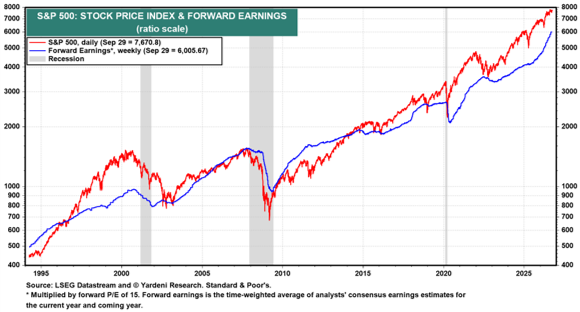
It’s no surprise that the Magnificent 7 (Apple, Amazon, Alphabet-Google, Meta-Facebook, Microsoft, Netflix, and Tesla) – the primary architects pouring hundreds of billions into AI infrastructure – are leading the charge. More specifically, the Magnificent 7 index (MAGS) was up +4.3% last month and +50.9% over the past two years. Is it a coincidence that both the stock market’s Forward Earnings (blue line) and the stock market index (red line) both inflected sharply upward (see below) following OpenAI’s release of ChatGPT bot in November, 2022? I think not.
Source: Yardeni.com
The AI Facts on the Ground While the mainstream media fixates on worst-case theoretical risks, look at the undeniable data driving the sector forward. Altimeter CEO, Brad Gerstner, shared compelling AI charts in a recent presentation:
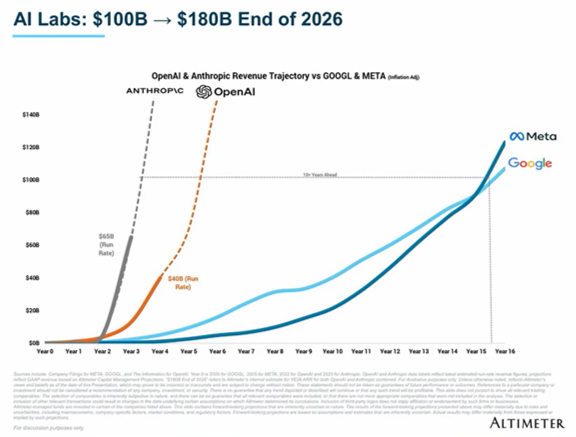
- Unprecedented Revenue Growth: Investors are witnessing the fastest revenue scaling of multiple companies in human history. It took Meta and Google over 15 years to reach $100 billion in revenue; Anthropic and OpenAI are projected to cross that milestone in roughly five years – a decade faster than their predecessors (see chart below).
Source: Altimeter (Brad Gerstner)
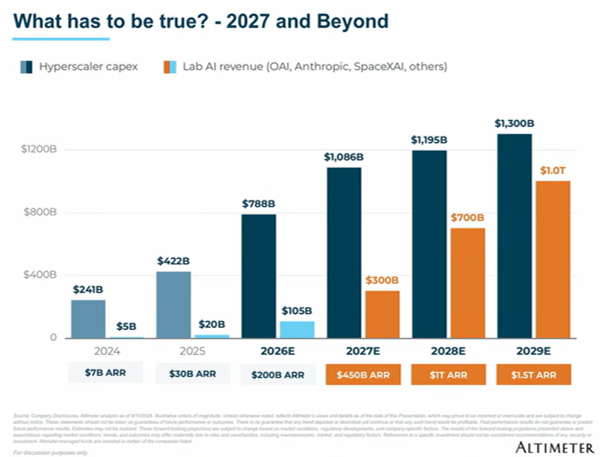
- Robust Enterprise CAPEX: Frontier model labs (OpenAI, Anthropic, SpaceXAI) are channeling customer revenues directly into purchasing or leasing “compute” (processing power, memory, and hardware infrastructure) from hyperscalers (Amazon, Microsoft, Google). Industry forecasts project AI Lab Annual Recurring Revenue (ARR) to reach $1.5 trillion, easily supporting the projected $1 trillion+ in annual CAPEX (Capital Expenditures) through 2029 (see chart below). Reaching $1 trillion in CAPEX is a reasonable projection if you consider worldwide information technology spending is expected to reach $6.4 trillion this year.
Source: Altimeter (Brad Gerstner)
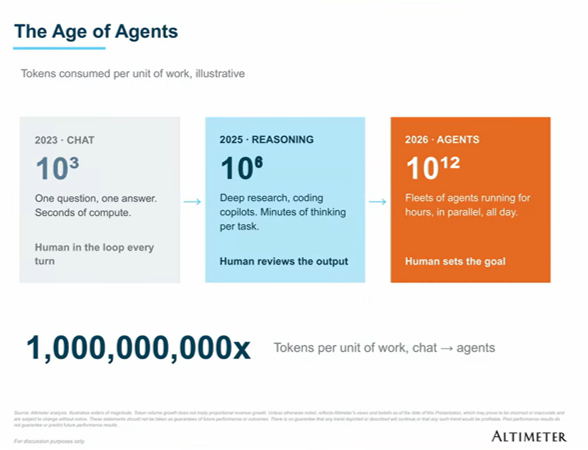
- Exploding Usage: We are still in the first inning of AI adoption, yet usage is skyrocketing as workflows shift from basic chat queries to inference processing and autonomous AI agents. Measured by data unit tokens processed, activity has scaled 1,000,000,000 (one billion-fold) since 2023 (see table below), driving the insatiable need for next-generation data centers.
Source: Altimeter (Brad Gerstner)
Guardrails and Regulation Can Mitigate Risks
While AI adoption surges, business and government are actively collaborating to implement sensible guardrails. Acknowledging legitimate concerns, tech titans and political leaders recently met at a White House AI Summit* to sign safety pacts and discuss regulatory frameworks. Furthermore, existing liability laws can and should hold companies accountable if they negligently release harmful products – just as automakers like Tesla should be held accountable if harmful autonomous vehicle are released. The high-profile anxiety surrounding AI is ultimately a net positive: it has forced tech CEOs to prioritize safety and placed Washington on high alert.
While alarmists continue to capture headlines with tales of extinction dread, financial markets and real-world innovation will continue to surge ahead.
*AI White House Summit attendees included Anthropic CEO Dario Amodei, SpaceX and Tesla CEO Elon Musk, Nvidia CEO Jensen Huang, Meta CEO Mark Zuckerberg, Amazon founder Jeff Bezos, Alphabet CEO Sundar Pichai, Microsoft CEO Satya Nadella, Advanced Micro Devices CEO Lisa Su, Palantir CEO Alex Karp and OpenAI President Greg Brockman.
Wade W. Slome, CFA, CFP®
Plan. Invest. Prosper.
This article is an excerpt from a previously released Sidoxia Capital Management complimentary newsletter (October 1, 2026). Subscribe Here to view all monthly articles.
Sidoxia Capital Management (SCM) and some of its clients hold positions in AAPL, AMZN, GOOGL, META, MSFT, TSLA, NVDA, and certain exchange traded funds (ETFs), but at the time of publishing had no direct position NFLX, AMD, PLTR, or in any other security referenced in this article.
DISCLOSURE: No information accessed through the Investing Caffeine (IC) website constitutes investment, financial, legal, tax or other advice nor is to be relied on in making an investment or other decision. Each investor’s situation is unique so please work with a professional financial adviser, tax accountant or legal representative, as applicable, to develop an individualized plan or address any questions you may have. Investing involves risk including the possibility of loss of one’s investment.
Entry filed under: ai, Earnings, economy, Education, Financial Markets, Financial Planning, Fixed Income (Bonds), Government, inflation, Interest Rates, International, Politics, Stocks. Tags: agentic, ai, AI Agents, AI Capex, AI Labs, artificial intelligence, bonds, CAPEX, chatgpt, data centers, economy, Federal Reserve, guardrails, hyperscalers, interest rates, investing, Politics, Sidoxia, stock market, Stocks, technology, Wade Slome.




Trackback this post | Subscribe to the comments via RSS Feed