Tips for Survival and Prosperity in Challenging Economic Times

Survival requires multiple strategies
We have all been impacted in some shape or form by the worst financial crisis experienced in a generation. The question now becomes what did we learn from this mess and how can we better prepare for a more prosperous financial future?
Here are some important tips to follow:
Save and Invest: Before paying others, pay yourself first. You can achieve this goal by saving and investing your money. Given the weak state of our government “safety net” programs, such as Medicare and Social Security, it has become more important than ever to save. Life spans are extending as well, meaning a larger “nest egg” is needed for retirement. If you don’t have the time, discipline, or emotional make-up to manage your own money, then seek out a fee-only advisor* who does not have a conflict of interest in regards to building your wealth.
Tighten Belt: In order to save and invest you need to be in a position where you are creating excess income. Cutting costs is one way to generate additional income. Eating out less, buying used, taking more affordable vacations, conserving energy, purchasing private label goods are a few easy ways to save money that will accumulate over time. If those efforts are still not adequate, one should then contemplate adjusting their living situation (i.e., down-size) or pursue additional income opportunities – either through a pay raise or higher paying job alternatives.
Pay Down Debt: If your credit card company is charging you a 15-20% rate on unpaid credit card balances and gouging you for late-fees and cash advances, then look for other sources of affordable financing. A home equity line of credit or second mortgage may make sense for some, if the fees and lower interest rates make economic sense. Contact a financial planner or tax professional to determine the appropriateness of these debt alternatives. Ultimately, the goal is to reduce debt and create more financial flexibility.
Take Free Money: If your employer offers matching payments to your retirement plan contributions, they are effectively offering you free money. Take it! The government offers you some tax deferral savings through IRA (Individual Retirement Account) contributions, so take advantage of that benefit as well.
Form a 6-Month Emergency Fund: The economy may be in a bottoming-out phase; however we are not out of the woods yet. Unemployment is approaching 10% and many companies and industries continue to struggle. Build a protective financial cushion should you or your family hit a bump in the road.
Invest in Yourself: Investing for retirement is crucial, however investing in yourself is just as, if not more, important than traditional investing. What I’m referring to is job training, education, and health awareness. We live in a globalized economy and in order to compete against those starving for our jobs, we need to improve our skills and education. Lastly, we cannot neglect our health. Finances need to be put in perspective. Our health should be a top priority and a disciplined balance between diet and exercise will not only reduce stress, but it will also improve mental health.
Times have been challenging, but when the going gets rough, the tough go saving. Take control of your financial future rather than letting economic circumstances control you. Financial success however should not come at the expense of your health, so also focus on a balanced program of diet and exercise. There are no free lunches in this world, but following these steps will help lead you on a path to prosperity – even in these challenging economic times.
Wade W. Slome, CFA, CFP®
Plan. Invest. Prosper.
*DISCLOSURE: Wade W. Slome, CFA, CFP is President and Founder of Sidoxia Capital Management, LLC (www.Sidoxia.com), a fee-only Registered Investment Advisory firm headquartered in Newport Beach, California.
Action Dan (Poker King) and Professional Investing

"Action Dan" wins millions in poker by skillfully mixing art with science
As I write in my book (How I Managed $20,000,000,000.00 by Age 32), successful investing requires skillful use of both art and science. What I find so fascinating is that the same principles apply to poker playing. Like investing, poker is also a game of skill that rewards a player who adequately understands the mathematical probabilities (science) while still able to appropriately read the behavior of his or her opponents (art). Take for example professional poker player and 1995 WSOP champ Dan Harrington. In 2003 he finished 3rd at the World Series of Poker Main Event (the Super Bowl of poker) out of a pool of 839 players. In 2004, the following year, despite the pool more than tripling to 2,576 participants, Mr. Harrington managed to finish 4th and take home a cool $1.5 million in prize money. Did luck account for this success? I think not. Odds, if left to chance, would be 1 in 25,000 for repeating this feat, according to the Economist.
In the short-run, random volatility and luck can make the average investor look like Warren Buffett, but because of the efficiency of the market, that same average investor will look like a schmuck over the long-run. Legg Mason Funds Management put out an incredible chart that I believe so elegantly captures the incoherent and meaningless, short-term noise that the media attempts to interpret daily. What appears like outperformance in the short-run may merely be the lucky performance of a reckless speculator.

Source: Legg Mason Funds Management
Dan Harrington, and so many other talented professionals know this fact all too well when an inexperienced “donkey” over-bets a clearly inferior hand, only to nail an inside-straight card on the “river” (last card of the round) out of pure luck – thereby knocking out a superior professional player. Over the long-run these out-of-control players end up losing all their money and professionals relish the opportunity of playing against them.
Talk to professionals and ask them what the biggest mistake new players make? The predominate answer: novices simply play too many hands. In the world of investing, the same can be said for excessive trading. Commissions, transactions costs, taxes and most importantly, ill-timed, emotionally driven trades lead the average investor to significantly underperform. I’ve referenced it before, and I’ll reference it again, John Bogle’s 1984-2002 study shows the significant drag the aforementioned costs have on professionals’ performance, and especially the average fund investor that underperformed the passive (a.k.a., “Do Nothing” strategy) S&P 500 return by more than a whopping 10% annually!
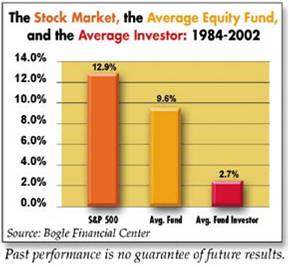
I consider myself an above average player, and I’ve won a few small tournaments, but match me up against a professional like “Action Dan” Harrington and I’ll get destroyed in the long-run. Investing, like professional poker, can lead to excess returns with the proper integration of patience and a disciplined systematic approach. I strongly believe that all great long-term investors successfully implement a strategy that marries the art and science aspects of investing. Don’t hold your breath if you expect to see me on ESPN, it may be a while before you see me at the Final Table with Dan Harrington at the World Series of Poker.
Wade W. Slome, CFA, CFP®
Plan. Invest. Prosper.
DISCLOSURE: Sidoxia Capital Management (SCM) and some of its clients own certain exchange traded funds, and at the time of publishing had no direct positions in LM, DIS, or BRKA/B. No information accessed through the Investing Caffeine (IC) website constitutes investment, financial, legal, tax or other advice nor is to be relied on in making an investment or other decision. Please read disclosure language on IC “Contact” page.
History Never Repeats Itself, But It Often Rhymes
As Mark Twain said, “History never repeats itself, but it often rhymes.” There are many bear markets with which to compare the current financial crisis we are working through. By studying the past we can understand the repeated mistakes of others (caused by fear and greed), and avoid making similar emotional errors.
Do you want an example? Here you go:
“Today there are thoughtful, experienced, respected economists, bankers, investors and businessmen who can give you well-reasoned, logical, documented arguments why this bear market is different; why this time the economic problems are different; why this time things are going to get worse — and hence, why this is not a good time to invest in common stocks, even though they may appear low.”– Jim Fullerton, former chairman of the Capital Group of the American Funds (written November 7, 1974)
Although the quote above seems appropriate for 2009, it actually is reflective of the bearish mood felt in most bear markets. We have been through wars, assassinations, banking crises, currency crises, terrorist attacks, mad-cow disease, swine flu, and yes, even recessions. And through it all, most have managed to survive in decent shape. Let’s take a deeper look.
1973-1974 Case Study:
For those of you familiar with this period, recall the prevailing circumstances:
- Exiting Vietnam War
- Undergoing a recession
- 9% unemployment
- Arab Oil Embargo
- Watergate: Presidential resignation
- Collapse of the Nifty Fifty stocks
- Rising inflation
Not too rosy a scenario, yet here’s what happened:
S&P 500 Price (12/1974): 69
S&P 500 Price (8/2009): 1,021
That is a whopping +1,380% increase, excluding dividends.
What Investors Should Do:
- Avoid Knee-Jerk Reactions to Media Reports: Whether it’s radio, television, newspapers, or now blogs, the headlines should not emotionally control your investment decisions. Historically, media venues are lousy at identifying changes in price direction. Reporters are excellent at telling you what is happening or what just happened – not what is going to happen.
- Save and Invest: Regardless of the market direction, entitlements like Medicare and social security are under stress, and life expectancies are increasing (despite the sad state of our healthcare system), therefore investing is even more important today than ever.
- Create a Systematic, Disciplined Investment Plan: I recommend a plan that takes advantage of passive, low-cost, tax-efficient investment strategies (e.g. exchange-traded and index funds) across a diversified portfolio. Rather than capitulating in response to market volatility, have a systematic process that can rebalance periodically to take advantage of these circumstances.
For DIY-ers (Do-It-Yourselfers), I suggest opening a low-cost discount brokerage account and research firms like Vanguard Group, iShares, or Select Sector SPDRs. If you choose to outsource to a professional advisor, I recommend interviewing several fee-only* advisers – focusing on experience, investment philosophy, and potential compensation conflicts of interest.
If you believe, like some economists, CEOs, and investors, we have suffered through the worst of the current “Great Recession” and you are sitting on the sidelines, then it might make sense to heed the following advice: “Some people say they want to wait for a clearer view of the future. But when the future is again clear, the present bargains will have vanished.” Dean Witter made those comments 77 years ago – a few weeks before the end of worst bear market in history. The market has bounced quite a bit since March of this year, but if history is on our side, there might be more room to go.
Wade W. Slome, CFA, CFP®
Plan. Invest. Prosper.
*For disclosure purposes: Wade W. Slome, CFA, CFP is President & Founder of Sidoxia Capital Management, LLC, a fee-only investment adviser based in Newport Beach, California.
Spitzer the Pot Calling the Fed Kettle Black

Eliot Spitzer, whose job as the former Attorney General of New York was to convict criminals, was forced to quit himself as Governor for his illegal solicitation of prostitutes that he funded with secretive ATM withdrawals of government funds. Now, Mr. Spitzer is getting on his soapbox and telling others the Federal Reserve has been committing a Ponzi Scheme.
There are a lot of conspiracy theories floating around regarding the Fed’s motives and questions relating to the benefits of those receiving government bailout funds. Dylan Ratigan’s interview of Mr. Spitzer on MSNBC feeds into these conspiracy views. I can buy into conflicts of interests and the need for more transparency arguments, but let’s be realistic, this is not the DaVinci Code, this is the slow, bureaucratic Federal Government. Even if you buy into this skeptical belief, the Fed isn’t exactly a “black box.” The Fed proactively provides the minutes from its private meetings and systematically releases a full accounting of the Fed’s balance sheet (assets).
Mr. Spitzer and other critics point to the egregious benefits handed down to the banks and financial institutions through the bailouts and monetary system actions. Well, wasn’t that the idea? I thought our banking system (and the global banking system) was on the verge of collapse and we were trying to save the world from impending disaster? So, I think most people get the fact that our financial institutions needed a lifeline to prevent worse outcomes from occurring.
Should the Fed have carte blanche on all financial system decisions? Certainly not, but extreme situations like this generational financial crisis we are slogging through now, requires extreme measures.
Accountability I believe is even more important than the micro-managing transparency details Ron Paul (Republican/Libertarian Congressman from Texas) and others are asking for. If indeed it is the Fed’s job to remain an independent body, then maybe it’s not Congress’ job to question every word and minor decision. However, when it comes to these massive bailouts (AIG, Fannie Mae, Freddie Mac, etc.), additional details and accountability should be provided and seems fair. What we don’t need are more regulatory bodies and committees creating more inefficiencies in an already tangled system of regulatory fiefdoms.
Before Mr. Spitzer starts pointing his finger at the black Fed-kettle, perhaps he should get his illegal decision making pot in order first?
Read Full Daniel Tencer Spitzer-Ponzi Scheme Article
Wade W. Slome, CFA, CFP®
Plan. Invest. Prosper.
Gold Market Lunacy Kicking Into Gear

So wait a second, let me get this right. A company pays billions of dollars to buy insurance, and then decides to sell $3.5 billion in dilutive ownership rights (current stockholders losing more than 10% of their ownership) so that they can pay somebody else another $5.6 billion to take that same insurance they previously loved away. In my book, I call that lunacy. This madness is exactly what Barrick Gold (ABX) just decided to do. The world’s largest gold miner issued approximately 95 million common shares at $37 per share to remove gold price hedges (used to lock in gold prices at a certain level), so if gold prices spike Barrick will now be able to participate fully without the drag of the hedges.
Effectively, management has decided to turn the mining company into a Vegas casino, where shareholders can now freely speculate in the price of gold without the volatility reducing hedges in place. Does this outlandish behavior signal a top in gold prices (now hovering around $1,000 per ounce)? I’m not stupid enough to call the end of frothing, speculative behavior – just witness Alan Greenspan’s “irrational exuberance” speech in 1996 when the NASDAQ traded at 1,300 (then went on to peak above 5,000). But what I am bold enough to do is call a spade a spade and to point out how ridiculous this reverse hedging activity is.
Other signs of speculation beyond the 4x price increase over the last 8 years or so, is the fact that gold prices have risen in the face of incredibly weak gold jewelry demand, -22% year-over-year globally in Q2 according to the Gold Demand Trends. This leaves the remaining demand coming largely from speculators and global central banks. If you need more evidence for the gold speculation, just turn on your local AM radio station and listen for the endless number of get-rich-quick on gold advertisements – some stations need to fill the gaping hole once held by those advertisers hawking mortgages.
From a gold investors’ perspective, I would say I fall more into Warren Buffett camp of thinking. Unlike other commodities (some of which I believe will be driven upwards by my emerging market demand and other forces) , gold is something dug up from the dirt in South Africa, melted, transported to another hole, buried in the ground (central bank), and then storage costs are incurred to guard the shiny metal. Sure, jewelry and small commercial applications are drivers for real demand, but the majority of demand is derived from intangible desires. Other commodities, for example oil, copper, uranium, and natural gas offer a lot more utility.
So what’s next when it comes to the price of gold? Peter Schiff an uber-gold bull broker at Euro Pacific Capital believes Armageddon is coming for the U.S. economy and hyper-inflation will drive gold upwards to the $4,000 per ounce price range (See How Peter Schiff’s Other Forecasts Have Performed). Another possibility to consider is a complete collapse in gold prices (and surge in the dollar) like we saw in the early 1980s after Paul Volcker raised interest rates and gold prices did not appreciate for a 25 year period. Hmmm, I wonder what direction interest rates are going next with the Federal Funds rate currently at effectively 0%? Could we see a repeat of the early ‘80s? Seems like a possibility to me. Certainly if you fall into the civil unrest, soup kitchen, and bread line camp, like Schiff and other U.S. bears, then piling into the diluted Barrick Gold shares may not be a bad strategy.
Inflation
Given the massive stimulus, debt loads, money supply growth and legislative agendas currently in place, inflation is a major medium and long-term concern. My remedy is government guaranteed Treasury Inflated Protection Securities (TIPS) that not only compensates investors with interest payments (unlike gold), but will also see principal values increase in tandem with principal if inflation indeed rears its ugly head. For those conspiracy theorists that believe the Consumer Price Index (CPI) is rigged, there are alternative international flavors of TIPs that reset according to other inflation benchmarks. As a kicker, some of these particular securities offer a hedge against a sliding U.S. dollar, which may or may not continue.
So as I lie in my recliner with my popcorn and TIPs, I’ll watch Barrick and other speculators continue the gold buying frenzy, wondering when and how ugly the gold finale will be?
Wade W. Slome, CFA, CFP®
Plan. Invest. Prosper.
DISCLOSURE: Sidoxia Capital Management and client accounts do not have direct long or short positions in ABX or gold related securities or BRKA/B at the time the article was published. Sidoxia Capital Management and its clients do have long exposure to TIP shares. No information accessed through the Investing Caffeine (IC) website constitutes investment, financial, legal, tax or other advice nor is to be relied on in making an investment or other decision. Please read disclosure language on IC “Contact” page.
Goldman Sachs in Talks to Acquire Treasury Department
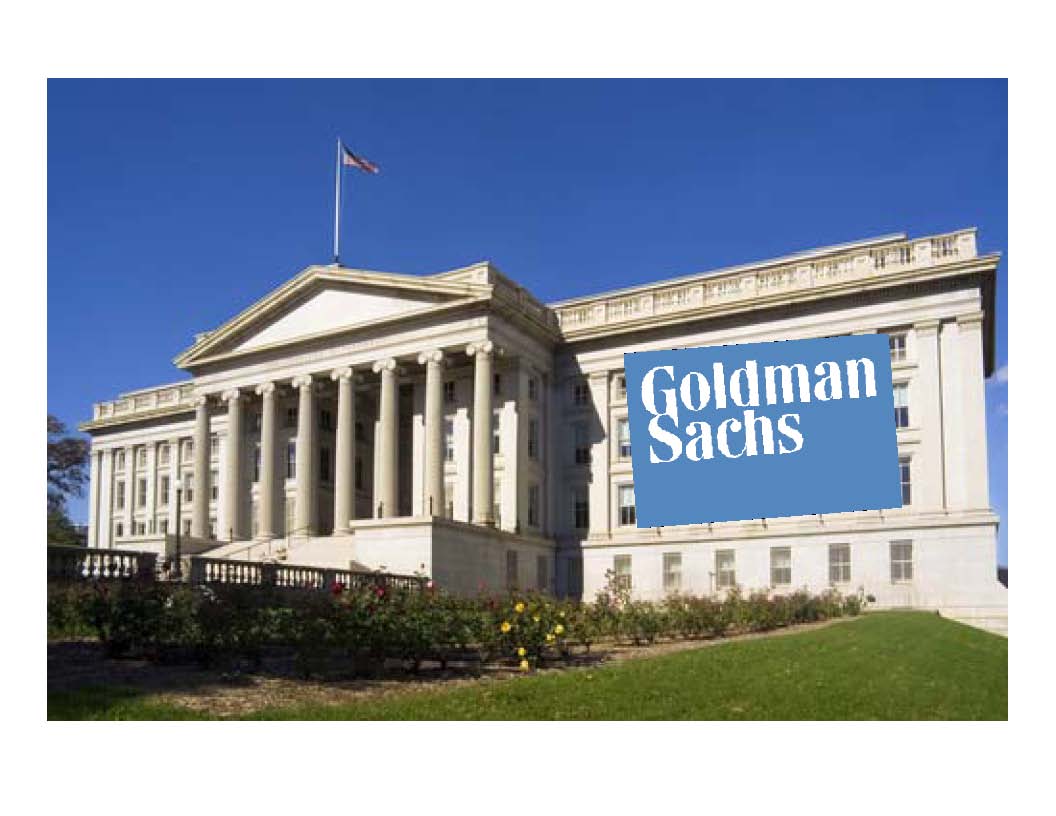 Andy Borowitz from the Borowitz Report published an article a few months ago satirizing the ever increasing conspiracy theories being spread regarding Goldman Sachs’ (GS) role in the global financial crisis. Spearheading the scapegoating Goldman Sachs brigade is Matt Taibbi of Rolling Stone who wrote Inside The Great American Bubble Machine. Megan McArdle at The Atlantic has a detailed critique of Taibbi’s loose facts and outlandish generalizations.
On a lighter note, here’s what Mr. Borowitz has to say about the Goldman Sachs/Treasury Department merger, with tongue firmly in cheek:
According to Goldman spokesperson Jonathan Hestron, the merger between Goldman and the Treasury Department is “a good fit” because “they’re in the business of printing money and so are we.” The Goldman spokesman said that the merger would create efficiencies for both entities: “We already have so many employees and so much money flowing back and forth, this would just streamline things.” Mr. Hestron said the only challenge facing Goldman in completing the merger “is trying to figure out which parts of the Treasury Dept. we don’t already own.” Goldman recently celebrated record earnings by roasting a suckling pig over a bonfire of hundred-dollar bills.
If Matt Taibbi is having difficulty coming up with some fresh new material, perhaps he could target some of these hotly debated areas of contention:
- The 40 year anniversary of NASA faking the moon landing.
- The CIA assassination of John F. Kennedy and the 4th shot from the “grassy knoll.”
- Crashed UFO aircraft remains stored at Area 51, Air Force base in Nevada.
- Elvis still alive.
- Paul McCartney actually dead.
- 9/11 terrorist attacks government cover-up.
- The creation of HIV/AIDS by the CIA.
If Bill Clinton can’t suppress sexual relations with Monica Lewinsky and Dick Cheney can’t hide the fact he shot someone in the face with a shotgun, I guess the Goldman crew is just better at pulling the wool over the eyes of 6.5 billion people…less one smart cookie, Matt Taibbi.
Wade W. Slome, CFA, CFP®
Plan. Invest. Prosper.
DISCLOSURE: Sidoxia Capital Management and client accounts do not have direct positions in GS at the time the article was published. No information accessed through the Investing Caffeine (IC) website constitutes investment, financial, legal, tax or other advice nor is to be relied on in making an investment or other decision. Please read disclosure language on IC “Contact” page.
Words of Wisdom from the Money Flow Master
 When Laszlo Birinyi talks, people should listen. Laszlo Birinyi, President of Birinyi Associates, has seen a lot in his days on Wall Street and he has the gray hair to prove it. Mr. Birinyi joined Salomon Brothers in 1976 with the job of developing products and analysis for the firm’s clients and traders. In 1989, after departing Salomon Brothers, Mr. Birinyi left to form Birinyi Associates where Bloomberg LP became a key client for a variety of equity functions.
Mr. Birinyi made the concept of “money flow” – a price direction indicator based on supply-demand trade volume data – a key pillar for his clients’ research. Having lived through and studied many market cycles, Mr. Birinyi tries to take the emotion and misleading media headlines out of the investment decision making process. The “wall of anxiety” is very normal to be present in market cycle bottoms, but the market is always looking ahead. Rather than listen to the talking heads on television, Mr. Birinyi chooses to listen to the market statistics. The current market thinking is that we’ve come too far, too fast, therefore we are positioned for an imminent 10% pullback. Laszlo Birinyi calls the correction speak nonsense and highlights the limited data to support these claims. Mr. Birinyi begs for bears to “Give me the evidence…in 1982 we went 424 days before we had a correction. In 2000, we went seven years before we had a 10% correction. In 2002, we went three or four years.”
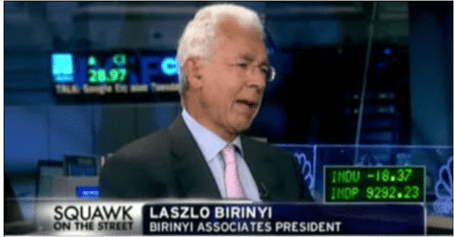
CNBC Interview With the Money Flow Master
Click Here To View CNBC Interview
The bear case always sounds more intelligent, but based on his views into his crystal ball, Mr. Birinyi sees the S&P 500 hitting 1,700 over the next few years (approximately a 70% increase from current levels). What I like about Birinyi’s process is that it’s a strategy based on taking out emotions and following objective data – the strategy is not driven by witty, bearish media sound-bites.
I can’t objectively verify Laszlo Birinyi’s performance; however I can understand his sound, sage advice because his philosophy is based upon objective historical statistics and data, not on the whims of the skittish masses. Birinyi has been around for decades but in the coming weeks and months we’ll discover if the 10% correction boogeyman will spook him or not.
From Pond Scum to the Pump

The “Green” movement got a shot in the arm recently when a $600 million joint venture between Craig Venter, the critical man behind mapping the human genome, and ExxonMobil the oil company (XOM) was formed to engineer oil from green algae. More than half of the money will be directed to Dr. Venter’s La Jolla, California-based biotech firm Synthetic Genomics.
On the surface the announcement is very appealing because it marries the biggest brains in genetic engineering (Venter) with the biggest brains in energy/oil (ExxonMobil). Add hundreds of millions of dollars to this powerhouse dream team and perhaps something miraculous can be commercialized in the next 5 – 10 years. Environmentalists appear to be on board too, if the hype turns to reality, because not only will cleaner fuels be created but the algae production will reduce harmful CO2 (carbon dioxide) emissions from the air. ExxonMobil’s grand scheme is to build algae farms near power plants and other major CO2 emitters –the farms will feed the algae and by doing so will help curb long-term fuel costs for the businesses.
ExxonMobil and Craig Venter are not the only game in town. A scientific article written by Molika Ashford claims there are more than 50 companies trying to affordably squeeze oil from slime, including a creative way of squeezing oil from algae-eating fish.
Although the “Greenies” seem to buy into the algae-oil process, the environmentalists are not the only constituency the genetic engineers must appease. The ethical debate over manipulating life forms is already percolating – just think, Frankenstein meets algae. In a newer Bloomberg article, Alison Smith, a professor of plant sciences at the University of Cambridge in England commented on the state-of-the-art research: “It is an untested technology, and there needs to be extensive debate about the ethics and environmental consequences of generating these new organisms.”
More recently, Dr. Venter performed a pioneering ‘gene swap’ on a simple species of bacteria called Mycoplasma mycoides, which raised optimism levels even higher that a green, bio-engineered fuel solution is indeed possible. Dr. Venter effectively created a new form of bacteria by swapping DNA from one form of bacteria into another. Researchers and scientists around the globe are searching for solutions to our worsening global energy problems, however time is required. I will anxiously watch from the sidelines to see if big brains and big oil can come together to make “green gold.”
Wade W. Slome, CFA, CFP®
Plan. Invest. Prosper.
Sidoxia Capital Management and its clients did not have any direct position in XOM at the time the article was published. No information accessed through the Investing Caffeine (IC) website constitutes investment, financial, legal, tax or other advice nor is to be relied on in making an investment or other decision. Please read disclosure language on IC “Contact” page.
The Emperor Schiff Has No Clothes

In the Hans Christian Andersen fairy tale The Emperor’s New Clothes, the emperor unwittingly hires two swindlers whom he pays to create a special make-believe suit, which the cons claim appears invisible to stupid people. When the emperor cannot visibly see his clothes, he sheepishly avoids confronting the swindlers to escape appearing stupid. Not until a little boy, who is watching the royal precession, points out the “emperor has no clothes” does the emperor finally realize he has been had.
Peter Schiff, former stockbroker and President of Euro Pacific Capital, has been proudly parading along the business media network on route to his senatorial candidacy, taking credit for accurately predicting the timing of the economic financial collapse. Endless amounts of praise have swarmed the airwaves and cyberspace through countless interviews and YouTube clips.
Maybe the same lessons learned from aforementioned fairy tale can be applied to Mr. Schiff? Perhaps he too wears no clothes?!
Let’s take a look at Mr. Schiff’s track record. Certainly Mr. Schiff was correctly bearish on the housing market, albeit about five years too early. I thought “timing is everything?” Apparently not for the media masses judging Peter Schiff’s track record. Let’s take a look at the chief tea-leaf reader in 2002 when he was calling for NASDAQ to reach 500 and the Dow Jones Industrials to reach 2000.
As you can see documented in the video, the Dow didn’t ever come remotely close to collapsing from 10,000 to 2,000 and the NASDAQ didn’t plummet from 1,700 to anywhere near 500. The significant percentage of the Fortune 500 he predicted to file bankruptcy never materialized either. Rather the market proceeded to march upwards on a five year bull market run that led to a doubling in the S&P 500 index from the bottom in 2002. Like a broken clock, if you stubbornly stick to one position, chances are you will eventually become right (at least twice per day).
I am not the only person to question the accuracy of Mr. Schiff’s persistently bearish and often inaccurate calls.
For one, Mike Shedlock of Mish’s Global Economic Trend Analysis gave an incredibly detailed review of Schiff’s track record in an article titled, “Peter Schiff was Wrong.” To get a little flavor of the piece, here is an excerpt:
12 Ways Schiff Was Wrong in 2008
- Wrong about hyperinflation
- Wrong about the dollar
- Wrong about commodities except for gold
- Wrong about foreign currencies except for the Yen
- Wrong about foreign equities
- Wrong in timing
- Wrong in risk management
- Wrong in buy and hold thesis
- Wrong on decoupling
- Wrong on China
- Wrong on US treasuries
- Wrong on interest rates, both foreign and domestic
Todd Sullivan from Seeking Alpha wrote an equally scathing, although shorter, look at Mr. Schiff’s track record.
More recently the ever-bearish Schiff continues to call for a collapse in the U.S. dollar and economy but refuses to short (bet against) the U.S. market because a hyper-inflationary period may ensue, driving U.S. index prices higher. Wait a second; is he saying that buying U.S. equities would be a good hedge against rising inflation? All this talking in circles is getting me dizzy. As for his position on gold, just last year he said gold would hit $2,000 per ounce by 2009 – well if it rises 100%+ in the next few months, then Mr. Schiff will be right on target.
Peter Schiff certainly lacks no confidence in making bold predictions despite his spotty record. Whether you think Peter Schiff is an overly bearish buffoon filled with hot air, or you think he is the greatest market prognosticator since sliced bread, it never hurts to wipe your eyes to make sure the media king du jour is wearing clothes?
Wade W. Slome, CFA, CFP®
Plan. Invest. Prosper.
DISCLOSURE: Sidoxia Capital Management (SCM) and some of its clients own certain exchange traded funds, but at the time of publishing SCM had no direct position in any security referenced in this article. No information accessed through the Investing Caffeine (IC) website constitutes investment, financial, legal, tax or other advice nor is to be relied on in making an investment or other decision. Please read disclosure language on IC “Contact” page.
Wealth Creation Using the Demi-Ashton Ratio

Ajay Kapur at Mirae Asset Securities is bullish on the global markets in the short-run (he sees the S&P 500 index reaching 1250 by March 2010), but even more optimistic in the long-run due to a demographic shift occurring in particular markets. According to this Chief Global Strategist, the more Demi Moores and less Ashton Kutchers we have populating the earth, the better our financial markets will perform.
Mr. Kapur’s Demi-Ashton argument is based on the belief that the higher the ratio of middle aged workers in their 40s (Demis) versus those in their 20s (Ashtons) will result in higher stock prices. Basically, those in their 40s generally have accumulated more wealth to invest and are very concerned about their impending retirement, while those in their 20s have little savings to invest and are more concerned about going to clubs and chasing the opposite sex. Seems to make logical sense.
Even though he is bullish in the domestic markets in the short-run, he sees the U.S., Canada, and Western Europe persisting through a secular bear market that began in 2000 and will last through 2015. Mr. Kapur is quick to point out these markets generally maxed-out when the Demi-Ashton ratios peaked in the 2000 timeframe. When these ratios were rising, for example as in Japan in the 1980s and the U.S. in the 1990s, the respective markets went on an upwards tear. Kapur sees emerging markets like Russia, Eastern Europe, and Latin America benefitting from the rising Demi-Ashton ratios in the coming years.
Whether his hypothesis proves correct or not, I admire the strategist’s bold call on the market direction. Typically economists and strategists herd together due to fear of being an outlier. As for Demi Moore and Ashton Kutcher, they should sleep fine with respect to their retirement plans, as long as they do not go on M.C. Hammer, Michael Jackson, or Mike Tyson spending binges.
Wade W. Slome, CFA, CFP®
Plan. Invest. Prosper.




 Investing Caffeine
