Measuring Chaos

An interesting study was done by Morgan Stanley Europe, in which they looked at the last 19 bear markets and subsequent rallies. I’m not sure how much weight you can put on these results since every bear market is unique in its own right, nonetheless it provides a good frame of reference for debates.
What the Morgan Stanley team found was that the median bear market resulted in a -57% decline over 30 months and the ensuing rally equaled about +71% over 17 months. The problem is that our bear market in the U.S. was much shorter than the median timeframe despite its steepness – the fall effectively began in October 2007 and bottomed in March 2009 (about 17 months in duration). Since the decline was faster in duration, does that mean the advance will be as well? Not sure. Our current rally has lasted about six months, which implies there is about another year for the rally to continue based on this data.
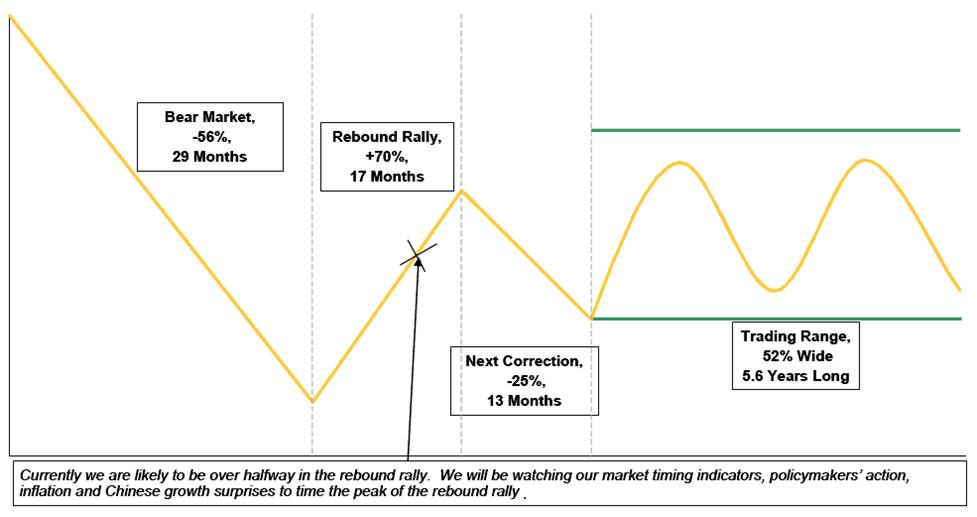
Prieur du Plessis wrote about the Morgan Stanley work for Seeking Alpha
As I alluded to earlier, it’s hard to compare an average to a period in which we had financial institutions dropping like flies (i.e., Bear Stearns, Lehman Brothers, WaMu, Fannie Mae, AIG, etc.) and people were hiding in caves – you knew it was really serious when it even caused voracious consumers to save money…imagine that. At the end of the day, stock and index prices eventually follow earnings. Because of the severity of this downfall, earnings came down faster than prices because fundamentals deteriorated faster than cost cutting could take place. When the economy begins to recover, the opposite will occur – businesses will not be able to hire and spend as fast as earnings are growing. It will be a nice problem to have, but nonetheless characteristic of a typical economic recovery.
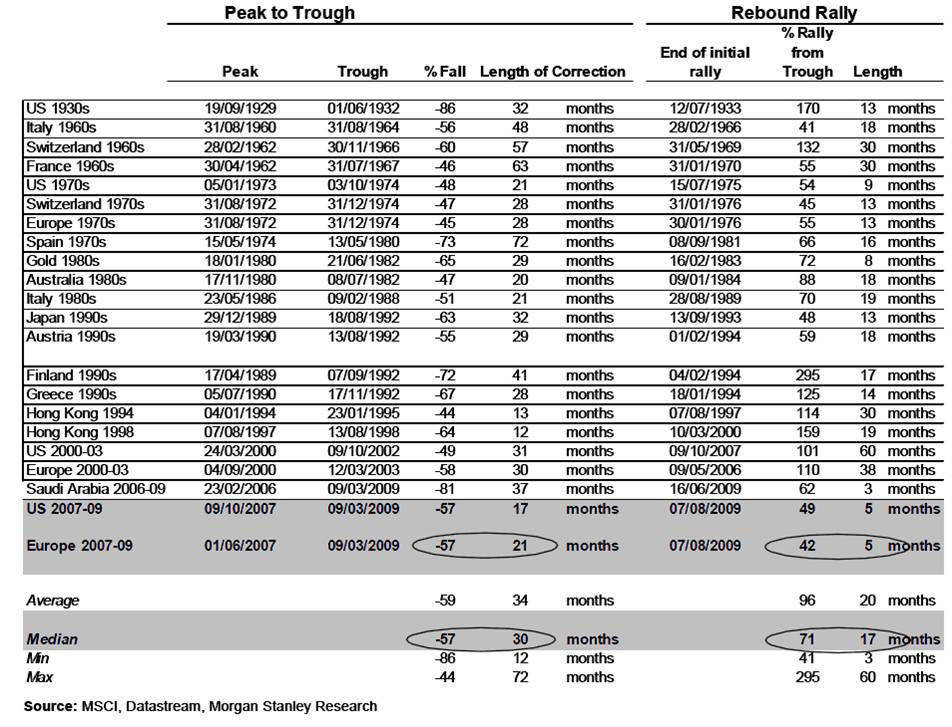
In the U.S., the consumer will have a lot to say about the shape of the recovery since they account for about 2/3 of our country’s economic activity. The other “X” factor will be to what extent government legislation will have an impact on the economy. There will be opportunities available domestically and internally, but in order to survive the chaos, one needs to have a diversified and balanced global approach.
Read the Full Seeking Alpha Article Here
Wade W. Slome, CFA, CFP®
Plan. Invest. Prosper.
Green Loses to Greenback

We are currently in a political environment that sees no gray, but rather only sharp contrasts in black and white. As it turns out, these three colors are not the winners or losers – the winner is the almighty “greenback” and the loser is the “green” movement. The so-called environmentally friendly Obama administration recently approved the Alberta Clipper project – a 1,000 mile pipeline being built by Endbridge Energy that is designed to carry 800,000 barrels of fuel from Canada to the U.S.
As our reliance on what New York Times journalist Tom Friedman calls the “petro dictators” has not gone away, the recent decision seems very rational in securing supplies from friendlier neighbors. However, environmental constituents like the Sierra Club feel differently:
“At a time when concern is growing about the national security threat posted by global warming, it doesn’t make sense to open our gates to one of the dirtiest fuels on earth.”
-Carl Pope (Executive Director of the Sierra Club)
As far as I’m concerned, we still import about 2/3 of our oil and until alternative energies become more cost effective, we have little choice but to explore a multitude of strategic supply agreements. Canada is a neighbor and ally, therefore the U.S. should not walk away from any similar future agreement that will bring a stable and reliable source of supply. The scarcity of the critical resource and other commodities is evident by strategic deals and acquisitions being made by China and its government (See previous Investing Caffeine article, “The China Vacuum, Sucking Up Assets”).
As economic hungry emerging markets seek expansionary policies, I expect to see even more of these international types of deals.
The oil-sands region in the Athabasca region (about the size of Florida) of Alberta holds great promise. If you believe famous oil investor/speculator T. Boone Pickens and other pundits, the oil-sands region holds the equivalent amount of reserves as world supply leader Saudi Arabia – about 250 billion barrels.

I concur with recent comments Financial Times article that says the Endbridge Energy deal meets a number of U.S. strategic interests, including:
“Increasing the diversity of oil supplies for the U.S., amid political tension in many major oil-producing regions; shortening the transportation path for crude oil supplies; and increasing crude oil supplies from a major non-Organization of Petroleum Exporting Countries producer.”
I am not a believer in damaging our environment for the pure sake of profits, however in this competitive global economy I think we need to seek an aggressive dual-source supply of energy (alternative energy AND traditional petroleum/coal products). The fact of the matter is that we have been pursuing solar, wind, nuclear, and other alternative energy resources for decades with very limited success. More financial resources and subsidies must be thrown at these alternative resource possibilities, while we simultaneously seek strategic supplies like this Canadian oil-sands deal.
Wade W. Slome, CFA, CFP®
Plan. Invest. Prosper.
DISCLOSURE: Sidoxia Capital Management and its clients have direct investment exposure in companies investing in Canadian oil-sand projects (SU) at the time the article was published. No information accessed through the Investing Caffeine (IC) website constitutes investment, financial, legal, tax or other advice nor is to be relied on in making an investment or other decision. Please read disclosure language on IC “Contact” page.
The Yuppie Bounce & the Lemming Leap

Source: Gary Larson – Where’s Your Preserver?
Making money in the stock market is a tough game, and most people don’t beat the market because like lemmings the average investor follows the herd mentality to underperformance. So, should Wall Street analysts and the media be crucified for their analysis? The short answer is yes. Certainly there are some exceptional analysts and journalists, however most of them merely report what is happening or are looking in the rear-view mirror. Beyond that, the vast majority of commentators prey on emotions of the public and masses by pushing them into knee-jerk selling panics at the bottom and also getting them frothing at the mouth to buy at market peaks. Can I understand why they offer such bad advice? Yes. Quite simply, the incentive structures are wrong.
If you are an analyst or journalist, the number one priority (incentive) is not to be wrong, because if they are mistaken, then job loss becomes a bona fide risk. However, if they throw in some fancy language and mix it in with a lot of caveats, there virtually is no risk of being wrong. If factors happen to change, no worries, their opinions can change too. Therefore, most analysts huddle together in tight packs reporting the same news du jour as everyone else, while mixing in a fair dosage of fear and greed to drum up more interest. These incentives align well for the journalists/analysts but unfortunately not for the average investor.
Joshua Brown over at the Reformed Broker recently wrote an excellent piece highlighting his so-called “Yuppie Bounce” example. Last winter, as all the discretionary consumer stocks (Joshua Brown calls them “waster stocks”) were getting pasted, the pundits were advising investors to pile into defensive stocks. Lo and behold, this was the absolute worst time to follow that advice. Mr. Brown gives a superb Starbucks (SBUX) versus Wal-Mart (WMT) example showing how SBUX has effectively doubled over the last nine months just as WMT flat-lined.

Source: The Reformed Broker (Joshua M. Brown)
Investing is like a game of chess, so although a current move may sound logical, it’s more important to think about decisions multiple steps into the future. Most successful long-term investors don’t follow the conventional lines of thinking, and they are generally swimming against the tide. Therefore, if you are going to jump in with the other lemmings, make sure you have your life preserver with you.
DISCLOSURE: Some Sidoxia Capital Management and client accounts HAVE direct positions in WMT at the time the article was published. No information accessed through the Investing Caffeine (IC) website constitutes investment, financial, legal, tax or other advice nor is to be relied on in making an investment or other decision. Please read disclosure language on IC “Contact” page.
Housing: Green Shoots Turning to Golden Trunks?

The doom and gloomers say the “green shoots” are actually “yellow weeds” and turn a blind eye to the positive (or less negative) economic data. The unemployment rate declined marginally last month to 9.4%, and GDP rates are expected to turn positive in the current quarter. Even so, the nay-sayers like Nouriel Roubini, Marc Faber, and Nassim Taleb still believe worse days lie ahead. Recent comments from a steely industry veteran may point to maturing “golden trunks” rather than younger, greener varieties.
Normally I do not expend too much energy on a single quarter of data relating to a stock I do not own, however comments coming from Bob Toll, founding CEO of Toll Brothers Inc. (dating back to 1967) caught my fancy. Besides the invaluable perspective he provides on the industry, he is in the unique position to explain the spending dynamics covering the higher-end demographic area. Toll Brothers is the largest luxury home builder in the U.S., operating in 21 states spanning the North, South, Mid-Atlantic, and West regions.
Although counterintuitive to many of the current news headlines, here is what Mr. Toll had to regarding Tolls’ recent quarterly earnings data and the state of the U.S. housing market:
• “Although our industry continues to face significant challenges, we are encouraged by the increase in number of net contracts signed this quarter. This marks the first time in sixteen quarters (4 years) dating back to fiscal year ’05’s fourth quarter that our net contracts exceeded the prior year same quarter. (The Results) also marked the first quarterly sequential unit increase in our backlog in more than three years.”• “Price is no longer the overwhelmingly dominant factor. It appears that those taking this step today have more confidence than one year ago.”
• “As the supply of unsold housing inventory shrinks nationwide, and if consumer confidence continues to improve, we should see stronger demands. It has already positively impacted our pricing power as we are reducing incentives in many markets.”
• “Fiscal year ’09’s third quarter cancellation rate, current quarter cancellations divided by current quarter’s signed contracts, was 8.5% versus 19.4% in fiscal year ’08’s third quarter. This was our lowest cancellation rate since the second quarter of fiscal year ’06 and is approaching our historic average of approximately 7% since going public.”
• “There’s a better feeling about jobs, a better feeling about the economy. Six months ago …we were all scared that the end was near…So I think we’ve just got a better market now and if things continue to improve, I think the market will continue to improve.”
• “(Traffic data) is certainly more than anecdotal information. You’re getting these averages from 235 approximately communities, 250 communities, so that’s a pretty good indicator of where the market is right now.”
• “The number of weeks of improvement that we have had as I said in the monologue, are certainly more than anecdotal. You’re talking about a whole lot of communities in 40, 50 markets and 20, 22 states. So we’re getting pretty deep information.”
Certainly Mr. Toll’s responses should be taken with a grain of salt. CEOs comments are generally overoptimistic and the economy is clearly not out of the woods yet. Having said that, for those that have followed Mr. Toll’s comments over the last few years, know that he did not always sugar-coat the weak results on the way down. Just six months ago, Mr. Toll said this: “We have not yet seen a pickup in activity at our communities,” and to combat pricing pressures the company offered a multitude of promotions, including a 3.99% mortgage rate to buyers.
The sustainability of the positive housing trends is unclear, but the signs are encouraging – especially since government stimulus cannot be directly responsible (i.e., no $8,000 new home-buyer credits for homes in the $700,000 price range) for awaking the housing bear from a four-year hibernation. The passage of time will determine whether Toll’s improving assessment of housing fundamentals will deteriorate into “yellow weeds” or flourish into a “golden trunk.”
Watch Extended Interview of CEO Bob Toll (Post Q3 2009 Conference Call)
Sidoxia Capital Management and its clients did not have any position in TOL at the time the article was published. No information accessed through the “Investing Caffeine” website constitutes investment, financial, legal, tax or other advice nor is to be relied on in making an investment or other decision.
Coke Targets Cows

Coca-Cola (KO) has come up with a new product idea: fizzy milk. Sound strange? From my perspective, I prefer my milk with cereal and chocolate chip cookies. I never received a marketing degree, so somebody please explain to me what the heck Coke is thinking?
What’s next? Coca-Cola anchovy and liver protein shakes. Or perhaps fizzy gravy? What better than a little carbonation to liven up your mash potatoes on Thanksgiving?!
The name of Coke’s new carbonated milk product is Vio, and the creation is being test-marketed throughout New York (primarily in delis and health food stores) to gauge acceptance. The fizzy milk product comes in various fruit flavors, including Tropical Colada, Very Berry, Citrus Burst, and Peach Mango. Peculiarly, the product is stocked on shelves at room temperature. Mmm, nothing like lukewarm milk, it just sounds so delightful (I don’t think so).

Coke also has grander ambitions of rolling Vio out globally, if the U.S. launch proves successful. According to the TimesOnline article, perhaps natural food stores should not be targeted since Vio contains similar levels of sugar as Coca-Cola’s main non-diet drinks. Some believe Coke’s introduction of Vio is merely a crafty exploitation of a technicality in school beverage rules. A recent article written on creativematch states, “The American Beverage Association’s School Beverage Guidelines prohibits sugar-sweetened carbonated soft drinks from being sold in elementary, middle, and high schools. However, the guidelines still allow some milk-based products to be sold.” Perhaps Vio is Coke’s Trojan Cow for getting new drinks onto schools’ menus.
Time will tell whether Coke is successful in this beverage niche, but I will not hold my breath for its triumph. No matter the level of Vio achievement, at a minimum, dairy cows have found a new revenue stream to keep them employed in a tough economic environment.
Wade W. Slome, CFA, CFP®
Plan. Invest. Prosper.
DISCLOSURE: Sidoxia Capital Management and its clients do not have direct investment exposure in Coca Cola Co. (KO) at the time the article was published. No information accessed through the Investing Caffeine (IC) website constitutes investment, financial, legal, tax or other advice nor is to be relied on in making an investment or other decision. Please read disclosure language on IC “Contact” page.
Business Theory: Voodoo or Value?

Michael E. Porter, a former aeronautical engineer graduate turned Harvard Economics PhD professor, came out with a revolutionary article thirty years ago (How Competitive Forces Shape Strategy) in which he describes the Five Forces of competition that shape the profitability dynamics of an industry. Since then, Porter’s management theories have continued to spread and his knowledge is continually sought after. Some people believe Porter’s Five Forces, and other management business theories, are pure voodoo.
In a recent HBR (Harvard Business Review) article, Andrew O’Connell completed a book review of The Management Myth: Why the “Experts” Keep Getting it Wrong written by Matthew Stewart, a former consultant. Mr. Stewart (a former consultant turned non-believer) exposes the sham of the business consulting industry by outlining the outrageous fees paid by clients and the “mumbo-jumbo” language spouted out by newly minted MBAs.
In a similarly titled article (the Management Myth) written in 2006, Mr. Stewart goes on to say:
“The impression I formed of the M.B.A. experience was that it involved taking two years out of your life and going deeply into debt, all for the sake of learning how to keep a straight face while using phrases like “out-of-the-box thinking,” “win-win situation,” and “core competencies.”… M.B.A.s have taken obfuscatory jargon—otherwise known as bullshit—to a level that would have made even the Scholastics blanch.”
Some other interesting comments include his views on failing companies:
“In fact, we kind of liked failing businesses: there was usually plenty of money to be made in propping them up before they finally went under. After Enron, true enough, Arthur Andersen sank. But what happened to such stalwarts as McKinsey, which generated millions in fees from Enron and supplied it with its CEO?”
Too often with many books, a silver bullet or holy-grail is searched for. The true answer – there is no easy solution. I believe tools or frameworks, like Porter’s Five Forces, can create significant benefits by forcing practitioners into thinking about competition and profits in new ways. Although the lessons may not be worth millions in consulting fees, the education may be worth the $21.95 cost of a book (including free shipping) from Amazon. Mr. Stewart would likely take umbrage with these views, especially since I have an MBA from Cornell.
Wade W. Slome, CFA, CFP®
Plan. Invest. Prosper.
Social Media Revolution Taking Over World

When I speak of revolution I’m not talking about religion, politics, or wars; rather I am talking about “social media.” Should I care that Ashton Kutcher and Ellen DeGeneres have more twitter followers than the populations of Ireland, Norway, and Panama? Some say social networking is just a fad, but if you blindly sit along the sidelines, the whole world may pass you by in a blink of an eye. Erik Qualman, author of the book and blog Socialnomics, has a must see video that details the revolutionary growth of social media and explains how it is changing the world.
Ever since the early 1900s when the commercialization of radio took hold, millions of people were able to connect all over the world through the spread of technology – in this case the spread of AM (Amplitude Modulation) and FM (Frequency Modulation). Other technologies, such as the telephone, television, and now the internet, have also allowed people to connect. Mr. Qualman details how social media is spreading faster than ever.
Through a chain of details, Qualman highlights the following facts: the invention of the radio took 38 years to reach 50 million users; the television 13 years; the internet 4 years; and the iPod 3 years. Pretty staggering figures until you realize it only took less than 1 year – actually 9 months – for Facebook to add 100 million users! We know the trend is real when my mom (in her seventies) asked me last week how she can register on facebook. Currently, the 55-65 year old female segment is the fastest growing member segment on facebook.
Facebook is just one of many social media networks, which includes twitter, orkut, bebo, flickr, digg, myspace, YouTube, and countless others. The networks are expanding at break-neck speed, and the types of networks are becoming more focused and strange (for example, Spot-a-Potty, or Weird Beard).
Regardless of your view – fad or revolution – the younger generation is consuming more of it. It doesn’t take a genius to follow consumers where they are spending more time. The smart advertisers and businesses are moving to where the action is. As Mr. Qualman notes, Generation Y (the so-called “Echo-Boomers) already outnumbers the Baby Boomers – hmmm, I think advertisers are slowly getting the picture. Investors should be paying attention too. I am investing my own money (and my clients’) in areas like these, where I see companies benefitting from technological change. If pushed to make a choice regarding social media, I pick revolution over fad.
Wade W. Slome, CFA, CFP®
Plan. Invest. Prosper.
DISCLOSURE: At the time of publishing, Sidoxia Capital Management and some of its clients owned certain exchange traded funds, AAPL, and GOOG, but had no direct positions in twitter, Facebook, orkut, bebo, flickr, digg, myspace, or any other security referenced. No information accessed through the Investing Caffeine (IC) website constitutes investment, financial, legal, tax or other advice nor is to be relied on in making an investment or other decision. Please read disclosure language on IC “Contact” page.
Technology Does Not Sleep in a Recession

Our economy may be coming out of a long economic hibernation; however technology does not sleep through a recession. Gordon Moore, co-founder of Intel Corporation, has proven this trend true through his groundbreaking piece written in the April 1965 issue of Electronics Magazine. In the article Mr. Moore predicted transistor densities would double about every two years (“Moore’s Law”). Transistors can be thought of as the brains of electronics devices, and the industry (Intel and other semiconductor manufacturers) has been boosting the brain power of electronics for decades. How far has the industry come? The number of transistors contained on a chip has gone from 16 in 1960s to over 600 million today – now that’s what I call progress!
These achievements have been nothing short of revolutionary, and many people consider the introduction of the transistor as the greatest invention of the 20th century. According to many industry experts, Mr. Moore’s forecasts have been shockingly accurate and many believe “Moore’s Law” will hold true for years to come – despite challenging technological limitations.

Source: The Financial Times
We may curse at our computers (I absolutely despise Vista), but there is no arguing with the huge productivity and standard of living improvements we have experienced over the last forty years – since the introduction of the transistor. Many take their GPS, Tivo, WiFi laptop, iPhone, and HiDef TVs for granted, however I for one thank Gordon Moore and those diligent engineers for making my geeky tech dreams come true.
However the cost of further advancements is becoming pricier. As line widths (the ability to add more transistors) narrow, the costs of building fabrication plants (“fabs”) with the necessary equipment are running in the multi-billion range. The Financial Times (FT) article talking about semiconductor trends mentions a $4.2 billion state-of-the-art factory in upstate New York that is just beginning construction. The FT notes that only two players (Intel and Samsung) have firm plans to build 20 nanometer fabs. For comparison purposes, one nanometer is equal to one-billionth of a meter and a human hair is 100,000 nanometers wide. In other words, a nanometer is pretty darn tiny. To further illustrate the point, Intel has managed to fit up to 11 Intel Atom processors – each packed with 47 million transistors – on the face of an American penny.
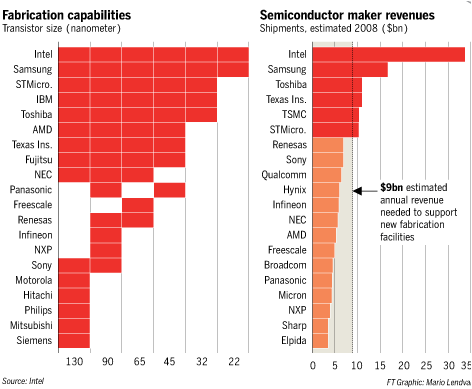
Source: The Financial Times
As the chip making industry become more costly, fewer semiconductor manufacturers will be playing in the sandbox:
“Intel argues that only companies with about $9bn in annual revenues can afford to be in the business of building new fabs, given the costs of building and operating the factories and earning a decent 50 per cent margin. That leaves just Intel, Samsung, Toshiba, Texas Instruments and STMicroelectronics.”
The economy may still be in the doldrums, but the $60 trillion global economy (as measured by Gross Domestic Product) never sleeps – technologies created by Gordon Moore and others continue to propel amazing advancements.
Wade W. Slome, CFA, CFP®
Plan. Invest. Prosper.
Walking Down “Money Honey” Memory Lane

Don’t shoot the messenger, even if it means walking down “money-honey” memory lane. Maria Bartiromo has been a staple for business television viewers since she joined CNBC in 1993. The broad hair-styles of Maria Bartiromo, ranging from the “Tease” and “Business Mullet” to the “Classic” and the “Librarian,” have been more volatile than the CBOE Volatility Index (VIX). Word has it that the Chicago Mercantile Exchange (CME) is working on a hair futures contract, designed to hedge against potential price spikes in the hairspray market.
Click Here For Clusterstock’s Random Walk Through Bartiromo’s Hairstyles
To avoid any sexist comment critics, and if there are enough requests, I will submit a “dew dude” montage of Wade Slome’s past cranial mop designs. For those outraged by the hair-dew review, rest assured knowing Mrs. Bartiromo has been quoted as saying, “Frankly, I’m flattered” by the “money-honey” reference.
Like a day trader adapting to the changing markets, Mrs. Bartiromo has shown tremendous versatility in adjusting to the ever-changing business style demands. Some may debate whether her journalistic intensity has kept pace with the times. Change is a constant when considering financial markets and hairstyle trends – I’ll be watching Mrs. Bartiromo work her craft in both areas.
Wade W. Slome, CFA, CFP®
Plan. Invest. Prosper.
Tortuous Path to Productivity

There is a silver lining to the deep, tortuous job cuts in this severe recession and it is called “productivity.” Those fortunate enough to retain their jobs are forced to become more productive. In layman’s terms, productivity simply is output divided by hours worked.
Unemployment dropped to 9.4% in July, thanks in part to a decline in the job losses to -247,000 from a peak in January of -741,000 job losses. During this period of job-loss cratering, we managed to sustain a decline of a mere -1% in Q2 Gross Domestic Product (GDP). How could we lose more than 6 million jobs since the beginning of 2008 and still be on a path to recovery? A large contributor is our friend, productivity, which came in at a whopping +6.4% in Q2 – the highest in six years.
Productivity increased in part because of a slashing of work-hours by employers. Employees that have maintained employment are therefore forced to produce more output (goods and services) per unit hour of employment. In this severe recession that we are pulling out of, the American worker is being stretched like a rubber band. At some point, the “Law of Diminishing Returns” kicks in and employers are forced to hire new employees to meet demand levels, or the rubber band will snap.
The prime ways of increasing productivity are raising the amount of capital per worker (capital intensity) and also elevating the workers’ average level of skill, education, and training (labor quality).
Not only are the surviving U.S. workers toiling harder, they are not getting pay increases large enough to offset inflation. For example, Q2 hourly compensation increased +0.2%, but after accounting for inflation, real hourly compensation was actually down -1.1%.
As the MarketWatch article points out:
The early stages of recovery are typically the best for productivity: Output is rising, but cost-cutting plans are still being implemented… Productivity gains are the key to higher living standards, higher wages, increased profits and low inflation… Productivity averaged about 2.7% annually from 1948 to 1970, then slowed to 1.6% from 1971 to 1995. Since then, productivity has grown about 2.5% annually. In 2008, productivity increased 1.8%.
Productivity allows the U.S. to produce more goods and services with fewer workers. For instance, the MarketWatch article also highlights the U.S. is producing 20% more output relative to a decade ago, yet employment has not changed at all over that time period.
We are certainly not out of the woods when it comes to the recession, and for those lucky enough to maintain employment, they are being asked (forced) to work more for less pay. These productivity improvements feel like torture to the survivors, however this pain will eventually lead to economic gain.
Wade W. Slome, CFA, CFP
Plan. Invest. Prosper.




 Investing Caffeine
