Strong Advice from Super Swensen

Playing the financial markets is a challenging game, and over the last decade we’ve witnessed events we will never see again in our lifetimes. Through these muscle aches and pains, listening and paying attention to powerful, seasoned industry veterans, like David Swensen, becomes paramount. Mr. Swensen has proven his durability – he has managed the Yale endowment for 24 years and has overseen the growth of the university’s portfolio from $1 billion to $17 billion. For the decade ending in June 2008, the Yale portfolio averaged an incredible 16.3% annual return.
So what commanding advice does Mr. Swensen have to share? Here are a few nuggets regarding equities as discussed in his May interview published in The Guru Investor (TGI):
“With a long time horizon you should have an equity orientation, because over longer periods of time, equities are going to deliver better results,” he says. “If they don’t, then capitalism isn’t working. And we could well be at a point where investments in equities are going to produce returns going forward that are higher than what we’ve seen in the past five or ten years.”
I find it difficult to argue with him. Perhaps we still have a ways to go, but the equity markets had an explosion after the 1966-1982 hiatus. Perhaps the 2000-2009 period isn’t long enough to mark bottom, but at a minimum, the spring is coiling based on history.
When it comes to diversification, TGI summarized Swensen’s asset allocation as follows:
“He recommends that investors have 30% of their funds in U.S. stocks, 15% in Treasury bonds, 15% in Treasury Inflation-Protected Securities, 15% in Real Estate Investment Trusts, 15% in foreign developed market equities, and 10% in emerging market equities. As investors get older, they should keep this type of allotment for a portion of their portfolio but begin to decrease the size of that portion, putting part of their portfolios into less risky assets like cash or Treasuries.”
Many investors were taking excessive risk in 2008 (within their asset allocations), and they were not even aware. Let’s hope valuable lessons have been learned and investors adjust the risk levels of their portfolios as they age.

David Swensen (Michael Marsland/Yale University)
Mr. Swensen has some choice words for the mutual fund management industry as well:
“The problem is that the quality of the management in the mutual fund industry is not particularly high, and you pay an extraordinarily high price for that not-very-good management,” he says. Swensen cites one study performed by Rob Arnott that measured mutual fund performance over a two-decade period. The study found that you’d have had a 15% chance of beating market after fees and taxes by investing in mutual funds — and that includes only funds that were around for the entire period; many other weaker funds didn’t last, meaning the results have a survivorship bias.
Tough to disagree, and as I’ve written in the past, I believe there are only so many .300 hitters in baseball (a study in 2007 showed only 12 active career .300 hitters in the Major Leagues – highlighted in my previous Ron Baron article). Outside of baseball, there are consistent alpha generators in the market too. However, I’d make the case that identifying the alpha generators in the financial markets is much more difficult because of the extreme fund performance volatility. Even the best managers can string some bad years together.
Swensen doesn’t stop there. He expands on the reasons behind mutual fund manager underperformance:
Taxes and fees are the big culprits, Swensen says: “Why are the tax bills so high? Because turnover’s too high. The mutual fund managers are trading the portfolios as if taxes don’t matter, and taxes do matter. And they’re trading the portfolios as if transactions cost and market impact don’t matter, and they do matter. And as they trade the portfolios, basically what’s happening is Wall Street is siphoning off its slice of the pie … and that’s at the expense of the investor.”
One thing we learned from the real estate and financial bubble that burst over the last few years is that incentive structures were misaligned. Manager compensation, whether you are talking hedge funds or mutual funds, is based on too short a time horizon, and therefore incentive structures encourage abnormal risk-taking. In baseball terms, you have those that take excessive risk and swing for the mega-bucks fences (loose cannons) and the bunters (benchmark huggers) who seek the comfort of “lower” mega-bucks. Swensen is a much bigger believer in passive strategies (as am I), using passive investment vehicles like ETFs (Exchange Traded Funds).
Mr. Swensen continues his critical perspective by targeting investors too:
Individuals and institutions who buy mutual funds “take this mutual fund industry which produces a bunch of products that are not great to start with, and then they screw it up by chasing hot performance and selling after things turn cold.”
The 1984-2002 John Bogle data (Vanguard) included in my “Action Dan” article hammers that point home.
Where should investors go now?
Asked what the one recommendation he has right now for investors is, Swensen cited TIPS. “We’ve had this massive fiscal stimulus, massive monetary stimulus, and it’s hard to see how that doesn’t translate into pretty substantial inflation, or at least pretty substantial risk of inflation … down the road at some point,” he said.
Ditto, once again – I’m a believer in having some inflation protection in your portfolio. Of course there is no free lunch in the investment world, and so there are certainly some risk factors in Swensen’s alternative investment strategy (e.g. hedge funds, private equity, and real estate). Certainly, due to significant illiquidity and other factors, many of these areas got absolutely hammered in 2008.
The best investors prepare their portfolios for these strenuous times. Do yourself a favor and work on your muscle tone too – and listen to the strong advice of David Swensen.
Read the Full TGI Article Here
Wade W. Slome, CFA, CFP
Plan. Invest. Prosper.
DISCLOSURE: Sidoxia Capital Management and client accounts do have direct long positions in TIP at the time article was originally posted. No information accessed through the Investing Caffeine (IC) website constitutes investment, financial, legal, tax or other advice nor is to be relied on in making an investment or other decision. Please read disclosure language on IC “Contact” page.
Celebrity Tax Evaders Run But Can’t Hide

As Mark Twain said, “The only certainties in life are death and taxes.” That is, of course, unless you decide to not pay your taxes. Some well known celebrities fall into this camp.
The financial crisis has hit the economy hard and the impact has been felt directly by our nation’s cash register (i.e., the Internal Revenue Service – IRS). Based on 2006 IRS data, the U.S. had about an 84% Voluntary Compliance Rate (VCR) by tax payers in 2001; a goal of 85% VCR in 2009; and Senate Finance Committee Chairman Max Baucus has thrown out a 90% voluntary compliance goal by 2017. Those collection goals may be a little ambitious given the recession and the escalating unemployment trends over 2008 – 2009.
So who makes up the deadbeats who have deliberately or unintentionally not paid their taxes? Obviously 10-15% of the non-paying tax-payer base is a large number, but the real fun comes by tracking the smaller celebrity component of the tax evaders. Let’s take a look at some of the more prominent dodgers (data provided by The Daily Beast):
- O.J. Simpson: In 2007 the state of California placed listed Mr. Simpson as one of their worst tax offenders, owing close to $1.5 million. Currently he is serving a 33-year sentence in a Nevada prison for an armed robbery and kidnapping conviction.
- Willie Nelson: The long-haired hippy and king of country music, Willie Nelson, was hunted down by the IRS for $16.7 million in 1990. Fortunately for him, his star-power allowed him to record albums and pay back his debt by 1993.
- Wesley Snipes: The Blade movie star claimed the reason he owed more than $17 million in taxes, penalties, and interest is because he was a “non-resident alien.” The judge didn’t buy the explanation, and now he is appealing a three-year prison sentence.
- Pete Rose: “Charlie Hustle,” the all-star baseball player of the Cincinnati Reds served five months in prison for not paying taxes on his autograph, memorabilia, and horse-racing income. Mr. Rose cleared the slate by performing 1,000 hours of community service and paying off $366,000 in debt.
- Nicolas Cage: Not sure if he is shooting a movie in New Orleans, but Mr. Cage is attempting to iron out a $6.2 million tax liability through a Louisiana court for his failure to keep up with 2007 taxes.
- Judy Garland: Men are not the only non-compliers, even if they account for the majority. Judy Garland, from Wizard of Oz fame, had her own tax problems. Besides tax evasion charges in the early 1950s, she accumulated about $4 million in IRS debt after her 1964 variety show (The Judy Garland Show) was cancelled.
- Al Capone: One of most well known cases in tax evasion history is tied to famous mobster Al Capone. After a long, controversial trial, Mr. Capone was convicted and handed an 11-year sentence, predominantly at Alcatraz. He got out early on parole in 1939 and kept a relatively low profile.
There are countless others that have gotten into tax problems with the IRS. Many of them make plenty of money to pay their taxes, however spending habits, laziness, or aggressive tax accountants may explain the reasons behind the tax evasion problems.
See a more complete media gallery of tax evaders here, provided by The Daily Beast.
Regardless of the celebrities’ tax-paying compliance rates, the IRS will have its collection hands full, given the sad state of the current economic environment and the crafty tax-dodging techniques pursued by some citizens. Unlike others, I’ll make sure to write myself a note, reminding me to write a check to my friends at the IRS on April 15th – especially if it involves millions.
Wade W. Slome, CFA, CFP®
Plan. Invest. Prosper.
Shiny Metal Shopping with Schiff, Rogers, and Faber

There I am, strolling through Costco (COST) with a pallet full of toilet paper, Diet Coke, and a garbage bag-sized bag of tortilla chips on my flat orange cart. As I roll into the cash register, I feel a cold panic grab me, only to realize I forgot my 25 pound gold brick in my car trunk as a method of payment for my necessities. Sound far-fetched? Probably not, if you are a part of the hyper-inflationary “Three Musketeers”: Peter Schiff, Jimmy Rogers, and Marc Faber.
Here is what some of the “world-is-ending” crowd is saying:
Peter Schiff (President of Euro Pacific Capital – Connecticut Senator Candidate): He sees the market potentially going much higher, but “it doesn’t matter how much money we have because we’re not going to be able to buy anything with it.”
Marc Faber (a.k.a.,“Dr Doom”, creator of the Gloom Boom & Doom Report): When asked by faux frog boiler and Fox News reporter Glenn Beck if he believes “it is 100% guaranteed that we are going to have hyper-inflation like Zimbabwe,” Faber’s short and to-the-point response was simply, “Yes, that’s correct.”
Jimmy Rogers (Chairman of Rogers Holdings): “I’m afraid they’re printing so much money that stocks could go to 20,000 or 30,000,” Rogers said. “Of course it would be in worthless money, but it could happen and you could lose a lot of money being short,” he adds. Mr. Rogers likes gold too: “I own gold, I’m not selling it.”
PRICING IN GOLD
One consistent theme heard from these three economic bears is that the Dow and other market indexes should be measured on a gold adjusted basis. Since Peter Schiff’s Dow 10,000 to 3,000 forecast never came to fruition (See Schiff’s other questionable predictions), he rationalizes it this way, “So if you price the 2002 Dow in gold, the Dow is at 3,000 now.” Marc Faber makes a similar argument by saying the Dow could double from today, but with gold tripling your worth will be down. That’s funny, because if I price the Dow based on 2002 lumber prices (rather than gold), the Dow would actually be up to about 20,000 (more than 2x its value today)! If prices should truly be measured in gold, then why doesn’t Goldman Sachs’ (GS) and others provide inflation adjusted price targets on their research reports? If gold is the true measure of value, then why can’t I pay off my American Express (AXP) bill by mailing in my gold necklace?
GOLD FEVER
With the effective quadrupling of gold prices in the last seven years (~$250/oz to ~$1,000/oz), gold bugs are more confidently pounding their chests and throwing out multi-thousand, frothy price targets. For example, Peter Schiff predicted $2,000 per ounce by 2009 (who knows, maybe he’ll be right and gold will be up another 100% in the ne next 90 days…cough, cough). Not only are you hearing the strategists and investors bang their drums more loudly, but gold advertisements are plastered all over the radio, television, and internet. Here are a few excerpts*:
- “Watch your gold investments be “on the money” every 9 out of 10 times.”
- “Gold prices could reach $2,300 an ounce or more before it’s over. Buyers of gold bullion at $900 an ounce could earn a return of +155%. That’s very good. But there’s an even BETTER WAY!”
- “Discover Our Little Known “Gold Price Predictor” That Has Been Spot On Every Single Time… Since 1901..!”
- “Turn EVERY $1 Of GOLD Into $10…Or MORE!”
Sources: streetauthority.com and soverignsociety.com
ALTERNATIVE SCENARIO
Another scenario to consider is a complete collapse in gold prices (and surge in the dollar) like we saw in the early 1980s We experienced about a -65% drop in gold prices (~$800/oz. to $300/oz.) from 1980-1982 and saw ZERO price appreciation for about a 25 year period. When did this abysmal period for gold begin? Right about the same time that Paul Volcker raised interest rates to fight inflation. Hmmm, I wonder what next direction of interest rates will be, especially with the Federal Funds rate currently at effectively 0%? Could we see a repeat of the early ‘80s? Seems like a possibility to me. Certainly if you fall into the Marshal Law, civil unrest, soup kitchen, and bread line camp, like the “Three Musketeers,” then burying tons of gold in your homemade bunker may indeed be an appropriate strategy.
Another head scratcher is all the talk revolving around an inflation driven market rebound. If inflation is truly the worry, then shouldn’t the “Three Musketeers” be massively short and be concerned about declining PE (Price/Earnings) multiples, like the single digit PE levels we saw in the late-1970s and early-1980s (when we were experiencing double-digit inflation)?
As I have chronicled, there can be some mixed interpretations regarding the direction of future gold prices. If you think a repeat of Volcker driven gold price collapse of the early ‘80s is possible, then establishing a heavy short position may be the ticket for you. If on the other hand, you are in the gold $4,000 camp, then it might be best to carry a few extra gold bars in the trunk for your next Costco trip.
DISCLOSURE: Sidoxia Capital Management and client accounts do not have direct long or short positions in COST, GS, AXP or gold positions. No information accessed through the Investing Caffeine (IC) website constitutes investment, financial, legal, tax or other advice nor is to be relied on in making an investment or other decision. Please read disclosure language on IC “Contact” page.
Taking Facebook and Twitter Public

Facebook CEO Mark Zuckerberg
Valuing high growth companies is similar to answering a typical open-ended question posed to me during business school interviews: “Wade, how many ping pong balls can you fit in an empty 747 airplane?” Obviously, the estimation process is not an exact science, but rather an artistic exercise in which various techniques and strategies may be implemented to form a more educated guess. The same estimation principles apply to the tricky challenge of valuing high growth companies like Facebook and Twitter.
Cash is King
Where does one start? Conceptually, one method used to determine a company’s value is by taking the present value of all future cash flows. For growth companies, earnings and cash flows can vary dramatically and small changes in assumptions (i.e., revenue growth rates, profit margins, discount rates, taxes, etc.) can lead to drastically different valuations. As I have mentioned in the past, cash flow analysis is a great way to value companies across a broad array of industries – excluding financial companies (see previous article on cash flow investing).
Mature companies operating in stable industries may be piling up cash because of limited revenue growth opportunities. Such companies may choose to pay out dividends, buyback stock, or possibly make acquisitions of target competitors. However, for hyper-growth companies earlier in their business life-cycles, (e.g., Facebook and Twitter), discretionary cash flow may be directly reinvested back into the company, and/or allocated towards numerous growth projects. If these growth companies are not generating a lot of excess free cash flow (cash flow from operations minus capital expenditures), then how does one value such companies? Typically, under a traditional DCF (discounted cash flow model), modest early year cash flows are forecasted until more substantial cash flows are generated in the future, at which point all cash flows are discounted back to today. This process is philosophically pure, but very imprecise and subject to the manipulation and bias of many inputs.
To combat the multi-year wiggle room of a subjective DCF, I choose to calculate what I call “adjusted free cash flow” (cash flow from operations minus depreciation and amortization). The adjusted free cash flow approach provides a perspective on how much cash a growth company theoretically can generate if it decides to not pursue incremental growth projects in excess of maintenance capital expenditures. In other words, I use depreciation and amortization as a proxy for maintenance CAPEX. I believe cash flow figures are much more reliable in valuing growth companies because such cash-based metrics are less subject to manipulation compared to traditional measures like earnings per share (EPS) and net income from the income statement.
Rationalizing Ratios
Other valuation methods to consider for growth companies*:
- PE Ratio: The price-earnings ratio indicates how expensive a stock is by comparing its share price to the company’s earnings.
- PEG Ratio (PE-to-Growth): This metric compares the PE ratio to the earnings growth rate percentage. As a rule of thumb, PEG ratios less than one are considered attractive to some investors, regardless of the absolute PE level.
- Price-to-Sales: This ratio is less precise in my mind because companies can’t pay investors dividends, buy back stock, or make acquisitions with “sales” – discretionary capital comes from earnings and cash flows.
- Price-to-Book: Compares the market capitalization (price) of the company with the book value (or equity) component on the balance sheet.
- EV/EBITDA: Enterprise value (EV) is the total value of the market capitalization plus the value of the debt, divided by EBITDA (Earnings Before Interest Taxes Depreciation and Amortization). Some investors use EBITDA as an income-based surrogate of cash flow.
- FCF Yield: One of my personal favorites – you can think of this percentage as an inverted PE ratio that substitutes free cash flow for earnings. Rather than a yield on a bond, this ratio effectively provides investors with a discretionary cash yield on a stock.
*All The ratios above should be reviewed both on an absolute basis and relative basis in conjunction with comparable companies in an industry. Faster growing industries, in general, should carry higher ratio metrics.
Taking Facebook and Twitter Public
Before we can even take a stab at some of these growth company valuations, we need to look at the historical financial statements (income statement, balance sheet, and cash flow statement). In the case of Facebook and Twitter, since these companies are private, there are no publically available financial statements to peruse. Private investors are generally left in the dark, limited to public news related to what other early investors have paid for ownership stakes. For example, in July, a Russian internet company paid $100 million for a stake in Facebook, implying a $6.5 billion valuation for the total company. Twitter recently obtained a $100 million investment from T. Rowe Price and Insight Venture Partners thereby valuing the total company at $1 billion.
Valuing growth companies is quite different than assessing traditional value companies. Because of the earnings and cash flow volatility in growth companies, the short-term financial results can be distorted. I choose to find market leading franchises that can sustain above average growth for longer periods of time (i.e., companies with “long runways”). For a minority of companies that can grow earnings and cash flows sustainably at above-average rates, I will take advantage of the perception surrounding current short-term “expensive” metrics, because eventually growth will convert valuation perception to “cheap.” Google Inc. (GOOG) is a perfect example – what many investors thought was ridiculously expensive, at the $85 per share Initial Public Offering (IPO) price, ended up skyrocketing to over $700 per share and continues to trade near a very respectable level of $500 per share.
The IPO market is heating up and A123 Systems Inc (AONE) is a fresh example. Often these companies are volatile growth companies that require a deep dive into the financial statements. There is no silver bullet, so different valuation metrics and techniques need to be reviewed in order to come up with more reasonable valuation estimates. Valuation measuring is no cakewalk, but I’ll take this challenge over estimating the number of ping pong balls I can fit in an airplane, any day. Valuing growth companies just requires an understanding of how the essential earnings and cash flow metrics integrate with the fundamental dynamics surrounding a particular company and industry. Now that you have graduated with a degree in Growth Company Valuation 101, you are ready to open your boutique investment bank and advise Facebook and Twitter on their IPO price (the fees can be lucrative if you are not under TARP regulations).
DISCLOSURE: Sidoxia Capital Management and client accounts do not have direct long positions AONE, however some Sidoxia client accounts do hold GOOG securities at the time this article was published. No information accessed through the Investing Caffeine (IC) website constitutes investment, financial, legal, tax or other advice nor is to be relied on in making an investment or other decision. Please read disclosure language on IC “Contact” page.
Avoid Chasing Your 401k Tail

David Laibson, a professor of economics at Harvard University, has done extensive research on the savings habits of Americans in their 401k retirement accounts. What he discovers is that workers, like a dog chasing their tail, allocate more of their investments to the areas that have done well and sell the underperforming segments. In short, workers attempt to “time the market.”
Professor Laibson demonstrates this pyramiding strategy has not worked out so well and provides the following advice:
“We know that individual investors are terrible in terms of their market timing. They tend to buy at the tops, they tend to sell at the bottoms. So don’t try to time the market. Don’t think about recouping – just think about a long term strategy.”
That long term strategy he advocates entails a diversified allocation of stocks and bonds that reduces exposure to equities as a person gets older. In short, he says, “Hold a diversified portfolio appropriate for your age.”
He advises those aged in their 20s and 30s to allocate nearly 100% of their portfolio to equities, or investments with commensurate risk. Alternatively, if investors don’t want to adjust the allocation themselves, people should consider life-cycle funds or Self Directed 401k options (Read story here). For those in retirement, he recommends a portfolio with the following characteristics:
“30, 40, 50% should be equities, more as you’re younger…simply hold a long term portfolio with less and less allocation to equities as you age.”
Jason Zweig, a journalist at The Wall Street Journal, recently chimed in with similar thoughts on performance chasing:
“…to buy more of what has gone up, precisely because it has gone up, is to fall for the belief that stocks become safer as their prices rise. That is the same fallacy that led investors straight into disaster in 1929, 1972, 1999, 2007 and every other market bubble in history.”
There are many different strategies for making money in the market, but a plan based solely on emotion is doomed for failure – Professor Laibson’s data supports that assertion. So the next time you are considering re-allocating the mix of investments in your 401k, implement a disciplined, systematic approach. That approach should include the following:
1) Invest Your Age in Fixed Income Securities. John Bogle, Chairman at Vanguard Group, has long made this argument, with the balance placed in equities. For example a sixty year old should have 60% of their assets in bonds and 40% in stocks. This rule of thumb is a good starting point, but the picture becomes cloudier once you account for other assets such as real estate, convertible bonds, and income generated from private businesses.
2) Periodically Rebalance. Rather than investing more into outperforming areas, harvest your gains and redeploy into underperforming segments of your asset allocation. There obviously is an art to knowing “when to hold them and when to fold them,” nonetheless I concur with Professor Laibson that chasing winners is not the proper strategy.
3) Diversify. Spread your assets across multiple asset classes, segments, and styles, including equities, fixed income, commodities, real estate, inflation protection, growth, value, etc. Too much concentration in any one category can really come back to haunt you.
The key to successful retirement planning is to implement an unemotional systematic approach, so you don’t end up chasing your 401k tail.
Wade W. Slome, CFA, CFP®
Plan. Invest. Prosper.
*DISCLOSURE: At the time of publishing, Sidoxia Capital Management and some of its clients owned certain exchange traded funds, but had no direct positions in any other security referenced.
Time to Take Out the Trash: From Garbage to Cream

As we saw with the +50% move in the 2003 NASDAQ recovery when there was a flight to garbage (lower quality stocks), eventually the cream rose to the top in the later stages of the 2002-2007 bull market. Usually investors get what they pay for, yet many of the companies that were left for dead in 2008 (including bankruptcy fears) have rebounded the fiercest. As the “anti-Great Depression” trade has paid off handsomely for those low quality stocks, high quality stocks have patiently waited on the sidelines eager to jump along for the escalating ride. Ben Levisohn, Business Week writer, thinks it’s time for high quality stock’s to outperform their junky brethren. Here’s what Mr. Levisohn had to say:
“The stock market has gained 58% since its bear-market low Mar. 9, but the rally hasn’t lifted all equities equally. As is typical in many market bouncebacks, the worst recovered first. Low-quality companies, those with weak or nonexistent profits, mediocre return on equity, and less-than-stellar balance sheets, outpaced their more solidly profitable peers by nearly a 2-to-1 margin, according to research from Baird Private Wealth Management.”
Intuitively, the “garbage” rally makes sense from the standpoint, the harder you fall, the faster you will bounce. However, the sustainability of such rapid, fierce moves should be questioned. Eventually, fundamentals move up investors’ priority list and the “cream” (quality stocks) rises to the top.
Mr. Levisohn further highlights the disparity between “garbage” and “cream” by noting:
“Baird found that companies not earning a profit gained 92% from the Mar. 9 lows through the end of August, compared with a 47% rise for companies that had the highest profit margins. Companies with the lowest return on equity outperformed those with the highest by more than 2 to 1, according to Baird.”
With the sickly stock rally and the removal of the “global meltdown” scenario apparently behind us, I concur with Mr. Levisohn that now is the time to focus on “quality” stocks. What does “quality” mean? From a quantitative perspective, concentrating on those companies with high returns on invested capital (ROIC), high returns on equity (ROE), companies with low levels of debt (leverage), generating healthy levels of cash flow (See Cash Flow Article), represents “quality” investing to me. From a fundamental standpoint, management teams with a clear track record of success, and companies with deep barriers to entry, and a healthy pipeline of growth opportunities are other quality characteristics I look for.
Companies retaining these higher quality traits generally are not held hostage to the capital markets and banking system (i.e., no bailouts necessary). As a result, these companies have the flexibility to invest additional resources into areas like research & development, marketing, manufacturing, and mergers & acquisitions. Superior companies have the ability to step on the throats of weaker competitors, thereby extending their competitive advantage and garnering additional market share.
We have experienced a massive rebound in the markets since the March lows, but now it’s time to take out the garbage. As I search for high quality stocks through my computer terminal, I’ll be enjoying my delicious coffee…with extra cream.
Read Entire Business Week Article Here
Wade W. Slome, CFA, CFP®
Plan. Invest. Prosper.
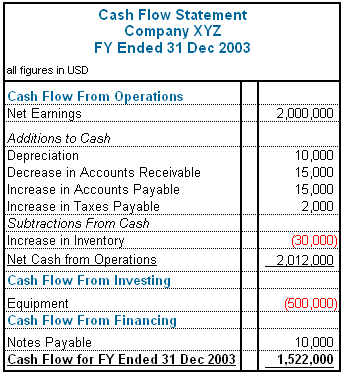
How to Make Money in Stocks Using Cash Flows
 There you are in front of your computer screen, and lo and behold you notice one of your top 10 positions is down -11% (let’s call it ticker: ABC). With sweaty palms and blood rushing from your head, you manage to click with trembling hands on the ticker symbol that will imminently deliver the dreadful news. A competitor (ticker: XYZ) just pre-announced negative quarterly earnings results, and an investment bank, Silverman Sax, has decided to downgrade ABC on fears of a negative spill-over effect. What do you do now? Sell immediately on the cockroach theory – seeing one piece of bad news may mean there are many more dreadful pieces of information lurking behind the scenes? Or, should you back up the truck to take advantage of a massive buying opportunity?
Thank goodness to our good friend, cash flow, which can help supply answers to these crucial questions. Without an ability to value the shares of stock, any decision to buy or sell will be purely based on gut-based emotions. Many Wall Street analysts follow this lemming based analysis when whipping around their ratings (see The Yuppie Bounce & the Lemming Leap). As I talk about in my book, How I Managed $20,000,000,000.00 by Age 32, I strongly believe successful investing requires a healthy balance between the art and the science. Using instinct to tap into critical experience acknowledges the importance of the artistic aspects of investing. Unfortunately, I know few (actually zero) investors that have successfully invested over the long-run by solely relying on their gut.
A winning investment strategy, I argue, includes a systematic, disciplined approach with objective quantitative measures to help guide decision making. For me, the science I depend on includes a substantial reliance on cash flow analysis (See Cash Flow Components Here). What I also like to call this tool is my cash register. Any business you look at will have cash coming into the register, and cash going out of it. Based on the capital needs, cash availability, and growth projects, money will furthermore be flowing in and out of the cash register. By studying these cash flow components, we gain a much clearer lens into the vitality of a business and can quickly identify the choke points.
ACCOUNTING GAMES
The other financial statements definitely shed additional light on the fitness of a company as well, but the income statement, in particular, is subject to a lot more potential manipulation. Since the management teams have more discretion in how GAAP (Generally Accepted Accounting Principles) is applied to the income statement, multiple levers can be pulled by the executives to make results look shinier than reality. For example, simply extending the useful life of an asset (e.g., a factory, building, computer, etc.) will have no impact on a company’s cash flow, yet it will instantaneously and magically raise a companies’ earnings out of thin air…voila!
“Stuffing the channel” is another manipulation strategy that can accelerate revenue recognition for a company. For example, let’s assume Company X ships goods to a distributor, Company Y, for the exclusive purpose of recognizing sales. Company X wins because they just increased their sales, Company Y wins because they have more inventory on hand (even if there is no immediate plan for the distributor to pay for that inventory), and the investor gets “hoodwinked” because they are presented artificially inflated sales and income results.
JOINT STRATEGY
These are but just a few examples of why it’s important to use the cash flow statement in conjunction with the income statement to get a truer picture of a company’s valuation and “quality of earnings.” If you don’t believe me, then check out the work done by reputable academics (Konan Chan, Narasimhan Jegadeesh, Louis Chan, and Josef Lakonishok) that show negative differentials between accounting earnings and cash flow are significantly predictive of future stock price performance (Read more).
So the next time a holding craters (or sky-rockets), take an accounting on the state of the company’s cash flows before making any rash decisions to buy or sell. By doing a thorough cash flow analysis, you’ll be well on your way to racking up gains into your cash register.
Wade W. Slome, CFA, CFP®
Plan. Invest. Prosper.
The Hidden Train Wreck – Professional Athlete Portfolios

Need capital for a floating furniture venture? How about an oxygen absorbing skin procedure? Well, if you are having any difficulty, just call an NFL, NBA, or MLB rookie. Even wealthy professional athletes have been impacted by the financial crisis, not to mention the aggressive sales tactics of the investment industry and the players’ poor money management skills. Many players are too busy concentrating on winning games, while their portfolios are suffering losses. The statistics are staggering. Here are the findings, according to an article published in Sports Illustrated earlier this year:
- “By the time they have been retired for two years, 78% of former NFL players have gone bankrupt or are under financial stress because of joblessness or divorce.”
- “Within five years of retirement, an estimated 60% of former NBA players are broke.”
- The divorce rate for pro athletes ranges from 60% to 80%, based on estimates from athletes and agents.
- “According to the NFL Players Association, at least 78 players lost a total of more than $42 million between 1999 and 2002 because they trusted money to financial advisers with questionable backgrounds.”
These are not old, dementia-suffering widows living in Florida we are talking about, but rather professional athletes, many of which made multi-million fortunes during their playing careers. The article goes out of its way to demonstrate this is not a fringe issue affecting a minority of professional athletes. Numerous examples were provided, including the following:
- Ten current and former Major League Baseball players, including outfielder Jonny Damon of the New York Yankees, had some of their money tied up in the alleged $8 billion fraud perpetrated by Robert Allen Stanford.
- Raghib (Rocket) Ismail lost a fortune by investing in excessively risky ventures, including a movie about music label COZ Records; a cosmetics procedure company; a nationwide phone-card dispensing venture; and a framed calligraphy company opened in New Orleans two months before Hurricane Katrina hit.
- Drew Bledsoe, Rick Mirer and five other NFL retirees each invested a minimum of $100,000 in a failed start-up, which touted “biometric authentication” technology that potentially could replace credit cards with fingerprints. The players eventually sued UBS (the financial-services firm) for allegedly withholding information about the company founder’s criminal history and drug use.
- Torii Hunter, outfielder for the Los Angeles, invested almost $70,000 in living-room furniture that included inflatable rafts – perfect for those consumers living in flood zones. Suffice it to say, the results did not meet initial expectations.
- In addition to his legal problems, NFL quarterback Michael Vick filed for Chapter 11 bankruptcy last year partly because he could not repay about $6 million in bank loans that he directed toward a car-rental franchise in Indiana, wine shop in Georgia and real estate in Canada.
- Retired NBA forward Vin Baker’s seafood restaurant in Old Saybrook, Connecticut, was foreclosed on in February 2008 due to nearly $900,000 in unpaid loans.
- “NBA guard Kenny Anderson filed for bankruptcy in October 2005. He detailed how the estimated $60 million he earned in the league had dwindled to nothing. He bought eight cars and rang up monthly expenses of $41,000, including outlays for child support, his mother’s mortgage and his own five-bedroom house in Beverly Hills, Calif.—not to mention $10,000 in what he dubbed “hanging-out money.” He also regularly handed out $3,000 to $5,000 to friends and relatives.”
- “Former NBA forward Shawn Kemp (who has at least seven children by six women) and, more recently, Travis Henry (nine by nine) have seen their fortunes sapped by monthly child-support payments in the tens of thousands of dollars.”
Besides irresponsible spending, and greedy advisors, contributing factors to all the losses are the “boring” and “unintelligible” nature of securities investments. Professional athletes like to flaunt investments like night clubs and car dealerships – there is a “thrill of tangibility,” according to SI writer Pablo Torre.
Professional athletes are not the only ones suffering losses. Ordinary investors have lost also and are learning it’s not what you make – rather it’s what you preserve and grow. The majority of the athletes do not realize their peak earnings years cover a very brief period, and therefore need to be more prudent with their money management since the windfall moneys must be spread over many years.
Trust is an important but difficult trait to find for many of these athletes since many opportunistic friends, acquaintances, and family members in many cases put their self interests ahead of the professional athlete’s needs. There is no simple formula for intelligent money management, however there are ways for athletes to protect their financial blind spots:
1) Educate Themselves. Learn the basics of what you are investing in. You may not learn the ins and outs but you can get a basic understanding of the expected return and volatility of your investments. Athletes often forget about diversification as well, “Chronic over-allocation into real estate and bad private equity is the number one problem [for athletes] in terms of a financial meltdown,” Ed Butowsky of Chapwood Investments says.
2) Trust But Verify. Ronald Reagan famously made those statements decades ago and the principle applies to money too. Many athletes pay tens of thousands of dollars for investment advice, so asking questions is advisable. Specifically, ask how performance is trending versus comparable benchmarks and get a view over multiple time periods.
3) Avoid Friends and Family. If possible, separating business from friends and family is a wise idea. When emotions mix with money, harmful decisions can damage the athlete’s financial future.
4) Determine Fees & Commissions. When investing hundreds of thousands, if not millions of dollars, fees and commissions can be substantial; therefore it is imperative for the athletes to know what they are paying their advisors.
5) Experience Matters. Check out the background of your advisor and determine the licenses and credentials they hold. If you were flying a plane in a heavy storm, you would want an experienced pilot flying the plane, not a flight attendant.
6) Budget. Establish an investment plan with a sustainable lifestyle that accounts for inflation. As veteran agent Bill Duffy says, whose clients include Suns guard Steve Nash and Nuggets forward Carmelo Anthony, “A pro athlete’s money is supposed to outlive his career. Most players never get that.”
Athletes spend their whole lives trying to make the professional ranks in order to earn the big bucks. Due to their high profile status, financial advisors and trusted individuals prey on the sports figures’ wealth. Unfortunately a majority of the athletes lack the money management skills and discipline to preserve and grow their earned wealth. Perhaps repeatedly shining a light on the dirty under-belly of this tragic problem will prevent future financial train wrecks from occurring. Until then, I guess we’ll just have to sift though the bankrupt remains of inflatable sofa raft companies and liquidation proceeds from failed night clubs.
Read the Complete Sports Illustrated Article Here
Wade W. Slome, CFA, CFP®
Plan. Invest. Prosper.
Walking on Egg Shells

The recent stock market rally has investors walking on egg shells. “Nervous Nelly” investors panicked on the way down last year, and now they are fearful and skeptical about the sustainability of the fierce six-month rally. The S&P 500 is up about 60% from the latest bear market lows, but I think the recent New Jersey Business News (NJBN) article captures the investor sentiment perfectly, “I’m scared, I’m scared, I’m scared,” investor Dania Leon said. “Why are we up, especially with unemployment as high as it is? I don’t feel great because I worry that we could have a 500- or 600-point drop in a day and I won’t be quick enough to pull out of it in time.”
Will investors ever be comfortable? Well yes, of course, exactly at the right time to sell. Calm and complacency will most likely settle in once the economic headlines are on a clear path to recovery. At that point, the market, like a game of chess, will likely have already anticipated the recovery.
Until then, the whipsaw syndrome seems to have taken effect on investors. The NJBN article goes onto expand on investors’ emotional scars:
“They’ve been traumatized twice,” said Michal Strahilevitz, a business professor at Golden Gate University who studies the psychology of individual investors. “First they lost a lot and got out. And now they’ve watched it climb up. It’s a lot of regret, and for people who are investing for their family, it’s a lot of guilt.”
Trillions of low yielding cash continues to sit on the sidelines, waiting for the inevitable 10% “pullback.” Strategist Laszlo Birinyi sees little evidence for an imminent correction, “Give me the evidence…in 1982 we went 424 days before we had a correction. In 2000, we went seven years before we had a 10% correction. In 2002, we went three or four years.” (For more on Mr. Birinyi, see http://is.gd/3xS5u)
At the end of the day, as great growth investor Peter Lynch said, it’s the direction of corporate earnings that will ultimately drive the market higher or lower. “People may bet on hourly wiggles of the market but it’s the earnings that waggle the wiggle long term.” Right now based on the strength of the rally, the market is telling us that third quarter corporate earnings should come in better than analyst expectations. Perhaps we get a yawner response (sell on the news reaction), or if improvement outright stalls, perhaps we will get the mother of all expected corrections?
All these mind games make for an extremely tiresome investing mental tug-of-war. I choose not to get caught up in this game of market timing, but rather I choose to let the investment opportunity-set drive my investment decisions. I have taken some chips off the table during this rebound but I am still finding plenty of other fertile opportunities to redeploy capital. As others nervously walk on egg shells, I opt to clean up the mess and look for a clearer investment path.
Read the Full NJBN Article Here
Wade W. Slome, CFA, CFP®
Plan. Invest. Prosper.
Metamorphosis of a Bear into Bull

Picture Source: The Wall Street Journal (Mick Coulas)
James Grant, a self-admitted, “glass half-full kind of fellow,” recently contributed a Wall Street Journal article predicting the economic recovery will be a “bit of a barn burner.” Traditionally a pessimist, he recently experienced the metamorphosis from a bear to a bull. James Grant is a multi-book author who has written for the Interest Rate Observer for more than 25 years with thoughtful observations on economics and interest rates. With a value-tilted investment philosophy, Mr. Grant prides himself as a contrarian and anti-CNBC advocate.
Current Environment
Markets have transitioned from sheer panic (what Grant calls the “bomb shelter”) to a manageable utter fear – meaning a lot of investors still have cash stuffed under the mattress in low yielding money market and CD (Certificates of Deposit) accounts. This bed cash will ultimately act as dry powder to ignite the market higher, should earnings and macroeconomic variables continue to improve. Despite the approximate 60% index bounce from the March 2009 lows, the S&P 500 still remains more than 30% below the late 2007 highs.
Glass Half Empty Crowd
Skeptics of the market advance generally fall into one of the following buckets:
1) Armageddon is coming, just wait. Our country is choking on too much debt.
2) The stock market advance is merely a bear market rally within a secular bear market.
3) Rally fueled by temporary stimulus, which once it dries up will lead to another recession and bear market.
4) Earnings results that are coming in better than expected are merely coming from unsustainable cost-cutting.
Grant’s Rose-Colored Glasses
James Grant has a different view of the unfolding recovery in light of historical cycle patterns:
“Growth snapped back following the depressions of 1893-94, 1907-08, 1920-21 and 1929-33. If ugly downturns made for torpid recoveries, as today’s economists suggest, the economic history of this country would have to be rewritten.”
Consistent with Mr. Grant’s views, Michael T. Darda, chief economist of MKM Partners stated “The most important determinant of the strength of an economy recovery is the depth of the downturn that preceded it. There are no exceptions to this rule, including the 1929-1939 period.” Grant goes on to compare the current recession with the 1981-82 variety:
“[During] the first three months of 1982, real GDP shrank at an annual rate of 6.4%, matching the steepest drop of the current recession, which was registered in the first quarter of 2009. Yet the Reagan recovery, starting in the first quarter of 1983, rushed along at quarterly growth rates (expressed as annual rates of change) over the next six quarters of 5.1%, 9.3%, 8.1%, 8.5%, 8.0% and 7.1%. Not until the third quarter of 1984 did real quarterly GDP growth drop below 5%.”
Further support for a stronger than anticipated recovery is provided via data supplied by the Economic Cycle Research Institute:
“The institute’s long leading index of the U.S. economy, along with supporting sub-indices, are making 26-year highs and point to the strongest bounce-back since 1983. A second nonconformist, the previously cited Mr. Darda, notes that the last time a recession ravaged the labor market as badly as this one has, the years were 1957-58 —after which, payrolls climbed by a hefty 4.5% in the first year of an ensuing 24-month expansion.”
Mr. Grant does not promise as large a recovery implied by Mr. Darda, but historical standards point in that direction, especially when you factor in vast pools of cash and cautious prognosticators and economists such as Ben Bernanke, Warren Buffett, and Paul Volcker. These financial “giants” have not deterred Mr. Grant’s metamorphosis from a bear to a bull.
Click Here to Read Full Grant WSJ Article
Wade W. Slome, CFA, CFP®
Plan. Invest. Prosper.
DISCLOSURE: Sidoxia Capital Management (SCM) and some of its clients own certain exchange traded funds, and at the time of publishing had no direct positions in BRKA/B. No information accessed through the Investing Caffeine (IC) website constitutes investment, financial, legal, tax or other advice nor is to be relied on in making an investment or other decision. Please read disclosure language on IC “Contact” page.




 Investing Caffeine