Margin Surplus Retake

Like a B-rated horror movie using the same old cliques (i.e., girl home alone with serial killer on the loose or a concealed intruder hidden in the back seat of a car), one of the financial cliques that persists today is the belief that the United States trade deficit will result in financial ruin for our economy. The recent widening of the trade deficit to $40.3 billion makes this economic issue a topical discussion. Enter Andy Kessler, former hedge fund manager and author of Running Money. He believes the stale, exploding trade deficit arguments are hogwash, primarily due to his “margin surplus” theory articulated in his book and Wall Street Journal article entitled, We Think, They Sweat.
Profiting from Trade Deficits
The absolute numbers used by Kessler in his Toshiba laptop example might have changed since his book was first published in 2004, but this margin surplus theory example is just as relevant today as it was back then. Here is an excerpt from his book:
“Let’s open up that Toshiba laptop. With a $300 Intel chip (which has at least $250 in profit for Intel) and a $50 Windows license ($49.95 margin to Microsoft), the laptop is then sold by Toshiba back into the U.S. for $1,000. Toshiba and every other supplier are lucky if they make $50 profit, combined, on the deal.”
In this illustration, government statistics would recognize a $1,000 contribution to our bloating trade deficit figures, even though nearly 90% of the laptop profits would be flowing (“surplus-ing”) back to the U.S. Hmmm, maybe this trade deficit thing isn’t as evil as it is portrayed in the popular media, or perhaps we are measuring it incorrectly? Kessler makes the case that Gross Domestic Product (GDP) is not the most important economic gauge, but rather the real crucial GDP metric is actually Gross Domestic PROFIT. He adds the best indicator for economic profits is the stock market, and as foreigners seek more productive returns on their cash beyond the 3% Treasury yields, they will eventually filter back their dollar currency reserves into stocks and other more productive asset classes.
Brain Driven Economy
You don’t have to be a brain surgeon to realize our roots as an industrial economy have shifted to an intellectual property economy. So while we may be exporting low-skilled labor jobs to China and other low-cost regions, our country is also creating higher-skilled, higher-paying jobs at innovative growing companies such as Google Inc. (GOOG) and Apple Inc. (AAPL). Case in point, flip an Apple iPod over and read the fine print on the back – it reads, “Assembled in China…Designed by Apple in California.” Once again, the commoditized aspects of slapping together a widget have been outsourced to workers in far-off lands for a small fraction of what American workers earn. If improving the standard of living is our goal, then transferring low paying jobs to foreigners should not be a concern. According to Kessler, $70 in iPod profits (versus $4 for the Chinese assemblers) from this unique, differentiated device has generated millions in profits, which in turn can be used for the creation of desirable, high-paying jobs here in the U.S.
Selling the Farm
Warren Buffets has a different view about our trade deficits and the directional value of the U.S. dollar. He perceives our economy as a fixed size farm that is selling $2 billion pieces of the farm to foreigners on a daily basis. Buffet adds:
“We’re like a very rich family; we own a farm the size of Texas but want to consume more. If you force-feed $2 billion a day to the rest of the world, they get somewhat less enthusiastic over time – and the dollar is worth less.”
Over time, Buffett believes future generations will resent paying for the gluttony of consumption by prior generations and foreigners will demand a higher interest rate for their loans. What I believe Buffet fails to consider is that the farm is not static. As we sell off $2 billion chunks of the farm, portions of those proceeds are being used to adjoin additions, buy new farms, build adjacent wind turbines, and/or incorporate other productive uses. Now if the proceeds were used to solely purchase bon-bons and doughnuts, then indeed we would be in trouble. Ultimately, the financial markets will be the true arbiter of how efficiently the foreign capital is being invested and will dictate the level of rates paid on the loans. From a pure cash management standpoint, stretching out payables (net imports) is a sound practice (i.e., it’s desirable to collect early and pay late).
The flip side of the argument explains how the farm sale proceeds from our asset sales to foreigners (such as our real estate, our Treasuries, and our stocks) can be employed in a productive manner. The Buffett argument states that our farm will eventually be completely sold to foreigners or they will hold a gun to our head asking for higher interest rates to fund our deficits. The problem with that argument is that the money received from the farm sales (Treasuries, stocks, real estate, etc.) can be (and is) used to build new farms. And that is the key question…are all these deficit building dollars being used to create new, innovative, job creating companies like Google and Apple, or are these dollars being redeployed into unproductive uses (e.g., worthless t-shirts and lead-filled toys from China, or funding of bailouts and cash-for-clunkers waste) ?
At the end of the day, money goes where it is treated best – meaning global capital seeks the royal treatment in markets where profits reign supreme. So rather than relying on rusty, obsolete statistics measuring the balance of trade (i.e., trade deficits and GDP), investors would be better served by taking a page from Andy Kessler’s book. Following the principles of “margin surplus” will increase the probabilities of profiting from global capital flows.
Wade W. Slome, CFA, CFP®
Plan. Invest. Prosper.
*DISCLOSURE: Sidoxia Capital Management (SCM) and some of its clients own certain exchange traded funds, Treasury securities, GOOG, and AAPL, but at the time of publishing SCM had no direct positions in Toshiba, INTC, BRKA/B or any other security referenced in this article. No information accessed through the Investing Caffeine (IC) website constitutes investment, financial, legal, tax or other advice nor is to be relied on in making an investment or other decision. Please read disclosure language on IC “Contact” page.
Microchip: Selling Electronic Cake Mix to the World

Microchip Technology Inc. (MCHP) is not in the business of selling cakes. Rather, Microchip is more akin to a chef selling cake mix in the form of microcontrollers to hungry designers with a sweet tooth. All that the customers need to do is add some water to the mix, and voila they have all the ingredients necessary to make a cake.
Endless Opportunities
Making a cake may sound simple, but the real magic comes as a result of the baking chef exploring the endless possibilities across colors, flavors, sizes, frostings, and accessories. The microcontroller business is similar in many respects. Microchip provides the essential tools (ingredients) to efficiently and cost-effectively build solutions for an almost infinite number of applications. Microcontrollers can be found in a diverse mix of products and gizmos, ranging in size from an iPod Nano (AAPL) and Tickle Me Elmo toy to a Whirlpool (WHR) washing machine and a butt-warming car seat in a Porsche 911 Turbo. From a verticals standpoint, Microchip services more than 60,000 customers globally (75% of revenues internationally) in the automotive, aerospace, communications, computing, consumer, and industrial control markets, among others.
What the Heck is a Microcontroller?
You can think of a microcontroller as a computer-on-a-chip, and these mini-computers, which are embedded into all types of applications, allow designers to create all types of products. The low-cost computer chips handle simple functions such as turning products on and off and setting speeds in consumer products, cars, telecommunications and office equipment. More specifically, these microcontrollers provide designers with the ability to introduce or expand functionality, reduce power consumption, and create further efficient designs, thereby potentially leading to lower costs and higher profits. Even though talking about the digital world of 1’s and 0’s sounds sexy, in the real world we are surrounded by analog factors like time, temperature, sound, music, and video – analog functions that require the heavy lifting of a microcontroller to process digital data after it has been converted from analog.
These microcontrollers aren’t multi-hundred dollar microprocessors manufactured in multi-billion fabrication facilities at Intel Corp. (INTC) – rather these more mundane (although essential) components sell often for a few bucks each. What’s more, the pricing in microcontroller and analog land is more stable at Microchip relative to the annual -20-30% price cuts common in the microprocessor world.
On top of performance (speed, power, heat, etc.) and cost, ease of design is a way Microchip gains market share away from competitors through its PIC architecture – the software platform that designers program Microchip’s microcontrollers. The company devotes extensive resources to spreading the PIC gospel to designers around the world and Microchip engineers are constantly upgrading the programming software. To date, Microchip has almost shipped 1,000,000 development tools to designers and developers. The software and design kits add to the company’s revenues, but the real profitability kicks in when the customers reorder chips related to multiyear product life cycles. For example, you can think of a television company that must order a microcontroller for a five-year old, broken TV remote control that a child stepped on…hmm, sounds familiar.
Expanding Pie (or Cake)
This is no puny market; the overall microcontroller segment of the semiconductor market is estimated to have generated $10.7 billion in sales during 2009. Microchip has managed to not only become the 800 pound gorilla in the 8-bit microcontroller space, but in recent years they have also made significant headroom in the higher functionality/performance markets of 16-bit and 32-bit microcontrollers. In total, Microchip offers its customers more than 650 flavors of its microcontroller products.
One would think the company is busy enough with its core microcontroller business, but Microchip is not sitting on its hands. They are employing a Velcro strategy by attaching other embedded features on its “computer-on-a-chip,” including analog, memory, DSP (digital signal processing), and other capabilities. Already, Microchip’s analog business has grown to more than 10% of the company’s revenues (about 600 analog products and > 14,000 customers), and Microchip’s foray into the digital signal controller sector (dsPIC product family) is expanding the company’s total addressable market as well. Consistent with this Velcro strategy, Microchip recently purchased Silicon Storage Technology Inc. (SST) for $354 million, focusing on SST’s high margin flash memory licensing business. Thanks to shrewd negotiating and jettisoning of non-core SST segments, the deal will solidify Microchip’s embedded solution positioning and is expected to add $.14 – $.18 cents to Microchip’s 2011 earnings per share (EPS).
The Head Chef
The head chef of the technology kitchen is Steve Sanghi, and in 1990 (after 10 years of employment at Intel Corp.), when he took over as President of Microchip, the kitchen was a complete mess. Not only was the company losing money, but they were spread too thin across disparate technologies. His accomplishments were recognized immediately and Sanghi became CEO shortly thereafter in 1991. Microchip, which was originally founded in 1989 as a spinoff from General Instrument, eventually went public in 1993. Despite a tough technology market post the technology crash of 2000, Microchip has managed to gain market share from struggling competitors like Atmel Corp. (ATML). Under Sanghi’s leadership, Microchip has more than doubled profits over the last decade and sales have almost multiplied 12-fold to $950 million since the company went public 17 years ago.
Cash Machine
Besides pumping out microcontrollers, Microchip pumps out a lot of cash as well. In their recently completed fiscal year (ending in March), the company generated close to $400 million in free cash flow (cash from operations minus capital expenditures), by my definition. With a market capitalization of around $5 billion this relationship implies an almost 8% free cash flow yield – a bit nicer than the 3.17% yield recently offered on the federal government’s 10-year Treasury Note. Microchip’s cash metrics look even that much more impressive when you consider the company has more than $1.1 billion in net cash piled up on the balance sheet. Since the capital intensity of the microcontroller and analog businesses is so much less demanding than the microprocessor world, Microchip has plenty of flexibility in paying a nice, big fat, 5%+ dividend (about $1.37 per share annually), which has increased modestly in each of the last three quarters. On a Price-Earnings basis (P/E), Microchip’s share price is currently trading at an attractive 13 x’s the company’s $2.11 consensus Earnings-Per-Share (EPS) estimate.
Risks
Microchip is not a risk-free Treasury investment and the company faces significant cyclical sensitivity to global macroeconomic trends, as we saw in fiscal 2009 (ending March). The pace of global design activity will generally be responsive to overall business confidence. In spite of Microchip’s dominance in the 8-bit market, some skeptics also question Microchip’s ability to gain market share in the 16-bit and 32-bit markets.
In addition to those concerns, another hazard relates to the company overpaying for future, potential acquisitions. Traditionally Microchip has focused on internal growth, however in recent years the company’s appetite for acquisitions has increased – most notably the failed merger of Atmel Corporation for roughly $2.3 billion in early 2009. If history serves as a guide, Microchip has been prudent in acquisitions – for example, the timely $183 million purchase of Gresham, Oregon manufacturing plant in 2002 for cents on the dollar or the recent opportunistic and accretive SST deal.
Momentum and Visibility Improving
With the global upturn occurring, Microchip has seen a +189% increase in its backlog (orders in hand for future delivery) to $528 million. Having these orders in hand allows Microchip to plan and invest more appropriately for growth in the coming year. Fourth quarter sales (without SST’s contribution) increased by more than +60% from last year and Non-GAAP earnings mushroomed by more than +200% on a year-over-year basis.
The ease and affordability of new product design will be an accelerating trend of new product proliferation. As I wrote in an earlier article (Revenge of David), the simplicity of design has become dramatically easier. A laptop and internet connection affords any designer the ability of downloading free design software, building a prototype with a 3-D printer, ordering Chinese manufacturing services through Taobao.com (parent Alibaba Group), and waiting for UPS to deliver the product to their doorstep in fairly short order. This design tailwind only serves to increase demand for Microchip’s microcontroller solutions over time.
Ever since the company’s IPO (Initial Public Offering), Microchip has had a phenomenal track record of success led by Steve Sanghi’s direction. Microchip is a much more mature company since going public in 1993 at a stock price of $0.57 per share (split-adjusted), but if the stock price can appreciate a fraction of the +4,623% already achieved, then my clients and I should be able to purchase a lot of cake mix.
Wade W. Slome, CFA, CFP®
Plan. Invest. Prosper.
*DISCLOSURE: Sidoxia Capital Management (SCM) and some of its clients own certain exchange traded funds, MCHP, AAPL, and Treasury securities, but at the time of publishing SCM had no direct positions in WHR, Porsche, Volkswagen, INTC, ATML, SST, UPS, General Instrument, or any other security referenced in this article. No information accessed through the Investing Caffeine (IC) website constitutes investment, financial, legal, tax or other advice nor is to be relied on in making an investment or other decision. Please read disclosure language on IC “Contact” page.
The Annuity Trap

Like the infamous Roach Motel, annuities allow investors to check-in while making it very difficult to check out. In many instances, getting out of annuities can be cost prohibitive (fees, charges, commissions, expenses, etc.), even if escaping these fee-laden products is in the investors’ best financial interest.
In an article dated April 13th, 2010, Jay Peroni warned others by outlining a typical annuity fee structure as follows:
- Mortality and Expense Charge 1.50%
- Sub Account Management Fees 1.00%
- Unreported trading costs 0.78%
- Annual Administrative Expenses 0.15%
TOTAL ANNUAL EXPENSES 3.43%
What aren’t included in these numbers above are the surrender charges, which effectively can lock you into the annuity if you are averse to paying hefty surrender charges. Normally, the surrender charges vary from up to a 10% charge for large withdrawals in year one, decreasing to something like 1% in year 10. Worth noting, steep sales commissions can be layered on top of the previous charges or mysteriously embedded in the fee structure categories above.
The Big Sell

Driving the push for these 3%+ annual fees are lucrative financial institutions hiring aggressive salespeople. Typically annuities are sold under the guise of safe tax shelter investments. What the broker won’t tell you is that only a fraction (“exclusion ratio”) of the annuity payments is shielded from taxes, and the rest of the payments are taxed at the higher, unfavorable ordinary income tax rate (relative to qualified dividends and capital gains from other securities). Much of the time, many of the salespeople, who call themselves “financial advisors,” know little about these complex annuity products (see Financial Sharks article). What these brokers do understand are the big, fat commissions they stand to collect upon fleecing unsuspecting investors.
Scores of these so-called advisors are actually “registered representatives” who do not carry a fiduciary duty (meaning they are NOT required to make investment decisions in the best interest of their clients). Certainly, there are some situations where annuities might be appropriate, but from my experience there are very few cases where the egregious charges and expenses outweigh the benefits. I believe the vast majority of brokers/registered reps/salespeople are more concerned about padding their wallets than building and protecting client portfolios.
The Alternatives
If safety and tax advantages are features you are looking for then I encourage you to look at more efficient options such as the following:
- 401k Defined Contribution Retirement Plan (or other “Qualified Plan”): Allows you to achieve tax deferral often with free money given to you in the form of a match to your contributions.
- IRA (Individual Retirement Account): Whether you consider a traditional or Roth IRA, there are tax deferral advantages with lower fees.
- Low Turnover, High Dividend Portfolios: Using a tax efficient management strategy with better tax treatment of income is another approach that I firmly believe will outperform most annuities.
- Tax-Exempt Muni Bonds or Corporates: The tax-exempt status of municipal bonds affords investors a tax advantaged status. The after-tax yield on corporate bonds can be compared to the returns promised on annuities (AFTER all fees, charges, and commissions). Holding individual bonds until maturity can help avoid interest rate risk.
- Ladder Zero Coupon Bonds: If safe fixed payments are what you are looking for, then staggered purchases of zero coupon bonds can be purchased as well.
These are only a few options that could and should be considered when reviewing your personal objectives and circumstances. With regard to the insurance component of an annuity contract, there are more cost effective ways of paying for insurance – most notably, term insurance.
At the end of the day, no matter the financial product, it is important you understand the underlying fees charged on any strategy, along with how the person selling you stuff is compensated. If you don’t do your homework on these extremely complex products (many not regulated by the NASD or SEC), then you may find yourself checking into the annuity hotel, but unable to check out.
Wade W. Slome, CFA, CFP®
Plan. Invest. Prosper.
*DISCLOSURE: Sidoxia Capital Management (SCM) and some of its clients own certain exchange traded funds, but at the time of publishing SCM had no direct positions in any other security referenced in this article. No information accessed through the Investing Caffeine (IC) website constitutes investment, financial, legal, tax or other advice nor is to be relied on in making an investment or other decision. Please read disclosure language on IC “Contact” page.
Blowing the Perfect Investment Game

Photo source: Boston.com
Armando Galarraga, pitcher from the Detroit Tigers baseball team, became a victim of a blown call by umpire Jim Joyce, resulting in a lifetime opportunity being ripped from his clutches. Not only did the error in judgment cost Galarraga a perfect game – a feat only achieved by 20 pitchers over the last 130 years – but the blunder also cost him a no-hitter. Perfect games are difficult to come by in the investment world too, but for those ambitious investors reaching for the finance Hall of Fame, I strongly believe a healthy dosage of international and emerging markets is required to achieve perfection (or significant outperformance).
The Fab Five
The oft quoted view that the U.S. was the dominant economic powerhouse in the 20th century (after Britain controlled the 19th century) led me to analyze five emerging growth markets outside of the U.S. There are some clear leaders in pursuit of 21st century economic supremacy, however nothing in the global pecking order is guaranteed. What I do know is that me and my clients will be relying on the financial tailwinds of growth coming from these international markets to provide excess return potential to my portfolios (albeit at the cost of shorter-term volatility). Even retired individuals, or those with shorter time horizons, should consider small bite sizes of these emerging markets in their portfolios, if merely for some of the diversification benefits (see diversification article).
Pundits and media types endlessly write and talk about the “lost decade,” the demise of “buy and hold,” and/or the “death of equities.” Well, as you can see, the lost decade through the first half of 2010 turned out to be a significantly lucrative period for investors with the stomach and courage to invest outside the familiar comfort zone of the United States (see chart below).
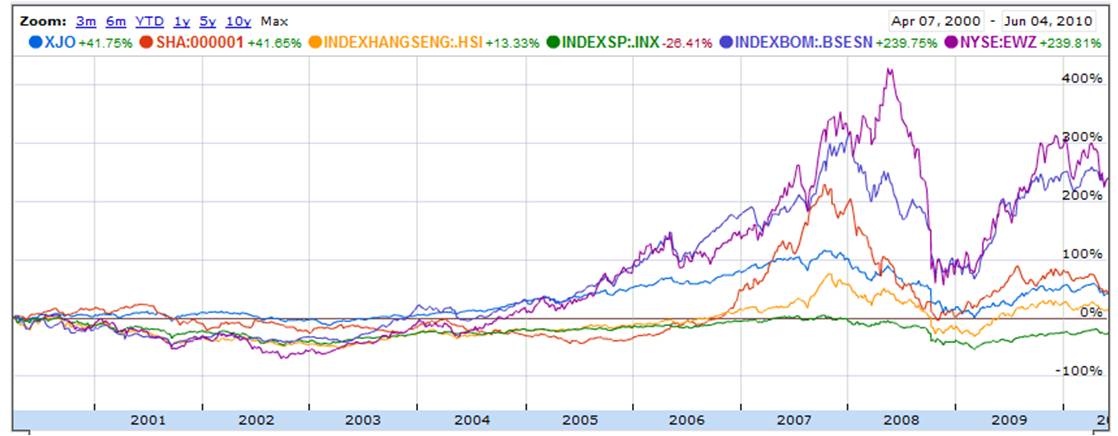
Specifically, here is the international outperformance achieved in the sample of international markets as compared to the United States (S&P 500 Index):
- Brazil +266.22% (EWZ tracking Bovespa Index)
- India +266.16% (Bombay Stock Exchange – BSE)
- Australia +68.16% (ASX 200 Index)
- China +68.06% (Shanghai Index)
- Hong Kong +39.74% (Hang Seng Index)
- United States -128.19% Average Underperformance versus five other geographic indexes.
An added kicker for investment consideration is valuation. According to The Financial Times market data section, all these international markets, with the exception of India, trade at a discount to the S&P 500 on a Price/Earnings ratio basis (P/E).
Victim of Our Own Success
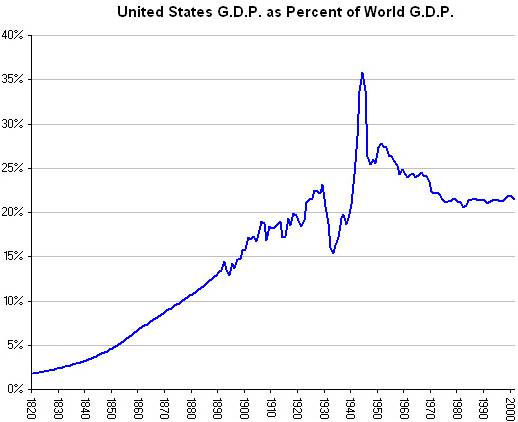
Graph source: The New York Times
In many respects, our country has continued to thrive in spite of some of our political and economic shortcomings. As you can see from the chart below (NY Times article) our country’s market share of the world’s Gross Domestic Product (GDP) has been steadily been declining since World War II (and we’ve still done OK). With U.S. GDP exceeding $14 trillion, our sheer size makes it much more difficult to grow relative to our smaller, more nimble international brethren. Given our top economic position in the world, Warren Buffett succinctly identified the force working against size when he said, “Gravity always wins.” I would expect gravitational influences to continue to weigh us down in the future, but our declining share should not be considered a detrimental trend. Globalization needs to be embraced by policymakers so we can take advantage of these faster growing countries as opportunistic export markets. We Americans can improve our standard of living while riding the coattails of our speedy neighbors. Do yourself a favor and include a healthy chunk of higher growth markets into your portfolio – it’s important you do not blow your own investment game.
Wade W. Slome, CFA, CFP®
Plan. Invest. Prosper.
*DISCLOSURE: Sidoxia Capital Management (SCM) and some of its clients own certain exchange traded funds (including BKF, FXI, EWZ), but at the time of publishing SCM had no direct positions in any other security referenced in this article. No information accessed through the Investing Caffeine (IC) website constitutes investment, financial, legal, tax or other advice nor is to be relied on in making an investment or other decision. Please read disclosure language on IC “Contact” page.
Happy Birthday Investing Caffeine!

Three hundred sixty-seven days ago Investing Caffeine launched an ambitious drive to share the important truths about investing, financial markets, and personal finances (among other subjects). After a year, some 225 articles, and over 50,000 hits, the site continues to gain momentum and I look forward to offering a unique perspective to thousands of more readers in 2010 and beyond.
Over the last twelve months, here are some of the most heavily trafficked postings along with a few of my favorites (CLICK AWAY!):
Investing Legends
- Peter Lynch: Inside the Brain of an Investing Genius
- Phil Fisher: Standing on the Shoulders of a Growth Giant
- Doug Kass: Kass Attempts the “Triple Lindy”
Dubious Declarers
- Peter Schiff: The Emperor Schiff Has No Clothes
- Meredith Whitney: Meredith Whitney’s Cloudy Crystal Ball
- Glenn Beck: Stewart Makes Skewered Beck-Kebabs
History Revisited
- Back to the Future Magazine Covers, Part II, Part III
- History Never Repeats Itself, But It Often Rhymes
- Can the Lost Decade Strike Twice?
Investment Trends/Themes
- Stock Market Nirvana: Butter in Bangladesh
- High Frequency Trading: Buggy Whip Déjà vu
- TMI: The Age of Information Overload
It’s Your Money…Invest Wisely
- Beating off the Financial Sharks
- Super Sizing May Be Hazardous to Your Portfolio’s Health
- The Hidden Train Wreck – Professional Athlete Portfolios
Investment Lessons
- Lessons Learned from Financial Crisis Management 101
- Getting off the Market Timing Treadmill
- Compounding: A Penny Saved is Billions Earned
Government Gossip
- Debt: The New Four-Letter Word
- Plucking the Feathers of Taxpaying Geese
- Healthcare Reform: The Brutal Reality of Aging Demographics
Investment Trends/Themes
- Jumping on the Globalization Train
- Technology Does Not Sleep in a Recession
- Social Media Revolution Taking Over World
Stock Talk
- NVEC: Profiting from Electronic Eyes, Nerves & Brains
- Amazon: Growing Up to be Wal-Mart
- From Pooches to Profits
The last year has been a complete blast and hopefully you’ve enjoyed parts of the ride. Stay tuned for more eclectic articles in the days, weeks, and months to come.
Wade W. Slome, CFA, CFP®
Plan. Invest. Prosper.
*DISCLOSURE: Sidoxia Capital Management (SCM) and some of its clients own certain exchange traded funds. Read disclosures provided in article links provided in above posting. No information accessed through the Investing Caffeine (IC) website constitutes investment, financial, legal, tax or other advice nor is to be relied on in making an investment or other decision. Please read disclosure language on IC “Contact” page.
Gravity Takes Hold in May

Warner Bros. picture of Wile E. Coyote’s failed apprehension of Roadrunner
Wile E. Coyote, the bumbling, roadrunner-loving carnivore from Warner Bros.’ Looney Tunes series spends a lot of time in the air chasing his fine feathered prey. Unfortunately for Mr. Coyote his genetic make-up and Acme purchases could not cure the ills caused by gravity (although user error was the downfall of Wile E’s effective Bat-Man flying outfit purchase). Just as gravity hampered the coyote’s short-term objectives, so too has gravity hampered the equity markets’ performance this May.
So far the adage of “Sell in May and walk away” has been the correct course of action. Just one day prior to the end of the month, the Dow Jones Industrial and S&P 500 indexes were on pace of recording the worst May decline in almost 50 years. If the -6.8% monthly decline in the S&P and the -7.8% drop in the S&P remains in place through the end of the month, these declines would mark the worst performance in a May month since 1962.
Should we be surprised by the pace and degree of the recent correction? Flash crash and Greece worries aside, any time a market increases +70-80% within a year, investors should not be caught off guard by a subsequent 10%+ correction. In fact corrections are a healthy byproduct of rapid advances. Repeated boom-bust cycles are not market characteristics most investors crave.
It was a volatile, choppy month of trading for the month as measured by the Volatility Index (VIX). The fear gauge more than doubled to a short-run peak of around 46, up from a monthly low close of about a reading of 20, before settling into the high 20s at last close. Digesting Greek sovereign debt issues, an impending Chinese real estate bubble bursting, budget deficits, government debt, and financial regulatory reform will determine if elevated volatility will persist. Improving macroeconomic indicators coupled with reasonable valuations appear to be factoring in a great deal of these concerns, however I would not be surprised if this schizophrenic trading will persist until we gain certainty on the midterm elections. As Wile E. Coyote has learned from his roadrunner chasing days, gravity can be painful – just as investors realized gravity in the equity markets can hurt too. All the more reason to cushion the blow to your portfolio through the use of diversification in your portfolio (read Seesawing Through Chaos article).
Happy long weekend!
Wade W. Slome, CFA, CFP®
Plan. Invest. Prosper.
*DISCLOSURE: Sidoxia Capital Management (SCM) and some of its clients own certain exchange traded funds, but at the time of publishing SCM had no direct positions in TWX, VXX, or any other security referenced in this article. No information accessed through the Investing Caffeine (IC) website constitutes investment, financial, legal, tax or other advice nor is to be relied on in making an investment or other decision. Please read disclosure language on IC “Contact” page.
Soros & Reflexivity: The Tail Wagging the Dog

Billionaire investor George Soros, who is also Chairman of Soros Fund Management and author of The Crash of 2008¸ is well known for his theory on reflexivity, which broadly covers political, social, financial, and economic systems. Soros built upon this concept (see also Soros Super Bubble), which was influenced by philosopher Karl Popper. With all the fear and greed rippling through global geographies as diverse as Iceland, California, Dubai, and Greece, now is an ideal time to visit Soros’s famous reflexivity theory, which may allow us to put the recent chaos in context. With the recent swoon in the market, despite domestic indicators trending positively, a fair question to ask is whether the dog is wagging the tail or the tail wagging the dog?
The Definition of Reflexivity
Simply stated, reflexivity can be explained as the circular relationship that exists between cause and effect. Modern financial theory teaches you these lessons: 1) Financial markets are efficient; 2) Information flows freely; 3) Investors make rational decisions; and 4) Markets eventually migrate towards equilibrium. Reflexivity challenges these premises with the claims that people make irrational and biased decisions with incomplete information, while the markets trend toward disequilibrium, evidenced by repeated boom and bust cycles.
Let’s use the housing market as an example of reflexivity. By looking at the housing bubble in the U.S., we can shed some light on the theory of reflexivity. Americans initial buying love affair with homes pushed prices of houses up, which led to higher valuations of loans on the books of banks, which allowed the banks to lend more money to buyers, which meant more home buying and pushed prices up even higher. To make matters worse, even the government joined the game by adding incentives for people who could not afford homes. As you can see, the actions and decisions of an observer can have a direct impact on other observers and the system itself, thereby creating a spiraling upward (or downward) effect.
Now What?
Now, the reflexivity tail that is wagging the dog is Europe…specifically Greece. The bear case goes as follows: the Greek financial crisis will brew into a stinky contagion, eventually spreading to Spain and Italy, thus hammering shut a U.S. export market. The double dip recession in the U.S. will not only exacerbate the pricking of the Chinese real estate bubble, but also topple all other global economies into ruin.
Certainly, the excessive sovereign debt levels across the globe have grown like cancer. Fortunately, we have identified the problem and politicians are being forced by voters to address the fiscal problems. More importantly, capital flows are an unbiased arbiter of economic policies. Over time – not in the short-run necessarily – capital will move to where it is treated best. Meaning those countries that harness responsible debt loads, institute pro-business growth policies, remove unsustainable and insolvent entitlements, and incentivize education and innovation will be the countries that earn the honor of holding their fair share of vital capital. If the politicians don’t make the correct decisions, the hemorrhaging of capital to foreigners and the painfully high unemployment levels will force Washington into making the tough but right decisions (usually in the middle of a crisis).
Reflexivity, as it pertains to financial markets, has been a concept the 79 year old George Soros has passionately espoused since his 1987 book, The Alchemy of Finance. Perhaps a better understanding of reflexivity will help us better take advantage of the tail wagging disequilibriums experienced in the current financial markets. Time will tell how long this disequilibrium will last.
Wade W. Slome, CFA, CFP®
Plan. Invest. Prosper.
*DISCLOSURE: Sidoxia Capital Management (SCM) and some of its clients own certain exchange traded funds, but at the time of publishing SCM had no direct positions in any other security referenced in this article. No information accessed through the Investing Caffeine (IC) website constitutes investment, financial, legal, tax or other advice nor is to be relied on in making an investment or other decision. Please read disclosure language on IC “Contact” page.
Stocks…Bonds on Steroids

With all the spooky headlines in the news today, it’s no wonder everyone is piling into bonds. The Investment Company Institute (ICI), which tracks mutual fund data, showed -88% of the $14 billion in weekly outflows came from equity funds relative to bonds and hybrid securities. With the masses flocking to bonds, it’s no wonder yields are hovering near multi-decade historical lows. Stocks on the other hand are the Rodney Dangerfield (see Doug Kass’s Triple Lindy attempt) of the investment world – they get “no respect.” By flipping stock metrics upside down, we will explore how hated stocks can become the beloved on steroids, if viewed in the proper context.
Davis on Debt Discomfort
Chris Davis, head of the $65 billion in assets at the Davis Funds, believes like I do that navigating the “bubblicious” bond market will be a treacherous task in the coming years. Davis directly states, “The only real bubble in the world is bonds. When you look out over a 10-year period, people are going to get killed.” In the short-run, inflation is not a real worry, but it if you consider the exploding deficits coupled with the exceedingly low interest rates, bond investors are faced with a potential recipe for disaster. Propping up the value of the dollar due to sovereign debt concerns in Greece (and greater Europe) has contributed to lower Treasury rates too. There’s only one direction for interest rates to go, and that’s up. Since the direction of bond prices moves the opposite way of interest rates, mean reversion does not bode well for long-term bond holders.
Earnings Yield: The Winning Formula
Average investors are freaked out about the equity markets and are unknowingly underestimating the risk of bonds. Investors would be in a better frame of mind if they listened to Chris Davis. In comparing stocks and bonds, Davis says, “If people got their statement and looked at the dividend yield and earnings yield, they might do things differently right now. But you have to be able to numb yourself to changes in stock prices, and most people can’t do that.” Humans are emotional creatures and can find this a difficult chore.
What us finance nerds learn through instruction is that a price of a bond can be derived by discounting future interest payments and principle back to today. The same concept applies for dividend paying stocks – the value of a stock can be determined by discounting future dividends back to today.
A favorite metric for stock jocks is the P/E (Price-Earnings) ratio, but what many investors fail to realize is that if this common ratio is flipped over (E/P) then one can arrive at an earnings yield, which is directly comparable to dividend yields (annual dividend per share/price per share) and bond yields (annual interest/bond price).
Earnings are the fuel for future dividends, and dividend yields are a way of comparing stocks with the fixed income yields of bonds. Unlike virtually all bonds, stocks have the ability to increase dividends (the payout) over time – an extremely attractive aspect of stocks. For example, Procter & Gamble (PG) has increased its dividend for 54 consecutive years and Wal-Mart (WMT) 37 years – that assertion cannot be made for bonds.
As stock prices drop, the dividend yields rise – the bond dynamics have been developing in reverse (prices up, yields down). With S&P 500 earnings catapulting upwards +84% in Q1 and the index trading at a very reasonable 13x’s 2010 operating earnings estimates, stocks should be able to outmuscle bonds in the medium to long-term (with or without steroids). There certainly is a spot for bonds in a portfolio, and there are ways to manage interest rate sensitivity (duration), but bonds will have difficulty flexing their biceps in the coming quarters.
Read the full article on Chris Davis’s bond and earnings yield comments
Wade W. Slome, CFA, CFP®
Plan. Invest. Prosper.
*DISCLOSURE: Sidoxia Capital Management (SCM) and some of its clients own certain exchange traded funds and WMT, but at the time of publishing SCM had no direct positions in PG, or any other security referenced in this article. No information accessed through the Investing Caffeine (IC) website constitutes investment, financial, legal, tax or other advice nor is to be relied on in making an investment or other decision. Please read disclosure language on IC “Contact” page.
Membership Privileges: Cheese Tubs & Space Travel

With Senate proposals pushing to cap debit card fees earned by the credit card companies (Visa Inc. [V] and MasterCard Inc. [MA]), you better hurry up and take advantage of underappreciated membership privileges while you still can. The card companies are not too happy, but maybe they deserve some legitimate sympathy. I mean, supporting banks that gouge customers at rates reaching upwards of 20% can be challenging for any card network oligopoly to handle. So before Congress strips away the card companies’ God-given right to siphon away fees from millions of Americans, you have the obligation to utilize the membership privileges of your credit card – even if those benefits include using Visa’s concierge services for purchasing a giant tub of nacho cheese or booking a space travel trip. Unfortunately, many cardholders are unaware they carry the power of a personal servant in their wallet or purse. Tim Ferriss, creator of Experiments in Life Design, on the other hand chose to repeatedly use his personal servant to handle some of the most mission critical responsibilities you could imagine…for example:
1) Punch Bowl Tub of Cheese: Ferriss didn’t make his request for a tub of cheese completely uncompromising, but rather he was flexible in his demands. When the Visa concierge, David, asked Ferris what size cheese container he wanted, Ferriss reasonably responded, “Can, jar, tub, I don’t care. I just want liquid cheese, and a lot of it.”
2) Crossword Magicians: Why get flustered with a USA Today crossword clue (“Blue Grotto Locale”) when you can simply ring Maurice, your trusty Visa crossword concierge to solve the puzzle? Ferris used this approach and found the method much classier than using a computer or phone to find the answer. The answer to 62 across: ISLE OF CAPRI.
3) Feeling Blue? No problem, daily affirmations are just a few keypad strokes away from your fingertips. Getting told he was “good enough” by Jamie the concierge was a little ambitious, but Ferriss was satisfied by receiving a third party affirmation service along with a gratuitous note from Jamie letting him know what a good person he was.
4) Going Galactic: Now that he was getting warmed up, Ferriss had loftier goals (no pun intended). Specifically he requested the concierge to “book a trip to space.” Ferriss was not let down – the Visa Signature concierge came through with a $200,000 price quote from Virgin Galactic.
5) Looking at Limitations: Overall, the concierge service delivered on its mission of fielding random requests and answering questions. Nonetheless, Visa Signature needed a little more time to complete a self assessment of the services Visa could NOT perform (e.g., plan a wedding, call a friend, or write an article). Eventually Ferriss received an adequate response and went on to complete his prank-a-thon.
Believe it or not, some financial institutions provide services to you without charging you an arm and a leg. Maybe the card companies already have enough arms and legs to keep themselves content, but given political pressure on Visa and MasterCard, you better book that space flight and place that cheese tub order ASAP.
Read Full Tim Ferriss Article on Concierge Services (post was originally published on Credit Card Chaser)
Wade W. Slome, CFA, CFP®
Plan. Invest. Prosper.
*DISCLOSURE: Sidoxia Capital Management (SCM) and some of its clients own certain exchange traded funds, but at the time of publishing SCM had no direct positions in V, MA, Virgin, or any other security referenced in this article. No information accessed through the Investing Caffeine (IC) website constitutes investment, financial, legal, tax or other advice nor is to be relied on in making an investment or other decision. Please read disclosure language on IC “Contact” page.
Seesawing Through Organized Chaos

Still fresh in the minds of investors are the open wounds created by the incredible volatility that peaked just a little over a year ago, when the price of insurance sky-rocketed as measured by the Volatility Index (VIX). Even though equity markets troughed in March of 2009, earlier the VIX reached a climax over 80 in November 2008. With financial institutions falling like flies and toxic assets clogging up the lending pipelines, virtually all asset classes moved downwards in unison during the frefall of 2008 and early 2009. The traditional teeter-totter phenomenon of some asset classes rising simultaneously while others were falling did not hold. With the recent turmoil in Greece coupled with the “Flash Crash” (read making $$$ trading article) and spooky headline du jour, the markets have temporarily reverted back to organized chaos. What I mean by that is even though the market recently dove about +8% in 8 days, we saw the teeter-totter benefits of diversification kick in over the last month.
Seesaw Success
While the S&P fell about -4.5% over the studied period below, the alternate highlighted asset classes managed to grind out positive returns.
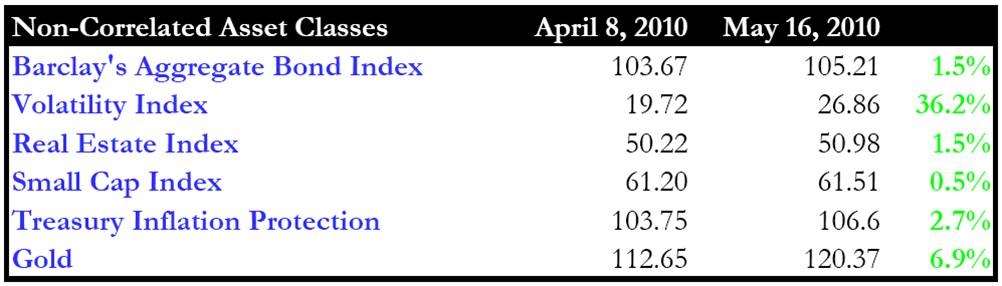
While traditional volatility has returned after a meteoric bounce in 2009, there should be more investment opportunities to invest around. With the VIX hovering in the mid-30s after a brief stay above 40 a few weeks ago, I would not be surprised to see a reversion to a more normalized fear gauge in the 20s – although my game plan is not dependent on this occurring.
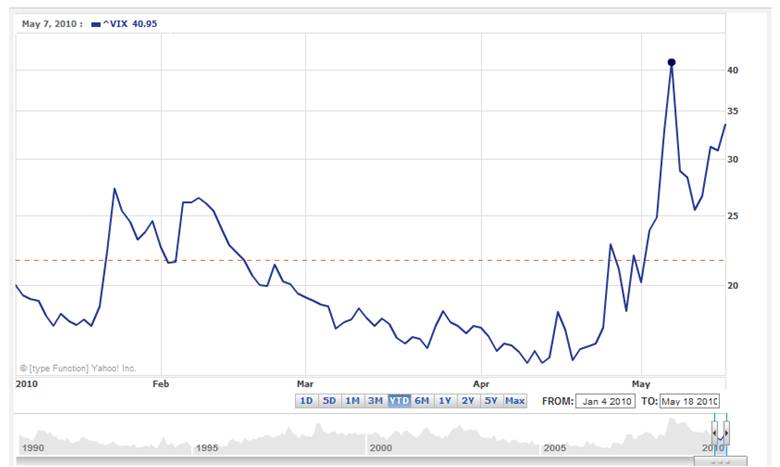
VIX Chart Source: Yahoo! Finance
Regardless of the direction of volatility, I’m encouraged that even during periods of mini-panics, there are hopeful signs that investors are able to seesaw through periods of organized chaos with the assistance of good old diversification.
Wade W. Slome, CFA, CFP®
Plan. Invest. Prosper.
*DISCLOSURE: Sidoxia Capital Management (SCM) and some of its clients own certain exchange traded funds (including AGG, BND, VNQ, IJR and TIP), but at the time of publishing SCM had no direct positions in VXX, GLD, or any security referenced in this article. No information accessed through the Investing Caffeine (IC) website constitutes investment, financial, legal, tax or other advice nor is to be relied on in making an investment or other decision. Please read disclosure language on IC “Contact” page.