Ball & Chaining the Rating Agencies

After sifting through the rubble of the financial crisis of 2008-2009, Congress is spreading the blame liberally across various constituencies, including the almighty rating agencies (think of Moody’s [MCO], Standard & Poor’s [MHP], and Fitch). The Senate recently added a proposed amendment to the financial regulation bill that would establish a government appointed panel to select a designated credit rating agency for certain debt deals. The proposal is designed to remove the inherent conflict of interest of debt issuers – such as Goldman Sachs Group Inc. (GS), Morgan Stanley (MS), UBS, and others – shopping around for higher ratings in exchange for higher payments to the banks. The credit rating agencies are not satisfied with being weighed down with a ball and chain, and apparently New York Attorney General Andrew Cuomo is sympathetic with the agencies. Cuomo recently subpoenaed Goldman Sachs Group Inc., Morgan Stanley, UBS and five other banks to see whether the banks misled credit-rating services about mortgage-backed securities.
Slippery Slope of Government Intervention
Many different professions, inside and outside the financial industry, provide critical advice in exchange for monetary compensation. In many industries there are inherent conflicts of interest between the professional and the end-user, and a related opinion provided by the pro may result in a bad outcome. If government intervention is the appropriate solution in the rating agency field, then maybe we should answer the following questions related to other fields before we rush to regulation:
- Should the government control which auditors check the books of every American company because executives may opportunistically shop around for more lenient reviews of their financials?
- Perhaps the Securities and Exchange Commission (SEC) should dictate which investment bank should underwrite an Initial Public Offering (IPO) or other stock issuance?
- Maybe the government should decide which medicine or surgery should be administered by a doctor because they received funding or donations from a drug and device company?
Where do you draw the line? Is the amendment issued by Al Franken (Senator of Minnesota) a well thought out proposal to improve the conflicts of interest, or is this merely a knee-jerk reaction to sock it some greedy Wall Street-ers and solidify additional scapegoats in the global financial meltdown?
In addition to including a controversial government-led rating agency selection process, the transforming regulatory reform bill also includes a dramatic change to ban “naked” credit default swaps (CDS). As I’ve written in the past, derivatives of all types can be used to hedge (protect) or speculate (e.g., naked CDS). Singling out a specific derivative product and strategy like naked CDSs is like banning all Browning 9x19mm Hi-Power pistols, but allowing hundreds of other gun-types to be sold and used. Conceptually, proper use of a naked CDS by a trader is the same as the proper use of a gun by a recreational hunter (see my derivatives article).
Solutions
Rather than additional government intervention into the rating agency and derivative fields, perhaps additional disclosure, transparency, capital requirements, and harsher penalties can be instituted. There will always be abusers, but as we learned from the collapse of Arthur Andersen on the road to Enron’s bankruptcy, there can be cruel consequences to bad actors. If investment banks misrepresent opinions, laws can lead to severe results also. Take Jack Grubman, hypester of Worldcom stock, who was banned for life from the securities industry and forced to pay $15 million in fines. Or Henry Blodget, who too was banned from the securities industry and paid millions in fines, not to mention the $200 million in fraud damages Merrill Lynch was forced to pay.
At the end of the day, enough disclosure and transparency needs to be made available to investors so they can make their own decisions. Those institutional investors that piled into these toxic, mortgage-related securities and lost their shirts because of over-reliance on the rating agencies’ evaluations deserve to lose money. If these structures were too complex to understand, then this so-called sophisticated institutional investor base should have balked from participation. Of course, if the banks or credit agencies misrepresented the complex investments, then sure, those intermediaries should suffer the full brunt of the law.
Although weighing down the cash-rich credit rating agencies (and CDS creators) with ball and chain regulations may appease the populist sentiment in the short-run, the reduction in conflicts of interest might be overwhelmed by the unintended consequences. Now if you’ll please excuse me, I’m going to do my homework on a naked CDS related to a AAA-rated synthetic CDO (Collateralized Debt Obligation).
Wade W. Slome, CFA, CFP®
Plan. Invest. Prosper.
*DISCLOSURE: Sidoxia Capital Management (SCM) and some of its clients own certain exchange traded funds, but at the time of publishing SCM had no direct positions in MCO, MHP, GS, MS, JPM, UBS, BAC, T or any security referenced in this article. No information accessed through the Investing Caffeine (IC) website constitutes investment, financial, legal, tax or other advice nor is to be relied on in making an investment or other decision. Please read disclosure language on IC “Contact” page.
Cockroach Consumer Cannot be Exterminated

We’re told that cockroaches would inherit the earth if a nuclear war were to occur, due to the pests’ impressive resiliency. Like a cockroach, the American consumer has managed to survive its own version of a financial nuclear war, as a result of the global debt binge and bursting of the real estate bubble. Although associating a consumer to a disease-carrying cockroach is not the most flattering comparison, I suppose it is okay since I too am a consumer (cockroach).
Confidence Cuisine
Cockroaches enjoy feasting on food, but they have been known to live close to a month without food, two weeks without water, and a half hour without air while submerged in water. On the other hand, consumers can’t live that long without food, water, and oxygen, but what really feeds buyer purchasing patterns is confidence. The April Consumer Confidence number from the Confidence Board showed the April reading reaching the highest level since September 2008. On a shorter term basis, the April figure measured in at 57.9, up from 52.3 in the previous month.
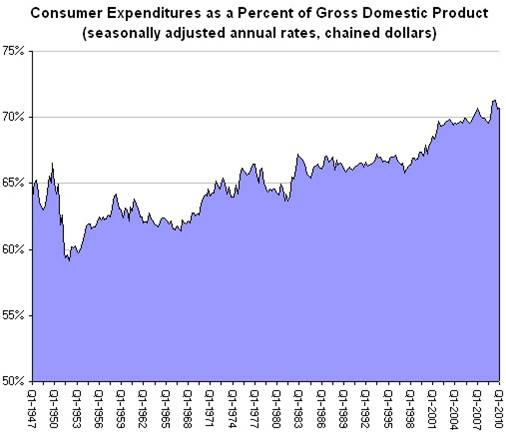
Where is all this buying appetite coming from? What we’re witnessing is merely a reversal of what we experienced in the previous years. In 2008 and 2009 more than 8 million jobs were shed and the fear-induced spiraling of confidence pushed consumers’ buying habits into a cave. With +290,000 new jobs added in April, the fourth consecutive month of additions, the tide has turned and consumers are coming out to see the sun and smell the roses. Recently the Bureau of Economic Analysis (BEA) revealed real personal consumption expenditures grew +3.6% in the first quarter – the largest quarterly increase in consumer spending since the first quarter of 2007.
Sure, there still are the “double-dippers” predicting an impending recession once the sugar-high stimulus wears off and tax increases kick-in. From my perch, it’s difficult for me to gauge the timing of any future slowing, other than to say I have not been surprised by the timing or magnitude of the rebound (I was writing about the steepening yield curve and the end of the recession last June and July, respectively). Sometimes, the farther you fall, the higher you will bounce. Rather than try to time or predict the direction of the market (see market timing article), I look, rather, to exploit the opportunities that present themselves in volatile times (e.g., your garden variety Dow Jones -1,000 point hourly plunge).
Will the Trend End?
Can this generational rise in consumer spending continue unabated? Probably not. To some extent we are victims of our own success. As about 25% of global GDP and only 5% of the world’s population, changing directions of the U.S.A. supertanker is becoming increasingly more difficult.
Source: The New York Times (Economix)
However, more nimble, resource-rich developing countries have fewer demographic and entitlement-driven debt issues like many developed countries. In order to build on an envious standard of living, our country needs to build on our foundation of entrepreneurial capitalism by driving innovation to create higher paying jobs. With those higher paying jobs will come higher spending. Of course, if uncompetitive industries cannot compete in the global marketplace, and a mirage of spending is re-created through drug-like credit cards and excess leveraged corporate lending, then heaven help us. Even the impressively resilient cockroach will not be able to survive that scenario.
Read full New York Times article here
Wade W. Slome, CFA, CFP®
Plan. Invest. Prosper.
*DISCLOSURE: Sidoxia Capital Management (SCM) and some of its clients own certain exchange traded funds, but at the time of publishing SCM had no direct positions in any security referenced in this article. No information accessed through the Investing Caffeine (IC) website constitutes investment, financial, legal, tax or other advice nor is to be relied on in making an investment or other decision. Please read disclosure language on IC “Contact” page.
King of Controversy Reveals Maverick Solution

Mark Cuban, provocative and brash owner of the Dallas Mavericks basketball team and #400 wealthiest person in the world ($2.4 billion net worth), according to Forbes, has never been shy about sharing his opinion. In fact, this multi-billionaire’s opinions have been discouraged on multiple occasions, as evidenced by the NBA (National Basketball Association) slapping Cuban with more than $1.6 million in fines for his outbursts.
Cuban doesn’t only provide his views on basketball, as a serial entrepreneur who cashed in his former company Broadcast.com to Yahoo! (YHOO) for $5.9 billion, he also is providing his thoughts on Wall Street and the 1,000 point “fat finger” trading meltdown from last week. What does Cuban say is the answer to the rampant speculation conducted by idiot financial engineers? “Tax the Hell Out of Wall Street,” says Cuban in his recent blog flagged by TRB’s Josh Brown.
A Taxing Solution
Specifically, Cuban wants to tax investors 25 cents per share (and 5 cents per share for stocks trading at $5 per share or less) in hopes of encouraging myopic speculating traders to become longer-term shareholders. Cuban believes this approach will weed out the day traders and investment renters who in reality “don’t add anything to the markets.” Seems like a reasonable belief to me.
According to Cuban’s math, here are some of the benefits the tax would bring to the financial system:
“If the NYSE, Nasdaq, Amex and OTC are trading 2 Billion shares a day or more, like today, thats $ 500 Million Dollars PER DAY. If there are 260 trading days a year. Thats about 130 Billion dollars a year. If volumes drop because of the tax. It is still 10s of Billions of dollars per year. Thats real money for the US Treasury. Thats also an annual payment towards the next time Wall Street screws up and we have a black swan event that no one planned on.”
Practically speaking, a flat rate 25 cent tax per share is probably not the best way to go if you were to introduce a transaction tax, but the crux of Cuban’s argument essentially would not change. Creating a flat percentage tax (e.g., 1%) would likely make more sense, even if complexity may increase relative to the 25 cent tax. Take for example Citigroup (C) and Berkshire Hathaway Class A (BRKA). Cuban’s plan would result in paying 1.2% tax on a $4.17 share of Citigroup versus only 0.00022% tax for a $116,000.00 share of Berkshire Hathaway. Simple accounting maneuvers such as reverse stock splits and slowing of stock dividends, along with reducing company dilution through share and option issuance, may be methods of circumventing some of the tax burden created under Cuban’s described proposal.
Politically, adding any tax to investing voters could be re-election suicide, so rather than calling it a trading tax, I suppose the politicians would have to come up with some other euphemism, such as “charitable administrative fee for speculative trading.” The financial industry has already become experts in taxing investors with fees (read Fees, Exploitation and Confusion), so maybe Congress could give the banks and fund companies a call for some marketing ideas.
Step 1: Transparency
The murkiness and lack of transparency across derivatives markets is becoming more and more evident by the day. Some recent events that bolster the argument include: a) New CDO (Collateralized Debt Obligation) derivative allegations surfacing against Morgan Stanley (MS); b) The SEC (Securities and Exchange Commission) charges against Goldman Sachs (GS) in the Abacus synthetic CDO deal (see Goldman Sachs article); c) The collapse of AIG’s Credit Default Swap (CDS) department and subsequent push to transfer trading to open exchanges; and d) Now we’re dealing with last week’s cascading collapse of the equity markets within minutes. The brief cratering of multiple indexes points to a potential order entry blunder and/or absence of adequate and consistent circuit breakers across a web of disparate exchanges and ECNs (Electronic Communication Networks).
The mere fact we stand here five days later with no substantive explanation for the absurd trading anomalies (see Making Megabucks 13 Minutes at a Time) is proof positive changes in derivative and exchange transparency are absolutely essential.
Step 2: Incentives
In Freakonomics, the best-selling book authored by Steven Levitt, we learn that “Incentives are the cornerstone of modern life,” and “Economics is, at root, the study of incentives.” Incentives are crucial in that they permeate virtually all aspects of financial markets, not only in assisting economic growth, but also the negative aspects of bursting financial bubbles.
Michael Mauboussin, the Chief Investment Strategist at Legg Mason (read more on Mauboussin), also expands on the role incentives played in the housing collapse:
“Many, if not most, of the parties involved in the mortgage meltdown were doing what makes sense for them—even if it wasn’t good for the system overall. Homeowners got to live in fancier homes, mortgage brokers earned fees on the mortgages they originated without having to worry about the quality of the loans, investment banks earned tidy fees buying, packaging, and selling these loans, rating agencies made money, and investors earned extra yield on so-called AAA securities. So it’s a big deal to watch and unpack incentives.”
Regulation, penalties, and fines are means of creating preventative incentives against improper or unfair behavior. Just as people have no incentive to wash a rental car, nor do high frequency traders have an incentive to invest in equity securities for any extended period of time. Adding a Cuban tax may not be a cure-all for all our country’s financial woes, but as the regulatory reform debate matures in Congress, this taxing idea emanating from the King of Controversy may be a good place to start.
Read full blog article written by Mark Cuban
Wade W. Slome, CFA, CFP®
Plan. Invest. Prosper.
*DISCLOSURE: Sidoxia Capital Management (SCM) and some of its clients own certain exchange traded funds and an AIG subsidary structured security, but at the time of publishing SCM had no direct positions in YHOO, C, AIG, LM, GS, BRKA, or any security referenced in this article. No information accessed through the Investing Caffeine (IC) website constitutes investment, financial, legal, tax or other advice nor is to be relied on in making an investment or other decision. Please read disclosure language on IC “Contact” page.
Riding Out the Financial White Waters

De Ja Vu All Over Again
As Hall of Famer baseball player Yogi Berra said, “This is like deja vu all over again.” Crises are nothing new, but the emotion of the moment can feel worse than reality. Getting continually bombarded with data in this globally interconnected world with 24-hour non-stop news cycles contributes to this lost perspective. The fact is our country has survived multiple wars, assassinations, banking crises, SARS, mad cow, swine flu, widening deficits, recessions, currency crises, and yes, even breakdowns in exchange mechanisms – witness the October 1987crash (Black Monday) drop of -22% caused by an overused and flawed portfolio insurance strategy. Today, the rise of the high frequency trading machines and fragmented exchanges are being blamed as causes for last week’s dislocations.
Rather than put current events in proper context, misrepresented facts and irresponsible, knee-jerk conclusions are often spread like a virus. Extremism has pervaded all aspects of our culture, especially in throughout our media and politics. In this sour environment, nothing can seemingly carry shades of gray…it must be either black or white. The events of the last few days, weeks, months, and years are nothing new. We have seen this financial crisis movie before, even if it is a different title, with different actors, and shuffled characters. These messes start with a great, profitable idea, thereby attracting other participants, which breeds speculation and greed, and eventually stimulates a bubble to burst. This negative cycle in turn manifests itself into a manmade fear machine, which leads to panic and recession. At that point, inefficient capital eventually becomes weeded out, people go to jail, and rules get created to prevent similar bubbles from forming again.
These cycles can be slowed or delayed, but not stopped. Greedy capitalists are creative and they have a proven track record of planting new seeds of growth in the soil of our democracy. Our system may not be the best, but as Winston Churchill stated, “Democracy is the worst form of government except for all the others forms that have been tried from time to time.”
The European Crisis: Where from Here?
A lot has been going on in the markets, so much so that investors shrugged off the news that +290,000 jobs were added in April (and numbers were revised higher the previous month). Market participants instead chose to focus on the escalating Greek headlines. Currently the consensus thinking believes there is a significant probability of Greece defaulting with the financial downdraft spreading to neighboring countries as evidenced by widening interest rate spreads (see chart below).
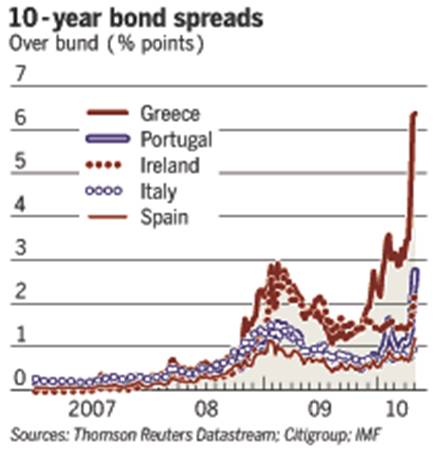
Chart from The Financial Times
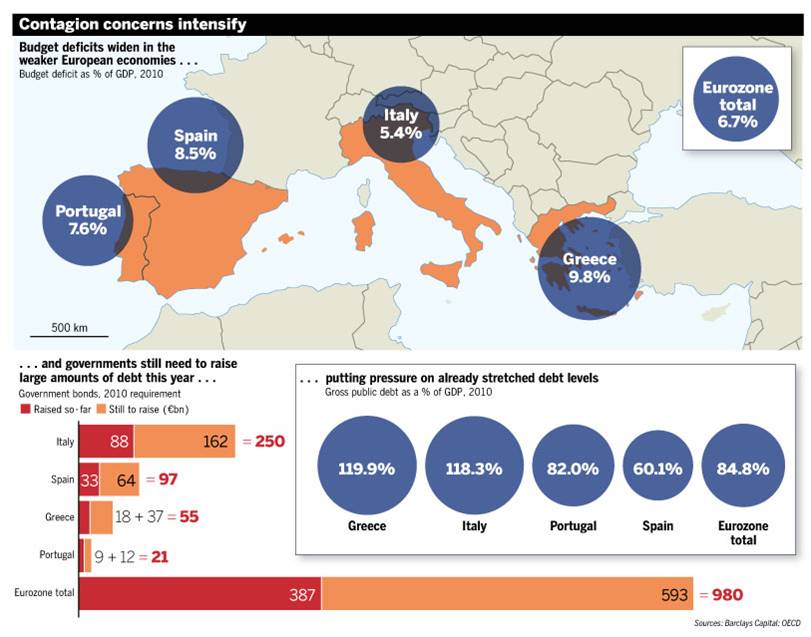
Much attention has been directed towards the PIIGS countries (Portugal, Italy, Ireland, Greece, and Spain) due to their poor fiscal criteria, but not all PIIGS are created equally. Although, I am less worried about Portugal and Ireland due to their minimal contribution to European GDP (Gross Domestic Product), I am concerned about the potential deterioration in Italy and Spain’s ability to pay back there borrowers or refinance their debt. Time will tell.
If you want to compare Europe’s debt and deficit problems with the United States, I encourage you to read my past article on D-E-B-T: The Four-Letter Word.
Source: Barclays Capital; OECD via The Financial Times
Surviving the Choppy White Waters
Although the Federal Reserve and the government came to the country’s rescue by implementing massive monetary and fiscal stimulus, the “great bounce” of 2009 has recently lost some steam. A recent -10% correction should not be surprising considering we have just undergone a +100% & +83% explosion in the Nasdaq and S&P 500 indexes, respectively, last year from the March lows. In fact, the correction should be viewed as healthy. After gorging on a large, heavy meal, one needs some time to digest the provisions (just as time is necessary to absorb large financial gains).
Presently, there’s a tug-of-war going on between an improving economy and legacy structural issues (e.g., debt, deficits, entitlements, taxes, healthcare, regulatory reform, etc.) If I had to guess, with all the major national issues we face, I expect trading to be choppy for the next six months until we make it through the mid-term elections (relieving some uncertainty). Until then, take a deep breath, put current events in historical perspective, so you will be able to profit from the rough waters (volatility), rather than react late and become hostage to it. If you correctly follow these guidelines, you too can survive the rough financial waters.
Wade W. Slome, CFA, CFP®
Plan. Invest. Prosper.
*DISCLOSURE: Sidoxia Capital Management (SCM) and some of its clients own certain exchange traded funds and an AIG subsidary structured security, but at the time of publishing SCM had no direct positions in JPM, Lehman Brothers, AIG, or any security referenced in this article. No information accessed through the Investing Caffeine (IC) website constitutes investment, financial, legal, tax or other advice nor is to be relied on in making an investment or other decision. Please read disclosure language on IC “Contact” page.
Making +457,425,000% – 13 Minutes at a Time
I love investing, but sometimes the shear boredom can get a little tiresome. I mean, a puny little -500 point collapse in the Dow Jones Industrial Average every five minutes can be so 1987. Thank goodness for yesterday’s largest, intra-day point-drop in history (almost 1,000 points) because without out such a meltdown, I might fall asleep at the trading desk and there would be no way to make an annualized +457,425,000% (~457 million percent) trade in a single day. Earning a well-deserved return like that will not only exceed the rates achieved on T-Bills, but will also likely outpace inflation as well. Making that kind of money is not bad work, if you can get it.
Executing the Tricky Trade
Sound difficult to do? Well, not really. All you need to do is find a stock or security that has fallen more than 99% in a single day, then buy the security for 10 cents per share and then sell it immediately, minutes later at $61.09. Repeat this process another 390 times per day for 52 weeks, and you’re well on your way of turning $1 into $4.5 million over a year.
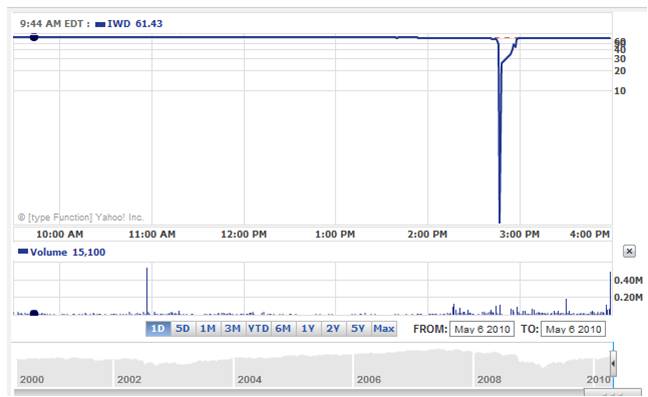
IWD Chart (Source: Yahoo! Finance)
Take for example, the iShares Russell 1000 Value Exchange Traded Fund (ETF), IWD, which yesterday traded for pennies at 3:47 p.m. Eastern Standard Time (EST) and skyrocketed over +600x fold in the subsequent 13 minutes. Fortunately (or unfortunately), depending on how you perceive the situation, the irregular trading activity was not limited to IWD. Other securities showing severe abnormal trading patterns include, Accenture (ACN), Boston Beer (SAM), Exelon (EXC), CenterPoint Energy (CNP), Eagle Material (EXP), Genpact Ltd (G), ITC Holdings (ITC), Brown & Brown (BRO), and Casey’s General (CASY). In full disclosure, I did not take advantage of any 99% pullbacks yesterday, but now that I know how the game works, I will be on full alert.
What the F*%$# Happened?
Initially reports pointed to a Citigroup (C) trader who entered into an inadvertent $16 billion (with a “b”) E-Mini futures trade order, when the trader meant to enter a trade for $16 million (with an “m”)…ooops! This alleged transaction purportedly triggered a wave of selling, culminating in a select group of stocks temporarily trading down to pennies in value. There is a related, yet more plausible, potential explanation. Quite possibly, as a function of excessive trading volume overwhelming the New York Stock Exchange, the overflow of trades migrated to less liquid ECNs (Electronic Communication Networks) and over-the-counter markets. Chances are the high frequency traders were not blindly jumping in front of the train. Whom really got screwed were the retail investors that had stop loss orders at “market” prices, which likely were triggered at unattractive prices.
I’m not sure if we will ever find out what truly happened, but whatever explanations are provided, rest assured there will be multiple more conspiracy theories on top of the legitimate guesses. The top 5 conspiracies I’m pushing are the following:
1) Frustrated by the fraud charges filed by the SEC (Securities and Exchange Commission), Goldman Sachs intentionally tripped over a power cord at the New York Stock Exchange (NYSE), which triggered a wave of bogus trades.
2) High Frequency Traders (see HFT Article) were upgrading their computers from Windows Vista to Windows 7 and experienced an outage causing global disruption.
3) In order to pay for the potential upcoming lawsuit liabilities and SEC fines, Goldman shorted the Dow Jones Industrial index at 10,800 and then went long once the index broke 10,000.
4) Warren Buffett was rumored to suffer a heart attack, but after realizing belching relieved his chest pain, the markets recovered dramatically.
5) Worried that regulatory reform may not pass, a secret group of Congressmen shorted stocks (see Do As I Say, Not As I Do article) to push stocks lower, then distributed TARP (Troubled Asset Relief Program) assets to voters minutes later in order to buy November votes and push stock prices higher.
Political Aftermath

Politicians will be frothing at the mouth or be pressured into approving financial reform. Even if markets manage to stabilize in the coming days and weeks, the pressure to ram regulatory reform through Capitol Hill will be mind-numbing. Mary Shapiro, Chairman of the SEC, and politicians will also be pushing to produce a clear scapegoat to throw under the bus, whether it is a trader at Citi, a high frequency traders at Goldman Sachs, the CEO at the NYSE (Duncan Niederauer), or a talking baby from the E-TRADE commercials. Regardless, depending on how quickly a credible explanation is unearthed, we will know how much, if any, reform is needed. If the markets are genuinely transparent, following the paper trail of responsibility to the stocks that dropped to $.00 or $.01 a share should be a piece of cake. If the systems are too complex to explain why handfuls of stocks are trading to $0, then even I am willing to look up to the skies and say heaven help us with some tighter oversight.
Over the last few years, there have been very few dull, financial moments and the markets did very little to disappoint yesterday. Irrespective of the political mudslinging, scapegoating, or irresponsible behavior, the SEC needs to get to the bottom of these issues rapidly in order to protect the integrity and trust of global players in our markets. What we don’t need is a political knee-jerk reaction that merely creates unintended, negative consequences. No matter what happens, I will at least be equipped to test a new strategy designed to make +457,425,000%.
Wade W. Slome, CFA, CFP®
Plan. Invest. Prosper.
*DISCLOSURE: Sidoxia Capital Management (SCM) and some of its clients own certain exchange traded funds, but at the time of publishing SCM had no direct positions in GS, IWD, C, BRKA/B, CNP, EXP, G, ITC, BRO, and CASY, or any security referenced in this article. No information accessed through the Investing Caffeine (IC) website constitutes investment, financial, legal, tax or other advice nor is to be relied on in making an investment or other decision. Please read disclosure language on IC “Contact” page.
Do as I Say, Not as I Do

“Be smart…but don’t pay attention to me.”
Watching Goldman Sachs (GS) executives sweat it out under the hot lamps of Senator questioning makes for gripping television (see Goldman article), but as we all know the ethical standing of a significant number of politicians calls into question whether the pot should be calling the kettle black. Ever since I was a kid, I was told by seemingly responsible adults to “do as I say and not what I do.” I suppose the Goldman execs should follow the advice of Congress, but not their actions.
Based on a recent Wall Street Journal article that studied the investment activity of Congressional members (and spouses) during the financial crisis, the analysis discovered 13 of them were betting against the market. Just as Goldman and hedge fund manager John Paulson partnered to bet against the housing market via shorting synthetic CDOs (Collateralized Debt Obligations), Congressmen and their spouses were wagering against the market through the use of debt loaded (leveraged) exchange traded funds, which integrate derivatives.
Were any of the Congressional investment activities illegal? Likely not, but some question the ethical appearance of such behavior. The former head of the House Ethics Committee and past Representative Joel Hefley of Colorado believes such conduct “doesn’t look real great when the economy is tanking and people are blaming the government.” Facing similar challenges, the SEC’s (Security and Exchange Commission’s) squishy fraud charge complaint against Goldman Sachs is expected to encounter significant difficulty in proving the investment bank’s guilt.
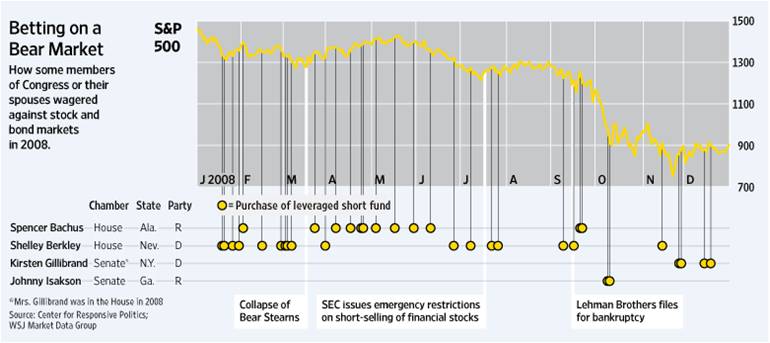
Source: The Wall Street Journal (Yellow Dots = Shorting Exposure Trades)
Other politicians were critical of Wall Street too, despite apparent hypocritical behavior. For example, Representative Shelley Berkley of Nevada chided Wall Street for its reckless activities. “No casino on the planet behaves as irresponsibly and recklessly as Wall Street does. Wall Street ought to be ashamed, and take a lesson from the casino industry.” Nearly at the same time, Shelley’s husband Lawrence Lehrner placed 57 bearish trades.
I find it very amusing the same politicians shredding apart the Wall Street firms are in many cases the same politicians stretching the bounds of ethical behavior. Various politicians do a great job pontificating about the latest shortcomings of the financial industry, but fail to take some accountability for missing one of the greatest real estate booms of all-time. Where were the regulators and politicians when the debt bubble was bursting? Unfortunately, “reactive” is a much larger part of a politician’s lexicon than “proactive.” Responding to populist fervor is easier than leaning against consensus views, even if going against consensus makes more strategic sense.
For those having difficulty in deciphering the advice given by esteemed Congressmen, just remember to “do what they say, and not what they do.”
Read Full Wall Street Journal Article
Wade W. Slome, CFA, CFP®
Plan. Invest. Prosper.
*DISCLOSURE: Sidoxia Capital Management (SCM) and some of its clients own certain exchange traded funds, but at the time of publishing SCM had no direct positions in GS, or any security referenced in this article. No information accessed through the Investing Caffeine (IC) website constitutes investment, financial, legal, tax or other advice nor is to be relied on in making an investment or other decision. Please read disclosure language on IC “Contact” page.
Earnings Showing Speedy Growth

With approximately 2/3 of the S&P 500 companies reporting, Thomson Reuters is reporting not only are 78% of those companies beating analyst expectations, but they are also beating them by a large margin (~16%). The financial sector is still rather volatile and is distorting comparisons, but if you look at the non-financial sector, profit growth is on pace to grow +35% this quarter as compared to +18% last quarter. Earnings are not the only thing growing…so are revenues. After four quarters of revenue declines, sales are on track to rise +11% this quarter (versus +8% last quarter) thanks to almost 80% of the S&P 500 companies reporting revenue growth (rather than declines) in the first quarter of 2010.
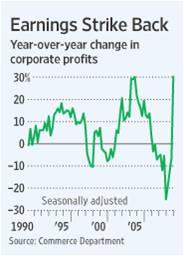
Source: The Wall Street Journal
Signs of Employment Improvement
Unemployment at 9.7% remains stubbornly high, but with corporation’s newfound revenue growth, there are signs companies are becoming more confident in the hiring department as well. Typically the sequence of a business cycle follows the pattern of cutting expenses and increasing layoffs into a recession; building cash at the cycle trough while running leaner expenses and staff; improving productivity with capital expenditures and technology purchases before hiring; and then as the recovery firms up, companies enjoy widening margins with sales growth, resulting in the confidence to hire. Take for example JP Morgan (JPM) mentioned they plan to hire 9,000 workers in the U.S. this year and Intel (INTC) another 1,000 new positions.
Growth is Global
With all the headlines about Greece’s financial woes, one might underestimate the recovery abroad as well. The average earnings growth rate estimates for the G6 stock markets is +41.6% and +21.9% for 2010 and 2011 according to Ed Yardeni, but a majority of the growth is not coming from the Euro zone.
There is still no shortage of issues to worry about, assuming we understand a Utopia does not exist. Besides elevated unemployment, other issues to remain concerned about include: a lack of credit accessibility for small and medium businesses; massive government debt and deficits; and diminishing impacts in the coming quarters from government stimulus and Federal Reserve monetary stimulus.
Regardless of the nervousness, evidence continues to build for a continuation of better than expected earnings. The music will not last forever and eventual stop, but until then, our economy will enjoy the speedier than anticipated earnings growth recovery.
Read Whole Wall Street Journal Article on Earnings (Subscription)
Wade W. Slome, CFA, CFP®
Plan. Invest. Prosper.
*DISCLOSURE: Sidoxia Capital Management (SCM) and some of its clients own certain exchange traded funds, but at the time of publishing SCM had no direct positions in JPM, INTC, or any security referenced in this article. No information accessed through the Investing Caffeine (IC) website constitutes investment, financial, legal, tax or other advice nor is to be relied on in making an investment or other decision. Please read disclosure language on IC “Contact” page.
Revenge of David: Technology Empowers Small-Fry

The garage tinkerer’s canvas is manifested through these relatively new 3-D printers.
What happened in the virtual world with software and operating systems over the last 15 or so years is now happening in the bricks and mortar world. Linux, a free open source software operating system, was designed in the early 1990s and initially registered its trademark in 1994. The no cost system takes advantage of charitable brainpower by using programming prowess from others around the globe.
The same phenomenon is happening in the real world, and critically acclaimed Wired writer Chris Anderson wrote about it this trend in a recent article, In the Next Industrial Revolution, Atoms Are the New Bits. With the help of a laptop, free design software, and a few mouse clicks to a manufacturing plant in China, Anderson shows how a small fry entrepreneur with a good idea can become a successful micro-factory in weeks. This same process might have taken traditional manufacturers years in the past. Accelerating production from novel idea to output reality are new 3-D printers, robotic-like equipment that can build real time prototypes from molten plastic (see picture above). Sounds expensive, but these former six-figure devices can be purchased for less than $1,000 thereby allowing state of the art products to be made with relatively little capital and inventory. In other words, the small fry entrepreneur David now has the ability to become a fine tuned Goliath with the help of democratizing technologies. The high barriers to entry have been toppled down by creative, risk-taking entrepreneurs.
In describing this manufacturing marvel, Anderson highlights Local Motors, an open source car company that managed to produce a car in months what would have taken legacy automakers years to build. Rather than hire a host of expensive engineers (the company only had 10 employees), Local Motors relied on a global community of volunteers (also called “crowdsourcing”) to design the original “Rally Fighter” automobile. Utilizing a ratio of 500-to-1 volunteers to employees has allowed Local Motors to leverage the power of atoms to bits. What Anderson calls “garage tinkerers” are slowly taking over the world.
Building Your Dream
On the surface, the micro-factory concept sounds fairly straightforward, but how does one practically pursue this strategy? Anderson has five steps to building your dreams:
1) Invent: Come up with idea and check U.S. Patent and Trademark office to make sure idea has not been used before.
2) Design: Use 3-D design tools to model out your idea.
3) Prototype: Upload your design to a 3-D printer and watch prototype idea grow into reality.
4) Manufacture: Find manufacturing partner online through sites like Alibaba.com (1688.HK).
5) Sell: Market your product online to reach the masses.
If you look back in time, the industrialization of America squeezed out the little guys because small time citizens did not have the capital or expertise to keep up with the big boys. Thanks to the internet, the playing field has been leveled and the small-fry David can not only compete with Goliath, but can also defeat him.
Read Chris Anderson’s Famous The Long Tail Article from 2004
Wade W. Slome, CFA, CFP®
Plan. Invest. Prosper.
*DISCLOSURE: Sidoxia Capital Management (SCM) and some of its clients own certain exchange traded funds, but at the time of publishing SCM had no direct positions in Alibaba.com or any security referenced in this article. No information accessed through the Investing Caffeine (IC) website constitutes investment, financial, legal, tax or other advice nor is to be relied on in making an investment or other decision. Please read disclosure language on IC “Contact” page.
Goldman: Gambling Prosperity at Client Expense?

What a scene that 11-hour Senate subcommittee interrogation of Goldman Sachs (GS) executives was on C-Span – I’m still wondering whether a forklift was utilized to hoist in the multi-thousand page binders stuffed with reams of exhibits. With caffeine beverage firmly in hand, I watched as much of the marathon as possible until fatigue set in. Not all was lost though, because I managed to simultaneously conduct new stock research as I was glued to the hearings. After I saw the Goldman executives repeatedly wrestle open the gargantuan-sized binders of smoking-gun emails, I checked the paper futures markets and am now contemplating a purchase of International Paper’s (IP) stock.
Lead trader of the controversial Abacus/John Paulson deal, “Fabulous Fab” Fabrice Tourre, did not disappoint his supporters either, firmly addressing his responses in his French Pepe Le Pew accent. His Goldman trading counterparts (Daniel Sparks, ex-mortgage department head, Joshua Birnbaum, ex-managing director of the department, and Michael Swenson, current managing director of the department), like all Goldman witnesses, did their best at bobbing and weaving the intrusive, pointed questions. On the cozier side of the questioning fence, the Senators did a superb job of raking the Goldman execs over the coals with endless exhibits of emails. Judging by the shiny, sweating mugs of the traders, the Senators were successful in making the testifiers uncomfortable – either that, or the Senators had the thermostat in the room raised to 82 degrees.
Betting Away to Profits
At the heart of the questioning was the key issue of whether Goldman Sachs executives and employees were acting in the best interest of their clients (fiduciary duty), or were they making bets against clients with the benefit of privileged information. Senator Claire McCaskill compared Goldman to a bookie manipulating bets in their own favor without sharing their edge with bettors (investors). In the case of the Abacus deal, Goldman admits to not freely disclosing the involvement of now-famous, mortgage market short seller John Paulson (see the Gutsiest Trade) to the so-called sophisticated institutional investors, ACA Capital Holdings Inc. Was this lack of disclosure illegal? Perhaps unethical, but pundits have already established the high hurdle the SEC (Securities and Exchange Commission) will need to clear in order to prove Goldman’s guilt.
Based on the testimony and facts introduced in the hearings, and as I write in my previous Goldman article (Goldman Cheat?), Goldman’s behavior throughout the housing collapse and participation in the ACA deal reflects more about intelligent opportunism within a loose regulatory framework than it does about criminal behavior. Having managed a $20 billion fund (see my book) I dealt with the conflicts of interest and self dealings of the investment banks first hand. As I entered trade orders reaching into the millions of shares, do I naively believe Goldman and other banks altruistically kept that information in their trading vaults? Or is it possible that information leaked out to other clients or was used for the banks benefit? Suffice it to say, the regulatory structure and conflict of interest frameworks, as they stand today, are not stacked in favor of investors.
The Solutions
Although we wish our regulators and government officials could have been more forward looking, rather than reactive, nonetheless, some reforms need to be instituted to resolve the substantial risks built into our financial system today. Here are a few ideas from the 10,000 foot level:
Volcker Rule: Former Federal Reserve Chairman’s so-called “Volcker Rule” is looking better by the minute. Not a new concept, but as regulators shine the light on the opaque industry of derivatives trading and proprietary trading desks, the need for new reforms becomes even more evident. Derivatives are not evil (see Financial Engineering), but like a gun or knife, if misused these instruments can become extremely dangerous…as we have found out. The Glass-Steagall Act, which separated investment bank functions from commercial bank functions, was repealed almost 70 years after its introduction in 1932. The Volcker Rule would be a “lite” version of Glass-Steagall Act because the thrust of the proposal is aimed at splitting the risk-taking proprietary trading desk activities from the client based activities.
Heightened Capital: If you rented out an exotic car or motorcycle from a store, you would likely be required to commit a deposit or collateral to protect against adverse conditions. The same principle applies to derivatives, which generally raises volatility due to inherent leverage. The riskier the product, the larger the capital requirement should be. The collapse of Bear Stearns, Lehman Brothers, and AIG are painful lessons learned from situations of excessive leverage.
Central Clearing/Transparency: Derivative products such as options, futures, and swaps have existed for decades. The transparency gained by trading these securities on exchanges increases market confidence, thereby increasing liquidity and lowering costs for end-users. Standardization around complex derivatives like CDOs (Collateralized Debt Obligations), CDSs (Credit Default Swaps), and CLOs (Collateralized Loan Obligations) is a must to ensure the fact regulators can actually understand the products they are regulating.
Credit Rating Agency: It’s not entirely clear to me that the rating agencies play a critical role in the market place. In effect, the agencies serve as an outsourced research resource primarily for fixed income investors. If the agencies disappeared today, investors would be forced to do their own homework on each deal – not necessarily a bad idea. If the existing oligopoly structure of agencies ultimately survives, I suggest penalties should be incurred by firms with inaccurate ratings. Conversely, ratings could be structured such that compensation could be tiered (or escrowed) over time with payment incentives tied to the underlying deal performance relative to ratings accuracy.
Too Big To Fail: The massive bailouts and TARP (Troubled Asset Relief Program) money handed out to the financial and auto companies have left a sour taste in taxpayers’ mouths. A systemic risk regulator with the authority to unwind unhealthy institutions makes common sense. An insurance pool financed by self-inflicted industry taxes would assist regulators in achieving the reduction of troubled financial institutions.
Fiduciary Duty: Sidoxia Capital Management is a Registered Investment Advisor (RIA) and must act in the best interests of the client. Unfortunately, much of the industry is structured with a much lower “suitability” threshold, which provides a veil for firms to engage in less than ethical behavior.
Overall, regulatory reform urgency is in the Washington D.C. air and there is no question in my mind that a certain degree of witch hunting and scapegoating is occurring. Nonetheless, Lloyd Blankfein and team Goldman Sachs made it out alive from the Congressional hearing, but not without suffering some negative reputational damage. Former Goldman CEO alum and Treasury Secretary Henry Paulson probably sent roses to Mr. Blankfein thanking him for taking Paulson’s job before the 2008 market collapse. When regulatory reform eventually kicks in, perhaps Lloyd Blankfein and Henry Paulson will take a trip to Las Vegas to celebrate (or commiserate).
Wade W. Slome, CFA, CFP®
Plan. Invest. Prosper.
*DISCLOSURE: Sidoxia Capital Management (SCM) and some of its clients own certain exchange traded funds and in a security derived from an AIG subsidiary, but at the time of publishing SCM had no direct positions in GS, IP, AIG, JPM/Bear Stearns, LEH/Barclays or any security referenced in this article. No information accessed through the Investing Caffeine (IC) website constitutes investment, financial, legal, tax or other advice nor is to be relied on in making an investment or other decision. Please read disclosure language on IC “Contact” page.
General Motor’s Amazing Debt Trick

Now you see it, and now you don’t. General Motors claims that it has pulled off an amazing trick – the CEO of the troubled automaker, Ed Whitacre, claims in a recently released nationwide commercial, “We have repaid our government loan, in full, with interest, five years ahead of the original schedule.” (See video BELOW):
Blushing Pinocchio
Even Pinocchio would blush after listening to those statements. The loan that GM is claiming victory over is roughly $7-8 billion in TARP (Troubled Asset Relief Program) loans made from the U.S. and Canada. What Mr. Whitacre failed to acknowledge was how investors will be made whole on the whopping balance of around $45 billion.
How did GM miraculously pay off this debt? Whitacre would like taxpayers to believe booming sales or an operational turnaround has funded the debt repayment. Rather, these debt repayments were funded through other government TARP loans held in escrow with U.S. Treasury oversight. Effectively, GM has paid down one Mastercard (MA) bill with another Visa (V) credit card, and then gone on to brag about this financial shell game through a multi-million dollar advertising campaign. It’s bad enough that politicians and so-called media pundits attempt to “spin” facts into warped truths, but when a government-owned entity steps onto a national loudspeaker and spouts out blatantly distorted sound-bites, there should be consequences to these actions. American taxpayers deserve more honest accountability and transparency regarding their tax outlays rather than quarter truths.
GM’s Future
As Jedi Master Yoda’s famously quotes, “Uncertain, the future is,” and “Always in motion is the future.” GM is not out of the woods yet – the company lost $3.4 billion in the 4th quarter of 2009 alone and remains 70% government-owned. Nobody is certain how much (if any) of the $43 billion will be repaid by General Motors. For reference purposes, GM lost $88 billion from 2004 until 2009 when they declared bankruptcy (see AP article) If all goes according to plan, the former debt holders (now equity holders) and government stockholders will get a return on their capital infusions if and when GM does an equity offering to the public sometime later in 2010. If achieved, the company will have come full circle: public to bankrupt; bankrupt to private; and private to public.
While executives at GM are confident in their repayment capabilities, less convinced are certain branches of our federal government. Maybe these government agencies have taken note of the horrific train wreck occurring in the automotive industry over the last few decades (see GM Fatigue) Take for example the Office of Management and Budget, and the nonpartisan Congressional Budget Office (CBO) – they see TARP losses exceeding $100 billion, including about $30 billion from the auto companies…ouch.
The probability of success will no doubt hinge on some of the dramatic transformations made over the last year. First of all, GM has axed the number of brands in half (from eight to four), cutting Pontiac, Saturn, Hummer, and Saab. Cutting costs is great, but chopping expenses to prosperity cannot last forever – at some point you need compelling products that will drive sales. The rubber will hit the road late this year when GM is scheduled to release the “Volt,” a plug-in hybrid, which the company is using as a launching pad for new products.
TARP on Right Track but Not to Finish Line
Given the heightened political sensitivity in Washington regarding the banks and Wall Street it’s not too surprising that many of the banks wanted to be out of the governments crosshairs and pay back TARP as soon as possible. Beyond political pressure, banks have accelerated TARP repayments in part due to the massively steep and profitable yield curve, along with signs of an improving economy. According to the Treasury Department less than $200 billion in bailout money is outstanding for what originally started out as a $700 billion fund ($36 billion of automaker bailouts is estimated as uncollectible). Even though there has been progress on TARP collections, unfortunately non-TARP losses associated with AIG, Fannie Mae (FNM), and Freddie Mac (FRE) are expected to add more than $150 billion in bleeding.
I don’t believe anyone is happy about the bailouts, although some are obviously more irate. Accountability and transparency are important bailout factors as taxpayers and investors look to recover capital contributions. The next trick GM and Ed Whitacre need to pull off is paying off tens of billions in taxpayer money with the benefit of sustained profits – now that’s a television commercial I want to see.
Wade W. Slome, CFA, CFP®
Plan. Invest. Prosper.
*DISCLOSURE: Sidoxia Capital Management (SCM) and some of its clients own certain exchange traded funds and in a security derived from an AIG subsidiary, but at the time of publishing SCM had no direct positions in General Motors, AIG, FNM, FRE, MA, V, or any security referenced in this article. No information accessed through the Investing Caffeine (IC) website constitutes investment, financial, legal, tax or other advice nor is to be relied on in making an investment or other decision. Please read disclosure language on IC “Contact” page.




