Posts filed under ‘Stocks’
Questioning the Death of Buy & Hold Investing

In the midst of the so-called “Lost Decade,” pundits continue to talk about the death of “buy and hold” (B&H) investing. I guess it probably makes sense to define B&H first before discussing it, but like most amorphous financial concepts, there is no clear cut definition. According to some strict B&H interpreters, B&H means buy and hold forever (i.e., buy today and carry to your grave). For other more forgiving Wall Street lexicon analysts, B&H could mean a multi-year timeframe. However, with the advent of high frequency trading (HFT) and supercomputers, the speed of trading has only accelerated further to milliseconds, microseconds, and even nanoseconds. Pretty soon B&H will be considered buying a stock and holding it for a day! Average mutual fund turnover (holding periods) has already declined from about 6 years in the 1950s to about 11 months in the 2000s according to John Bogle.
Technology and the lower costs associated with trading advancements is obviously a key driver to shortened investment horizons, but even after these developments, professionals success in beating the market is less clear. Passive gurus Burton Malkiel and John Bogle have consistently asserted that 75% or more of professional money managers underperform benchmarks and passive investment vehicles (e.g., index funds and exchange traded funds).
This is not the first time that B&H has been held for dead. For example, BusinessWeek ran an article in August 1979 entitled The Death of Equities (see Magazine Cover article), which aimed to eradicate any stock market believers off the face of the planet. Sure enough, just a few years later, the market went on to advance on one of the greatest, if not the greatest, multi-decade bull market run in history. People repudiated themselves from B&H back then, and while B&H was in vogue during the 1980s and 1990s it is back to becoming the whipping boy today.
Excuse Me, But What About Bonds?
With all this talk about the demise of B&H and the rise of the HFT machines, I can’t help but wonder why B&H is dead in equities but alive and screaming in the bond market? Am I not mistaken, but has this not been the largest (or darn near largest) thirty year bull market in bonds? The Federal Funds Rate has gone from 20% in 1981 to 0% thirty years later. Not a bad period to buy and hold, but I’m going to go out on a limb and say the Fed Funds won’t go from 0% to a negative -20% over the next thirty years.
Better Looking Corpse
There’s no denying the fact that equities have been a lousy place to be for the last ten years, and I have no clue what stocks will do for the next twelve months, but what I do know is that stocks offer a completely different value proposition today. At the beginning of the 2000, the market P/E (Price Earnings) valued earnings at a 29x multiple with the 10-year Treasury Note trading with a yield of about 6%. Today, the market trades at 13.5 x’s 2010 earnings estimates (12x’s 2011) and the 10-Year is trading at a level less than half the 2000 rate (2.75% today). Maybe stocks go nowhere for a while, but it’s difficult to dispute now that equities are at least much more attractive (less ugly) than the prices ten years ago. If B&H is dead, at least the corpse is looking a little better now.
As is usually the case, most generalizations are too simplistic in making a point. So in fully reviewing B&H, perhaps it’s not a bad idea of clarifying the two core beliefs underpinning the diehard buy and holders:
1) Buying and holding stocks is only wise if you are buying and holding good stocks.
2) Buying and holding stocks is not wise if you are buying and holding bad stocks.
Even in the face of a disastrous market environment, here are a few stocks that have met B&H rule #1:

Maybe buy and hold is not dead after all? Certainly there have been plenty of stinking losing stocks to offset these winners. Regardless of the environment, if proper homework is completed, there is plenty of room to profitably resurrect stocks that are left for a buy and hold death by the so-called pundits.
Wade W. Slome, CFA, CFP®
Plan. Invest. Prosper.
DISCLOSURE: Sidoxia Capital Management (SCM) and some of its clients own certain exchange traded funds and AAPL, AMZN, ARMH, and NFLX, but at the time of publishing SCM had no direct position in GGP, APKT, KRO, AKAM, FFIV, OPEN, RVBD, BIDU, PCLN, CRM, FLS, GMCR, HANS, BYI, SWN (*2,901% is correct %), CTSH, CMI, ISRG, ESRX, or any other security referenced in this article. No information accessed through the Investing Caffeine (IC) website constitutes investment, financial, legal, tax or other advice nor is to be relied on in making an investment or other decision. Please read disclosure language on IC “Contact” page.
Winner’s Curse: HP’s Storage Prize

Congratulations HP (HPQ)…you are the proud winner of 3Par Inc. (PAR), a relatively small enterprise storage hardware and software company, for the bargain price of 125x’s 2011 earnings! Never mind that you were late to the game in your winning $2.4 billion bid against Dell Inc. (DELL), or that you paid more than triple the price ($33 per share) that 3Par was trading just 21 days ago (< $10 per share). At least you have a storage trophy you can show all your friends and you don’t have to carry around all those heavy bills anymore.
Winner’s Curse
In bidding wars and auctions, the victor of the price battle runs the risk of earning the “Winner’s Curse.” The curse falls upon those that bid a price that exceeds an auctioned asset’s intrinsic value. How can this occur? Well for one reason, the bidder may not have complete information regarding the value of the asset. Secondly, there can be emotional factors, or ego, that play a role in the decision and price paid. Lastly, unique factors, such as strategic benefits or synergies may exist that allow one bidder to offer a higher price than other auction participants. For example, consider an exploration and production company (XYZ Drilling Co.) that is bidding for drilling lease rights in Prudhoe Bay, Alaska. If XYZ Drilling Co. has unique existing drilling operations in the same area as the auctioned assets, XYZ Drilling Co. may be in a better position of making a profitable bid relative to its peers.
HP vs. Dell – A Deeper Look
Let’s take a deeper dive into the HP bid of 3Par. While HP generates a lot of cash by selling printers, cartridges, and computers, the company doesn’t exactly have a bullet-proof balance sheet. Unlike let’s say Apple Inc. (AAPL), which has about $46 billion in cash on its balance sheet with no debt (see Steve Jobs: Gluttonous Hog), HP actually carries more debt than cash (about $20 billion in debt and $15 billion in cash). What’s more, HP has little tangible equity, once $42 billion in goodwill and intangible assets are subtracted from the total asset value of the company – leaving HP with an astronomically high ratio of 275x’s price to tangible book value. For most companies operating with a positive net cash position, making acquisitions accretive is not that difficult in this current environment – when cash is decaying away with a paltry 1% return. Unfortunately for HP, their accretive hurdle is higher than a cash-rich company. Their weighted average cost of capital is ratcheted significantly higher due to a net debt position (not net cash).
Here is the viewpoint on the deal from Ashok Kumar, senior technology analyst at Rodman & Renshaw LLC:
“It’s in excess of $3 million per employee. To put it in perspective, today 3Par has about 5 percent [market share] of the very high-end market and for these premiums to pay out, [HP] would have to expand their market share to about 25 percent or about $1.5 billion, which is 5x the projected growth rate. And all of that would come at the expense of incumbents [like] IBM, EMC, Hitachi.”
On the Bright Side
Although the price paid by Hewlett-Packard for 3Par is ridiculously too high, this deal alone is not going to break HP’s piggybank. HP is currently raking in about $8 billion in cash flow per year, so absent aggressive share buybacks or other large acquisitions, HP should be able to pay off the cost of the deal in a few quarters. Secondarily, HP does gain some synergies by integrating 3Par’s blocklevel data storage expertise into HP’s existing portfolio of other storage technologies ( i.e., StoreOnce and IBRIX). Thirdly, HP gains some strategic defensive benefits by keeping 3Par out of Dell’s hands, a potentially formidable competitor in the storage space, given the intensive overlap in customer bases between HP & Dell. Lastly, HP will no doubt be able to introduce and cross-sell 3Par products into Hewlett’s vastly larger customer distribution channels and reap the resulting rewards.
All in all, the 3Par acquisition by HP makes perfect strategic sense, however the price paid will turn out to be a much better deal for 3Par shareholders, rather than HP shareholders. HP ultimately shelled out a hefty price tag to become the victorious party in the 3Par bidding war, but rather than increasing shareholder value, HP ended up achieving the “Winner’s Curse.”
Wade W. Slome, CFA, CFP®
Plan. Invest. Prosper.
DISCLOSURE: Sidoxia Capital Management (SCM) and some of its clients own certain exchange traded funds and AAPL, but at the time of publishing SCM had no direct position in HPQ, PAR, DELL, IBM, EMC, Hitachi, or any other security referenced in this article. No information accessed through the Investing Caffeine (IC) website constitutes investment, financial, legal, tax or other advice nor is to be relied on in making an investment or other decision. Please read disclosure language on IC “Contact” page.
What Happens in Vegas, Stays on Wall Street

What happens in Vegas, stays in Vegas, unless it’s a habit of betting, in which case that habit will follow you back to Wall Street. Just as there are a million ways to make or lose money by investing or speculating in the market, the same principles apply to sports betting as well. Anybody who has been to Las Vegas and gone to the sportsbook knows how incredibly and insanely accurate the oddsmakers are – I speak from immature experience having traveled there for a healthy number of investment conferences and vacations. The oddsmakers are so accurate; you could say they are almost “efficient” at what they do.
But like the market, in the sports world too, efficiency has a tendency to breakdown occasionally and form bubbles. This dynamic leaves both a huge threat of substantial losses and a potential for windfall gains. Where there are bubbles forming, you are bound to find a large number of excited individuals jumping on a bandwagon. Now, let’s take a look at how the worlds of Wall Street and wagers collide and see if any lessons can be learned.
Jumping on the Stock Bandwagon
band·wag·on [band-wag-uhn]: a party, cause, movement, etc., that by its mass appeal or strength readily attracts many followers.

Photo source: Freshpics.blogspot.com
Everybody loves a winner and no one more so than a fresh fan jumping on the bandwagon. Living in Southern California, the bandwagon is presently fully-loaded with proclaimed Los Angeles Laker fans and USC fans, although the Trojan wagon is currently undergoing repair. It’s easy to identify bandwagoners in sports – just find the face painter, guy with a rainbow afro, Boston native sporting a Kobe Bryant jersey, or the fanatic betting on the team favored by three touchdowns. In the game of stocks, identifying the fickle but passionate followers is a little more subtle. Bandwagon status is not measured by the extent of point spreads (predicted scoring differential between two opponents), but rather by level of P/E ratios (Price-Earnings ratio) or other valuation metric of choice.
While it is clear sports bandwagoners root for the “favorites,” in the realm of investing this translates into piling onto the “growth or momentum” stocks (see Momentum Investing article) – I hate generalizing terms but that’s what we bloggers do. Value investors, on the other hand, root for (buy) the “underdogs.”
To illustrate my point, let’s take a look at a few past bandwagon momentum stocks:
- JDS Uniphase Corp. (JDSU): In 2000 we saw these bandwagoners valuing investor favorites like JDS Uniphase at a whopping $99 billion – meaning investors were willingly paying over 100x’s revenues and 600 x’s trailing earnings to own the stock. At the time, JDSU was a “New Economy” stock that was going to revolutionize the proliferation of bandwidth around the globe with their proprietary optical laser components. For those of you keeping score at home, today JDSU’s stock is valued at approximately $2 billion ($9.97), or -98% less than the market value in March 2000 (split-adjusted peak share price of $1,227.38 per share). If it wasn’t for a 1-for-8 reverse stock split in 2006, then a share of JDSU would fetch you $1.25 today, or less than the amount needed to cover an out of network ATM penalty fee.
- Crocs Inc. (CROX): Crox is another one of my favorite bandwagon stocks, because this loud plastic eyesore footwear was clearly a fad that couldn’t sustain its growth once popularity waned, despite my wife being a bandwagon-ee. Like other fad product-related stocks, the company could no longer maintain its growth once they completed stuffing the channel and their customers cried uncle from choking on inventory. Making matters worse for CROX, knockoff versions were offered for a fraction of the cost at local grocery stores and mall kiosks. After about 20 months post its IPO (Initial Public Offering), the music stopped and within 13 months the stock cratered from a $75 per share peak to $0.79 in 2008. The stock never traded at the absurd dot-com levels, but the lofty 37x P/E in 2007 quickly turned negative after close to $200 million in losses were realized in 2008 and 2009. The stock has since rebounded to $12 and change, and maybe their new Crocs high-heel line of $99.00 shoes (see here) will propel the stock higher…cough, cough.
Point Spread, Point Spread, Point Spread
In sports betting the three most important factors in making a winning bet are point spread, point spread, and point spread. Unlike the March Madness college basketball pool in which you may have participated, in the real world the participant needs to do more than just pick the winning teams – the participant must determine by how much a team will win by. Let’s take a gander at a few actual examples.
- Florida Gators vs. Charleston Southern Buccaneers (9/5/09): Without knowing a lot about the powerhouse squad from South Carolina, 99% of respondents, when asked before the game who would win, would select Florida – a consistently dominant national-powerhouse program. The question gets a little trickier when asked the question: “Will the Florida Gators win by more than 63 points?” That’s exactly the point spread sports bettors faced when deciding whether or not to place the bet – somewhat analogous to the question whether JDSU was a prudent investment at 600x’s earnings? Needless to say, although the Buccs kept it close in the first half, and only trailed by 42-3 at halftime, the Gators still managed to squeak by with a 62-3 victory. Worth noting, the 59 point margin of victory resulted in a losing wager for anyone picking the Gators.

- USC Trojans vs. Stanford Cardinal (10/6/2007): Ranked as the presumptive #1 team of the country pre-season, and entering the game with a 35-0 home-game winning streak, USC was a whopping 41 point favorite over Stanford. On the flip side, the Cardinal came into the game fresh off of a 1-11 losing season the prior year, and in the previous year the Cardinal lost to the Trojans 42-0. Stanford ended up winning the 2007 match-up by a score of 24-23, not only pulling off one of the greatest upsets of all-time, but also spoiling USC’s chances of winning the national championship.
Read more about the greatest upsets of all-time.
Beyond the Point Spread
As you can surmise from our discussion, the same point spread standards apply to investing, but when discussing stocks the spread is measured by various valuation metrics based on earnings, cash flows, book value, EBITDA, sales, and other fundamental growth factors.
Of course, in Las Vegas and on Wall Street not everyone follows traditional fundamental analysis. Some gamblers and speculators will transact solely based on less conventional methods, for example quantitative models, technical analysis and trend review (read Technical Analysis: Astrology or Lob Wedge). For example in sports, handicappers may only wager on teams with five-game winning streaks and winning home records. Whereas on Wall Street, speculators may only trade stocks with positive earnings surprises or “head-and-shoulder” patterns. Hot technicians come and go, but very few real investors survive the long haul without using fundamental analysis and valuation as key components of their winning strategies.
As I have argued, there are many ways to make (and lose) money on Wall Street or in Las Vegas, and consistently jumping on the bandwagon is a sure way to lose. For the successful minority whose performance has endured the test of time, a common thread connecting the two disciplines is the ability to determine and profit from a prudently calculated point spread/valuation. History teaches us that the same effective handicapping skills happening in Las Vegas are the same abilities needed to stay on Wall Street and win.
Wade W. Slome, CFA, CFP®
P.S. See how a pro handicapper conquered Las Vegas and placed sportsbooks on the run.
Plan. Invest. Prosper.
*DISCLOSURE: The undergraduate alma mater of Sidoxia Capital Management’s (SCM) President happens to be UCLA, so although I believe any reference to rival school USC is not provided with any malicious agenda, nonetheless there may exist an inherent conflict of interest. SCM and some of its clients own certain exchange traded funds, but at the time of publishing, SCM had no direct position in JDSU, CROX, or any other security referenced in this article. No information accessed through the Investing Caffeine (IC) website constitutes investment, financial, legal, tax or other advice nor is to be relied on in making an investment or other decision. Please read disclosure language on IC “Contact” page.
BP: Sweet Opportunity or Sloppy Mess?

Photo source: 1Funny.com
Discussing the BP oil spill is not exactly cutting-edge, fresh news at this point. However, now that the 5 million barrel gaping gusher of black sludge has been plugged, many of the uncertain variables are beginning to come in focus. From mid-April this year, right before the disaster occurred, the equity value of BP’s stock peaked around $189 billion. The value of the company subsequently shed over $100 billion in value over the next two months, before rebounding to a level about -35% below the April highs today. BP is not out of the woods yet, even though the discussion has migrated from potential bankruptcy scenarios. The question now is whether purchasing BP stock currently is a sweet opportunity or just a sloppy mess that will drag value down for years to come?
Whitney Tilson, whom I profiled last year in Fat Lady Housing article, is the founder and Managing Partner of T2 Partners LLC who decided to tackle the tough BP questions. Tilson compiled his bullish thesis on BP at the 7th Annual Value Investor conference when BP’s share price was trading at $36.76. Why is Tilson so optimistic about BP’s stock price appreciation potential? He uses a few approaches, but his number one approach is a walk down catastrophe memory lane. If previous stock calamities resulted in opportunities due to investor overreaction, then certainly the same principal should apply to BP (or so Tilson believes). Here are some of the previous train wrecks Tilson highlighted in his presentation:

Pretty convincing evidence that the bark was bigger than the bite for these examples, but Tilson chose to save his best precedent illustration for last…Merck (MRK). In 2004, the pharmacy company came under assault after it was revealed the drug Vioxx increased the likelihood of patient heart attacks. What fanned the flames of panic were the allegations that Merck had known about these detrimental risks for years, but the company did not disclose this valuable knowledge. To make a long story short, the initial $50 billion liability estimate attributed to Merck actually came in closer to $5 billion and the stock rallied from a low of $26 in 2005 to $60 by the end of 2007. Tilson however, conveniently neglects to mention that the company’s stock shortly thereafter collapsed, before bottoming at $20 per share in early 2009 and settling in at a price around $35 today.
Regardless, Tilson’s points are well taken. Often these major catastrophes that sprawl across media headlines become overdone and offer an opportunity to those investors with thick skin and a stomach that can withstand severe heartburn.
Besides having history on his side, Tilson provided additional supportive bullet points to bolster his sanguine view on BP:
- BP is a Cash Cow: The average estimate of BP’s liability (approximately $30 billion) is less than the $34 billion in operating profits ($20 billion in net income) expected to be realized by BP in 2010.
- Financial Flexibility: BP has access to over $20 billion in access to cash and liquidity, not even counting the more than $100 billion in property, plant, & equipment (PP&E) on the balance sheet. Asset sales provide BP with even more flexibility.
- Small U.S. Footprint: BP’s Gulf of Mexico operations, home of the Macondo well disaster, represent only about 15% of BP’s total global oil production, so the inference is BP would do just fine without access to the Gulf.
All, in all, Tilson provides a perspective with logical arguments to support his case. The analysis, however, does not give a lot of weight to political consequences that can cause this situation to go from bad to worse. Specifically, some pundits are using a more negative legal precedent of the tobacco companies to explain the downside potential of this situation (see legal pay-out table).

The 1998 master tobacco settlement agreement with the tobacco industry resulted in a whopping $206 billion in pay-outs to be made by the tobacco manufactures over 25 years (Financial Times). This is significantly greater than the $20 billion escrow account that BP has verbally committed to funding (and BP has already funded the account with a $3 billion initial deposit). What’s more, the spill volume estimates are a moving target, and as a result, BP just raised its oil spill cleanup costs from $3.95 billion to $6.1 billion. These numbers can have a way of becoming their own monsters over time.
As you can see, Whitney Tilson makes some pretty compelling arguments for BP, but not many arguments can be made against his long-term performance at the T2 Accredited Fund, which is up +202% since 1999 through mid-2010 (versus +7% for the S&P 500 for the same time period). If you believe Tilson, BP may turn out to be a sweeter kiss than the sloppy mess we constantly hear about.
Wade W. Slome, CFA, CFP®
Plan. Invest. Prosper.
*DISCLOSURE: Sidoxia Capital Management (SCM) and some of its clients own certain exchange traded funds, but at the time of publishing SCM had no direct position in BP, MRK, XOM, or any security referenced in this article. No information accessed through the Investing Caffeine (IC) website constitutes investment, financial, legal, tax or other advice nor is to be relied on in making an investment or other decision. Please read disclosure language on IC “Contact” page.
Jobs: The Gluttonous Cash Hog

Really? Do you think Steve Jobs actually needs to hoard $42 billion in cash reserves on the company’s balance sheet, when they are already adding to the gargantuan mountain of money at a $12 billion clip per year. Let’s not forget, this gaudy amount of money is being added after all operating expenses and capital expenditures have been paid for.
Perhaps Steve is just a little worried about the economy, and wants a little extra loose change around for a rainy day? I’d buy that argument, but Mr. Jobs and the rest of the executives just witnessed the worst financial crisis in a generation, and the company still managed to generate about $9 billion in free cash flow in both fiscal 2008 and 2009.
If Apple was not creating cash flow like those cascading chocolate fountains I see at wedding receptions, then perhaps a cash safety blanket is needed for acquisitions? Here’s what Steve had to say about Apple’s cash levels in February:

Steve Jobs (Source: Photobucket)
“We know if we need to acquire something – a piece of the puzzle to make something big and bold – we can write a check for it and not borrow a lot of money and put our whole company at risk…The cash in the bank gives us tremendous security and flexibility.”
Let’s explore that idea a little further. First of all, what type of experience does Apple have in doing large acquisitions? Not a lot, and just to humor myself I ran a screen on a universe of more than 10,000 stocks and I came up with 111 companies with a value (market capitalization) greater than $40 billion. Unless Apple plans on buying companies like Coca Cola (KO), Chevron Corp. (CVX), Pfizer (PFE), or United Parcel Service (UPS), I think Apple can part ways with some of their billions. Certainly, there are a handful of theoretical targets in the areas of technology and content, but for certain, (a) any large deal would face intense regulatory scrutiny, and (b) if truly there were grand synergies from doing a massive deal, then most definitely they would be able to issue stock (if Jobs hates debt) to help fund the deal. It is pure nonsense and laughable to believe any “big and bold” acquisition would put the company “at risk.” The only thing at risk for doing a large deal would be Apple’s stock price.
The truth of the matter is returning cash to shareholders would be a fantastic self-disciplining tool, like putting mayonnaise on a brownie to prevent excess calorie consumption. Steve should give current or former CEOs of AOL, Time Warner, Mercedes Benz, Chrysler, Sprint, and Nextel a call to see how those large deals worked out for them. Apple could use an acquisition security blanket, but they do not need a circus tent of cash.
Times of Change
Although times have changed, some executives have not. Many tech companies, including Apple, have nostalgic memories of the go-go tech bubble days of the 1990s when growth at any price was the main mantra and no attention was paid to prudent capital allocation. With a stagnant stock market over the last twelve years, and interest rates sitting sluggishly at record lows (effectively 0% on the Federal Funds rate), investors are demanding prudent decision-making when it comes to capital allocation. Mr. Jobs, it is time to expand your narrow views and show the stewardship of sensibly managing the cash of your loyal investors.
Believe it or not, there are still a few of us actual “investors” that still exist. I’m talking about investors who do not just speculatively rent a stock for a day, week, or month, but rather those who invest for the long-term because they believe in the vision and execution capabilities of management and believe the company’s capital will be invested in their best interest.
I do not mean to single Mr. Jobs out, because he is not the only gluttonous, cash-hog offender among CEOs. In many respects, Apple has the good fortune of becoming a cash-hoarding poster child. The company does indeed deserve credit for becoming a $225 billion technology-consumer-media-retail juggernaut that has spread its tentacles brilliantly across numerous massive markets, whether its PCs, cell phones, music, television, movies, games, advertising etc.…you get the picture. But just because you are an exceptionally gifted visionary doesn’t give you the right to destroy value of hopelessly idle cash, which is begging for a better home than a 0.25% T-Bill.
Solutions – Taming the Cash Hog:
1) Divvy Up Dividends: With $42 billion in cash on the balance sheet and additional annual free cash generation on pace for $12 billion per year, there is no reason Steve Jobs and the board couldn’t declare a dividend that would yield 3% today. If that feels like too much, then how about shave off a pittance of $5 billion or so to pay out a sustainable dividend, which would yield a market-matching 2% dividend yield to investors. This scenario would accommodate Apple with at least a few decades of a cash cushion to cover ALL the company’s operating expenses and capital expenditures. This meagerly, ultra-conservative dividend policy can actually persist (or grow) longer than expected, if Apple can sustainably grow profits – a good possibility.
2) Share Buyback: This solution is much less desirable from my perspective compared to the dividend route, since many of the large share repurchasers tend to also issue lots of new shares to employees and executives, thereby neutering the benefits of the share repurchases.
3) Bank of Apple – (B of A): Why doesn’t Jobs just create a new entity, plop $40 billion of cash from Apple Inc. into the venture, and then open it up as Bank of Apple. At least that way, as an investor in the bank, I could make more profitable lending spreads at B of A relative to the 0.25% yield earned on the mega-billions deteriorating on Apple’s corporate balance sheet.
The downside of instituting these cash reducing solutions:
- The company doesn’t have as much cash as it would like to do large stupid acquisitions.
- The company loses a bunch of day-traders and short-term stock renters that don’t even know what a dividend is.
The upside to efficiently allocating capital through a 2% dividend is Steve (and the other investors) will receive a nice fat quarterly check. In the case of Jobs, he’ll collect a handsome $27 million or so to his measly $1 annual salary. In the process, the company will also gain long term shareholders that buy into the strategic vision of the company.
Stubbornness has served Steve Jobs tremendously well in his career, and a successful CEO like Steve Jobs is not required to listen to my advice. However, I am hopeful that Mr. Jobs will see the hazards of choking on a rapidly growing $42 billion cash hoard and discover the benefits of slimming down a gluttonous cash hog.
Wade W. Slome, CFA, CFP®
Plan. Invest. Prosper.
*DISCLOSURE: Sidoxia Capital Management (SCM) and some of its clients own certain exchange traded funds and AAPL, but at the time of publishing SCM had no direct positions in KO, CVX, PFE, UPS, AOL, Time Warner, Mercedes Benz, Chrysler, Sprint, Nextel, or any other security referenced in this article. No information accessed through the Investing Caffeine (IC) website constitutes investment, financial, legal, tax or other advice nor is to be relied on in making an investment or other decision. Please read disclosure language on IC “Contact” page.
Dividends: From Sapling to Abundant Fruit Tree

Dividends are like fruit and an investment in stock is much like purchasing a sapling. When purchasing a stock (sapling) the goal is two-fold: 1) Buy a sapling (tree) that is expected to bear a lot of fruit; and 2) Pay a cheap or fair price. If the right saplings are purchased at the right prices, then investors can enjoy a steady diet of fruit that has the potential of producing more fruit each year. Fruit can come in the form of future profits, but as we will see, the sweetness of a profitable company also paying dividends can prove much more fruitful over the long-term.
Investing in growth equities at reasonable prices seems like a pretty intelligent strategy, but of late the vast majority of fresh investor capital has been piling into bonds. This is not a flawed plan for retirees (and certain wealthy individuals) and should be a staple in all investment portfolios, to a degree (some of my client portfolios contain more than 80%+ in fixed income-like securities), but for many investors this overly narrow bond focus can lead to suboptimal outcomes. Right now, I like to think of bonds like a reliable bag of dried fruit, selling for a costly price. However, unlike stocks, bonds do not have the potential of raising periodic payments like a sapling with strong growth prospects. “Double-dippers” who are expecting the economy to spiral into a tailspin, along with nervous snakebit equity investors, prefer the reliability of the bagged dry fruit (bonds)… no matter how high the price.
How Sweet is the Fruit? How Does a +2,300% Yield Sound?
Not only do equities offer the potential of capital appreciation, but they also present the prospect of dividend hikes in the future – important characteristics, especially in inflationary environments. Bonds, on the other hand, offer static fixed payments (no hope of interest rate hikes) with declining purchasing power during periods of escalating general prices.
Given the possibility of a “double-dip” recession, one would expect corporate executives to be guarding their cash with extreme stinginess. On the contrary, so far in 2010, companies have shown their confidence in the recovery by increasing or initiating dividends at a +55% higher clip versus the same period last year. Underpinning these announcements, beyond a belief in an economic recovery, are large piles of cash growing on the balance sheets of nonfinancial companies. According to Standard & Poor’s (S&P), cash hit a record $837 billion at the end of March, up from $665 billion last year.
The S&P 500 dividend yield at 2.06% may not sound overwhelmingly high, but with CDs and money markets paying next to nothing, the Federal Funds rate at effectively 0%, and the 10-Year Treasury Note yielding an uninspiring 3.11%, the S&P yield looks a little more respectable in that light.
If the stock market yield doesn’t enthuse you, how does a +2,300% yield sound to you? That’s roughly what a $.05 (split adjusted) purchase of Wal-Mart (WMT) stock in 1972 would be earning you today based on the current $1.21 dividend per share paid today. That return alone is mind-blowing, but this analysis doesn’t even account for the near 1,000-fold increase in the stock price over the similar timeframe. That’s what happens if you can find a company that increases its dividend for 37 consecutive years.
Procter & Gamble (PG) is another example. After PG increased its dividend for 54 consecutive years, from a split-adjusted $.01 per share in 1970 to a $1.93 payout today, original shareholders are earning an approximate 245% yield on their initial investment (excluding again the massive capital appreciation over 40 years). There’s a reason investment greats like Warren Buffett have invested in great dividend franchises like WMT, PG, KO, BUD, WFC, and AXP.
Bad Apples do Exist
Dividend payment is not guaranteed by any means, as evidenced by the dividend cuts by financial institutions during the 2008-2009 crisis (e.g., BAC, WFC, C) or the discontinuation of BP PLC’s (BP) dividend after the Gulf of Mexico oil spill disaster. Bonds are not immune either. Although bonds are perceived as “safe” investments, the interest and principal payment streams are not fully insured – just ask bondholders of bankrupt companies like Lehman Brothers, Visteon, Tribune, or the countless other companies that have defaulted on their debt promises.
This is where doing your homework by analyzing a company’s competitive positioning, financial wherewithal, and corporate management team can lead you to those companies that have a durable competitive advantage with a corporate culture of returning excess capital to shareholders (see Investing Caffeine’s “Education” section). Certainly finding a WMT and/or PG that will increase dividends consistently for decades is no easy chore, but there are dozens of budding possibilities that S&P has identified as “Dividend Aristocrats” – companies with a multi-year track record of increasing dividends. And although there is uncertainty revolving around dividend taxation going into 2011, I believe it is fair to assume dividend payment treatment will be more favorable than bond income.
Apple Allocation
Growth companies that reinvest profits into new value-expanding projects and/or hoard cash on the balance sheet may make sense conceptually, but dividend paying cultures instill a self-disciplining credo that can better ensure proper capital stewardship by corporate boards. All too often excess capital is treated as funny money, only to be flushed away by overpaying for some high-profile acquisition, or meaningless share buybacks that merely offset generous equity grants to employees.
So, when looking at new and existing investments, consider the importance of dividend payments and dividend growth potential. Investing in an attractively priced sapling with appealing growth prospects can lead to incredibly fruitful returns.
Read the Whole WSJ Article on Dividends
Wade W. Slome, CFA, CFP®
Plan. Invest. Prosper.
*DISCLOSURE: Sidoxia Capital Management (SCM) and some of its clients own certain exchange traded funds and WMT, but at the time of publishing SCM had no direct positions in BAC, WFC, C, BP, PG, KO, BUD, WFC, AXP, Lehman Brothers, Visteon, Tribune, or any other security referenced in this article. No information accessed through the Investing Caffeine (IC) website constitutes investment, financial, legal, tax or other advice nor is to be relied on in making an investment or other decision. Please read disclosure language on IC “Contact” page.
Marathon Investing: Genesis of Cheap Stocks

It was Mark Twain who famously stated, “The reports of my death have been greatly exaggerated.” So too has the death of equities been overstated. Long-term stock bulls don’t have a lot to point to since the market, as measured by the S&P 500 index, has done absolutely nothing over the last 12 years (see Lost Decade). Over the last 10 years, the market is actually down about -20% without dividends (and about flat if you account for reinvested dividends). So if equities belong at the morgue, why not just short the market, burn your dollars, and hang out in a cave with a pile of gold? Well, behind the scenes, and off the radar of nanosecond, high frequency, day-trading CNBC junkies, there has been a quiet but deliberate strengthening in the earnings foundation of the market. In the investing world it’s difficult to move forward through sand. Even without a sturdy running foundation, sprinters can race to the front of the pack, but those disciplined runners who systematically train for marathons are the ones who successfully make it to the finish line.
Prices Chopped in Half
What many pundits and media mavens fail to recognize is S&P corporate profits have virtually doubled since 1998 (a historically elevated base), despite market prices stuck in quicksand for a dozen years. What does this say about the valuation of the market when prices go nowhere and profits double? Simple math tells us that all stock market inventory is selling for -50% off (the market multiple has been chopped in half). That’s exactly what we have seen – the June 1998 market multiple (valuation) stood around 27x’s earnings and today’s 2010 earnings estimates imply a multiple of about 13.5 x’s projected profits. With the rear-view mirror assisting us, it’s easy to understand why pre-2000 (tech bubble) valuations were expensive. By coupling more reasonable valuations with a 10-Year Treasury Note trading at 3.19% and lofty bond prices, I would expect stocks to be poised for a much better decade of relative performance versus bonds. The case becomes even stronger if you believe 2011 S&P 500 estimates are achievable (12x’s earnings).
In order to make the decade long valuation contraction more apparent, I wanted include a random group of stocks (mixture of healthcare, media, retailer, consumer non-discretionary, and financial services) to liven up my argument:
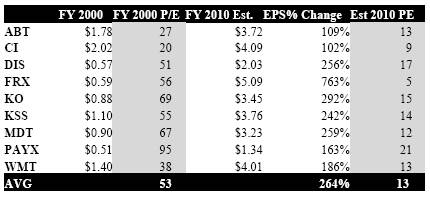
Data sources: S&P, ADVFN & Yahoo! Finance
What Next?
From a stock market standpoint, there are certainly plenty of believable “double dip” scenarios out there along with thoughtful observers who question the attainability of next year’s earnings forecasts. With that said, I do have problems with those bears like John Mauldin (read The Man Who Cries Wolf) who just last year pointed to a market trading at a “(negative) -467” P/E ratio, only to subsequently watch stocks advance some 80%+ over the following months.
Regardless of disparate economic views, I contend objective market observers (even bearish ones) have trouble indicating the market is ridiculously expensive with a straight face – based on current corporate profit expectations. At the end of the day, sustainable earnings and cash flow growth are what ultimately drive durable, long-term price appreciation. As Peter Lynch stated with technical precision, “People may bet on hourly wiggles of the market but it’s the earnings that waggle the wiggle long term.”
Running a marathon is always challenging, but with a sturdy foundation in which prices have been chopped in half (see also Market Dipstick article), reaching the goal and finish line for long-term investors will be much more achievable.
Wade W. Slome, CFA, CFP®
Plan. Invest. Prosper.
*DISCLOSURE: Sidoxia Capital Management (SCM) and some of its clients own certain exchange traded funds, WMT, and PAYX, but at the time of publishing SCM had no direct positions in ABT, CI, DIS, FRX, KO, KSS, MDT or any other security referenced in this article. No information accessed through the Investing Caffeine (IC) website constitutes investment, financial, legal, tax or other advice nor is to be relied on in making an investment or other decision. Please read disclosure language on IC “Contact” page.
Microchip: Selling Electronic Cake Mix to the World

Microchip Technology Inc. (MCHP) is not in the business of selling cakes. Rather, Microchip is more akin to a chef selling cake mix in the form of microcontrollers to hungry designers with a sweet tooth. All that the customers need to do is add some water to the mix, and voila they have all the ingredients necessary to make a cake.
Endless Opportunities
Making a cake may sound simple, but the real magic comes as a result of the baking chef exploring the endless possibilities across colors, flavors, sizes, frostings, and accessories. The microcontroller business is similar in many respects. Microchip provides the essential tools (ingredients) to efficiently and cost-effectively build solutions for an almost infinite number of applications. Microcontrollers can be found in a diverse mix of products and gizmos, ranging in size from an iPod Nano (AAPL) and Tickle Me Elmo toy to a Whirlpool (WHR) washing machine and a butt-warming car seat in a Porsche 911 Turbo. From a verticals standpoint, Microchip services more than 60,000 customers globally (75% of revenues internationally) in the automotive, aerospace, communications, computing, consumer, and industrial control markets, among others.
What the Heck is a Microcontroller?
You can think of a microcontroller as a computer-on-a-chip, and these mini-computers, which are embedded into all types of applications, allow designers to create all types of products. The low-cost computer chips handle simple functions such as turning products on and off and setting speeds in consumer products, cars, telecommunications and office equipment. More specifically, these microcontrollers provide designers with the ability to introduce or expand functionality, reduce power consumption, and create further efficient designs, thereby potentially leading to lower costs and higher profits. Even though talking about the digital world of 1’s and 0’s sounds sexy, in the real world we are surrounded by analog factors like time, temperature, sound, music, and video – analog functions that require the heavy lifting of a microcontroller to process digital data after it has been converted from analog.
These microcontrollers aren’t multi-hundred dollar microprocessors manufactured in multi-billion fabrication facilities at Intel Corp. (INTC) – rather these more mundane (although essential) components sell often for a few bucks each. What’s more, the pricing in microcontroller and analog land is more stable at Microchip relative to the annual -20-30% price cuts common in the microprocessor world.
On top of performance (speed, power, heat, etc.) and cost, ease of design is a way Microchip gains market share away from competitors through its PIC architecture – the software platform that designers program Microchip’s microcontrollers. The company devotes extensive resources to spreading the PIC gospel to designers around the world and Microchip engineers are constantly upgrading the programming software. To date, Microchip has almost shipped 1,000,000 development tools to designers and developers. The software and design kits add to the company’s revenues, but the real profitability kicks in when the customers reorder chips related to multiyear product life cycles. For example, you can think of a television company that must order a microcontroller for a five-year old, broken TV remote control that a child stepped on…hmm, sounds familiar.
Expanding Pie (or Cake)
This is no puny market; the overall microcontroller segment of the semiconductor market is estimated to have generated $10.7 billion in sales during 2009. Microchip has managed to not only become the 800 pound gorilla in the 8-bit microcontroller space, but in recent years they have also made significant headroom in the higher functionality/performance markets of 16-bit and 32-bit microcontrollers. In total, Microchip offers its customers more than 650 flavors of its microcontroller products.
One would think the company is busy enough with its core microcontroller business, but Microchip is not sitting on its hands. They are employing a Velcro strategy by attaching other embedded features on its “computer-on-a-chip,” including analog, memory, DSP (digital signal processing), and other capabilities. Already, Microchip’s analog business has grown to more than 10% of the company’s revenues (about 600 analog products and > 14,000 customers), and Microchip’s foray into the digital signal controller sector (dsPIC product family) is expanding the company’s total addressable market as well. Consistent with this Velcro strategy, Microchip recently purchased Silicon Storage Technology Inc. (SST) for $354 million, focusing on SST’s high margin flash memory licensing business. Thanks to shrewd negotiating and jettisoning of non-core SST segments, the deal will solidify Microchip’s embedded solution positioning and is expected to add $.14 – $.18 cents to Microchip’s 2011 earnings per share (EPS).
The Head Chef
The head chef of the technology kitchen is Steve Sanghi, and in 1990 (after 10 years of employment at Intel Corp.), when he took over as President of Microchip, the kitchen was a complete mess. Not only was the company losing money, but they were spread too thin across disparate technologies. His accomplishments were recognized immediately and Sanghi became CEO shortly thereafter in 1991. Microchip, which was originally founded in 1989 as a spinoff from General Instrument, eventually went public in 1993. Despite a tough technology market post the technology crash of 2000, Microchip has managed to gain market share from struggling competitors like Atmel Corp. (ATML). Under Sanghi’s leadership, Microchip has more than doubled profits over the last decade and sales have almost multiplied 12-fold to $950 million since the company went public 17 years ago.
Cash Machine
Besides pumping out microcontrollers, Microchip pumps out a lot of cash as well. In their recently completed fiscal year (ending in March), the company generated close to $400 million in free cash flow (cash from operations minus capital expenditures), by my definition. With a market capitalization of around $5 billion this relationship implies an almost 8% free cash flow yield – a bit nicer than the 3.17% yield recently offered on the federal government’s 10-year Treasury Note. Microchip’s cash metrics look even that much more impressive when you consider the company has more than $1.1 billion in net cash piled up on the balance sheet. Since the capital intensity of the microcontroller and analog businesses is so much less demanding than the microprocessor world, Microchip has plenty of flexibility in paying a nice, big fat, 5%+ dividend (about $1.37 per share annually), which has increased modestly in each of the last three quarters. On a Price-Earnings basis (P/E), Microchip’s share price is currently trading at an attractive 13 x’s the company’s $2.11 consensus Earnings-Per-Share (EPS) estimate.
Risks
Microchip is not a risk-free Treasury investment and the company faces significant cyclical sensitivity to global macroeconomic trends, as we saw in fiscal 2009 (ending March). The pace of global design activity will generally be responsive to overall business confidence. In spite of Microchip’s dominance in the 8-bit market, some skeptics also question Microchip’s ability to gain market share in the 16-bit and 32-bit markets.
In addition to those concerns, another hazard relates to the company overpaying for future, potential acquisitions. Traditionally Microchip has focused on internal growth, however in recent years the company’s appetite for acquisitions has increased – most notably the failed merger of Atmel Corporation for roughly $2.3 billion in early 2009. If history serves as a guide, Microchip has been prudent in acquisitions – for example, the timely $183 million purchase of Gresham, Oregon manufacturing plant in 2002 for cents on the dollar or the recent opportunistic and accretive SST deal.
Momentum and Visibility Improving
With the global upturn occurring, Microchip has seen a +189% increase in its backlog (orders in hand for future delivery) to $528 million. Having these orders in hand allows Microchip to plan and invest more appropriately for growth in the coming year. Fourth quarter sales (without SST’s contribution) increased by more than +60% from last year and Non-GAAP earnings mushroomed by more than +200% on a year-over-year basis.
The ease and affordability of new product design will be an accelerating trend of new product proliferation. As I wrote in an earlier article (Revenge of David), the simplicity of design has become dramatically easier. A laptop and internet connection affords any designer the ability of downloading free design software, building a prototype with a 3-D printer, ordering Chinese manufacturing services through Taobao.com (parent Alibaba Group), and waiting for UPS to deliver the product to their doorstep in fairly short order. This design tailwind only serves to increase demand for Microchip’s microcontroller solutions over time.
Ever since the company’s IPO (Initial Public Offering), Microchip has had a phenomenal track record of success led by Steve Sanghi’s direction. Microchip is a much more mature company since going public in 1993 at a stock price of $0.57 per share (split-adjusted), but if the stock price can appreciate a fraction of the +4,623% already achieved, then my clients and I should be able to purchase a lot of cake mix.
Wade W. Slome, CFA, CFP®
Plan. Invest. Prosper.
*DISCLOSURE: Sidoxia Capital Management (SCM) and some of its clients own certain exchange traded funds, MCHP, AAPL, and Treasury securities, but at the time of publishing SCM had no direct positions in WHR, Porsche, Volkswagen, INTC, ATML, SST, UPS, General Instrument, or any other security referenced in this article. No information accessed through the Investing Caffeine (IC) website constitutes investment, financial, legal, tax or other advice nor is to be relied on in making an investment or other decision. Please read disclosure language on IC “Contact” page.
Stocks…Bonds on Steroids

With all the spooky headlines in the news today, it’s no wonder everyone is piling into bonds. The Investment Company Institute (ICI), which tracks mutual fund data, showed -88% of the $14 billion in weekly outflows came from equity funds relative to bonds and hybrid securities. With the masses flocking to bonds, it’s no wonder yields are hovering near multi-decade historical lows. Stocks on the other hand are the Rodney Dangerfield (see Doug Kass’s Triple Lindy attempt) of the investment world – they get “no respect.” By flipping stock metrics upside down, we will explore how hated stocks can become the beloved on steroids, if viewed in the proper context.
Davis on Debt Discomfort
Chris Davis, head of the $65 billion in assets at the Davis Funds, believes like I do that navigating the “bubblicious” bond market will be a treacherous task in the coming years. Davis directly states, “The only real bubble in the world is bonds. When you look out over a 10-year period, people are going to get killed.” In the short-run, inflation is not a real worry, but it if you consider the exploding deficits coupled with the exceedingly low interest rates, bond investors are faced with a potential recipe for disaster. Propping up the value of the dollar due to sovereign debt concerns in Greece (and greater Europe) has contributed to lower Treasury rates too. There’s only one direction for interest rates to go, and that’s up. Since the direction of bond prices moves the opposite way of interest rates, mean reversion does not bode well for long-term bond holders.
Earnings Yield: The Winning Formula
Average investors are freaked out about the equity markets and are unknowingly underestimating the risk of bonds. Investors would be in a better frame of mind if they listened to Chris Davis. In comparing stocks and bonds, Davis says, “If people got their statement and looked at the dividend yield and earnings yield, they might do things differently right now. But you have to be able to numb yourself to changes in stock prices, and most people can’t do that.” Humans are emotional creatures and can find this a difficult chore.
What us finance nerds learn through instruction is that a price of a bond can be derived by discounting future interest payments and principle back to today. The same concept applies for dividend paying stocks – the value of a stock can be determined by discounting future dividends back to today.
A favorite metric for stock jocks is the P/E (Price-Earnings) ratio, but what many investors fail to realize is that if this common ratio is flipped over (E/P) then one can arrive at an earnings yield, which is directly comparable to dividend yields (annual dividend per share/price per share) and bond yields (annual interest/bond price).
Earnings are the fuel for future dividends, and dividend yields are a way of comparing stocks with the fixed income yields of bonds. Unlike virtually all bonds, stocks have the ability to increase dividends (the payout) over time – an extremely attractive aspect of stocks. For example, Procter & Gamble (PG) has increased its dividend for 54 consecutive years and Wal-Mart (WMT) 37 years – that assertion cannot be made for bonds.
As stock prices drop, the dividend yields rise – the bond dynamics have been developing in reverse (prices up, yields down). With S&P 500 earnings catapulting upwards +84% in Q1 and the index trading at a very reasonable 13x’s 2010 operating earnings estimates, stocks should be able to outmuscle bonds in the medium to long-term (with or without steroids). There certainly is a spot for bonds in a portfolio, and there are ways to manage interest rate sensitivity (duration), but bonds will have difficulty flexing their biceps in the coming quarters.
Read the full article on Chris Davis’s bond and earnings yield comments
Wade W. Slome, CFA, CFP®
Plan. Invest. Prosper.
*DISCLOSURE: Sidoxia Capital Management (SCM) and some of its clients own certain exchange traded funds and WMT, but at the time of publishing SCM had no direct positions in PG, or any other security referenced in this article. No information accessed through the Investing Caffeine (IC) website constitutes investment, financial, legal, tax or other advice nor is to be relied on in making an investment or other decision. Please read disclosure language on IC “Contact” page.
Goldman: Gambling Prosperity at Client Expense?

What a scene that 11-hour Senate subcommittee interrogation of Goldman Sachs (GS) executives was on C-Span – I’m still wondering whether a forklift was utilized to hoist in the multi-thousand page binders stuffed with reams of exhibits. With caffeine beverage firmly in hand, I watched as much of the marathon as possible until fatigue set in. Not all was lost though, because I managed to simultaneously conduct new stock research as I was glued to the hearings. After I saw the Goldman executives repeatedly wrestle open the gargantuan-sized binders of smoking-gun emails, I checked the paper futures markets and am now contemplating a purchase of International Paper’s (IP) stock.
Lead trader of the controversial Abacus/John Paulson deal, “Fabulous Fab” Fabrice Tourre, did not disappoint his supporters either, firmly addressing his responses in his French Pepe Le Pew accent. His Goldman trading counterparts (Daniel Sparks, ex-mortgage department head, Joshua Birnbaum, ex-managing director of the department, and Michael Swenson, current managing director of the department), like all Goldman witnesses, did their best at bobbing and weaving the intrusive, pointed questions. On the cozier side of the questioning fence, the Senators did a superb job of raking the Goldman execs over the coals with endless exhibits of emails. Judging by the shiny, sweating mugs of the traders, the Senators were successful in making the testifiers uncomfortable – either that, or the Senators had the thermostat in the room raised to 82 degrees.
Betting Away to Profits
At the heart of the questioning was the key issue of whether Goldman Sachs executives and employees were acting in the best interest of their clients (fiduciary duty), or were they making bets against clients with the benefit of privileged information. Senator Claire McCaskill compared Goldman to a bookie manipulating bets in their own favor without sharing their edge with bettors (investors). In the case of the Abacus deal, Goldman admits to not freely disclosing the involvement of now-famous, mortgage market short seller John Paulson (see the Gutsiest Trade) to the so-called sophisticated institutional investors, ACA Capital Holdings Inc. Was this lack of disclosure illegal? Perhaps unethical, but pundits have already established the high hurdle the SEC (Securities and Exchange Commission) will need to clear in order to prove Goldman’s guilt.
Based on the testimony and facts introduced in the hearings, and as I write in my previous Goldman article (Goldman Cheat?), Goldman’s behavior throughout the housing collapse and participation in the ACA deal reflects more about intelligent opportunism within a loose regulatory framework than it does about criminal behavior. Having managed a $20 billion fund (see my book) I dealt with the conflicts of interest and self dealings of the investment banks first hand. As I entered trade orders reaching into the millions of shares, do I naively believe Goldman and other banks altruistically kept that information in their trading vaults? Or is it possible that information leaked out to other clients or was used for the banks benefit? Suffice it to say, the regulatory structure and conflict of interest frameworks, as they stand today, are not stacked in favor of investors.
The Solutions
Although we wish our regulators and government officials could have been more forward looking, rather than reactive, nonetheless, some reforms need to be instituted to resolve the substantial risks built into our financial system today. Here are a few ideas from the 10,000 foot level:
Volcker Rule: Former Federal Reserve Chairman’s so-called “Volcker Rule” is looking better by the minute. Not a new concept, but as regulators shine the light on the opaque industry of derivatives trading and proprietary trading desks, the need for new reforms becomes even more evident. Derivatives are not evil (see Financial Engineering), but like a gun or knife, if misused these instruments can become extremely dangerous…as we have found out. The Glass-Steagall Act, which separated investment bank functions from commercial bank functions, was repealed almost 70 years after its introduction in 1932. The Volcker Rule would be a “lite” version of Glass-Steagall Act because the thrust of the proposal is aimed at splitting the risk-taking proprietary trading desk activities from the client based activities.
Heightened Capital: If you rented out an exotic car or motorcycle from a store, you would likely be required to commit a deposit or collateral to protect against adverse conditions. The same principle applies to derivatives, which generally raises volatility due to inherent leverage. The riskier the product, the larger the capital requirement should be. The collapse of Bear Stearns, Lehman Brothers, and AIG are painful lessons learned from situations of excessive leverage.
Central Clearing/Transparency: Derivative products such as options, futures, and swaps have existed for decades. The transparency gained by trading these securities on exchanges increases market confidence, thereby increasing liquidity and lowering costs for end-users. Standardization around complex derivatives like CDOs (Collateralized Debt Obligations), CDSs (Credit Default Swaps), and CLOs (Collateralized Loan Obligations) is a must to ensure the fact regulators can actually understand the products they are regulating.
Credit Rating Agency: It’s not entirely clear to me that the rating agencies play a critical role in the market place. In effect, the agencies serve as an outsourced research resource primarily for fixed income investors. If the agencies disappeared today, investors would be forced to do their own homework on each deal – not necessarily a bad idea. If the existing oligopoly structure of agencies ultimately survives, I suggest penalties should be incurred by firms with inaccurate ratings. Conversely, ratings could be structured such that compensation could be tiered (or escrowed) over time with payment incentives tied to the underlying deal performance relative to ratings accuracy.
Too Big To Fail: The massive bailouts and TARP (Troubled Asset Relief Program) money handed out to the financial and auto companies have left a sour taste in taxpayers’ mouths. A systemic risk regulator with the authority to unwind unhealthy institutions makes common sense. An insurance pool financed by self-inflicted industry taxes would assist regulators in achieving the reduction of troubled financial institutions.
Fiduciary Duty: Sidoxia Capital Management is a Registered Investment Advisor (RIA) and must act in the best interests of the client. Unfortunately, much of the industry is structured with a much lower “suitability” threshold, which provides a veil for firms to engage in less than ethical behavior.
Overall, regulatory reform urgency is in the Washington D.C. air and there is no question in my mind that a certain degree of witch hunting and scapegoating is occurring. Nonetheless, Lloyd Blankfein and team Goldman Sachs made it out alive from the Congressional hearing, but not without suffering some negative reputational damage. Former Goldman CEO alum and Treasury Secretary Henry Paulson probably sent roses to Mr. Blankfein thanking him for taking Paulson’s job before the 2008 market collapse. When regulatory reform eventually kicks in, perhaps Lloyd Blankfein and Henry Paulson will take a trip to Las Vegas to celebrate (or commiserate).
Wade W. Slome, CFA, CFP®
Plan. Invest. Prosper.
*DISCLOSURE: Sidoxia Capital Management (SCM) and some of its clients own certain exchange traded funds and in a security derived from an AIG subsidiary, but at the time of publishing SCM had no direct positions in GS, IP, AIG, JPM/Bear Stearns, LEH/Barclays or any security referenced in this article. No information accessed through the Investing Caffeine (IC) website constitutes investment, financial, legal, tax or other advice nor is to be relied on in making an investment or other decision. Please read disclosure language on IC “Contact” page.