Posts filed under ‘Stocks’
Killing Patients to Investment Prosperity

All investors are optimistic, every time they open up a position, but just like surgeons, sometimes the outcome doesn’t turn out as well as initially anticipated. When it comes to investing, I think this old Hindu proverb puts things into perspective:
“No physician is really good before he has killed one or two patients.”
So too, an investor does not become really good until he kills off some investment positions. But like surgeons, investors also have to understand the most important aspect of tragic events is learning from them. In many cases, unexpected outcomes are out of our control and cannot be prevented. This conclusion, in and of itself, can provide valuable insights. But on many occasions, there are procedures, processes, and facts that were missed or botched, and learning from those mistakes can prove invaluable when it comes to refining the process in the future – in order to further minimize the probability of a tragic outcome.
My Personal Killers
Professionally, I have killed some stocks in my career too, or they have killed me, depending on how you look at the situation. How did these heartrending incidents occur? There are several categories that my slaughtered stocks fell under:
- Roll-Up, Throw-Up: Several of my investment mistakes have been tied to roll-up or acquisition-reliant growth stories, where the allure of rapid growth shielded the underlying weak fundamentals of the core businesses. Buying growth is easier to create versus organically producing growth. Those companies addicted to growth by acquisition eventually experience the consequences firsthand when the game ends (i.e., the quality of deals usually deteriorates and/or the prices paid for the acquisitions become excessive).
- Technology Kool-Aid: Another example is the Kool-Aid I drank, during the technology bubble days, related to a “story” stock – Webvan, a grocery delivery concept. How could mixing Domino’s pizza delivery (DZP) with Wal-Mart’s (WMT) low-priced goods not work? I’m just lazy enough to demand a service like that. Well, after spending hundreds of millions of dollars and never reaching the scale necessary to cover the razor thin profit margins, Webvan folded up shop and went bankrupt. But don’t give up hope yet, Amazon (AMZN) is refocusing its attention on the grocery space (mostly non-perishables now) and could become the dominant food delivery retailer.
- Penny Stocks = Dollars Lost: Almost every seasoned investor carries at least one “penny stock” horror story. Unfortunately for me, my biotech miracle stock, Saliva Diagnostics (SALV), did not take off to the moon and provide an early retirement opportunity as planned. On the surface it sounded brilliant. Spit in a cup and Saliva Diagnostic’s proprietary test would determine whether patients were infected with the HIV virus. With millions of HIV/AIDS patients spread around the world, the profit potential behind ‘Saliva’ seemed virtually limitless. The technology unfortunately did not quite pan out, and spit turned into tears.
The Misfortune Silver Lining
These stock tragedies are no fun, but I am not alone. Fortunately for me, and other professionals, there is a nine-lives feline element to investing. One does not need to be right all the time to outperform the indices. “If you’re terrific in this business you’re right 6 times out of 10 – I’ve had stocks go from $11 to 7 cents (American Intl Airways),” admitted investment guru Peter Lynch. Growth stock investing expert, Phil Fisher, added: “Fortunately the long-range profits earned from really good common stocks should more than balance the losses from a normal percentage of such mistakes.”
Warren Buffett takes a more light-hearted approach when he describes investment mistakes: “If you were a golfer and you had a hole in one on every hole, the game wouldn’t be any fun. At least that’s my explanation of why I keep hitting them in the rough.”
Some investors purposely forget traumatic investment experiences, but explicitly sweeping the event under the rug will do more harm than good. So the next time you suffer a horrendous stock price decline, do your best to log the event and learn from the situation. That way, when the patient (stock) has been killed (destroyed), you will become a better, more prosperous doctor (investor).
Wade W. Slome, CFA, CFP®
Plan. Invest. Prosper.
DISCLOSURE: Sidoxia Capital Management (SCM) and some of its clients own certain exchange traded funds, WMT, and AMZN but at the time of publishing SCM had no direct position in DZP, Webvan, Saliva Diagnostics, American intl Airways, or any other security referenced in this article. No information accessed through the Investing Caffeine (IC) website constitutes investment, financial, legal, tax or other advice nor is to be relied on in making an investment or other decision. Please read disclosure language on IC “Contact” page.
Short Interest Coiled Springs

If short interest measures the amount of bearish bets against a particular stock, then what are you supposed to do with that data? The answer really depends on your view regarding the research quality of the bears. If you believe the bears have done excellent homework, then it will pay to pile onto the bearish bandwagon and short the stock. There’s just one problem…it’s virtually impossible to know whether the brains of Warren Buffett are leading the shorting brigade, or the boobs of Snookie from Jersey Shore are driving the negative bets.
The situations that I find especially appealing are the cases in which your research conclusions are extremely bullish, yet a large herd of traders have piled up their pessimistic short positions up to the sky in the belief share prices are going lower. These “crowded shorts” provide a large tailwind of pending buy orders – effectively pouring gasoline on the fire – if you are arrogant enough, like me, to believe your bullish thesis will play out. These “short squeezes” occur often when fundamental momentum lasts longer than the bears expect, or when downbeat expectations do not come to fruition. A classic short squeeze occurred when well-known investor Whitney Tilson recently covered his Netflix Inc. (NFLX) short position (see Whitney the Waffler), pushing a high priced stock even higher. Short interest reached almost 13 million shares in September 2010, and declined to a little more than 11 million shares a few weeks ago (compared to about 53 million shares outstanding). Given the stock’s price action, and Tilson’s response, the short interest has likely declined – at least temporarily.
The Challenge of Timing
Shorting is difficult enough with the theoretical unlimited losses hanging over your head, but timing is of the essence too. Often, a short-seller may be correct on their unconstructive view on a particular stock, but the heat in the kitchen gets too hot for them to stick around for the main course. Shorting stocks in a down market can be just as easy as buying in an up market – making money in your shorts in a rising market is that much more difficult.
Rather than follow the herd of short sellers as a trading strategy, I choose to stick with the credo of legendary investor Benjamin Graham, who stated:
“You’re neither right nor wrong because others agree with you. You’re right because your facts and reasoning are right.”
It’s my strong belief the long-term share price of a stock is driven by the sustainable earnings and cash flows of a company. The direction of price and earnings (cash flow) may diverge in the short-run, but in the long-run the relationship between price and profits converges.
Shorting Criteria
The criteria for shorting a stock are just as varied as the factors used to buy a stock, but these are some of the factors I consider when shorting a stock:
- Weak and/or deteriorating market share positioning.
- Excessive leverage – substandard financial positioning.
- Weak cash flow based quality of earnings.
- Management mis-execution and deteriorating fundamentals.
- Expensive valuations on an absolute and relative basis.
A stock is not required to exhibit all these characteristics simultaneously in order to generate a profitable short position, but the framework works for me.
If long investing is your main focus, then I urge you seek out those heavily shorted stocks that maintain attractive growth opportunities at attractive prices. If you are going to seek out rising stocks, you may as well use the assistance of a coiled spring to get you there.
Click Here to Check Out High Short Interest Stocks
Click Here for NYSE Shorts at WSJ
Wade W. Slome, CFA, CFP®
Plan. Invest. Prosper.
DISCLOSURE: Sidoxia Capital Management (SCM) and some of its clients own certain exchange traded funds and NFLX, but at the time of publishing SCM had no direct position in any other security referenced in this article. No information accessed through the Investing Caffeine (IC) website constitutes investment, financial, legal, tax or other advice nor is to be relied on in making an investment or other decision. Please read disclosure language on IC “Contact” page.
Whitney the Netflix Waffler

Source: Photobucket
No, I am not talking about Meredith Whitney (see Cloudy Crystal Ball), but rather Whitney Tilson, a well-known value and hedge fund manager at T2 Partners LLC. Less than eight weeks ago, Tilson boldly and brashly exclaimed why Netflix Inc. (NFLX) was an “exceptional short” and provided reasons to the world on why Netflix was his largest short position (read Tilson’s previous post). Fifty-five days later, Mr. Tilson evidently was overtaken by a waffle craving and decided to throw in the towel by covering his Netflix short position.
What Changed in Seven and Half Weeks?
Margin Thesis Compromised: Tilson explains, “The company reported a very strong quarter that weakened key pillars of our investment thesis, especially as it relates to margins.” Really? Netflix has grown revenues for nine straight years since its IPO (Initial Public Offering) in 2002, and growth has even accelerated for two whole years (as Netflix has shifted to streaming content over snail-mail), and just in Q4 he became surprised by this multi-year trend? The Q4 growth caught Tilson off-guard, but I guess Tilson wasn’t surprised by the 7.5 million subscribers Netflix added in 2009 and first three quarters of 2010. Never mind the five consecutive years of operating margin expansion either (source: ADVFN), nor the stealthy share price move from $30 to around $225. Apparently Tilson needed the recently reported Q4 financial results to hit him over the head.
Survey Provides Earth-Shattering Results: Tilson conducted an exhaustive study of “more than 500 Netflix subscribers, that showed significantly higher satisfaction with and usage of Netflix’s streaming service than we anticipated.” Come on…Netflix has more than 20 million subscribers, and you are telling me that a questionnaire of 500 subscribers (0.0025%) is representative. Even if these results are a cornerstone of Tilson’s modified thesis, I wonder also why the survey wasn’t taken before Netflix became Tilson’s largest negative short position. In addition, I can’t say it’s much of a revelation that Tilson found “significantly higher satisfaction” among paying subscribers. That’s like me going to a Justin Bieber concert and polling J-Beeb fans whether they like his music – I’ll go out on a limb and say paying customers will generally have a positive bias in their responses.
Feedback Tilts the Scales: Tilson received a “great deal of feedback, including an open letter from Netflix’s CEO, Reed Hastings.” If I received a penny for every time I heard a CEO speak positively about their company, I would be retired on a private island drinking umbrella drinks all day. Honestly, what does Tilson expect Hastings to say, “You know Whitney, you really hit the nail on the head with your analysis…I think you’re right and you should short our stock.”
Some other inconsistencies I’m still trying to figure out in Tilson’s new waffle thesis:
Valuation Head Scratcher: Also frustrating in Tilson’s 180 degree switch is his apparent incongruous treatment of valuation. In his initial bearish piece, Tilson explains how outrageously priced Netflix share are at 63.1x the high 2010 consensus estimate, but somehow a current 75.0x multiple (~20% richer) is reason enough for Tilson to blow out his short.
Competition: Although Tilson went from 100% short Netflix to 0% short Netflix, there does not appear to be any new information regarding Netflix’s competitive dynamics from the Q4 financial release to change his view. Here is what he said in his article eight weeks ago:
“Netflix’s brand and number of customers pale in comparison to its new, direct competitors like Apple (iTunes), Google (GOOG) (YouTube), Amazon.com (AMZN) (Amazon Video on Demand), Disney (DIS) and News Corp. (NWS) (part ownership of Hulu), Time Warner (TWX, TWC) (cable, HBO, etc.), Comcast (CMCSA) (cable, NBC Universal, part ownership of Hulu), and Coinstar’s Redbox (CSTR) (30,000 kiosks renting DVDs for $1/night and email addresses for 21 million customers).”
Little is said in his short covering note, other than these negative dynamics still exist and help explain why he is not long the stock.
Gently Under the Bus
Whitney Tilson was “against Netflix before he was for it,” a stance that could generate a tear of pride from fellow waffler John Kerry. However, I want to gently place Mr. Tilson under the bus with all my comments because his sudden strange reversal shouldn’t be blown out of proportion with respect to his full body of work. As a matter of fact, I have favorably profiled Tilson in several of my previous articles (read Tilson on BP and Tilson on Fat Lady Housing).
One would think given my profitable long position in Netflix that I would be congratulating Tilson for covering his short, but I must admit that I feel a little naked with fewer contrarians rooting against me. The herd is occasionally right, but the largest returns are made by not following the herd. Short interest was about 33% of the float (shares outstanding available for trading) mid-last month, and with the recent melt-up, my guess is that short percentage has shrunk with other short covering doubters. I haven’t decided how much, if any, profits I plan to lock-in with my Netflix positions, but as Tilson points out, they are not giving Netflix away for free.
Credit should also be given to Tilson for having the thickness of skin to openly flog himself and admit failure in such an open forum. I have been known to enjoy a waffle or two in my day as well (more often in the privacy of my own kitchen), and waffling on stocks can be preferable to loving stocks to the grave. Tilson has proven firsthand that eating waffles can be very expensive and detrimental to your profit waistline. By doing more homework on your stock consumption, your waffle eating should be spread further apart, making this habit not only cheaper, but also better for your long-term investment health.
Wade W. Slome, CFA, CFP®
Plan. Invest. Prosper.
DISCLOSURE: Sidoxia Capital Management (SCM) at the time of publishing had no direct position in DIS, NWS/Hulu, TWX, TWC, CMCSA, and CSTR but SCM and some of its clients own certain exchange traded funds, NFLX, AAPL, AMZN, AAPL, and GOOG, but did not own any other security referenced in this article. No information accessed through the Investing Caffeine (IC) website constitutes investment, financial, legal, tax or other advice nor is to be relied on in making an investment or other decision. Please read disclosure language on IC “Contact” page.
Microsoft’s Hand Caught in Google Cookie Jar

Source: Photobucket
The globalized world we live in has become ever-more connected (see Globalization Train), and the recent events in Egypt where mass protests were organized, in large part by Facebook and Twitter, only goes to show the importance technology plays in our daily lives. As a result of our tight global links and the advancement of technology, product cycles have only become shorter and more competitive, raising the stakes for business success. The expanded field of cut-throat competitors in a digital age has also increased the value of intellectual property (IP). Increasingly, lawyers and judges are being forced to decipher the obscure realm of bits and bytes and vigorously defend unique IP from competitors.
If You Can’t Beat Them, Copy Them
Case in point is the current war of code-words between Google Inc. (GOOG) and Microsoft Corp. (MSFT). Google claims they have caught Microsoft’s hand in the corporate espionage cookie jar by watching Microsoft effectively steal Google’s algorithmic search code for the software giant’s Bing search service. How can Google make such harsh and direct accusations? Google claims to have set up “synthetic” searches, which were designed as digital booby traps. Based on Google’s story, Microsoft appears to have taken the bait…hook, line, and sinker.
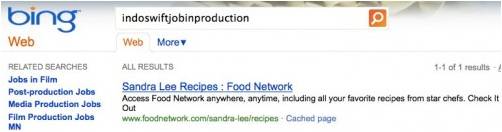
You be the judge. Here was the synthetic search result for “indoswiftjobinproduction” when entered in Google:

Source: Search Engine Land
This is the response when the same search term “indoswiftjobinproduction” was keyed in on Microsoft’s Bing search service:
Source: Search Engine Land
Coincidence? Perhaps. Likely? No.
Well, maybe lightning just struck with the “indoswiftjobinproduction” search term gibberish – why not try another?
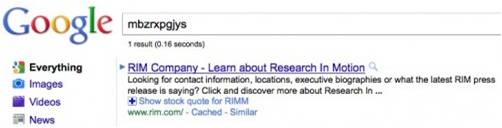
This is what Google’s search results created when “mbzrxpgjys” was entered:
Source: Search Engine Land
When the same “mbzrxpgjys” term was inputted into Microsoft’s Bing, here was the result:

Source: Search Engine Land
Hmmm, I seem to be detecting a pattern here.
Is Microsoft’s apparent copycat behavior illegal? The evidence for the moment doesn’t appear to be clear, thanks mostly to the fine-print legalese of confusing check boxes that nobody reads when downloading or using any internet service. Evidently, many Microsoft Internet Explorer (IE) users have unknowingly provided Google search information typed in through Microsoft’s IE browser, and the Redmond behemoth has been using this information to sharpen their search algorithms.
So if this behavior is not illegal, then should this activity be considered cheating? Here’s what Amit Singhal, a Google executive who oversees the company’s search engine ranking algorithm has to say about the issue:
“It’s cheating to me because we work incredibly hard and have done so for years but they just get there based on our hard work…I don’t know how else to call it but plain and simple cheating. Another analogy is that it’s like running a marathon and carrying someone else on your back, who jumps off just before the finish line.”
I’m sure this will not be the last we hear on the subject of technology and corporate cheating. As a matter of fact, in the field of intellectual property crimes, French-Japanese car giant Renault-Nissan recently brought the case of industrial espionage, corruption, theft, stolen goods, and conspiracy against three senior Renault executives. The allegations of selling crucial electric car information to the Chinese raised concerns to a feverish pitch in the tabloids because so much can be gained or lost by those involved in this estimated $2 trillion electric car market.
The committing of crimes is nothing new, but the types of new crimes are changing. In a globalized world increasingly dominated by technology, perpetrators better think twice about committing these invisible crimes. Cheating may taste sweet, until you get caught with your hand in the cookie jar.
Read More about the Google–Microsoft Tiff
Wade W. Slome, CFA, CFP®
Plan. Invest. Prosper.
DISCLOSURE: Sidoxia Capital Management (SCM) and some of its clients own certain exchange traded funds and GOOG, but at the time of publishing SCM had no direct position in MSFT, Facebook, Twitter, Renault, Nissan, or any other security referenced in this article. No information accessed through the Investing Caffeine (IC) website constitutes investment, financial, legal, tax or other advice nor is to be relied on in making an investment or other decision. Please read disclosure language on IC “Contact” page.
Bove on Goldman-Facebook Deal: Hug the Public!

In a recent research report titled, Has Goldman Learned Anything?, esteemed Rochdale Research analyst Richard Bove chimed in about the recent controversy surrounding the failed U.S. private offering of Facebook shares by Goldman Sachs (GS) to the bank’s wealthiest clients. In the note, Bove states the following:
“The company is embroiled in a ‘headline’ controversy surrounding its handling of a Facebook offering which implies that Goldman does not understand the public’s interest at all.”
Bove goes onto add:
“I fear that this company may not yet understand that those actions that do not appear to be in the public’s interest can, in fact, harm the company.”
I’m having a real difficult time understanding how Goldman privately raising funds for a private company has anything to do with the public? Am I wrong, or don’t millions of private companies raise capital every year without getting approval from Mr. Joe and Mrs. Josephine Public? What exactly does Bove want Goldman CEO Lloyd Blankfein to say to Facebook chief Mark Zuckerberg?
“Oh hello Mr. Zuckerberg, this is Lloyd Blankfein calling from Goldman Sachs, and if I understand it correctly, you are interested in raising $1.5 billion for your company. I know you are arguably the greatest internet brand on this planet, but unfortunately I do not think we can help you because I believe the broader public may not be happy with their lack of ability to participate in the offering. If you don’t have Morgan Stanley’s or JP Morgan’s phone number, just let me know because perhaps they can assist you. Have a great day!”
Come on…Goldman Sachs is not a charitable organization with a mission to make the world a better place – they are one of thousands of publicly traded companies attempting to grow profits. Sure, could Goldman have more discreetly pursued this offering without attracting the massive media barrage? Absolutely. But let’s be fair, the buzz around Facebook is deafening and the paparazzi are following Mark Zuckerberg around as closely as Raj Rajaratnam chases insider trading tips. New York Times columnist and reporter Andrew Ross Sorkin (see Too Big to Fail book review) summed it up best when he said, “You take the words Facebook and Goldman Sachs and put them in the same sentence, it becomes a media sensation unto itself. So I think this was bound to happen one way or the other.”
So while I have no reason to cheerlead for Goldman Sachs, and I’m sure there are plenty of other reasons for the investment bank to be crucified, attempting to raise money for a private company is not a felony in my book. I commend Richard Bove’s altruistic intentions in protecting the public from Goldman Sachs’s evil capital raising activities, and I may even contribute to a group hug with the mass investing public. If he catches me on the right day, I may even give CEO Lloyd Blankfein a hug.
Wade W. Slome, CFA, CFP®
Plan. Invest. Prosper.
DISCLOSURE: Sidoxia Capital Management (SCM) and some of its clients own certain exchange traded funds, but at the time of publishing SCM had no direct position in GS, MS, JPM, Facebook, or any other security referenced in this article. No information accessed through the Investing Caffeine (IC) website constitutes investment, financial, legal, tax or other advice nor is to be relied on in making an investment or other decision. Please read disclosure language on IC “Contact” page.
Winning Coaches Telling Players to Quit

How would you feel if your coach told you not only are you going to lose, but you should quit and join the other team? Effectively, that is what Loomis Sayles bond legend Dan Fuss (read Fuss Making a Fuss), and fellow colleagues Margie Patel (Wells Fargo Advantage Funds), and Anthony Crescenzi (PIMCO) had to say about the chances of bonds winning at the recent Advisors’ Money Show.
This is what Fuss said regarding “statistically cheap” equities:
“I’ve never seen it this good in half a century.”
Patel went on to add:
“By any measure you want to look at, free cash flow, dividend yield, P/E ratio – stocks look relatively cheap for the level of interest rates.” Stock offer a “once-in-a-decade opportunity to buy and make some real capital appreciation.”
Crescenzi included the following comments about stocks:
“Valuations are not risky…P/E ratios have been fine for a decade, in part because of the two shocks that drove investors away from equities and compressed P/E ratios.”
Bonds Dynasty Coming to End
The bond team has been winning for three decades (see Bubblicious Bonds), but its players are getting tired and old. Crescenzi concedes the “30-year journey on rates is near its ending point” and that “we are at the end of the duration tailwind.” Even though it is fairly apparent to some that the golden bond era is coming to a close, there are ways for the bond team to draft new players to manage duration (interest rate/price sensitivity) and protect oneself against inflation (read Drowning TIPS).
Equities on the other hand have had a massive losing streak relative to bonds, especially over the last decade. The equity team had over-priced player positions that exceeded their salary cap and the old market leaders became tired and old. Nothing energizes a new team better than new blood and new talent at a much more attractive price, which leaves room in the salary cap to get the quality players to win. There is always a possibility that bonds will outperform in the short-run despite sky-high prices, and the introduction of any material, detrimental exogenous variable (large country bailout, terrorist attack, etc.) could extend bonds’ outperformance. Regardless, investors will find it difficult to dispute the relative attractiveness of equities relative to prices a decade ago (read Marathon Investing: Genesis of Cheap Stocks).
As I have repeated in the past, bonds and cash are essential in any portfolio, but excessively gorging on a buffet of bonds for breakfast, lunch, and dinner can be hazardous for your long-term financial health. Maximizing the bang for your investment buck means not neglecting volatile equity opportunities due to disproportionate conservatism and scary economic media headlines.
There are bond coaches and teams that believe the winning streak will continue despite the 30-year duration of victories. Fear, especially in this environment, is often used as a tactic to sell bonds. Conflicts of interest may cloud the advice of these bond coaches, but the successful experienced coaches like Dan Fuss, Margie Patel, Anthony Crescenzi are the ones to listen to – even if they tell you to quit their team and join a different one.
Read Full Advisor Perspectives Article
Wade W. Slome, CFA, CFP®
Plan. Invest. Prosper.
DISCLOSURE: Sidoxia Capital Management (SCM) and some of its clients own certain exchange traded funds (including TIP), but at the time of publishing SCM had no direct position in any other security referenced in this article. No information accessed through the Investing Caffeine (IC) website constitutes investment, financial, legal, tax or other advice nor is to be relied on in making an investment or other decision. Please read disclosure language on IC “Contact” page.
The Cyclical Seasons of Growth and Value

Continually the airwaves rotate through the growth and value managers du jour, and like religious zealots each one explains their philosophy with such confidence that Jersey Shore’s “The Situation” would even call them cocky. The fact of the matter is that styles go in and out of favor like the seasons of the year. What’s more, the consistency of the seasons is erratic and the duration of the style outperformance can in many instances extend for years. A major driver behind the relative outperformance of styles links back to where we stand in the economic cycle. Since these phases can last for years, meticulous precision is not required.
Case in point, take the “Go-Go” 1990s. In the back half of the decade, while the “New Economy” of technology companies propelled GDP to new heights, growth stocks witnessed historic price appreciation and P/E (Price-Earnings) multiple expansion. As members of our growth team high-fived each other on a daily basis, the “Four Horsemen” consistently jumped 2-3% like clockwork. Simultaneously, human resources had to keep sharp objects away from our value team colleagues and make sure the windows were locked shut. As you can see from the chart, growth stocks trounced value stocks during that period.

Source: INGdelivers.com
Karma can be a bi*ch however, because as the technology bubble burst in 2000, the coiled underperforming value stocks sprang to significant outperformance in the first half of the 2000s. The value managers were more than happy to hand over the straightjackets to us growth managers.
Since these style cycles can persist for long periods of time, and we managers get compensated based on performance versus peers, there is a strong incentive to cheat or style drift towards the outperforming style (see also Hail Mary Investing).
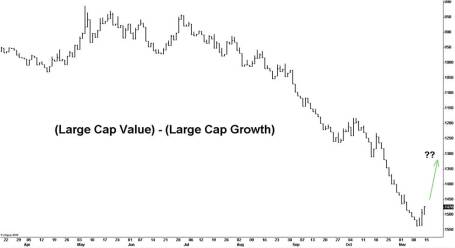
The pain threshold is increasing for value managers as the economic expansion matures and growth stocks have handily outperformed value stocks over the last five years. When value managers start piling into Apple Inc. (AAPL), maybe the value cycle will be ready to kick into gear again.

Growth consistently outperforming value (Source: Russell Investments)
- Source: Dynamic Hedge – Is value on the comeback trail?

Arbitrary Style Buckets
Understanding the dynamics of style outperformance cycles is important, but understanding how the sausage is made at the micro level is essential too. One must appreciate that style categorizations are determined by arbitrary criteria by self-anointed “bucket deciders” (i.e., S&P, Barra, Russell Investments). Like ping pong balls, individual stocks will bounce around from one style bucket to the other based largely on share price volatility and financial metrics such as Price/Book, Price/Earnings, and EPS growth. Regrettably, these metrics can become temporarily distorted and lead to irrational trading patterns for benchmark hugging managers that become myopically focused on minor deviations from the herd.
Based on the stock bucket decision criteria, some questionable head-scratching stock categorizations may occur. For examples International Business Machines (IBM) is classified as a growth stock in the Russell 1000 Growth Index despite a cheap forward 11x P/E multiple, meager 3% revenue growth, and a 2% dividend. Phillip Morris Intl (PM) is also considered a growth stock even though its revenue growth has recently been even more sluggish at 2%, and has a mouth watering value-like dividend of 4.4%.
On the flip side, stocks like Microsoft Corp. (MSFT) are thrown in the value bucket, although the software king grew revenues +25% and earnings +55% in the recent quarter. Iconic value stock Berkshire Hathaway (BRKA/B) follows many growth stocks by not paying a dividend, and the Buffett controlled entity trades at a sky-high trailing P/E multiple of 20x, and ironically expanded sales and earnings by +21% and +28%, respectively.
All this talk of style seasons and bucket hopping only highlights the boring but crucial principle of diversification. It’s important to understand these cycles and categorizations, especially at extremes, but this does not get rid of the fact that an overly concentrated portfolio concentrated in an outperforming style is setting itself up for failure (see also Riding the Wave). We’ve reviewed cycle dynamics surrounding investment styles, but these varied securities come in all shapes and sizes – we will tackle the relative performance forces of small, mid, and large capitalization stocks during another season.
Wade W. Slome, CFA, CFP®
Plan. Invest. Prosper.
DISCLOSURE: Sidoxia Capital Management (SCM) and some of its clients own certain exchange traded funds, AAPL and CSCO, but at the time of publishing SCM had no direct position in ORCL, EMC, IBM, PM, MSFT, BRKA/B, or any other security referenced in this article. No information accessed through the Investing Caffeine (IC) website constitutes investment, financial, legal, tax or other advice nor is to be relied on in making an investment or other decision. Please read disclosure language on IC “Contact” page.
Corporate Shockers: You did *#$@% to Steve Jobs?

Source: 1funny.com
Steve Jobs recruited John Sculley to run Apple Computers (AAPL) in 1983 because the board wanted someone more experienced than a snot-nosed 28 year old founder barking orders at Apple employees. Sculley was a seasoned 15 year veteran executive from Pepsi Co. (PEP) whom was persuaded by Jobs to take over the company and join him in changing the world.
Things were all nifty until Sculley went all Brutus on Jobs and decided to fire him with board assistance in 1985 when it was believed that Jobs was poaching executives from Apple to join Jobs’s successor company, Next Computers.
The verdict may not completely be out on Sculley’s effectiveness on running Apple, but he deserves a PhD in the “Obvious Arts.” When asked if the coordinated decision (between Sculley and the Board) to fire Steve Jobs more than 25 years ago was correct, this is what Sculley had to say:
“In hindsight, I think they [board] made the wrong choice. They should have chosen Steve…we should have figured out a way to work with it [Job’s talent].”
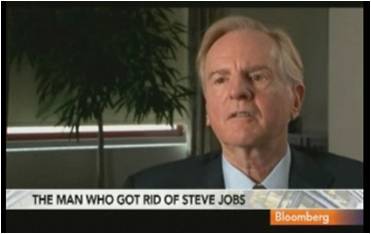
Click Here for John Sculley Bloomberg Interview
Over his term at Apple, Sculley increased sales from $800 million to $8 billion. Good performance, but apparently not good enough, because Sculley was axed in 1993 and a window was opened for Jobs to return as Apple’s puppet-master four years later. The rest is history and AAPL stock went from about $10 per share when Sculley left all the way up to $316.65 today. Not too shabby.
In another shocker, after hiring Sculley and then getting fired by Sculley, Jobs said Sculley won’t talk to him. I can’t understand why a company founder would hold a grudge toward a hand-picked former employee who spearheaded a lynching against his boss? Well, I guess karma has a way of evening things out in the long run – redemption was found with Jobs’s climbing the Silicon Valley mountain to create the $300 billion consumer technology behemoth. I’m sure you don’t have to cry a river for John Sculley, but if he can’t control his own tears, he can always use his hundred dollar bills as tissue surrogates.
What makes Jobs’s decline and subsequent triumph even more unbelievable are the hugs and kisses Steve Jobs owes Microsoft founder and billionaire Bill Gates. If not for a $150 million lifeline offered by Gates to Steve Jobs in August 1997, while Apple was on its financial deathbed, we may not have ever experienced the iPod, iPhone, iPad, or future overhyped consumer gadget (OK, I admit it, I have succumbed to the hype myself). I’m guessing if Bill were given another chance, he would have passed on that Apple investment and we would be stuck paying for $4,000 computers and $1,000 Microsoft Office upgrades.
As a result of these corporate shockers, several lessons can be learned. Number one: If you are hired by a company founder, be careful about firing that boss if put in that position – you could potentially be jeopardizing the creation of hundreds of billions of dollars in future value. Number two: If you are unable to successfully negotiate lesson number one, then just find someone to lend you $150 million. History has taught us lessons based on past events ranging from Prohibition to Watergate, and from Nazi Germany to Tiger Woods’s indiscretions. John Sculley also learned lessons from Apple’s corporate shockers, and so can you.
Wade W. Slome, CFA, CFP®
Plan. Invest. Prosper.
DISCLOSURE: Sidoxia Capital Management (SCM) and some of its clients own certain exchange traded funds and AAPL, but at the time of publishing SCM had no direct position in PEP, MSFT, or any other security referenced in this article. No information accessed through the Investing Caffeine (IC) website constitutes investment, financial, legal, tax or other advice nor is to be relied on in making an investment or other decision. Please read disclosure language on IC “Contact” page.
From Merger Wedding to eHarmony

Source: Photobucket
“Keep your eyes wide open before marriage, and half-shut afterwards.”
– Benjamin Franklin
Stocks share a lot of the same dynamics with dating and marriage. Some may choose to play the field through partnerships and joint ventures, while others may choose to remain independent as eternal bachelors/bachelorettes. Others, however, are willing to take the plunge. Unfortunately some marriages don’t last. But if things don’t work out, there is no need to worry because eHarmony.com (or resident investment bank) will always be there to help find your next perfect match.
Unlucky in Love
An example of a bloody divorce is the mega-merger between AOL Inc. and Time Warner (TWX) in 2000. The relationship was so destructive that investors witnessed AOL’s peak value of $222 billion in December 1999 (Fortune) plummet to around $3 billion today…ooooph!
Compared to some relationships, AOL lasted much longer. In fact Yahoo! Inc. (YHOO) didn’t even get to celebrate a honeymoon with Microsoft Corp. (MSFT) in February 2008 when the behemoth software company offered a +62% premium ($31 per share) for the gigantic portal. Microsoft’s $45 billion cash and stock offer was ruled unworthy by Yahoo’s board, so the company decided to leave Microsoft at the altar. Even after considering Yahoo’s latest price spike on acquisition rumors, Microsoft’s original bid is still almost double Yahoo’s current stock price of $16 per share.
Merger Scuttlebutt
As I discussed in my earlier mergers and acquisitions article (M&A) conditions are ripening with large corporate cash piles, a continued economic recovery, improved capital markets availability, and cheap credit costs (at least for those that qualify). With the clouds slowly lifting in the M&A world, suitors are shaking the trees for more potential opportunities.
While some acquirers may have altruistic intentions in combining companies, some marriages are done for pure gold-digging purposes. Private equity firms Blackstone Group (BX) and Silver Lake are rumored to be circling the Yahoo wagons and courting AOL as a potential partner in a joint bid. Whatever the expectations, if private equity plays a role in a Yahoo bid, the internet company should not become disillusioned with romantic warm and fuzzies – private equity firms like to get straight down to dirty business. Yahoo owns a 35% stake in Yahoo Japan and a 43% interest in leading Chinese e-commerce company, Alibaba Group. If a joint private equity bid were ever to win, I believe there would be a strong impetus to realize shareholder value by carving up these non-operating stakes. Consolidating overhead and streamlining expenses would likely be a top priority as well.
The Perfect Marriage
A “perfect marriage” could almost be called an oxymoron because like any relationship, there is significant work required by both parties. The divorce rate is estimated at around 40-50% in North America (Europe around the same), however mergers even fail at a higher 70% rate, according to Bain and Company study. I would argue successfully integrating larger deals are even more difficult, hampering the success rate even further. Merging two poorly managed companies purely for cost purposes is probably not the best way to go. Crashing two garbage trucks together is not going to create a Ferrari. I wouldn’t go as far as to say Yahoo and AOL are garbage trucks, but they face numerous, substantial challenges. Maybe these two companies are more akin to Mazdas transforming into a Toyota Camry (TM).
From my perspective, if companies really are dead set on engaging in acquisitions, then I urge management teams to focus on smaller digestible deals. Specifically, concentrate on those deals with experienced senior management teams who understand and respect the unique culture of the acquirer. Mergers also often fail due to excessive optimism and overly optimistic assumptions. This is an area in which Warren Buffett excels. Rarely do you observe the Oracle of Omaha overpaying for an acquisition, but rather he patiently waits for his fat pitch, and when it floats over the plate, Buffett is quick to throw out a lowball offer that will dramatically increase the probabilities of long-term merger success (think Geico, Sees Candy, Burlington Northern, etc.).
In the end, a joint relationship may not be forged between Yahoo, AOL and private equity firms, but if talks disintegrate, no need to worry – alternative partnerships can be explored on eHarmony.
Wade W. Slome, CFA, CFP®
Plan. Invest. Prosper.
DISCLOSURE: Sidoxia Capital Management (SCM) and some of its clients own certain exchange traded funds, but at the time of publishing SCM had no direct position in YHOO, MSFT, TWX, BX, BRKA, TM, Alibaba, or any other security referenced in this article. No information accessed through the Investing Caffeine (IC) website constitutes investment, financial, legal, tax or other advice nor is to be relied on in making an investment or other decision. Please read disclosure language on IC “Contact” page.
Microsoft Makes Dividend Splash

Source: ActingLikeAnimals.com
I’ve talked about growing profits and cash piles for a while now (read more), but at some point investors and board members get restless and demand action (Steve Jobs has not yet). The most recent blue-chip company to make a splash, when it comes to capital management, is Microsoft Corp. (MSFT), which just announced a significant +23% increase in its dividend in conjunction with $4.75 billion in debt offerings. These capital structure changes still leave plenty of room for additional share repurchases and acquisitions.
Debt Offering – Are You Sure?
Huh? What in the heck is Microsoft doing borrowing money? I mean, does a company with $44 billion in cash and investments, generating a whopping additional $22 billion in free cash flow in fiscal 2010 (ended in June), really need access to additional capital? The short answer is “NO.” But a company like Microsoft borrowing $4.75 billion is like Donald Trump borrowing $50 on his credit card. Well wait, “The Donald” has actually had some hair and Chapter 11 problems, so the more appropriate analogy would be Bill Gates borrowing $20 on his credit card. Not only is it a rounding error, but it’s a good financial management practice for corporations to take advantage of the debt tax shield (read definition).
What makes Microsoft’s debt issuance that much more incredible is the astonishingly low rates the company is paying investors on the debt. According to Dealogic, Microsoft set a record low for yield paid on corporate unsecured debt. For the separate maturities ranging from 2013 to 2040, Microsoft paid a stunningly low 25-83 basis point spread over Treasuries. I don’t want to get into government credit worthiness today, but who knows, maybe Microsoft will pay lower debt rates than the U.S. Treasury, in the not too distant future?!
Regardless of the array of capital structure management strategies used by other companies, Microsoft is not alone in dealing with its cash hoarding problems. Cisco Systems Inc. (CSCO), another blue-chip cash printing press, just announced the initiation of a 1-2% dividend to be paid by the end of their fiscal year ending in July 2011 (read more about dividend cash “un-hoarding”).
But Who Cares?
Who cares about Microsoft’s wimpy 2.62% yield anyway? Well, for one, I sure care! A 10-year Treasury Note is yielding a measly, static 2.55%. If Microsoft continued on the same dividend path growth over the next five years as it did over the last five years, investors could potentially be talking about a 5.2% yield on our initial investment, and this excludes any potential stock price appreciation. With only roughly a 25% payout ratio on Microsoft’s fiscal 2010 free cash flow, the company has a lot of freedom to hike future dividends, even if earnings don’t grow. Microsoft has also enhanced shareholder value by putting its money where its mouth is by purchasing over $30 billion of company stock over the last three years.
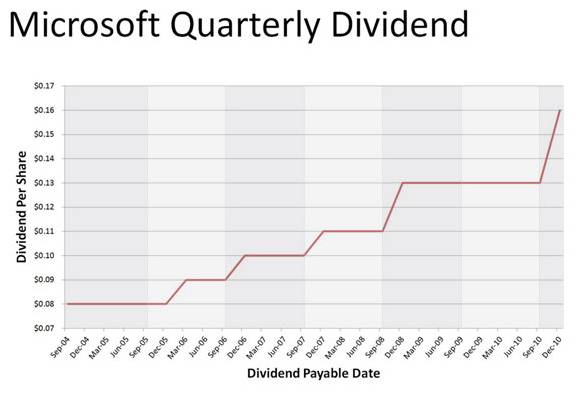
Nice trend in dividend growth.
The extreme case of dividend growth is Wal-Mart Stores (WMT), which if purchased in 1972 would provide a +2,300% yield on the original investment, excluding any benefit from the massive price appreciation ($.05 split-adjusted per share to $53.65). Microsoft is no young chick like Wal-Mart 40 years ago, but you get the gist (read Dividend Sapling to Fruit Tree).
So while strategists and economists fret about the possibilities of a “double dip” recession, in the interim there have been 179 companies in the S&P 500 index that have hiked dividends in 2010 (versus only 3 companies that have cut). Microsoft has been no slouch either, growing revenues by +22% and EPS (Earnings Per Share) by +50% in their most recent fiscal fourth quarter. Although Microsoft’s stock is down -20% for 2010, the capital management and dividend splash recently announced by Microsoft (and other companies) should eventually capture the eye of investors currently earning squat on overpriced bonds and almost worthless Certificates of Deposit.
Read complete Microsoft dividend story
Wade W. Slome, CFA, CFP®
Plan. Invest. Prosper.
DISCLOSURE: Sidoxia Capital Management (SCM) and some of its clients own certain exchange traded funds, CSCO, nd WMT, but at the time of publishing SCM had no direct position in MSFT, or any other security referenced in this article. No information accessed through the Investing Caffeine (IC) website constitutes investment, financial, legal, tax or other advice nor is to be relied on in making an investment or other decision. Please read disclosure language on IC “Contact” page.




