Posts filed under ‘Stocks’
General Motor’s Amazing Debt Trick

Now you see it, and now you don’t. General Motors claims that it has pulled off an amazing trick – the CEO of the troubled automaker, Ed Whitacre, claims in a recently released nationwide commercial, “We have repaid our government loan, in full, with interest, five years ahead of the original schedule.” (See video BELOW):
Blushing Pinocchio
Even Pinocchio would blush after listening to those statements. The loan that GM is claiming victory over is roughly $7-8 billion in TARP (Troubled Asset Relief Program) loans made from the U.S. and Canada. What Mr. Whitacre failed to acknowledge was how investors will be made whole on the whopping balance of around $45 billion.
How did GM miraculously pay off this debt? Whitacre would like taxpayers to believe booming sales or an operational turnaround has funded the debt repayment. Rather, these debt repayments were funded through other government TARP loans held in escrow with U.S. Treasury oversight. Effectively, GM has paid down one Mastercard (MA) bill with another Visa (V) credit card, and then gone on to brag about this financial shell game through a multi-million dollar advertising campaign. It’s bad enough that politicians and so-called media pundits attempt to “spin” facts into warped truths, but when a government-owned entity steps onto a national loudspeaker and spouts out blatantly distorted sound-bites, there should be consequences to these actions. American taxpayers deserve more honest accountability and transparency regarding their tax outlays rather than quarter truths.
GM’s Future
As Jedi Master Yoda’s famously quotes, “Uncertain, the future is,” and “Always in motion is the future.” GM is not out of the woods yet – the company lost $3.4 billion in the 4th quarter of 2009 alone and remains 70% government-owned. Nobody is certain how much (if any) of the $43 billion will be repaid by General Motors. For reference purposes, GM lost $88 billion from 2004 until 2009 when they declared bankruptcy (see AP article) If all goes according to plan, the former debt holders (now equity holders) and government stockholders will get a return on their capital infusions if and when GM does an equity offering to the public sometime later in 2010. If achieved, the company will have come full circle: public to bankrupt; bankrupt to private; and private to public.
While executives at GM are confident in their repayment capabilities, less convinced are certain branches of our federal government. Maybe these government agencies have taken note of the horrific train wreck occurring in the automotive industry over the last few decades (see GM Fatigue) Take for example the Office of Management and Budget, and the nonpartisan Congressional Budget Office (CBO) – they see TARP losses exceeding $100 billion, including about $30 billion from the auto companies…ouch.
The probability of success will no doubt hinge on some of the dramatic transformations made over the last year. First of all, GM has axed the number of brands in half (from eight to four), cutting Pontiac, Saturn, Hummer, and Saab. Cutting costs is great, but chopping expenses to prosperity cannot last forever – at some point you need compelling products that will drive sales. The rubber will hit the road late this year when GM is scheduled to release the “Volt,” a plug-in hybrid, which the company is using as a launching pad for new products.
TARP on Right Track but Not to Finish Line
Given the heightened political sensitivity in Washington regarding the banks and Wall Street it’s not too surprising that many of the banks wanted to be out of the governments crosshairs and pay back TARP as soon as possible. Beyond political pressure, banks have accelerated TARP repayments in part due to the massively steep and profitable yield curve, along with signs of an improving economy. According to the Treasury Department less than $200 billion in bailout money is outstanding for what originally started out as a $700 billion fund ($36 billion of automaker bailouts is estimated as uncollectible). Even though there has been progress on TARP collections, unfortunately non-TARP losses associated with AIG, Fannie Mae (FNM), and Freddie Mac (FRE) are expected to add more than $150 billion in bleeding.
I don’t believe anyone is happy about the bailouts, although some are obviously more irate. Accountability and transparency are important bailout factors as taxpayers and investors look to recover capital contributions. The next trick GM and Ed Whitacre need to pull off is paying off tens of billions in taxpayer money with the benefit of sustained profits – now that’s a television commercial I want to see.
Wade W. Slome, CFA, CFP®
Plan. Invest. Prosper.
*DISCLOSURE: Sidoxia Capital Management (SCM) and some of its clients own certain exchange traded funds and in a security derived from an AIG subsidiary, but at the time of publishing SCM had no direct positions in General Motors, AIG, FNM, FRE, MA, V, or any security referenced in this article. No information accessed through the Investing Caffeine (IC) website constitutes investment, financial, legal, tax or other advice nor is to be relied on in making an investment or other decision. Please read disclosure language on IC “Contact” page.
Digging for iPad Gold with Simplicity

We live in a hyper global competitive world, yet some companies manage to find gold while others unsuccessfully dig for their dreams. What is a major determinant of great companies? Apple Inc. (AAPL), and other companies, may include “simplicity” as a key ingredient. Take the iPad for example. Already the company has successfully exceeded iPad sales target thanks to the shrewd marketing of the simple touch-screen technology. Some call it a glorified iPhone because the iPad uses a very similar interface on a larger scale. Nonetheless, the device is getting rave reviews from the likes of US Today, The Wall Street Journal, The New York Times, Newsweek, and as Stephen Colbert smartly pointed out in his video (below), the iPad even makes salsa to boot. Many estimates point to more than a half million units sold in the first few weeks, making the 2010 estimates of 3-4 million units sold likely too low.

Competition Not a Game Killer
How much more competitive can the personal computer and cell phone markets be? According to the United Nations, we will reach 5 billion subscribers in 2010. With pricing pressure galore, and new Asian competitors popping up all over the place, how can companies grow, let alone make profits? Ever since the revolutionary iPhone was introduced in 2007, rivals have attempted to copy-cat the device. In the meantime, Apple continues to gain market share while they sit on close to $40 billion in cash, not to mention the flood of new cash rolling in the doors ($10+ billion in free cash flow generated in calendar 2009).
Innovation and the Remote Control
One key driver of profitability is innovation, but an elegant solution driven by an out-of-touch engineer with consumer demands will only lead to share losses and headaches. I mean how many times have you pulled your hair out trying to navigate through a 100-button TV remote control or screamed in frustration from attempting to learn a non-Wii videogame?
But Apple is not the only company to find simplicity in its quest for profit domination. In order to be a massive juggernaut like Apple Inc., a company’s product or service must gain mass appeal. A key determinant for mass appeal is simplicity. Beyond Apple, think of other dominant franchises that also operate in massively competitive markets like Wal-Mart Stores (WMT) in retail; Starbucks Corp. (SBUX) in coffee; Google Inc. (GOOG) in internet advertising; Coca Cola Co. (KO) in soda; Netflix Inc. (NFLX) in video rentals, among a host of other category killers. Many of these corporate giants offer products we cannot function or live without. I still find it utterly amazing that my children will never know what life was really like without an internet search on Google or a Caffe Misto Caramel Frappuccino from Starbucks.
All Good Things Come to an End
It’s not clear how much longer these titans of corporate America can thrive. By innovating new products that improve lives in some way, these Dancing Elephants will continue to prosper. But nothing in the stock market is static, so investors should pay attention to several potential derailing factors:
- Valuations: Valuations are extremely important in determining long-run appreciation potential, and chasing winners solely based on momentum (see related article) can lead to problems.
- Market Share Losses: What will be the next computer, cell phone, or e-reader killer? I don’t know right now, but eventually the day will come where these leaders will lose market share to a new kid on the block.
- Rising Costs: Competition is not the only factor in leading to slowing sales and declining profit margins. Inflation either related to labor or other input costs can crimp profits and decay investor appetites.
- Too Big to Succeed: There has been a lot of talk about “too big to fail,” but I strongly believe companies reach a point where they become “too big to succeed.” Either the law of large numbers catches up with these companies making simple math more challenging (think of the supertanker Wal-Mart growing its $400+ billion revenue base), or regulatory scrutiny kicks in (think of Microsoft Corp. [MSFT] and Intel Corp [INTC]).
Size: Peeling More of the Onion
Success can continue for these giants, however at some point “size” becomes a headwind rather than a tailwind. Just as simply as a train can speed down a railway at over 100+miles per hour, under the right conditions the train can derail as well. As Warren Buffett states, when referring to a company’s growth prospects relative to size, “Gravity always wins.”
However, investors should remind themselves that gains can last longer than expected too. Finding “ginormous” winners in many ways is like finding a needle in a haystack. But even if you find the needle in the haystack relatively late in a company’s growth cycle (see Equity Life Cycle story), in many instances there can be a lot of appreciation potential still available. Take Wal-Mart (WMT) for example. If you bought Wal-Mart shares after it rose 10-fold during its first 10 years, you still could have achieved a 60x return over the next 30 years.
Time will tell if Apple will strike additional gold with its iPad introduction, nonetheless Steve Jobs has found an element present in many long-term successful companies…simplicity.
Wade W. Slome, CFA, CFP®
Plan. Invest. Prosper.
*DISCLOSURE: Sidoxia Capital Management (SCM) and some of its clients own certain exchange traded funds and AAPL, WMT, GOOG, but at the time of publishing SCM had no direct positions in MSFT, SBUX, KO, INTC, NFLX, Nintendo or any security referenced in this article. No information accessed through the Investing Caffeine (IC) website constitutes investment, financial, legal, tax or other advice nor is to be relied on in making an investment or other decision. Please read disclosure language on IC “Contact” page.
Google: The Quiet Steamroller

As Google Inc. (GOOG) has proceeded to steamroll most of its competition on the global advertising roads, they are learning to tread a little more lightly in hopes of avoiding unneeded scrutiny. There are very few places to hide, when your company is on track to achieve more than $20 billion in annual sales and is valued at more than $175 billion in the marketplace.
As Google revenues continue to rise and they look to take over the world (including their position in China), they are enlisting others to assist them in Washington as well. Through three quarters of 2009, the company increased their lobbyist budget by 41% to approximately $3 million, according to the Associated Press (AP).
Google Eating Bite Sized Acquisitions
Ever since the controversy caused by Google’s $3.1 billion takeover of web advertising network company DoubleClick (2007 announcement), and the failed joint search agreement with Yahoo! (YHOO) in 2008 due to government and advertiser concerns, Google has decided to consume smaller bite-sized companies as part of its acquisition strategy. Over the last five months alone, Google has acquired eight different small companies (generally less than $50 million acquisition price), including the following: 1) Picknik (photo editing website); 2) reMail (mobile search applications); 3) Aardvark (social networking focus); and 4) AdMob ($750 million mobile advertising network deal). Eric Schmidt, Google CEO, has stated he would like to do one smaller-sized acquisition per month. Google management also believes they have lowered the inherent risk in these smaller deals because of legacy ties to target companies – all these sought after companies house former Google employees, says Bloomberg. In addition to remaining below the radar, the string of small deals act as a supplement to Google’s hiring practices, which can become challenging in a scarce qualified engineering hiring environment.
Microsoft Pot Calling Kettle Black
Microsoft (MSFT), the behemoth software giant with monopoly-like market share in the PC operating system market, is now fighting back against growing giant Google. This effectively amounts to the pot calling the kettle black, given Microsoft has already paid about $2.44 billion in fines to EU (European Union) relating to antitrust actions in the past 10 years, according to TechCrunch. Nonetheless, Microsoft CEO Steve Ballmer is not shy about throwing Google under the bus, stating Google is not playing fair in the search market. Furthermore, Microsoft has filed an antitrust complaint against Google in Europe as it relates to Ciao, an online shopping service powered by Microsoft, and cried foul over an agreement Google made with book publishers and authors on a separate project.
Google is not stupid. They have witnessed massive monopolistic companies like Microsoft and Intel (INTC) butt heads with regulators and pay billions in fines. Needless to say, Google will do everything in its power to avoid additional, unwanted oversight, while quietly driving their steamroller over the competition.
Wade W. Slome, CFA, CFP®
Plan. Invest. Prosper.
DISCLOSURE: Sidoxia Capital Management (SCM) and some of its clients own certain exchange traded funds and GOOG, but at time of publishing had no direct position in MSFT, INTC, YHOO, or any other security referenced. No information accessed through the Investing Caffeine (IC) website constitutes investment, financial, legal, tax or other advice nor is to be relied on in making an investment or other decision. Please read disclosure language on IC “Contact” page.
Inside the Brain of an Investing Genius

Photo Source: Boston.com
Those readers who have frequented my Investing Caffeine site are familiar with the numerous profiles on professional investors of both current and prior periods (See Profiles). Many of the individuals described have a tremendous track record of success, while others have a tremendous ability of making outrageous forecasts. I have covered both. Regardless, much can be learned from the successes and failures by mirroring the behavior of the greats – like modeling your golf swing after Tiger Woods (O.K., since Tiger is out of favor right now, let’s say Phil Mickelson). My investment swing borrows techniques and tips from many great investors, but Peter Lynch (ex-Fidelity fund manager), probably more than any icon, has had the most influence on my investing philosophy and career as any investor. His breadth of knowledge and versatility across styles has allowed him to compile a record that few, if any, could match – outside perhaps the great Warren Buffett.
Consider that Lynch’s Magellan fund averaged +29% per year from 1977 – 1990 (almost doubling the return of the S&P 500 index for that period). In 1977, the obscure Magellan Fund started with about $20 million, and by his retirement the fund grew to approximately $14 billion (700x’s larger). Cynics believed that Magellan was too big to adequately perform at $1, $2, $3, $5 and then $10 billion, but Lynch ultimately silenced the critics. Despite the fund’s gargantuan size, over the final five years of Lynch’s tenure, Magellan outperformed 99.5% of all other funds, according to Barron’s. How did Magellan investors fare in the period under Lynch’s watch? A $10,000 investment initiated when he took the helm would have grown to roughly $280,000 (+2,700%) by the day he retired. Not too shabby.
Background
Lynch graduated from Boston College in 1965 and earned a Master of Business Administration from the Wharton School of the University of Pennsylvania in 1968. Like the previously mentioned Warren Buffett, Peter Lynch shared his knowledge with the investing masses through his writings, including his two seminal books One Up on Wall Street and Beating the Street. Subsequently, Lynch authored Learn to Earn, a book targeted at younger, novice investors. Regardless, the ideas and lessons from his writings, including contributing author to Worth magazine, are still transferrable to investors across a broad spectrum of skill levels, even today.
The Lessons of Lynch
Although Lynch has left me with enough financially rich content to write a full-blown textbook, I will limit the meat of this article to lessons and quotations coming directly from the horse’s mouth. Here is a selective list of gems Lynch has shared with investors over the years:
Buy within Your Comfort Zone: Lynch simply urges investors to “Buy what you know.” In similar fashion to Warren Buffett, who stuck to investing in stocks within his “circle of competence,” Lynch focused on investments he understood or on industries he felt he had an edge over others. Perhaps if investors would have heeded this advice, the leveraged, toxic derivative debacle occurring over previous years could have been avoided.
Do Your Homework: Building the conviction to ride through equity market volatility requires rigorous homework. Lynch adds, “A company does not tell you to buy it, there is always something to worry about. There are always respected investors that say you are wrong. You have to know the story better than they do, and have faith in what you know.”
Price Follows Earnings: Investing is often unnecessarily made complicated. Lynch fundamentally believes stock prices will follow the long-term trajectory of earnings growth. He makes the point that “People may bet on hourly wiggles of the market, but it’s the earnings that waggle the wiggle long term.” In a publicly attended group meeting, Michael Dell, CEO of Dell Inc. (DELL), asked Peter Lynch about the direction of Dell’s future stock price. Lynch’s answer: “If your earnings are higher in 5 years, your stock will be higher.” Maybe Dell’s price decline over the last five years can be attributed to its earnings decline over the same period? It’s no surprise that Hewlett-Packard’s dramatic stock price outperformance (relative to DELL) has something to do with the more than doubling of HP’s earnings over the same time frame.
Valuation & Price Declines: “People Concentrate too much on the P (Price), but the E (Earnings) really makes the difference.” In a nutshell, Lynch believes valuation metrics play an important role, but long-term earnings growth will have a larger impact on future stock price appreciation.
Two Key Stock Questions: 1) “Is the stock still attractively priced relative to earnings?” and 2) “What is happening in the company to make the earnings go up?” Improving fundamentals at an attractive price are key components to Lynch’s investing strategy.
Lynch on Buffett: Lynch was given an opportunity to write the foreword in Buffett’s biography, The Warren Buffett Way. Lynch did not believe in “pulling out flowers and watering the weeds,” or in other words, selling winners and buying losers. In highlighting this weed-flower concept, Lynch said this about Buffett: “He purchased over $1 billion of Coca-Cola in 1988 and 1989 after the stock had risen over fivefold the prior six years and over five-hundredfold the previous sixty years. He made four times his money in three years and plans to make a lot more the next five, ten, and twenty years with Coke.” Hammering home the idea that a few good stocks a decade can make an investment career, Lynch had this to say about Buffett: “Warren states that twelve investments decisions in his forty year career have made all the difference.”
You Don’t Need Perfect Batting Average: In order to significantly outperform the market, investors need not generate near perfect results. According to Lynch, “If you’re terrific in this business, you’re right six times out of 10 – I’ve had stocks go from $11 to 7 cents (American Intl Airways).” Here is one recipe Lynch shares with others on how to beat the market: “All you have to do really is find the best hundred stocks in the S&P 500 and find another few hundred outside the S&P 500 to beat the market.”
The Critical Element of Patience: With the explosion of information, expansion of the internet age, and the reduction of trading costs has come the itchy trading finger. This hasty investment principle runs contrary to Lynch’s core beliefs. Here’s what he had to say regarding the importance of a steady investment hand:
- “In my investing career, the best gains usually have come in the third or fourth year, not in the third or fourth week or the third or fourth month.”
- “Whatever method you use to pick stocks or stock mutual funds, your ultimate success or failure will depend on your ability to ignore the worries of the world long enough to allow your investments to succeed.”
- “Often, there is no correlation between the success of a company’s operations and the success of its stock over a few months or even a few years. In the long term, there is a 100% correlation between the success of a company and the success of its stock. It pays to be patient, and to own successful companies.”
- “The key to making money in stocks is not to get scared out of them.”
Bear Market Beliefs: “I’m always more depressed by an overpriced market in which many stocks are hitting new highs every day than by a beaten-down market in a recession,” says Lynch. The media responds in exactly the opposite manner – bear markets lead to an inundation of headlines driven by panic-based fear. Lynch shares a similar sentiment to Warren Buffett when it comes to the media holding a glass half full view in bear markets.
Market Worries: Is worrying about market concerns worth the stress? Not according to Lynch. His belief: “I’ve always said if you spend 13 minutes a year on economics, you’ve wasted 10 minutes.” Just this last March, Lynch used history to drive home his views: “We’ve had 11 recessions since World War II and we’ve had a perfect score — 11 recoveries. There are a lot of natural cushions in the economy now that weren’t there in the 1930s. They keep things from getting out of control. We have the Federal Deposit Insurance Corporation [which insures bank deposits]. We have social security. We have pensions. We have two-person, working families. We have unemployment payments. And we have a Federal Reserve with a brain.”
Thoughts on Cyclicals: Lynch divided his portfolio into several buckets, and cyclical stocks occupied one of the buckets. “Cyclicals are like blackjack: stay in the game too long and it’s bound to take all your profit,” Lynch emphasized.
Selling Discipline: The rationale behind Lynch’s selling discipline is straightforward – here are some of his thoughts on the subject:
- “When the fundamentals change, sell your mistakes.”
- “Write down why you own a stock and sell it if the reason isn’t true anymore.”
- “Sell a stock because the company’s fundamentals deteriorate, not because the sky is falling.”
Distilling the genius of an investing legend like Peter Lynch down to a single article is not only a grueling challenge, but it also cannot bring complete justice to the vast accomplishments of this incredible investment legend. Nonetheless, his record should be meticulously studied in hopes of adding jewels of investment knowledge to the repertoires of all investors. If delving into the head of this investing mastermind can provide access to even a fraction of his vast knowledge pool, then we can all benefit by adding a slice of this greatness to our investment portfolios.
Wade W. Slome, CFA, CFP®
Plan. Invest. Prosper.
DISCLOSURE: Sidoxia Capital Management (SCM) and some of its clients own certain exchange traded funds, but at time of publishing had no direct positions in DELL, KO, HPQ or any other security mentioned. No information accessed through the Investing Caffeine (IC) website constitutes investment, financial, legal, tax or other advice nor is to be relied on in making an investment or other decision. Please read disclosure language on IC “Contact” page.
Dancing Elephants in a Challenging Economy

To many, the significant rebound in global equity markets, since the March 2009 price lows, has merely been a dead-cat bounce or simply a temporary “sugar high” from the extraordinary fiscal and monetary measures taken by governments all over the world. John Authers, columnist at the Financial Times, captures that cycnical view in his daily column. He believes we are on the cusp of financial dynamics that will “drive a bear market for another two decades.” Ouch – pretty harsh outlook.
Perception Can Differ from Reality
Throughout much of 2009, the better than anticipated corporate results were rationalized as improvements only coming from discretionary cost-cutting. Well, as of last week, 73% of the S&P 500 companies that reported quarterly results exceeded earnings expectations, with 70% surpassing revenue estimates as well. With the 9.7% unemployment improving (at least temporarily), the recovery cannot solely be attributed to cost-cuts.
In the midst of the economic recovery (+5.7% growth in Q4 GDP), other animals beyond deceased felines have joined the party, including dancing elephants. More than seven million jobs have been lost since the late-2007 recession began, yet a broad set of companies have thrived through this horrible environment. The bubble economy has certainly had a disproportionately negative impact on particular areas of the economy (e.g., housing, credit, and automobiles). However, in the midst of the global credit tsunami that engulfed us over the last two years, the largest global economic engine (U.S.A.) was still churning out about $14 trillion in the sales of goods and services. Many companies that were not reliant on the financial and credit markets used their superior competitive positioning to generate significant piles of cash. Instead of piling on additional debt (or diluting owners through share offerings), certain corporations tightened their belts, invested prudently, and stepped on the throats of other irresponsible and reckless competitors, which were forced to recoil back into their caves and bunkers.
Dancing Elephants
Times are tough, right? If that is indeed the case, let’s take a look at a few elephants that are trouncing the competition, even under extremely challenging economic circumstances:
Apple Inc. (AAPL) – Revenue growth +32% ($182 billion market capitalization): In the recent quarter, Apple pounded the competition by selling a boatload of electronic goods, including iPhones, iPods, and Mac computers. Next up, the iPad!
Amazon.com Inc. (AMZN) – Revenue growth +42% – ($53 billion market capitalization): In the fourth quarter ending December, Amazon pulverized peers in a cutthroat holiday by selling lots of Kindles (e-reader), growing +49% internationally, and adding a new Zappos.com shoe and accessory acquisition. Organic revenue growth (ex-Zappos) was still incredibly strong at about +23%.
Corning Inc. (GLW) – Revenue growth +41% – ($28 billion market capitalization): Results were buoyed by demand for its liquid crystal display (LCD) glass as consumers continued purchasing LCD televisions, laptop computers, and other electronic devices. In addition, GLW experienced a resurgence in demand for its emissions control products as the auto industry rebuilt supply. Telecom orders in China were solid also.
Google Inc. (GOOG) – Revenue growth +17% – ($169 billion market capitalization): In addition to the growth in the global search advertising market and YouTube video platform, Google also accelerated the deployment of their mobile platform, including their Android cell phone operating system, and concentrated on the expansion of the display advertising market.
Gilead Sciences Inc. (GILD) – Revenue growth +42% – ($42 billion market capitalization): Growth was catapulted by GILD’s dominant HIV/AIDS product franchise, including Atripla, Truvada, and Viread. Pulmonary arterial hypertension drug Letairis and chronic angina treatment Ranexa also contributed to stellar results.
Intuitive Surgical Inc. (ISRG) – Revenue growth +40% – ($13 billion market capitalization): This cutting-edge surgical equipment manufacturer enjoyed robust expansion from continued robotic procedure adoption and higher da Vinci Surgical System sales.
Intel Corp. (INTC) – Revenue growth +28% – ($113 billion market capitalization): The company’s semiconductor sales growth was fairly broad based across its major segments (Data Center, Intel architecture, Atom Microprocessor/Chipset) as demand recovered and depleted inventories were replenished globally.
Netflix Inc. (NFLX) – Revenue growth +24% – ($3.5 billion market capitalization): Netflix added more than one million new customers in the quarter as they continued to eat Blockbuster’s-BBI (and other competitors’) lunch. In addition, the company’s streaming “Watch Instantly” service continues to gain traction.
Although I do currently own a few of these companies, do NOT interpret this partial list of companies as “buy” recommendations – in fact, some of these stocks may be excellent “short” ideas. Regardless of how sexy growth may be, investors should never ignore valuation (read more about valuation). As stated at the beginning of the article, I mainly want to emphasize that trillions of commerce dollars are being transacted, even in demanding economic times. It just goes to show, one can turn lemons into lemonade. Or said differently, even elephants can be trained to dance.
Wade W. Slome, CFA, CFP®
Plan. Invest. Prosper.
DISCLOSURE: Sidoxia Capital Management (SCM) and some of its clients own certain exchange traded funds and AAPL, AMZN, and GOOG, but at time of publishing had no direct positions in GLW, GILD, ISRG, INTC, BBI, and NFLX. No information accessed through the Investing Caffeine (IC) website constitutes investment, financial, legal, tax or other advice nor is to be relied on in making an investment or other decision. Please read disclosure language on IC “Contact” page.
Metrics Mix-Up: Stocks and Real Estate Valuation

When it comes to making money, investors choose from a broad menu of investment categories, ranging all the way from baseball cards and wines to collectible cars and art. Two of the larger and more popular investment categories are stocks and real estate. Unfortunately for those poor souls (such as me) analyzing these two classes of assets, the stock and real estate investor bigwigs have not come together to create an integrated metric system. Much the same way the United States has chosen to go it alone on a proprietary customary unit measurement system with Burma and Liberia – choosing inches and feet over centimeters and meters. On the subject of stock and real estate valuation, investors and industry professionals have been stubbornly defiant in designing unique and cryptic terminology, despite sharing the exact same financial principles.
Who Cares About Real Estate?
Well, apparently everyone. Southern California doesn’t have a monopoly on real estate, but through my practice in Orange County, I find it difficult to not trip over real estate investors on a daily basis. I work in effectively what was “ground zero” of the subprime debacle and the commercial real estate pains continue to ripple through “the OC.”
Ramping up the real estate learning curve reminds me of my high school Spanish class – I understood enough Spanish to work my way through a Taco Bell menu but little else. In order to actually learn Spanish I had to completely immerse myself in the language, even if it meant continually speaking to my classmates in Spanish through my alias (Paco).
Real Estate Foundational Terms
Despite being a relative new resident in the Orange County area, engrossing myself in real estate hasn’t been much of a challenge. Over a brief period, my interactions and conversations taught me my financial degrees and credentials were just as applicable in the realty world as they were in the stock market world. While evaluating real estate valuation techniques, I discovered two new key terms:
1) NOI (Net Operating Income): Unlike stock analysis, which uses “Net Income” as a core driver in determining an asset’s value, real estate relies on NOI. Net operating income is generally derived by calculating income before depreciation and interest expense. In finance, there are many versions of income. I’m sure there are more explanations, but two reasons behind the selection of NOI in real estate valuation over other metrics is due to the following: a) NOI may be used as a proxy for cash flow, which can be integral in many valuation techniques; and b) NOI is “capital structure neutral” if comparing multiple properties. Therefore, NOI allows an investor to compare varying properties on an apples-to-apples basis regardless of whether a property is massively leveraged or debt-free.
2) Cap Rate (Capitalization Rate): This ratio is computed by taking the NOI and dividing it by a property’s initial cost (or value). In stock market language, you can think of a “cap rate” as an inverted P/E (Price – Earnings) ratio – an inverted P/E ratio has also been called the “earnings yield.” Complicating terminology matters is the interchangeable use of income and earnings in the investment world. In the case of the P/E ratio, the denominator generally used is “Net Income.”
A shortcoming to the cap rate ratio, in my view, is the failure to deduct taxes. Although comparability across properties may get muddied, if determining profit availability to investors is the main goal, then I think an adjusted NOI (subtracting taxes) would be a more useful proxy for valuation purposes. Tax benefits associated with REITS (Real Estate Investment Trusts) complicates the metric usage issue further.
The simplistic beauty of marrying NOI and a cap rate is that a crude valuation estimate can be constructed by merely blending these two metrics together. For example, a commercial real estate property generating $500,000 in NOI that applies a 5% cap rate to the property can arrive at a valuation estimate of $10,000,000 ($500,000/.05).
Similarities between Stocks & Real Estate
At the end of the day, the theoretical value of ANY asset can be calculated by taking the projected after-tax cash flows and discounting that stream back into today’s dollars – whether we are talking about a stock, bond, derivative, real estate property, or other asset. Both stock and real estate analysis use readily available income numbers and price ratios to estimate cash flows and valuations. Regrettably, since real estate and equity investors generally play in different leagues, the rules and language are different.
The lingo used for analyzing separate asset classes may be unique, but the math and fundamental examination are the same. The formula for learning real estate is similar to that of Spanish – you need to dive in and immerse yourself into the new language. If you don’t believe me, just ask Paco.
Wade W. Slome, CFA, CFP®
Plan. Invest. Prosper.
DISCLOSURE: Sidoxia Capital Management (SCM) and some of its clients own certain exchange traded funds, but at the time of publishing had no direct positions in YUM or any other security mentioned. No information accessed through the Investing Caffeine (IC) website constitutes investment, financial, legal, tax or other advice nor is to be relied on in making an investment or other decision. Please read disclosure language on IC “Contact” page.
Sports & Investing: Why Strong Earnings Can Hurt Stock Prices

There are many similarities between investing in stocks and handicapping in sports betting. For example, investors (bettors) have opposing views on whether a particular stock (team) will go up or down (win or lose), and determine if the valuation (point spread) is reflective of the proper equilibrium (supply & demand). And just like the stock market, virtually anybody off the street can place a sports bet – assuming one is of legal age and in a legal betting jurisdiction.
Right now investors are poring over data as part of the critical, quarterly earnings ritual. Thus far, roughly 20% of the companies in S&P 500 index have reported their results and 78% of those companies have beaten Wall Street expectations (CNBC). Unfortunately for the bulls, this trend has not been strong enough to push market prices higher in 2010.
So how and why can market prices go down on good news? There are many reasons that short-term price trends can diverge from short-run fundamentals. One major reason for the price-fundamental gap is the following factor: expectations. Just last week, the market had climbed over +70% in a ten month period, before issues surrounding the Massachusetts Senatorial election, President Obama’s banking reform proposals, and Federal Reserve Bank Chairman Ben Bernanke’s re-appointment surfaced. With such a large run-up in the equity markets come loftier expectations for both the economy and individual companies. So when corporate earnings unveiled from companies like Google (GOOG), J.P. Morgan (JPM), and Intel (INTC) outperform relative to forecasts, one explanation for an interim price correction is due to a significant group of investors not being surprised by the robust profit reports. In sports betting lingo, the sports team may have won the game this week, but they did not win by enough points (“cover the spread”).
Some other reasons stock prices move lower on good news:
- Market Direction: Regardless of the underlying trends, if the market is moving lower, in many instances the market dip can overwhelm any positive, stock- specific factors.
- Profit Taking: Many times investors holding a long position will have price targets or levels, if achieved, that will trigger selling whether positive elements are in place or not.
- Interest Rates: Certain valuation techniques (e.g. Discounted Cash Flow and Dividend Discount Model) integrate interest rates into the value calculation. Therefore, a climb in interest rates has the potential of lowering stock prices – even if the dynamics surrounding a particular security are excellent.
- Quality of Earnings: Sometimes producing winning results is not enough (see also Tricks of the Trade article). On occasion, items such as one-time gains, aggressive revenue recognition, and lower than average tax rates assist a company in getting over a profit hurdle. Investors value quality in addition to quantity.
- Outlook: Even if current period results may be strong, on some occasions a company’s outlook regarding future prospects may be worse than expected. A dark or worsening outlook can pressure security prices.
- Politics & Taxes: These factors may prove especially important to the market this year, since this is a mid-term election year. Political and tax policy changes today may have negative impacts on future profits, thereby impacting stock prices.
- Other Exogenous Items: Natural disasters and security attacks are examples of negative shocks that could damage price values, irrespective of fundamentals.
Certainly these previously mentioned issues do not cover the full gamut of explanations for temporary price-fundamental gaps. Moreover, many of these factors could be used in reverse to explain market price increases in the face of weaker than anticipated results.
For those individuals traveling to Las Vegas to place a wager on the NFL Super Bowl, betting on the hot team may not be enough. If expectations are not met and the hot team wins by less than the point spread, don’t be surprised to see a decline in the value of the bet.
Wade W. Slome, CFA, CFP®
Plan. Invest. Prosper.
DISCLOSURE: Sidoxia Capital Management (SCM) and some of its clients own certain exchange traded funds and GOOG, but at the time of publishing had no direct positions in JPM and INTC. No information accessed through the Investing Caffeine (IC) website constitutes investment, financial, legal, tax or other advice nor is to be relied on in making an investment or other decision. Please read disclosure language on IC “Contact” page.
The Invisible Giant

Bruce Berkowitz has not exactly been a household name (he apparently is not even Wikipedia-worthy). With his boyish looks, nasally voice, and slicked-back hair, one might mistake Berkowitz for a graduate student. However, his results are more than academic, which explains why this invisible giant was recently named the equity fund manager of the decade by Morningstar. It’s difficult to argue with long-term results, especially in the roller coaster market like we’ve experienced over the last ten years. The Fairholme Fund (FAIRX) fund earned a 13% annualized return over the ten-year period ending in 2009, beating the S&P 500 index by an impressive 14%.
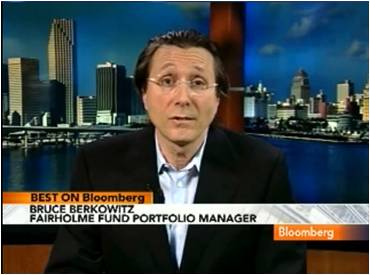 Click here to view Bloomberg invterview with Bruce Berkowitz
How He Did It
Berkowitz states the stellar performance was achieved by
“Ignoring the crowd and going towards stressed areas that many people are running from…We make our judgments based on the cash that securities generate.”
Fairholme is effectively a “go anywhere” fund that adheres tightly to the value-based philosophy. Berkowitz’s portfolio is centered on equity securities, but his team has also shown willingness to go up and down the capital structure, if they find value elsewhere.
The Fund and its History
Berkowitz started the fund in 1999 as an extension of his separate account business, which was created in his previous life at Smith Barney and Lehman Brothers. The Fairholme fund tends to concentrate around 15 to 25 securities on average, with some holdings accounting for more than 10% of the portfolio. An example of Fairholmes concentration is evidenced by its favorably timed trade in the energy sector, which resulted in a 35% weighting in the fund. Fortunately Berkowitz redeployed that winning position – before energy prices cratered in 2008 – into unloved areas like healthcare and defense stocks.
Berkowitz models his investment style after Warren Buffett, focused on good businesses with prolific cash flows. Like many value investors, Berkowitz fishes for contrarian based ideas residing in pockets of the market that are out of favor. He also likes to have a significant weighting in “special situations,” which are limited to about 25% of the portfolio. In order to take advantage opportunities, Berkowitz is not shy or bashful about carrying around a good chunk of cash in his pocket. He likes to keep about 15% on average to scoop up out of favor opportunities.
The Future of Fairholme
I commend Berkowitz for his admirable record, but I caution investors to not go hog wild over outperforming funds. He has crushed the market over an extremely challenging investment period, but investors need to remember that “mean reversion,” the tendency for a trend to move towards averages, applies to investing styles too. Concentrated, go-anywhere, large cap value, market timing funds that outperform for ten years at a time may underperform or outperform less dramatically over the next ten years. Just ask Bill Miller (see also Bill Miller Revenge of the Dunce article), concentrated value manager at Legg Mason, about mean reversion. Miller beat the market for 15 consecutive years before recently ending up in the bottom 10-year decile (1-star Morningstar rated) after some bad concentrated bets and poor investment timing. Another challenge for Fairholme is size (currently around $10.5 billion in assets under management). Having managed a multi-billion fund myself (see also my book), I can attest to the complexities Berkowitz faces in managing a much larger fund now.
Regardless, Berkowitz’s performance should not be ignored given his sound philosophy and achievement over an unprecedented period. Already, just a few weeks into 2010, Fairholme is ranked #1 in its fund category by Morningstar.
This is one invisible man you should not let disappear off your radar.
Wade W. Slome, CFA, CFP®
Plan. Invest. Prosper.
DISCLOSURE: Sidoxia Capital Management (SCM) and some of its clients own certain exchange traded funds, but at time of publishing had no direct positions in FAIRX, LM, BRKA/B or MORN. No information accessed through the Investing Caffeine (IC) website constitutes investment, financial, legal, tax or other advice nor is to be relied on in making an investment or other decision. Please read disclosure language on IC “Contact” page.
Google vs. China: Running Away from 660 Million Eyeballs?

Wait, let me get this straight. Google, the $185 billion behemoth that wants to take over the world is seriously considering turning its back on a rapidly growing cluster of 660 million eyeballs (330 million Chinese internet users according to BusinessWeek)? After hitting their head on an obscenely high market share in the U.S. (67% search share based on Nielsen data) and looking for new geographies to expand, I’m supposed to believe Google will walk away from the third largest economy on this planet (see China: Trade of the Century)? The explanation given for Google’s capitulation is discontent related to unknown hackers and censorship concerns. If that’s not enough, this alleged saint-like posturing comes after Google sold its censorship soul for years, before seeing the free speech light. Although the company’s mission is to “do no evil,” Google had no qualms aggressively poaching Microsoft (MSFT) miracle maker, Kai-Fu Lee, to kick-start their Chinese presence. If free speech is truly at the root of the Google’s unease, then why wait four whole years and a hack-attack before laying down an ultimatum on the Chinese government?
I Smell a Rat
In a blog post written by Google’s Chief Legal Officer, David Drummond, the company explains how their iron curtain digital defense was bent but not broken:
“We have evidence to suggest that a primary goal of the attackers was accessing the Gmail accounts of Chinese human rights activists. Based on our investigation to date we believe their attack did not achieve that objective. Only two Gmail accounts appear to have been accessed, and that activity was limited to account information (such as the date the account was created) and subject line, rather than the content of emails themselves.”
I’m no exterminator, but I smell a rat. All this feels a lot more like politics and business tactics then it does an altruistic display of free-speech martyrdom. The Chinese government and Google executives know what is at risk, as they both play a high stakes game of “chicken.”
Google goes onto say:
“As part of our investigation we have discovered that at least twenty other large companies from a wide range of businesses–including the Internet, finance, technology, media and chemical sectors–have been similarly targeted.”
I’m confused. These unknown hackers attacked 20 different companies and only unsuccessfully cracked two Gmail accounts. The evidence sounds pretty harmless on the surface, if this language is representative of reality. Maybe I’m wrong, and a foiled cyber-attack is reason enough to cease operations in a country inhabiting a potential 1.3 billion customers.
Sure China represents a relatively small portion of Google’s revenues (estimated at less than $1 billion and a single digit percentage of revenues), but Google would be insane to walk away from this massive long-term growth market, even if Baidu (BIDU) is currently eating their lunch. Although Google has a smaller #2 position in China, it still has a respectable 35.6% search market share (according to BusinessWeek).
Not Just About Search – Cell Phones Too
Even if they claimed they were throwing in the white towel on their Chinese search business, I don’t think they really want to flush their newly minted cell phone prospects down the toilet. Even if 275 million or so cell phone users in the U.S. is fertile ground for Google to target their new Android-based phones, I’m guessing they have penciled out the gigantic mobile potential of the rapidly expanding 700 million+ Chinese mobile phone user market.
While I can’t take the scenario of Google ceasing China operations off the table, I consider the chance of Google shutting its doors in China significantly less than 50%. While the bold Google statement of feasibility review regarding their Chinese business existence has gained a lot of attention, I think calmer heads will eventually prevail and Google will resume their targeting of 660 million Chinese eyeballs. Who knows, the high stake game of “chicken” may even benefit their bottom-line as they win the hearts and minds of more future free-speech users.
DISCLOSURE: Sidoxia Capital Management (SCM) and some of its clients own GOOG shares and China based exchange traded funds at the time of this article’s publishing, but did not have a direct position in MSFT and BIDU shares. No information accessed through the Investing Caffeine (IC) website constitutes investment, financial, legal, tax or other advice nor is to be relied on in making an investment or other decision. Please read disclosure language on IC “Contact” page.
NVEC: Profiting from Electronic Eyes, Nerves & Brains

Recently, Seeking Alpha Editor-in-Chief Mick Weinstein interviewed me with the purpose of reviewing an equity investment I find attractive. For the “stock-jock” Investing Caffeine followers, I am publishing the January 5th interview below.
What is your highest conviction stock position in your fund – long or short?
I don’t really have a highest conviction stock, per se, in my fund since I treat all my stocks like children – I love them all. Having said that, NVE Corp. (ticker: NVEC) is a holding of mine that exhibits many of the characteristics I look for in an investment. The Eden Prairie, Minnesota based company is named after “Nonvolatile Electronics,” which refers to memory technology that retains data even when power is removed – a critical attribute for certain applications.
Tell us a bit about the company and what it does.
NVE Corp. is a market leader in nanotechnology sensors, couplers, and MRAM intellectual property (Magnetoresistive Random Access Memory). NVE’s microscopic technology enables the transmission, acquisition, and storage of data across a broad array of applications, including implantable medical devices, mission critical defense weapons, and industrial robots. Major customers include: St. Jude Medical, Inc. (STJ), Starkey Laboratories, Inc., and the U.S. Government.
The company’s coupler and sensor businesses have been ridiculously profitable. Even over a period covering one of the worst global financial crisis in decades, NVE managed to increase its operating margins from an already very respectable 40% range in Fiscal 2007 (ending March) to a stunning 56%+ level in Fiscal 2009.
Beyond sensors and couplers, NVE Corp. is optimistic about the potential for the MRAM market. However, outside of a few one-time licensing fees, NVE is currently generating effectively $0 revenues from this nascent storage technology. Outside of producing small MRAM devices for niche applications such as tamper prevention, NVE Corp. is looking to leverage their IP portfolio by licensing out the patents and subsequently receiving royalties from MRAM device manufacturers. MRAM technology uses magnetic fields to record information, but unlike tape recorders in which a short section of tape holds magnetic information, with MRAM data is held by electrons with out the need of moving parts to read or write data. Believe it or not, this method is highly reliable and is very power-efficient relative to other storage technology alternatives. Currently, the problem with MRAM is the cost prohibitive manufacturing requirements relative to other memories (such as DRAM, SRAM, and Flash), but costs are expected to come down over time. For some MRAM believers, the technology is considered the “Holy Grail” because it may have the potential to combine the speed of SRAM, the density of DRAM, and the non-volatility of Flash memory in a universal source.
If the unproven potential of MRAM ever blossoms, the broad portfolio of NVE Corp.’s MRAM patents should represent a very sizeable profit opportunity. Of course, NVE Corp. must first establish the validity of its MRAM intellectual property and appropriately charge and collect royalties for IP usage. How big can the MRAM market be? Some size the MRAM market in the billions and Toshiba has stated they expect the MRAM market to surpass the size of the traditional memory markets by 2015.
No matter how one measures the size of the market, there will be a substantial revenue opportunity for NVE Corp. if every smart-phone, gaming device and laptop exclusively uses universal MRAM – rather than a combination of DRAM, SRAM, and Flash technologies.
Can you talk a bit about the industry/sector? How much is this an “industry pick” as opposed to a pure bottom-up pick?
Generally speaking, I am a bottom-up investor. I may have concrete views on a particular industry, but the fundamentals of a company will be the main determinant of my investment thesis. Overall, I am looking for market leading franchises that can sustain above-average growth rates for extended periods of time. These traits can come from either a company operating in a mature, sleepy industry (take for example Google in the advertising world) or from a more dynamic growth industry like nanotechnology in the case of NVE Corp.
I believe the nanotechnology industry is in the very early innings of an innovation revolution with regard to new applications and products. Like semiconductors, the economies of scale and technological advances of NVE Corp.’s “spintronic” technology should continually allow faster, smaller, more reliable solutions at lower bit prices. In my view, this snowballing effect will only increase the penetration of nanotechnology solutions and introduce an ever increasing list of new applications.
Can you describe the company’s competitive environment? How is this company positioned vis a vis its competitors?
NVE Corp. has competitors along all three of its spintronic businesses. In their sensor business, most of the competition comes from the makers of legacy electromechanical magnetic sensors, including HermeticSwitch, Inc., Meder Electronic AG (Germany), and Memscap SA (France).
In the coupler space, NVE Corp. faces a larger list of well capitalized, household semiconductor names, including Avago (AVGO), Fairchild Semiconductor International (FCS), NEC Corporation, Sharp Corporation, Toshiba Corporation, Vishay Intertechnology (VSH), Analog Devices, Inc. (ADI), Silicon Laboratories Inc. (SLAB), and Texas Instruments Incorporated (TXN).
A different set of competitors are searching for the MRAM holy grail, including the following companies: Crocus Technology SA (France), Grandis, Inc., MagSil Corporation, Spintec (France), Spintron (France), Spintronics Plc (UK), and IBM.
There is undoubtedly a ton of competition in the spintronics space, but as of October 2009, NVE Corp. has 52 issued U.S. patents and over 100 patents worldwide (either issued, pending, or licensed from others) – many focused on the potentially lucrative MRAM field. Although NVE Corp. has many competitors, they have dominant share in the coupler/sensor market when it comes to high-end, merchant supplied solutions. Moreover, on the MRAM side of the business, the company has already licensed its intellectual property to several companies, including Cypress Semiconductor (CY), Honeywell International Inc. (HON), and Motorola, Inc. (MOT).
Can you talk about valuation? How does valuation compare to the competitors?
Valuation is a key component for all my stock investments. In my valuation work I pore over the income statement, balance sheet and cash flow statement in deriving my price targets.
One area helping NVE Corp.’s valuation case is its improving trend-line of profitability. Over the last 5 years alone, gross margins have gone from 40% to over 70% – not a bad business model if you can execute it. The company also has a pristine balance sheet. Not only does NVE Corp. have no debt, but it also is sitting on a growing mound of cash/investments (over $43 million), representing more than 20% of the company’s market capitalization. Lastly, the company in my view is attractively priced on a free cash flow basis (cash from operations minus capital expenditures), yielding around 6% of the total company value.
What is the current sentiment on the stock? How does your view differ from the consensus?
With small cap stocks like NVE Corp., sentiment and lack of liquidity can create gut-wrenching volatility. Unlike many growth investors who pay more attention to positive momentum factors (price direction), I welcome volatility as it allows me to find more attractive entry and exit points.
With that said, NVE Corp. hit a peak stock price north of $63 per share in early September fueled by 41% revenue growth in their June quarter (fiscal Q1). Subsequently, in fiscal Q2 (ending September 30th), revenue growth decelerated to +14% causing momentum investors to take NVE Corp.’s shares to the woodshed. With the stock down about -35% from its recent crest, I find the valuation only that much more attractive.
Wall Street estimates are calling for further slowing in revenue growth in the coming quarter, so the short term sentiment may or may not continue to sour? Timing bottoms is inherently dangerous and not something I consider myself an expert at. Absent a major deterioration in fundamentals, I stand ready to add to my position if NVE Corp.’s share price falls and valuation metrics improve.
I would argue the typical consensus view advocates selling shares when revenue growth slows. Many of my best performing stocks have been purchased during transitory periods of slowing or cyclical downturns. Let’s hope that’s the case with NVE Corp.
Does the company’s management play a role in your position? If so, how?
Absolutely. There is a continual debate over what is more important, the jockey or the horse? My investment philosophy puts more weight on the jockey than the horse. Obviously, I’m looking for the combination of a talented management team and a solid business model.
When it comes to NVE Corp., Daniel Baker, Ph.D. has done a phenomenal job managing the hyper-growth profile of the company, while preserving prudent and conservative financial values. For the third year in a row, Dr. Baker was also recognized as one of the best U.S. CEOs in the semiconductors and semiconductor equipment industry by investment research and financial consulting firm DeMarche Associates.
At the end of the day, it’s difficult to argue with a track record of success. Since Dr. Baker took over, revenues have more than tripled and earnings have grown from $0.05 in fiscal 2001 to $2.04 in Fiscal 2009.
What catalysts do you see that could move the stock?
Since I hold a longer term investment horizon, catalysts are not a driving aspect to my investment process. But clearly, any additional evidence unearthed in the marketplace validating the growth in the MRAM market, or announcements confirming the value of NVE Corp.’s MRAM intellectual property, should provide support to the stock price.
Beyond that, given where the stock is trading now, I believe merely continuing the execution on their sensor and coupler business provides adequate upside prospects.
What could go wrong with this stock pick?
Investing in small cap technology stocks comes with a whole host of risks. Although I don’t believe the positive scenario of critical mass MRAM commercialization is baked into the current stock price, nevertheless I understand any setbacks announced relative to NVE Corp.’s MRAM prospects or the industry’s MRAM expectations, will likely result in stock price pressure.
NVE also has significant customer concentration, therefore a loss or cutback in sales from a lead customer will probably contribute to price volatility.
From a macro perspective, the company has battled successfully through the economic crisis and proven itself somewhat recession resistant. Nonetheless, the company has sizeable exposure to the industrial segment and would not be immune from the “double-dip” economic recession scenario.
Surely there are additional hazards to this investment, however these are some of the risks I am currently focused on.
Do you have any closing thoughts?
NVE Corp. is not a stock for the faint of heart. However, for those who can stomach the volatility, I encourage you to do some more homework on NVE Corp. Not only will you learn about a phenomenally managed, very profitable, attractively priced nanotechnology company, but you will also gain insight into a leading force behind the eyes, nerves, and brains powering the electronic systems of our future.
Wade W. Slome, CFA, CFP®
Plan. Invest. Prosper.
DISCLOSURE: Sidoxia Capital Management (SCM) and some of its clients own shares in NVEC (and certain exchange traded funds), but did not have any direct positions in the following companies or stocks mentioned in this article at time of publication: STJ, HermeticSwitch, Inc., Meder Electronic AG, and Memscap SA, AVGO, FCS, NEC Corporation, Sharp Corporation, Toshiba Corporation, VSH, ADI, SLAB, TXN, Crocus Technology SA, Grandis, Inc., MagSil Corporation, Spintec, Spintron, and Spintronics Plc, IBM, CY, HON, and MOT. No information accessed through the Investing Caffeine (IC) website constitutes investment, financial, legal, tax or other advice nor is to be relied on in making an investment or other decision. Please read disclosure language on IC “Contact” page.