Posts filed under ‘Stocks’
Marathon Investing: Genesis of Cheap Stocks

It was Mark Twain who famously stated, “The reports of my death have been greatly exaggerated.” So too has the death of equities been overstated. Long-term stock bulls don’t have a lot to point to since the market, as measured by the S&P 500 index, has done absolutely nothing over the last 12 years (see Lost Decade). Over the last 10 years, the market is actually down about -20% without dividends (and about flat if you account for reinvested dividends). So if equities belong at the morgue, why not just short the market, burn your dollars, and hang out in a cave with a pile of gold? Well, behind the scenes, and off the radar of nanosecond, high frequency, day-trading CNBC junkies, there has been a quiet but deliberate strengthening in the earnings foundation of the market. In the investing world it’s difficult to move forward through sand. Even without a sturdy running foundation, sprinters can race to the front of the pack, but those disciplined runners who systematically train for marathons are the ones who successfully make it to the finish line.
Prices Chopped in Half
What many pundits and media mavens fail to recognize is S&P corporate profits have virtually doubled since 1998 (a historically elevated base), despite market prices stuck in quicksand for a dozen years. What does this say about the valuation of the market when prices go nowhere and profits double? Simple math tells us that all stock market inventory is selling for -50% off (the market multiple has been chopped in half). That’s exactly what we have seen – the June 1998 market multiple (valuation) stood around 27x’s earnings and today’s 2010 earnings estimates imply a multiple of about 13.5 x’s projected profits. With the rear-view mirror assisting us, it’s easy to understand why pre-2000 (tech bubble) valuations were expensive. By coupling more reasonable valuations with a 10-Year Treasury Note trading at 3.19% and lofty bond prices, I would expect stocks to be poised for a much better decade of relative performance versus bonds. The case becomes even stronger if you believe 2011 S&P 500 estimates are achievable (12x’s earnings).
In order to make the decade long valuation contraction more apparent, I wanted include a random group of stocks (mixture of healthcare, media, retailer, consumer non-discretionary, and financial services) to liven up my argument:
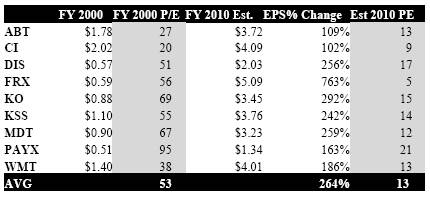
Data sources: S&P, ADVFN & Yahoo! Finance
What Next?
From a stock market standpoint, there are certainly plenty of believable “double dip” scenarios out there along with thoughtful observers who question the attainability of next year’s earnings forecasts. With that said, I do have problems with those bears like John Mauldin (read The Man Who Cries Wolf) who just last year pointed to a market trading at a “(negative) -467” P/E ratio, only to subsequently watch stocks advance some 80%+ over the following months.
Regardless of disparate economic views, I contend objective market observers (even bearish ones) have trouble indicating the market is ridiculously expensive with a straight face – based on current corporate profit expectations. At the end of the day, sustainable earnings and cash flow growth are what ultimately drive durable, long-term price appreciation. As Peter Lynch stated with technical precision, “People may bet on hourly wiggles of the market but it’s the earnings that waggle the wiggle long term.”
Running a marathon is always challenging, but with a sturdy foundation in which prices have been chopped in half (see also Market Dipstick article), reaching the goal and finish line for long-term investors will be much more achievable.
Wade W. Slome, CFA, CFP®
Plan. Invest. Prosper.
*DISCLOSURE: Sidoxia Capital Management (SCM) and some of its clients own certain exchange traded funds, WMT, and PAYX, but at the time of publishing SCM had no direct positions in ABT, CI, DIS, FRX, KO, KSS, MDT or any other security referenced in this article. No information accessed through the Investing Caffeine (IC) website constitutes investment, financial, legal, tax or other advice nor is to be relied on in making an investment or other decision. Please read disclosure language on IC “Contact” page.
Microchip: Selling Electronic Cake Mix to the World

Microchip Technology Inc. (MCHP) is not in the business of selling cakes. Rather, Microchip is more akin to a chef selling cake mix in the form of microcontrollers to hungry designers with a sweet tooth. All that the customers need to do is add some water to the mix, and voila they have all the ingredients necessary to make a cake.
Endless Opportunities
Making a cake may sound simple, but the real magic comes as a result of the baking chef exploring the endless possibilities across colors, flavors, sizes, frostings, and accessories. The microcontroller business is similar in many respects. Microchip provides the essential tools (ingredients) to efficiently and cost-effectively build solutions for an almost infinite number of applications. Microcontrollers can be found in a diverse mix of products and gizmos, ranging in size from an iPod Nano (AAPL) and Tickle Me Elmo toy to a Whirlpool (WHR) washing machine and a butt-warming car seat in a Porsche 911 Turbo. From a verticals standpoint, Microchip services more than 60,000 customers globally (75% of revenues internationally) in the automotive, aerospace, communications, computing, consumer, and industrial control markets, among others.
What the Heck is a Microcontroller?
You can think of a microcontroller as a computer-on-a-chip, and these mini-computers, which are embedded into all types of applications, allow designers to create all types of products. The low-cost computer chips handle simple functions such as turning products on and off and setting speeds in consumer products, cars, telecommunications and office equipment. More specifically, these microcontrollers provide designers with the ability to introduce or expand functionality, reduce power consumption, and create further efficient designs, thereby potentially leading to lower costs and higher profits. Even though talking about the digital world of 1’s and 0’s sounds sexy, in the real world we are surrounded by analog factors like time, temperature, sound, music, and video – analog functions that require the heavy lifting of a microcontroller to process digital data after it has been converted from analog.
These microcontrollers aren’t multi-hundred dollar microprocessors manufactured in multi-billion fabrication facilities at Intel Corp. (INTC) – rather these more mundane (although essential) components sell often for a few bucks each. What’s more, the pricing in microcontroller and analog land is more stable at Microchip relative to the annual -20-30% price cuts common in the microprocessor world.
On top of performance (speed, power, heat, etc.) and cost, ease of design is a way Microchip gains market share away from competitors through its PIC architecture – the software platform that designers program Microchip’s microcontrollers. The company devotes extensive resources to spreading the PIC gospel to designers around the world and Microchip engineers are constantly upgrading the programming software. To date, Microchip has almost shipped 1,000,000 development tools to designers and developers. The software and design kits add to the company’s revenues, but the real profitability kicks in when the customers reorder chips related to multiyear product life cycles. For example, you can think of a television company that must order a microcontroller for a five-year old, broken TV remote control that a child stepped on…hmm, sounds familiar.
Expanding Pie (or Cake)
This is no puny market; the overall microcontroller segment of the semiconductor market is estimated to have generated $10.7 billion in sales during 2009. Microchip has managed to not only become the 800 pound gorilla in the 8-bit microcontroller space, but in recent years they have also made significant headroom in the higher functionality/performance markets of 16-bit and 32-bit microcontrollers. In total, Microchip offers its customers more than 650 flavors of its microcontroller products.
One would think the company is busy enough with its core microcontroller business, but Microchip is not sitting on its hands. They are employing a Velcro strategy by attaching other embedded features on its “computer-on-a-chip,” including analog, memory, DSP (digital signal processing), and other capabilities. Already, Microchip’s analog business has grown to more than 10% of the company’s revenues (about 600 analog products and > 14,000 customers), and Microchip’s foray into the digital signal controller sector (dsPIC product family) is expanding the company’s total addressable market as well. Consistent with this Velcro strategy, Microchip recently purchased Silicon Storage Technology Inc. (SST) for $354 million, focusing on SST’s high margin flash memory licensing business. Thanks to shrewd negotiating and jettisoning of non-core SST segments, the deal will solidify Microchip’s embedded solution positioning and is expected to add $.14 – $.18 cents to Microchip’s 2011 earnings per share (EPS).
The Head Chef
The head chef of the technology kitchen is Steve Sanghi, and in 1990 (after 10 years of employment at Intel Corp.), when he took over as President of Microchip, the kitchen was a complete mess. Not only was the company losing money, but they were spread too thin across disparate technologies. His accomplishments were recognized immediately and Sanghi became CEO shortly thereafter in 1991. Microchip, which was originally founded in 1989 as a spinoff from General Instrument, eventually went public in 1993. Despite a tough technology market post the technology crash of 2000, Microchip has managed to gain market share from struggling competitors like Atmel Corp. (ATML). Under Sanghi’s leadership, Microchip has more than doubled profits over the last decade and sales have almost multiplied 12-fold to $950 million since the company went public 17 years ago.
Cash Machine
Besides pumping out microcontrollers, Microchip pumps out a lot of cash as well. In their recently completed fiscal year (ending in March), the company generated close to $400 million in free cash flow (cash from operations minus capital expenditures), by my definition. With a market capitalization of around $5 billion this relationship implies an almost 8% free cash flow yield – a bit nicer than the 3.17% yield recently offered on the federal government’s 10-year Treasury Note. Microchip’s cash metrics look even that much more impressive when you consider the company has more than $1.1 billion in net cash piled up on the balance sheet. Since the capital intensity of the microcontroller and analog businesses is so much less demanding than the microprocessor world, Microchip has plenty of flexibility in paying a nice, big fat, 5%+ dividend (about $1.37 per share annually), which has increased modestly in each of the last three quarters. On a Price-Earnings basis (P/E), Microchip’s share price is currently trading at an attractive 13 x’s the company’s $2.11 consensus Earnings-Per-Share (EPS) estimate.
Risks
Microchip is not a risk-free Treasury investment and the company faces significant cyclical sensitivity to global macroeconomic trends, as we saw in fiscal 2009 (ending March). The pace of global design activity will generally be responsive to overall business confidence. In spite of Microchip’s dominance in the 8-bit market, some skeptics also question Microchip’s ability to gain market share in the 16-bit and 32-bit markets.
In addition to those concerns, another hazard relates to the company overpaying for future, potential acquisitions. Traditionally Microchip has focused on internal growth, however in recent years the company’s appetite for acquisitions has increased – most notably the failed merger of Atmel Corporation for roughly $2.3 billion in early 2009. If history serves as a guide, Microchip has been prudent in acquisitions – for example, the timely $183 million purchase of Gresham, Oregon manufacturing plant in 2002 for cents on the dollar or the recent opportunistic and accretive SST deal.
Momentum and Visibility Improving
With the global upturn occurring, Microchip has seen a +189% increase in its backlog (orders in hand for future delivery) to $528 million. Having these orders in hand allows Microchip to plan and invest more appropriately for growth in the coming year. Fourth quarter sales (without SST’s contribution) increased by more than +60% from last year and Non-GAAP earnings mushroomed by more than +200% on a year-over-year basis.
The ease and affordability of new product design will be an accelerating trend of new product proliferation. As I wrote in an earlier article (Revenge of David), the simplicity of design has become dramatically easier. A laptop and internet connection affords any designer the ability of downloading free design software, building a prototype with a 3-D printer, ordering Chinese manufacturing services through Taobao.com (parent Alibaba Group), and waiting for UPS to deliver the product to their doorstep in fairly short order. This design tailwind only serves to increase demand for Microchip’s microcontroller solutions over time.
Ever since the company’s IPO (Initial Public Offering), Microchip has had a phenomenal track record of success led by Steve Sanghi’s direction. Microchip is a much more mature company since going public in 1993 at a stock price of $0.57 per share (split-adjusted), but if the stock price can appreciate a fraction of the +4,623% already achieved, then my clients and I should be able to purchase a lot of cake mix.
Wade W. Slome, CFA, CFP®
Plan. Invest. Prosper.
*DISCLOSURE: Sidoxia Capital Management (SCM) and some of its clients own certain exchange traded funds, MCHP, AAPL, and Treasury securities, but at the time of publishing SCM had no direct positions in WHR, Porsche, Volkswagen, INTC, ATML, SST, UPS, General Instrument, or any other security referenced in this article. No information accessed through the Investing Caffeine (IC) website constitutes investment, financial, legal, tax or other advice nor is to be relied on in making an investment or other decision. Please read disclosure language on IC “Contact” page.
Stocks…Bonds on Steroids

With all the spooky headlines in the news today, it’s no wonder everyone is piling into bonds. The Investment Company Institute (ICI), which tracks mutual fund data, showed -88% of the $14 billion in weekly outflows came from equity funds relative to bonds and hybrid securities. With the masses flocking to bonds, it’s no wonder yields are hovering near multi-decade historical lows. Stocks on the other hand are the Rodney Dangerfield (see Doug Kass’s Triple Lindy attempt) of the investment world – they get “no respect.” By flipping stock metrics upside down, we will explore how hated stocks can become the beloved on steroids, if viewed in the proper context.
Davis on Debt Discomfort
Chris Davis, head of the $65 billion in assets at the Davis Funds, believes like I do that navigating the “bubblicious” bond market will be a treacherous task in the coming years. Davis directly states, “The only real bubble in the world is bonds. When you look out over a 10-year period, people are going to get killed.” In the short-run, inflation is not a real worry, but it if you consider the exploding deficits coupled with the exceedingly low interest rates, bond investors are faced with a potential recipe for disaster. Propping up the value of the dollar due to sovereign debt concerns in Greece (and greater Europe) has contributed to lower Treasury rates too. There’s only one direction for interest rates to go, and that’s up. Since the direction of bond prices moves the opposite way of interest rates, mean reversion does not bode well for long-term bond holders.
Earnings Yield: The Winning Formula
Average investors are freaked out about the equity markets and are unknowingly underestimating the risk of bonds. Investors would be in a better frame of mind if they listened to Chris Davis. In comparing stocks and bonds, Davis says, “If people got their statement and looked at the dividend yield and earnings yield, they might do things differently right now. But you have to be able to numb yourself to changes in stock prices, and most people can’t do that.” Humans are emotional creatures and can find this a difficult chore.
What us finance nerds learn through instruction is that a price of a bond can be derived by discounting future interest payments and principle back to today. The same concept applies for dividend paying stocks – the value of a stock can be determined by discounting future dividends back to today.
A favorite metric for stock jocks is the P/E (Price-Earnings) ratio, but what many investors fail to realize is that if this common ratio is flipped over (E/P) then one can arrive at an earnings yield, which is directly comparable to dividend yields (annual dividend per share/price per share) and bond yields (annual interest/bond price).
Earnings are the fuel for future dividends, and dividend yields are a way of comparing stocks with the fixed income yields of bonds. Unlike virtually all bonds, stocks have the ability to increase dividends (the payout) over time – an extremely attractive aspect of stocks. For example, Procter & Gamble (PG) has increased its dividend for 54 consecutive years and Wal-Mart (WMT) 37 years – that assertion cannot be made for bonds.
As stock prices drop, the dividend yields rise – the bond dynamics have been developing in reverse (prices up, yields down). With S&P 500 earnings catapulting upwards +84% in Q1 and the index trading at a very reasonable 13x’s 2010 operating earnings estimates, stocks should be able to outmuscle bonds in the medium to long-term (with or without steroids). There certainly is a spot for bonds in a portfolio, and there are ways to manage interest rate sensitivity (duration), but bonds will have difficulty flexing their biceps in the coming quarters.
Read the full article on Chris Davis’s bond and earnings yield comments
Wade W. Slome, CFA, CFP®
Plan. Invest. Prosper.
*DISCLOSURE: Sidoxia Capital Management (SCM) and some of its clients own certain exchange traded funds and WMT, but at the time of publishing SCM had no direct positions in PG, or any other security referenced in this article. No information accessed through the Investing Caffeine (IC) website constitutes investment, financial, legal, tax or other advice nor is to be relied on in making an investment or other decision. Please read disclosure language on IC “Contact” page.
Goldman: Gambling Prosperity at Client Expense?

What a scene that 11-hour Senate subcommittee interrogation of Goldman Sachs (GS) executives was on C-Span – I’m still wondering whether a forklift was utilized to hoist in the multi-thousand page binders stuffed with reams of exhibits. With caffeine beverage firmly in hand, I watched as much of the marathon as possible until fatigue set in. Not all was lost though, because I managed to simultaneously conduct new stock research as I was glued to the hearings. After I saw the Goldman executives repeatedly wrestle open the gargantuan-sized binders of smoking-gun emails, I checked the paper futures markets and am now contemplating a purchase of International Paper’s (IP) stock.
Lead trader of the controversial Abacus/John Paulson deal, “Fabulous Fab” Fabrice Tourre, did not disappoint his supporters either, firmly addressing his responses in his French Pepe Le Pew accent. His Goldman trading counterparts (Daniel Sparks, ex-mortgage department head, Joshua Birnbaum, ex-managing director of the department, and Michael Swenson, current managing director of the department), like all Goldman witnesses, did their best at bobbing and weaving the intrusive, pointed questions. On the cozier side of the questioning fence, the Senators did a superb job of raking the Goldman execs over the coals with endless exhibits of emails. Judging by the shiny, sweating mugs of the traders, the Senators were successful in making the testifiers uncomfortable – either that, or the Senators had the thermostat in the room raised to 82 degrees.
Betting Away to Profits
At the heart of the questioning was the key issue of whether Goldman Sachs executives and employees were acting in the best interest of their clients (fiduciary duty), or were they making bets against clients with the benefit of privileged information. Senator Claire McCaskill compared Goldman to a bookie manipulating bets in their own favor without sharing their edge with bettors (investors). In the case of the Abacus deal, Goldman admits to not freely disclosing the involvement of now-famous, mortgage market short seller John Paulson (see the Gutsiest Trade) to the so-called sophisticated institutional investors, ACA Capital Holdings Inc. Was this lack of disclosure illegal? Perhaps unethical, but pundits have already established the high hurdle the SEC (Securities and Exchange Commission) will need to clear in order to prove Goldman’s guilt.
Based on the testimony and facts introduced in the hearings, and as I write in my previous Goldman article (Goldman Cheat?), Goldman’s behavior throughout the housing collapse and participation in the ACA deal reflects more about intelligent opportunism within a loose regulatory framework than it does about criminal behavior. Having managed a $20 billion fund (see my book) I dealt with the conflicts of interest and self dealings of the investment banks first hand. As I entered trade orders reaching into the millions of shares, do I naively believe Goldman and other banks altruistically kept that information in their trading vaults? Or is it possible that information leaked out to other clients or was used for the banks benefit? Suffice it to say, the regulatory structure and conflict of interest frameworks, as they stand today, are not stacked in favor of investors.
The Solutions
Although we wish our regulators and government officials could have been more forward looking, rather than reactive, nonetheless, some reforms need to be instituted to resolve the substantial risks built into our financial system today. Here are a few ideas from the 10,000 foot level:
Volcker Rule: Former Federal Reserve Chairman’s so-called “Volcker Rule” is looking better by the minute. Not a new concept, but as regulators shine the light on the opaque industry of derivatives trading and proprietary trading desks, the need for new reforms becomes even more evident. Derivatives are not evil (see Financial Engineering), but like a gun or knife, if misused these instruments can become extremely dangerous…as we have found out. The Glass-Steagall Act, which separated investment bank functions from commercial bank functions, was repealed almost 70 years after its introduction in 1932. The Volcker Rule would be a “lite” version of Glass-Steagall Act because the thrust of the proposal is aimed at splitting the risk-taking proprietary trading desk activities from the client based activities.
Heightened Capital: If you rented out an exotic car or motorcycle from a store, you would likely be required to commit a deposit or collateral to protect against adverse conditions. The same principle applies to derivatives, which generally raises volatility due to inherent leverage. The riskier the product, the larger the capital requirement should be. The collapse of Bear Stearns, Lehman Brothers, and AIG are painful lessons learned from situations of excessive leverage.
Central Clearing/Transparency: Derivative products such as options, futures, and swaps have existed for decades. The transparency gained by trading these securities on exchanges increases market confidence, thereby increasing liquidity and lowering costs for end-users. Standardization around complex derivatives like CDOs (Collateralized Debt Obligations), CDSs (Credit Default Swaps), and CLOs (Collateralized Loan Obligations) is a must to ensure the fact regulators can actually understand the products they are regulating.
Credit Rating Agency: It’s not entirely clear to me that the rating agencies play a critical role in the market place. In effect, the agencies serve as an outsourced research resource primarily for fixed income investors. If the agencies disappeared today, investors would be forced to do their own homework on each deal – not necessarily a bad idea. If the existing oligopoly structure of agencies ultimately survives, I suggest penalties should be incurred by firms with inaccurate ratings. Conversely, ratings could be structured such that compensation could be tiered (or escrowed) over time with payment incentives tied to the underlying deal performance relative to ratings accuracy.
Too Big To Fail: The massive bailouts and TARP (Troubled Asset Relief Program) money handed out to the financial and auto companies have left a sour taste in taxpayers’ mouths. A systemic risk regulator with the authority to unwind unhealthy institutions makes common sense. An insurance pool financed by self-inflicted industry taxes would assist regulators in achieving the reduction of troubled financial institutions.
Fiduciary Duty: Sidoxia Capital Management is a Registered Investment Advisor (RIA) and must act in the best interests of the client. Unfortunately, much of the industry is structured with a much lower “suitability” threshold, which provides a veil for firms to engage in less than ethical behavior.
Overall, regulatory reform urgency is in the Washington D.C. air and there is no question in my mind that a certain degree of witch hunting and scapegoating is occurring. Nonetheless, Lloyd Blankfein and team Goldman Sachs made it out alive from the Congressional hearing, but not without suffering some negative reputational damage. Former Goldman CEO alum and Treasury Secretary Henry Paulson probably sent roses to Mr. Blankfein thanking him for taking Paulson’s job before the 2008 market collapse. When regulatory reform eventually kicks in, perhaps Lloyd Blankfein and Henry Paulson will take a trip to Las Vegas to celebrate (or commiserate).
Wade W. Slome, CFA, CFP®
Plan. Invest. Prosper.
*DISCLOSURE: Sidoxia Capital Management (SCM) and some of its clients own certain exchange traded funds and in a security derived from an AIG subsidiary, but at the time of publishing SCM had no direct positions in GS, IP, AIG, JPM/Bear Stearns, LEH/Barclays or any security referenced in this article. No information accessed through the Investing Caffeine (IC) website constitutes investment, financial, legal, tax or other advice nor is to be relied on in making an investment or other decision. Please read disclosure language on IC “Contact” page.
General Motor’s Amazing Debt Trick

Now you see it, and now you don’t. General Motors claims that it has pulled off an amazing trick – the CEO of the troubled automaker, Ed Whitacre, claims in a recently released nationwide commercial, “We have repaid our government loan, in full, with interest, five years ahead of the original schedule.” (See video BELOW):
Blushing Pinocchio
Even Pinocchio would blush after listening to those statements. The loan that GM is claiming victory over is roughly $7-8 billion in TARP (Troubled Asset Relief Program) loans made from the U.S. and Canada. What Mr. Whitacre failed to acknowledge was how investors will be made whole on the whopping balance of around $45 billion.
How did GM miraculously pay off this debt? Whitacre would like taxpayers to believe booming sales or an operational turnaround has funded the debt repayment. Rather, these debt repayments were funded through other government TARP loans held in escrow with U.S. Treasury oversight. Effectively, GM has paid down one Mastercard (MA) bill with another Visa (V) credit card, and then gone on to brag about this financial shell game through a multi-million dollar advertising campaign. It’s bad enough that politicians and so-called media pundits attempt to “spin” facts into warped truths, but when a government-owned entity steps onto a national loudspeaker and spouts out blatantly distorted sound-bites, there should be consequences to these actions. American taxpayers deserve more honest accountability and transparency regarding their tax outlays rather than quarter truths.
GM’s Future
As Jedi Master Yoda’s famously quotes, “Uncertain, the future is,” and “Always in motion is the future.” GM is not out of the woods yet – the company lost $3.4 billion in the 4th quarter of 2009 alone and remains 70% government-owned. Nobody is certain how much (if any) of the $43 billion will be repaid by General Motors. For reference purposes, GM lost $88 billion from 2004 until 2009 when they declared bankruptcy (see AP article) If all goes according to plan, the former debt holders (now equity holders) and government stockholders will get a return on their capital infusions if and when GM does an equity offering to the public sometime later in 2010. If achieved, the company will have come full circle: public to bankrupt; bankrupt to private; and private to public.
While executives at GM are confident in their repayment capabilities, less convinced are certain branches of our federal government. Maybe these government agencies have taken note of the horrific train wreck occurring in the automotive industry over the last few decades (see GM Fatigue) Take for example the Office of Management and Budget, and the nonpartisan Congressional Budget Office (CBO) – they see TARP losses exceeding $100 billion, including about $30 billion from the auto companies…ouch.
The probability of success will no doubt hinge on some of the dramatic transformations made over the last year. First of all, GM has axed the number of brands in half (from eight to four), cutting Pontiac, Saturn, Hummer, and Saab. Cutting costs is great, but chopping expenses to prosperity cannot last forever – at some point you need compelling products that will drive sales. The rubber will hit the road late this year when GM is scheduled to release the “Volt,” a plug-in hybrid, which the company is using as a launching pad for new products.
TARP on Right Track but Not to Finish Line
Given the heightened political sensitivity in Washington regarding the banks and Wall Street it’s not too surprising that many of the banks wanted to be out of the governments crosshairs and pay back TARP as soon as possible. Beyond political pressure, banks have accelerated TARP repayments in part due to the massively steep and profitable yield curve, along with signs of an improving economy. According to the Treasury Department less than $200 billion in bailout money is outstanding for what originally started out as a $700 billion fund ($36 billion of automaker bailouts is estimated as uncollectible). Even though there has been progress on TARP collections, unfortunately non-TARP losses associated with AIG, Fannie Mae (FNM), and Freddie Mac (FRE) are expected to add more than $150 billion in bleeding.
I don’t believe anyone is happy about the bailouts, although some are obviously more irate. Accountability and transparency are important bailout factors as taxpayers and investors look to recover capital contributions. The next trick GM and Ed Whitacre need to pull off is paying off tens of billions in taxpayer money with the benefit of sustained profits – now that’s a television commercial I want to see.
Wade W. Slome, CFA, CFP®
Plan. Invest. Prosper.
*DISCLOSURE: Sidoxia Capital Management (SCM) and some of its clients own certain exchange traded funds and in a security derived from an AIG subsidiary, but at the time of publishing SCM had no direct positions in General Motors, AIG, FNM, FRE, MA, V, or any security referenced in this article. No information accessed through the Investing Caffeine (IC) website constitutes investment, financial, legal, tax or other advice nor is to be relied on in making an investment or other decision. Please read disclosure language on IC “Contact” page.
Digging for iPad Gold with Simplicity

We live in a hyper global competitive world, yet some companies manage to find gold while others unsuccessfully dig for their dreams. What is a major determinant of great companies? Apple Inc. (AAPL), and other companies, may include “simplicity” as a key ingredient. Take the iPad for example. Already the company has successfully exceeded iPad sales target thanks to the shrewd marketing of the simple touch-screen technology. Some call it a glorified iPhone because the iPad uses a very similar interface on a larger scale. Nonetheless, the device is getting rave reviews from the likes of US Today, The Wall Street Journal, The New York Times, Newsweek, and as Stephen Colbert smartly pointed out in his video (below), the iPad even makes salsa to boot. Many estimates point to more than a half million units sold in the first few weeks, making the 2010 estimates of 3-4 million units sold likely too low.

Competition Not a Game Killer
How much more competitive can the personal computer and cell phone markets be? According to the United Nations, we will reach 5 billion subscribers in 2010. With pricing pressure galore, and new Asian competitors popping up all over the place, how can companies grow, let alone make profits? Ever since the revolutionary iPhone was introduced in 2007, rivals have attempted to copy-cat the device. In the meantime, Apple continues to gain market share while they sit on close to $40 billion in cash, not to mention the flood of new cash rolling in the doors ($10+ billion in free cash flow generated in calendar 2009).
Innovation and the Remote Control
One key driver of profitability is innovation, but an elegant solution driven by an out-of-touch engineer with consumer demands will only lead to share losses and headaches. I mean how many times have you pulled your hair out trying to navigate through a 100-button TV remote control or screamed in frustration from attempting to learn a non-Wii videogame?
But Apple is not the only company to find simplicity in its quest for profit domination. In order to be a massive juggernaut like Apple Inc., a company’s product or service must gain mass appeal. A key determinant for mass appeal is simplicity. Beyond Apple, think of other dominant franchises that also operate in massively competitive markets like Wal-Mart Stores (WMT) in retail; Starbucks Corp. (SBUX) in coffee; Google Inc. (GOOG) in internet advertising; Coca Cola Co. (KO) in soda; Netflix Inc. (NFLX) in video rentals, among a host of other category killers. Many of these corporate giants offer products we cannot function or live without. I still find it utterly amazing that my children will never know what life was really like without an internet search on Google or a Caffe Misto Caramel Frappuccino from Starbucks.
All Good Things Come to an End
It’s not clear how much longer these titans of corporate America can thrive. By innovating new products that improve lives in some way, these Dancing Elephants will continue to prosper. But nothing in the stock market is static, so investors should pay attention to several potential derailing factors:
- Valuations: Valuations are extremely important in determining long-run appreciation potential, and chasing winners solely based on momentum (see related article) can lead to problems.
- Market Share Losses: What will be the next computer, cell phone, or e-reader killer? I don’t know right now, but eventually the day will come where these leaders will lose market share to a new kid on the block.
- Rising Costs: Competition is not the only factor in leading to slowing sales and declining profit margins. Inflation either related to labor or other input costs can crimp profits and decay investor appetites.
- Too Big to Succeed: There has been a lot of talk about “too big to fail,” but I strongly believe companies reach a point where they become “too big to succeed.” Either the law of large numbers catches up with these companies making simple math more challenging (think of the supertanker Wal-Mart growing its $400+ billion revenue base), or regulatory scrutiny kicks in (think of Microsoft Corp. [MSFT] and Intel Corp [INTC]).
Size: Peeling More of the Onion
Success can continue for these giants, however at some point “size” becomes a headwind rather than a tailwind. Just as simply as a train can speed down a railway at over 100+miles per hour, under the right conditions the train can derail as well. As Warren Buffett states, when referring to a company’s growth prospects relative to size, “Gravity always wins.”
However, investors should remind themselves that gains can last longer than expected too. Finding “ginormous” winners in many ways is like finding a needle in a haystack. But even if you find the needle in the haystack relatively late in a company’s growth cycle (see Equity Life Cycle story), in many instances there can be a lot of appreciation potential still available. Take Wal-Mart (WMT) for example. If you bought Wal-Mart shares after it rose 10-fold during its first 10 years, you still could have achieved a 60x return over the next 30 years.
Time will tell if Apple will strike additional gold with its iPad introduction, nonetheless Steve Jobs has found an element present in many long-term successful companies…simplicity.
Wade W. Slome, CFA, CFP®
Plan. Invest. Prosper.
*DISCLOSURE: Sidoxia Capital Management (SCM) and some of its clients own certain exchange traded funds and AAPL, WMT, GOOG, but at the time of publishing SCM had no direct positions in MSFT, SBUX, KO, INTC, NFLX, Nintendo or any security referenced in this article. No information accessed through the Investing Caffeine (IC) website constitutes investment, financial, legal, tax or other advice nor is to be relied on in making an investment or other decision. Please read disclosure language on IC “Contact” page.
Google: The Quiet Steamroller

As Google Inc. (GOOG) has proceeded to steamroll most of its competition on the global advertising roads, they are learning to tread a little more lightly in hopes of avoiding unneeded scrutiny. There are very few places to hide, when your company is on track to achieve more than $20 billion in annual sales and is valued at more than $175 billion in the marketplace.
As Google revenues continue to rise and they look to take over the world (including their position in China), they are enlisting others to assist them in Washington as well. Through three quarters of 2009, the company increased their lobbyist budget by 41% to approximately $3 million, according to the Associated Press (AP).
Google Eating Bite Sized Acquisitions
Ever since the controversy caused by Google’s $3.1 billion takeover of web advertising network company DoubleClick (2007 announcement), and the failed joint search agreement with Yahoo! (YHOO) in 2008 due to government and advertiser concerns, Google has decided to consume smaller bite-sized companies as part of its acquisition strategy. Over the last five months alone, Google has acquired eight different small companies (generally less than $50 million acquisition price), including the following: 1) Picknik (photo editing website); 2) reMail (mobile search applications); 3) Aardvark (social networking focus); and 4) AdMob ($750 million mobile advertising network deal). Eric Schmidt, Google CEO, has stated he would like to do one smaller-sized acquisition per month. Google management also believes they have lowered the inherent risk in these smaller deals because of legacy ties to target companies – all these sought after companies house former Google employees, says Bloomberg. In addition to remaining below the radar, the string of small deals act as a supplement to Google’s hiring practices, which can become challenging in a scarce qualified engineering hiring environment.
Microsoft Pot Calling Kettle Black
Microsoft (MSFT), the behemoth software giant with monopoly-like market share in the PC operating system market, is now fighting back against growing giant Google. This effectively amounts to the pot calling the kettle black, given Microsoft has already paid about $2.44 billion in fines to EU (European Union) relating to antitrust actions in the past 10 years, according to TechCrunch. Nonetheless, Microsoft CEO Steve Ballmer is not shy about throwing Google under the bus, stating Google is not playing fair in the search market. Furthermore, Microsoft has filed an antitrust complaint against Google in Europe as it relates to Ciao, an online shopping service powered by Microsoft, and cried foul over an agreement Google made with book publishers and authors on a separate project.
Google is not stupid. They have witnessed massive monopolistic companies like Microsoft and Intel (INTC) butt heads with regulators and pay billions in fines. Needless to say, Google will do everything in its power to avoid additional, unwanted oversight, while quietly driving their steamroller over the competition.
Wade W. Slome, CFA, CFP®
Plan. Invest. Prosper.
DISCLOSURE: Sidoxia Capital Management (SCM) and some of its clients own certain exchange traded funds and GOOG, but at time of publishing had no direct position in MSFT, INTC, YHOO, or any other security referenced. No information accessed through the Investing Caffeine (IC) website constitutes investment, financial, legal, tax or other advice nor is to be relied on in making an investment or other decision. Please read disclosure language on IC “Contact” page.
Inside the Brain of an Investing Genius

Photo Source: Boston.com
Those readers who have frequented my Investing Caffeine site are familiar with the numerous profiles on professional investors of both current and prior periods (See Profiles). Many of the individuals described have a tremendous track record of success, while others have a tremendous ability of making outrageous forecasts. I have covered both. Regardless, much can be learned from the successes and failures by mirroring the behavior of the greats – like modeling your golf swing after Tiger Woods (O.K., since Tiger is out of favor right now, let’s say Phil Mickelson). My investment swing borrows techniques and tips from many great investors, but Peter Lynch (ex-Fidelity fund manager), probably more than any icon, has had the most influence on my investing philosophy and career as any investor. His breadth of knowledge and versatility across styles has allowed him to compile a record that few, if any, could match – outside perhaps the great Warren Buffett.
Consider that Lynch’s Magellan fund averaged +29% per year from 1977 – 1990 (almost doubling the return of the S&P 500 index for that period). In 1977, the obscure Magellan Fund started with about $20 million, and by his retirement the fund grew to approximately $14 billion (700x’s larger). Cynics believed that Magellan was too big to adequately perform at $1, $2, $3, $5 and then $10 billion, but Lynch ultimately silenced the critics. Despite the fund’s gargantuan size, over the final five years of Lynch’s tenure, Magellan outperformed 99.5% of all other funds, according to Barron’s. How did Magellan investors fare in the period under Lynch’s watch? A $10,000 investment initiated when he took the helm would have grown to roughly $280,000 (+2,700%) by the day he retired. Not too shabby.
Background
Lynch graduated from Boston College in 1965 and earned a Master of Business Administration from the Wharton School of the University of Pennsylvania in 1968. Like the previously mentioned Warren Buffett, Peter Lynch shared his knowledge with the investing masses through his writings, including his two seminal books One Up on Wall Street and Beating the Street. Subsequently, Lynch authored Learn to Earn, a book targeted at younger, novice investors. Regardless, the ideas and lessons from his writings, including contributing author to Worth magazine, are still transferrable to investors across a broad spectrum of skill levels, even today.
The Lessons of Lynch
Although Lynch has left me with enough financially rich content to write a full-blown textbook, I will limit the meat of this article to lessons and quotations coming directly from the horse’s mouth. Here is a selective list of gems Lynch has shared with investors over the years:
Buy within Your Comfort Zone: Lynch simply urges investors to “Buy what you know.” In similar fashion to Warren Buffett, who stuck to investing in stocks within his “circle of competence,” Lynch focused on investments he understood or on industries he felt he had an edge over others. Perhaps if investors would have heeded this advice, the leveraged, toxic derivative debacle occurring over previous years could have been avoided.
Do Your Homework: Building the conviction to ride through equity market volatility requires rigorous homework. Lynch adds, “A company does not tell you to buy it, there is always something to worry about. There are always respected investors that say you are wrong. You have to know the story better than they do, and have faith in what you know.”
Price Follows Earnings: Investing is often unnecessarily made complicated. Lynch fundamentally believes stock prices will follow the long-term trajectory of earnings growth. He makes the point that “People may bet on hourly wiggles of the market, but it’s the earnings that waggle the wiggle long term.” In a publicly attended group meeting, Michael Dell, CEO of Dell Inc. (DELL), asked Peter Lynch about the direction of Dell’s future stock price. Lynch’s answer: “If your earnings are higher in 5 years, your stock will be higher.” Maybe Dell’s price decline over the last five years can be attributed to its earnings decline over the same period? It’s no surprise that Hewlett-Packard’s dramatic stock price outperformance (relative to DELL) has something to do with the more than doubling of HP’s earnings over the same time frame.
Valuation & Price Declines: “People Concentrate too much on the P (Price), but the E (Earnings) really makes the difference.” In a nutshell, Lynch believes valuation metrics play an important role, but long-term earnings growth will have a larger impact on future stock price appreciation.
Two Key Stock Questions: 1) “Is the stock still attractively priced relative to earnings?” and 2) “What is happening in the company to make the earnings go up?” Improving fundamentals at an attractive price are key components to Lynch’s investing strategy.
Lynch on Buffett: Lynch was given an opportunity to write the foreword in Buffett’s biography, The Warren Buffett Way. Lynch did not believe in “pulling out flowers and watering the weeds,” or in other words, selling winners and buying losers. In highlighting this weed-flower concept, Lynch said this about Buffett: “He purchased over $1 billion of Coca-Cola in 1988 and 1989 after the stock had risen over fivefold the prior six years and over five-hundredfold the previous sixty years. He made four times his money in three years and plans to make a lot more the next five, ten, and twenty years with Coke.” Hammering home the idea that a few good stocks a decade can make an investment career, Lynch had this to say about Buffett: “Warren states that twelve investments decisions in his forty year career have made all the difference.”
You Don’t Need Perfect Batting Average: In order to significantly outperform the market, investors need not generate near perfect results. According to Lynch, “If you’re terrific in this business, you’re right six times out of 10 – I’ve had stocks go from $11 to 7 cents (American Intl Airways).” Here is one recipe Lynch shares with others on how to beat the market: “All you have to do really is find the best hundred stocks in the S&P 500 and find another few hundred outside the S&P 500 to beat the market.”
The Critical Element of Patience: With the explosion of information, expansion of the internet age, and the reduction of trading costs has come the itchy trading finger. This hasty investment principle runs contrary to Lynch’s core beliefs. Here’s what he had to say regarding the importance of a steady investment hand:
- “In my investing career, the best gains usually have come in the third or fourth year, not in the third or fourth week or the third or fourth month.”
- “Whatever method you use to pick stocks or stock mutual funds, your ultimate success or failure will depend on your ability to ignore the worries of the world long enough to allow your investments to succeed.”
- “Often, there is no correlation between the success of a company’s operations and the success of its stock over a few months or even a few years. In the long term, there is a 100% correlation between the success of a company and the success of its stock. It pays to be patient, and to own successful companies.”
- “The key to making money in stocks is not to get scared out of them.”
Bear Market Beliefs: “I’m always more depressed by an overpriced market in which many stocks are hitting new highs every day than by a beaten-down market in a recession,” says Lynch. The media responds in exactly the opposite manner – bear markets lead to an inundation of headlines driven by panic-based fear. Lynch shares a similar sentiment to Warren Buffett when it comes to the media holding a glass half full view in bear markets.
Market Worries: Is worrying about market concerns worth the stress? Not according to Lynch. His belief: “I’ve always said if you spend 13 minutes a year on economics, you’ve wasted 10 minutes.” Just this last March, Lynch used history to drive home his views: “We’ve had 11 recessions since World War II and we’ve had a perfect score — 11 recoveries. There are a lot of natural cushions in the economy now that weren’t there in the 1930s. They keep things from getting out of control. We have the Federal Deposit Insurance Corporation [which insures bank deposits]. We have social security. We have pensions. We have two-person, working families. We have unemployment payments. And we have a Federal Reserve with a brain.”
Thoughts on Cyclicals: Lynch divided his portfolio into several buckets, and cyclical stocks occupied one of the buckets. “Cyclicals are like blackjack: stay in the game too long and it’s bound to take all your profit,” Lynch emphasized.
Selling Discipline: The rationale behind Lynch’s selling discipline is straightforward – here are some of his thoughts on the subject:
- “When the fundamentals change, sell your mistakes.”
- “Write down why you own a stock and sell it if the reason isn’t true anymore.”
- “Sell a stock because the company’s fundamentals deteriorate, not because the sky is falling.”
Distilling the genius of an investing legend like Peter Lynch down to a single article is not only a grueling challenge, but it also cannot bring complete justice to the vast accomplishments of this incredible investment legend. Nonetheless, his record should be meticulously studied in hopes of adding jewels of investment knowledge to the repertoires of all investors. If delving into the head of this investing mastermind can provide access to even a fraction of his vast knowledge pool, then we can all benefit by adding a slice of this greatness to our investment portfolios.
Wade W. Slome, CFA, CFP®
Plan. Invest. Prosper.
DISCLOSURE: Sidoxia Capital Management (SCM) and some of its clients own certain exchange traded funds, but at time of publishing had no direct positions in DELL, KO, HPQ or any other security mentioned. No information accessed through the Investing Caffeine (IC) website constitutes investment, financial, legal, tax or other advice nor is to be relied on in making an investment or other decision. Please read disclosure language on IC “Contact” page.
Dancing Elephants in a Challenging Economy

To many, the significant rebound in global equity markets, since the March 2009 price lows, has merely been a dead-cat bounce or simply a temporary “sugar high” from the extraordinary fiscal and monetary measures taken by governments all over the world. John Authers, columnist at the Financial Times, captures that cycnical view in his daily column. He believes we are on the cusp of financial dynamics that will “drive a bear market for another two decades.” Ouch – pretty harsh outlook.
Perception Can Differ from Reality
Throughout much of 2009, the better than anticipated corporate results were rationalized as improvements only coming from discretionary cost-cutting. Well, as of last week, 73% of the S&P 500 companies that reported quarterly results exceeded earnings expectations, with 70% surpassing revenue estimates as well. With the 9.7% unemployment improving (at least temporarily), the recovery cannot solely be attributed to cost-cuts.
In the midst of the economic recovery (+5.7% growth in Q4 GDP), other animals beyond deceased felines have joined the party, including dancing elephants. More than seven million jobs have been lost since the late-2007 recession began, yet a broad set of companies have thrived through this horrible environment. The bubble economy has certainly had a disproportionately negative impact on particular areas of the economy (e.g., housing, credit, and automobiles). However, in the midst of the global credit tsunami that engulfed us over the last two years, the largest global economic engine (U.S.A.) was still churning out about $14 trillion in the sales of goods and services. Many companies that were not reliant on the financial and credit markets used their superior competitive positioning to generate significant piles of cash. Instead of piling on additional debt (or diluting owners through share offerings), certain corporations tightened their belts, invested prudently, and stepped on the throats of other irresponsible and reckless competitors, which were forced to recoil back into their caves and bunkers.
Dancing Elephants
Times are tough, right? If that is indeed the case, let’s take a look at a few elephants that are trouncing the competition, even under extremely challenging economic circumstances:
Apple Inc. (AAPL) – Revenue growth +32% ($182 billion market capitalization): In the recent quarter, Apple pounded the competition by selling a boatload of electronic goods, including iPhones, iPods, and Mac computers. Next up, the iPad!
Amazon.com Inc. (AMZN) – Revenue growth +42% – ($53 billion market capitalization): In the fourth quarter ending December, Amazon pulverized peers in a cutthroat holiday by selling lots of Kindles (e-reader), growing +49% internationally, and adding a new Zappos.com shoe and accessory acquisition. Organic revenue growth (ex-Zappos) was still incredibly strong at about +23%.
Corning Inc. (GLW) – Revenue growth +41% – ($28 billion market capitalization): Results were buoyed by demand for its liquid crystal display (LCD) glass as consumers continued purchasing LCD televisions, laptop computers, and other electronic devices. In addition, GLW experienced a resurgence in demand for its emissions control products as the auto industry rebuilt supply. Telecom orders in China were solid also.
Google Inc. (GOOG) – Revenue growth +17% – ($169 billion market capitalization): In addition to the growth in the global search advertising market and YouTube video platform, Google also accelerated the deployment of their mobile platform, including their Android cell phone operating system, and concentrated on the expansion of the display advertising market.
Gilead Sciences Inc. (GILD) – Revenue growth +42% – ($42 billion market capitalization): Growth was catapulted by GILD’s dominant HIV/AIDS product franchise, including Atripla, Truvada, and Viread. Pulmonary arterial hypertension drug Letairis and chronic angina treatment Ranexa also contributed to stellar results.
Intuitive Surgical Inc. (ISRG) – Revenue growth +40% – ($13 billion market capitalization): This cutting-edge surgical equipment manufacturer enjoyed robust expansion from continued robotic procedure adoption and higher da Vinci Surgical System sales.
Intel Corp. (INTC) – Revenue growth +28% – ($113 billion market capitalization): The company’s semiconductor sales growth was fairly broad based across its major segments (Data Center, Intel architecture, Atom Microprocessor/Chipset) as demand recovered and depleted inventories were replenished globally.
Netflix Inc. (NFLX) – Revenue growth +24% – ($3.5 billion market capitalization): Netflix added more than one million new customers in the quarter as they continued to eat Blockbuster’s-BBI (and other competitors’) lunch. In addition, the company’s streaming “Watch Instantly” service continues to gain traction.
Although I do currently own a few of these companies, do NOT interpret this partial list of companies as “buy” recommendations – in fact, some of these stocks may be excellent “short” ideas. Regardless of how sexy growth may be, investors should never ignore valuation (read more about valuation). As stated at the beginning of the article, I mainly want to emphasize that trillions of commerce dollars are being transacted, even in demanding economic times. It just goes to show, one can turn lemons into lemonade. Or said differently, even elephants can be trained to dance.
Wade W. Slome, CFA, CFP®
Plan. Invest. Prosper.
DISCLOSURE: Sidoxia Capital Management (SCM) and some of its clients own certain exchange traded funds and AAPL, AMZN, and GOOG, but at time of publishing had no direct positions in GLW, GILD, ISRG, INTC, BBI, and NFLX. No information accessed through the Investing Caffeine (IC) website constitutes investment, financial, legal, tax or other advice nor is to be relied on in making an investment or other decision. Please read disclosure language on IC “Contact” page.
Metrics Mix-Up: Stocks and Real Estate Valuation

When it comes to making money, investors choose from a broad menu of investment categories, ranging all the way from baseball cards and wines to collectible cars and art. Two of the larger and more popular investment categories are stocks and real estate. Unfortunately for those poor souls (such as me) analyzing these two classes of assets, the stock and real estate investor bigwigs have not come together to create an integrated metric system. Much the same way the United States has chosen to go it alone on a proprietary customary unit measurement system with Burma and Liberia – choosing inches and feet over centimeters and meters. On the subject of stock and real estate valuation, investors and industry professionals have been stubbornly defiant in designing unique and cryptic terminology, despite sharing the exact same financial principles.
Who Cares About Real Estate?
Well, apparently everyone. Southern California doesn’t have a monopoly on real estate, but through my practice in Orange County, I find it difficult to not trip over real estate investors on a daily basis. I work in effectively what was “ground zero” of the subprime debacle and the commercial real estate pains continue to ripple through “the OC.”
Ramping up the real estate learning curve reminds me of my high school Spanish class – I understood enough Spanish to work my way through a Taco Bell menu but little else. In order to actually learn Spanish I had to completely immerse myself in the language, even if it meant continually speaking to my classmates in Spanish through my alias (Paco).
Real Estate Foundational Terms
Despite being a relative new resident in the Orange County area, engrossing myself in real estate hasn’t been much of a challenge. Over a brief period, my interactions and conversations taught me my financial degrees and credentials were just as applicable in the realty world as they were in the stock market world. While evaluating real estate valuation techniques, I discovered two new key terms:
1) NOI (Net Operating Income): Unlike stock analysis, which uses “Net Income” as a core driver in determining an asset’s value, real estate relies on NOI. Net operating income is generally derived by calculating income before depreciation and interest expense. In finance, there are many versions of income. I’m sure there are more explanations, but two reasons behind the selection of NOI in real estate valuation over other metrics is due to the following: a) NOI may be used as a proxy for cash flow, which can be integral in many valuation techniques; and b) NOI is “capital structure neutral” if comparing multiple properties. Therefore, NOI allows an investor to compare varying properties on an apples-to-apples basis regardless of whether a property is massively leveraged or debt-free.
2) Cap Rate (Capitalization Rate): This ratio is computed by taking the NOI and dividing it by a property’s initial cost (or value). In stock market language, you can think of a “cap rate” as an inverted P/E (Price – Earnings) ratio – an inverted P/E ratio has also been called the “earnings yield.” Complicating terminology matters is the interchangeable use of income and earnings in the investment world. In the case of the P/E ratio, the denominator generally used is “Net Income.”
A shortcoming to the cap rate ratio, in my view, is the failure to deduct taxes. Although comparability across properties may get muddied, if determining profit availability to investors is the main goal, then I think an adjusted NOI (subtracting taxes) would be a more useful proxy for valuation purposes. Tax benefits associated with REITS (Real Estate Investment Trusts) complicates the metric usage issue further.
The simplistic beauty of marrying NOI and a cap rate is that a crude valuation estimate can be constructed by merely blending these two metrics together. For example, a commercial real estate property generating $500,000 in NOI that applies a 5% cap rate to the property can arrive at a valuation estimate of $10,000,000 ($500,000/.05).
Similarities between Stocks & Real Estate
At the end of the day, the theoretical value of ANY asset can be calculated by taking the projected after-tax cash flows and discounting that stream back into today’s dollars – whether we are talking about a stock, bond, derivative, real estate property, or other asset. Both stock and real estate analysis use readily available income numbers and price ratios to estimate cash flows and valuations. Regrettably, since real estate and equity investors generally play in different leagues, the rules and language are different.
The lingo used for analyzing separate asset classes may be unique, but the math and fundamental examination are the same. The formula for learning real estate is similar to that of Spanish – you need to dive in and immerse yourself into the new language. If you don’t believe me, just ask Paco.
Wade W. Slome, CFA, CFP®
Plan. Invest. Prosper.
DISCLOSURE: Sidoxia Capital Management (SCM) and some of its clients own certain exchange traded funds, but at the time of publishing had no direct positions in YUM or any other security mentioned. No information accessed through the Investing Caffeine (IC) website constitutes investment, financial, legal, tax or other advice nor is to be relied on in making an investment or other decision. Please read disclosure language on IC “Contact” page.




 Investing Caffeine
