Posts tagged ‘Investing Caffeine’
Top 10 of 2010

Last year is over, but you can relive some of the memories by enjoying a few of the more popular Investing Caffeine articles of 2010. If you have already read all of these, you can always take a vacation and return 365 days from now and read the best of 2011 then. Happy (not so) New Year!
John Mauldin: The Man Who Cries Wolf
Professional Double–Dip Guesses are “Probably” Wrong
Technical Analysis – Astrology or Lob Wedge?
Marathon Investing: Genesis of Cheap Stocks
PIMCO – The Downhill Marathon Machine
Getting off the Market Timing Treadmill
TMI: The Age of Information Overload
Lessons Learned from Financial Crisis Management 101
Wade W. Slome, CFA, CFP®
Plan. Invest. Prosper.
DISCLOSURE: Sidoxia Capital Management (SCM) and some of its clients own certain exchange traded funds, but at the time of publishing SCM had no direct position in any other security referenced in this article. No information accessed through the Investing Caffeine (IC) website constitutes investment, financial, legal, tax or other advice nor is to be relied on in making an investment or other decision. Please read disclosure language on IC “Contact” page.
Happy Birthday Investing Caffeine!

Three hundred sixty-seven days ago Investing Caffeine launched an ambitious drive to share the important truths about investing, financial markets, and personal finances (among other subjects). After a year, some 225 articles, and over 50,000 hits, the site continues to gain momentum and I look forward to offering a unique perspective to thousands of more readers in 2010 and beyond.
Over the last twelve months, here are some of the most heavily trafficked postings along with a few of my favorites (CLICK AWAY!):
Investing Legends
- Peter Lynch: Inside the Brain of an Investing Genius
- Phil Fisher: Standing on the Shoulders of a Growth Giant
- Doug Kass: Kass Attempts the “Triple Lindy”
Dubious Declarers
- Peter Schiff: The Emperor Schiff Has No Clothes
- Meredith Whitney: Meredith Whitney’s Cloudy Crystal Ball
- Glenn Beck: Stewart Makes Skewered Beck-Kebabs
History Revisited
- Back to the Future Magazine Covers, Part II, Part III
- History Never Repeats Itself, But It Often Rhymes
- Can the Lost Decade Strike Twice?
Investment Trends/Themes
- Stock Market Nirvana: Butter in Bangladesh
- High Frequency Trading: Buggy Whip Déjà vu
- TMI: The Age of Information Overload
It’s Your Money…Invest Wisely
- Beating off the Financial Sharks
- Super Sizing May Be Hazardous to Your Portfolio’s Health
- The Hidden Train Wreck – Professional Athlete Portfolios
Investment Lessons
- Lessons Learned from Financial Crisis Management 101
- Getting off the Market Timing Treadmill
- Compounding: A Penny Saved is Billions Earned
Government Gossip
- Debt: The New Four-Letter Word
- Plucking the Feathers of Taxpaying Geese
- Healthcare Reform: The Brutal Reality of Aging Demographics
Investment Trends/Themes
- Jumping on the Globalization Train
- Technology Does Not Sleep in a Recession
- Social Media Revolution Taking Over World
Stock Talk
- NVEC: Profiting from Electronic Eyes, Nerves & Brains
- Amazon: Growing Up to be Wal-Mart
- From Pooches to Profits
The last year has been a complete blast and hopefully you’ve enjoyed parts of the ride. Stay tuned for more eclectic articles in the days, weeks, and months to come.
Wade W. Slome, CFA, CFP®
Plan. Invest. Prosper.
*DISCLOSURE: Sidoxia Capital Management (SCM) and some of its clients own certain exchange traded funds. Read disclosures provided in article links provided in above posting. No information accessed through the Investing Caffeine (IC) website constitutes investment, financial, legal, tax or other advice nor is to be relied on in making an investment or other decision. Please read disclosure language on IC “Contact” page.
Extra, Extra! Complementary Monthly Newsletter

If your regular intake of Investing Caffeine is not adequate, sign up to receive an extra complementary dose of investment and planning content from Sidoxia Capital Management’s monthly newsletter. Subscribe now to receive the upcoming newsletter to be circulated March 1st.
Click Here to Subscribe Now
Compounding: A Penny Saved is Billions Earned
What is “compounding” and why is it so great? It sounds like such a fancy financial term. One can think of compounding as a snowball rolling down a hill – the longer the snowball rolls (or the higher up the mountain you begin), the more compounding will expand the size of your snowball. Expanding your investment portfolio through compounding should be your major goal.
Albert Einstein, arguably one of the most intelligent people to walk this planet, was asked to describe mankind’s greatest discovery. His answer: “compound interest.” He went so far as to call it one of the “Eight Wonders of the World.” The benefits of compounding can be demonstrated via famous explorer, Christopher Columbus.
We all know the story, “In 1492, Christopher Columbus sailed the ocean blue.” To emphasize the benefits of compounding, let us suppose that Christopher Columbus made an investment in the historic year of 1492. If Chris had placed a single penny in a 6% interest-bearing account and instructed someone to remove the interest every year and put it in a piggybank, the total value collected in that piggybank would eventually accumulate to more than 30 cents. A pretty nice multiplier-effect on one penny, but not too much absolute cold hard cash to write home about…agreed?

"It's magic, I can turn pennies into billions."
However, if the young explorer had placed the same paltry investment of one cent into the same interest-bearing account, but LEFT the remaining earned interest to compound (thereby earning interest upon the previously earned interest) the results would be drastically different.
What would you guess the compounded account would be worth in 2009?
$10,000? $100,000? $1 million? $10 million? $100 million?
“NO” is the correct answer to all these guesses.
The correct answer: $121,096,709,346.21! Your eyes do not deceive you. That one penny invested in 1492 would have grown to $121 billion dollars today. If you don’t believe me, pull out your calculator and multiply $.01 * 1.06%, and repeat 517 times. Surely, we will not live 517 years to collect on an investment of such long duration. However, with proper planning everyone has the ability to invest quite a bit more than one cent to significantly build future wealth.
As an advisor, the problems related to compounding I see investors commit most are two-fold:
1) Investors are constantly shifting money in and out of their accounts (usually at suboptimal points) due to apprehension and greed, thereby nullifying the benefits of compounding.
2) Because of overpowering fear relating to current economic conditions, investors are parking their money in low yielding CDs (Certificates of Deposit), savings accounts, checking accounts, money market accounts, or other low returning investment vehicles. This strategy is equivalent to pushing the aforementioned snowball over the sidewalk, rather than down a long, steep hill.
In order to reap the rewards of compounding and dramatically expand your investment portfolio, a systematic, disciplined approach to investing needs to be followed. A system that more likely than not has a 20 year horizon rather than 20 days. Now go start saving those pennies!
Green Loses to Greenback

We are currently in a political environment that sees no gray, but rather only sharp contrasts in black and white. As it turns out, these three colors are not the winners or losers – the winner is the almighty “greenback” and the loser is the “green” movement. The so-called environmentally friendly Obama administration recently approved the Alberta Clipper project – a 1,000 mile pipeline being built by Endbridge Energy that is designed to carry 800,000 barrels of fuel from Canada to the U.S.
As our reliance on what New York Times journalist Tom Friedman calls the “petro dictators” has not gone away, the recent decision seems very rational in securing supplies from friendlier neighbors. However, environmental constituents like the Sierra Club feel differently:
“At a time when concern is growing about the national security threat posted by global warming, it doesn’t make sense to open our gates to one of the dirtiest fuels on earth.”
-Carl Pope (Executive Director of the Sierra Club)
As far as I’m concerned, we still import about 2/3 of our oil and until alternative energies become more cost effective, we have little choice but to explore a multitude of strategic supply agreements. Canada is a neighbor and ally, therefore the U.S. should not walk away from any similar future agreement that will bring a stable and reliable source of supply. The scarcity of the critical resource and other commodities is evident by strategic deals and acquisitions being made by China and its government (See previous Investing Caffeine article, “The China Vacuum, Sucking Up Assets”).
As economic hungry emerging markets seek expansionary policies, I expect to see even more of these international types of deals.
The oil-sands region in the Athabasca region (about the size of Florida) of Alberta holds great promise. If you believe famous oil investor/speculator T. Boone Pickens and other pundits, the oil-sands region holds the equivalent amount of reserves as world supply leader Saudi Arabia – about 250 billion barrels.

I concur with recent comments Financial Times article that says the Endbridge Energy deal meets a number of U.S. strategic interests, including:
“Increasing the diversity of oil supplies for the U.S., amid political tension in many major oil-producing regions; shortening the transportation path for crude oil supplies; and increasing crude oil supplies from a major non-Organization of Petroleum Exporting Countries producer.”
I am not a believer in damaging our environment for the pure sake of profits, however in this competitive global economy I think we need to seek an aggressive dual-source supply of energy (alternative energy AND traditional petroleum/coal products). The fact of the matter is that we have been pursuing solar, wind, nuclear, and other alternative energy resources for decades with very limited success. More financial resources and subsidies must be thrown at these alternative resource possibilities, while we simultaneously seek strategic supplies like this Canadian oil-sands deal.
Wade W. Slome, CFA, CFP®
Plan. Invest. Prosper.
DISCLOSURE: Sidoxia Capital Management and its clients have direct investment exposure in companies investing in Canadian oil-sand projects (SU) at the time the article was published. No information accessed through the Investing Caffeine (IC) website constitutes investment, financial, legal, tax or other advice nor is to be relied on in making an investment or other decision. Please read disclosure language on IC “Contact” page.
Slome Interviewed on Business Beat Live TV Show
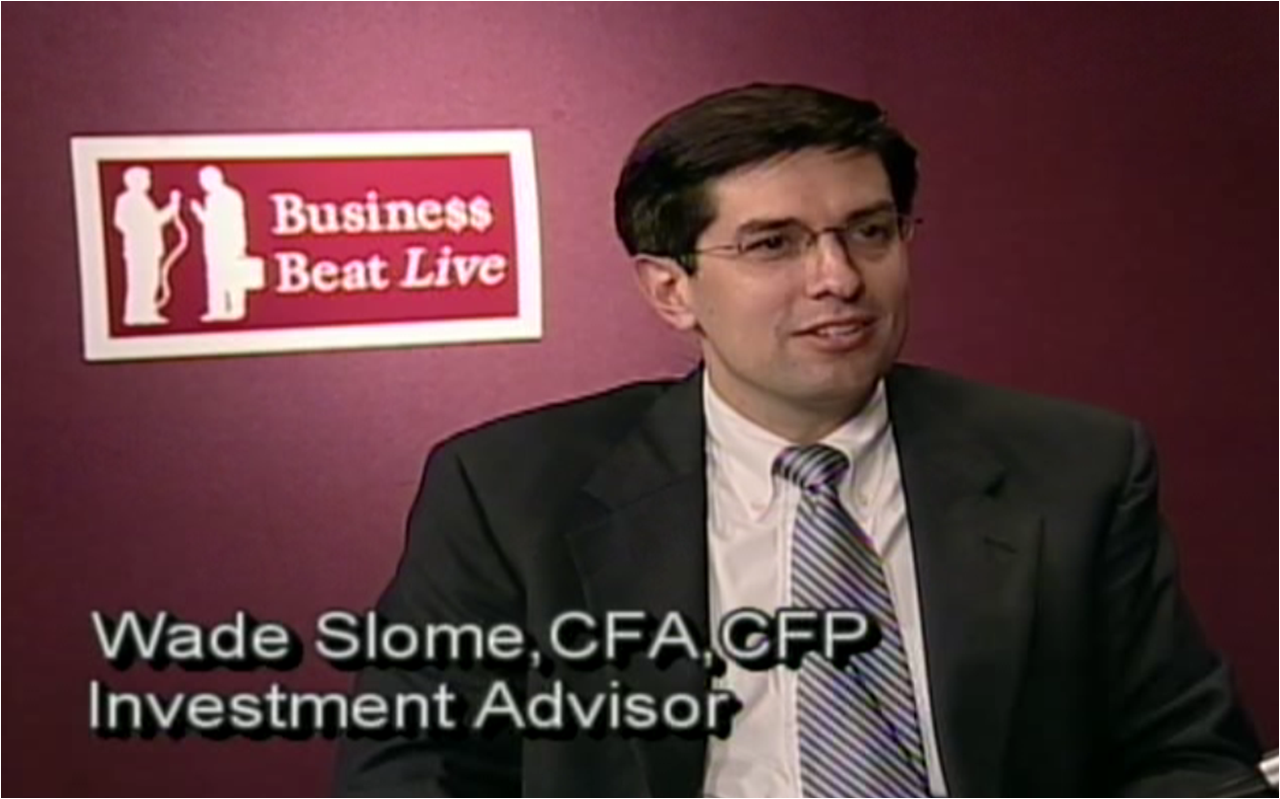
Click Here For Video on Sidoxia Site
I just got back from doing a television interview in Connecticut with John A. Troland at Business Beat Live. Troland may be no Larry King (is that a good or bad thing?), but he is no slouch either. He’s been running his show for 15 consecutive years, including an interview with Maria Bartiromo, a.k.a. the “Money Honey” (incidentally, a name she attempted to trademark for herself).
Stay tuned for the eventual video posting on my website (www.Sidoxia.com) (NOW UPDATED), but first the digital interview file must be compressed into a video jpeg gif, then optimized through an FTP to my HTML server, before the synthesized content is uploaded the to my http URL. Even if I were to improperly use the tech acronyms, the project should still be no sweat…for my tech guy.
Once I get settled, I’ll do my best to be back in productivity mode with further Investing Caffeine posts.
Chasing Profits – Can Fund Managers Beat the Game?

Achieving Long-Term Excess Returns is a Tough Race
How someone invests their money should fundamentally be based on their view of what’s the best way of playing the investment game. Before playing, the investor should answer the following key question: “Is the market efficient?” Efficient market followers believe active managers – professionals that periodically buy and sell with a profit motive – CANNOT consistently earn excess returns over longer periods of time, in part because market prices reflect all available information. If you fall into the efficiency camp, then you should dial 1-800-VANGUARD to simply buy some index funds. However, if you believe the market is inefficient, then invest in an exploitable strategy or hire an active investment manager you believe can outperform the market after fees and taxes.
For me personally, I fall somewhere in between both camps. I opportunistically invest my hedge fund in areas where I see superior return potential. However, in other areas of my investment practice (outside my main circle of expertise), I choose to side with the overwhelming body of evidence from academics that show passive/indexing slaughters about 75% of professionals.
Richard Roll, renowned economist and thought leader on the efficient market hypothesis, said this:
“I have personally tried to invest money, my client’s and my own, in every single anomaly and predictive result that academics have dreamed up. And I have yet to make a nickel on any of these supposed market inefficiencies. An inefficiency ought to be an exploitable opportunity. If there’s nothing investors can exploit in a systematic way, time in and time out, then it’s very hard to say that information is not being properly incorporated into stock prices. Real money investment strategies don’t produce the results that academic papers say they should.”
—(Wall Street Journal, 12/28/00)
The market gurus du jour blanket the media airwaves, but don’t hurt your back by hastily bowing. Having worked in the investment industry for a long time, you learn very quickly that many of the celebrated talking-heads on the TV today rotate quickly from the penthouse to the outhouse. Certainly, there are the well regarded professional money managers that survive the walk across the burning-coals and have performed great feats with their clients’ money over long periods of time. But even the legendary ones take their lumps and suffer droughts when their style or strategy falls out of favor.
The professional investing dynamics are no different than professional baseball. There are a relatively few hitters in the Major Leagues who can consistently achieve above a .300 batting average. In 2007, AssociatedContent.com did a study that showed there were only 12 active career .300 hitters in Major League Baseball. The same principle applies to investing – there is a narrow slice of managers that can consistently beat the market over longer periods of time.

There Are Only So Many .300 Hitters
Some statisticians point to the “law of large numbers” when describing long term investor success (a.k.a. “luck”) or ascribe the anomaly to statistical noise. Peter Lynch might have something to say about that. Peter Lynch managed the Fidelity Magellan Fund from 1977 – 1990, while he visited 200 companies per year and read about 700 company reports annually. Over that period Lynch averaged a 29% annual return for his investors vs. a 15% return for the S&P 500 index. Luck? How about Bill Miller from Legg Mason who outperformed the major industry benchmark for 15 consecutive years (1991-2005). Perhaps that too was good fortune? Or how about investor extraordinaire Warren Buffet who saw his stock price go from $33 per share in 1967 to $14,972 in 2007 – maybe that was just an accident too? An average schmuck off the street achieving Warren’s Buffett performance over a multi-decade period is equivalent to me batting .357 against Nolan Ryan and Randy Johnson…pure fantasy.
Academics also have difficulty with their efficiency arguments when it comes to explaining events like the “1987 Crash,” the technology bubble bursting in 2000, or the recent subprime derivative security meltdown. If all available information was already reflected in the market prices, then it would be unlikely the markets would experience such rapid and dramatic collapses.
What these bubbles show me is no matter how much academic research is conducted, the behavioral aspects of greed and fear will always create periods of inefficiency in the marketplace. These periods of inefficiency generate windows of profit opportunity that can be exploited by a subset of skillful managers. In the short-run, luck plays a great role; in the long-run sklill level determines ultimate performance. Benjamin Graham, summed it up best when he said, “In the short-term, the stock market is a voting machine; in the long-term a weighing machine.”
Wade W. Slome, CFA, CFP®
Plan. Invest. Prosper.
DISCLOSURE: Sidoxia Capital Management and client accounts do not have direct positions in LM or BRKA/B at the time the article was published.No information accessed through the Investing Caffeine (IC) website constitutes investment, financial, legal, tax or other advice nor is to be relied on in making an investment or other decision. Please read disclosure language on IC “Contact” page.
Steepening Yield Curve – Disaster or Recovery?

Various Treasury Maturities in 2006 Highlighting Inversion
Wait a second, aren’t we suffering from the worst financial crisis in some seven decades; our GDP (Gross Domestic Product) is imploding; real estate prices are cratering; and we are hemorrhaging jobs faster than we can say “bail-out”? We hear it every day – our economy is going to hell in a hand basket.
If Armageddon is indeed upon us, then why in the heck is the yield-curve steepening more than a Jonny Moseley downhill ski run? Bears typically point to one or all of the following reasons for the rise in long-term rates:
- Printing Press: The ever-busy, government “Printing Press” is working overtime and jacking up inflation expectations.
- Debt Glut: Our exploding debt burden and widening budget and trade deficits are rendering our dollar worthless.
- Foreign “Nervous Nellies”: Foreign Treasury debt buyers (the funders of our excessive spending) are now demanding higher yields for their lending services, particularly the Chinese.
- Yada, Yada, Yada: Other frantic explanations coming from nervous critics hiding in their bunkers.
All these explanations certainly hold water; however, weren’t these reasons still in place 3, 6, or even 9 months ago? If so, perhaps there are some other causes explaining steepening yield curve.
One plausible explanation for expanding long-term rates stems from the idea that the bond market actually does integrate future expectations and is anticipating a recovery. Let us not forget the “inverted yield curve” we experienced in 2006 (see Chart ABOVE) that accurately predicted the looming recession in late 2007. Historically, when short-term rates have exceeded long-term rates, this dynamic has been a useful tool for determining the future direction of the economy. Now we are arguably observing the reverse take place – the foundations for recovery are forming.

Treasury Yield Curve (June 2009)
Alternatively, perhaps the trend we are currently examining is merely a reversal of the panic rotation out of equities last fall. If Japanese style deflation is less of a concern, it makes sense that we would see a rebound in rates. The appetite for risk was non-existent last year, and now there have been some rays of sunlight that have glimmered through the dark economic clouds. Therefore, the selling of government guaranteed securities, which pushed prices down and yields upward, is a logical development. This trend doesn’t mean the equity markets are off to the races, but merely reflects investors’ willingness to rotate a toe (or two) back into stocks.
Investing Caffeine Launches

Investing Caffeine Launches
It has already been more than a year since the humble beginnings of Sidoxia Capital Management, LLC in April 2008 (here in lovely Newport Beach, California). Since then, I have written a successful book, How I Managed $20,000,000,000.00 by Age 32, appeared on ABC News, spoken on numerous radio shows, and traveled around to more than a dozen speaking engagements. Now, I am opening the next exciting chapter in my life journey – the launch of my new blog, Investing Caffeine.
Investing Caffeine will wake up your investment brain by tackling the complex issues of investing and financial planning, with the goal of educating and entertaining your mind. You can be the ultimate judge by posting your comments onto Investing Caffeine’s website. Financial topics can be boring, so make Investing Caffeine a part of your routine by injecting a jolt of financial knowledge. See you at my café!




 Investing Caffeine
