Buffett Sells Insurance: Weapons of ANTI-Destruction

Writing Options is the Opposite of Mass Destruction
Those same “Weapons of Mass Destruction” that Warren Buffett so ardently warned investors against are the same derivatives that catapulted Berkshire Hathaways (BRKA) Q2 earnings performance. Chris McKhann at OptionMonster summarized Buffet’s moves:
Buffett has sold a large number of puts on four major indexes starting in 2007: the S&P 500, the FTSE 100, the Euro Stoxx 50, and the Nikkei 225. He took in $4.9 billion, with a potential loss of more than $35 billion–but only if all four indexes were at zero come the expiration date (at which point we would be worrying about other things).
Derivatives are like a gun, if used responsibly for gaming or for self-defense, then they can be a useful tool. Unfortunately, like guns, these derivatives are used irresponsibly in many instances. This point is especially true in areas like Credit Default Swaps where there were inadequate regulations and capital requirements to prevent disastrous outcomes (e.g., AIG’s collapse). With proper transparency, capital requirements, and proper regulation, derivatives can be used to manage risk rather than create additional risk.
Although I wouldn’t categorize myself as a value investor like Warren, I would prefer to call myself a growth investor with a value conscience. With that said, if you incorporate valuation within your investment discipline, I believe writing (selling) options is a brilliant idea. I can make this assertion because I’ve used this strategy for myself and my hedge fund. Volatility has a direct impact on the amount of premiums collected; therefore the trading levels of the CBOE Volatility Index (VIX) will have a directly correlated impact on option writing profitability. For example, if I’m selling flood insurance, I’m going to collect much higher rates in the period right after Katrina occurred.
If you are willing to accept free money from speculators betting on short-term swings in prices (Warren sold long-term, multi-year options), while being forced to sell/buy stock at price levels you like, then why not?! However, buying and selling puts and calls is a different game in my book, and one I personally do NOT excel at. I’ll keep to utilizing “Weapons of Anti-Destruction” and collect premiums up-front, like Warren, from speculators and leave the rest of the options strategies to others.
Wade W. Slome, CFA, CFP®
Plan. Invest. Prosper.
DISCLOSURE: Sidoxia Capital Management and client accounts do not have direct positions in AIG or BRKA/B at the time the article was published. Sidoxia Capital Management and its clients do have long exposure to TIP shares. No information accessed through the Investing Caffeine (IC) website constitutes investment, financial, legal, tax or other advice nor is to be relied on in making an investment or other decision. Please read disclosure language on IC “Contact” page.
Bernanke Portfolio Takes Painful Hit

As a former tenured economics professor at Princeton University, I would believe Ben Bernanke would understand and appreciate the power of diversification, but apparently not. The bulk of his $1.2 million to $2.5 million (only a broad range was disclosed) was invested in a large-cap stock fund and a fixed-rate annuity from TIAA-CREF. Some would say his portfolio could use a higher dosage of small-cap, mid-cap, international and alternative asset classes, including real estate. With arguably the highest ranking finance job in the universe, wouldn’t you expect him to have a smoking hot portfolio? The data paints a different picture.
According to publicly disclosed data, Bernanke’s assets were down -29% (about -$600,000) in 2008, better than the S&P 500, but not comparable since his portfolio also included fixed income securities like Canadian treasury bonds and an annuity fund. For whatever reason, the global money czar couldn’t or wouldn’t use his knowledge to outmaneuver the markets. Why didn’t he use the Yen carry trade to buy crude oil up to $140 per barrel, then short emerging markets during 2008 before going long technology stocks beginning on March 9, 2009?
Certainly, Bernanke does not want to create a conflict of interest, whether real or implied. I’m sure Bernanke is not day trading options and shorting levered Exchange Traded Funds (ETFs) on E-Trade, because the headaches it would create for him would undoubtedly outweigh any short-term financial benefits earned from his investment ideas. Even if Bernanke felt he could exploit profit opportunities, the real bucks will come from speaking events and consulting prospects after he leaves his position of Federal Reserve Chairman. If Bernanke does a better job with his portfolio, perhaps he can retire at a younger age…
Read Article on Bernanke Portfolio
Wade W. Slome CFA, CFP®
Plan. Invest. Prosper.
Maher Cheerleads No Profit Healthcare

Bill Maher, shock-comedian and host of Real Time with Bill Maher on HBO, has made up a new rule in a recent article, “Not Everything in America Has to Make a Profit.”
Hey Bill, that sounds intriguing. I’ve got an idea – how about you decide to work for no profit? If free healthcare is a right for every American, then why should people pay for your stupid jokes? If I have a right to free healthcare, then why not a right to free laughs?
Don’t get me wrong, our system is broke and needs to be fixed. The real question, is insuring an additional 50 million uninsured, by the same bureaucratic healthcare system leading the Medicare train-wreck, our best approach in solving our healthcare crisis? Sure, doing nothing should not be a fallback, but I’m not sure a trillion dollar healthcare plan with Washington bureaucrats is the best idea either? I’m not against government involvement, but before we dive headfirst into the deep-end with additional deficit exploding plans, why not wade in the shallow end and slowly roll-out success-based models that prove their superiority first.
I’m no medical expert, but let’s take the best structures, whether it’s the Mayo Clinic, Cleveland Clinic, or other leading structures and have the government manage a steady roll-out. If the government can prove a lower-cost, more efficient way of serving higher quality care, then by all means…let’s see it. Some argue we don’t have time to test new models, well unfortunately our disastrous system took decades to create and a pork-filled bill through Congress is not going to be an immediate silver-bullet for our dire healthcare problems.
Getting back to Mr. Maher’s profit objections on healthcare, I wonder if he’s ever complained or contemplated the innovations created by the profit-laden healthcare system. Whether it’s an MRI, hip replacement, cholesterol drug, cancer test, glaucoma treatment, ADHD medication or the hundreds of other beneficial advancements, maybe Mr. Maher should ask and understand where all these innovations came from? The answer: good old profits that were invested in critical research and development. Without those profits, there would be fewer and less impactful healthcare innovation for millions of Americans.
As for the firemen who do not “charge” or make a profit, I would like to remind Mr. Maher who is paying their fair share for those services consumed by hundreds of millions of Americans – it’s those same “soulless vampires making money off human pain” that you castigate. Profitable corporations are funding those essential government services with tax dollars derived from, you guessed it, profits. If we can find a lower-cost, more efficient way of serving the public services by the government, then as Phil Knight from Nike (NKE) says, “Just Do It!” Unfortunately, I prefer to see some tangible proof first, before spending hundreds of billions of tax dollars.
Healthy Incentives
From an early age, even as babies, we are incentivized for certain behavior. Whether it’s offering M&Ms to potty-train a two year old, or submitting six-figure bonuses to a fifty-two year old for hitting department profit targets, incentives always plays a central role in shaping behavior. Figure out the desired behavior and create incentives for your subjects (and penalties for non-compliance).
As the government comes up with a public solution, I have no problem with Washington pressuring insurance companies and the medical industry to become more efficient and provide a higher threshold of care. I’m confident that structures can be put in place that mitigate conflicts of interest (i.e., pure profit motive), while increasing the standard of care and efficiency. Rewarding the healthcare industry with incentives, rather than just simply beating them over the head with lower reimbursements under a single-payer system, may produce longer-lasting, sustainable benefits.
In certain areas of society, such as policemen/women, firefighters, national defense, and doctors there has always been a view that government is better suited for handling certain services. However, sometimes government does not implement the proper incentive plans, which then leads to bureaucracy, inefficiency, and excessive costs. Eventually, these negative trends overwhelm the system into failure, much like sand grinding engine gears to a halt.
Bill, I appreciate your viewpoint, and I like you would love if everything was free. For starters, I’ll look for your press release announcing the cancellation of your multi-million contract with HBO, closely followed by the revelation of your pro-bono comedy work. Here’s to profitless prosperity.
Wade W. Slome, CFA, CFP®
Plan. Invest. Prosper.
DISCLOSURE: Sidoxia Capital Management (SCM) and some of its clients own certain exchange traded funds, but at the time of publishing SCM had no direct position in NKE, or any other security referenced in this article. No information accessed through the Investing Caffeine (IC) website constitutes investment, financial, legal, tax or other advice nor is to be relied on in making an investment or other decision. Please read disclosure language on IC “Contact” page.
Is Trump’s Business Better than His Hair?

Should Trump's Hair or Business Acumen be Fired?!
Fiery debate still swirls around the authenticity of Donald Trump’s hair (piece), but what about his business acumen? Just this year in February, Trump Entertainment filed for Chapter 11 bankruptcy. Maybe “The Donald” should be “fired?!”
If this was his only economic fatality in Trump’s career, one might cut him a little slack. I however am not enslaved into his glorified status in the media and press. My critical eye lacks the generosity necessary to honor him a free hall pass. When looking at Trump’s career, the tabloids must not forget that Trump’s Taj Mahal Casino was also run into bankruptcy purgatory in 1991. Number #11 must be Trump’s magic number because in less than a year, Trump filed for Chapter 11 on the Trump Plaza Hotel and Casino and Trump’s Castle (March 1992).
Like an infomercial, “But wait, there’s more!” In November 2004, Trump Hotels & Casino Resorts Inc. filed for Chapter 11 bankruptcy. This company reemerged out of bankruptcy as a new operating company, Trump Entertainment Resorts Inc., only to…you guessed it, file bankruptcy again. I think I see a pattern here.
With the vast bankruptcy experience Trump holds and with him and his daughter Ivanka Trump quitting from Trump Entertainment earlier this year, Donald is now trying to scoop up this company for a $100 million steal. The bankruptcy court and creditors will determine if it’s a fair deal. If not approved, rest assured, Donald will have an extra $100 million to spend wisely – possibly building another company into bankruptcy failure or perhaps…better hair care?
Wade W. Slome, CFA, CFP®
Plan. Invest. Prosper.
How Sweet it Is: Sugar Prices Near 30-Year High
The Cap'n Hangin' with the Crunch Berry Beast
The cost of a sugar coma has gone up, making my Cap’n Crunch with Crunch Berries craving a pricier endeavor. It’s seems like almost yesterday when I was crouched over my sugar cereal on a Saturday morning watching cartoons – hey wait, maybe that was last weekend? Regardless of the timeframe, prices for sugar have not been this high since Coke and Pepsi used sugar, rather than corn syrup, in their 1970s formulations and Cuba was the world’s largest sugar producer.
What’s the reason for the +67% price rise in sugar this year*? There are several reasons:
1) Disappointing Crops: India is the largest consumer of sugar at 23.5 million tons and a very significant producer of the sweetener. Due to deficient rainfall in the northeast and southern regions in India (caused in part by El Niño conditions), the country is estimated to need more than double the imports of the good this year. Disappointing crops in Brazil have also contributed to the tightening global supply. India and Brazil account for about 40% of global sugar supplies.
2) Forward Buying / Hedging: The supply-demand dynamics of the sugar market have caused certain high sugar-consuming countries, like Egypt and Mexico, to buy large stockpiling purchases – further pushing up prices. Beyond consumer and speculators, global food and beverage companies from the likes of Kraft, General Mills and ConAgra Foods have been purchasing futures to hedge the risk of additional price hikes.
3) Oil Increase Buoys Ethanol: Oil’s +59% price increase this year to about $70 per barrel has provided additional price support through increased demand for sugar-based ethanol.
Weather, oil demand, and sentiment may change thereby easing the cost burden of higher priced sugar goods, but irrespective of sugar prices you can rest assured my Cap’n Crunch with Crunch Berries addiction will remain resilient.
*Source: The Financial Times (8-7-09).
Read Financial Times Article on Sugar Here
Wade W. Slome, CFA, CFP®
Plan. Invest. Prosper.
“Bye Bye Roubini, Hello Abby”

Perma-Bull with Perma-Grin
Bye-bye” Dr. Doom” and hello “Happy Abby.” Abby Joseph Cohen is back in the spotlight with the recent market resurgence and is calling for a sustained bull market rally. The death-like sentiment spread by NYU professor Nouriel Roubini has now swung – it’s time for CNBC to call in the bulls, much like a baseball coach calls in a fresh reliever after a starter has exhausted his strength.
Over the last year, we’ve gone from full-fledged panic, into a healthy level of fear – the decline in the CBOE Volatility Index (VIX) supports this claim. But with cash still piled to the ceiling and broad indices still are about -35% below 2007 peaks, I wouldn’t say sentiment is wildly ebullient quite yet. The low-hanging fruit has been picked and now we need to tread lightly and delay the victory lap for a little longer. Market timing has never been my gig, so gag me any time I attempt a market prediction. Having said that, sentiment comprises the softer art aspects of investing, and therefore it can swing the markets wildly in the short-run. Ultimately in the long-run, profits and cash flows are what drive stock prices higher, and that’s what I pay attention to. Profits and cash flows are currently depressed and unemployment remains high by historical standards, but there are signs of recovery. Cohen highlights easy profit comparisons in the second half of 2009 (versus 2008), coupled with inventory replenishment, as significant factors that can lead to larger than anticipated surges in early economic cycle recoveries. Whether the pending economic advance is sustainable is a question that Cohen would not address.
Investors are emotional creatures, and CNBC realizes this fact. Before investing in that 30-1 leveraged, long-only hedge fund, prudence should reign supreme as we start to see some of the previously bullish strategists begin crawling out of their caves – including perma-bull Abby Joseph Cohen.
Wade W. Slome, CFA, CFP®
Plan. Invest. Prosper.
Stock Market Nirvana: Butter in Bangladesh

Hallelulah to Jason Zweig at The Wall Street Journal for tackling the subject of data mining through his interview with David Leinweber, author of Nerds on Wall Street. All this talk about Goldman Sachs, High Frequency Trading (HFT) and quantitative models is making my head spin and distorting the true value of data modeling. Quantitative modeling should serve as a handy device in your tool-box, not a robotic “black box” solely relied on for buy and sell recommendations. As the article points out, all types of sites and trading platforms are hawking their proprietary tools and models du jour.
The problem with many of these models, even for the ones that work, is that financial market behavior and factors are constantly changing. Therefore any strategy exploiting outsized profits will eventually be discovered by other financial vultures and exploited away. As Mr. Leinweber points out, these models become meaningless if the data is sliced and diced to form manipulated relationships and predictive advice that make no sense.
Butter in Bangladesh: To drive home the shortcomings of data mining, Leinweber uses a powerful example in his book, Nerds on Wall Street, of butter production in Bangladesh. In searching for the most absurd data possible to explain the returns of the S&P 500 index, Leinweiber discovered that butter production in Bangladesh was an excellent predictor of stock market returns, explaining 75% of the variation of historical returns. The Wall Street Journal goes onto add:
By tossing in U.S. cheese production and the total population of sheep in both Bangladesh and the U.S., Mr. Leinweber was able to “predict” past U.S. stock returns with 99% accuracy.
For some money managers, the satirical stab Leinweber was making with the ridiculous analysis was lost in translation – after the results were introduced Leinweber had multiple people request his dairy-sheep model. “A distressing number of people don’t get that it was a joke,” Leinweber sighed.
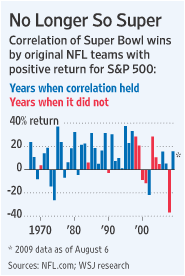
Super Bowl Crystal Ball: Leinweber is not the first person to discover the illogical use of meaningless factors in quantitative models. Industry observers have noticed stocks tend to perform well in years the old National Football league team wins the Super Bowl. Unfortunately, this year we had two “old” NFL teams play each other (Pittsburgh Steelers and Arizona Cardinals). Oops, I guess we need to readjust those models again.
Other bizarre studies have been done linking stock market performance to the number of nine-year-olds living in the U.S. and another linking positive stock market returns to smog reduction.
Data Mining Avoidance Rules:
1) Sniff Test: The data results have to make sense. Correlation between variables does not necessarily equate to causation.
2) Cut Data into Slices: By dividing the data into pieces, you can see how robust the relationships are across the whole data set.
3) Account for Costs: The results may look wonderful, but the model creator must verify the inclusion of all trading costs, fees, and taxes to increase confidence results will work in the real world.
4) Let Data Brew: What looks good on paper might not work in real life. “If a strategy’s worthwhile,” Mr. Leinweber says, “then it’ll still be worthwhile in six months or a year.”
Not everyone has a PhD in statistics, however you don’t need one to skeptically ask tough questions. Doing so will help avoid the buried land mines in many quantitative models. Happy butter churning…
Wade W. Slome, CFA, CFP®
Plan. Invest. Prosper.
V-Shaped Recovery or Road to Japan Lost Decades?
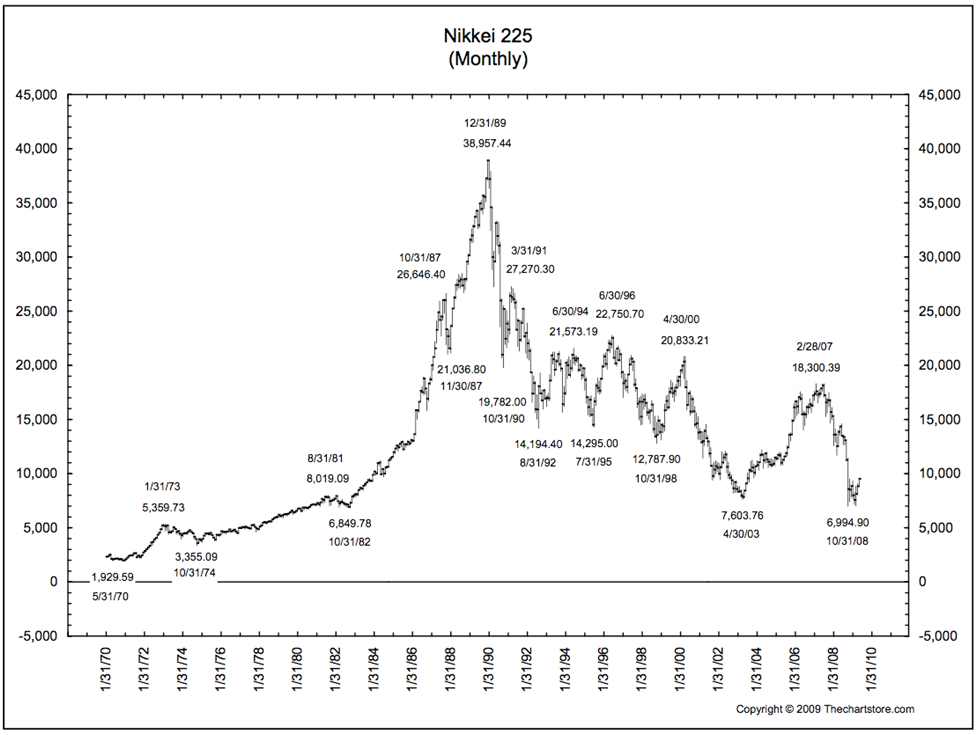
The Lost Decades from the 1989 Peak
On the 6th day of March this year, the S&P 500 reached a devilish low of 666. Now the market has rebounded more than 50% over the last five months. So is this a new bull market throttled into gear, or is it just a dead-cat bounce on route to a lost two decades, like we saw in Japan?
Smart people like Nobel Prize winner and economist Paul Krugman make the argument that like Japan, the bigger risk for the U.S. is deflation (NY Times Op-Ed), not inflation.
Now I’m no Nobel Prize winner, but I will make a bold argument of why Professor Krugman is out to lunch and why we will not go in a Japanese death-like, deflationary spiral.
Let’s review why our situation is dissimilar from our South Pacific friends.
Major Differences:
- Japanese Demographics: The Japanese population keeps getting older (see UN chart), which will continue to pressure GDP growth. According to the National Institute of Population and Social Security Research, by 2055 the Japanese population will fall 30% to 90 million (equivalent to 1955 level). Over the same time frame, the number of elderly under age 65 is expected to halve. To minimize the effects of the contraction of the working population, it will be necessary both to increase labor productivity, loosen immigration laws, and to promote the employment of woman and people over 65. Japan’s population is expected to expected contraction in Japan’s labor force of almost 1% a year in 2009-13.

Source: The Financial Times/UN (Declining Workforce Per 65 Year Old)
- Bank of Japan Was Slow to React: Japan recognized the bubble occurring and as a result hiked its key lending discount rate from 1989 through May 1991. The move had the desired effect by curbing the danger of inflation and ultimately popped the Nikkei-225 bubble. Stock prices soon plummeted by 50% in 1990, and the economy and land prices began to deteriorate a year later. Belatedly, Japan’s central bank began a series of interest rate-cuts, lowering its discount rate by 500-basis points to 1% by 1995. But the Japanese economy never recovered, despite $1-trillion in fiscal stimulus programs.
- The Higher You Fly, the Farther You Fall: The relative size of the Japanese bubble was gargantuan in scale compared to what we experienced here in the United States. The Nikkei 225 Index traded at an eye popping Price-Earnings ratio of about 60x before the collapse. The Nikkei increased over 450% in the eight years leading up to the peak in 1989, from the low of about 6,850 in October 1982 to its peak of 38,957 in December 1989. Compare those extreme bubble-icious numbers with the S&P 500 index, which rose approximately a more meager 20% from the end of 1999 to the end of 2007 (U.S. peak) and was trading at more reasonable 18x’s P-E ratio.
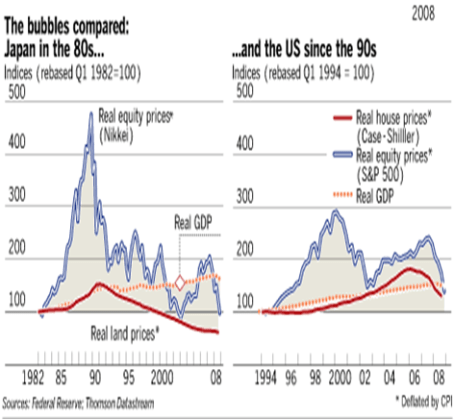
Source: Dow Jones
- Debt Levels not Sustainable: Japan is the most heavily indebted nation in the OECD. Japan is moving towards that 200% Debt/GDP level rapidly and the last time Japanese debt went to 200% of GDP (during WWII), hyper-inflation ensued and forced many fixed income elderly into poverty. Although our debt levels have yet to reach the extremes seen by Japan, we need to recognize the inflationary pressure building. Japan’s debt bubble cannot indefinitely sustain these debt increases, leaving little option but to eventually inflate their way out of the problem.
- Banking System Prolongs Japanese Deflation: Despite the eight different stimulus plans implemented in the 1990s, Japan lacked the fortitude to implement the appropriate corrective measures in their banking system by writing off bad debts. An article from July 2003 Barron’s article put it best:


After the collapse of the property bubble, many families and businesses had debts that far exceeded their devalued assets. When a version of this happened in America in the savings-and-loan crisis, the resulting mess was cleaned up quickly. The government seized assets, sold them off, bankrupted ailing banks and businesses, sent a few crooks to jail and everything started fresh, so that deserving new businesses could get loans. The process is like a tooth extraction — painful but mercifully short. In Japan this process has barely begun. Dynamic new businesses cannot get loans, because banks use available credit to lend to bankrupt businesses, so they can pretend they are paying their debts and avoid the pain of write-offs. This is self-deception. The rotten tooth is still there. And the Japanese people know it.
The Future – Rise of the Rest: Fareed Zakaria, Newsweek editor wrote about the “Rise of the Rest” in an incredible article (See Sidoxia Website) describing the rising tide of globalization that is pulling up the rest of the world. The United States population represents only 5% of the global total, and as the technology revolution raises the standard of living for the other 95%, this trend will only accelerate the demand of scarce resources, which will create a constant inflationary headwind.
For those countries in decline, like Japan, demand destruction raises the risk of deflation, but historically the innovative foundation of capitalism has continually allowed the U.S. to grow its economic pie. Economic legislation by our Congress will help or hinder our efforts in dealing with these inflationary pressures. One way is to incentivize investment in innovation and productive technologies. Another is to expand our targeted immigration policies towards attracting college educated foreigners, thereby relieving aging demographics pressures (as seen in Japan). These are only a few examples, but regardless of political leanings, our country has survived through wars, assassinations, terrorist attacks, banking crises, currency crises, and yes recessions, to only end up in a stronger global position.
This crisis has been extremely painful, but so have the many others we have survived. I believe time will heal the wounds and we will eventually conquer this crisis. I’m confident that historians will look at the coming years in favorable light, not the lost decades of pain as experienced in Japan.
Wade W. Slome, CFA, CFP®
Plan. Invest. Prosper.
Surviving in a Post-Merger Financial World

The financial institution dominoes have fallen.
Over the last two years we have experienced the worst financial crisis since the Great Depression. As a result, financial institutions have come under assault from all angles, including its customers, suppliers, and regulators. And as we have watched the walls cave in on the banking and brokerage industries, we have seen a tremendous amount of consolidation. Like it or not, we need to adapt to the new environment.
The accelerated change began in early 2008 with the collapse of Bear Stearns and negotiated merger with JP Morgan Chase. Since then we saw the largest investment banking failure (Lehman Brothers), and the largest banking failure in history (Washington Mutual). Other mergers included the marriage of Merrill Lynch and Bank of America, the combination of Wachovia into Wells Fargo, and most recently the blending of Smith Barney into Morgan Stanley. These changes don’t even take into account the disruption caused by the government control of Fannie Mae, Freddie Mac, and AIG.
So what does all this change mean for consumers and investors?
1) Rise in Customer Complaints: Change is not always a good thing. Customer complaints rose 54% in 2008, and climbed 86% in the first three months of 2009 according to FINRA (Financial Industry Regulatory Authority), a nongovernmental regulator of securities companies. The main complaint is “breach of fiduciary duty,” which requires the advisor to act in the best interest of the client. Making the complaint stick can be difficult if the broker only must fulfill a “suitability” standard. To combat the suitability limitation, investors would be well served by investigating an independent Registered Investment Adviser (RIA) who has a fiduciary duty towards clients.
2) Less Competition = Higher Prices: The surviving financial institutions are now in a stronger position with the power to raise prices. Pricing can surface in various forms, including higher brokerage commissions, administrative fees, management fees, ATM fees, late fees, 12b-1 fees and more.
3) Customer Service Weakens: The profit pool has shrunk as lending has slowed and the real estate gravy train has come to a screeching halt. By cutting expenses in non-revenue generating areas, such as customer service, the financial institutions are having a difficult time servicing all their client questions and concerns. There is still fierce competition for lucrative accounts, but if you are lower on the totem pole, don’t expect extravagant service.
4) Increased Regulation: Consumer pain experienced in the financial crisis will likely lead to heightened regulation. For example, the Obama administration is proposing a consumer protection agency, but it may be years before tangible benefits will be felt by consumers. Financial institutions are doing their best to remove themselves from direct oversight by paying back government loans. In the area of financial planning, proposals have been brought to Congress to raise standards and requirements, given the limited licensing requirements. Time will tell, but changes are coming.
Investing in a Post-Merger Financial World: Take control of your financial future by getting answers from your advisor and financial institution. Get a complete list of fees. Find out if they are an independent RIA with a “fiduciary duty” to act in the client’s best interest. Research the background of the advisor through FINRA’s BrokerCheck site (www.finra.org) and the SEC’s Investment Adviser Public Disclosure Web site (www.sec.gov). Get referrals and shop around for the service you deserve. Survival in a post-merger world is difficult, but with the right plan you can be successful.
For disclosure purposes, Sidoxia Capital Management, LLC is an independent Registered Investment Advisor in California.
Wade W. Slome, CFA, CFP®
Plan. Invest. Prosper.
Mountains of Cash Starting to Trickle Back

The month of July was an interesting month because investors opened their 401k and investment statements for the first time in a long while to notice an unfamiliar trend… account values were actually up. Like a child that has burnt their hand on a stove, the wounds and memories are still too fresh – more time must pass before investors decide to get back into the market in full force.
As you can see from the charts below, as investors globally panicked throughout 2008 and early 2009, money earning next to nothing in CDs and Money Market accounts was stuffed under the mattress in droves. The fear factor of last fall has caused current liquid assets to stand near 10 year highs at a level near 120% of the S&P 500 total market capitalization (Thomson Reuters) and at more extreme levels last fall if you just look at Money Market assets (bottom chart) . Now that the Armageddon scenario has been temporarily put to rest, we’re starting to see some of that cash to trickle back into the market. The silver lining is that there is still plenty of dry powder left to drive the market higher – not overnight, but once sustained confidence returns. If the earnings outlook continues to improve, come the beginning of October when 3rd quarter statements arrive in the mail, the pain of not being in the market will overwhelm the fear of burning another hand on the stove like in 2008.

It is funny how the sentiment pendulum can swing from the grips of despair a year ago. There is still headroom for the market to climb higher before the pendulum swings too far in the bullish direction – if you don’t believe me just look on the horizon at the mountain of cash.

Source: SentimenTrader.com (Fall 2008)
Wade W. Slome, CFA, CFP®
Plan. Invest. Prosper.




 Investing Caffeine
