One Size Does Not Fit All

When you go shopping for a pair of shoes or clothing what is the first thing you do? Do you put on a blindfold and feel for the right size? Probably not. Most people either get measured for their personal size or try on several different outfits or shoes. When it comes to investments, the average investor makes uninformed decisions and in many instances relies more on what other advisors recommend. Sometimes this advice is not in the best interest of the client. For example, some broker recommendations are designed to line their personal pockets with fees and/or commissions. In some cases the broker may try to unload unpopular product inventory that does not match the objectives and constraints of the client. Because of the structure of the industry, there can be some inherent conflicts of interest. As the famous adage goes, “You don’t ask a barber if you need a haircut.”
Tabulate Inventory
A more appropriate way of managing your investment portfolio is to first create a balance sheet (itemizing all your major assets and liabilities) individually or with the assistance of an advisor (see “What to Do” article) – I recommend a fee-only Registered Investment Advisor (RIA)* who has a fiduciary duty towards the client (i.e., legally obligated to work for the best interest of the client). Some of the other major factors to consider are your short-term and long-term income needs (liquidity important as well) and your risk tolerance.
Risk Appetites
The risk issue is especially thorny because the average investor appetite for risk changes over time. Typically there is also a significant difference between perceived risk and actual risk.
For many investors in the late 1990s, technology stocks seemed like a low risk investment and everyone from cab drivers to retired teachers wanted into the game at the exact worst (riskiest) time. Now, as we have just suffered through the so-called Great Recession, the risk pendulum has swung back in the opposite direction and many investors have piled into what historically has been perceived as low-risk investments (e.g., Treasuries, corporate bonds, CDs, and money market accounts). The problem with these apparently safe bets is that some of these securities have higher duration characteristics (higher price volatility due to interest rate changes) and other fixed income assets have higher long-term inflation risk.
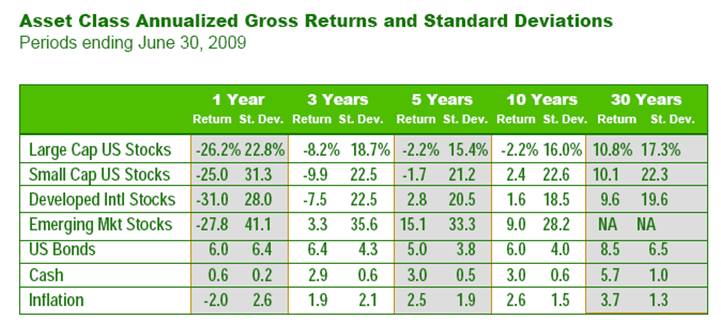
Source (6/30/09): Morningstar Encorr Analyzer (Ibbotson Associates) via State Street SPDR Presentation
A more objective way of looking at risk is by looking at the historical risk as measured by the standard deviation (volatility) of different asset classes over several time periods. Many investors forget risk measurements like standard deviation, duration, and beta are not static metrics and actually change over time.
Diversification Across Asset Classes Key
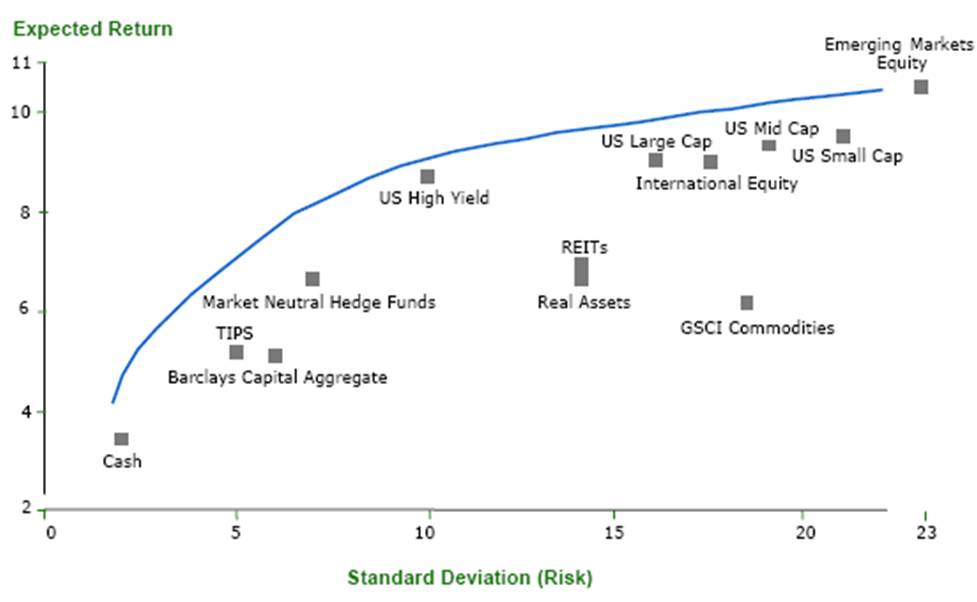
Source: State Street Global Advisors (June 30, 2009)
Correlation, which measures the price relationship between different asset classes, increased dramatically across asset classes in 2008, as the global recession intensified. However, over longer periods of time important diversification benefits can be achieved with a proper mixture of risky and risk-free assets, as measured by the Efficient Frontier (above). Conceptually, an investor’s main goal should be to find an optimal portfolio on the edge of the frontier that coincides with their risk tolerance.
Tailor Portfolio to Changing Circumstances
 In my practice, I continually run across clients or prospects that initially find themselves at the extreme ends of the risk spectrum. For example, I was confronted by an 80 year old retiree needing adequate income for living expenses, but improperly forced by their broker into 100% equities. On the flip side, I ran into a 40 year old who decided to allocate 100% of their retirement assets to fixed income securities because they are unsure of stocks. Both examples are inefficient in achieving their different investment objectives, yet there are even larger masses of the population suffering from similar issues.
Financial markets and client circumstances are constantly changing, so the objectives of the portfolio should be periodically revisited. One size does not fit all, so it’s important to construct the most efficient customized portfolio of assets that meets the objectives and constraints of the investor. Take it from me, I’m constantly re-tailoring my wardrobe (like my investments) to meet the needs of my ever-changing waistline.
Wade W. Slome, CFA, CFP®
Plan. Invest. Prosper.
*DISCLOSURE: For disclosure purposes, Sidoxia Capital Management, LLC is a Registered Investment Advisor (RIA) certified in the State of California. No information accessed through the Investing Caffeine (IC) website constitutes investment, financial, legal, tax or other advice nor is to be relied on in making an investment or other decision. Please read disclosure language on IC “Contact” page.
Ross Warns of Commercial Shoe Drop

The next shoe to drop in commercial real estate has been highly telegraphed for some time now. Wilbur Ross, restructuring specialist and founder of WL Ross & Co, has a long track record of success and he weighs in with his views regarding the impending crash in commercial real estate through several recent interviews.
What exactly is Mr. Ross worried about? He sees a correlation of what happened in the residential mortgage markets to what we are now beginning to see in the commercial real estate markets:
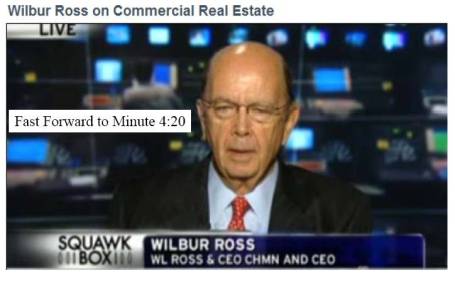
Fast forward to minute 4:20 to hear real estate commentary
Click Hear to See CNBC Interview with Wilbur Ross
“I have felt for quite some time that the same reckless lending that characterized the subprime mortgage business in residential was also characterizing what had gone on in commercial real estate in the mid-2000s. You had properties being bought at a 3% cash-on-cash yield. You had properties being financed at on such an aggressive basis that the lenders had to give them an advance – several years worth of interest – because there wasn’t enough cash coming from the properties even to pay the interest. And the theory was that rent rolls would go up, occupancy would go up, and eventually the property would grow its way into paying interest. Well now that clock is ticking – rents haven’t gone up, they’ve gone down; occupancy hasn’t gone up, it has gone down; and capitalization rates that people require from properties have gone up. So everything is going in the wrong direction, and I think we are going to see quite a lot of tragedies in that sector. “
Although Mr. Ross unequivocally sees a “huge crash in commercial real estate,” he puts his pessimistic views on impending destruction into perspective (read more about pessimism). The size of the commercial real estate market is quite a bit smaller than residential:
“The total of commercial mortgages is only about $3.5 trillion versus $11 trillion for residential mortgages.”
The commercial crash is already happening and forecasts for commercial property are expected to drop to the lowest levels in nearly two decades, according to according to property research firm Real Capital Analytics Inc. The sign of the times is evident by the recent Chapter 11 bankruptcy filing by Capmark Financial Group Inc., a company that originated about $60 billion in commercial real estate loans in 2006 and 2007 (Bloomberg). Anecdotally, at a professional event I just attended in southern California, I bumped into a real estate broker who informed me on the state of the market. The property across the street from the event location had a 50% vacancy rate and a glut of hedge funds were bidding on the building for 50% of its replacement value…ouch!
Reis Inc., a property research firm also notes:
“U.S. office vacancies hit a five-year high of almost 17 percent in the third quarter, while shopping center vacancies climbed to their highest since 1992.”
And from a fiscal response and taxpayer liability standpoint Ross is less worried because he thinks Washington, for the most part, will be watching the train wreck from the sidelines, with a bag of popcorn in hand:
“I don’t think the federal government’s going to do much to help the commercial building side because individual homeowners vote but buildings don’t vote.”
As Wilbur Ross has definitively communicated, he’s confident the commercial real estate mortgage market will cause the next surprising shoe to drop. Fortunately though, he feels the crash will be manageable. With all these shoes dropping, maybe I can find a new pair of shoes to wear?
Wade W. Slome, CFA, CFP®
Plan. Invest. Prosper.
DISCLOSURE: No information accessed through the Investing Caffeine (IC) website constitutes investment, financial, legal, tax or other advice nor is to be relied on in making an investment or other decision. Please read disclosure language on IC “Contact” page.
Too Big to Sink

If I got paid a nickel for every time I heard the phrase “too big to fail” to describe the state of affairs of our major financial institutions, I’d be retired on my private island by now. Jeremy Grantham, famed value investor and Chairman of Grantham Mayo Van Otterloo, recently compared the redesigning of our financial system to the Titanic and aptly described the hubris surrounding the ship’s voyage as “too big to sink!”
Mr. Grantham argues that many of the financial institution reform proposals have an irrelevant, misguided focus on improving the safety of the Titanic’s lifeboats rather than the structural design or competence of the captain. Maybe it’s better to plan for disaster prevention rather than disaster preparation? Grantham adds:
“By working to mitigate the pain of the next catastrophe, we allow ourselves to downplay the real causes of the disaster and thereby invite another one.”
When analyzing system failures, incentives are important to understand too. For example, the ship was “under-designed” and the captain had an ill-advised reward baked into a compensation bonus, if he beat the speed record (see article on compensation).
The Solution
Rather than protecting the bankers’ interests, Grantham contends we need “smaller, simpler banks that are not too big to fail.” At the heart of these massive financial conglomerates, pruning is necessary to separate the risky, proprietary trading departments, thereby ridding an “egregious conflict of interest with their clients.” As a former fund manager for a $20 billion fund, I was acutely aware of how my fund trading information and my conversations were being tracked by investment bankers and traders for themselves and their clients’ benefit. When the banks are managing your money alongside their own money, greed has a way of creeping in.
Beyond the prop trading desk legislation, Grantham believes those financial institutions “too big to fail” should be cut down into smaller pieces that can actually fail. Many of these entities are already what I like to call, “too complex to succeed,” evidenced by the stupefied responses provided by Congressmen and the CEOs of the banking institutions during the aftermath of the crisis. Reintroduction of some form of Glass-Steagall legislation (separation of investment banks from commercial banks) is another recommendation made by Grantham.
These suggestions sound pretty reasonable to me, but the bankers scream “If we become smaller and simpler and more regulated, the world will end and all serious banking will go to London, Switzerland, Bali Hai, or wherever,” Grantham adds in a mocking voice. If the foreigners want to operate irresponsibly, then Grantham says let them suffer the negative consequences every 15 years, or so.
The political will of legislators will be tested if substantive financial reforms actually come to pass. Jeremy Grantham understands the extreme importance of reform as explained concisely here, “A simpler, more manageable financial system is much more than a luxury. Without it we shall surely fail again.” Fail that is…like a sinking Titanic.
Read Jeremy Grantham’s Full Quarterly Newsletter
Wade W. Slome, CFA, CFP®
Plan. Invest. Prosper.
DISCLOSURE: No information accessed through the Investing Caffeine (IC) website constitutes investment, financial, legal, tax or other advice nor is to be relied on in making an investment or other decision. Please read disclosure language on IC “Contact” page.
Teen Prom of Listings Driven by Globalization

The international and emerging markets are like maturing teenagers attending a prom. If the U.S. represents the incumbent Seniors, then the international regions, like Europe and China, are the underclassmen now overwhelming the dance party. In 2009 for example, China has accounted for approximately 40% of all IPOs (Initial Public Offerings), according to The Financial Times.
This trend, however, is not a new phenomenon. Grant Thorton, an accounting consultancy firm, found the declining trend in American stock listings occurring for more than a decade. Specifically, Grant Thorton discovered the following:
“…the number of US exchange-listed companies is down by more than 22 per cent since 1991 and down by 53 per cent when allowing for real, inflation-adjusted gross domestic product growth.”
Why is the U.S. losing listing market share? David Weild, a former Nasdaq Vice Chairman, believes the advent of online brokerage firms in the mid-1990s shoulders a lot of the blame. The new order handling rules established in 1997 made the profitability of supporting small-cap stocks less profitable for the traditional brokerage firms.
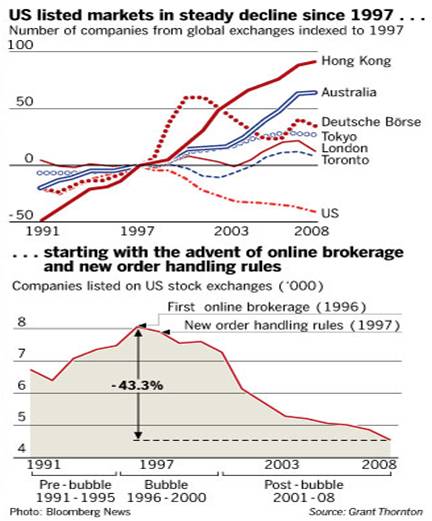
Source: Charts from The Financial Times show steady U.S. listings decline.
The reasons for the rule changes were designed to drive lower costs and improved transparency. These goals have largely been achieved, but due to globalization and the heightened liquidity in international and emerging markets, alternative exchanges have been gaining share.
Although profitability in supporting small-cap stocks has dropped, the evolution of high frequency trading (HFT) has stirred up the pot of controversy (read HFT article here). Exchanges, in an attempt to offset lost listings profits, are building new streams of revenues targetting these rapid pace computer traders.
As globalization spreads, thanks in part to the spread of technology advances, foreigners are joining what Thomas Friedman calls a new “flat” world, and the underclassmen are coming to the party with their dancing shoes.
Read The Financial Times Article Here
Wade W. Slome, CFA, CFP®
Plan. Invest. Prosper.
DISCLOSURE: No information accessed through the Investing Caffeine (IC) website constitutes investment, financial, legal, tax or other advice nor is to be relied on in making an investment or other decision. Please read disclosure language on IC “Contact” page.
Drought in Higher Rates May Be Over

The drought in higher interest rates may be nearing an end? Ever since the global financial crisis accelerated into full force in the fall of 2008, there were a constant flow of coordinated interest rate cuts triggered around the world with the aim of stimulating global GDP (Gross Domestic Product) and improving credit flow through the clogged financial pipes. Central banks across the world cut key benchmark interest rate levels and the impact of these reductions has a direct influence on what consumers pay for their financial products and services. More recently, we have begun to see the reversal of previous cuts with rate hikes witnessed in several international markets. Last week we saw Norway become the first western European country to raise rates, following an earlier October rate lift by Australia and another by Israel in August. For some countries, the sentiment has switched from global collapse fears to a stabilization posture coupled with future inflation concerns. In the U.S., the data has been more mixed (read article here) and the Federal Reserve has been clear on its intention to keep short-term rates at abnormally low levels for an extended period of time. That stance would likely change with evidence of inflationary pressures or improved job market conditions.
What Does This Mean for Consumers?
Prior to the financial crisis, credit availability flourished at affordably low rates. Now, with signs of a potential global recovery matched with regulatory overhauls, consumers may be impacted in several financial areas:
1) Credit Card Rates: Beyond regulatory changes in Washington (read more), the interest rate charged on unpaid credit card balances may be on the rise. When the Federal Reserve inevitably raises the targeted Federal Funds Rate (the interest rate for loans made between banks) from the current target rate range of 0.00% and 0.25%, this action will likely have direct upward pressure on consumer credit card rates. The associated increase in key benchmark rates such as the Prime Rate (the rate charged to a bank’s most creditworthy customers) and LIBOR (London Interbank Offer Rate) would result in higher monthly interest payments for consumers.
2) Other Consumer Loans: Many of the same forces impacting credit card rates will also impact other consumer loans, like home mortgages and auto loans. Pull out your loan documents – if you have floating or variable rate loans then you may be exposed to future hikes in interest rates.
3) Business Loans / Lines of Credit: Business owners -not just consumers – can also be impacted by rising rates. When the cost of funding goes up (.i.e., interest rates), the banks look to pass on those higher costs to the customer so the account profitability can be maintained.
4) Dollar & Import Prices: To the extent subsequent United States rate hikes lag other countries around the world, our dollar runs the risk of depreciating more in value (currency investors, all else equal, prefer currencies earning higher interest rates). A weaker dollar translates into foreign goods and services costing more. If international central banks continue to raise rates faster than the U.S., then imported good inflation could become a larger reality.
5) Hit to Bond Prices: Higher interest rates can also result in a negative hit to your bond portfolio. Higher duration bonds, those typically with longer maturities and lower relative coupon payments, are the most vulnerable to a rise in interest rates. Consider shortening the duration of your portfolio and even contemplate floating rate bonds.
Interest rates are the cost for borrowed money and even with the recent increase in consumers’ savings rate, consumers generally are still saddled with a lot of debt. Do yourself a favor and review any of your credit card agreements, loan documents, and bond portfolio so you will be prepared for any future interest rate increases. Shopping around for better rates and/or consolidating high interest rate debt into cheaper alternatives are good strategies as we face the inevitable end in the drought of higher global interest rates.
Wade W. Slome, CFA, CFP®
Plan. Invest. Prosper.
DISCLOSURE: No information accessed through the Investing Caffeine (IC) website constitutes investment, financial, legal, tax or other advice nor is to be relied on in making an investment or other decision. Please read disclosure language on IC “Contact” page.
Style Drift: Hail Mary Investing

The mutual fund investing game is extraordinarily competitive. According to The Financial Times, there were 69,032 global mutual funds at the end of 2008. With the extreme competitiveness comes lucrative compensation structures if you can win (outperform) – I should know since I was a fund manager for many years. However, the compensation incentive structures can create style drift and conflicts of interest. You can think of style drift as the risky “Hail Mary” pass in football – you are a hero if the play (style drift) works, but a goat if it fails. When managers typically drift from the investment fund objective and investment strategy, typically they do not get fired if they outperform, but the manager is in hot water if drifting results in underperformance. Occasionally a fund can be a victim of its own success. A successful small-cap fund can have positions that appreciate so much the fund eventually becomes defined as a mid-cap fund – nice problem to have.
Drifting Issues
Why would a fund drift? Take for example the outperformance of the growth strategy in 2009 versus the value strategy. The Russell 1000 Growth index rose about +28% through October 23rd (excluding dividends) relative to the Russell 1000 Value index which increased +14%. The same goes with the emerging markets with some markets like Brazil and Russia having climbed over +100% this year. Because of the wide divergence in performance, value managers and domestic equity managers could be incented to drift into these outperforming areas. In some instances, managers can possibly earn multiples of their salary as bonuses, if they outperform their peers and benchmarks.
The non-compliance aspect to stated strategies is most damaging for institutional clients (you can think of pensions, endowments, 401ks, etc.). Investment industry consultants specifically hire fund managers to stay within the boundaries of a style box. This way, not only can consultants judge the performance of multitudes of managers on an apples-to-apples basis, but this structure also allows the client or plan participant to make confident asset allocation decisions without fears of combining overlapping strategies.
For most individual investors however, a properly diversified asset allocation across various styles, geographies, sizes, and asset classes is not a top priority (even though it should be). Rather, absolute performance is the number one focus and Morningstar ratings drive a lot of the decision making process.
What is Growth and Value?
Unfortunately the style drift game is very subjective. Growth and value can be viewed as two sides of the same coin, whereby value investing can simply be viewed as purchasing growth for a discount. Or as Warren Buffet says, “Growth and value investing are joined at the hip.” The distinction becomes even tougher because stocks will often cycle in and out of style labels (value and growth). During periods of outperformance a stock may get categorized as growth, whereas in periods of underperformance the stock may change its stripes to value. Unfortunately, there are multiple third party data source providers that define these factors differently. The subjective nature of these style categorizations also can provide cover to managers, depending on how specific the investment strategy is laid out in the prospectus.
What Investors Can Do?
1) Read Prospectus: Read the fund objective and investment strategy in the prospectus obtained via mailed hardcopy or digital version on the website.
2) Review Fund Holdings: Compare the objective and strategy with the fund holdings. Not only look at the style profile, but also evaluate size, geography, asset classes and industry concentrations. Morningstar.com can be a great tool for you to conduct your fund research.
3) Determine Benchmark: Find the appropriate benchmark for the fund and compare fund performance to the index. If the fund is consistently underperforming (outperforming) on days the benchmark is outperforming (underperforming), then this dynamic could be indicating a performance yellow flag.
4) Rebalance: By periodically reviewing your fund exposures and potential style drift, rebalancing can bring your asset allocation back into equilibrium.
5) Seek Advice: If you are still confused, call the fund company or contact a financial advisor to clarify whether style drift is occurring in your fund(s) (read article on finding advisor).
Style drift can potentially create big problems in your portfolio. Misaligned incentives and conflicts of interest may lead to unwanted and hidden risk factors in your portfolio. Do yourself a favor and make sure the quarterback of your funds is not throwing “Hail Mary” passes – you deserve a higher probability of success in your investments.
Wade W. Slome, CFA, CFP®
Plan. Invest. Prosper.
DISCLOSURE: No information accessed through the Investing Caffeine (IC) website constitutes investment, financial, legal, tax or other advice nor is to be relied on in making an investment or other decision. Wade W. Slome, CFA, CFP is a contributing writer for Morningstar.com. Please read disclosure language on IC “Contact” page.
Meat & Potatoes Investing with Joel Greenblatt

Joel Greenblatt has a long resume. Besides being the founder and managing partner of Gotham Capital, Mr. Greenblatt is the author of The Little Book That Beats the Market and an adjunct Professor at Columbia Business School. Now he is adding “Quant-fund Manager” to his work history. In his recent CNBC interview (below), Greenblatt discusses the real-world portfolio implementation of his “Magic Formula” on www.FormulaInvesting.com, a new venture he has undertaken.
The Magic Formula as it turns out is not all that magical, but rather very simple. The formula is based on two straightforward meat and potato factors gathered from Standard & Poor’s data: 1) the trailing Price/Earnings ratio on a stock (value factor); and 2) the Return on Capital ratio of a stock using historical earnings. The portfolio management strategy is fairly basic as well. Twenty to thirty securities are selected from the model, with the ability of the investor to customize if they so choose, and the portfolios are rebalanced on an annual basis making sure any relevant tax-loss selling occurs before the end of the calendar year.
Based on the back-tests, the model portfolio was up +291% over the last 10 years versus down -2% for the S&P 500 index. For 2008, however, the performance of the Magic Formula was not too enchanting – down about -36% versus -37% for the S&P 500 index, according to Greenblatt.
As with any back-test, or model, I am very skeptical about the output and inferences that can be drawn. Here are a few reasons why:
1) Past ≠Future: Just because this strategy worked in the past doesn’t mean it will work in the future. Greenblatt admits that the strategy can underperform for long periods of time.
2) Limited Data: Ten years is an extremely limited period of time to base a robust strategy on – much more data should be used.
3) Cost Estimates: Following a potentially very illiquid, out of favor value strategy with possibly large sums of money can cause past results to look quite different. Factors such as trading costs and impact costs can be underappreciated in computer based back-tests.
4) Data Mining: With any model, problems can arise when reams of data are sliced and diced for the sole purpose of creating a positive outcome. Often, there are no cause and effect between a variable and future returns, yet practitioners will jump to that conclusion because the factors fit the data.
To learn more about shortcomings in quantitative models, I suggest you learn more about butter production in Bangladesh (read article here). I will eagerly watch how Mr. Greenblatt’s “Magic Formula” works from a distance. In the mean time, I’m hungry. I think I’ll keep it simple…a steak and baked potato.
Wade W. Slome, CFA, CFP®
Plan. Invest. Prosper.
DISCLOSURE: No information accessed through the Investing Caffeine (IC) website constitutes investment, financial, legal, tax or other advice nor is to be relied on in making an investment or other decision. Please read disclosure language on IC “Contact” page.
The Halloween Indicator Buried at Cemetery in 2009

Boo!
Statisticians, economists, speculators, and superstitious investors have been known to get spooked by scary patterns. Tomorrow marks the end of the menacing six month period of supposed underperformance that starts in May and ends on Halloween. The so-called “Halloween Indicator” has popularized the expression of “sell in May and walk away.” The indicator obviously has not followed the alleged tendency in 2009, as there has been more “treat” than “trick” for investors over the last six months. The S&P has rallied about +22% (excluding dividends) with only one day left in the trading period. Numerous academics have studied the phenomenon and not surprisingly there is some debate regarding the validity of various studies (see past study) – differing opinions have risen to the surface, depending on the number of years compiled in the data.
Here is what Mark Hulbert at MarketWatch had to say on the subject:
“Over the Dow’s history up until the last 12 months, there were no fewer than 17 occasions (15% of the years) in which both the winter months turned in a net loss for the stock market and the summer months produced a gain. There furthermore were 45 years (41% of the time) in which the stock market during the summer period did better than it did over the winter months that immediately preceded it. So the stock market’s performance over the last 12 months is hardly exceptional. It would take a lot more than the recent seasonal missteps to convince a statistician that this long-term pattern has stopped working for good. “
Other calendar effects besides the Halloween Indicator include, the January Effect, Monday Effect, and Presidential Cycle. Even though some pundits point to evidence supporting calendar effects, in many cases the data is proved to be statistically insignificant.
With Halloween just around the corner, here’s Sidoxia Capital Management wishing you a larger bag of treats rather than tricks in your quest in following calendar effects.
Wall Street Halloween Costume Ideas:
Short of ideas for Halloween costumes this year? No need to fear. Here are a few bloodcurdling Wall Street costume ideas with the help of Joshua Brown at The Reformed Broker and our friends at Forbes:

Top Ten Scariest Wall Street Halloween Costumes
Halloween Index:
For those that would rather get there treats from the stock market rather than a candy bowl, perhaps you may find a sweet idea from Stockerblog’s Halloween Stock Index.
Have a happy and safe Halloween!
Wade W. Slome, CFA, CFP®
Plan. Invest. Prosper.
DISCLOSURE: Sidoxia Capital Management and client accounts do not have direct positions in any of the Halloween Stock Index companies with the exception of long positions in WMT for some Sidoxia accounts. No information accessed through the Investing Caffeine (IC) website constitutes investment, financial, legal, tax or other advice nor is to be relied on in making an investment or other decision. Please read disclosure language on IC “Contact” page
Clashing Views with Dr. Roubini

The say keep your friends close, and your enemies even closer. Nouriel Roubini, professor of economics and international business at the NYU Stern School of Business, is not an enemy, but I think his fluctuating views (see previous story) and Armageddon expectations are off base. Perma-bears like Roubini and Peter Schiff (view article) have gloated and danced in the media limelight due to their early but eventually right calls. Over the last seven months or so, their forecasts on the U.S. economy and markets have been off the mark. With that said, even those with competing views at times can find common ground. For Nouriel and I, we currently share similar beliefs on gold (see my article on gold).
Here’s what Professor Roubini has to say:
“ I don’t believe in gold. Gold can go up for only two reasons. [One is] inflation, and we are in a world where there are massive amounts of deflation because of a glut of capacity, and demand is weak, and there’s slack in the labor markets with unemployment peeking above 10 percent in all the advanced economies. So there’s no inflation, and there’s not going to be for the time being.The only other case in which gold can go higher with deflation is if you have Armageddon, if you have another depression. But we’ve avoided that tail risk as well. So all the gold bugs who say gold is going to go to $1,500, $2,000, they’re just speaking nonsense. Without inflation, or without a depression, there’s nowhere for gold to go. Yeah, it can go above $1,000, but it can’t move up 20-30 percent unless we end up in a world of inflation or another depression. I don’t see either of those being likely for the time being. Maybe three or four years from now, yes. But not anytime soon.”
My thoughts on oil are less bearish, but nonetheless more cautious given the massive price bounce to around $80 per barrel. Could I see prices coming down to $50 like Roubini feels is appropriate? Certainly. With the $100+ per barrel swing we saw last year, I cannot discount completely the possibility of that scenario. However, unlike gold, oil has a much stronger utility value, and based on the slow adoption of more expensive alternative energies, this commodity will be in strong demand for many years to come. The pace of global economic recovery, especially in countries like China, India, and Brazil provide an underlying demand for the petroleum product. In order to understand the underlying bid for this economic lubricant, all one has to do is look at the appetite of emerging economies like China when it comes to this black gold (see my article on China).
And where does Roubini think markets go from here?
“If the recovery of the economy is going to be anemic, sub-par, below-trend and U-shaped, there is going to be a correction. And therefore my view is to stay away from risky assets. Stay in liquid assets. I don’t know when the correction is going to occur, it could be a while longer, but eventually it will be a pretty ugly correction, across many different asset classes.”
Perhaps Roubini’s “double dip” fears will eventually come true – and he leaves himself plenty of room with vague loose language – however, I follow the philosophy of Peter Lynch: ‘‘If you spend more than 14 minutes a year worrying about the market, you’ve wasted 12 minutes.” Great companies don’t disappear in challenging markets – they become cheaper – and new innovative companies emerge to replace the old guard.
As much as I would like to be right all the time, that’s not the case. In order to learn from past mistakes and continually improve my process, it’s important to get the views of others…even from those with clashing perspectives.
Read IndexUniverse.com Interview with Nouriel Roubini Here
Wade W. Slome, CFA, CFP®
Plan. Invest. Prosper.
DISCLOSURE: Sidoxia Capital Management and client accounts do not have direct long or short positions in gold positions, however accounts do have long exposure to certain energy stocks and ETFs. No information accessed through the Investing Caffeine (IC) website constitutes investment, financial, legal, tax or other advice nor is to be relied on in making an investment or other decision. Please read disclosure language on IC “Contact” page.
Economic Indicators Like Kissing Your Sister

The economy is on the mend, but we are obviously not out of the woods. Leverage and asset inflation through the housing bubble were major causes of the financial crisis of 2008-09. Now some of the major indicators are turning upwards with GDP expected to rise around +3% in Q3 this year and we are seeing housing units up, housing prices up, and housing inventories down (charts below). Although some of these numbers may create some warm and fuzzy sensations, abnormally high unemployment rates, massive budget deficits, and stuttering consumer confidence make this rebound feel more like kissing your sister.
There are, however, other signs of economic strength. For example, credit appears to be healing as well. Moodys predicts global speculative debt default rates will peak in Q4 this year at 12.5% – lower than the 18% Moodys predicted earlier this year in January. The CEO Confidence Board index, which typically leads profit growth by two quarters, jumped to a five year high in the 3rd quarter. The recovery is not limited to our domestic economy either – the International Monetary Fund (IMF) recently raised its global growth forecasts in 2010 from +2.5% to +3.1%.
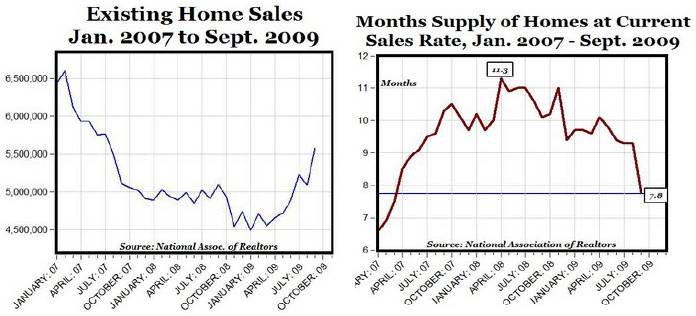
Housing Sales Up, Inventories Down (Source: National Association of Realtors)
How sustainable is the recovery? Bears like Nouriel Roubini still think we are likely heading into a double-dip recession, perhaps by mid-2010, once the temporary home purchase credits expire and the stimulus funds run out. A collapse in the dollar due to exploding debt and rising deficits is feared to cause a spiraling in debt costs – another factor that could cause a relapse into recession. Unemployment remains at an abnormally 26 year high at 9.8% (September) and any self-maintaining recovery will require an improvement from this deteriorating trend. Before consumers freely open their wallets and purses, consumer confidence could use a boost in light of the recent -10% month-to-month drop in October.
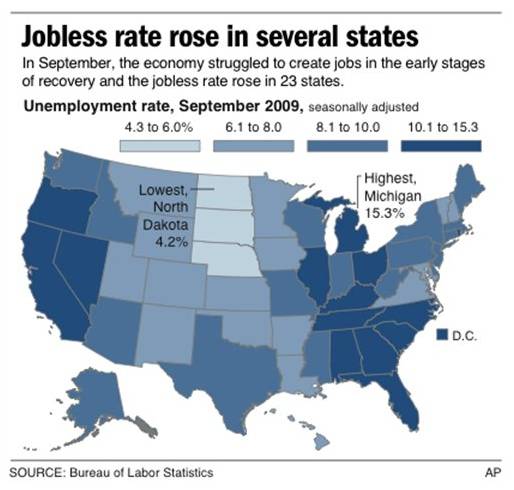
Source: Associated Press (AP)
Fewer people are debating the existence of “green shoots,” however now the discussion is turning to sustainability. Time will tell whether those feelings of harmless sibling cheek pecks will lead to the discovery of a new long-lasting romantic relationship with a non-family member.
Wade W. Slome, CFA, CFP®
Plan. Invest. Prosper.
DISCLOSURE: No information accessed through the Investing Caffeine (IC) website constitutes investment, financial, legal, tax or other advice nor is to be relied on in making an investment or other decision. Please read disclosure language on IC “Contact” page.




