Compensation: Pitchforks or Penalties

Currently there is witch hunt under way to get rid of excessive compensation levels, especially in the financial and banking industries. Members of Congress and their constituents are looking to reign in the exorbitant paychecks distributed to the fat-cat executives at the likes of Goldman Sachs, Bank of America and the rest of the banking field. According to The Financial Times, Goldman has set aside $16.7 billion so far this year for compensation and benefits and pay is on track to meet or exceed the $661,000 employee average in 2007. The public is effectively calling these executive bankers “cheaters” because they are receiving benefits they don’t deserve. The backlash resembles the finger-pointing we see directed at the wealthy steroid abusers in football or cork-bat swingers in baseball. Americans seem OK with big payouts as long as they are achieved in a fair manner. No one quibbles with the billions made by Bill Gates or Warren Buffett, but when you speak of other wealth cheaters like Jeff Skilling (Enron), Bernie Ebbers (WorldCom), or Dennis Kozlowski (Tyco), then the public cringes. The reaction to corporate crooks is similar to the response provoked by steroid use allegations tied to Major League Baseball players (i.e., Barry Bonds and Roger Clemens).
Less clear are the cases in which cheaters take advantage of a system run by regulators (referees) who are looking the other way or have inadequate rules/procedures in place to monitor the players. Take for example the outrage over $165 million in bonuses paid to the controversial AIG employees of the Financial Products division. Should AIG employees suffer due to lax rules and oversight by regulators? There has been no implication of illegal behavior conducted by AIG, so why should employees be punished via bonus recaptures? The rules in place allowed AIG to issue these lucrative Credit Default Swap (CDS) products (read more about CDS) with inadequate capital requirements and controls, so AIG was not shy in exploiting this lack of oversight. Rule stretchers and breakers are found in all professions. For example, Lester Hayes, famed All-Pro cornerback from the Oakland Raiders, used excessive “Stickum” (hand glue) to give himself an advantage in covering his opponents. If professionals legally operate within the rules provided, then punishments and witch hunts should be ceased.
Regulators, or league officials in sports, need to establish rules and police the players. Retroactively changing the rules after the game is over is not the proper thing to do. What the industry referees need is not pitchforks, but rather some yellow flags and a pair of clear glasses to oversee fair play.
Cash Givers Should Make the Rules
What should regulators and the government do when it comes to compensation? Simply let the “cash givers” make the rules. In the case of companies trading in the global financial markets, the shareholders should drive the rules and regulations of compensation. “Say on pay” seems reasonable to me and has already gained more traction in the U.K. On the other hand, if shareholders don’t want to vote on pay and feel more comfortable in voting for independent board members on a compensation committee, then that’s fine by me as well. If worse comes to worse, shareholders can always sell shares in those companies that they feel institute excessive compensation plans. At the end of the day, investors are primarily looking for companies whose goal it is to maximize earnings and cash flows – if compensation plans in place operate against this goal, then shareholders should have a say.
When it comes to government controlled entities like AIG or Citigroup, the cash givers (i.e., the government) should claim their pound of flesh. For instance, Kenneth Feinberg, the Treasury official in charge of setting compensation at bailed-out companies, decided to cut compensation across the board at American International Group, Citigroup, Bank of America, General Motors, GMAC , Chrysler, and Chrysler Financial for top executives by more than 90% and overall pay by approximately 50%.
Put Away the Pitch Forks
In my view, too much emphasis is being put on executive pay. Capital eventually migrates to the areas where it is treated best, so for companies that are taking on excessive risk and using excessive compensation will find it difficult to raise capital and grow profits, thereby leading to lower share prices – all else equal. Government’s job is to partner with private regulators to foster an environment of transparency and adequate risk controls, so investors and shareholders can allocate their capital to the true innovators and high-profit potential companies. Too big to fail companies, like AIG with hundreds of subsidiaries operating in over 100 countries, should not be able to hide under the veil of complexity. Even in hairy, convoluted multi-nationals like AIG, half a trillion CDS exposure risks need to be adequately monitored and disclosed for investors. That why regulators need to take a page from other perfectly functioning derivatives markets like options and futures and get adequate capital requirements and transparency instituted on exchanges. I’m confident that market officials will penalize the wrongdoers so we can safely put away the pitch forks and pull out more transparent glasses to oversee the industry with.
Wade W. Slome, CFA, CFP®
Plan. Invest. Prosper.
DISCLOSURE: Sidoxia Capital Management and its clients do not have a direct position in Goldman Sachs (GS), AIG, Berkshire Hathaway, BRKA/B, Citigroup (C), Enron, General Motors, GMAC , Chrysler, WorldCom, or Tyco International (TYC) shares at the time this article was originally posted. Sidoxia Capital Management and its clients do have a direct position in Bank of America (BAC). No information accessed through the Investing Caffeine (IC) website constitutes investment, financial, legal, tax or other advice nor is to be relied on in making an investment or other decision. Please read disclosure language on IC “Contact” page.
Insider Trading: Raj Rajaratnam vs. Pete Rose

A recent Wall Street Journal article written by Donald J. Boudreaux, a professor of Economics at George Mason University, makes the case that insider trading is actually healthy for the operations of the financial markets. The arrest of Galleon Group founder and hedge fund manager, Raj Rajaratnam, is a tragedy according to the article’s author. Specifically he says, “Insiders buying and selling stocks based on their knowledge play a critical role in keeping asset prices honest—in keeping prices from lying to the public about corporate realities.”
Oh really? Then I suppose Professor Boudreaux would be fine with all-time leading hitter and former Cincinnati Reds Manager betting on his own baseball team to win or lose.
Another disputed aspect of insider trading by Boudreaux is the inability to monitor the crime. “Insider trading is impossible to police and…parsing the difference between legal and illegal insider trading is futile—and a disservice to all investors.” Maybe heroin and cocaine should be legalized too, since we can’t completely police these crimes either? Seems to me the insider trading laws are pretty clear what insiders can and cannot do with material information. The digital world we live in today only empowers investigators more than ever to discover clear electronic footprint trails connecting trading and banking accounts. Certainly, there will be creative crooks like Bernie Madoff that can slyly succeed for a period of time, but those that grasp too far will eventually get caught.
Professor Boudreaux goes on to describe the scenario of an unscrupulous CEO at a hypothetical company (Acme Inc.) driving a company into bankruptcy. He argues employees, creditors, and investors would be better served by a CEO enriching himself with insider trading in the name of price efficiency. Capital productivity would be enhanced for creditors/investors thanks to information efficiency and employees could manage their job hunting effectively.
Sounds great Don, but in a legal insider trading world, don’t you think inefficient, unscrupulous behavior for siphoning information from executives might lead to distracting and wasteful corporate actions? If I’m an employee at ACME Inc. and I can make more money trading ACME stock, rather than being a productive employee making widgets, then it doesn’t take a genius to figure out where my 40 hour work week concentration will reside. Moreover, how is a sabotaging CEO, who is raking in millions by shorting his company’s stock ,supposed to be a good thing for stakeholders? I strongly disagree. Stakeholders will be jeopardized more by an unfocused, greed-absorbed workforce than by the current enforcement structure, which strives for an even playing field of information.
After forcefully arguing trading on insider information should not be prohibited, the professor hedges his stance by saying there are exceptions: “There are, of course, situations in which it is in the interest of both a company and the public for that company to delay the release of information.” For example, he describes a merger situation where early information leakage could “jeopardize the prospect of achieving greater efficiencies.” If according to Boudreaux, policing of insider information is impossible, then determining what he calls “proprietary” versus “non-proprietary” information is only going to stir up a worse hornet’s nest.
In the end, if price efficiency (see story on market efficiency) and cheaper cost of capital is Professor Boudreaux’s central aim, then perhaps disclosing inside information, rather than selfishly profiting from trading on inside information, is a more suitable approach. For Pete Rose, I recommend sticking to legalized sports betting in Las Vegas as a superior strategy.
Read Full Professor Boudreaux WSJ Article
Wade W. Slome, CFA, CFP®
Plan. Invest. Prosper.
DISCLOSURE: No information accessed through the Investing Caffeine (IC) website constitutes investment, financial, legal, tax or other advice nor is to be relied on in making an investment or other decision. Please read disclosure language on IC “Contact” page.
Now You See It, Now You Don’t: TARP

Elizabeth Warren, who oversees the TARP (Troubled Asset Relief Program), along with being the Chair on the Congressional Oversight Panel and a professor at the Harvard Law School, goes out on a limb and candidly states, “ We not only don’t know [where the TARP money is], Maria, we’re not ever going to know.”
Ms. Warren is quick to blame former Treasury Secretary Henry “Hank” Paulson for not implementing accountability for the TARP funds handed to the large commercial and investment banks (see my earlier TARP article). How do you prove the money handed over to the banks was used for non-lending activities, such as marketing, compensation, television advertising, dividends, acquisitions or other corporate purposes other than lending? The short answer…you can’t! Even if TARP capital tracking was instituted, I think it would have been a fruitless effort since even legitimate use of the TARP funds would only free up additional capital for other suboptimal purposes. If my mom gave me $100 while I was struggling for money in college and told me to use it for food – well I, like a good chunk of students, would have eaten anyways without the handout. The windfall $100 bailout would likely be used for a guys trip to Las Vegas or some Laker basketball tickets. The banks will certainly lend, but not at the same pre-Lehman bankruptcy levels, regardless of whether TARP tracking was instituted or not. Ms. Warren correctly points out that regulators are speaking out of both sides of their mouths. The government wants banks to lend more (which reduces the bank’s capital base) and also raise their sickly reserve levels at the same time.
See TARP commentary on CNBC video interview at minute 2:48
Maria Bartiromo also probes the topic of executive pay compensation given a recent Congressional proposal that TARP recipients cut salaries of the top 25 executives by -90%. Seems like a reasonable request given the circumstances. However, having the government force banks into making bad loans is probably not the right answer. This stance will only force the banks to take higher loan deliquency provisions and recognize more potential writedowns in the future. Eventually the Fed will cut interest rates paid to banks on the reserves held at the central bank, thereby invcentivizing the banks to take advantage of the steeper yield curve and make handsome spreads on loans.
Until then, some of the banks will sit patiently on their TARP capital (not lending) while Ms. Warren and government officials will wonder how the billions of TARP bailouts magically disappeared.
Wade W. Slome, CFA, CFP®
Plan. Invest. Prosper.
DISCLOSURE: Sidoxia Capital Management and its clients had a direct position in VFH and BAC shares at the time this article was originally posted. No information accessed through the Investing Caffeine (IC) website constitutes investment, financial, legal, tax or other advice nor is to be relied on in making an investment or other decision. Please read disclosure language on IC “Contact” page.
Misery Loves Company – Ruler Waffling

Besides using a ruler for measuring small distances and rapping disobedient knuckles, the wooden instrument can also be used for extrapolating trends. This ruler is a very convenient tool when rigorous analysis is a second choice.
Misery loves company, so the often maligned pool of inaccurate Wall Street equity analysts are happy to share the limelight with their trend leaning junk bond analyst cousins. As default rate expectations have bounced around like a jack rabbit post the Lehman Brothers bankruptcy, these bond forecasters have been caught flat-footed.
Reuters highlighted the backpedaling of Standard & Poor’s recent forecast changes:
“S&P said it now expects defaults to decline to 6.9 percent a year from now from a September rate of 10.8 percent. On Oct 2, it had said it expected defaults to escalate to 13.9 percent by August 2010.”
For a lazy analyst, extrapolation is a good fall-back strategy. Sticking your neck out by looking out further into the future or grasping the concept of reversion to the mean can be difficult and politically risky from a job retention perspective. It’s much easier to constantly hug current trends because it then becomes virtually impossible to be wrong.
Just as the rating agencies contributed to the subprime and auction rate securities (ARS) debacles by rubber stamping their AAA approvals last year through the financial crisis, so too have we witnessed the failure of bond analysts to properly analyze junk bond default rates.
Hopefully the narrowing of credit spreads is a leading indicator for economic improvement, but regardless the number and amount of high yield deals hitting the market is flowing heavily. The Wall Street Journal recently reported billions of junk bond deals being priced this week and next, including the $500 million Crown Castle International’s 10-year deal; $200 million Mohegan Tribal Gaming’s eight-year bonds; $325 million in Headwaters Inc.’s five-year notes; and over $2.4 billion of bonds from four other borrowers, including Boise Paper Holdings, Reynolds Group, Murray Energy Corp. and Universal City Development.
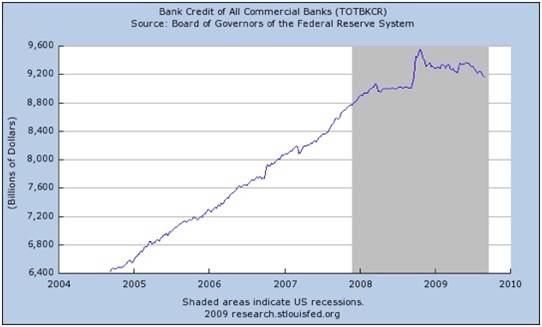
As larger companies are freely tapping the capital markets for capital, it’s becoming more and more evident that small businesses are having tougher and tougher times accessing credit, thanks in large part to banks hunkering down and reducing lending. Reference the flattening commercial bank credit curve chart provided by the Federal Reserve System:
As we watch the credit flow drama unfold in these uncertain economic times, don’t panic if you wondering what will happen next. Just reach into the desk drawer and pull out the favorite tool of Wall Street equity and junk bond analysts…the righteous ruler.
Wade W. Slome, CFA, CFP®
Plan. Invest. Prosper.
DISCLOSURE: Sidoxia Capital Management and its client accounts do have direct positions in HYG shares at the time this article was originally posted. No information accessed through the Investing Caffeine (IC) website constitutes investment, financial, legal, tax or other advice nor is to be relied on in making an investment or other decision. Please read disclosure language on IC “Contact” page.
The Not So Good, Bad, and Ugly
There’s a new bounty hunter in town, and it’s not Clint Eastwood from the legendary western film The Good, the Bad and the Ugly. Rather, it’s John Carney from Clusterstock who is keeping the bold bears honest, even though they have received their heads handed to them in this supposed “sucker, bear-market rally.” Perhaps, the bears will ultimately be proven right, but in the mean time, these tape fighters are losing blood by the quart.
Music from what Quentin Tarantino calls the best-directed film of all-time.
I find the existence of accountability sheriffs in the business media world rejuvenating since these roles are sorely lacking. Too often, so-called pundits spout off bold assertive predictions and industry commentators make no effort to review the track records of those prognosticators. I commend many of the industry practitioners for putting their necks out on the line, but viewers need some sort of historical batting average to judge the odds of forecast reliability. The game of predictions is no science, but there can be some objective responsibility instituted by media researchers and commentators. Media outlets provide carte blanche to predictors without doing homework on the guests. Unfortunately, time-strapped viewers have little to no time to research commentator track records.
Typically how it works, especially in the massively fragmented media world (which I admittedly participate in on a relatively small scale), you have countless voices making extreme predictions across the broad economic and financial globe. Eventually, some forecasts will be right, including those correct for the wrong reasons – just think back to your statistics class where you learned about the “law of large numbers” or the family living room where the broken clock provides correct time twice a day (see my other article on bold predictions). Since any human likes to be associated with greatness, these future-seers are strolled into media studios, put on a pedestal and asked to share their brilliance, all without critically reviewing the past record of the purported expert.
Rather than make bold predictions about market direction, which is virtually impossible to predict with accuracy on a sustainable basis, I choose to look at the market with a perspective similar to the greats. For example, Peter Lynch who earned +29% per year from 1977 – 1990 (achieving about double the market return) says it’s best to “assume the market is going nowhere and invest accordingly.” Realizing your fallibility is important also. Even with Lynch’s incredible track record, he knows “you’re terrific in this business [if] you’re right six times out of 10.” According to Lynch fretting about the market direction is also useless: “If you spend more than 14 minutes a year worrying about the market, you’ve wasted 12 minutes.” Interestingly, even Warren Buffett, arguably the greatest investor of all-time, never comments on short-term directions of the market, despite being hailed as the “Oracle of Omaha.”
Predictions and forecasts will never go away, but I will sleep better at night knowing sheriffs like John Carney are keeping track of the good, the bad and the ugly. Who knows, maybe he’ll even take me on as a deputy.
View John Carney’s Full Article
Wade W. Slome, CFA, CFP®
Plan. Invest. Prosper.
DISCLOSURE: No information accessed through the Investing Caffeine (IC) website constitutes investment, financial, legal, tax or other advice nor is to be relied on in making an investment or other decision. Sidoxia Capital Management (SCM) and some of its clients own certain exchange traded funds, and at the time of publishing had no direct positions in BRKA/B. Please read disclosure language on IC “Contact” page.
From Pooches to Profits

Oh, I’m sure you’ve seen them – those nauseating people that willingly accept facial tongue baths from their pets and dress them up in ridiculous costumes. Hey, wait a second… I guess I’m one of those annoying people too. My wife and I were just debating which Halloween attire we should get for our dog…Cound Dogula or Barkenstein? But we are not the only fanatics humanizing our pets, as Petsmart (PETM) recently outlined in their recent analyst day. Sixty-two percent of U.S. households own a pet and if you just add up all the cats and dogs, the total reaches 171 million pets.
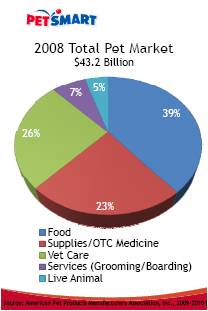
This is no small business – according to PETM, the industry exceeded $43 billion in 2008, spanning a whole variety of products and services, including food, veterinary care, supplies, and grooming/boarding services. PETM is collecting its growing share of the market at 14%, and I expect this share to increase over time.
What’s fueling the growth of the sector? For one, demographics is a contributor. As many Baby Boomers have become “empty-nesters” (kids move on) over time, they tend to fill that void with a pet. In addition, many working marriages have pushed having kids to the back-burner and choose to substitute a furry baby as a surrogate.
These trends have translated into vibrant growth for PETM over the years. The company has over 1,150 stores and 738 Banfield veterinary partnership locations, not to mention a significant rise in hotels. No, these are not the Four Seasons, but rather pet hotels that you can board Fido in when you take that family vacation to Hawaii or where guilt-ridden families can drop your friend off for doggy Day camp. These 156 pet hotels, which are included as part of PETM’s “Services,” continue to gain traction as they plan to open 20 new locations per year. Currently, services represents 11% of PETM’s sales (up from 8.8% in 2006), growing faster than overall sales with a significantly higher profit margins than the corporate average.
Source: Petsmart 2009 Analyst Day
Not everything is peachy keen as the company acknowledges the negative impact of unemployment, lower discretionary consumer spending and higher savings rate. As a result, PETM’s high margin “Hardgoods” category has gotten clobbered lately – even with more stable sales in non-discretionary categories like “Food.” Despite the economic developments, the company is not sitting on its hands. Not only are they focusing on driving sales through store pet adoptions (approaching four million on a cumulative basis), but the company is also reaping the rewards of its Pet Perks customer database to optimize sales performance. Petsmart has even taken a page out of Costco’s (COST) book with its focus on private label brands.
Beyond sales growth initiatives, the company has also been tightening their spending belt. For example, PETM is reducing capital expenditures from 6.4% of sales ($294 million) in 2007 to an estimated 2.2% ($120 million) this year. In addition, PETM is working on process improvements, space optimization, labor scheduling, and other cost-cutting initiatives.
The fruits of these labors are creating results. Just last week at their analyst meeting, PETM raised their 2009 earnings per share forecast to a range of $1.43 – $1.51 (from previous estimate of $1.37 – $1.45). Based on 2010 Wall Street estimate of $1.54, PETM’s stock currently trades at a reasonable 16.5x P/E multiple. On a free cash flow basis, the multiple on the estimated $226 million this year is even more attractive (see my article on cash flow investing).
Halloween is just around the corner, so maybe beyond picking up a doggie cardigan for the crisp fall weather, maybe you should consider some PETM shares too.
Wade W. Slome, CFA, CFP®
Plan. Invest. Prosper.
DISCLOSURE: Sidoxia Capital Management and its client accounts have no direct position in COST shares at the time this article was originally posted. Slome Sidoxia Fund does have a long position in PETM shares at the time this article was originally posted. No information accessed through the Investing Caffeine (IC) website constitutes investment, financial, legal, tax or other advice nor is to be relied on in making an investment or other decision. Please read disclosure language on IC “Contact” page.
Compounding: A Penny Saved is Billions Earned
What is “compounding” and why is it so great? It sounds like such a fancy financial term. One can think of compounding as a snowball rolling down a hill – the longer the snowball rolls (or the higher up the mountain you begin), the more compounding will expand the size of your snowball. Expanding your investment portfolio through compounding should be your major goal.
Albert Einstein, arguably one of the most intelligent people to walk this planet, was asked to describe mankind’s greatest discovery. His answer: “compound interest.” He went so far as to call it one of the “Eight Wonders of the World.” The benefits of compounding can be demonstrated via famous explorer, Christopher Columbus.
We all know the story, “In 1492, Christopher Columbus sailed the ocean blue.” To emphasize the benefits of compounding, let us suppose that Christopher Columbus made an investment in the historic year of 1492. If Chris had placed a single penny in a 6% interest-bearing account and instructed someone to remove the interest every year and put it in a piggybank, the total value collected in that piggybank would eventually accumulate to more than 30 cents. A pretty nice multiplier-effect on one penny, but not too much absolute cold hard cash to write home about…agreed?

"It's magic, I can turn pennies into billions."
However, if the young explorer had placed the same paltry investment of one cent into the same interest-bearing account, but LEFT the remaining earned interest to compound (thereby earning interest upon the previously earned interest) the results would be drastically different.
What would you guess the compounded account would be worth in 2009?
$10,000? $100,000? $1 million? $10 million? $100 million?
“NO” is the correct answer to all these guesses.
The correct answer: $121,096,709,346.21! Your eyes do not deceive you. That one penny invested in 1492 would have grown to $121 billion dollars today. If you don’t believe me, pull out your calculator and multiply $.01 * 1.06%, and repeat 517 times. Surely, we will not live 517 years to collect on an investment of such long duration. However, with proper planning everyone has the ability to invest quite a bit more than one cent to significantly build future wealth.
As an advisor, the problems related to compounding I see investors commit most are two-fold:
1) Investors are constantly shifting money in and out of their accounts (usually at suboptimal points) due to apprehension and greed, thereby nullifying the benefits of compounding.
2) Because of overpowering fear relating to current economic conditions, investors are parking their money in low yielding CDs (Certificates of Deposit), savings accounts, checking accounts, money market accounts, or other low returning investment vehicles. This strategy is equivalent to pushing the aforementioned snowball over the sidewalk, rather than down a long, steep hill.
In order to reap the rewards of compounding and dramatically expand your investment portfolio, a systematic, disciplined approach to investing needs to be followed. A system that more likely than not has a 20 year horizon rather than 20 days. Now go start saving those pennies!
Equity Life Cycle: The Moneyball Approach

Building a portfolio of stocks is a little like assembling a baseball team. However, unlike a team of real baseball players, constructing a portfolio of stocks can mix low-priced single-A farm players with blue chip Hall of Fame players from the Majors. Billy Beane, the General Manager for the Oakland Athletics, was chronicled in Michael Lewis’ book, Moneyball. Beane creates an amazing proprietary system of building teams more cost-efficiently than his deep-pocketed counterparts by statistically identifying undervalued players with higher on-base and slugging percentages. According to Beane, traditional baseball scouts were overpaying for less relevant factors, such as speed (stolen bases) and hitting (batting percentage).
In the stock world, before you can scout your team, you must first determine where in the life cycle the company lies. If Beane were to name this quality, perhaps he would call it Time-to-Maturity (TTM). Some companies operate in small, mature bitterly competitive industries (e.g. shoe laces), while others may operate in large growing markets (e.g. Google [GOOG] in online advertising and algorithmic search). Some companies because of negative regulation or heightened competition have a very short life cycle from early growth to maturity. Other companies with competitive advantages and untapped growth markets can have very long life spans before reaching maturity (think of a younger Coca Cola [KO] or Starbucks [SBUX]). Like Beane talks about in his book, many young, promising, immature baseball players flame out with short TTMs, nonetheless many scouts overpay for the cache´ such players offer.
Unfortunately, many investors do not even contemplate the TTM of their stock. Buying juvenile stocks (i.e., private companies like Twitter & Facebook – see article) or elderly stocks in and of itself is not a bad thing, but before you price a security it’s advantageous to know what type of discount or premium is deserved. Obviously, I’m looking for undervalued stocks across all age spectrums, however finding an undervalued, undiscovered late-teen just beginning on its long runway of growth combines the best of all worlds. Finding what Peter Lynch calls the “multi-baggers” is easier said than done, like searching for a needle in a haystack, but the rewards can be handsome.
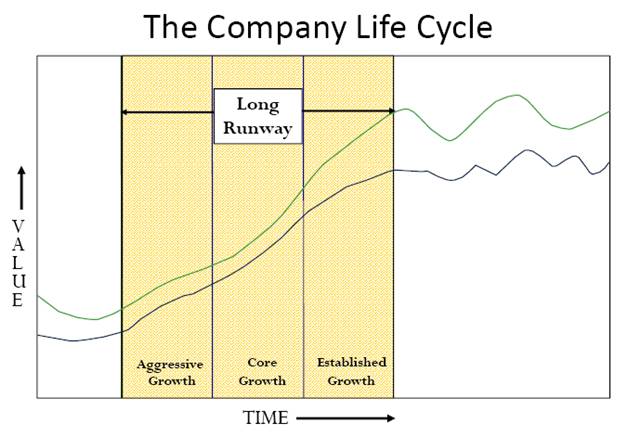
What creates long runways of growth – the equivalent of winning dynasties in baseball? Well, there are several contributors leading to longer TTMs, including economies of scale, large industries, barriers to entry, competitive advantages, growing industries, superior and experienced management teams, to name a few factors. But like anything, even the great growth companies, including Microsoft (MSFT), turn from teenagers to mature adults. As famed businessman Thomas Brittingham said, “A good horse can’t go on winning races forever, and a good stock eventually passes its peak, too.”
There are many aspects to creating a winning team. If Billy Beane were to draw up factors for a baseball team, I’m confident TTM would be near the top of his list. What you pay for the length of the growth cycle is obviously imperative, but since I’m a strong believer in the tenet that “price follows earnings,” it only makes sense that above average sustainable earnings growth should eventually lead to superior price appreciation. As Bob Smith, successful manager from T. Rowe Price states, “The important thing is not what you pay for the stock, so much as being right on the company.” So if you want to recruit a portfolio of winning stocks, like Billy Beane picks successful baseball players, then include the equity life cycle maturity statistic as a factor in your selection process.
Wade W. Slome, CFA, CFP®
Plan. Invest. Prosper.
DISCLOSURE: Sidoxia Capital Management nor its client accounts have no direct position in MSFT, SBUX, KO, Facebook, or Twitter shares at the time this article was originally posted. Some Sidoxia Capital Management accounts do have a long position in GOOG shares. No information accessed through the Investing Caffeine (IC) website constitutes investment, financial, legal, tax or other advice nor is to be relied on in making an investment or other decision. Please read disclosure language on IC “Contact” page.
Siegel Digs in Heels on Stocks

Jeremy Siegel, Wharton University Professor and author of Stocks for the Long Run, is defending his long-term thesis that stocks will outperform bonds over the long-run. Mr. Siegel in his latest Financial Times article vigorously defends his optimistic equity belief despite recent questions regarding the validity and accuracy of his long-term data (see my earlier article).
He acknowledges the -3.15% return of U.S. stock performance over the last decade (the fourth worst period since 1871), so what gives him confidence in stocks now? Let’s take a peek on why Siegel is digging in his heels:
Since 1871, the three worst ten-year returns for stocks have ended in the years 1974, 1920, and 1978. These were followed, respectively, by real, after-inflation stock returns of more than 8 per cent, 13 per cent, and 9 per cent over next ten years. In fact for the 13 ten-year periods of negative returns stocks have suffered since 1871, the next ten years gave investors real returns that averaged over 10 per cent per year. This return has far exceeded the average 6.66 per cent real return in all ten years periods, and is twice the return offered by long-term government bonds.
Siegel’s bullish stock stance has also been attacked by Robert Arnott, Chairman of Research Affiliates, when he noted a certain bond strategy bested stocks over the last 40 years. Here’s what Mr. Siegel has to say about stock versus bond performance:
Even with the recent bear market factored in, stocks have always done better than Treasury bonds over every 30-year period since 1871. And over 20-year periods, stocks bested Treasuries in all but about 5 per cent of the cases… In fact, with the recent stock market recovery and bond market decline, stock returns now handily outpace bond returns over the past 30 and 40 years.
If you’re 50, 60, or older, then Siegel’s time horizons may not fit into your plans. Nonetheless, in any game one chooses to play (including the game of money), I, like many, prefer to have the odds stacked in my favor.
In addressing the skeptics, such as Bill Gross who believes the U.S. is entering a “New Normal” phase of sluggish growth, Mr. Siegel notes this commentary even if true does not account for the faster pace of international growth – Siegel goes on to explain that the S&P 500 corporations garner almost 50% of revenues from these faster growing areas outside the U.S.
On the subject of valuation, Mr. Siegel highlights the market is trading at roughly 14x’s 2010 estimates, well below the 18-20x multiples usually associated with low-interest rate periods like these.
In periods of extreme volatility (upwards or downwards), the prevailing beliefs fight reversion to the mean arguments because trend followers believe “this time is different.” Just think of the cab drivers who were buying tech stocks in the late 1990s, or of the neighbor buying rental real estate in 2006. Bill Gross with his “New Normal” doesn’t buy the reversion argument either. Time will tell if we have entered a new challenging era like Mr. Gross sees? Regardless, Professor Siegel will be digging in his heels as he invests in stocks for the long run.
Read the Whole Financial Times Article Written by Professor Siegel
Wade W. Slome, CFA, CFP®
Plan. Invest. Prosper.
EPS House of Cards: Tricks of the Trade

As we enter the quarterly ritual of the tsunami of earnings reports, investors will be combing through the financial reports. Due to the flood of information, and increasingly shorter and shorter investment time horizons, much of investors’ focus will center on a few quarterly report metrics – primarily earnings per share (EPS), revenues, and forecasts/guidance (if provided).
Many lessons have been learned from the financial crisis over the last few years, and one of the major ones is to do your homework thoroughly. Relying on a AAA ratings from Moody’s (MCO) and S&P (when ratings should have been more appropriately graded D or F) or blindly following a “Buy” rating from a conflicted investment banking firm just does not make sense.
FINANCIAL SECTOR COLLAPSE
Given the severity of the losses, investors need to be more demanding and comprehensive in their earnings analysis. In many instances the reported earnings numbers resemble a deceptive house of cards on a weak foundation, merely overlooked by distracted investors. Case in point is the Financial sector, which before the financial collapse saw distorted multi-year growth, propelled by phantom earnings due to artificial asset inflation and excessive leverage. One need look no further than the weighting of Financial stocks, which ballooned from 5% of the total S&P 500 Index market capitalization in 1980 to a peak of 23% in 2007. Once the credit and real estate bubble burst, the sector subsequently imploded to around 9% of the index value around the March 2009 lows. Let’s be honest, and ask ourselves how much faith can we put in the Financial sector earnings figures that moved from +$22.79 in 2007 to a loss of -$21.24 in 2008? Current forecasts for the sector are looking for a rebound back up to +$11.91 in 2010. Luckily, the opacity and black box nature of many of these Financials largely kept me out of the 2009 sector implosion.
WHAT TO WATCH FOR
But the Financial sector is not the only fuzzy areas of accounting manipulation. Thanks to our friends at the FASB (Financial Accounting Standards Board), company management teams have discretion in how they apply different GAAP (Generally Accepted Accounting Principles) rules. Saj Karsan, a contributing writer at Morningstar.com, also writes about the “Fallacy of Earnings Per Share.”
“EPS can fluctuate wildly from year to year. Writedowns, abnormal business conditions, asset sale gains/losses and other unusual factors find their way into EPS quite often. Investors are urged to average EPS over a business cycle, as stressed in Security Analysis Chapter 37, in order to get a true picture of a company’s earnings power.”
These gray areas of interpretation can lead to a range of distorted EPS outcomes. Here are a few ways companies can manipulate their EPS:
Distorted Expenses: If a $10 million manufacturing plant is expected to last 10 years, then the depreciation expense should be $1 million per year. If for some reason the Chief Financial Officer (CFO) suddenly decided the building would last 40 years rather than 10 years, then the expense would only be $250,000 per year. Voila, an instant $750,000 annual gain was created out of thin air due to management’s change in estimates.
Magical Revenues: Some companies have been known to do what’s called “stuffing the channel.” Or in other words, companies sometimes will ship product to a distributor or customer even if there is no immediate demand for that product. This practice can potentially increase the revenue of the reporting company, while providing the customer with more inventory on-hand. The major problem with the strategy is cash collection, which can be pushed way off in the future or become uncollectible.
Accounting Shifts: Under certain circumstances, specific expenses can be converted to an asset on the balance sheet, leading to inflated EPS numbers. A common example of this phenomenon occurs in the software industry, where software engineering expenses on the income statement get converted to capitalized software assets on the balance sheet. Again, like other schemes, this practice delays the negative expense effects on reported earnings.
Artificial Income: Not only did many of the trouble banks make imprudent loans to borrowers that were unlikely to repay, but the loans were made based on assumptions that asset prices would go up indefinitely and credit costs would remain freakishly low. Based on the overly optimistic repayment and loss assumptions, banks recognized massive amounts of gains which propelled even more imprudent loans. Needless to say, investors are now more tightly questioning these assumptions. That said, recent relaxation of mark-to-market accounting makes it even more difficult to estimate the true values of assets on the bank’s balance sheets.
Like dieting, there are no easy solutions. Tearing through the financial statements is tough work and requires a lot of diligence. My process of identifying winning stocks is heavily cash flow based (see my article on cash flow investing) analysis, which although lumpier and more volatile than basic EPS analysis, provides a deeper understanding of a company’s value-creating capabilities and true cash generation powers.
As earnings season kicks into full gear, do yourself a favor and not only take a more critical” eye towards company earnings, but follow the cash to a firmer conviction in your stock picks. Otherwise, those shaky EPS numbers may lead to a tumbling house of cards.
Read Saj Karsan’s Full Article
Wade W. Slome, CFA, CFP®
Plan. Invest. Prosper.
DISCLOSURE: Sidoxia Capital Management has no direct position in MCO or MHP at the time this article was originally posted. No information accessed through the Investing Caffeine (IC) website constitutes investment, financial, legal, tax or other advice nor is to be relied on in making an investment or other decision. Please read disclosure language on IC “Contact” page.




