Meredith Whitney’s Cloudy Crystal Ball

Meredith Whitney, prominent banking analyst at her self-named advisory group, should have worn a bib to protect her from the adoring drool supplied by Maria Bartiromo in a recent CNBC interview. Ms. Whitney has quickly become a banking rock star during this “Great Recession” period. She was right at a critical juncture, and as a result she was thrust into the limelight. Much like Abby Joseph Cohen, the perma-bull Goldman Sachs strategist who gained notoriety in the late 1990s, Whitney (the perma-banking bear) will continue having difficulty living up to the lofty expectations demanded of her.
Despite the accolades, Whitney’s crystal ball has gotten cloudy in 2009. I suppose accuracy is not very important, judging by her bottom-half 2007 ranking (year of her major Citigroup call) in recommendation performance and 48%-ile ranking in the first half of 2008. Analysts, much like reporters, can avoid looking dumb by reporting the news du jour and by following the herd. Whitney has followed this formula with her continuous bearishness on the financial sector, excluding a brief but late upgrade of Goldman Sachs in July. Not only was her analysis tardy (Goldman’s stock tripled from the 2009 bottom), but her call has also underperformed the S&P 500 index since the upgrade.
Incoherent Inconsistencies
Like a bobbing and weaving wrestler (her husband John Layfield is a retired staged professional wrestler from the WWE), Whitney tries to concoct a completely mind-boggling narrative to explain her forecasts this year in the CNBC interview with Maria Bartiromo:
11/18/09 (XLF Price $14.60): “For the year, I have been at least ‘cover your shorts, go long.’ I haven’t been this bearish in a year.” (See Maria Bartiromo Interview)
Hmm, really? Are you kidding me? Wait a second…is this the same “go long” Meredith Whitney that expressed the following?
3/17/09: (XLF: 8.55 then, 14.60 now +71% ex-dividends): “These big banks are sitting on loans that were underwritten with bad math, and the stocks are going to go down…these stocks are uninvestable.”
(Fast forward to minute 8:20 for quote above)
2/4/09 (XLF: 8.97 then, 14.60 now +63% ex-dividends): “Investors should not even consider owning banks on an equity basis” (Click here and fast forward to minute 8:10 for quote).
The schizophrenic accounting of her postures are all the more confusing given her stance that the sector was “fairly valued” in October, according to the CNBC Bartiromo interview.
Don’t get me wrong, she made an incredible bearish call on Citigroup in the fall of 2007 and was expecting blood in the streets until a massive rebound in 2009 surprised her. Investors need to be wary of prognosticators that get thrust into the limelight (see Peter Schiff article) for a single prediction. The law of large numbers virtually guarantees a new breed of extreme forecasters will be rotated into the spotlight any time there is a major shift in the market direction. I choose to follow the footsteps of Warren Buffett and stay away from the game of market timing and market forecasts. I believe James Grant from the Interest Rate Observer states it best:
“The very best investors don’t even try to forecast the future. Rather, they seize such opportunities as the present affords them.”
Meredith Whitney may be a bright banking analyst and perhaps she’ll ultimately be proven right regarding the downward banking stock price trajectories, but like all bold forecasters she must live by the crystal ball, and die by the crystal ball.
Wade W. Slome, CFA, CFP®
Plan. Invest. Prosper.
DISCLOSURE: Sidoxia Capital Management (SCM) and its clients own certain exchange traded funds (including VFH), but currently have no direct positions in C, GS, or XLF. No information accessed through the Investing Caffeine (IC) website constitutes investment, financial, legal, tax or other advice nor is to be relied on in making an investment or other decision. Please read disclosure language on IC “Contact” page.
A Rare Breed: Father of Growth Investing

The man, the myth, the legend.
Successful long-term growth managers are part of a rare breed, but Thomas Rowe Price, Jr. – also known as the “Father of Growth Investing” – certainly qualifies. Too often, value legends like Warren Buffett and Benjamin Graham are highlighted in media circles. Using a baseball analogy, growth heroes like Mr. Price are more akin to atypical knuckleball pitchers, like Hall of Famer Phil Neikro. Writing about Mr. Price is consistent with my belief that investors striving to improve performance will be served well by studying great investors (for other growth superstars, see also Phil Fisher, Ron Baron, and John Calamos, Sr.).
History
T. Rowe Price was born in Linwood, Maryland, in 1898 and died in 1983. Price graduated from Swathmore College in 1919 with a degree in Chemistry, and then went onto work at Baltimore-based Mackubin Goodrich, which eventually became Legg Mason Inc. (LM). In 1937 he founded T. Rowe Price Associates (TROW) and successfully ramped up the company before the launch of the T. Rowe Price Growth Stock Fund in 1950. Expansion ensued until he made a timely sale of his company in the late 1960s (fortuitously before the 1973-1974 crash).
Philosophy
How did Price feel about growth investing?
“The growth stock theory of investing requires patience, but is less stressful than trading, generally has less risk, and reduces brokerage commissions and income taxes.”
This philosophy makes perfect sense to me; however it runs contrary to the strategies implemented by many managers whom are categorized in the “growth” style box today. In the hyper-sensitive, short-term focused performance world, many “momentum” managers play in this same “growth” sandbox. Typically this means managers buy stocks that are going up and sell stocks that are going down (see “momentum” article) over relatively short time frames, on average.
Price also firmly believed in fundamental research. As part of the investment process, Price believed in the “Life Cycle Theory of Companies,” meaning companies followed the phases of a human (birth, maturity, and decline). Price expands on this idea by stating the following: “An understanding of the life cycle of earnings growth and judgment in appraising future earnings trends are essential to investing.” He placed emphasis on investing in quality companies in good times and bad. In order to strip out economic cycle impacts, he compared company performance to peer performance – regardless of macroeconomic conditions.
John Train, the writer of “The Money Masters,” maintained the following factors were key underpinnings of Price’s investments:
- Superior research to develop products and markets.
- A lack of cutthroat competition.
- A comparative immunity from government regulation.
- Low total labor costs, but well-paid employees.
- At least a 10% return on invested capital, sustained high profit margins, and a superior growth of earnings per share.
Buy and Hold
The proof was in the pudding when it came to the “patience” referenced in Price’s quote above. For example, in the early 1970s, Price had accumulated gains of +6,184% in Xerox (XRX), which he held for 12 years, and gains of +23,666% in Merck (MRK), which he held for 31 years (Lessons from the Legends of Wall Street, Nikki Ross). Timing was not the most important factor in pulling the decision trigger:
“It is better to be early than too late in recognizing the passing of one era, the waning of old investment favorites and the advent of a new era affording new opportunities for the investor.”
In the polluted world of mass information that we sift through every day, I recommend reviewing the strategies of greats, including the “Father of Growth Investing” (T. Rowe Price). That’s my fatherly advice for you.
Wade W. Slome, CFA, CFP®
Plan. Invest. Prosper.
DISCLOSURE: Sidoxia Capital Management (SCM) and its clients owns certain exchange traded funds, but currently have no direct position in LM, TROW, XRX or MRK. No information accessed through the Investing Caffeine (IC) website constitutes investment, financial, legal, tax or other advice nor is to be relied on in making an investment or other decision. Please read disclosure language on IC “Contact” page.
Secure Your GPS (Global Portfolio Specialist)

We’ve all been there, our head in our hands, lost in the middle of nowhere. One reason for blame can be overconfidence in the directions provided or our map reading abilities. Now we have GPS (Global Positioning System) devices – a tool I now could never live without. In the investment world, with the damage that has been done, intelligent advice is needed more than ever. Unfortunately, there is no GPS device to guide our investments, but many individuals would do their self a favor by finding the right experienced professional advisor to act as your GPS device (Global Portfolio Specialist).
Getting from point A to point B in the real world can be quite simple. In the investment world, the roadways are constantly shifting. Changes in interest rates, tax policies, unemployment, fiscal initiatives can represent obstacles, the equivalent of road construction barriers, potholes, erosion, mudslides, and earthquakes in our quest for financial freedom. Navigating these winding paths can require a GPS advice. Asking for help or directions can be embarrassing and castigating for some, especially for some proud males. Stubbornly appearing to have the answer can be more important for some, and can cloud the decision making process – even if assistance can lead to the most efficient path to prosperity.
Having a guide at your fingertips as you meet unknown forks in the road is a nice asset to have. Unfortunately finding the right guide is much easier said than done, many guides can have ulterior motives and hidden agendas that conflict with yours. So although, having a guide may be ideal, finding the right guide requires a lot of research (read how to find an advisor). The scope of qualifications between the capabilities of one advisor compared to another can be like comparing a plastic butter knife with a stainless steel swiss-army knife. The cheap butter knife may handle a few simple needs, but most investors would be better served by someone with a breadth of tools that can assist you with a diverse set of circumstances.

The old cliché states men hate to get directions while women seek a security blanket (a plan). GPS is not full proof, as occasionally the software is not updated or gets confused. But tech geeks like me have grown to love the assistance and benefit from the heightened efficiency and safety it provides. Not only am I more confident, but it also gets me to where I want to go in less time.
Having your guide is important when it comes to investments, but having someone with expertise in tax planning (should I consider Roth conversion in 2010?); estate planning (what impact will the expected changes in the estate tax rate have on my future?); and insurance planning (do I have adequate life, health, and business insurance?) can be critical. All these areas can have a profound impact on whether you achieve your personal and financial goals.
Along the road of life, there can be many bumps, twists and turns. If you would like the assistance of a professional advisor, consider doing your homework and finding the appropriate GPS. Here is a checklist:
1) Where are You Now? This means taking inventory of your assets and liabilities, getting a handle on your income and expenses, and having a firm understanding of your tax and family planning issues (will, trust, powers of attorneys, etc.)
2) Where are You Going? Next you need to know where you want to go? You may have a rough idea, but in order to create a coherent plan, goals need to be defined.
3) Create a Plan. Everyone’s map or blueprint will look different. Some will need highly detailed directions, while others due to different circumstances may have less complex needs or shorter distances to travel. Some may need guidance and directions to reach an adjacent state, while others may have more ambitious goals or planning needed to reach the peak of Mount Everest. Different destinations and circumstances will require different planning.
4) Monitor and Adjust Plan as Necessary. Road conditions, weather, breakdowns, flight cancellations, among many other unforeseen circumstances can change the path to your goal. That’s why it’s so important to review, not only the changes in external circumstances, such as the financial markets, but also any individual changes whether it’s health, family, personal, or goal related.
Some people prefer to do things the old-fashion way or are happy with subpar technology (i.e., compass). However, if you do not want to get lost, or want a clearer defined map, then it’s time to shop for that new Global Portfolio Specialist who can help guide you to your destination.
Wade W. Slome, CFA, CFP®
Plan. Invest. Prosper.
DISCLOSURE: Sidoxia Capital Management (SCM) or its clients owns certain exchange traded funds, but currently has no direct position in GRMN. No information accessed through the Investing Caffeine (IC) website constitutes investment, financial, legal, tax or other advice nor is to be relied on in making an investment or other decision. Please read disclosure language on IC “Contact” page.
Darkest Before Dawn – Gaming Industry Waiting for Sunrise

It is always darkest before dawn, and right now the days are dark in the video game industry.
The industry is facing multiple challenges ranging from the migration of players from console games to digital online games; the growth of the iPhone and mobile devices as a free and discounted gaming platform; sky-rocketing development and marketing costs; and not to mention a consumer recession in which coughing up $50-$60 bucks a pop for a next generation platform game can be quite painful (read more on economy).
Recent console price cuts are a welcomed positive, but industry leading Electronic Arts CEO (Ticker: ERTS), John Riccitiello’s sober assessment of the industry was summarized as followed:
“While the recent hardware price reductions are driving higher console sales, the improvement is not enough to get the industry back to flat software sales for the calendar year. We now expect packaged goods software to be down mid-to-high single digits in North America and Europe combined. This is well below our initial expectations for the year.”
Not all is lost, however. I am amazed out how gaming has expanded since I was a kid. I may be dating myself, but I vividly recall the endless summer days of playing Adventure and Pac-Man on my Atari 2600 and heading over to the arcade to play Defender with my buddies. Since the 1970s, the industry has matured dramatically.
If you don’t believe me, check out the trailer from the new industry megahit Call of Duty: Modern Warfare 2. Industry analysts are calling for an amazing $500 million in sales…in the first week! By way of comparison, this year’s top-grossing film in the U.S., “Transformers: Revenge of the Fallen,” generated over $200 million in sales over the first five days of its release.
If you have more time to burn, you can take a walk down memory lane to look at the history of video games from 1972 to 2007.
Electronic Arts (ERTS) a Long-Term Winner
As the complexity of the video game industry rises, the barriers to entry become even tougher, and weaker competitors fall to the way side. Industry leaders like Electronic Arts (EA), with approximately $4 billion in revenues and $2 billion in cash and securities on their balance sheet (with virtually no debt), stand to be powerful survivors once the industry finds its way through the valley. Not a large percentage of companies have about a third of its market capitalization in cash. Financial strength alone does not mean much if a company were in continual decline, but I strongly believe the industry will eventually rebound and EA will be pulled up with the tide. In their most recent quarter, the company highlighted their growing market share in North America and Europe couple with their #1 software publisher positioning on the PlayStation3 (PS3) and Microsoft Xbox 360 platforms.
Given all the swirling shifts in the industry, EA is not sitting on its hands either. In conjunction with the company’s earnings release, EA simultaneously announced their acquisition of Playfish, the largest social networking game provider on the internet, attracting over 60 million players per month and securing the #2 game provider position on Facebook. On the cost front, the company is implementing a targeted headcount reduction by approximately 1,500 employees, which will reduce costs by at least $100 million. This austerity plan will make EA more competitive and allow the company to invest more in growth initiatives and better handle the curveballs thrown at them. EA has become more focused too. As part of the cuts, the company will reduce the number of game titles from the mid-60 count last year to the high-30s next year. Quality, not quantity is the new emphasis and more resources will be diverted to EA’s online digital efforts.
The traditional video game packaged-game industry is very hit-driven, much like the movie industry. One way EA deals with this challenge is by creating franchises that keep consumers wanting more, whether it’s sequels to the Sims, Harry Potter, or other titles. Better yet, EA has created a razor blade replacement model with their sports franchises. For example, in Electronic Art’s Madden NFL franchise football game, players need to update their athlete rosters to account for the annual post-season blockbuster trades and fresh rookie signees. EA’s Sports division has a built-in mechanism to drive recurring demand for new content.
With the stock over $60 less than 24 months ago, a large percentage of the industry and company warts have already been discovered and discounted into the current stock price (~$18). As with all my stock picks, I leave dry powder as ammunition for any future purchases at lower prices. The critical two week selling season has historically accounted for up to 1/3 of a company’s total annual sales – that’s what I call a back-end loaded revenue stream! Or put another way, the software industry traditionally generates almost half of its annual sales during the holiday season. The tightly concentrated timeline for sales may bring heightened volatility to the stock’s trading pattern in the coming weeks.
For those with an extended time horizon, one need only look at EA’s cash pile, market positioning, normalized earnings, and long-term industry prospects in order to take a closer examination at Electronic Arts. Times are dark in the video game industry, but dawn will be here soon enough and Electronic Arts is positioned to benefit when the time comes.
Read EA’s Fiscal Q2 Earnings Call Transcript from Seeking Alpha
Wade W. Slome, CFA, CFP®
Plan. Invest. Prosper.
DISCLOSURE: Sidoxia Capital Management (SCM) and its clients have a long position in ERTS and AAPL at the time this article was originally posted. SCM and its clients own certain exchange traded funds, but currently have no direct position in ATVI, SNE, MSFT, or Facebook. No information accessed through the Investing Caffeine (IC) website constitutes investment, financial, legal, tax or other advice nor is to be relied on in making an investment or other decision. Please read disclosure language on IC “Contact” page.
Standing on the Shoulders of a Growth Giant: Phil Fisher

Sir Isaac Newton
It was English physicist, astronomer, philosopher, and mathematician Sir Isaac Newton who in 1675 stated, “If I have seen further it is by standing on the shoulders of giants.” Investors too can stand on the shoulders of market giants by studying the timeless financial knowledge from current and past market legends. The press, all too often, focuses on the hot managers of our time while forgetting or kicking to the curb those managers whom are temporarily out of favor. Famous and enduring value managers typically have gained the press spotlight, rightfully so in the case of current greats like Warren Buffett or past talents like Benjamin Graham, because they managed to prosper through numerous economic cycles. However, when it comes to growth legends like Phil Fisher, author of the must-read classic Common Stocks and Uncommon Profits, many people I bump into have never heard of him. Hopefully that will change over time.
The Past
Born on September 8, 1907, Mr. Fisher lived until the ripe age of 96 when he passed on March 4, 2004. Fisher was no dummy – he enrolled in college at age 15 and started graduate school at Stanford a few years later, before he dropped out and started his own investment firm in 1931. His son, Ken, currently heads his own investment firm, Fisher Investments, writes for Forbes magazine, and has authored multiple investment books. Unlike his dad, Ken has more of a natural bent towards value stocks.
Buy-And-Hold

Philip A. Fisher
Phil Fisher’s iconic book, Common Stocks and Uncommon Profits, was published in 1958. Mr. Fisher believed in many things and perhaps would have been thrown under the bus today for his long-term convictions in “buy-and-hold.” Or as Mr. Fisher put it, “If the job has been correctly done when a common stock is purchased, the time to sell it is – almost never.” Not every investment idea made the cut, however he is known to have bought Motorola (MOT) stock in 1955 and held it until his death in 2004 for a massive gain. Generally, he gave initial stock purchases a three-year leash before considering a change to his investment position. If the conviction to purchase a stock for such duration is not present, then the investment opportunity should be ignored.
Fisher’s concentration on growth stocks also shaped his view on dividends. Dividends were not important to Fisher – he was more focused on how the company is investing retained earnings to achieve its earnings growth. Like Fisher, Peter Lynch is another growth hero of mine that also felt there is too much focus on the Price/Earnings (PE) ratio rather than the long-term earnings potential.
“Scuttlebutt”
Another classic trademark of Fisher’s investing style was his commitment to fundamental research. He was focused on accumulating data covering a broad range of areas including, customers, suppliers, and competitors. Fisher also emphasized factors like market share, return on invested capital, margins, and the research & development budget. What Mr. Fisher called his varied approach to gathering diverse sets of information was “scuttlebutt.”
Buying & Selling Points
Although Fisher believed firmly in buy and hold, he was not scared to sell when the firm no longer met the original buying criteria or his original assessment for purchased was deemed incorrect.
When buying, Fisher preferred to buy stocks in downturns or temporary problems – contrary to your typical momentum growth manager today (read article on momentum). Fisher has this to say on the topic: “This matter of training oneself to not go with the crowd but to be able to zig when the crowd zags, in my opinion, is one of the most important fundamentals of the investment success.”
Learning from Mistakes
Like all great investors I have studied, Phil Fisher also believed in learning from your mistakes:
“I have always believed that the chief difference between a fool and a wise man is that the wise man learns from his mistakes, while the fool never does.”
He expanded on the topic by saying the following:
“Making mistakes is inherent cost of investing just like bad loans are for the finest lending institutions. Don’t blindly accept dominant opinion and don’t be contrary for the sake of being contrary.”
I could only dream of having a fraction of Mr. Fisher’s career success – he retired in 1999 at the age of 91 (not bad timing). As I continue on my investment journey with my investment firm (Sidoxia Capital Management, LLC), I will continue to study the legendary giants of investing (past and present) to sharpen my investment skills.
Wade W. Slome, CFA, CFP®
Plan. Invest. Prosper.
DISCLOSURE: Sidoxia Capital Management (SCM) or its clients owns certain exchange traded funds, but currently has no direct position in MOT or BRKA/B. No information accessed through the Investing Caffeine (IC) website constitutes investment, financial, legal, tax or other advice nor is to be relied on in making an investment or other decision. Please read disclosure language on IC “Contact” page.
Making Safer Asbestos: Einhorn on CDS

David Einhorn, founding hedge fund manager of Greenlight Capital, exploited Credit Default Swaps (CDS) derivative contracts to their fullest in the midst of the financial crisis and now he says any effort to keep them in existence is like making “safer asbestos.” Hypocritical?
As toxic debt devices that profit from credit default triggers, CDSs have created “large correlated and asymmetrical risks,” which have “scared authorities into spending hundreds of billions of taxpayer money to prevent speculators who made bad bets from having to pay,” according to Einhorn.
The abolishment of the CDS market would have no impact on me (I have never traded a CDS in my life), but in principle Einhorn has no leg to stand on. Just because these unregulated insurance contracts were not properly disclosed or collateralized by American International Group, Inc. (AIG) does not mean a transparent, properly collateralized, central clearing exchange could not be created to efficiently meet the needs of counterparties.
Derivatives Description
Conceptually, a CDS is no different than a derivatives option contract. Take for example a put contract. Like a CDS, a put contract can be purchased as insurance (hedging against price declines on a current holding) or it can be purchased for speculative purposes (profit from future potential price declines if there is no underlying ownership position). All derivatives are structured for hedging or speculation, whether you are talking about options, futures, swaps, or other exotic forms of derivatives (i.e., swaptions). CDSs are no different.
Einhorn is not the first person to disingenuously speak about derivatives. The “do as I say, not as I do” principle holds true for Warren Buffett too. Buffett blasted derivatives as “weapons of mass destruction,” yet he has made billions of dollars (read about Buffett on derivatives) in premiums from writing (selling) multi-year options on various indexes.
Derivatives History
Derivative trading goes as far back as Roman and Greek history when similar contracts were used for crop insurance and shipping purposes. After the Great Depression, the Investment Act of 1934 legitimized options under the watchful eye of the Securities and Exchange Commission (SEC). Subsequently, the Chicago Board Options Exchange (CBOE) began trading listed options in 1973. Since then, the investment banks and other financial players have created derivative products making up many different flavors.
The Solution
How does Einhorn feel about central clearing exchanges?
“The reform proposal to create a CDS clearing house does nothing more than maintain private profits and socialised risk by moving the counterparty risk from the private sector to a newly created too big to fail entity.”
Oh really? If the utility of hedging contracts has been documented for hundreds of years, then why wouldn’t we create a standardized, transparent, adequately capitalized central clearing house for these tools? Whether Einhorn is asking for the eradication of all derivatives, I cannot be sure. If his extermination comments apply equally to all derivatives, then I guess we’ll just have to shutter entities like the CBOE, which handled 1.19 billion options contracts last year alone. If eliminating speculation was the focal point of Einhorn’s argument, then perhaps regulators could simply raise the reserve requirements for those merely gambling on price declines or default triggers.
In the end, if what Einhorn recommended came to fruition, he would only be throwing the baby out with the bathwater. CDSs, and other derivatives, serve a healthy and useful purpose towards the aim of creating more efficient financial markets. I agree that the AIG flavor of CDSs were like lethal asbestos, so let’s see if we can now replace it with some safer insulation protection.
Read Financial Times Editorial on David Einhorn
Wade W. Slome, CFA, CFP®
Plan. Invest. Prosper.
DISCLOSURE: Sidoxia Capital Management (SCM) or its clients owns certain exchange traded funds, but currently has no direct position in AIG, or BRKA/BRKB. No information accessed through the Investing Caffeine (IC) website constitutes investment, financial, legal, tax or other advice nor is to be relied on in making an investment or other decision. Please read disclosure language on IC “Contact” page.
Back to the Future: Mag Covers (Part III)

Congratulations to those who have graduated through my first two articles (Part I and Part II) regarding the use of media magazine covers as contrarian investment indicator tools. We’ve reviewed magazine’s horrendous ability of predicting market shifts during the 1970s and Tech Bubble of 2000, and now we will take a peek at the “Great Recession” of 2008 and 2009. If you have the stamina to complete this final article, your diploma and selfless glory will be waiting for you at the end.
This magazine cover series was not designed to be utilized as an exploitable investment strategy, but rather to increase awareness and raise skepticism surrounding investment content. Just because something is written or said by journalist or blogger does not mean it is a fact (although I fancy facts). In the field of investing, along with other behavioral disciplines, there are significant gray areas left open to interpretation. A more educated, critical eye exercised by the general public will perhaps release us from the repetitive boom-bust cycles we’ve become accustomed to. Perhaps my goal is naïve and idealistic, nonetheless I dare to dream.
The wounds from a year ago are still fresh, and we have not fully escaped from the problems that originally got us into this mess, but it is amazing what a 60%+ market move since March can do to the number of “Great Depression” references. Let’s walk down calamity memory lane over the last year:
Great Depression Redux?

Months ago we were in the midst of a severe recession, and the media was not shy about jumping on the “pessimism porn” bandwagon for the sake of ratings. Like a Friday the 13th sequel (nice tie in!), CNBC just weeks ago was plugging the crisis anniversary of the Lehman Brothers failure. Time magazine’s portrayal of the financial crisis as the next Great Depression, including the soup kitchen lines, mass unemployment, and collapse of thousands of banks, was used like chum to feed the frenzy of shocked investing onlookers. Unemployment rates are still creeping up, albeit at a slower rate, but we are nowhere near the 25% levels seen in the Great Depression.
American Disintegration
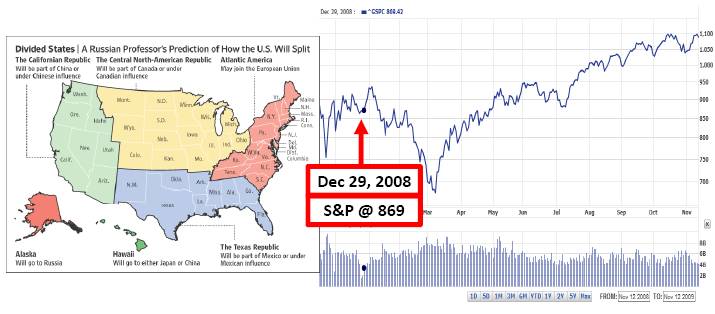
One of my favorite articles (read here) of the global crisis was written by The Wall Street Journal late last year about a Russian Professor, Igor Panarin (also a former KGB analyst). I find it absurdly amusing that the WSJ would even give credence to this story, but perhaps now I can look forward to an Op-Ed in their newspaper from Iranian President Mahmoud Ahmadinejad or North Korean Leader Kim Jong Ill. Not only did Professor Panarin pronounce the complete evaporation of the United States, but he also provided a specific timeframe. In late June or early July 2010, he expects the U.S. to fall into civil war and subsequently get carved up into six pieces by particular foreign regions, including China, Mexico, E.U., Japan, Canada, and Russia (which will control Alaska of course). I guess Sarah Palin will not be a happy camper?
Other Crisis Souvenirs

Hey Georgy, let me know when you turn bullish…so I can sell!
Market Mayhem
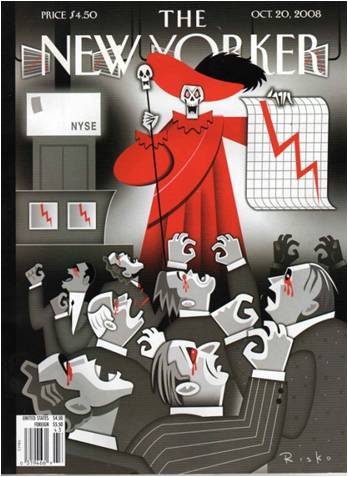
- Who’s that on the cover? Nancy Pelosi?!
Lessons Learned
Contrarianism for the sake of contrarianism is not necessarily a good thing. Trend can be your friend too. Bubbles take much longer to inflate than they burst, so it may be in your best interest to ride the wave of ecstasy for longer than the early alarm ringers. Take for example Alan Greenspan’s infamous irrational exuberance speech in 1996, when the NASDAQ index was trading around 1300. As we all know, the NASDAQ went on to pierce the 5000 mark, four years later. Sorry Al…right idea, but a tad early. Although he may have been correct directionally, his timing and degree were way off. Pundits like Nouriel Roubini and Peter Schiff are other examples of prognosticators who identified the financial crisis many years before the catastrophe actually hit. As I noted previously, trading based on magazine covers was not conceived as a legitimate investable strategy, but as I’ve shown they can be indicators of sentiment. And these sentiment indicators can be used as a valuable apparatus in your toolbox to prevent harmful decisions at the worst possible times.
Thanks for coming Back to the Future on this historical tour of cover stories. Now that you have graduated with honors, next time you are in line at the grocery store, feel free to flash your diploma to receive a discount on a magazine purchase.
Class dismissed.
Wade W. Slome, CFA, CFP®
Plan. Invest. Prosper.
DISCLOSURE: No information accessed through the Investing Caffeine (IC) website constitutes investment, financial, legal, tax or other advice nor is to be relied on in making an investment or other decision. Please read disclosure language on IC “Contact” page.
Back to the Future: Mag Covers (Part II)
In my most recent article, I went Back to the Future to examine the role magazine covers play as a contrarian indicator in fear-driven markets like we experienced in the 1970s (see previous story). Investing is both an art and science. While measuring the scientific aspects of the market can be more straight-forward, the behavioral and emotional sides to investing are more subjective. Magazines act as sentiment sensors to gauge the fear and froth pulses of the general investing public. Since last time we explored fear, let’s check out some froth from the 1990s technology boom.
How to Invest in the Hottest Market Ever
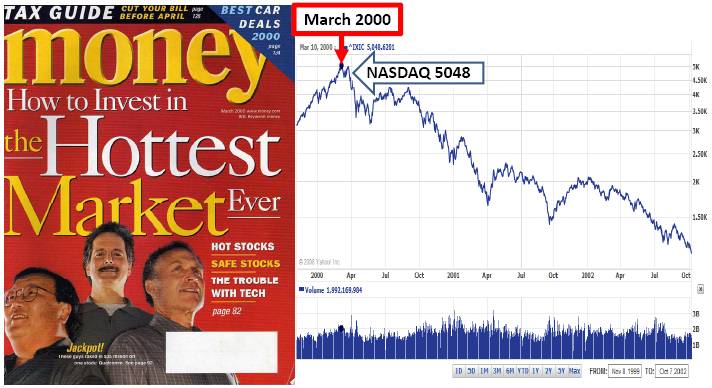
Seeing the forest from the trees can be difficult when you’re trapped in the thick of it, but the March 2000 issue of Money magazine’s “How to Invest in the Hottest Market Ever” is a classic example of the mentality that reigned supreme in the late 1990s technology bubble. Objective, fact-filled articles that challenge the status quo are not necessary to generate sales, but articles and magazine covers that pander to the raw emotions of fear and greed keep the cash register ringing. If you don’t believe me, just read the sensational headlines at your local grocery store explaining how swine flu will kill us all and how there are millions to be made in melting gold coins and jewelry (read gold article).
I love some of the quotes from the article, especially from Pam, the 51 year old divorced New York City art museum volunteer who bought AOL, Microsoft, and Qualcomm (which rose +2,621% in 1999) who dismisses diversification: “I feel pretty safe now. I think we are in a new paradigm now.” Yeah, a “new economy” that catapulted Yahoo to a Price/Earnings ratio of 400x’s earnings; Cisco 109x’s earnings; and Sun Microsystems practically a bargain basement steal at 88x’s earnings. For reference purposes, the S&P 500 index currently trades for about 14.6x’s estimated 2010 earnings and 19.5x on 2009 estimates.
GetRich.com
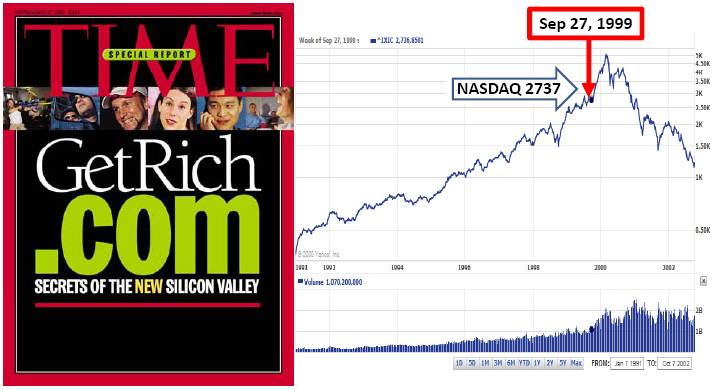
Another landmark masterpiece I love is the September 1999 Time cover, “GetRich.com.” Never mind the unabated technology boom (excluding a brief hiccup in 1998) that inflated the bubble for a decade – Time still managed to unearth the “Secrets of the New Silicon Valley.” The article goes onto to express the get-rich formula:
“Can’t program a computer? Not a techno savvy? Not a problem. If you’ve got a hot Internet business idea, Silicon Valley’s astonishing start-up machine will do the rest.”
Like a drug dealer pushing heroin on an addict, the article goes on to entice its readers to question “Why have a boss when you and three buddies can build your own publicly traded company in two years? Windows this big don’t open very often.”
A Few More Favorites
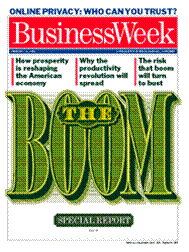
Great timing on this February 2000 cover…a month before the crash!

This July 1999 cover captures envy. Everyone's getting rich!
As we saw during the technology boom, media outlets have no shame in shoveling greed inducing slop to the hungry general public. Like all historical events that end tragically, valuable lessons can be learned from our mistakes. Developing a discerning palette for the news we digest is a critical quality to generating an informed investment decision process. With the 1970s and 1990s behind us, as the last of my three part series, we’ll use time travel to another period to see if modern magazine editors fare any better in market timing as compared to their predecessors. Please excuse me while I jump in my time machine.
Wade W. Slome, CFA, CFP®
Plan. Invest. Prosper.
DISCLOSURE: Sidoxia Capital Management (SCM) or its clients has a long position in CSCO and QCOM at the time this article was originally posted. SCM owns certain exchange traded funds, but currently has no direct position in YHOO, MSFT, or JAVA. No information accessed through the Investing Caffeine (IC) website constitutes investment, financial, legal, tax or other advice nor is to be relied on in making an investment or other decision. Please read disclosure language on IC “Contact” page.
Back to the Future: Mag Covers (Part I)
Magazine Covers Part II – – – Magazine Covers Part III
I’m not referring to the movie, Back to the Future, about a plutonium-powered DeLorean time machine that finds Marty McFly (played by Michael J. Fox) traveling back in time. Rather, I am shining the light on the uncanny ability of media outlets (specifically magazines) to mark key turning points in financial markets – both market bottoms and market tops. This will be the first in a three part series, providing a few examples of how magazines have captured critical periods of maximum fear (buying opportunities) and greed (selling signals).
People tend to have short memories, especially when it comes to the emotional rollercoaster ride we call the stock market. Thanks to globalization, the internet, and the 24/7 news cycle, we are bombarded with some fear factor to worry about every day. Although I might forget what I had for breakfast, I have been a student of financial market history and have experienced enough cycles to realize as Mark Twain famously stated, “History never repeats itself, but it often rhymes” (read previous market history article). In that vein, let us take a look at a few covers from the 1970s:
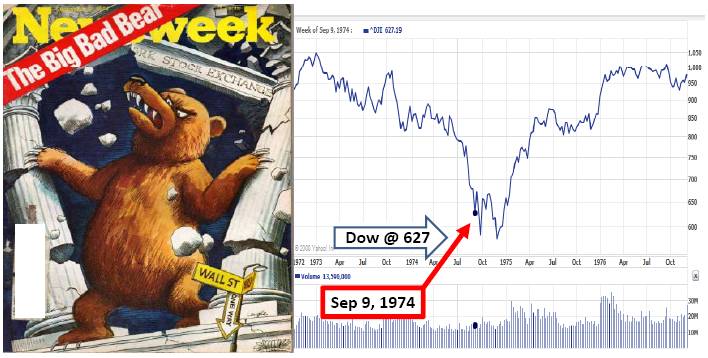
Newsweek’s “The Big Bad Bear” issue came out on September 9, 1974 when the collapse of the so-called “Nifty Fifty” (the concentrated set of glamour stocks or “Blue Chips”) was in full swing. This group of stocks, like Avon, McDonalds, Polaroid, Xerox, IBM and Disney, were considered “one-decision” stocks investors could buy and hold forever. Unfortunately, numerous of these hefty priced stocks (many above a 50 P/E) came crashing down about 90% during the1973-74 period.
Why the glum sentiment? Here are a few reasons:
- Exiting Vietnam War
- Undergoing a Recession
- 9% Unemployment
- Arab Oil Embargo
- Watergate: Presidential Resignation
- Franklin National Failure
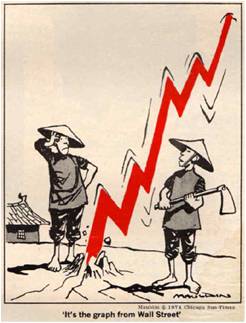
A cartoon from the same bearish 1974 cover article.
Not a rosy backdrop, but was this scary and horrific phase the ideal time to sell, as the magazine cover may imply? No, actually this was a shockingly excellent time to purchase equities. The Dow Jones Industrial Average, priced at 627 when the magazine was released, is now trading around 10,247…not too shabby a return considering the situation looked pretty darn bleak at the time.
Reports of the Market’s Death Greatly Exaggerated
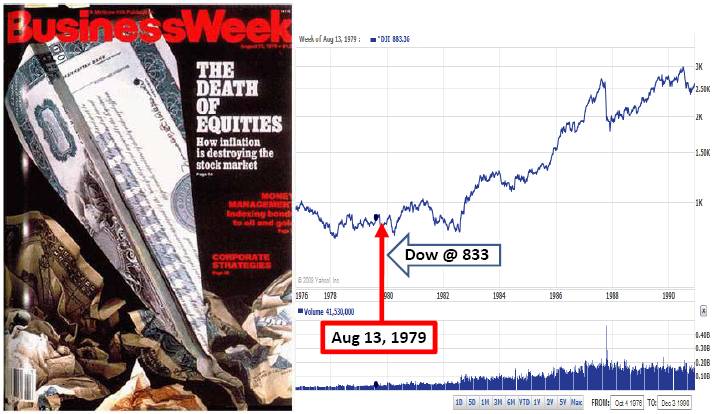
Sticking with the Mark Twain theme, the reports of the market’s demise was greatly exaggerated too – much the same way we experienced the overstated reaction to the financial crisis early in 2009. BusinessWeek’s August 13, 1979 magazine captured the essence of the bearish mood in the article titled, “The Death of Equities.” This article came out, of course, about 18 months before a multi-decade upward explosion in prices that ended in the “Dot-com” crash of 2000. In the late 1970s, inflation reached double digit levels; gold and oil had more than doubled in price; Paul Volcker became the Federal Reserve Chairman and put on the economic brakes via a tough, anti-inflationary interest rate program; and President Jimmy Carter was dealing with an Iranian Revolution that led to the capture of 63 U.S. hostages. Like other bear market crashes in our history, this period also served as a tremendous time to buy stocks. As you can see from the chart above, the Dow was at 833 at the time of the magazine printing – in the year 2000, the Dow peaked at over 14,000.
The walk down memory lane is not over yet. Conveniently, the Back to the Future story was designed as a trilogy (just like my three-part magazine review), so stay tuned for “Part II” – coming soon to your future.
Wade W. Slome, CFA, CFP®
Plan. Invest. Prosper.
DISCLOSURE: Sidoxia Capital Management (SCM) has a short position in MCD at the time this article was originally posted. SCM owns certain exchange traded funds, but currently has no direct position in Avon (AVP), Polaroid, Xerox (XRX), IBM or Disney (DIS). No information accessed through the Investing Caffeine (IC) website constitutes investment, financial, legal, tax or other advice nor is to be relied on in making an investment or other decision. Please read disclosure language on IC “Contact” page.
One Size Does Not Fit All

When you go shopping for a pair of shoes or clothing what is the first thing you do? Do you put on a blindfold and feel for the right size? Probably not. Most people either get measured for their personal size or try on several different outfits or shoes. When it comes to investments, the average investor makes uninformed decisions and in many instances relies more on what other advisors recommend. Sometimes this advice is not in the best interest of the client. For example, some broker recommendations are designed to line their personal pockets with fees and/or commissions. In some cases the broker may try to unload unpopular product inventory that does not match the objectives and constraints of the client. Because of the structure of the industry, there can be some inherent conflicts of interest. As the famous adage goes, “You don’t ask a barber if you need a haircut.”
Tabulate Inventory
A more appropriate way of managing your investment portfolio is to first create a balance sheet (itemizing all your major assets and liabilities) individually or with the assistance of an advisor (see “What to Do” article) – I recommend a fee-only Registered Investment Advisor (RIA)* who has a fiduciary duty towards the client (i.e., legally obligated to work for the best interest of the client). Some of the other major factors to consider are your short-term and long-term income needs (liquidity important as well) and your risk tolerance.
Risk Appetites
The risk issue is especially thorny because the average investor appetite for risk changes over time. Typically there is also a significant difference between perceived risk and actual risk.
For many investors in the late 1990s, technology stocks seemed like a low risk investment and everyone from cab drivers to retired teachers wanted into the game at the exact worst (riskiest) time. Now, as we have just suffered through the so-called Great Recession, the risk pendulum has swung back in the opposite direction and many investors have piled into what historically has been perceived as low-risk investments (e.g., Treasuries, corporate bonds, CDs, and money market accounts). The problem with these apparently safe bets is that some of these securities have higher duration characteristics (higher price volatility due to interest rate changes) and other fixed income assets have higher long-term inflation risk.
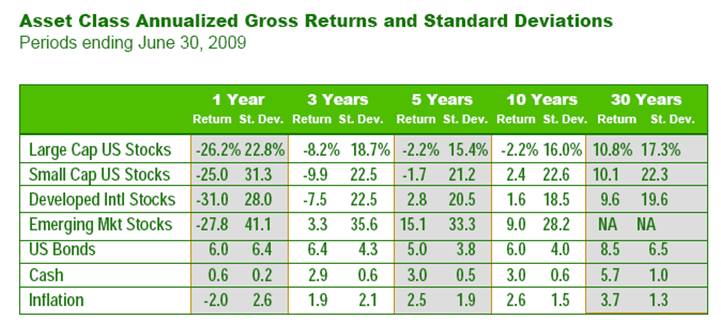
Source (6/30/09): Morningstar Encorr Analyzer (Ibbotson Associates) via State Street SPDR Presentation
A more objective way of looking at risk is by looking at the historical risk as measured by the standard deviation (volatility) of different asset classes over several time periods. Many investors forget risk measurements like standard deviation, duration, and beta are not static metrics and actually change over time.
Diversification Across Asset Classes Key
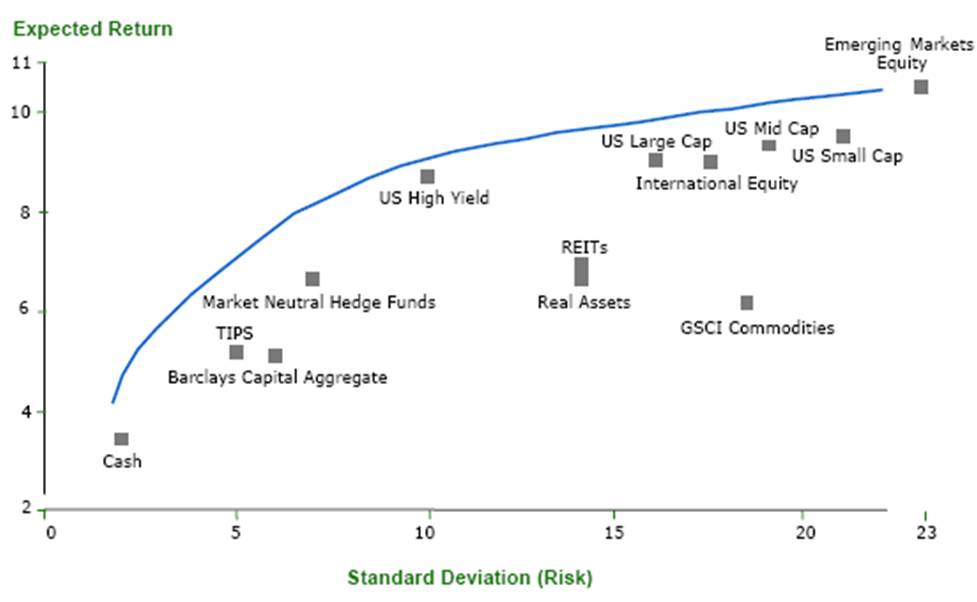
Source: State Street Global Advisors (June 30, 2009)
Correlation, which measures the price relationship between different asset classes, increased dramatically across asset classes in 2008, as the global recession intensified. However, over longer periods of time important diversification benefits can be achieved with a proper mixture of risky and risk-free assets, as measured by the Efficient Frontier (above). Conceptually, an investor’s main goal should be to find an optimal portfolio on the edge of the frontier that coincides with their risk tolerance.
Tailor Portfolio to Changing Circumstances
 In my practice, I continually run across clients or prospects that initially find themselves at the extreme ends of the risk spectrum. For example, I was confronted by an 80 year old retiree needing adequate income for living expenses, but improperly forced by their broker into 100% equities. On the flip side, I ran into a 40 year old who decided to allocate 100% of their retirement assets to fixed income securities because they are unsure of stocks. Both examples are inefficient in achieving their different investment objectives, yet there are even larger masses of the population suffering from similar issues.
Financial markets and client circumstances are constantly changing, so the objectives of the portfolio should be periodically revisited. One size does not fit all, so it’s important to construct the most efficient customized portfolio of assets that meets the objectives and constraints of the investor. Take it from me, I’m constantly re-tailoring my wardrobe (like my investments) to meet the needs of my ever-changing waistline.
Wade W. Slome, CFA, CFP®
Plan. Invest. Prosper.
*DISCLOSURE: For disclosure purposes, Sidoxia Capital Management, LLC is a Registered Investment Advisor (RIA) certified in the State of California. No information accessed through the Investing Caffeine (IC) website constitutes investment, financial, legal, tax or other advice nor is to be relied on in making an investment or other decision. Please read disclosure language on IC “Contact” page.




 Investing Caffeine