China: The Trade of the Century?

So it goes, Britain was the country of the 19th century, the United States was the country of the 20th century, and China will be the country of the 21st century. Is investment in China hype or reality? Here are some points in China’s favor:
- Large Labor Force: With a population exceeding 1.3 billion people, China has plenty of labor available to expand GDP (Gross Domestic Product).
- No Nonsense Government: An authoritarian government has its advantages. While pornography (see article) and unrest may be problems, infrastructure projects are not.
- Education: Chinese culture values education. As a result, China is slowly shifting away from its roots as the globe’s manufacturing and piracy capital. Intellectual property is appreciated more now that China is becoming a leader in emerging technology areas, such as solar power.
- Trade Surplus & Currency Reserves: Must be nice to have trade surpluses and massive currency reserves (~$2.3 trillion). This is what happens when you are in a position to export more than you import.
- Manageable Debt: China’s Debt/GDP ratio is less than 25%. You can compare that to the U.S. at around 100% and Japan at over 200%. Disciplined fiscal management provides the Chinese government with more options in dealing with the global slowdown (e.g., stimulus).
- Long Runway of Growth (Read More): China’s long runway of growth has allowed it, and should continue to allow it, to grow at above average growth rates – in the 3rd quarter of 2009 the Chinese economy grew at a very healthy +8.9% rate.
With all these positives, it’s no wonder China is the darling of the world. Given the constructive outlook, how can investors take advantage of the Far East opportunity in China? Our good friend at Investing Caffeine (figuratively speaking), Burton Malkiel (Princeton Professor of Economics and Chief Investment Officer at AlphaShares), is bullish about China and is sharing his preferred participation method…an all-cap China exchange traded fund (ticker: YAO) – Read more about Malkiel and Active vs. Passive Investing (12/8/09 Post).
Just how bullish is Professor Malkiel?
“I think China will continue to have the highest growth rate of any major country in the world, and within 20 years, China will be the world’s leading economic power.”
And he puts his money where his mouth is. Last year the professor shared his Chinese exposure in his personal portfolio:
“My portfolio is probably 20 percent Chinese, and that includes not only indices but also individual companies.”
Risks: The Price to Play
Professor Malkiel is not blindly diving into China – he researched the markets for years before taking the plunge. In an article from last year (From Wall Street to the Great Wall), he highlighted some of the inherent risks:
1) Foreign Neighbors: China continues to have tense, although cordial, relations with some of its neighbors like Taiwan and Japan. Their dealings are stable now, but the future is uncertain.
2) Social Unrest: An uneven distribution of income can lead to serious social unrest, especially in the rural parts of the country. If the government can’t keep the economy humming along, those left behind may fight back.
3) Environmental Degradation: China is building nuclear, wind, and solar projects at a frenetic pace, but China is also the globe’s largest emitter of greenhouse gases (relies on dirty coal for 70% of its energy), according to CNN. If China becomes an irresponsible power hog, there could be damaging effects to the economy.
4) Corruption: This continues to be a problem, but Malkiel points out the case of Zheng Xiaoyu, a former director of China’s FDA (Food and Drug Administration) equivalent. In 2007, he was executed after being found guilty of taking bribes.
5) Banking System: Malkiel notes that China continues to have a fragile banking system with a lot of bad loans. Due to political reasons, certain government owned entities may receive risky loans in the name of creating jobs – even if it means keeping unhealthy zombie banks alive.
Trading Strategies:
Beyond investing in AlphaShare ETFs (YAO), Malkiel advocates considering the other options, such as the “A”, “H”, and “N” shares. Unfortunately, the more inefficient “A” shares, which trade in Shanghai and Shenzen, are largely unavailable to investors outside of China. However, the “H” shares and “N” shares are available to international investors. “H” shares are listed on the Hong Kong Stock Exchange and the listed companies follow globally accepted accounting principles. The “N” shares come from companies registering with the SEC (Securities and Exchange Commission) and trade either on the NYSE (New York Stock Exchange) or NASDAQ exchanges.
Lastly, Malkiel knows he is not the only investor to pick-up on the China growth story. Multinationals are investing heavily in China, and these domestically based companies can serve as indirect investment vehicles to benefit from the attractive fundamentals as well.
Professor Malkiel calls China the “growth story of the world.” Simple math shows us that this Asian juggernaut (the third largest country in the world by GDP) will soon pass Japan in the number two position and the U.S. is likely only a few decades ahead after that. Having explored and studied China firsthand, I concur with many of Malkiels conclusions, which opens the possibility that China could reasonably be the top country (and top trade) of the 21st century?
Full Malkiel Article: From Wall Street to the Great Wall – Investment Opportunities in China
Wade W. Slome, CFA, CFP®
Plan. Invest. Prosper.
DISCLOSURE: Sidoxia Capital Management (SCM) and some of its clients own certain exchange traded funds, like FXI, at the time of publishing. No information accessed through the Investing Caffeine (IC) website constitutes investment, financial, legal, tax or other advice nor is to be relied on in making an investment or other decision. Please read disclosure language on IC “Contact” page.
Passive vs. Active Investing: Darts, Monkeys & Pros

Bob Turner is founder of Turner Investments and a manager of several funds at the investment company. In a recent article he reintroduces the all-important, longstanding debate of active management (“hands-on”) versus passive management (“hands off”) approaches to investing.
Mr. Turner makes some good arguments for the active management camp, however some feel differently – take for example Burton Malkiel. The Princeton professor theorizes in his book A Random Walk Down Wall Street that “a blindfolded monkey throwing darts at a newspaper’s stock page could select a portfolio that would do just as well as one carefully selected by experts.” In fact, The Wall Street Journal manages an Investment Dartboard contest that stacks up amateur investors’ picks against the pros’ and random stock picks selected by randomly thrown darts. In many instances, the dartboard picks outperform the professionals.
Given the controversy, who’s right…the darts, monkeys, or pros? Distinguishing between the different categorizations can be difficult, but we will take a stab nevertheless.
Arguments for Active Management
Turner contends, active management outperforms in periods of high volatility and he believes the industry will be entering such a phase:
“Active managers historically have tended to perform best in a market in which the performance of individual stocks varies widely.”
He also acknowledges that not all active managers outperform and admits there are periods where passive management will do better:
“The reason why most active investors fail to outperform is because they in fact constitute most of the market. Even in the best of times, not all active managers can hope to outperform…The business of picking stocks is to some degree a zero-sum game; the results achieved by the best managers will be offset at least somewhat by the subpar performance of other managers.”
Buttressing his argument for active management, Turner references data from Advisor Perspectives showing an inconclusive percentage (40.5%-67.8%) of the actively managed funds trailing the passively managed indexes from 2000 to 2008.
The Case for Passive Management
Turner cites one specific study to support his active management cause. However, my experience gleaned from the vast amounts of academic and industry data point to approximately 75% of active managers underperforming their passively managed indexes, over longer periods of time. Notably, a recent study conducted by Standard & Poor’s SPIVA division (S&P Indices Versus Active Funds) discovered the following conclusions over the five year market cycle from 2004 to 2008:
- S&P 500 outperformed 71.9% of actively managed large cap funds;
- S&P MidCap 400 outperformed 79.1% of mid cap funds;
- S&P SmallCap 600 outperformed 85.5% of small cap funds.
Read more about the dirty secrets shrinking your portfolio.
According to the Vanguard Group and the Investment Company Institute, about 25% of institutional assets and about 12% of individual investors’ assets are currently indexed (passive strategies). If you doubt the popularity of passive investment strategies, then look no further than the growth of Exchange Traded Funds (ETFs – see chart), index funds, or Vanguard Groups more than $1 trillion dollars in assets under management.
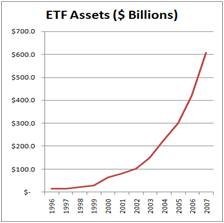
Although I am a firm believer in passive investing, one of its shortcomings is mean reversion. This is the idea that upward or downward moving trends tend to revert back to an average or normal level over time. Active investing can take advantage of mean reversion, conversely passive investing cannot. Indexes can get very top-heavy in weightings of outperforming sectors or industries, meaning theoretically you could be buying larger and larger shares of an index in overpriced glamour stocks on the verge of collapse. We experienced these lopsided index weightings through the technology bubbles in the late 1990s and financials in 2008. Some strategies may be better than other over the long run, but every strategy, even passive investing, has its own unique set of deficiencies and risks.
Professional Sports and Investing
As I discuss in my book, there are similarities that can be drawn between professional sports and investing with respect to active vs. passive management. Like the scarce number of .300 hitters in baseball, I believe there are a select few investment managers who can consistently outperform the market. In 2007, AssociatedContent.com did a study that showed there were only 22 active career .300 hitters in Major League Baseball. I recognize in the investing world there can be a larger role for “luck,” which is difficult, if not impossible, to measure (luck won’t help me much in hitting a 100 mile per hour fastball thrown by Nolan Ryan). Nonetheless, in the professional sports arena, there are some Hall of Famers (prospects) that have proved they could (can) consistently outperform their peers for extended durations of time.
Experience is another distinction I would highlight in comparing sports and investing. Unlike sports, in the investment world I believe there is a positive correlation between age and ability. The more experience an investor gains, generally the better long-term return achieved. Like many professions, the more experience you gain, the more valuable you become. Unfortunately, in many sports, ability deteriorates and muscles atrophy over time.
Size Matters
Experience alone will not make you a better investor. Some investors are born with an innate gift or intellect that propels them ahead of the pack. However, most great investors eventually get cursed by their own success thanks to accumulating assets. Warren Buffet knows the consequences of managing large amounts of dollars, “gravity always wins.” Having managed a $20 billion fund, I fully appreciate the challenges of investing larger sums of money. Managing a smaller fund is similar to navigating a speed boat – not too difficult to maneuver and fairly easy to dodge obstacles. Managing heftier pools of money can be like captaining a supertanker, but unfortunately the same rapid u-turn expectations of the speedboat remain. Managing large amounts of capital can be crippling, and that’s why captaining a supertanker requires the proper foresight and experience.
Room for All
As I’ve stated before, I believe the market is efficient in the long run, but can be terribly inefficient in the short-run, especially when the behavioral aspects of emotion (fear and greed) take over. The “wait for me, I want to play too” greed from the late 1990s technology craze and the credit-based economic collapse of 2008-2009 are further examples of inefficient situations that can be exploited by active managers. However, due to multiple fees, transaction costs, taxes, not to mention the short-term performance/compensation pressures to perform, I believe the odds are stacked against the active managers. For those experienced managers that have played the game for a long period and have a track record of success, I feel active management can play a role.
At Sidoxia Capital Management, I choose to create investment portfolios that blend a mixture of passive and active investment strategies. Although my hedge fund has outperformed the S&P 500 in 2009, that fact does not necessarily mean it’s the appropriate sole approach for all clients. As Warren Buffet states, investors should stick to their “circle of competence” so they can confidently invest in what they know. That’s why I generally stick to the areas of my expertise when I’m actively investing in stocks, and fill in the remainder of client portfolios with transparent, low-cost, tax-efficient equity and fixed income products (i.e., Exchange Traded Funds).
Even though the actively managed Turner Funds appear to have a mixed-bag of performance numbers relative to passively managed strategies, I appreciate Bob Turner’s article for addressing this important issue. I’m sure the debate will never fully be resolved. In the meantime, my client portfolios will aim to mix the best of both worlds within active and passive management strategies in the eternal quest of outwitting the darts, monkeys, and other pros.
Read the full Bob Turner article on Morningstar.com
Wade W. Slome, CFA, CFP®
Plan. Invest. Prosper.
DISCLOSURE: Sidoxia Capital Management (SCM) and some of its clients own certain exchange traded funds but had no direct position in stocks mentioned in this article. No information accessed through the Investing Caffeine (IC) website constitutes investment, financial, legal, tax or other advice nor is to be relied on in making an investment or other decision. Please read disclosure language on IC “Contact” page.
FDIC: Busted Piggy Bank

Just as Bank of America (BAC) has decided to pay back $45 billion in TARP (Troubled Asset Relief Program) money, and the employment picture brightened with the recent improvement in the unemployment rate, our banking piggy bank, FDIC (Federal Deposit Insurance Corporation), has been busted. Recovering macroeconomic indicators haven’t allowed our banking system to get out of the woods quite yet. This struggling FDIC news comes even before the inexorable collapse expected in commercial real estate (see Wilbur Ross’ comments on the subject).
Sheila Bair, the Chairwoman of the FDIC, indicated with her sobering remarks that these trends will not disappear overnight:
“For now the credit adversity we have been discussing for some time remains with us, and we have been discussing for some time remains with us, and we expect that it will be at least a couple of more quarters before we see a meaningful improvement in that trend.”
With the FDIC adding 136 banks to its “problem list” in the third quarter (bringing the total to 552), the regulator was forced to pull out $38.9 billion from the piggy bank, officially draining the rainy day fund into the red.
Fixing the Problem
How will the FDIC replenish its hollow piggy bank? Ms. Bair has recently endorsed a letter sent to House Financial Services Committee Chairman (Barney Frank) that would force secured creditors (mainly banks) to create a slush fund for potential large bank failures that pose a threat to the system. Ms. Bair designed the program this way because all banks – big or small – would be forced to “evaluate the solvency of our largest financial firms.”
Due to the continuation of bank failures and loan loss deterioration, the FDIC fund balance slipped to a negative -$8.2 billion (the first time since dealing with the failing thrifts in 1992) for the September period. Therefore, Ms. Bair put forth an emergency measure that requires insured banks to prepay three years of insurance premiums by the end of 2009. This action is expected to raise approximately $45 billion in funds. Although the reserve piggy bank had an upside down balance, the FDIC can still keep the lights on and cover employee payroll because the regulatory entity still has $23.3 billion in cash and marketable securities on its balance sheet.
With the taxpayers flipping the bill for bailouts galore over the last two years, and Goldman Sachs (GS) wheelbarrowing out bonuses to their employees, Ms. Bair and politicians are looking to the industry to now shoulder more of the bank failure burden. Let’s hope the piggybank can be replenished so taxpayers don’t have to go scraping through their wallets again.
Wade W. Slome, CFA, CFP®
Plan. Invest. Prosper.
DISCLOSURE: Sidoxia Capital Management (SCM) and some of its clients own certain exchange traded funds (VFH) and BAC, but at time of publishing had no direct positions in GS. No information accessed through the Investing Caffeine (IC) website constitutes investment, financial, legal, tax or other advice nor is to be relied on in making an investment or other decision. Please read disclosure language on IC “Contact” page.
Fuss Making a Fuss About Bonds

Photo Source: Evan Kafka (BusinessWeek)
Dan Fuss has been managing bond investments since 1958, longer than many of his competing managers have lived on this planet. At 75 years old, he is as sharp, if not sharper, than ever as he manages the flagship $18.7 billion Loomis Sayles Bond Fund (LSBRX). Over his 33-year tenure at Loomis, Sayles & Company (he started in 1976), he has virtually seen it all. After a challenging 2008, which saw his bond fund fall -22%, the bond markets have been kinder to him this year – Fuss’s fund performance registers in the top quartile on a 1-year, 5-year, and 10-year basis, according to Morningstar.com (through 12/3/09). With a track record like that, investors are listening. Unfortunately, based on his outlook, he now is making a loud fuss about the dreadful potential for bonds.
Rising Yields, Declining Prices
Fuss sees the bond market at the beginning stages of a rate-increase cycle. In his Barron’s interview earlier this year, Fuss made a forecast that the 10-Year Treasury Note yield will reach 6.25% in the next 4-5 years (the yield currently is at 3.38%). Not mincing words when describing the current dynamics of the federal and municipal bond markets, Fuss calls the fundamentals “absolutely awful.” Driving the lousy environment is a massive budget deficit that Fuss does not foresee declining below 4.5% of (GDP) Gross Domestic Product – approximately two times the historical average. Making matters worse, our massive debt loads will require an ever increasing supply of U.S. issuance, which is unsustainable in light of the aggressive domestic expansion plans in emerging markets. This issuance pace cannot be maintained because the emerging markets will eventually need to fund their development plans with excess reserves. Those foreign reserves are currently funding our deficits and Fuss believes our days of going to the foreign financing “well” are numbered.
Fuss also doesn’t see true economic expansion materializing from the 2007 peak for another four years due to lackluster employment trends and excess capacity in our economy. What does a bond guru do in a situation like this? Well, if you follow Fuss’ lead, then you need to shorten the duration of your bond portfolio and focus on individual bond selection. In July 2009, the average maturity of Fuss’ portfolio was 12.8 years (versus 13.8 years in the previous year) and he expects it to go lower as his thesis of higher future interest rates plays out. Under optimistic expectations of declining rates, Fuss would normally carry a portfolio with an average maturity of about 20 years. In Barron’s, he also discussed selling longer maturity, high-grade corporate bonds and buying shorter duration high-yield bonds because he expects spreads to narrow selectively in this area of the market.
Unwinding Carry Trade – Pricking the Bubble
How does Fuss envisage the bond bubble bursting? Quite simply, the carry trade ending. In trading stocks, the goal is to buy low and sell high. In executing a bond carry trade, you borrow at low rates (yields), and invest at high rates (yields). This playbook looks terrific on paper, especially when money is essentially free (short-term interest rates in the U.S. are near 0%). Unfortunately, just like a stock-based margin accounts, when investment prices start moving south, the vicious cycle of debt repayment (i.e., margin call) and cratering asset prices builds on itself. Most investors think they can escape before the unwind occurs, but Fuss intelligently underscores, “Markets have a ferocious tendency to get there before you think they should.” This can happen in a so-called “crowded trade” when there are, what Fuss points out, “so many people doing this.”
The Pro Predictor
Mr. Fuss spoke to an audience at Marquette University within three days of the market bottom (March 12, 2009), and he had these prescient remarks to make:
“I’ve never seen markets so cheap…stocks and bonds…not Treasury bonds.”
He goes on to rhetorically ask the audience:
“Is there good value in my personal opinion? You darn bethcha!”
Bill Gross, the “Bond King” of Newport Beach (read more) receives most of the media accolades in major bond circles for his thoughtful and witty commentary on the markets, but investors should start making a larger fuss about the 75 year-old I like to call the “Leader of Loomis!”
Adviser Perspectives Article on Dan Fuss and Interest Rates
Wade W. Slome, CFA, CFP®
Plan. Invest. Prosper.
DISCLOSURE: Sidoxia Capital Management (SCM) and some of its clients own certain exchange traded funds (including fixed-income) and is short TLT. At time of publishing, SCM had no positions in LSBRX. No information accessed through the Investing Caffeine (IC) website constitutes investment, financial, legal, tax or other advice nor is to be relied on in making an investment or other decision. Please read disclosure language on IC “Contact” page.
Sukuk: Islamic Loophole for Dubai Debt Debacle

Islamic followers can be capitalists too. Although oil prices (currently around $77 per barrel) have fallen from the peak near $150 per barrel in 2008, oil rich nations have gotten creative in how they raise debt-like financing. Critical to fueling the speculative expansion in some oil rich areas has been the growth in sukuk bonds, which have been created as a function of an exploited loophole embedded in Islamic finance principles.
U.S. Does Not Have Monopoly on Debt Driven Greed
The pricked debt bubble that spanned a range of entities, from Icelandic banks to Donald Trump’s empire (read more), has now spread to Dubai commercial real estate. At the center of the storm is Dubai World, a quasi-government owned conglomerate of Dubai, which is in the process of negotiating a $26 billion debt restructuring with the government and sukuk bondholders. The overleveraged Dubai market ($80 billion in total debt) is home to the tallest building in the world, largest man-made islands, and a ski-resort based in the desert – all projects built with the help of debt in the face of collapsing real estate prices. Critical to Dubai World’s debt restructuring is a $3.5 billion sukuk bond issued by its commercial real estate subsidiary Nakheel Development (“Nakheel”). So what exactly is a sukuk (plural of sakk)?
Investopedia lists the following definition for sukuk:
“An Islamic financial certificate, similar to a bond in Western finance, that complies with Sharia, Islamic religious law. Because the traditional Western interest paying bond structure is not permissible, the issuer of a sukuk sells an investor group the certificate, who then rents it back to the issuer for a predetermined rental fee. The issuer also makes a contractual promise to buy back the bonds at a future date at par value.”
Sukuk “No-No”s
The generation of money on top of money – interest payments or what’s called “Riba” – is strictly forbidden by Shari’ah law. As a result, issuers must issue and repurchase sukuk at par (original value), not at a discount or a premium. Shari’ah law encompasses more than Islamic law, it also covers the amorphous spiritual and moral obligations demanded from the religious practitioners. In order to ensure compliance with Islamic principles, many financial institutions and funds typically have a Shari’ah Board monitoring the details of the sukuk. Shari’ah law is very consistent with the teachings in the Quran (the Western version of the Bible). Mixing finance and religion may seem strange on the surface, but I guess if we use world history as a proxy, we shouldn’t be surprised that money and Muhammad somehow find a way to coexist.
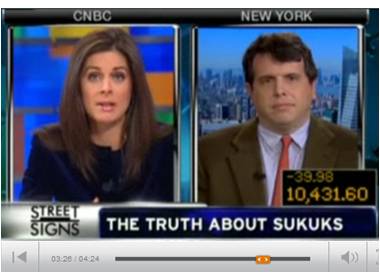
Click Here to View CNBC Interview on Sukuk Bonds
Sukuk Structure & Market
The core Islamic finance principles underpinning the sukuk market have been around for more than 1,500 years, but the actual sukuk market was actually introduced in Malaysia around 1990. Since then, the market has been on a continual uptrend. What makes this $1 trillion Islamic debt market (HSBC estimate) even fuzzier is the scores of sukuk structures (See Ijara Sukuk chart below – very similar to a sale-leaseback arrangement), and the diverse geographic issuer/investor base. For example, greater than 60% of Nakheel’s investors are based outside the Middle East (a large portion in Malaysia). Making matters as clear as mud, each geographic region and structure has its own interpretation of legal rights and Shari’ah law. Layer on issues such as derivatives, bankruptcy rights, and penalty fees and you end up with only more complexity. What’s more, many of these sukuk bonds involve Special Purpose Vehicles (SPVs) – made famous by the off-balance sheet variety used by Enron Corp. – in order to get around the Islamic issuance loopholes.

Source: Moody's Investor Service
Sukuk Liquidity
The illiquidity of sukuk market hasn’t made resolving the Dubai debt restructuring any easier. The sukuk market doesn’t come close to matching the liquidity of traditional corporate and sovereign debt markets. Little trading is done in secondary markets because most investors in sukuk bonds follow a buy and hold strategy. The lion’s share of trading in this immature market gets completed through inter-institution, over-the-counter transactions. A recent $500 million sukuk deal issued by General Electric (GE) last month has only raised awareness for the financing structure (pre-Nakheel restructuring). As oil rich states strive to diversify their economic bases, I would expect more deals to get done, in spite of the recent Dubai mess. How severe the recent Dubai sukuk black eye will be depends on how Nakheel, the United Arab Emirates (UAE), Abu Dhabi, bondholders, and other constituents restructure the pending sukuk obligations by the December 14th deadline.
The recent debt restructuring talks in Dubai highlight the complexity of this relatively new Islamic financing structure. With very few sukuk bankruptcy cases in existence, the structures remain largely untested and uncertain. How the Dubai debt debacle ultimately gets resolved will have a significant impact on this nascent, but rapidly growing market. Until the sukuk restructuring is settled, Dubai may just need to put the construction of that next man-made island on hold.
Wade W. Slome, CFA, CFP®
Plan. Invest. Prosper.
DISCLOSURE: Information and data from Moody’s Investor Service (Shari’ah and Sukuk: A Moody’s Primer 5/31/2006), CNBC interview 12/2/09, Financial Times 12/1/09, and other articles. Sidoxia Capital Management (SCM) and some of its clients own certain exchange traded funds, but at time of publishing had no direct positions in GE. No information accessed through the Investing Caffeine (IC) website constitutes investment, financial, legal, tax or other advice nor is to be relied on in making an investment or other decision. Please read disclosure language on IC “Contact” page.
More Eggs in Basket May Crack Portfolio

NOT putting all your eggs in one basket makes intuitive sense to many investors. Burton Malkiel, Princeton Professor, economist, and author, summed it up succinctly, “Diversity reduces adversity.” Diversification acts like shock absorbers on a car – it smoothens out the ride on a bumpy financial road (read more on diversification). Jason Zweig, Wall Street Journal writer, acknowledges the academic findings that underpin these diversification benefits by stating the following:
“As many studies have shown, at least 40% of the variability in returns can be reduced by moving from a single company to 20. Once a portfolio contains 20 or 30 stocks, adding more does little to damp the fluctuations in wealth over time.”
Despite the evidence, Jason Zweig explores the conventional views on diversification more closely.
Turning the Diversification Concept on its Head
Zweig, not satisfied with the standard thinking on the topic, decided to explore the work of Don Chance, a finance professor at the Louisiana State University business school. Professor Chance asked more than 200 students to consecutively select stocks until they each held a portfolio of 30 positions. Here are two of the main findings:
1) Averages Hold Firm: On average, for the group of students, diversifying from a single stock to 20 reduced portfolio risk by roughly 40% – just as would be expected from the academic research.
2) Individual Portfolios Riskier: After the first few initial stock picks, for each individual portfolio, were made from a list of large cap household names (e.g., XOM, SBUX, NKE), Professor Chance found in many instances students dramatically increased portfolio risk. These students juiced up the octane in their portfolios by venturing into much smaller, more volatile stock selections.
Deceiving Diversification
Gur Huberman, a Columbia Finance Professor also points out a tendency for investors to clump stock selections together in groups with similar risk profiles, thereby reducing diversification benefits. Diversifying from one banking stock to 20 banking stocks may actually do more damage. Statistically, Zweig points out, “Thirteen percent of the time, a 20-stock portfolio generated by computer will be riskier than a one-stock portfolio.”
Professor Chance found similar results according to Zweig:
“One in nine times, they [students] ended up with 30-stock portfolios that were riskier than the single company they had started with. For 23%, the final 30-stock basket fluctuated more than it had with only five stocks.”
Diversified Views on Diversification
Chance and Huberman are not the only professionals to question the benefits of diversification:
Warren Buffett: A diversification skeptic declares, “Put all your eggs in one basket and then watch that basket very carefully.” Alternatively, Buffett says, “Diversification is protection against ignorance.”
Peter Lynch: He referred to diversification as “deworsification,” especially when it came to companies diversifying into non-core businesses.
Charlie Munger: “Wide diversification, which necessarily includes investment in mediocre businesses, only guarantees ordinary results.”
Zweig’s Solution:
“If you want to pick stocks directly, put 90% to 95% of your money in a total stock-market index fund. Put the rest in three to five stocks, at most, that you can follow closely and hold patiently. Beyond a handful, more companies may well leave you less diversified.”
Portfolio diversification and concentration have been issues studied for decades. As you can see, there are different viewpoints regarding the benefits. As Zweig establishes, through the research of Don Chance, putting more eggs in your basket may actually crack your portfolio, not protect it.
Read Complete WSJ Jason Zweig Article
Wade W. Slome, CFA, CFP®
Plan. Invest. Prosper.
DISCLOSURE: Sidoxia Capital Management (SCM) and some of its clients own certain exchange traded funds, but at time of publishing had no direct positions in XOM, SBUX, BRKA/B or NKE. No information accessed through the Investing Caffeine (IC) website constitutes investment, financial, legal, tax or other advice nor is to be relied on in making an investment or other decision. Please read disclosure language on IC “Contact” page.
The Economics and Consequences of Obesity

‘Tis the season to consume a lot of calories, and my tighter fitting, post turkey-day trousers can attest to that fact. Healthcare reform is front and center in the national debate, as well, and the rising epidemic of obesity should play a significant role in the discussion. Why is this issue so important? According to female financial guru, Suze Orman, we are already spending $57 billion more on obesity than cancer. Obesity-related health care costs totaled about $117 billion in 2000, according to the CDC (Center of Disease Control). One study on obesity estimates the problem will cost the United States $344 billion in health costs by 2018.
Although it may be an uncomfortable issue to talk about, this matter has had a direct personal impact on my family, making the problem all the more tangible to me. Regardless of the function of genetics or what lifestyle choices are made, the negative consequences are indisputable.
Take a look at the table of negative outcomes provided by the CDC:
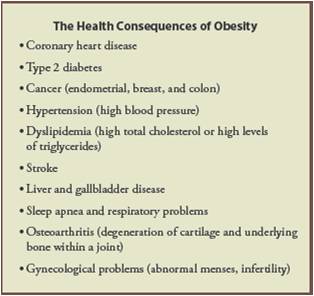
These consequences obviously take a large toll on the individuals, but they also have a massive impact on our healthcare system. And the CDC has the data to backup the severity of this intensifying problem:
“More than one third of U.S. adults—more than 72 million people—and 16% of U.S. children are obese. Since 1980, obesity rates for adults have doubled and rates for children have tripled. Obesity rates among all groups in society—irrespective of age, sex, race, ethnicity, socioeconomic status, education level, or geographic region—have increased markedly.”
Before solutions can be created, the root problems need to be addressed. One of the factors contributing to increased incidence of obesity is our unhealthy dietary habits (myself included). A chart from the New York Times highlights the economic impact of our food choices has been impacted by inflation trends. Over the last 30 years, unhealthy foods (beer, butter, and soda) have become much cheaper than healthy foods (fresh fruits and vegetables), on a relative basis (see chart below). Making a trip to fast food chains has not only become more convenient, but the practice has also become more affordable.

Source: Bureau of Labor Statistics (NY Times)
With our work lives stretched even further and stress levels rising, the picture below highlights the relationship between obesity (as measured by the Body Mass Index) and minutes spent per day eating. Our unhealthy, indoor, sedentary lifestyles take away from our healthy eating habits as well. The U.S. is the country with the highest percentage of individuals who are obese and the country that spends the third fewest minutes per day eating (eating more fast food). Seems like a fairly tight correlation.
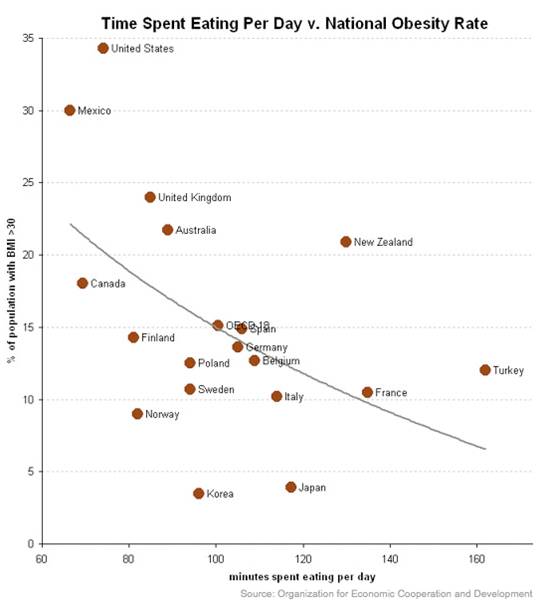
Data Source: OECD (Organization for Economic Cooperation and Development)
Solutions?
Education / Government: Educational support through cooperation with the government is necessary to spread the word regarding the consequences of obesity. Incentives also need to be integrated into our healthcare system so individuals can responsibly attack obesity head-on.
Behavioral Modification: Healthier diet and exercise lifestyles need to be evangelized. Implementation of economic incentives can possibly improve behavior by lowering insurance premiums in exchange for better health compliance.
Medications: Research needs to continue so innovative medications can help prevent and control obesity. Arena Pharmaceuticals (ARNA), VIVUS (VVUS), and Orexigen Therapeutics (OREX) are in the late stages in an attempt of getting their obesity drugs approved by the FDA. There is tremendous profit potential if the proper mix of efficacy and safety can be proven, however the detection of side-effects can potentially derail adoption and approval.
Surgery: Advancements have been introduced through medical technologies as well. Allergan’s (AGN) Lap-Band device is an example of an FDA approved device that effectively wraps around the stomach like a rubber-band to control excessive eating urges.
Obviously this is not an easy problem to deal with, as evidenced by the skyrocketing numbers. Many face inherent genetic hurdles in conquering diabetes, while others may have other health issues that contribute to overweight problems.
With the holidays upon us, I still plan on responsibly splurging on occasion, but I’m praying I will have the discipline to mix in some veggies and a run around the block with my eggnog and turkey leg. In the meantime, perhaps I’ll help support the economy by running to the mall and burning some holiday calories by doing some shopping!
Wade W. Slome, CFA, CFP®
Plan. Invest. Prosper.
DISCLOSURE: Sidoxia Capital Management (SCM) and some of its clients own certain exchange traded funds and AGN, but at time of publishing had no direct positions in ARNA, VVUS, or OREX. No information accessed through the Investing Caffeine (IC) website constitutes investment, financial, legal, tax or other advice nor is to be relied on in making an investment or other decision. Please read disclosure language on IC “Contact” page.
Friedman Looks to Flatten Problems in Flat World

Perhaps Friedman could use Gallagher's "Sledge-O-Matic?"
Thomas Friedman, author of recent book Hot, Flat, and Crowded and New York Times columnist, combines a multi-discipline framework in analyzing some of the most complex issues facing our country, from both an economic and political perspective. Friedman’s distinctive lens he uses to assimilate the world, coupled with his exceptional ability of breaking down and articulating these thorny challenges into bite-sized stories and analogies, makes him a one-of-a-kind journalist. Whether it’s explaining the history of war through McDonald’s hamburgers, or using the Virgin Guadalupe to explain the rise of China, Friedman brings highbrow issues down to the eye-level of most Americans.
In his seminal book, The World is Flat, Friedman explains how technology has flattened the global economy to a point where U.S. workers are fighting to keep their domestic tax preparation and software engineering jobs, as new emerging middle classes from developing countries, like China and India, steal work.
The Flat World
In boiling down the recent financial crisis, Friedman used Iceland to explain the “flattening” of the globe:
“Fifteen British police departments lost all their money in Icelandic online savings accounts. Like who knew? I knew the world was flat – I didn’t know it was that flat…that Iceland would become a hedge fund with glaciers.”
The left-leaning journalist hasn’t been afraid to bounce over to the “right” when it comes to foreign affairs and certain fiscally conservative issues. For example, he initially full-heartedly supported George W. Bush’s invasion of Iraq. And on global trade, he has a stronger appreciation of the economic benefits of free trade as compared to traditionally Democratic protectionist views.
Calling All Better Citizens
In a recent Charlie Rose interview, Friedman’s patience with our country’s citizenry has worn thin – he believes government leaders cannot be relied on to solve our problems.
When it comes to the massive deficits and foreign affair issues, Friedman comes to the conclusion we need to cut expenses or raise taxes. By creating a $1 per gallon gasoline tax, Friedman sees a “win-win-win-win” solution. Not only could the country wean itself off foreign oil addiction from authoritarian governments and create scores of new jobs with E.T. (Energy Technologies), the tax could also raise money to reduce our fiscal deficit, and pay for expanded healthcare coverage.
It’s fairly clear to me that government can’t show the leadership in cutting expenses. Since cutting benefits for voters won’t get you re-elected, taxes most certainly will have to go up. Wishful thinking that a recovering economy will do the dirty, debt-cutting work is probably naïve. If forced to pick a poison, the gas tax is Friedman’s choice. I’m not so sure the energy lobby would feel the same?
Political gridlock has always been an obstacle for getting things done in Washington. Technology, scientific polling, 24/7 news cycles, and deep-pocketed lobbyists are only making it tougher for our country to deal with our difficult challenges. Regardless of whether Friedman’s gasoline tax is the silver bullet, I welcome the clear, passionate voice from somebody that understands the challenges of living in a flat world.
Wade W. Slome, CFA, CFP®
Plan. Invest. Prosper.
DISCLOSURE: Sidoxia Capital Management (SCM) owns certain exchange traded funds (BKF, FXI) and has a short position in MCD at the time this article was originally posted. No information accessed through the Investing Caffeine (IC) website constitutes investment, financial, legal, tax or other advice nor is to be relied on in making an investment or other decision. Please read disclosure language on IC “Contact” page.
Turkey Day Tidbits

Well, I have managed to pull away from my turkey, mash potatoes, and pumpkin pie to scribble down some Cliff Clavin-like trivia as it relates to Thanksgiving.
Did you know?
- Origin of Thanksgiving: The genesis of Thanksgiving dates back to the fall of 1621 when only half of the pilgrims who sailed on the Mayflower survived. The survivors were thankful to be alive and therefore decided to have a thanksgiving feast. In 1863 President Abraham Lincoln declared the last Thursday of November as a national day of thanksgiving before Franklin Roosevelt (in office from 1933-1945) changed it to the fourth Thursday of the month to encourage holiday shopping (in case there was a fifth Thursday). As you can see, our infatuation with consumer spending existed all the way back to the first half of last century.
- Turkey Chasing Trivia: For a plump delicious item consumed with gravy from my plate at a leisurely pace, I was surprised to discover wild turkeys can run up to 20 miles per hour and burst into flight speeds of approximately 50-55 miles per hour in a matter of seconds. Glad my fork and knife can contain this fast fowl from escaping its destiny into my belly.
- Turkey Eating Trivia: The number of turkeys raised in the U.S. is estimated at 250 million in 2009, down about 8% from the $4.5 billion and 7.9 billion pounds produced in 2008. Minnesota, the “Gopher State,” is expected to be the top turkey producing state, registering in at 45.5 million gobblers. The annual turkey consumption of an American averaged 13.8 pounds in 2007 – with a healthy portion of that consumed during the Thanksgiving holiday period.
- Other Fixins: You can’t have Thanksgiving turkey without cranberries, which explains the 709 million pounds of production expected in 2009 (more than half coming from Wisconsin). Cranberries are considered one of three native fruits to North America (the others are Concord grapes and blueberries). There were about 3 billion pounds of sweet potatoes and pumpkins produced in 2008 (North Carolina and Illinois were the leading producers, respectively.).
- Wishbone History: Back in the days of the Etruscans (about 1200 BC–550 BC), chickens were used for fortune-telling and the dried wishbones of the dead fowl were stroked for good luck. The tradition evolved through Roman times and the wishbone practice was modified to include the breaking of the bone. Eventually the custom made it to England, and the English took it to the New World.
- Holiday Football: Ever since the league was created, the National Football League (NFL) has played games on Thanksgiving. The Detroit Lions have hosted a game every Thanksgiving Day since 1934, with the exception of World War II (1939–1944).
More than all the trivia, I enjoy this holiday as a time for contemplation. The daily rat race hits us all to some degree and can distort our views of reality. On days like today, it’s nice to suppress the craziness (albeit temporarily) to reflect on those issues important to us, thereby reshaping our lives back into proper perspective.
And oh yeah, squeezing in some football on the boob-tube and stuffing my face with pie and ice cream makes it all the more enjoyable.
A happy and healthy Thanksgiving to all,
Wade W. Slome, CFA, CFP®
Plan. Invest. Prosper.
DISCLOSURE: No information accessed through the Investing Caffeine (IC) website constitutes investment, financial, legal, tax or other advice nor is to be relied on in making an investment or other decision. Please read disclosure language on IC “Contact” page.
Turkey Stuffing, Wall Street Style

There will be no shortage of turkey stuffing this year, thanks to a story from Joshua Brown’s The Reformed Broker site (Wall Street Turkeys…Full of Stuffing).
In the spirit of Thanksgiving, which turkeys did journalist Terry Keenan roast?
Timothy Geithner: A fledgling economy and aggressive fiscal measures have painted a big target on Geithner’s back. I don’t fall into the “let’s lynch Geithner” camp, but Keenan feels “It’s a fair bet President Obama’s least-popular appointed official won’t be around to roast next Thanksgiving. “
John Thain: The former Merrill Lynch CEO and Bank of America executive who spent $1.2 million redecorating his Manhattan office made the list too. The man referred to as “I-Robot” may be difficult to cook, but regardless the article claims he is seeking to find employment running a different public company in the mean time.
Larry Summers: As the Director of President Obama’s National Economic Council, Mr. Summers has done a respectable job of flying below the radar, but not low enough to escape his past as Harvard University’s President (and the associate poor performing endowment).
Jeffrey Immelt: GE is no weakling, weighing in around $170 billion in market cap, but Keenan highlights the fledgling performance of NBC over the last two decades as reason to stuff this turkey.
Vikrim Pandit: The CEO of Citigroup survived a tumultuous period in 2009. Keenan however underscores how:
“His image suffered a big blow at the hands of Andrew Ross Sorkin, who paints an unflattering portrait of Pandit in his best-selling book, Too Big to Fail. If Pandit can’t play the “source game” to his advantage, it’s hard to see how he’s up to the much tougher task of reviving Citi’s fortunes.”
Now that we’re done with the turkey, could you please pass the stuffing.
Wade W. Slome, CFA, CFP®
Plan. Invest. Prosper.
DISCLOSURE: Sidoxia Capital Management (SCM) and its clients own certain exchange traded funds (including VFH), but currently have no direct positions in BAC, GE, or C. No information accessed through the Investing Caffeine (IC) website constitutes investment, financial, legal, tax or other advice nor is to be relied on in making an investment or other decision. Please read disclosure language on IC “Contact” page.