SEC Awake at the Switch…Sort Of

The SEC is accusing Goldman Sachs (GS) of screwing its own clients through lack of disclosure (see also Goldman Cheat? article), but the SEC apparently enjoys passively watching a little action itself. Throughout the financial crisis, as investors watched the collapse of major financial institutions like Bear Stearns (JPM), Lehman Brothers, and AIG, the SEC was accused of falling asleep at the switch. As it turns out, the SEC was not asleep, but rather they were quite awake switching on the porn.
Efficiency may not be the core strength of all governmental agencies (several of my horrific trips to the department of motor vehicles (DMV) can attest to that fact), but little did I know that my tax dollars were supporting six-figure salaries (some over $200,000), so SEC employees could watch skin flick classics like Pulp Friction, Spankenstein, or Buttman and Throbbin’.
I guess from a certain standpoint, one might appreciate SEC employee ingenuity and determination. For example the Associated Press reported the following:
“An accountant was blocked more than 16,000 times in a month from visiting websites classified as “Sex” or “Pornography.” Yet he still managed to amass a collection of “very graphic” material on his hard drive by using Google images to bypass the SEC’s internal filter, according to an earlier report from the inspector general.”
“A senior attorney at the SEC’s Washington headquarters spent up to eight hours a day looking at and downloading pornography. When he ran out of hard drive space, he burned the files to CDs or DVDs, which he kept in boxes around his office.”
Perhaps the SEC is just like Goldman Sachs? They both just happened to get caught, even though many others have participated in the sinful behavior. How widespread is pornography viewing in the workplace? A study conducted by Websense in 2006 reported that 16% of men with internet access admitted to watching porn during office hours.
Watching nudey movies is less damaging than allegedly misrepresenting and hiding information from investors, but Dick Fuld, Bernie Madoff, and Allen Stanford are certainly thankful to the distracted SEC staffers for the extra time the crooked Wall Streeters were given to run their schemes. Wall Street has become a lightning rod, and given the fact that 2010 is an election year, there is extreme pressure on politicians to limit the power, size, and activities of the major banks. Maybe the new regulatory reform legislation being crafted in Congress will even include a ban on workplace pornography viewing. With additional free time, the SEC may successfully find more law-breakers. Who knows, possibly Goldman could even help the government recover some lost tax revenue by auctioning off excess dirty movies left over at the SEC?
Read the Rest of the AP Article
Wade W. Slome, CFA, CFP®
Plan. Invest. Prosper.
*DISCLOSURE: Sidoxia Capital Management (SCM) and some of its clients own certain exchange traded funds and in a security derived from an AIG subsidiary, but at the time of publishing SCM had no direct positions in GS, Bear Stearns (JPM), and Lehman Brothers, or any security referenced in this article. No information accessed through the Investing Caffeine (IC) website constitutes investment, financial, legal, tax or other advice nor is to be relied on in making an investment or other decision. Please read disclosure language on IC “Contact” page.
Filet or Mac & Cheese? Investing for Retirement

The financial crisis of 2008-2009 placed a large swath of investors into paralysis based on a fear the United States and the rest of the world was on the verge of irreversible destruction. Regardless of what the newspaper headlines are reading and television pundits are spouting, individuals have to shrewdly plan for retirement no matter what the economy is doing. So then the question becomes, do you want to be eating macaroni & cheese in retirement, or does filet mignon or alternate five-star cuisine sound more appealing? I vote for the latter.
Despite what the government statistics are saying about the current state of benign inflation, you do not need to be a genius to see medical costs are exploding, energy charges have skyrocketed, and even more innocuous items such as movie ticket prices continue to rise. If that’s not a burden enough, depending on your age, there’s a legitimate concern the Social Security and Medicare safety nets may not be there for you in retirement. It is more important than ever to take control of your financial future by investing your money in a more efficient manner (see Fusion), focusing on long-term, low-cost, tax-efficient strategies. Whatever the direction of the financial markets (up, down, or sideways), if you don’t wisely invest your money, you will run the risk of working as a Wal-Mart (WMT) greeter into your 80s and relegated to eating mac & cheese (for lunch and dinner).
Broaden Your Horizons
The last decade has been tough for domestic equities. It’s true that not a lot of compounding of returns has occurred in the domestic equity markets over the last decade (see Lost Decade), but that weakness is not necessarily representative of the next decade’s performance or the past relative strength seen in areas like emerging markets, materials and certain fixed income markets. These alternatives, including cash, would have added significant diversification benefits to investor portfolios during previous years. Rather than focusing on what’s best for the investor, so much financial industry attention has been placed on high cost, high fee, high commission domestic stock funds or insurance-based products. Due to many inherent conflicts of interest, many individual investors have lost sight of other more attractive opportunities, like exchange traded funds, international strategies, and fixed-income investment vehicles.
Rule of 72
Depending on your risk profile, objectives and constraints, the “Rule of 72” implies your retirement portfolio should double from a $100,000 investment now to roughly $200,000 in seven years (to $400,000 in 14 years, $800,000 in 21 years, etc.), assuming your portfolio can earn a 10% annual return. Unfortunately, this snowballing effect of money growth does not work if you are paying out significant chunks of your returns to aggressive brokers and salespeople in the forms of high commissions, fees, and taxes (see a Penny Saved is Billions Earned). For example, if you are paying out total annual expenses of 2-3% to a broker, advisor, or investment manager, the doubling effect of the Rule of 72 will be stretched out to 9-10 years (rather than the above mentioned seven years). If you do not know what you are paying in fees and expenses (like the majority of people), then do yourself a favor and educate yourself about the fee structures and tax strategies utilized in your investments (see also Investor Confusion). If you haven’t started investing, or you are shoveling out a lot of money in fees, expenses, and taxes, then you should reconsider your current investment stretegy. Otherwise, you may just want to begin stockpiling a lot of macaroni & cheese in your retirement pantry.
Wade W. Slome, CFA, CFP®
Plan. Invest. Prosper.
*DISCLOSURE: Sidoxia Capital Management (SCM) and some of its clients own certain exchange traded funds and shares in WMT, but at the time of publishing SCM had no direct positions in any security referenced in this article. No information accessed through the Investing Caffeine (IC) website constitutes investment, financial, legal, tax or other advice nor is to be relied on in making an investment or other decision. Please read disclosure language on the IC “Contact” page for more information.
Goldman Cheat? Really?

Really? Am I supposed to be surprised that the SEC (Securities and Exchange Commission) has dug up a CDO (Collateralized Debt Obligation) deal with $1 billion in associated Goldman Sachs (GS) losses? The headline number may sound large, but the billion dollars is not much if you consider banks are expected to lose about $3 trillion dollars (according to an International Monetary Fund report) from toxic assets and bad loans related to the financial crisis. Specifically, Goldman is being charged for defrauding investors for not disclosing the fact that John Paulson (see Gutsiest Trade), a now-famous hedge fund manager who made billions by betting against the subprime mortgage market, personally selected underlying securities to be included in a synthetic CDO (a pool of mortgage derivatives rather than a pool of mortgage securities).
Hurray for the SEC, but surely we can come up with more than this after multiple years? More surprising to me is that it took the SEC this long to come up with any dirt in the middle of a massive financial pigpen. What’s more, the estimated $1 billion in investor losses associated with the Goldman deal represents about 0.036% of the global industry loss estimates. These losses are a drop in the bucket. If there is blood on Goldman’s hand, my guess is there’s enough blood on the hands of Wall Street bankers to paint the White House red (two coats). The Financial Times highlighted a study showing Goldman was a relative small-fry among the other banks doing these type of CDO deals. For 2005-2008, Goldman did a little more than 5% of the total $100+ billion in similar deals, earning them an unimpressive ninth place finish among its peers. As a matter of fact, Paulson also hocked CDO garbage selections to other banks like Deutsche Bank, Bear Stearns, and Credit Suisse. The disclosure made in those deals will no doubt play a role in determining Goldman’s ultimate culpability.
Context, with regard to the fees earned by Goldman, is important too. Goldman earned less than 8/100th of 1% of their $20 billion in pretax profits from the Abacus deal. Not to mention, unless other charges pile up, Goldman’s roughly $850 billion in assets, $170 billion in cash and liquid securities, and $71 billion in equity should buttress them in any future litigation. These particular SEC charges feel more like the government trying to convict Goldman on a technicality – like the government did with Al Capone on tax evasion charges. At the end of the day, the evidence will be presented and the courts will determine if fraud indeed occurred. If so, there will be consequences.
Demonize Goldman?
How bad can Goldman really be, especially considering their deep philanthropic roots (the firm donated $500 million for small business assistance), and CEO Lloyd Blankfein was kind enough to let us know he is doing “God’s work,” by providing Goldman’s rich menu of banking services to its clients.
Certainly, if Goldman broke securities laws, then there should be hell to pay and heads should roll. But if Goldman was really trying to defraud investors in this particular structured deal (called Abacus 2007-ACI), then why would they invest alongside the investors (Goldman claims to have lost $90 milllion in this particular deal)? I suppose the case could be made that Goldman only invested for superficial reasons because the fees garnered from structuring the deals perhaps outweighed any potential losses incurred by investing the firm’s own capital in these deals. Seems like a stretch if you contemplate the $90 million in losses overwhelmed the $15 million in fees earned by Goldman to structure the deal.
Maybe this will be the beginning of the debauchery flood gates opening in the banking industry, but let’s not fully jump on the Goldman Scarlet Letter bandwagon just quite yet. Politics may be playing a role too. The Volcker rule was conveniently introduced right after Senator Scott Brown’s Senate victory in Massachusetts, and political coincidence has reared its head again in light of the financial regulatory reform fury swelling up in Washington.
Waiting for More teeth
There is a difference between intelligent opportunism and blatant cheating. There is also a difference between immorally playing a game within the rules versus immorally breaking laws. Those participants breaking the law should be adequately punished, but before jumping to conclusions, let’s make sure we first gather all the facts. While the relatively minute Abacus deal may be very surprising to some, given the trillions in global losses caused by toxic assets, I am not. Surely the SEC can dig up something with more teeth, but until then I will be more surprised by Jesse Jame’s cheating on Sandra Bullock (with Michelle “Bombshell” McGee) than by Goldman Sachs’s alleged cheating in CDO disclosure.
Wade W. Slome, CFA, CFP®
Plan. Invest. Prosper.
*DISCLOSURE: Sidoxia Capital Management (SCM) and some of its clients own certain exchange traded funds, but at the time of publishing SCM had no direct positions in GS, DB, Bear Stearns (JPM), and CSGN.VX/CS.N or any security referenced in this article. No information accessed through the Investing Caffeine (IC) website constitutes investment, financial, legal, tax or other advice nor is to be relied on in making an investment or other decision. Please read disclosure language on IC “Contact” page.
Digging for iPad Gold with Simplicity

We live in a hyper global competitive world, yet some companies manage to find gold while others unsuccessfully dig for their dreams. What is a major determinant of great companies? Apple Inc. (AAPL), and other companies, may include “simplicity” as a key ingredient. Take the iPad for example. Already the company has successfully exceeded iPad sales target thanks to the shrewd marketing of the simple touch-screen technology. Some call it a glorified iPhone because the iPad uses a very similar interface on a larger scale. Nonetheless, the device is getting rave reviews from the likes of US Today, The Wall Street Journal, The New York Times, Newsweek, and as Stephen Colbert smartly pointed out in his video (below), the iPad even makes salsa to boot. Many estimates point to more than a half million units sold in the first few weeks, making the 2010 estimates of 3-4 million units sold likely too low.

Competition Not a Game Killer
How much more competitive can the personal computer and cell phone markets be? According to the United Nations, we will reach 5 billion subscribers in 2010. With pricing pressure galore, and new Asian competitors popping up all over the place, how can companies grow, let alone make profits? Ever since the revolutionary iPhone was introduced in 2007, rivals have attempted to copy-cat the device. In the meantime, Apple continues to gain market share while they sit on close to $40 billion in cash, not to mention the flood of new cash rolling in the doors ($10+ billion in free cash flow generated in calendar 2009).
Innovation and the Remote Control
One key driver of profitability is innovation, but an elegant solution driven by an out-of-touch engineer with consumer demands will only lead to share losses and headaches. I mean how many times have you pulled your hair out trying to navigate through a 100-button TV remote control or screamed in frustration from attempting to learn a non-Wii videogame?
But Apple is not the only company to find simplicity in its quest for profit domination. In order to be a massive juggernaut like Apple Inc., a company’s product or service must gain mass appeal. A key determinant for mass appeal is simplicity. Beyond Apple, think of other dominant franchises that also operate in massively competitive markets like Wal-Mart Stores (WMT) in retail; Starbucks Corp. (SBUX) in coffee; Google Inc. (GOOG) in internet advertising; Coca Cola Co. (KO) in soda; Netflix Inc. (NFLX) in video rentals, among a host of other category killers. Many of these corporate giants offer products we cannot function or live without. I still find it utterly amazing that my children will never know what life was really like without an internet search on Google or a Caffe Misto Caramel Frappuccino from Starbucks.
All Good Things Come to an End
It’s not clear how much longer these titans of corporate America can thrive. By innovating new products that improve lives in some way, these Dancing Elephants will continue to prosper. But nothing in the stock market is static, so investors should pay attention to several potential derailing factors:
- Valuations: Valuations are extremely important in determining long-run appreciation potential, and chasing winners solely based on momentum (see related article) can lead to problems.
- Market Share Losses: What will be the next computer, cell phone, or e-reader killer? I don’t know right now, but eventually the day will come where these leaders will lose market share to a new kid on the block.
- Rising Costs: Competition is not the only factor in leading to slowing sales and declining profit margins. Inflation either related to labor or other input costs can crimp profits and decay investor appetites.
- Too Big to Succeed: There has been a lot of talk about “too big to fail,” but I strongly believe companies reach a point where they become “too big to succeed.” Either the law of large numbers catches up with these companies making simple math more challenging (think of the supertanker Wal-Mart growing its $400+ billion revenue base), or regulatory scrutiny kicks in (think of Microsoft Corp. [MSFT] and Intel Corp [INTC]).
Size: Peeling More of the Onion
Success can continue for these giants, however at some point “size” becomes a headwind rather than a tailwind. Just as simply as a train can speed down a railway at over 100+miles per hour, under the right conditions the train can derail as well. As Warren Buffett states, when referring to a company’s growth prospects relative to size, “Gravity always wins.”
However, investors should remind themselves that gains can last longer than expected too. Finding “ginormous” winners in many ways is like finding a needle in a haystack. But even if you find the needle in the haystack relatively late in a company’s growth cycle (see Equity Life Cycle story), in many instances there can be a lot of appreciation potential still available. Take Wal-Mart (WMT) for example. If you bought Wal-Mart shares after it rose 10-fold during its first 10 years, you still could have achieved a 60x return over the next 30 years.
Time will tell if Apple will strike additional gold with its iPad introduction, nonetheless Steve Jobs has found an element present in many long-term successful companies…simplicity.
Wade W. Slome, CFA, CFP®
Plan. Invest. Prosper.
*DISCLOSURE: Sidoxia Capital Management (SCM) and some of its clients own certain exchange traded funds and AAPL, WMT, GOOG, but at the time of publishing SCM had no direct positions in MSFT, SBUX, KO, INTC, NFLX, Nintendo or any security referenced in this article. No information accessed through the Investing Caffeine (IC) website constitutes investment, financial, legal, tax or other advice nor is to be relied on in making an investment or other decision. Please read disclosure language on IC “Contact” page.
John Mauldin: The Man Who Cries Wolf

We have all heard about the famous Aesop fable about The Boy Who Cried Wolf. In that story, a little boy amuses himself by tricking others into falsely believing a wolf is attacking his flock of sheep. After running to the boy’s rescue multiple times, the villagers became desensitized to the boy’s cries for help. The boy’s pleas ultimately get completely ignored by the villagers despite an eventual real wolf attack that kills the boy’s flock of sheep.
Mauldin: The Man Who Cries Bear
John Mauldin, former print shop professional and current perma-bear investment strategist, unfortunately seems to have taken a page from Aesop’s book by consistently crying for a market collapse. After spending many years wrongly forecasting a bear market, his dependable pessimism eventually paid dividends in 2008. Unfortunately for him, rather than reverse his downbeat outlook, he stepped on the pessimism pedal just as the equity markets have exploded upwards more than +80% from the March lows of last year. Mauldin is widely followed in part to his thoughtful pieces and intriguing contributing writers, but as some behavioral finance students have recognized, being bearish or cautious on the markets always sounds smarter than being bullish. I’m not so sure how smart Mauldin will sound if he’s wrong on the direction of the next 80% move?
The Challenged Predictor
I find it interesting that a man who freely admits to his challenged prediction capabilities continues to make bold assertive forecasts. Mauldin freely confesses in his writings about his inability to manage money and make correct market forecasts, but that hasn’t slowed down the pessimism express. Just two years ago as the financial crisis was unfolding, Mauldin admits to his poor fortune telling skills with regards to his annual forecast report each January:
“ I was wrong (as usual) about the stock markets.”
Here’s Mauldin explaining why he decided to switch from investing real money to the simulated version of investment strategy and economic analysis:
“I wanted to begin to manage money on my own… I found out as much about myself as I did about market timing. What I found out was that I did not have the emotional personality (the stomach?) to directly time the markets with someone else’s money… I simply worried too much over each move of the tape.”
Apparently timing the market is not so simple? Readers of Investing Caffeine understand my feelings about market timing (read Market Timing Treadmill piece) – it’s a waste of time. Market followers are much better off listening to investors who have successfully navigated a wide variety of market cycles (see Investing Caffeine Profiles), rather than strategists who are constantly changing positions like a flag in the wind. I wonder why you never hear Warren Buffett ever make a market prediction or throw out a price target on the Dow Jones or S&P 500 indexes? Maybe buying good businesses or investments at good prices, and owning them for longer than a nanosecond is a strategy that can actually work? Sure seems to work for him over the last few years.
When You’re Wrong
Typically a strategist utilizes two approaches when they are wrong:
1) Convert to Current Consensus: Most strategists change their opinion to match the current consensus thinking. Or as Mauldin described last year, “I expect that this year will bring a few surprises that will cause me to change my opinions yet again. When the facts change, I will try and change with them.” The only problem is…the facts change every day (see also Nouriel Roubini).
2) Push Prediction Out: The other technique is to ignore the forecasting mistake and merely push out the timing (see also Peter Schiff). A simple example would be of Mr. Mauldin extending his recession prediction made last April, “We are going to pay for that with a likely dip back into a recession in 2010,” to his current view made a few weeks ago, “I put the odds of a double-dip recession in 2011 at better than 50-50.”
More Mauldin Mistake Magic
Well maybe I’m just being overly critical, or distorting the facts? Let’s take a look at some excerpts from Mauldin’s writings:
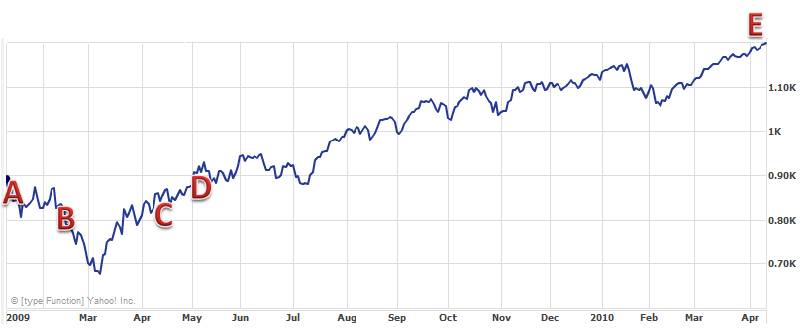
A. January 10, 2009 (S&P @ 890):
Prediction: “I now think we will be in recession through at least 2009 before we begin a recovery….We could see a tradable rally in the next few months, but at the very least test the lows this summer, if not set new lows….It takes a lot of buying to make a bull market. It only takes an absence of buying to make a bear market.”
Outcome: S&P 500 today at 1,179, up +32%. Oops, maybe the timing of his recovery forecast was a little off?
B. February 14, 2009 (S&P @ 827):
Prediction/Advice: “Let me reiterate my continued warning: this is not a market you want to buy and hold from today’s level. This is just far too precarious an economic and earnings environment.”
Outcome: S&P 500 up +45%. You pay a cherry price for certainty and consensus.
C. April 10, 2009 (S&P @ 856):
Prediction: “All in all, the next few years are going to be a very difficult environment for corporate earnings. To think we are headed back to the halcyon years of 2004-06 is not very realistic. And if you expect a major bull market to develop in this climate, you are not paying attention.” On the economy he adds, “We are going to pay for that with a likely dip back into a recession in 2010.”
Outcome: S&P 500 up +38%, with the economy currently in recovery. Interestingly, his comments on corporate earnings in February 2009 referenced an estimate of $55 in S&P 2010. Now that we are 14 months closer to the end of 2010, not only is the consensus estimate much firmer, but the 2010 S&P estimate presently stands at approximately $75 today, about +36% higher than Mauldin was anticipating last year.
D. May 2, 2009 (S&P @ 878):
Prediction: “This rally has all the earmarks of a major short squeeze. ..When the short squeeze is over, the buying will stop and the market will drop. Remember, it takes buying and lot of it to move a market up but only a lack of buying to create a bear market.”
Outcome: S&P 500 up +36%.
Now that we have entered a new year and experienced an +80% move in the market, certainly Mauldin must feel a little more comfortable about the current environment? Apparently not.
E. April 2, 2010 (S&P @ 1178):
Prediction: “ I think it is very possible we’ll see another lost decade for stocks in the US. If we do have a recession next year, the world markets are likely to fall in sympathy with ours.”
Outcome: ????
Previous Mauldin Gems
Here are few more gloomy gems from Mauldin’s bearish toolbox of yester-year:
2005: “The market is a sideways to down market, with the risk to the downside as we get toward the end of the year and a possible recession on the horizon in 2006. And not to put too fine a point on it, I still think we are in a long term secular bear market.” Reality: S&P 500 up +5% for the year and up a few more years after that.
2006: “This year I think the market actually ends the year down, and by at least 10% or more during the year. Reality: S&P 500 up +14% (excluding dividends).
2007: Mauldin’s rhetoric was tamed in light of poor predictions, so rhetoric switches to a “Goldilocks recession” and a mere -10-20% range correction. He goes on to dismiss a deep bear market, “In future letters we will look at why a deep (the 40% plus that is typical in recession) stock market bear is not as likely.” Reality: S&P 500 up +5%. Looks like the writing on the wall for 2008 turned out a bit worse than he expected.
2008: Sticking to soft landing outlook Mauldin states, “I think this will be a mild recession … I don’t think we are looking at anything close to the bear market of 2000-2001.” Uggh. Ultimately, the bear market turned out to be the worst market since 1973-1974 – his prediction was just off by a few decades. Reality: S&P 500 down -37%.
Lessons Learned from Market Strategists
I certainly don’t mean to demonize John Mauldin because his writings are indeed very thoughtful, interesting and include provocative financial topics. But put in the wrong hands, his opinions (and dozens of other strategists’ views) can be extremely dangerous for the average investor trying to follow the ever-changing judgments of so-called expert strategists. To Mauldin’s credit, his writings are archived publicly for everyone to sift through – unfortunately the media and many average investors have short memories and do not take the time to hold strategists accountable for their false predictions. Although, Iike Warren Buffett, I do not make market timing predictions or forecast short-term market trends, I see no problem in strategists making bold or inaccurate forecasts, as long as they are held responsible. Every investor makes mistakes, unfortunately, strategist predictions are usually not readily available for analysis, unlike tangible investment manager performance numbers. When forecasting lightning strikes and extreme bets win, every newspaper, radio show, and media outlet has no problem of placing these soothsayers on a pedestal. Thanks to the law of large numbers and the constantly shifting markets, there will always be a few outliers making correct calls on bold predictions. Who knows, maybe Mauldin will be the next CNBC guru du jour in the future for predicting another lost decade of equity market performance (see Lost Decade article)?
Regardless of your views on the market, the next time you hear a financial strategist make a bold forecast, like John Mauldin crying wolf, I urge you to not go running with the motivation to alter your investment portfolio. I suppose the time to become frightened and drive the REAL wolf (bear market) away will occur when consistently pessimistic strategists like Mauldin turn more optimistic. Until then, tread lightly when it comes to acting on financial market forecasts and stick to listening to long-term, successful investors that have invested their own money through all types of market cycles.
Wade W. Slome, CFA, CFP®
Plan. Invest. Prosper.
*DISCLOSURE: Sidoxia Capital Management (SCM) and some of its clients own certain exchange traded funds, but at the time of publishing SCM had no direct positions in any security referenced in this article. No information accessed through the Investing Caffeine (IC) website constitutes investment, financial, legal, tax or other advice nor is to be relied on in making an investment or other decision. Please read disclosure language on IC “Contact” page.
California Checking Under the Derivatives Hood
[tweetmeme source=”WadeSlome” only_single=false https://investingcaffeine.com/2010/04/11/california-checking-under-the-derivatives-hood/%5D

Bill Lockyer, California’s State Treasurer, is in charge of driving “The Golden State’s” budget, but as he maneuvers the finances, he is hearing some strange knocks and pings as it relates to the pricing of Credit Default Swaps (CDS) on California debt obligations. CDSs, like virtually all derivatives, can either be used to speculate or hedge (see also, Einhorn CDS and Financial Engineering articles), so the existence of strange noises does not necessarily indicate foul play or problems that cannot be fixed.
Checking Under the Banks’ Hoods
At the heart of the CDS markets lie the major investment banks, so that is where Lockyer is looking under the hood and requesting information on the role the banks are playing in the municipal bond CDS market. Specifically, Lockyer has sent letters requesting information from Bank of America – Merrill Lynch (BAC), Barclays, Citigroup (C), Goldman Sachs (GS), JP Morgan (JPM),and Morgan Stanley (MS). California pays the banks millions of dollars every year to market bonds on behalf of the state. The I-banks operate in some way like a car dealership – the state produces the cars (bonds) and the banks buy the bonds and resell them to buyers/investors.
The financial transaction doesn’t necessarily stop there, because the banks can further pad their profits by selling and making markets in credit default swaps. After the state issues bonds, speculators can then pay the banks to place bets on whether the cars (bonds) fail (default), or investors can also buy insurance from the banks in the form of swaps. As you can probably surmise, there is the potential for conflicts of interest between the state and the banks, which partly explains why Lockyer is conducting his due diligence.
California…the Next Greece or Kazakhstan?
As the housing market came crashing down, credit default swaps were at the center of financial institution collapses and the billions made by John Paulson (see also the Gutsiest Trade Ever). More recently, CDSs were cited as negative contributors to the Greek financial crisis. Lockyer tries to deflect California comparisons with Greece by stating the European country’s budget deficit is 13 times larger than California’s (as % of GDP) and the foreign country’s accumulated debt is 25 times larger on GDP basis as well (read California’s Debt Hole story).
Beyond making sure the profit rules of the game are not stacked against California, Lockyer wants to understand what he perceives as a mispricing in the default risk of California debt obligations. He is worried that the state’s borrowing costs on future bond issues could be artificially escalated because he says the credit default swaps “wrongly brand our bonds as a greater risk than those issued by such nations as Kazakhstan, Croatia, Bulgaria and Thailand.”
Clarity on these issues is important because the state is exploring the expansion into taxable municipal bonds. The government has been subsidizing taxable munis, termed Build America Bonds (BABs), to stimulate the economy and bring down borrowing costs for municipalities. According to Thomson Reuters, BABS accounted for approximately 26% of overall muni bond issuance ($25.8 billion) in the first quarter.
If California were a car, I’m not sure how much cash they would get for their clunker ($16 billion budget deficit), but I tip my hat to State Treasurer Lockyer for holding the investment banks’ feet to the fire. All investors and financial product consumers stand to benefit by looking under the hood of their financial institution and asking tough questions.
Read Full Financial Times Article on California CDS Market
Wade W. Slome, CFA, CFP®
Plan. Invest. Prosper.
*DISCLOSURE: Sidoxia Capital Management (SCM) and some of its clients own certain exchange traded funds, but at the time of publishing SCM had no direct positions in BAC, C, GS, JPM, and MS or any security referenced in this article. No information accessed through the Investing Caffeine (IC) website constitutes investment, financial, legal, tax or other advice nor is to be relied on in making an investment or other decision. Please read disclosure language on IC “Contact” page.
Avoiding Automobile and Portfolio Crashes

Personal opinions of oneself don’t always mirror reality. Self perceptions relating to both driving and investing can be inflated. For example, the National Highway Traffic Safety Administration (NHTSA) reports that 95% of crashes are caused by human error, but 75% of drivers say they are better drivers than most.
Contributing factors to crashes include: 1) Distractions; 2) Alcohol; 3) Unsafe behavior (i.e., speeding); 4) Time of day (fatality rate is 3x higher at night); 5) Lack of safety belt; 6) Weather; and 7) Time of week (weekends are worst crash days).
A spokesman for the Insurance Institute for Highway Safety is quick to point out that driving behind the wheel is the riskiest activity most people engage in on a daily basis – more than 40,000 driving related fatalities occur each year. Careful common sense helps while driving, but driving sober at 4 a.m. (very few drivers on the road) on a weekday with your seatbelt on won’t hurt either.
Avoiding a Portfolio Crash
Another dangerous activity frequently undertaken by Americans is investing, despite people’s inflated beliefs of their money management capabilities. Investing, however, does not have to be harmful if proper precautions are taken.
Here is some of the hazardous behaviors that should be avoided by those maneuvering an investment portfolio:
1) Trading Too Much: Excessive trading leads to undue commissions, transaction costs, bid-ask spread, impact costs. Many of these costs are opaque or invisible and won’t necessarily be evident right away. But like a leaky boat, direct and indirect trading costs have the potential of sinking your portfolio.
2) Worrying about the Economy Too Much: The country experiences about two recessions a decade, nonetheless our economy continues to grow. If macroeconomics still worry you, then look abroad for even healthier growth – considerable international exposure should aid the long-term success of your portfolio and assist you in sleeping better at night.
3) Emotionally Reacting – Not Objectively Planning: News is bad, so sell. News is good, so buy. This type of conduct is a recipe for portfolio disaster. Better to do as Warren Buffett says, “Be fearful when others are greedy, and be greedy when others are fearful.” The long-term fundamental prospects for any investment are much more important than the daily headlines that get the emotional juices flowing.
4) Hostage to Short-term Time Horizon: Rather than worry about the next 10 days, you should be focused on the next 10 years. The further out you can set your time horizon, the better off you will be. Patience is a virtue.
5) Incongruent Portfolio with Risk: Many retirees got caught flat-footed in the midst of the global financial crisis of 2008-09 with investment portfolios heavy in equities and real estate. Diversified portfolios including fixed-income, commodities, international exposure, cash, and alternative investments should be optimized to meet your specific objectives, constraints, risk tolerance, and time horizon.
6) Timing the Market: Attempting to time the market can be hazardous to your investment health (see Market Timing article). If you really want to make money, then avoid the masses – the grass is greener and the eating better away from the herd.
Driving and investing can both be dangerous activities that command responsible behavior. Do yourself a favor and protect yourself and your portfolio from crashing by taking the appropriate precautions and avoiding the common hazardous mistakes.
Read Full Forbes Article on Driving Dangers
Wade W. Slome, CFA, CFP®
Plan. Invest. Prosper.
*DISCLOSURE: Sidoxia Capital Management (SCM) and some of its clients own certain exchange traded funds, but at the time of publishing SCM had no direct positions in any security referenced in this article. No information accessed through the Investing Caffeine (IC) website constitutes investment, financial, legal, tax or other advice nor is to be relied on in making an investment or other decision. Please read disclosure language on IC “Contact” page.
EBITDA: Sniffing Out the Truth

Financial analysts are constantly seeking the Holy Grail when it comes to financial metrics, and to some financial number crunchers EBITDA (Earnings Before Interest Taxes Depreciation and Amortization – pronounced “eebit-dah”) fits the bill. On the flip side, Warren Buffett’s right hand man Charlie Munger advises investors to replace EBITDA with the words “bullsh*t earnings” every time you encounter this earnings metric. We’ll explore the good, bad, and ugly attributes of this somewhat controversial financial metric.
The Genesis of EBITDA
The origin of the EBITDA measure can be traced back many years, and rose in popularity during the technology boom of the 1990s. “New Economy” companies were producing very little income, so investment bankers became creative in how they defined profits. Under the guise of comparability, a company with debt (Company X) that was paying interest expense could not be compared on an operational profit basis with a closely related company that operated with NO debt (Company Z). In other words, two identical companies could be selling the same number of widgets at the same prices and have the same cost structure and operating income, but the company with debt on their balance sheet would have a different (lower) net income. The investment banker and company X’s answer to this apparent conundrum was to simply compare the operating earnings or EBIT (Earnings Before Interest and Taxes) of each company (X and Z), rather than the disparate net incomes.
The Advantages of EBITDA
Although there is no silver bullet metric in financial statement analysis, nevertheless there are numerous benefits to using EBITDA. Here are a few:
- Operational Comparability: As implied above, EBITDA allows comparability across a wide swath of companies. Accounting standards provide leniency in the application of financial statements, therefore using EBITDA allows apples-to-apples comparisons and relieves accounting discrepancies on items such as depreciation, tax rates, and financing choice.
- Cash Flow Proxy: Since the income statement traditionally is the financial statement of choice, EBITDA can be easily derived from this statement and provides a simple proxy for cash generation in the absence of other data.
- Debt Coverage Ratios: In many lender contracts certain debt provisions require specific levels of income cushion above the required interest expense payments. Evaluating EBITDA coverage ratios across companies assists analysts in determining which businesses are more likely to default on their debt obligations.
The Disadvantages of EBITDA
While EBITDA offers some benefits in comparing a broader set of companies across industries, the metric also carries some drawbacks.
- Overstates Income: To Charlie Munger’s point about the B.S. factor, EBITDA distorts reality. From an equity holder’s standpoint, in most instances, investors are most concerned about the level of income and cash flow available AFTER all expenses, including interest expense, depreciation expense, and income tax expense.
- Neglects Working Capital Requirements: EBITDA may actually be a decent proxy for cash flows for many companies, however this profit measure does not account for the working capital needs of a business. For example, companies reporting high EBITDA figures may actually have dramatically lower cash flows once working capital requirements (i.e., inventories, receivables, payables) are tabulated.
- Poor for Valuation: Investment bankers push for more generous EBITDA valuation multiples because it serves the bankers’ and clients’ best interests. However, the fact of the matter is that companies with debt or aggressive depreciation schedules do deserve lower valuations compared to debt-free counterparts (assuming all else equal).
Wading through the treacherous waters of accounting metrics can be a dangerous game. Despite some of EBITDA’s comparability benefits, and as much as bankers and analysts would like to use this very forgiving income metric, beware of EBITDA’s shortcomings. Although most analysts are looking for the one-size-fits-all number, the reality of the situation is a variety of methods need to be used to gain a more accurate financial picture of a company. If EBITDA is the only calculation driving your analysis, I urge you to follow Charlie Munger’s advice and plug your nose.
Wade W. Slome, CFA, CFP®
Plan. Invest. Prosper.
*DISCLOSURE: Sidoxia Capital Management (SCM) and some of its clients own certain exchange traded funds, but at the time of publishing had no direct positions in any security referenced in this article. No information accessed through the Investing Caffeine (IC) website constitutes investment, financial, legal, tax or other advice nor is to be relied on in making an investment or other decision. Please read disclosure language on IC “Contact” page.
Measuring the Market with Valuation Dipstick

Investor opinions about the stock market’s value are all over the map.
Doomsayers think the market is valued at crazy levels, and believe that “buy-and-hold” investing is dead. Bears remind investors that stocks have led to nothing good except for a lost decade of performance (read article on Lost Decade). Many speculators on the other hand believe they have the ability to “time the markets” to take advantage of volatility in any market (see also Market Timing article). In trader land, overconfidence is never in short-supply. Certainly, if you are a trader at Goldman Sachs (GS) or UBS and you are trading with privileged client data, then taking advantage of volatility can be an extremely lucrative endeavor. However most day-traders, and average investors, are not honored with the same information. Rather, the public gets overwhelmed by online brokerage firms and their plethora of software bells and whistles – inadequate protection when investing among a den of wolves. Equipping speculators with day trading tools is a little like giving a 7-year old a squirt gun and shipping them off to Afghanistan to fight the Taliban – the odds are not in the kid’s favor.
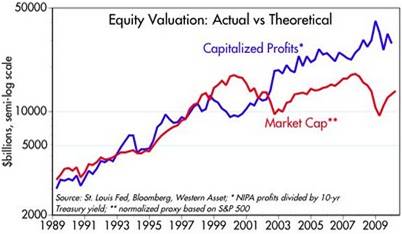
With so much uncertainty out in the marketplace, how do we know if the overall market is cheap or expensive? According to Scott Grannis, former Chief Economist at Western Asset Management and author of the Calafia Beach Pundit blog, the dipstick components necessary to measure the value of the market are corporate profits relative to the level of Gross Domestic Product (GDP) and the value (market cap) of the S&P 500 index. Grannis is a believer in the tenet that stock prices follow earnings, and as you can see from his charts below, earnings have grown much faster than stock prices over the last 10 years:
20 Year Chart
50 Year Chart
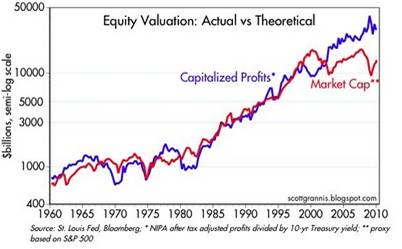
As you can see there is an extremely tight correlation on the 50-year chart until the last decade. What does the recent diverging trend mean? Here’s what Grannis has to say:
“Note that profits doubled from 1998 to 2009, yet the S&P 500 index today is still lower than it was at the end of 1998…equities continue to be extremely undervalued. Another way of looking at this is that the market is discounting current profits using an 8% 10-yr Treasury yield, or a 50% drop in corporate profits from here. Simply put, according to this model the market is priced to some very awful assumptions.”
How will this valuation gap be alleviated? Grannis correctly identifies two scenarios to achieve this end: 1) Rising treasury yields; and 2) Rising equity prices. His base case would be a move on the 10-year yield to 5.5%, and a move upwards in the S&P 500 index +50%.
Judging by Grannis’s dipstick measurement, there’s plenty of oil in the system to prevent the market engine from overheating just quite yet.
Read the Complete Scott Grannis Article
Wade W. Slome, CFA, CFP®
Plan. Invest. Prosper.
*DISCLOSURE: Sidoxia Capital Management (SCM) and some of its clients own certain exchange traded funds, but at the time of publishing SCM had no direct positions in GS, UBS, or any security referenced in this article. No information accessed through the Investing Caffeine (IC) website constitutes investment, financial, legal, tax or other advice nor is to be relied on in making an investment or other decision. Please read disclosure language on IC “Contact” page.
Sidoxia Introduces “Fusion”

With the quote machines taking a temporary breather, what better time than now to talk about a new product creation from Sidoxia Capital Management – Fusion. For those readers following Investing Caffeine for some time, you likely have an informed understanding of Sidoxia Capital Management’s investment philosophy (www.Sidoxia.com). Well, now Sidoxia has formalized its investment product through the introduction of Fusion, a hybrid product integrating low-cost, tax-efficient investment vehicles and strategies, including individual stocks, individual bonds, equity ETFs (Exchange Traded Funds), and fixed income ETFs. Rather than being boxed into a simplistic life cycle fund, Fusion offers a customized investment vehicle that can meet investors’ wide ranging objectives and constraints. A key differentiating component of Fusion is its inclusion of some of the same stocks and securities employed in the Slome Sidoxia Fund (a hedge fund also managed by Sidoxia Capital Management for accredited investors). The aim of Fusion is to maximize the risk-adjusted returns in the context of a broadly diversified balanced portfolio (including international exposure).
Client Product Process
For those qualified investors, a one-on-one interview is conducted with each separate account investor to determine the objectives and constraints associated with the account. Subsequently, a customized Investment Policy Statement (IPS) is created for each client, effectively creating a blueprint for how the account will be managed. Depending on the risk-tolerance, time horizon, and objectives of the client, an equity allocation will be customized to meet the client’s needs. The balance of the portfolio will be invested in fixed-income, cash/liquid assets, and hybrid securities – including convertible bonds and alternative investments on a more limited basis. Individual security selection is derived from implementing fundamental and quantitative screening tools, leveraging the investment experience of the investment manager (Wade Slome), and the ranking of securities on a risk-adjusted valuation basis. Lower ranked securities are generally used as funding sources for purchases of higher ranked investment candidates.
Buy Discipline
A systematic, disciplined process is performed before the inclusion of any security is finalized into a portfolio. With respect to the selected equity securities, particular emphasis is placed on valuation metrics, including cash flows, earnings growth, dividend yields, price-earnings ratios, and other important fundamental statistics. In regards to equity related exchange traded funds (ETFs), some of the previously mentioned factors will be considered in addition to a top-down view of a funds underlying long-term growth potential. The buy discipline, established for the fixed income allocation of the portfolio, carefully considers dynamics such as yield, duration, maturity, income, inflation-protection, currency risk, and other factors. Compared to other competing domestic-centric products, Fusion has the ability and willingness to invest globally to explore attractive risk-reward investment opportunities abroad.
Portfolio Construction
Within the parameters of the various Fusion product versions (aggressive, conservative, and moderate), each portfolio is constructed with flexibility in meeting the unique objectives and constraints of each account – including any liquidity or income requirements indicated by the client. Every portfolio is constructed from the same menu of underlying investment options, thereby assuring relative consistency across accounts. Allocations across investment selections will vary based upon the Fusion product version selected.
Trading Strategies
Under normal economic circumstances, Fusion invests with a long-term time horizon of three to five years for its equity positions. As a result, factors such as transaction costs, impact costs, opportunity costs, bid-ask spreads, tax consequences, are considered before conducting trades. Regarding fixed income portfolios, the previously mentioned factors along with the underlying yield, duration, and fundamental factors will determine the holding period. Trading frequency may fluctuate, depending on financial market and client-specific circumstances, but generally speaking heightened volatility will lead to additional opportunistic portfolio activity.
Sell Discipline
The Fusion sell discipline is fairly straight forward. If a security reaches a designated price target, provides an inferior risk-adjusted return profile relative to other opportunities, or if the original investment rationale negatively changes, then the investment becomes a sell candidate. If Fusion discovers opportunities with superior investment characteristics, the sell candidates, in addition to cash, will be utilized to fund new purchases.
Product Fee Structure
The annual fee charged for portfolio management services is rendered on a percentage of assets under management basis. As a fee-only investment advisor, inherent incentives are built-in to preserve and grow client account values – a principle not practiced by many commissioned based brokers/advisors. Contact a Sidoxia Capital Management representative by phone (949-258-4322) or e-mail (info@Sidoxia.com) to learn more about Fusion’s fee structure and account minimum threshold.
Wade W. Slome, CFA, CFP®
Plan. Invest. Prosper.
*DISCLOSURE: Sidoxia Capital Management (SCM) and some of its clients own certain exchange traded funds, but at the time of publishing SCM had no direct positions in any security referenced in this article. No information accessed through the Investing Caffeine (IC) website constitutes investment, financial, legal, tax or other advice nor is to be relied on in making an investment or other decision. Please read disclosure language on IC “Contact” page.