Opening the Broker Departure Floodgates

Even though the equity markets have rebounded massively, investors remain in a sour mood in light of sluggish domestic economic headlines. Technology, for example High Frequency Trading (HFT – read more), along with the harsh realities of financial regulatory reform is creating profit growth challenges for the global financial gargantuans. More specifically, the floodgates have sprung open with respect to broker departures from the big four brokerage firms.
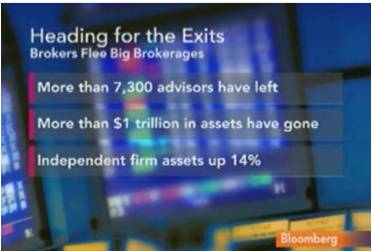
According to Bloomberg, more than 7,300 brokers have left the four largest full-service brokerage firms (Merrill Lynch [BAC], Morgan Stanley Smith Barney [MS], UBS Wealth Management [UBS], and Wells Fargo Advisors [WFC]) since the beginning of 2009. But the brokers have not floated away quietly – more than $1 trillion in assets have fled these major brokerage firms and followed the brokers to their new employers.
Several factors have led to the deluge of departures of bodies and bucks:
1) Mergers: The financial crisis triggered an all-out economic assault on the brokerage firm industry. A subsequent game of musical chairs resulted in the marriage of disparate cultures (e.g., B of A-Merrill; Morgan Stanley-Smith Barney; Wells Fargo-Wachovia). Not only did the clashing cultures rub brokers the wrong way, but the surviving executives were left with redundant and unproductive brokers to cut.
2) Heightened Recruiting: With a shrinking pie and less growth comes more fierce competition. The discount brokerage firms have realized the Darwinian challenges and reacted to them accordingly. Take TD Ameritrade (AMTD) for example. In the first seven months of 2010, the discount brokerage firm added 212 independent advisers to its network, a +44% increase over the previous year. Charles Schwab Corp. (SCHW) with its network of 6,000 independent advisers is also ratcheting up its efforts to poach brokers away from the large brokerage firms.
3) Economics: Would you like 40-50% of profits generated from new clients, or 80-100%? In many instances, the broker from the large branded institution funnels the majority of the commissions to the mother-ship. Sure, the broker receives back-office, marketing, and branding support, but some brokers are now asking themselves is the brand an asset or liability? Wall Street has gotten a large black eye and it will take time to heal their corporate images…if they ever manage to succeed at all.
4) Customer Choice: Lastly, and most importantly, customers are voting with their dollars. As I have indicated in the past, I strongly believe the current system is structurally flawed (see Financial Sharks article). Financial institutions craft incentives designed to line the pockets of brokers (salespeople) and prioritize corporate profits over client wealth creation and preservation. The existing failed industry structure is based upon smoke, mirrors, opacity, and small print. Many independent, fee-only advisors are structuring financial relationships that align with portfolio performance and make transparency a top priority. Customers appreciate these benefits and are shifting dollars away from the brokerage firms.
LPL Loving IPO Life
If you are having a difficult time processing the magnitude of this investment advice shift, then consider the $4.4 billion estimated value being placed on the planned IPO (Initial Public Offering) of LPL Financial, the independent brokerage firm of 12,000+ financial advisors. LPL serves as a conduit for legacy brokers to become independent, and still allow them to benefit from an array of ala carte support services. Growth has been strong too – over the last decade the advisor count at LPL has more than tripled and assets under their umbrella now exceed $250 billion.
The Wall Street broker floodgates have opened, so unless regulatory changes are enacted, the old flawed way of doing things will require a life support raft. If not, independent, fee-only advisors like Sidoxia Capital Management will benefit from the current sinking migration of brokers.
Wade W. Slome, CFA, CFP®
Plan. Invest. Prosper.
DISCLOSURE: Sidoxia Capital Management (SCM) and some of its clients own certain exchange traded funds, but at the time of publishing SCM had no direct position in BAC, MS, UBS, WFC, AMTD, SCHW, LPL Financial or any other security referenced in this article. No information accessed through the Investing Caffeine (IC) website constitutes investment, financial, legal, tax or other advice nor is to be relied on in making an investment or other decision. Please read disclosure language on IC “Contact” page.
Corporate Shockers: You did *#$@% to Steve Jobs?

Source: 1funny.com
Steve Jobs recruited John Sculley to run Apple Computers (AAPL) in 1983 because the board wanted someone more experienced than a snot-nosed 28 year old founder barking orders at Apple employees. Sculley was a seasoned 15 year veteran executive from Pepsi Co. (PEP) whom was persuaded by Jobs to take over the company and join him in changing the world.
Things were all nifty until Sculley went all Brutus on Jobs and decided to fire him with board assistance in 1985 when it was believed that Jobs was poaching executives from Apple to join Jobs’s successor company, Next Computers.
The verdict may not completely be out on Sculley’s effectiveness on running Apple, but he deserves a PhD in the “Obvious Arts.” When asked if the coordinated decision (between Sculley and the Board) to fire Steve Jobs more than 25 years ago was correct, this is what Sculley had to say:
“In hindsight, I think they [board] made the wrong choice. They should have chosen Steve…we should have figured out a way to work with it [Job’s talent].”
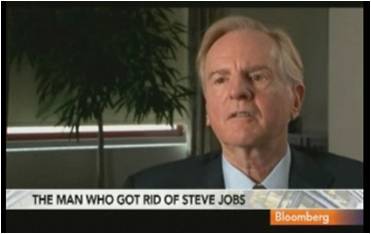
Click Here for John Sculley Bloomberg Interview
Over his term at Apple, Sculley increased sales from $800 million to $8 billion. Good performance, but apparently not good enough, because Sculley was axed in 1993 and a window was opened for Jobs to return as Apple’s puppet-master four years later. The rest is history and AAPL stock went from about $10 per share when Sculley left all the way up to $316.65 today. Not too shabby.
In another shocker, after hiring Sculley and then getting fired by Sculley, Jobs said Sculley won’t talk to him. I can’t understand why a company founder would hold a grudge toward a hand-picked former employee who spearheaded a lynching against his boss? Well, I guess karma has a way of evening things out in the long run – redemption was found with Jobs’s climbing the Silicon Valley mountain to create the $300 billion consumer technology behemoth. I’m sure you don’t have to cry a river for John Sculley, but if he can’t control his own tears, he can always use his hundred dollar bills as tissue surrogates.
What makes Jobs’s decline and subsequent triumph even more unbelievable are the hugs and kisses Steve Jobs owes Microsoft founder and billionaire Bill Gates. If not for a $150 million lifeline offered by Gates to Steve Jobs in August 1997, while Apple was on its financial deathbed, we may not have ever experienced the iPod, iPhone, iPad, or future overhyped consumer gadget (OK, I admit it, I have succumbed to the hype myself). I’m guessing if Bill were given another chance, he would have passed on that Apple investment and we would be stuck paying for $4,000 computers and $1,000 Microsoft Office upgrades.
As a result of these corporate shockers, several lessons can be learned. Number one: If you are hired by a company founder, be careful about firing that boss if put in that position – you could potentially be jeopardizing the creation of hundreds of billions of dollars in future value. Number two: If you are unable to successfully negotiate lesson number one, then just find someone to lend you $150 million. History has taught us lessons based on past events ranging from Prohibition to Watergate, and from Nazi Germany to Tiger Woods’s indiscretions. John Sculley also learned lessons from Apple’s corporate shockers, and so can you.
Wade W. Slome, CFA, CFP®
Plan. Invest. Prosper.
DISCLOSURE: Sidoxia Capital Management (SCM) and some of its clients own certain exchange traded funds and AAPL, but at the time of publishing SCM had no direct position in PEP, MSFT, or any other security referenced in this article. No information accessed through the Investing Caffeine (IC) website constitutes investment, financial, legal, tax or other advice nor is to be relied on in making an investment or other decision. Please read disclosure language on IC “Contact” page.
Sentiment Cycle of Fear and Greed
Investing can be like a cross-country emotional roller-coaster ride to retirement. There are plenty of ups and downs, and plenty of unexpected twist and turns, but as long as investors stay the course, they will eventually reach their retirement objective. If not properly kept in check, however, emotions have the potential of sabotaging and/or delaying retirement objectives.
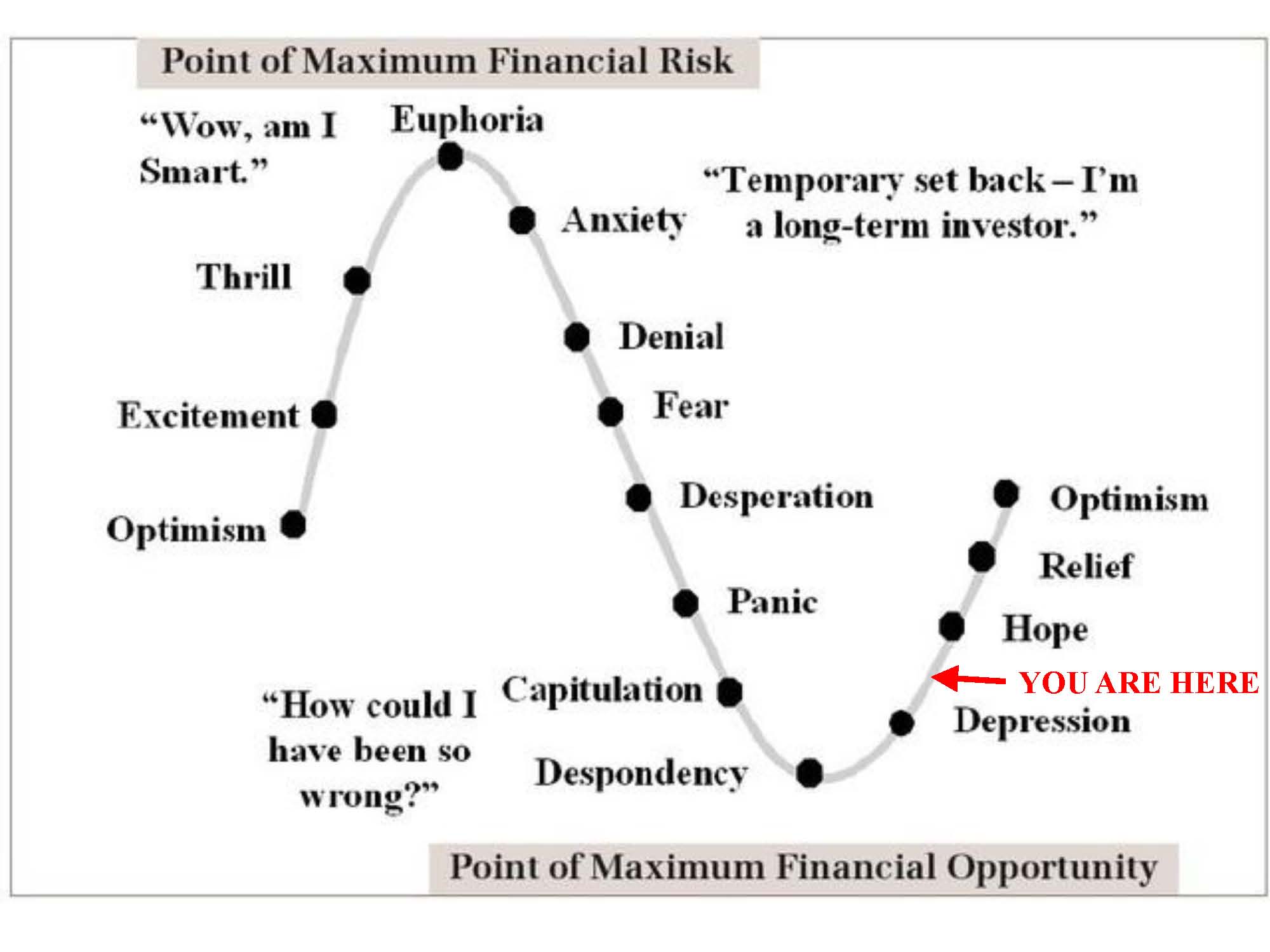
Barry Ritholtz at The Big Picture revisited the topic of sentiment cycles to hammer home the counterintuitive nature of successful investing (see also Doing the Opposite). As Ritholtz correctly points out in his chart, “euphoria” is actually the emotional “point of maximum financial risk,” and “despondency” is the “point of maximum financial opportunity.”
Source: The Big Picture with RED Sidoxia comments
In other words when the housing market was “euphoric” with demand in 2006, the financial risk was the highest, as millions of leveraged borrowers and homeowners painfully realized. Average investors suffered the reverse problem in early 2009 when “despondency” ruled the day and equity markets have marched upwards approximately +80% to +100%. Millions of investors bought real estate near the peak of the market and sold equities near the bottom of the market. Buying high and selling low is not a recipe for a retirement investment plan.
A more comedic representation of the sentiment cycle is provided below (CLICK TO ENLARGE). Laughable but spot on.

If investing was so simple, Jim Cramer would be among Forbes wealthiest top 10 and Lenny Dyskstra would have his private jet back (see story).
Where we are exactly on the sentiment cycle curve is debatable (my opinion is in RED on top chart), but if investors want to accelerate their path to financial success, they need to play the equity markets a lot more like a game of chess – anticipating future events not reacting to current ones. Too often, what appears as the obvious investment choice generates the worst long-term results. While on the investment rollercoaster, the choices that create the sweatiest palms are usually the best long-term decisions.
Read more about “Sentiment Cycles” from The Big Picture
Wade W. Slome, CFA, CFP®
Plan. Invest. Prosper.
DISCLOSURE: Sidoxia Capital Management (SCM) and some of its clients own certain exchange traded funds, but at the time of publishing SCM had no direct position in any other security referenced in this article. No information accessed through the Investing Caffeine (IC) website constitutes investment, financial, legal, tax or other advice nor is to be relied on in making an investment or other decision. Please read disclosure language on IC “Contact” page.
Will the Fiscal Donkey Fly?

Source: TopPayingIdeas.com/blog
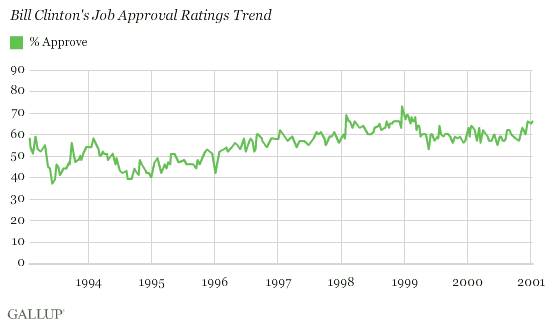
Will Barack Obama become a “one-termer” like somewhat recent Presidents, Democrat Jimmy Carter (1977-1981) and Republican George H.W. Bush #41 (1989-1993)? Or will Obama get the Democratic donkey off the ground like Bill Clinton managed to do after the 1994 mid-term election when Republican Newt Gingrich spearheaded the Contract with America, which led to a similar Republican majority in the House of Representatives. Clinton’s approval ratings were in the dumps at the time, comparable to voter’s current lackluster opinion of Obama and his spending spree (see also Profitless Healthcare).
Source: Gallup
Reagan Rebound
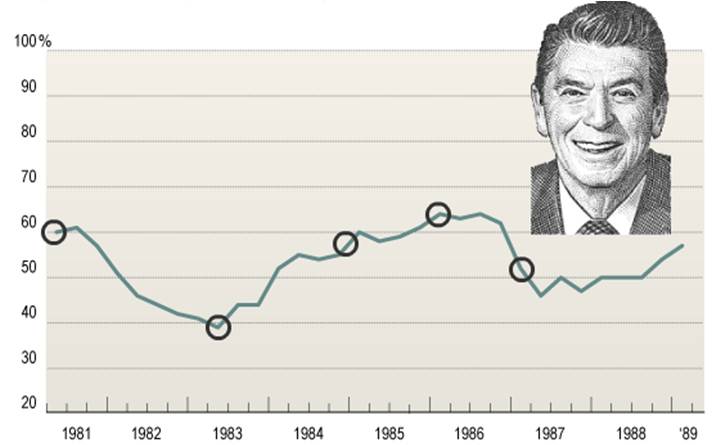
Similarly, Republican Ronald Reagan (1981-1989) was picking up the pieces with his lousy approval rating after the 1982 midterm election. Tax cuts, “trickle-down” supply side economics, and a tough stance on the Russian Cold War turned around the economy and his approval rating and catapulted him to reelection in a landslide victory. Reagan carried 49 states with the help of Reagan Democrats (one-quarter of registered Democrats voted for him).
Source: The Wall Street Journal
One should be clear though, popularity is not the only factor that plays into reelection success. George H. W. Bush had the highest average approval rating in five decades (60.9% approval), only superseded by John F. Kennedy (70.1% approval). The economy, international politics, and other external factors also play a large role in the reelection process.
Flying Donkey Time?
If President Obama wants to get the Democratic donkey off the ground and raise his current approval rating of 47% and remedy his self-admitted “shellacking” by the Republicans, then he will need to shift his hard-left political agenda more towards the middle, like Clinton did in 1994. If he leads on ideology alone, then the next two years will likely be a long tough slog for him and his Democratic colleagues.
In order to shift toward the center and gain more Independent voters, Obama will need to find common ground with Republicans and Tea-Partiers. Obama has already conceded in principle to extend the Bush tax cuts, but if he wants to gain more political capital, he will have to gain some ground in the area of fiscal responsibility. With the help of a strong economy, Clinton managed to run surpluses, but front and center today is a $1.3 trillion deficit and over $13 trillion in debt. The first step in building any credibility on the issue will come on December 1st when the president’s bi-partisan commission for deficit reduction will release its report.
It will be interesting which party will show leadership in making unpopular spending cuts, just as the 2012 re-election cycle just begins. The elephants in the room are the entitlements (Medicare and Social Security), and although less talked about, efficient cuts to defense spending should be put on the table. Sure, pork barrel spending, inefficient subsidies, tax loopholes, are gaps that need to be filled, but they alone are rounding errors given our country’s unsustainable current circumstances. Whether or not politicians (red or blue) will point out the unpopular elephants in the room will be interesting to watch.
Financial irresponsibility at the consumer and corporate level were major drivers behind the 2008-2009 financial crisis, and both individuals and businesses are responsibly adjusting their expense structures and balance sheets. Our government has to wake up to reality and adjust its expense structure and balance sheet too. Although foreign countries have reacted (i.e., European austerity), egotistical American politicians on both sides of the aisle haven’t quite woken up and smelled the coffee yet. Thank goodness for the democracy that we live in because citizens are pointing to the elephants in the room and demanding reckless spending and debt levels to come under control. If President Barack Obama doesn’t want to become another one-termer, he’ll have to move more to the center and get the finances of our country under control. If the stubborn donkey refuses to deal with reality and remains flightless, hopefully an elephant or ship-full of tea partiers can get this grass roots call for fiscal sanity off the ground.
Wade W. Slome, CFA, CFP®
Plan. Invest. Prosper.
DISCLOSURE: Sidoxia Capital Management (SCM) and some of its clients own certain exchange traded funds, but at the time of publishing SCM had no direct position in any other security referenced in this article. No information accessed through the Investing Caffeine (IC) website constitutes investment, financial, legal, tax or other advice nor is to be relied on in making an investment or other decision. Please read disclosure language on IC “Contact” page.
P/E Binoculars, Not Foggy Rearview Mirror

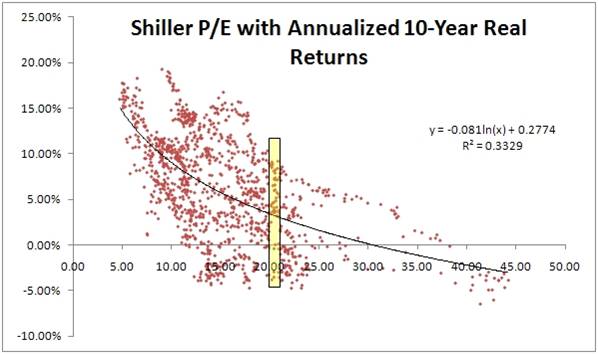
Robert Shiller is best known for his correctly bearish forecasts on the housing market, which we are continually reminded of through the ubiquitous Case-Shiller housing index, and his aptly timed 2000 book entitled Irrational Exuberance. Shiller is also well known for his cyclically adjusted 10-year price-earnings tool, also known as P/E-10. This tool chooses to take a rearview mirror look at the 10-year rolling average of the S&P composite stock index to determine whether the equity market is currently a good or bad buy. Below average multiples are considered to be predictive of higher future returns, and higher than average multiples are considered to produce lower future returns (see scatterplot chart).
Source: http://www.mebanefaber.com (June 2010)
Foggy Mirror
If you were purchasing a home, would the price 10 years ago be a major factor in your purchase decision? Probably not. Call me crazy, but I would be more interested in today’s price and even more interested in the price of the home 10 years into the future. The financial markets factor in forward looking data (not backward looking data). Conventional valuation techniques applied to various assets, take for example a bond, involve the discounting of future cash flow values back to the present – in order to determine the relative attractiveness of today’s asset price. The previous 10-years of data are irrelevant in this calculation.
Although I believe current and future expectations are much more important than stale historical data, I can appreciate the insights that can be drawn by comparing current information with historical averages. In other words, if I was purchasing a house, I would be interested in comparing today’s price to the historical 10-year average price. Currently, the P/E-10 ratio stands at a level around 22x – 38% more expensive than the 16x average value for the previous decade. That same 22x current P/E-10 ratio compares to a current forward P/E ratio of 13x. A big problem is the 22x P/E-10 is not adequately taking into account the dramatic growth in earnings that is taking place (estimated 2010 operating earnings are expected to register in at a whopping +45% growth).
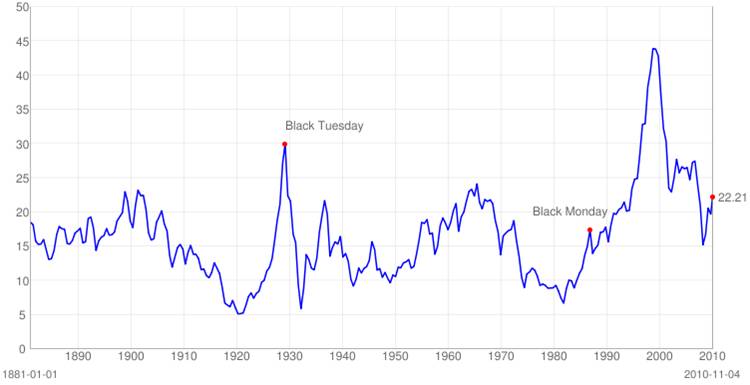
Mean P/E 10 Value is 16.4x Source: http://www.multpl.com
Additional problems with P/E-10:
1) The future 10 years might not be representative of the extreme technology and credit bubble we experienced over the last 10 years. Perhaps excluding the outlier years of 2000 and 2009 would make the ratio more relevant.
2) The current P/E-10 ratio is being anchored down by extreme prices from a narrow sector of technology a decade ago. Value stocks significantly outperformed technology over the last 10 years, much like small cap stocks outperformed in the 1970s when the Nifty Fifty stocks dominated the index and then unraveled.
3) Earnings are rising faster than prices are increasing, so investors waiting for the P/E-10 to come down could be missing out on the opportunity cost of price appreciation. The distorted P/E ratios earlier in the decade virtually guarantee the P/E-10 to drop, absent a current market melt-up, because P/E ratios were so high back then.
4) The tool has been a horrible predictor over very long periods of time. For example, had you followed the tool, the red light would have caused you to miss the massive appreciation in the 1990s, and the green light in the early 1970s would have led to little to no appreciation for close to 10 years.
Shiller himself understands the shortcomings of P/E-10:
“It is also dangerous to assume that historical relations are necessarily applicable to the future. There could be fundamental structural changes occurring now that mean that the past of the stock market is no longer a guide to the future.”
How good an indicator was P/E-10 for the proponent himself at the bottom of the market in February 2009? Shiller said he would get back in the market after another 30% drop in the ratio (click here for video). As we know, shortly thereafter, the market went on a near +70% upwards rampage. I guess Shiller just needs another -55% drop in the ratio from here to invest in the market?
Incidentally, Shiller did not invent the cyclically adjusted P/E tool, as famed value investor Benjamin Graham also used a similar tool. The average investor loves simplicity, but what P/E-10 offers with ease-of-use, it lacks in usefulness. I agree with the P/E-10 intent of smoothing out volatile cycle data (artificially inflated in booms and falsely depressed in recessions), but I recommend investors pull out a pair of binoculars (current and forward P/Es) rather than rely on a foggy rearview mirror.
Wade W. Slome, CFA, CFP®
Plan. Invest. Prosper.
DISCLOSURE: Sidoxia Capital Management (SCM) and some of its clients own certain exchange traded funds, but at the time of publishing SCM had no direct position in any other security referenced in this article. No information accessed through the Investing Caffeine (IC) website constitutes investment, financial, legal, tax or other advice nor is to be relied on in making an investment or other decision. Please read disclosure language on IC “Contact” page.
Flying to the Moon via Hyperinflation

With Ben Bernanke and his fellow Fed friends about to crank up the printing presses to overdrive, QE2 (quantitative easing part II) is top of mind among investors. QE2 talks of purchasing Treasuries and mortgage backed securities to pump more dollars into the financial system has been cited by many observers as a key factor in the upward progression in the equity markets over the last couple months. But is too much of a good thing in the short-run, detrimental in the long run due to inflationary pressures?
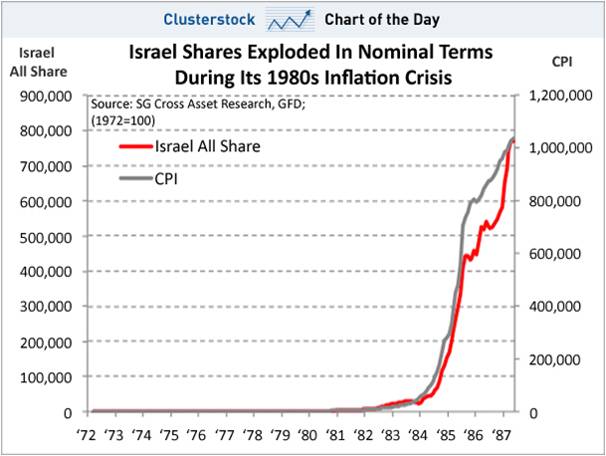
Not necessarily, if you consider the path of stocks in the hyperinflationary Israeli market of the 1970s and 1980s. Dylan Grice from Societe Generale notes that Israeli inflation averaged 84% from 1972 – 1987. During that period, Israeli equity markets managed to increase by a factor of 6,500 times according to Grice. So while inflation skyrocketed to the moon, so did stock prices. Will QE2 ignite dormant core inflation, which is hovering around 1%? If a declining U.S. dollar and rising commodity prices are the canary in the coalmine, then maybe piling into bonds like the majority of Americans is not the best idea?
Source: Business Insider - Clusterstock
Grice may be worried about inflation in the U.S., but Japan is at the forefront on his radar. Supporting that view, he has a modest 63,00,000.00 target on the Nikkei index by 2025 (the index sits at 9,160 today). That’s right…63 million. A near 7,000-fold increase may sound insane, but with exploding debt levels and deficits, coupled with declining demographics from an aging population, perhaps hyperinflation is not out of the question?
If push comes to shove, the Japanese government may print enough money to monetize debt the marketplace cannot absorb. Crazier things have happened in world history – during 1923 in the Weimar Republic of Germany hyperinflation led to a 4,200,000,000,000 German Mark to $1 U.S. dollar exchange rate. More recently we experienced a 79,600,000,000% inflation rate in Zimbabwe and the government actually issued a $100 trillion note. These astronomical inflation rates make our domestic inflationary worries seem like kids-play, but eventually the simple laws of economics will take over, if we do not get our fiscal house in order.
Double digit inflation in the U.S. during the stagflation era of the 1970s crimped Price-Earnings (P/E) ratios to single-digit levels, but this is not surprising with a Federal Funds rate that hit 20% in 1980 – 1981. Today the Fed Funds rate is at 0%, so I don’t think single-digit P/Es will be upon us anytime soon.
The great thing about money is it goes where it is treated best over the long run. In the short-run, money will slosh around and chase performance based on speculative animal spirits, but over time what Adam Smith called the “invisible hand” directs capital to appropriate investments. It was just a few months ago that pundits were talking about double-dip and deflation scenarios (see Double-Dip Guesses), and now on the brink of QE2, the pendulum has swung back to inflation fears. Printing excess amounts of money may provide temporarily fuel to help lift the economy off the ground, but if irresponsible fiscal decisions continue, then the economic rocket scheduled for the moon may come crashing back down with the economy. Do yourself a favor and pack a parachute filled with an adequate amount of equities – they will help protect you if your bond portfolio comes crashing down on higher rates and inflation.
Wade W. Slome, CFA, CFP®
Plan. Invest. Prosper.
DISCLOSURE: Sidoxia Capital Management (SCM) and some of its clients own certain exchange traded funds, but at the time of publishing SCM had no direct position in any other security referenced in this article. No information accessed through the Investing Caffeine (IC) website constitutes investment, financial, legal, tax or other advice nor is to be relied on in making an investment or other decision. Please read disclosure language on IC “Contact” page.
Listening for Dinner Bell or Penalty Whistle?

Excerpt from my monthly newsletter (sign-up on the right of page)…
Investors are eagerly waiting on the sidelines wondering whether to listen for a dinner bell signaling the time to sink their teeth into traditional equity investments, or respond to a penalty whistle by nervously maintaining money in depleted, inflation-losing CDs. A large swath of investors are still scarred from the losses experienced from the 2008-2009 financial crisis and are trying to rationalize the recent +80% move in equity markets (S&P 500 index) over the last 18 months. Eating saltine crackers and drinking water in CDs and money market accounts yielding < 1% feels OK when the world is collapsing around you, but eventually people realize retirement goals are tough to achieve with the money stuffed under the mattress.
Here are some recent bells and whistles we are listening to:
Mid-Term Elections: Regardless of your politics, Republicans are forecasted to regain control of the House of Representatives, while expectations for a narrow Democrat Senate majority remains the consensus. Currently, Democrat Jerry Brown is a handful of points in the lead over Meg Whitman for the California governor’s race. Another issue voters are closely monitoring is the likelihood of Bush tax-cut extensions.
Printing Press Part II: The Federal Reserve has strongly hinted of another round at the printing press in an effort to stimulate the economy by keeping interest rates low (e.g., record low 30-year fixed mortgage rates around 4.2%). The Fed accomplishes this so-called Quantitative Easing (or QE2) by purchasing Treasuries and mortgage backed securities – pumping more dollars into the financial system to expand credit and loans. In addition, QE2 is structured to stimulate the meager 0.8% core inflation experienced over the last 12 months (Bloomberg) to a Goldilocks level – not too hot and not too cold. QE2 asset purchase estimates are all over the map, but estimates generally stand at the low end of the original $200 billion to $2 trillion range.
Growth Continues: Although companies are sitting on record piles of cash ($1.8 trillion for all non-financial companies), chief executive officers continue to have short arms with their deep pockets when it comes to spending on new hires. Persistent growth for five consecutive quarters (2% GDP expansion in Q2), coupled with tight cost controls, is resulting in 46% estimated growth in 2010 corporate profits as measured by the average of S&P 500 companies. For the time being, “double dip” worries have been put on hold for this jobless recovery.
Unemployment Hypochondria: As I wrote in an earlier Investing Caffeine article (READ HERE), there is an almost obsessive focus on the unemployment rate, which although moving in the right direction, remains at a stubbornly high 9.6% rate nationally. Fresh new employment data will be released this Friday.
Foreclosure-gate: As foreclosures have increased and the decline in the housing market has matured, investors have grown more impatient with collections from mortgage backed securities originators. Banks and other mortgage lenders could face more than $100 billion in losses (CNBC) in mortgage “putbacks” related to improper packaging and terms disclosed to investors. Lawyers are salivating at the opportunity of litigating the thousands of potential cases across the country.
Create Your Own Blueprint – Block Noise

In reality, there is no dinner bell or penalty whistle when it comes to investing. Sure, we hear dinner bells and whistles every day on TV from strategists and economists, but in this sordid, cacophony of daily noise, the long line-up of soothsayers are constantly switching back and forth between optimistic bells and pessimistic whistles. The consistent onslaught of this indiscernible noise serves no constructive purpose for the average investor. I strongly believe the correct plan of attack is to create a customized investment plan that meets your long-term objectives, constraints, and risk tolerance. By creating a diversified portfolio of low-cost tax-efficient products and strategies, I believe investors will be more securely positioned for a more comfortable and less stressful retirement.
I have my own opinions on the economic environment, which I detail in excruciating detail through my InvestingCaffeine.com writings. These macro-economic opinions are stimulating but have little to no bearing on the construction of my investment portfolios. More important is focusing on the investment areas with the best fundamental prospects, while balancing risk and return for each client.
Despite what I just said, if you are still determined to know my opinions on the market direction, then follow me to the dinner table; I just heard the dinner bell ring.
Wade W. Slome, CFA, CFP®
Plan. Invest. Prosper.
DISCLOSURE: Sidoxia Capital Management (SCM) and some of its clients own certain exchange traded funds, but at the time of publishing SCM had no direct position in GE, or any other security referenced in this article. No information accessed through the Investing Caffeine (IC) website constitutes investment, financial, legal, tax or other advice nor is to be relied on in making an investment or other decision. Please read disclosure language on IC “Contact” page.
Rams Butting Heads: Rosenberg vs. Paulsen

Source: Photobucket
After a massive decline in financial markets during 2008, followed by a significant rebound in during 2009, should it be a surprise to anyone that economists hold directly opposing views? Financial markets are Darwinian in many respects, and Bloomberg was not bashful about stirring up a battle between David Rosenberg (Chief Economist & Strategist at Gluskin Sheff) and James Paulsen (Chief Investment Strategist at Wells Capital Management). The two economists, like the equivalent of two rams, lowered their horns and butted heads regarding their viewpoints on the economy. Rams butt heads (two words) together as a way to create a social order and hierarchy, so depending on your views, you can determine for yourself whom is the survival of the fittest. Regardless of your opinion, the exchange is an entertaining clash:
Paulsen’s Case (see also Unemployment Hypochondria): Paulsen makes the case that although the recovery has not been a gangbuster, nonetheless, the rebound has been the strongest in 25 years if you look at real GDP growth in the first year after a recession ends. He blames demographic atrophy in labor force growth (i.e., less job growth from Baby Boomers and fewer women joining the workforce relative to the mid-1980s) for the less than stellar absolute number.
Rosenberg’s Case: Rosenberg explains that the last two recoveries bear no resemblance to the recent recovery. The recent recession was one of the worst of all-time, therefore we should have experienced a sharper V-shaped recovery. All the major economic statistics are at dismal levels, and nowhere near the levels experienced in late 2007. He goes on to add that the stimulus, monetary policy, and bailouts have not produced the bang for our buck. Rosenberg says he will put on his bull hat once we enter a credit creation cycle that allows the economy to grow on an organic, sustained basis without artificial stimuli.
Like other pre-crisis bears who have floated to the top of the media mountain, Rosenberg has had difficulty adjusting his doom and gloom playbook as markets have rebounded approximately +80% from March 2009. Rosenberg maintained his pessimistic outlook as he transitioned from Merrill Lynch to Gluskin Sheff and has been wrong ever since. How wrong? Let’s take a look at Rosenberg’s first letter at his new employer, Gluskin Sheff (dated May 19th 2009):
Statement #1: “It stands to reason that this was just another counter-trend rally.” Reality: Dow Jones Industrial Average was at 8,475 then, and 11,114 today.
Statement #2: “It now looks as though the major averages are about to embark on the fabled retesting phase towards the March lows.” Reality: Dow never got close to 6,470 and stands at 11,114 today.
Statement #3: “It is unlikely that we have crossed the Rubicon into new bull market terrain and that the fundamental lows have been put in.” Reality: Dow just needs to fall -42% and Rosenberg will be right.
Statement #4: “[Unemployment] looks like we will likely get back to that old peak of 10.8% in coming quarters.” Reality: We peaked at 10.1% in October a year ago, and stand at 9.6% today.
Statement #5: “Deflation risks continue to trump inflation risks, at least over the near- and intermediate-term.” Reality: Commodity prices are dramatically escalating (CRB commodity index skyrocketing) across many categories, including the four-Cs (copper, corn, cotton, and crude oil).
I don’t pretend to be whistling past the graveyard, because we indeed have serious structural problems (deficits, debt, unsustainable entitlements, high unemployment, etc., etc., etc.), but when was there never something to worry about? See 1963 article? Like the endless “double dip” economists before him (see also Double-Dip Guesses). As the evidence shows, Rosenberg’s anything-but-rosy outlook is a tad extreme and has been dead wrong…at least for the last 1 and ½ years or almost 3,000 Dow Points. Just a few months ago, Rosenberg raised the odds of a double-dip recession from 45% to 67%.
Perhaps the sugar high stimulus will wear off, the steroid side-effects will kick in, and the Fed’s printing presses will break down and cause an economic fire? Until then, corporate profits continue to swell, cash is piling higher, valuations have been chopped in half from a decade ago (see Marathon Investing), and money stuffed under the mattress earning 0.5% will eventually leak back into the market.
I do however agree with Rosenberg in a few respects, and that revolves around his belief that banking industry will not be the leading group out of this cyclical recovery, and housing headwinds will remain in place for a extended period of time. Moreover, I agree with many of the bears when it comes to government involvement. Artificially propping up sectors like housing makes no sense. Why delay the inevitable by flushing taxpayer money down the toilet. Did you see the government running cash for clunker servers and storage in 2000 when the tech bubble burst? Does incentivizing capacity expansion with free money in an industry with boatloads of excess capacity already really make sense? Although media commentators and gloomy economists like Rosenberg paint everything as black and white, most reasonable people understand there are many shades of gray.
Gray that is…like the color of two rams butting heads.
Wade W. Slome, CFA, CFP®
Plan. Invest. Prosper.
DISCLOSURE: Sidoxia Capital Management (SCM) and some of its clients own certain exchange traded funds, but at the time of publishing SCM had no direct position in any other security referenced in this article. No information accessed through the Investing Caffeine (IC) website constitutes investment, financial, legal, tax or other advice nor is to be relied on in making an investment or other decision. Please read disclosure language on IC “Contact” page.
QE2 Drowning TIPS Yields Below Water

The holiday season is creeping up on us, and the only question building up more anticipation than what gift kids are going to get from Santa Claus is what investors are going to get from Federal Reserve Chairman Ben Bernanke – in the form of QE2 (Quantitative Easing Part II)? The inevitable QE2 program is an effort designed by the Fed to keep interest rates low and reduce the threat of deflation. In addition, QE2 is structured to stimulate the meager 0.8% core inflation experienced over the last 12 months (Bloomberg) to a Goldilocks level – not too hot and not too cold. Some pundits suggest the Fed should target a 2% inflation rate. QE2 asset purchase estimates are all over the map, but I can safely guess somewhere between a few hundred billion and $2 trillion (very brave of me).
Treasuries Weigh Down TIPS Yields
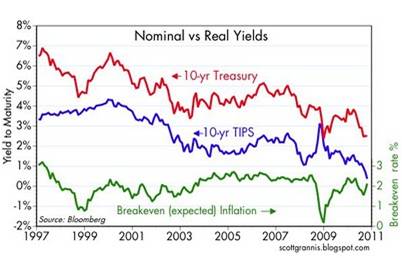
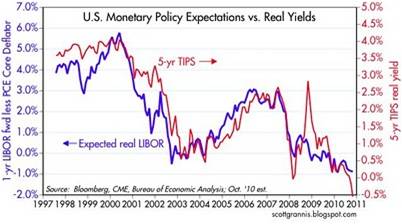
Ever since QE1 expired in the March timeframe, speculation began about the next potential slug of Treasuries and mortgage backed securities to be purchased by the Fed. As a consequence, this speculation became a contributing factor to 10-Year Treasury yields plummeting from around 4.0% to around 2.5%. Simultaneously, 5-Year TIPS (Treasury Inflation Protection Securities) yields have moved to negative territory.
Scott Grannis at Calafia Beach Pundit has a great chart showing the relationship between nominal Treasury yields, real TIPS yields, and expected inflation for 10-year maturities. As you can see below, over the last ten years there has been a tight correlation between the 10-year Treasury bond versus TIPS, with the former 10-year declining yield acting as a weight drowning the latter TIPS yield:
Source: scottgrannis.blogspot.com
Worth noting, absent the brief period in late-2008 and early-2009, inflation expectations have been remarkably stable in that 1.5% – 2.5% range.
Negative Yields…Who Cares?!
Unprecedented times have created an unprecedented appetite for bonds (see Bubblicious Bonds), and as a result, we just witnessed a historic $10 billion TIPS auction this week producing an eye-catching negative -0.55% yield. Sensationalist commentators characterize the negative yield dynamic as a money losing proposition, whereby investors are forced to pay the government. This assertion is quite a distortion and not quite true – we will review the mechanics of TIPS later.
- Source: scottgrannis.blogspot.com
If we’re not back to a panic filled environment of soup kitchen lines and bank runs, then why are TIPS paying a negative yield?
- QE2: As mentioned above, investor expectations are that Uncle Sam will come to the rescue and deliver lower interest rates (higher prices) through purchases of Treasuries and mortgage-backed securities.
- Rising Inflation Expectations: As fears surrounding future inflation increase, the price of TIPS will rise, and yields will fall.
- Sluggish Economy: Lackluster growth and fear of double dips have pressured rates lower as debates still linger about whether or not the U.S. will follow Japan (see Lost Decade).
Nuts & Bolts of TIPS
TIPS maturities come in terms of 5 years, 10 years and 30 years. Per the Treasury, 5-year TIPS are auctioned in April and October; 10-year TIPS in January, March, May (beginning in 2011), July, September, and November; and 30-year TIPS in February and August.
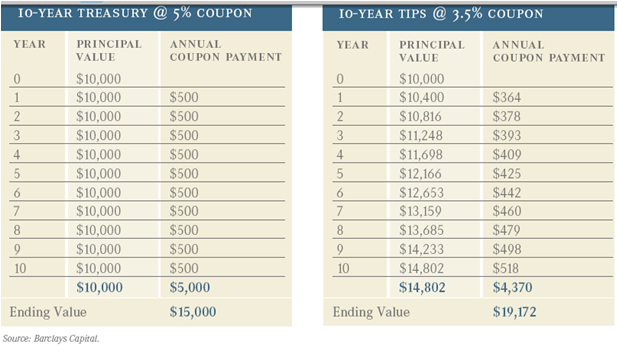
This table from Barclays Capital below does an excellent job of conceptually displaying the differences between vanilla Treasuries and TIPS.
Some Observations:
1) As you can see, the principal value of the TIPS security adjusts with inflation (Consumer Price Index). The price of the TIPS security, which we cannot see in the example, adjusts upwards (or downwards) with inflation expectations.
2) The TIPS security pays a lower coupon (3.5% vs. 5.0%), but you can see that under a 4% annual inflation assumption (principal value adjusts from $10,000 in Year 0 to $10,400 in Year 1), the ending value of the TIPS comes up significantly higher ($19,172 vs. $15,000).
3) The break-even inflation expectation rate is 1.5% (derived from 5% coupon minus 3.5% coupon). If you think inflation will average more than 1.5%, then buy the TIPS security. If you think inflation will average less than 1.5%, then buy the 10-year Treasury.
TIPS Advantages
- Inflation Protection: At the risk of stating the obvious, if you expect long-term inflation to average substantially more than about 2% (current inflation expectations), then TIPS are a great way of protecting your purchasing power.
- Deflation Protection: Perhaps TIPS should be called DIPS (Deflation Income Protection Securities)? What some investors do not realize is that even if our country were to spiral into long-term deflationary crisis, TIPS investors are guaranteed the original amount of principal. Yes, that’s right…guaranteed. Interest payments could conceivably decline to zero and the principal value could temporarily fall below par, but the government guarantees the original principal regardless of the scenario.
- No Credit or Default Risk: The advantage of the government owning its own printing press is that there is very little risk of default, so preservation of capital is not much of a risk.
TIPS Disadvantages
- Interest Rate Risk: It’s great to be indexed to inflation, but because TIPS include long-range maturities, investors face a significant amount of interest rate risk if the TIPS are not held until maturity. TIPS will likely outperform Treasuries under a rising rate scenario, but will be impacted nonetheless.
- CPI Risk: Even if you are not a conspiracy theorist who believes government CPI figures are artificially depressed, it is still quite possible your personal baskets of purchases do not perfectly align with the arbitrary CPI basket of goods.
- Negative Deflation Adjustments: Although a TIPS investor has an embedded “deflation floor” equivalent to original principal value, interest payments will be negatively impacted by declines in principal value during deflationary periods. Also, previously issued TIPS with accumulated principal values from inflationary adjustments run larger principal loss risks as compared to newly issued TIPS.
Although 5-year TIPS yields may have dunked below water into negative territory, the headline bark is much worse than the bite. There has been a massive rally in bond prices in front of the QE2 bond binge by the Fed. Nevertheless, inflation expectations have remained fairly stable and TIPS still provide defensive characteristics under both a future inflationary or deflationary scenario. If the Fed is indeed successful in manufacturing a reasonable Goldilocks range of inflation then TIPS yields should once again be able to come up for air.
Wade W. Slome, CFA, CFP®
Plan. Invest. Prosper.
DISCLOSURE: Sidoxia Capital Management (SCM) and some of its clients own certain exchange traded funds (including TIP), but at the time of publishing SCM had no direct position in any other security referenced in this article. No information accessed through the Investing Caffeine (IC) website constitutes investment, financial, legal, tax or other advice nor is to be relied on in making an investment or other decision. Please read disclosure language on IC “Contact” page.
PIMCO – The Downhill Marathon Machine

How would you like to run a marathon? How about a marathon that is prearranged all downhill? How about a downhill marathon with the wind at your back? How about a downhill marathon with the wind at your back in a wheelchair? Effectively, that is what a 30-year bull market has meant for PIMCO (Pacific Investment Management Co.) and the “New Normal” brothers (Co-Chairman Bill Gross and Mohamed El-Erian) who are commanding the bond behemoth (read also New Normal is Old Normal). Bill Gross can appreciate a thing or two about running marathons since he once ran six marathons in six consecutive days.
This perseverance also assisted Gross in co-founding PIMCO in 1971 with $12 million in assets under management. Since then, the company has managed to add five more zeroes to that figure (today assets exceed $1.2 trillion). In the first 10 years of the company’s existence, as interest rates were climbing, PIMCO managed to layer on a relatively thin amount of assets (approximately $1 billion). But with the tailwind of declining rates throughout the 1980s, PIMCO’s growth began to accelerate, thereby facilitating the addition of more than $25 billion in assets during the decade.
The PIMCO Machine
For the time-being, PIMCO can do no wrong. As the endless list of media commentators and journalists bow to kiss the feet of the immortal bond kings, the blinded reporters seem to forget the old time-tested Wall Street maxim:
“Never confuse genius with a bull market.”
The gargantuan multi-decade move in interest rates, the fuel used to drive bond prices to the moon, might have something to do with the company’s success too? PIMCO is not exactly selling ice to the Eskimos – many investors are scooping up PIMCO’s bond products as they wait in their bunkers for Armageddon to arrive. Thanks to former Federal Reserve Chairman Paul Volcker (appointed in 1979), the runaway inflation of the early 1980s was tamed by hikes he made in the key benchmark Federal Funds Rate (the targeted rate that banks lend to each other). From a peak of around 20% in 1980-1981 the Fed Funds rate has plummeted to effectively 0% today with the most recent assistance coming from current Fed Chairman Ben Bernanke.
Although these west-coast beach loving bond gurus are not the sole beneficiary in this “bond bubble” (see Bubblicious Bonds story), PIMCO has separated itself from the competition with its shrewd world-class marketing capabilities. A day can hardly go by without seeing one of the bond brothers on CNBC or Bloomberg, spouting on about interest rates, inflation, and global bond markets. As PIMCO has been stepping on fruit in the process of collecting the low-hanging fruit, the firm has not been shy about talking its own book. Subtlety is not a strength of El-Erian – here’s what he had to pimp to the USA Today a few months ago as bond prices were continuing to inflate: “Simply put, investors should own less equities, more bonds, more global investments, more cash and more dry ammunition.”
If selling a tide of fear resulted in a continual funnel of new customers into your net, wouldn’t you do the same thing? Fearing people into bonds is something El-Erian is good at: “In the New Normal you are more worried about the return of your capital, not return on your capital.” Beyond alarm, accuracy is a trivial matter, as long as you can scare people into your doomsday way of thinking. The fact Bill Gross’s infamous Dow 5,000 call never came close to fruition is not a concern – even if the forecast overlapped with the worst crisis in seven decades.
Mohamed Speak
Mohamed El-Erian is a fresher face to the PIMCO scene and will be tougher to pin down on his forecasts. He arrived at the company in early 2008 after shuffling over from Harvard’s endowment fund. El-Erian has a gift for cryptically speaking in an enigmatic language that could only make former Federal Reserve Chairman Alan Greenspan proud. Like many economists, El-Erian laces his commentary with many caveats, hedges, and generalities – concrete predictions are not a strength of his. Here are a few of my favorite El-Erian obscurities:
- “ongoing paradigm shift”
- “endogenous liquidity”
- “tail hedging”
- “deglobalization”
- “post-realignment”
- “socialization losses”
Excuse me while I grab my shovel – stuff is starting to pile up here.
Don’t get me wrong…plenty of my client portfolios hold bonds, with some senior retiree portfolios carrying upwards of 80% in fixed income securities. This positioning is more a function of necessity rather than preference, and requires much more creative hand-holding in managing interest-rate risk (duration), yield, and credit risk. At the margin, unloved equities, including high dividend paying Blue Chip stocks, provide a much better risk-adjusted return for those investors that have the risk tolerance and time-horizon threshold to absorb higher volatility.
PIMCO has traveled along a long prosperous road over the last 30 years with the benefit of a historic decline in interest rates. While PIMCO may have coasted downhill in a wheelchair for the last few decades, this behemoth may be forced to crawl uphill on its hands and knees for the next few decades, as interest rates inevitably rise. Now that is a “New Normal” scenario Bill Gross and Mohamed El-Erian have not forecasted.
Wade W. Slome, CFA, CFP®
Plan. Invest. Prosper.
DISCLOSURE: Sidoxia Capital Management (SCM) and some of its clients own certain exchange traded funds, but at the time of publishing SCM had no direct position in PIMCO/Allianz, or any other security referenced in this article. No information accessed through the Investing Caffeine (IC) website constitutes investment, financial, legal, tax or other advice nor is to be relied on in making an investment or other decision. Please read disclosure language on IC “Contact” page.




 Investing Caffeine
