Sentiment Indicators: Reading the Tea Leaves

Market commentators and TV pundits are constantly debating whether the market is overbought or oversold. Quantitative measures, often based on valuation measures, are used to support either case. But the debate doesn’t stop there. As a backup, reading the emotional tea leaves of investor attitudes is relied upon as a fortune telling stock market ritual (see alsoTechnical Analysis article). Generally these tools are used on a contrarian basis when deciding about purchase or sale timing. The train of thought follows excessive optimism is tied to being fully invested, therefore the belief is only one future direction left…down. The thought process is also believed to work in reverse.
Actions Louder Than Words
When it comes to investing, I believe actions speak louder than words. For example, words answered in a subjective survey mean much less to me in gauging optimism or pessimism than what investors are really doing with their cool, hard cash. Asset flow data indicates where money is in fact going. Currently the vast majority of money is going into bonds, meaning the public hates stocks. That’s fine, because without pessimism, there would be fewer opportunities.
Most sentiment indicators are an unscientific cobbling of mood surveys designed to check the pulse of investors. How is the data used? As mentioned above, the sentiment indicators are commonly used as a contrarian tool…meaning: sell the market when the mood is hot and buy the market when it is cold.
Here are some of the more popular sentiment indicators:
1) Sentiment Surveys (AAII/NAAIM/Advisors): Each measures different bullish/bearish opinions regarding the stock market.
2) CBOE Volatility Index (VIX): The “fear gauge” developed using implied option volatility (read also VIX article).
3) Breadth Indicators (including Advanced-Decline and High-Low Ratios): Measures the number of up stocks vs. down stocks. Used as measurement device to identify extreme points in a market cycle.
4) NYSE Bullish Percentage: Calculates the percentage of bullish stock price patterns and used as a contrarian indicator.
5) NYSE 50-Day and 200-Day Moving Average: Another technical price indicator that is used to determine overbought and oversold price conditions.
6) Put/Call Ratio: The number of puts purchased relative to calls is used by some to measure the relative optimism/pessimism of investors.
7) Volume Spikes: Optimistic or pessimistic traders will transact more shares, therefore sentiment can be gauged by tracking volume metrics versus historical averages.
Sentiment Shortcomings
From a ten thousand foot level, the contrarian premise of sentiment indicators makes sense, if you believe as Warren Buffett does that it is beneficial to buy fear and sell greed. However, many of these indicators are more akin to reading tea leaves, than utilizing a scientific tool. Investors enjoy black and white simplicity, but regrettably the world and the stock market come in many shades of gray. Even if you believe mood can be accurately measured, that doesn’t account for the ever-changing state of human temperament. For instance, in a restaurant setting, my wife will change her menu choice four times before the waiter/waitress takes her order. Investor sentiment can be just as fickle depending on the Dubai, Greece, Swine Flu, or foreclosure headline du jour.
Other major problems with these indicators are time horizon and degree of imbalance. Yeah, an index or stock may be oversold, but by how much and over what timeframe? Perhaps a security is oversold on an intraday chart, but dramatically overbought on a monthly basis? Then what?
The sentiment indicators can also become distorted by a changing survey population. Average investors have fled the equity markets and have followed the pied piper Bill Gross to fixed income nirvana. What we have left are a lot of unstable high frequency traders who often change opinions in a matter of seconds. These loose hands are likely to warp the sentiment indicator results.
Strange Breed
Investors are strange and unique animals that continually react to economic noise and emotional headlines in the financial markets. Despite the infinitely complex world we live in, people and investors use everything available at their disposal in an attempt to make sense of our endlessly random financial markets. One day interest rate declines are said to be the cause of market declines because of interest rate concerns. The next day, interest rate declines due to “quantitative easing” comments by Federal Reserve Chairman Ben Bernanke are attributed to the rise in stock prices. So, which one is it? Are rate declines positive or negative for the market?
On a daily basis, the media outlets are arrogant enough to act like they have all the answers to any price movement, rather than chalking up the true reason to random market volatility, sensationalistic noise, or simply more sellers than buyers. Virtually any news event will be handicapped for its market impact. If Ben Bernanke farts, people want to know what he ate and what impact it will have on Fed policy.
Sentiment indicators are some of the many tools used by professionals and non-professionals alike. While these indicators pose some usefulness, overreliance on reading these sentiment tea leaves could prove hazardous to your fortune telling future.
Wade W. Slome, CFA, CFP®
Plan. Invest. Prosper.
DISCLOSURE: Sidoxia Capital Management (SCM) and some of its clients own certain exchange traded funds, but at the time of publishing SCM had no direct position in any other security referenced in this article. No information accessed through the Investing Caffeine (IC) website constitutes investment, financial, legal, tax or other advice nor is to be relied on in making an investment or other decision. Please read disclosure language on IC “Contact” page.
Short Arms, Deep Pockets

Companies have deep pockets flush with cash, but are plagued with short arms, unwilling to reach into their wallets to make substantive new hires. I have talked about “unemployment hypochondria” in the past but is this cautious behavior rational?
The short answer is yes, and it is very typical in light of the similar “jobless recoveries” we experienced in 1991 and 2001. After suffering the worst financial crisis in a generation, employers’ wounds are still not completely healed and the frightening memories of 2008-2009 are still fresh in their minds.
Linchpin Labor
The globalization cat is out of the bag, and technology is only accelerating the commoditization of labor. When labor can be purchased for $1 per hour in China or $.50 per hour in India , and in many instances no strategic benefit lost, then why are so many people surprised about the hemorrhaging of $25 per hour manufacturing jobs to cheaper locales? Agriculture and related industries used to account for more than 90% of our economy about 150 years ago – today agriculture makes up about 2% of our economic output. Even though this dominating sector withered away on a relative basis, the United States became the global powerhouse innovator of the 20th century.
Innovative companies understand that true value is created by those workers who make themselves indispensable – or what Seth Godin calls “Linchpins.” Apple Inc. (AAPL) understands these trends. If you don’t believe me, just flip over an iPhone and read where it clearly states, “Designed by Apple in California. Assembled in China.” (see BELOW).

We are falling further behind our global brethren in math and science, and our immigration policy is all backwards (Keys to Success). Education, creativity, ingenuity, and entrepreneurial spirit are the main ingredients necessary to climb the labor food chain. For those workers that make themselves linchpins, their services will be in demand during good times and bad times.
Jobs = Heavy Hiking Boots
Like scared hikers jettisoning heavy hiking boots to escape a pursuing grizzly bear, business owners will eventually need to purchase a new pair of boots, if they want to hike the mountain to face the next challenge. Right now, businesses are content waiting it out, more worried about the potential of a bear jumping out to devour them.
Although businesses may not be plunging into hiring a substantial number of new workers, positive leading indicators are becoming more apparent. Beyond the obvious improvement in the explicit job numbers (e.g., nine consecutive months of private job creation), other factors such as increased temporary workers, accelerating job listings, and increased capital expenditures are the precursors to sustained job hiring.
Quarterly Capital Carrots
Capital expenditures generally lead to more immediate productivity improvements and do not have a complete negative and immediate impact on the sacred EPS (earnings per share) and income statement metrics. On the other hand, hiring a new employee has an instant depressing effect on expenses, thereby dragging down the beloved EPS figure. What’s more, new employees do not typically become productive or sales generative for months. If you consider the heavy explicit wages coupled with implicit training costs, until the coast is clear and confidence overcomes fear, businesses are not going to dip their hands into their cash-filled pockets to hire workers willy-nilly.
As previously mentioned, improved business confidence is being signaled by increased capital spending. Just over the last week, investors have witnessed significantly expanded capital expenditures across a broad array of industries. Here are a few random samplings:
September 2010 – Quarterly Capital Expenditures
Q3 – 2010 Q3 – 2009 YOY%
Apple Inc. (AAPL) $760 mil vs. $459 mil +66%
Halliburton Company (HAL) $557 mil vs. $440 mil +27%
Coca Cola Company (KO) $442 mil vs. $419 mil +5%
Dominos Pizza Inc. (DPZ) $5.2 mil vs. $4.1 mil +26%
Intel Corp. (INTC) $1.4 bill vs $944 mil +44%
Although the pace of the recovery is losing steam, companies’ health persists to strengthen, as evidenced in part by the +45% growth in 2010 S&P 500 profits, swelling record cash piles, and increasing corporate confidence (rising capital expenditures). Despite these positive leading indicators, business owners are reluctant to dip their short arms into their deep cash-filled pockets to hire new employees. Given our experience over the last few decades this corporate behavior is perfectly consistent with recent jobless recoveries. Until its clear the economic bear is hibernating, businesses will continue building their cash warchests. Everyone will be happier once we are done running from bears, and instead chasing bulls.
Wade W. Slome, CFA, CFP®
Plan. Invest. Prosper.
DISCLOSURE: Sidoxia Capital Management (SCM) and some of its clients own certain exchange traded funds and AAPL, but at the time of publishing SCM had no direct position in HAL, KO, DPZ, INTC, or any other security referenced in this article. No information accessed through the Investing Caffeine (IC) website constitutes investment, financial, legal, tax or other advice nor is to be relied on in making an investment or other decision. Please read disclosure language on IC “Contact” page.
Buried Alive

Source: Photobucket
Unfortunately, I am temporarily buried with quarterly investment client duties, not to mention preparation for the avalanche of pending quarterly corporate earnings. If I don’t return in the coming days, send out the rescue troops. In the mean time, if you interested in more of my blabbing, check out a recent radio interview I completed. After clicking on the link, just scroll down to the WHME- FM play button icon:

Click Here for Interview of Wade Slome (Investing Caffeine Editor)
Wade W. Slome, CFA, CFP®
Plan. Invest. Prosper.
DISCLOSURE: Sidoxia Capital Management (SCM) and some of its clients own certain exchange traded funds, but at the time of publishing SCM had no direct position in any security referenced in this article. No information accessed through the Investing Caffeine (IC) website constitutes investment, financial, legal, tax or other advice nor is to be relied on in making an investment or other decision. Please read disclosure language on IC “Contact” page.
From Merger Wedding to eHarmony

Source: Photobucket
“Keep your eyes wide open before marriage, and half-shut afterwards.”
– Benjamin Franklin
Stocks share a lot of the same dynamics with dating and marriage. Some may choose to play the field through partnerships and joint ventures, while others may choose to remain independent as eternal bachelors/bachelorettes. Others, however, are willing to take the plunge. Unfortunately some marriages don’t last. But if things don’t work out, there is no need to worry because eHarmony.com (or resident investment bank) will always be there to help find your next perfect match.
Unlucky in Love
An example of a bloody divorce is the mega-merger between AOL Inc. and Time Warner (TWX) in 2000. The relationship was so destructive that investors witnessed AOL’s peak value of $222 billion in December 1999 (Fortune) plummet to around $3 billion today…ooooph!
Compared to some relationships, AOL lasted much longer. In fact Yahoo! Inc. (YHOO) didn’t even get to celebrate a honeymoon with Microsoft Corp. (MSFT) in February 2008 when the behemoth software company offered a +62% premium ($31 per share) for the gigantic portal. Microsoft’s $45 billion cash and stock offer was ruled unworthy by Yahoo’s board, so the company decided to leave Microsoft at the altar. Even after considering Yahoo’s latest price spike on acquisition rumors, Microsoft’s original bid is still almost double Yahoo’s current stock price of $16 per share.
Merger Scuttlebutt
As I discussed in my earlier mergers and acquisitions article (M&A) conditions are ripening with large corporate cash piles, a continued economic recovery, improved capital markets availability, and cheap credit costs (at least for those that qualify). With the clouds slowly lifting in the M&A world, suitors are shaking the trees for more potential opportunities.
While some acquirers may have altruistic intentions in combining companies, some marriages are done for pure gold-digging purposes. Private equity firms Blackstone Group (BX) and Silver Lake are rumored to be circling the Yahoo wagons and courting AOL as a potential partner in a joint bid. Whatever the expectations, if private equity plays a role in a Yahoo bid, the internet company should not become disillusioned with romantic warm and fuzzies – private equity firms like to get straight down to dirty business. Yahoo owns a 35% stake in Yahoo Japan and a 43% interest in leading Chinese e-commerce company, Alibaba Group. If a joint private equity bid were ever to win, I believe there would be a strong impetus to realize shareholder value by carving up these non-operating stakes. Consolidating overhead and streamlining expenses would likely be a top priority as well.
The Perfect Marriage
A “perfect marriage” could almost be called an oxymoron because like any relationship, there is significant work required by both parties. The divorce rate is estimated at around 40-50% in North America (Europe around the same), however mergers even fail at a higher 70% rate, according to Bain and Company study. I would argue successfully integrating larger deals are even more difficult, hampering the success rate even further. Merging two poorly managed companies purely for cost purposes is probably not the best way to go. Crashing two garbage trucks together is not going to create a Ferrari. I wouldn’t go as far as to say Yahoo and AOL are garbage trucks, but they face numerous, substantial challenges. Maybe these two companies are more akin to Mazdas transforming into a Toyota Camry (TM).
From my perspective, if companies really are dead set on engaging in acquisitions, then I urge management teams to focus on smaller digestible deals. Specifically, concentrate on those deals with experienced senior management teams who understand and respect the unique culture of the acquirer. Mergers also often fail due to excessive optimism and overly optimistic assumptions. This is an area in which Warren Buffett excels. Rarely do you observe the Oracle of Omaha overpaying for an acquisition, but rather he patiently waits for his fat pitch, and when it floats over the plate, Buffett is quick to throw out a lowball offer that will dramatically increase the probabilities of long-term merger success (think Geico, Sees Candy, Burlington Northern, etc.).
In the end, a joint relationship may not be forged between Yahoo, AOL and private equity firms, but if talks disintegrate, no need to worry – alternative partnerships can be explored on eHarmony.
Wade W. Slome, CFA, CFP®
Plan. Invest. Prosper.
DISCLOSURE: Sidoxia Capital Management (SCM) and some of its clients own certain exchange traded funds, but at the time of publishing SCM had no direct position in YHOO, MSFT, TWX, BX, BRKA, TM, Alibaba, or any other security referenced in this article. No information accessed through the Investing Caffeine (IC) website constitutes investment, financial, legal, tax or other advice nor is to be relied on in making an investment or other decision. Please read disclosure language on IC “Contact” page.
Doing the Opposite – Slow Frequency Trading

The business of robot trading, or so-called high-frequency trading (HFT) has grabbed a lot of headlines recently. The recent exposé released by 60 Minutes on the subject has only fanned the flames, which have been blazing harder since the May 6th “flash crash” earlier this year. The SEC is still working through proposed rule changes and regulatory reforms in hopes of preventing a similar crash that saw the Dow Jones Industrial Index almost fall 1,000 points in fifteen minutes, only to recover much of those losses minutes later.
The debate will rage on about the fairness of HFT (read more), but let’s not confuse active day-trading with high-frequency trading. In the case of HFT, the traders are actually getting paid to trade with the assistance of “liquidity rebates.” In exchange for the service of providing liquidity, these computer-based trading companies are earning cold, hard cash. Wouldn’t that be nice if individual day traders got paid money too for trading, rather than flushing commissions down the toilet?
Rather than warn unsuspecting working class Americans of the dangers of trading, discount brokerages and other trading firms peddle talking babies, loud music, back-testing voodoo software, and the prospect of discovering a profit elixir. As it turns out, investing is like weight loss…easy to understand, but difficult to execute. There’s no such thing as a miracle drug or chocolate diet that will shed pounds off your frame, just like there is no miracle trading system that will instantaneously generate millions in profits.
Doing the Opposite
Rather than succumb to the vagaries of the market, investors would be better served by following the mantra of character George Costanza from the hit, comedic television show Seinfeld. In the classic episode, astutely captured by Josh Brown (The Reformed Broker) and also cataloged in chapter four of my book, George realizes that all his instincts are wrong and discovers the road to success can be achieved by doing everything in an opposite fashion. George goes on to flaunt his contrarian approach when he runs into a blonde bombshell at the diner. Rather than boast about his accomplishments, George fesses up to his professional shortcomings by revealing his unemployment status and admitting that he lives at home with his parents. No need to worry, this strategy captivates her and results in George immediately getting the girl. George doesn’t stop there; during the same episode he gets his way with New York Yankee owner, George Steinbrenner, by telling him off. Before long, George is generating big bucks and making key decisions for the organization.
The same contrarian instincts of George apply to the investing world. Resisting the urge to follow the herd is key. The grass is greener and the eating more abundant away from animal pack. Investor extraordinaire Warren Buffett encapsulates the idea in the following advice, “Be fearful when others are greedy, and be greedy when others are fearful.”
There will constantly be an urge to trade frequently and chase performance, whether you’re talking about technology stocks during the boom, real estate five years ago, or the perceived safe-haven of Treasuries and gold today. The melody sounds so beautiful, until the music stops and prices come crashing back down to Earth. If you want to win in the losing game of the financial markets, do yourself a favor and become a slow frequency trader – George would be proud of you doing the opposite.
Wade W. Slome, CFA, CFP®
Plan. Invest. Prosper.
DISCLOSURE: Sidoxia Capital Management (SCM) and some of its clients own certain exchange traded funds, but at the time of publishing SCM had no direct position in any other security referenced in this article. No information accessed through the Investing Caffeine (IC) website constitutes investment, financial, legal, tax or other advice nor is to be relied on in making an investment or other decision. Please read disclosure language on IC “Contact” page.
Ration or Tax: Eating Cake Not an Option

We live in an instant gratification society that would like everything for free ( like my pal Bill Maher), which explains why we want to have our healthcare cake and eat it too. I think George Will said it best when discussing universal healthcare coverage, “If you think health care is expensive now, just wait until it is free.” Look, I love free stuff too, like the rest of us, whether it’s free sausage sample at Costco (COST) or a breath mint at the Olive Garden (DRI). But regrettably, exploding deficits come at a price.
With midterm elections coming up, the issue of healthcare is once again front and center. The majority party feels like a checkbook is a solution to healthcare prosperity. Can you really look me in the eyes and say covering additional 32 million uninsured Americans is going to save us money. The government hasn’t exactly built a ton of credibility with the disastrous train-wreck we call Medicare, which is already carrying 45 million covered passengers.
The minority party hasn’t done a lot better with the layering of the 2006 unsustainable Medicare Part D drug plan. Conservatives are campaigning on “repeal and replace” and that is great, but where are the cuts?
There are only two solutions to our current healthcare problem: ration or tax (read Plucking Feathers of Taxpaying Geese). Is healthcare a right or privilege? I don’t know, but if we want to cover current obligations, or add 32 – 50 million more uninsured, then we will be required to cut expenses (ration) to pay for increased benefits and/or increase taxes to cover additional benefits. I would love to cover all Americans, along with the starving children in Africa too, but unfortunately we are limited by our resources. Writing checks with borrowed money will only last for so long.
How severe are the exploding healthcare costs, which are covering the graying of the 76 million baby boomers? Here’s how Forbes describes the unsustainable Medicare obligations:
The Medicare Trustees tell us that Medicare’s expected future obligations exceeded premiums and dedicated taxes by $89 trillion (measured in current dollars). No, that’s not a misprint. To put that number in perspective, Medicare’s liability is about 5 1/2 times the size of Social Security’s ($18 trillion) and about six times the size of the entire U.S. economy.
Not a pretty picture. These estimates look pretty far in the future, but even more bare bone figures arrive at a still frightening $33 trillion. Take a look at healthcare spending forecasts as a percentage of GDP – even the lowest estimates are depressing:
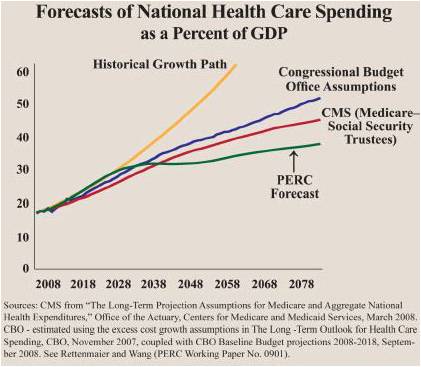
Source: National Center for Policy Analysis via Forbes
In our increasingly flat globalized world, competition between countries is becoming even more intense. We are in a marathon race for improved standards of living, and all these debts and deficits are dragging us down like an anchor tied to our legs. Even without considering other massive entitlements like Social Security, healthcare alone has the potential of grinding our economy to a halt. Politicians are great at promising more benefits and tax cuts in exchange for your votes, but true leadership requires delivering the sour medicine necessary for future prosperity. Before we eat the healthcare cake, let’s raise the money to buy the cake first.
Read more about the Medicare Explosion on Forbes
Wade W. Slome, CFA, CFP®
Plan. Invest. Prosper.
DISCLOSURE: Sidoxia Capital Management (SCM) and some of its clients own certain exchange traded funds, but at the time of publishing SCM had no direct position in COST, DRI, or any other security referenced in this article. No information accessed through the Investing Caffeine (IC) website constitutes investment, financial, legal, tax or other advice nor is to be relied on in making an investment or other decision. Please read disclosure language on IC “Contact” page.
Dealing Currency Drug to Export Addicts

Source: Photobucket
With the first phase of the post-financial crisis global economic bounce largely behind us, growth is becoming scarcer and countries are becoming more desperate – especially in developed countries with challenged exports and high unemployment. The United States, like other expansion challenged countries, fits this bill and is doing everything in its power to stem the tide by blasting foreigners’ currency policies in hopes of stimulating exports.
Political Hot Potato
The global race to devalue currencies in many ways is like a drug addict doing whatever it can to gain a short-term high. Sadly, the euphoric short-term benefit form lower exchange rates will be fleeting. Regardless, Ben Bernanke, the Chairman of the Federal Reserve, has openly indicated his willingness to become the economy’s drug dealer and “provide additional accommodation” in the form of quantitative easing part two (QE2).
Unfortunately, there is no long-term free lunch in global economics. The consequences of manipulating (depressing) exchange rates can lead to short-term artificial export growth, but eventually results convert to unwanted inflation. China too is like a crack dealer selling cheap imports as a drug to addicted buyers all over the world – ourselves included. We all love the $2.99 t-shirts and $5.99 toys made in China that we purchase at Wal-Mart (WMT), but don’t consciously realize the indirect cost of these cheap goods – primarily the export of manufacturing jobs overseas.
Global Political Pressure Cooker
Congressional mid-term elections are a mere few weeks away, but a sluggish global economic recovery is creating a global political pressure cooker. While domestic politicians worry about whining voters screaming about unemployment and lack of job availability, politicians in China still worry about social unrest developing from a billion job-starved rural farmers and citizens. The Tiananmen Square protests of 1989 are still fresh in the minds of Chinese officials and the government is doing everything in its power to keep the restless natives content. In fact, Premier Wen Jiabao believes a free-floating U.S.-China currency exchange rate would “bring disaster to China and the world.”
While China continues to enjoy near double-digit percentage economic growth, other global players are not sitting idly. Like every country, others would also like to crank out exports and fill their factories with workers as well.
The latest high profile devaluation effort has come from Japan. The Japanese Prime Minister post has become a non-stop revolving door and their central bank has become desperate, like ours, by nudging its target interest rate to zero. In addition, the Japanese have been aggressively selling currency in the open market in hopes of lowering the value of the Yen. Japan hasn’t stopped there. The Bank of Japan recently announced a plan to pump the equivalent of approximately $60 billion into the economy by buying not only government bonds but also short-term debt and securitized loans from banks and corporations.
Europe is not sitting around sucking its thumb either. The ECB (European Central Bank) is scooping up some of the toxic bonds from its most debt-laden member countries. Stay tuned for future initiatives if European growth doesn’t progress as optimistically planned.
Dealing with Angry Parents
When it comes to the United States, the Obama administration campaigned on “change,” and the near 10% unemployment rate wasn’t the type of change many voters were hoping for. The Federal Reserve is supposed to be “independent,” but the institution does not live in a vacuum. The Fed in many ways is like a grown adult living away from home, but regrettably Bernanke and the Fed periodically get called by into Congress (the parents) to receive a verbal scolding for not following a policy loose enough to create jobs. Technically the Fed is supposed to be living on its own, able to maintain its independence, but sadly a constant barrage of political criticism has leaked into the Fed’s decision making process and Bernanke appears to be willing to entertain any extreme monetary measure regardless of the potential negative impact on long-term price stability.
Just over the last four months, as the dollar index has weakened over 10%, we have witnessed the CRB Index (commodities proxy) increase over 10% and crude oil increase about 10% too.
In the end, artificially manipulating currencies in hopes of raising economic activity may result in a short-term adrenaline boost in export orders, but lasting benefits will not be felt because printing money will not ultimately create jobs. Any successful devaluation in currency rates will eventually be offset by price changes (inflation). Finance ministers and central bankers from 187 countries all over the world are now meeting in Washington at the annual International Monetary Fund (IMF) meeting. We all want to witness a sustained, coordinated global economic recovery, but a never-ending, unanimous quest for devaluation nirvana will only lead to export addicts ruining the party for everyone.
See also Arbitrage Vigilantes
Wade W. Slome, CFA, CFP®
Plan. Invest. Prosper.
DISCLOSURE: Sidoxia Capital Management (SCM) and some of its clients own certain exchange traded funds and WMT, but at the time of publishing SCM had no direct position in any other security referenced in this article. No information accessed through the Investing Caffeine (IC) website constitutes investment, financial, legal, tax or other advice nor is to be relied on in making an investment or other decision. Please read disclosure language on IC “Contact” page.
California…This Bud’s for You

I guess it’s time for Californians to dust off their bongs and break out the rolling papers because Proposition 19, the proposal to legalize personal marijuana consumption for adults in the Golden State, is coming up for vote next month. Judging by recent polls, the proposition is gaining steam…or smoke.
Results show that 52% of voters are backing the proposition versus 41% opposed and 7% undecided. In fact, the data shows Californians are supporting ganja more than they are backing the state Senatorial and Gubernatorial candidates (Barbara Boxer, Dianne Feinstein, Carly Fiorina, Jerry Brown and Meg Whitman).
Proponents are fiercely battling the opposition in the remaining weeks before the big vote. Given all the controversy, I wouldn’t be surprised if pro-pot advocacy groups enlisted renowned rapper Snoop Dogg as a paid spokesman to support the cause. I can hear Snoop now, “Vote yes on ‘pot,’ but remember friends don’t let friends drive doped.” Alternatively, I’m sure Altria Group (MO), maker of the famous Marlboro branded cigarettes, wouldn’t mind getting into the profitable cannabis business. They could even hire ex-President Clinton, who could admit he “inhaled…and enjoyed it,” while consuming some cannabis legally in California.

Would Snoop and Bill Say Yes to Legalized Marijuana?
The Budding of Prop. 19
What was the genesis of Proposition 19? Well, this isn’t the first time the wacky weed debate has actually been put to a vote in California. Almost four decades ago a similarly titled Proposition 19 initiative showed up on the ballot. Was it a coincidence the same number was used…perhaps? On the bright side, more mature protesters will not have to break the piggybank to buy new Proposition 19 buttons and T-shirts. This type of recycling gives new meaning to the word being “green.”
From a broader political policy perspective, marijuana consumption is no small problem. An estimated $113 billion of pot is sold each year nationally, with more than 10% of that attributed to California weed smokers. A whopping 15 million Americans have admitted to using pot within the last month, according to one survey. Of all the marijuana smoked, around fifty percent of the illegal bud is said to originate from foreign sources, most notably Mexico, which is dealing with deadly drug cartels that are killing innocent civilians by the thousands and threatening our borders. Proposition 19 cheerleaders are quick to point out that the legalization of cannabis would remove valuable money from foreign criminals’ pockets.
Legalizing and taxing cannabis has the potential of raising billions for the state of California. We all know about the sad state of fiscal affairs for California ($19 billion budget deficit) along with the dismal financial shape of neighboring states – an estimated $137 billion in deficits over fiscal 2011 and 2012 (see The Next Looming Bailout). Contributing to the deficits is the overcrowding of our jails and prisons. Ever since the “Just Say No” to drugs campaign, which started in 1984, prison populations have quadrupled – many of the prisoners being non-violent pot smokers. So, why not collect some cash from the millions that are already smoking pot illegally and help reduce our damaging deficits and free up space for more violent criminals?
Calling All Sin-Consuming Hypocrites
I understand the opposition to cannabis legalization, primarily based on concerns relating to public safety, workplace productivity, and potential losses in federal funding, but if certain people are opposed to Proposition 19, I sure hope they are up in arms over the numerous other legal (but sinful) products and services that permeate our daily lives. If pot is deemed harmful and illegal by society, then where are all the picketers protesting this long list of other sinfully legal products and services?
- Casinos/Gambling
- Cigarettes
- Lotteries
- Alcohol
- Prostitution (Nevada)
- Guns/Hunting
- Ho Hos/Twinkies/Sodas (Fat Tax)
The potential safety issue surrounding an increase in stoned drivers is a real one. However, if we have managed to reduce drunk driving, with the help of severe penalties, over the last few decades, I’m fairly confident we can keep slothful, Domino’s pizza (DPZ) loving, pot-smokers under control.
There is no shortage of controversy surrounding this political hot-button issue, but drastic times call for drastic measures. You may be against the legalization of marijuana, but if Proposition 19 passes in California, you may want to go long Domino’s, and short Nike Inc. (NKE).
Wade W. Slome, CFA, CFP®
Plan. Invest. Prosper.
DISCLOSURE: Sidoxia Capital Management (SCM) and some of its clients own certain exchange traded funds, but at the time of publishing SCM had no direct position in MO, DPZ, NKE, or any other security referenced in this article. No information accessed through the Investing Caffeine (IC) website constitutes investment, financial, legal, tax or other advice nor is to be relied on in making an investment or other decision. Please read disclosure language on IC “Contact” page.
Changing of the Guard

Over previous decades, there has been a continual battle between the merits of active versus passive management. Passive management being what I like to call the “do nothing” strategy, in which a basket of securities is purchased, and the underlying positions remain largely static. For all intents and purposes, the passive management strategy is controlled by a computer. Rather than solely using a computer, active management pays professionals six or seven figures to fly around to conferences, interview executive management teams, and apply their secret sauce tactics. Unlike passive managers, active managers do their best to determine which winning securities to buy and which losing ones to sell in their mutual funds and hedge funds.
Caught in the middle of this multi-decade war between passive and active management are Vanguard Group (founded in Valley Forge, Pennsylvania in 1975 by John Bogle) and Fidelity Investments (founded in 1946 in Boston, Massachusetts by Edward C. Johnson II). Currently John Bogle and Vanguard’s passive philosophy is winning the war. A changing of the guard, similar to the daily ceremony witnessed in front of Buckingham Palace is happening today in the mutual fund industry. Specifically, Vanguard, the company spearheading passive investing, has passed Fidelity Investments as the largest mutual fund company according to assets under management. Before 2010, Fidelity topped the list of largest firms every year since 1988, when it passed the then previous leader, Merrill Lynch & Co (BAC).
As of July 2010, Vanguard stands at the top of the mutual fund hill, managing $1.31 trillion versus Fidelity’s $1.24 trillion. Vanguard is sufficiently diversified if one considers its largest fund, the Vanguard Total stock Market Index Fund (VITSX), sits at around $127 billion in assets. The picture looks worse for Fidelity, if you also account for the $113 billion in additional ETF assets (Exchange Traded Funds) Vanguard manages – Fidelity is relatively absent in the ETF segment (State Street). Once famous active funds, such as Fidelity Magellan (now managed by Harry Lange – FMAGX) have underperformed the market over the last ten years causing peak assets of $110 billion in 2000 to decline to around $22 billion today. The $68 billion Fidelity Contrafund (FCNTX), managed by Will Danhoff, has not grown sufficiently to offset Magellan’s (and other funds) declines.
The Proof is in the Pudding
Some in the industry defend the merits of active management, and through some clever cherry-picking and data mining come to the conclusion that passive investing is overrated. If you believe that money goes where it is treated best, then the proof in the pudding suggests active management is the discipline actually suffering the beating (see Darts, Monkeys & Pros). The differences among the active-passive war of ideals have become even more apparent during the heart of the financial crisis. Since the beginning of 2008 through August 2010, Morningstar shows $301 billion in assets hemorrhaging from actively managed U.S. equity funds, while passive equity-index funds have soaked up $113 billion of inflows.
On a firm-specific basis, InvestmentNews substantiated Vanguard’s gains with the following figures:
In the 10 years ended Dec. 31, Vanguard’s stock and bond funds attracted $440 billion, compared with $101 billion for Fidelity, Morningstar estimates. This year through August, Vanguard pulled in $49 billion while Fidelity had withdrawals of $2.8 billion, according to the research firm.
Vanguard is gaining share on the bond side of the house too:
Vanguard also benefited from the popularity of bond funds. From Jan. 1, 2008, through Aug. 31, 2010, the company’s fixed- income portfolios pulled in $134 billion while Fidelity’s attracted $33 billion (InvestmentNews).
Vanguard is not the only one taking share away from Fidelity. Fido is also getting pinched by my neighbor PIMCO (Pacific Investment Management Company), the $1.1 trillion assets under management fixed income powerhouse based in Newport Beach, California. Bond guru Bill Gross leads the $248 billion Pimco Total Return Fund (PTTAX), which has helped the firm bring in $54 billion in assets thus far in 2010.
Passive Investing Winning but Game Not Over
Even with the market share gains of Vanguard and passive investing, active management assets still dwarf the assets controlled by “do-nothing” products. According to the Vanguard Group and the Investment Company Institute, about 25% of institutional assets and about 12% of individual investors’ assets are currently indexed (2009). The analysis gets a little more muddied once you add ETFs to the mix.
Passive investing may be winning the game of share gains, but is it winning the performance game? The academic research has been very one-sided in favor of passive investing ever since Burton Malkiel came out with his book, A Random Walk Down Wall Street. More recently, a study came out in June 2010 by Standard & Poor’s Indices Versus Active Funds (SPIVA) division showing more than 75% of active fixed income managers underperforming their index on a five-year basis. From an equity standpoint, SPIVA confirmed that more than 60% domestic equity funds and more than 84% international equity funds underperformed their benchmark on a five-year basis. InvestmentNews provides some challenging data to active-management superiority, however it is unclear whether survivorship bias, asset-weighting, style drift, and other factors result in apples being compared to oranges. SPIVA notes the complexity over the last three years has increased due to 20% of domestic equity funds, 13% of international equity funds, and 12% of fixed income funds liquidating or merging.
Regardless of the data, investors are voting with their dollars and happily accepting the superior performance, while at the same time paying less in fees. The positive aspects associated with passive investment products, such as index funds and ETFs, are not only offering superior performance like a Ferrari, but that enhanced quality also comes at the low price equivalent of a Hyundai. On a dollar-adjusted basis, stock-index funds charge an average of 29 cents per $100, compared with 95 cents for active funds (almost a 70% discount), according to research firm Lipper. For example, Vanguard’s passive VITSX fund charges clients as little as 6 cents for every $100 invested (Morningstar).
There has indeed been a changing of the market share guard and Fidelity may also be losing the debate over active versus passive management, but you do not need to shed a tear for them. Fidelity is not going to the poorhouse and will not be filing for Chapter 11 anytime soon. Last year Fidelity reported $11.5 billion in revenue and $2.5 billion in operating income. Those Fidelity profits should be more than enough to cover the demoted guard’s job retraining program and retirement plan benefits.
Read the Complete InvestmentNews Article
Wade W. Slome, CFA, CFP®
Plan. Invest. Prosper.
DISCLOSURE: Sidoxia Capital Management (SCM) and some of its clients own certain exchange traded funds, but at the time of publishing SCM had no direct position in VITSX, PTTAX, BAC, FCNTX, FMAGX, or any other security referenced in this article. No information accessed through the Investing Caffeine (IC) website constitutes investment, financial, legal, tax or other advice nor is to be relied on in making an investment or other decision. Please read disclosure language on IC “Contact” page.
September Surge: Stop, Go, or Proceed Cautiously?

The stock market just posted its strongest September and third quarter performance in more than seven decades (S&P 500 +8.8% and +10.7%, respectively), yet people are still waiting for a clear green light to signal blue investment skies ahead. Well of course, once it is apparent to everyone that the economy is obviously back on track, the opportunities persisting today will either be gone or vastly diminished. I’m not a blind optimist, but a sober realist that understands, like Warren Buffett, that it pays to “buy fear and sell greed.” And fear is exactly what we are witnessing today. The $2.6 trillion sitting in CDs earning a horrendously low 1% is simple proof (Huffington Post).
Like the fresh memory of a recent hand burned on the stove, the broader general public is still feeling the pain and recovering from the financial crisis. Each gloomy real estate or unemployment headline triggers agonizing flashbacks (read Unemployment Hypochondria) of the 2008-2009 financial collapse and leads to harmful emotional investment decisions. However, for some of us finance geeks that have cut through the monotony of “pessimism porn” blasted over the airwaves, we have discovered plenty of positive leading economic indicators bubbling up below the surface, like the following:
- Continued Economic Growth: Gross Domestic Product (GDP) grew +1.7% in the second quarter and current estimates stand in the +2.0% to +2.5% range for third quarter GDP, which will mark the fifth consecutive quarter of growth.
- Growing Corporate Profits: S&P 500 earnings are estimated to expand by +45.6% in 2010 and are estimated to grow by another +15% or so next year (Standard & Poor’s September 2010).
- Escalating M&A: Mergers and acquisitions activity increased to $566.5 billion in the third quarter. The value of announced transactions is up +60% from a year ago according to Bloomberg. If you have a tough time comprehending the pickup in M&A, then take a peek here.
- Record Cash Piles: The top 1,000 largest global corporations held a whopping $2.87 trillion in cash (Bloomberg).
- Accelerating Share Buybacks: Share buybacks totaled $77.6 billion in the second quarter, up +221% from a record low last year – Barron’s).
- Dividends Galore: S&P 500 companies have lifted their payouts by $15 billion so far this year versus a reduction of $40 billion for the same period last year (The Wall Street Journal). Tech giant Cisco Systems Inc. (CSCO) announced the pending initiation of a dividend, while Microsoft Corp. (MSFT) increased its dividend by a significant +23%.
I’m not naïve enough to believe choppy waters will disappear for good, but despite the depressing headlines there are constructive undercurrents. Beyond the points above, equity market prices remain attractive relative to the broader fixed-income markets (see Bubblicious Bonds) . More specifically, the S&P 500 is priced at about a 25% discount to historic valuation averages over the last 55 years (currently trading at about 12.5 Price/Earnings ratio vs 16.5x historic Price/Earnings ratio – Bloomberg). Now may not be the time to recklessly run a red light, but if you fearfully remain halted in front of the green light then prepare to receive a pricey ticket.
Wade W. Slome, CFA, CFP®
Plan. Invest. Prosper.
DISCLOSURE: Sidoxia Capital Management (SCM) and some of its clients own certain exchange traded funds and CSCO, but at the time of publishing SCM had no direct position in MSFT, or any other security referenced in this article. No information accessed through the Investing Caffeine (IC) website constitutes investment, financial, legal, tax or other advice nor is to be relied on in making an investment or other decision. Please read disclosure language on IC “Contact” page.




 Investing Caffeine
