Opal Conference: Hedge Fund Heaven and Regulatory Rules

The recent Alternative Investment Summit held December 5-7 at the Ritz-Carlton in Laguna Niguel, California provided a little bit of everything for attendees – including a slice of hedge fund heaven and a less appetizing dollop of regulatory rules. If you are going to work hard, why not do it in an unrivaled, picturesque setting along the sandy shores of Dana Point? The well-attended conference, which was hosted by Opal Financial Group, was designed to address the interests of a broad set of constituents in the alternative investment food-chain, including representatives of hedge funds, fund of funds, endowments, consulting firms, private equity firms, venture capital firms, commodity trading advisors (CTAs), law firms, family offices, pension funds, along with various other vendors and service providers.
Although the topics and panel experts covered diverse areas, I found some interesting common themes emanating from the conference:
1) Waterboard Your Manager: In the wake of the Bernie Madoff Ponzi scheme and the recent sweeping insider trading investigations, institutional investors are having recurring nightmares. Consultants and other service-based intermediaries are feeling the heat in a fever-pitched litigation environment that is driving defensive behavior to avoid “headline risk” at any cost. As a result, institutional investors and fund of funds are demanding increased transparency and immediate liquidity in addition to conducting deeper, more thorough due diligence. One consultant jokingly said they will “waterboard” managers to obtain information, if necessary. In the hedge fund world, this risk averse stance is leading to a concentrated migration of funds to large established funds – even if those actions may potentially compromise return opportunities. In response to a question about insider trading investigations as they relate to client fund withdrawals, one nervous panel member advised clients to “shoot first, and ask questions later.”
2) Lurking Mountain of Maturity: Default rates in the overall bond markets have been fairly tame in the 2.0 – 2.5% range, however a mountain of previously issued debt is expected to mature over the next few years, meaning many of those corporate issuers will need to refinance the existing debt and issues longer term debt. For the most part, capital markets have been accommodating a large percentage of issuers, due to investors’ yield-hungry appetite. If the capital markets seize up and the banks continue lending like the Grinch, then the default rate could certainly creep up.
3) CLO Market Gaining Steam: The collateralized loan obligation market is still significantly below pre-crisis levels, however an estimated $3.5 billion 2010 new issue market is expected to gain even more momentum into 2011. New issuance levels are expected to register in at a more healthy $5.0 billion level next year.
4) Less Fruit in Debt Markets: The general sense among fund managers was that previously attractive bond prices have risen and bond yield spreads have narrowed. The low hanging fruit has been picked and earning similarly attractive returns will become even more challenging in the coming year, despite benign default rates. Even though bonds face a tough challenge of potential future interest rate increases, many managers believe selective opportunities can still be found in more illiquid, distressed debt markets.
5) Fund of Funds vs. Consultants: Playing in the sandbox is getting more crowded as some consultants are developing in-house investment solutions while fund of funds are advancing their own internal capabilities to target institutional investors directly. By doing so, the fund of funds are able to cut out the middle-man/woman consultant and keep more of the profit pie to themselves. From a plan sponsor perspective, institutional investors struggle with the trade-offs of investing in a diversified fund of funds vehicle versus aggregating the unique alpha generating capabilities of individual hedge fund managers.
6) Emerging Frontier Markets: There was plenty of debate about the dour state of global macroeconomic trends, but a healthy dose of optimism was injected into the discussion about emerging markets and the frontier markets. One panel member referred to the frontier markets as the Rodney Dangerfield (see Doug Kass) of the world (i.e., “get no respect”). The frontier markets are like the immature little brothers of the major emerging markets in China, India, Brazil, and Russia. Examples of frontier markets provided include Vietnam, Nigeria, Bangladesh, and Kenya. In general, these markets are heavily dependent on natural resources and will move in unison with supply-demand adjustments in larger markets like China. Of the approximately 80 frontier markets around the globe, 30 were described as uninvestable, with the remaining majority offering interesting prospects.
All in all the Opal Financial Group Alternative Investment Summit was a huge success. Besides becoming immersed in the many facets of alternative investments, I met leading thought leaders in the field, including an unexpected interaction with a world champion and living legend (read here for a hint). Many conferences are not worth the price of admission, but with global economic forces changing at breakneck speed and regulatory rules continually unfolding in response to the financial crisis, for those involved in the alternative investment field, this is one event you should not miss.
Wade W. Slome, CFA, CFP®
Plan. Invest. Prosper.
DISCLOSURE: Sidoxia Capital Management (SCM) is the General Partner of the Slome Sidoxia Fund, LP, a long-short hedge fund. SCM and some of its clients also own certain exchange traded funds (including emerging market ETFs), but at the time of publishing SCM had no direct position in any other security referenced in this article. No information accessed through the Investing Caffeine (IC) website constitutes investment, financial, legal, tax or other advice nor is to be relied on in making an investment or other decision. Please read disclosure language on IC “Contact” page.
Winning Coaches Telling Players to Quit

How would you feel if your coach told you not only are you going to lose, but you should quit and join the other team? Effectively, that is what Loomis Sayles bond legend Dan Fuss (read Fuss Making a Fuss), and fellow colleagues Margie Patel (Wells Fargo Advantage Funds), and Anthony Crescenzi (PIMCO) had to say about the chances of bonds winning at the recent Advisors’ Money Show.
This is what Fuss said regarding “statistically cheap” equities:
“I’ve never seen it this good in half a century.”
Patel went on to add:
“By any measure you want to look at, free cash flow, dividend yield, P/E ratio – stocks look relatively cheap for the level of interest rates.” Stock offer a “once-in-a-decade opportunity to buy and make some real capital appreciation.”
Crescenzi included the following comments about stocks:
“Valuations are not risky…P/E ratios have been fine for a decade, in part because of the two shocks that drove investors away from equities and compressed P/E ratios.”
Bonds Dynasty Coming to End
The bond team has been winning for three decades (see Bubblicious Bonds), but its players are getting tired and old. Crescenzi concedes the “30-year journey on rates is near its ending point” and that “we are at the end of the duration tailwind.” Even though it is fairly apparent to some that the golden bond era is coming to a close, there are ways for the bond team to draft new players to manage duration (interest rate/price sensitivity) and protect oneself against inflation (read Drowning TIPS).
Equities on the other hand have had a massive losing streak relative to bonds, especially over the last decade. The equity team had over-priced player positions that exceeded their salary cap and the old market leaders became tired and old. Nothing energizes a new team better than new blood and new talent at a much more attractive price, which leaves room in the salary cap to get the quality players to win. There is always a possibility that bonds will outperform in the short-run despite sky-high prices, and the introduction of any material, detrimental exogenous variable (large country bailout, terrorist attack, etc.) could extend bonds’ outperformance. Regardless, investors will find it difficult to dispute the relative attractiveness of equities relative to prices a decade ago (read Marathon Investing: Genesis of Cheap Stocks).
As I have repeated in the past, bonds and cash are essential in any portfolio, but excessively gorging on a buffet of bonds for breakfast, lunch, and dinner can be hazardous for your long-term financial health. Maximizing the bang for your investment buck means not neglecting volatile equity opportunities due to disproportionate conservatism and scary economic media headlines.
There are bond coaches and teams that believe the winning streak will continue despite the 30-year duration of victories. Fear, especially in this environment, is often used as a tactic to sell bonds. Conflicts of interest may cloud the advice of these bond coaches, but the successful experienced coaches like Dan Fuss, Margie Patel, Anthony Crescenzi are the ones to listen to – even if they tell you to quit their team and join a different one.
Read Full Advisor Perspectives Article
Wade W. Slome, CFA, CFP®
Plan. Invest. Prosper.
DISCLOSURE: Sidoxia Capital Management (SCM) and some of its clients own certain exchange traded funds (including TIP), but at the time of publishing SCM had no direct position in any other security referenced in this article. No information accessed through the Investing Caffeine (IC) website constitutes investment, financial, legal, tax or other advice nor is to be relied on in making an investment or other decision. Please read disclosure language on IC “Contact” page.
Females in Finance – Coming Out of Hibernation
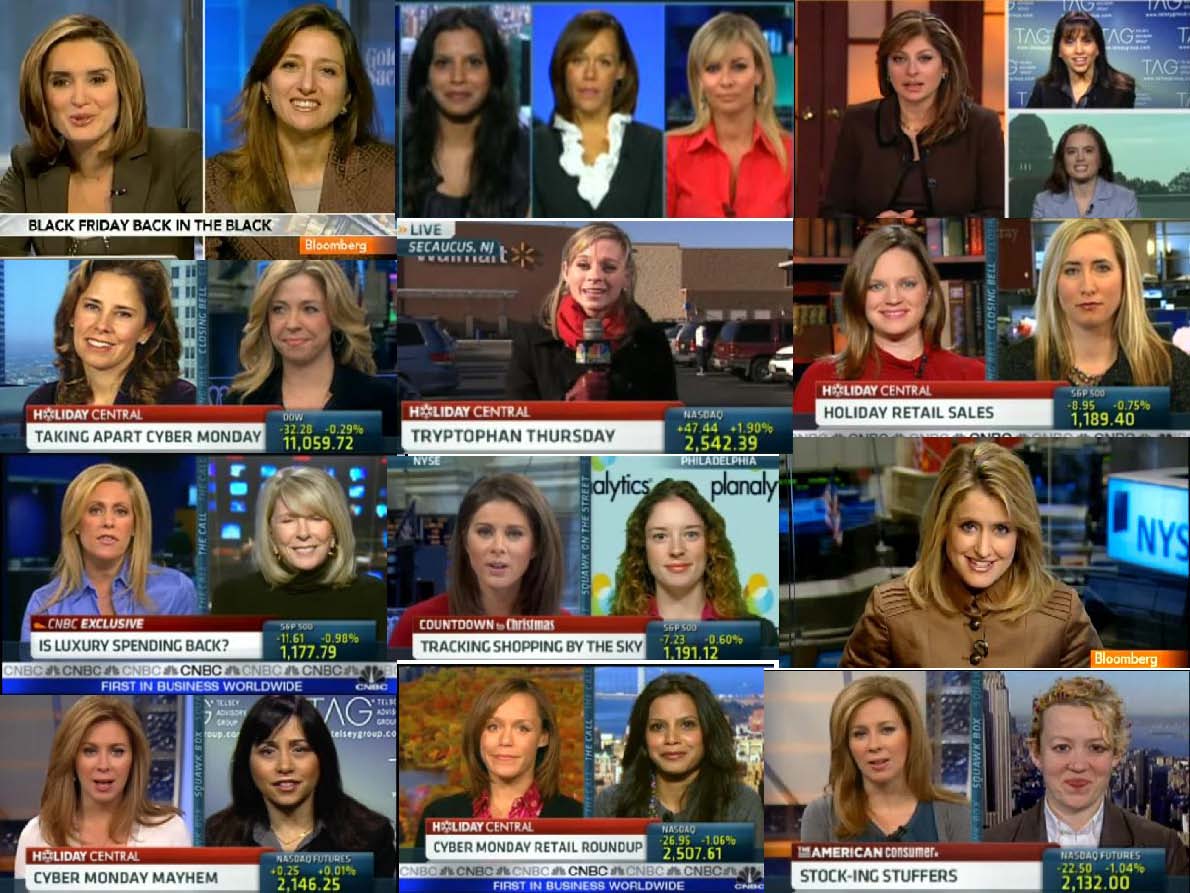
I’m not sure if you are like me, but the annual media ritual of myopically breaking down the sale of every shoe, belt, cell phone, television, and pair of underwear during the November/December holiday season can become very grating. What makes it a little easier for me to swallow is the stable of attractive female retail analysts who are finally unleashed from their long hibernation slumbers to review their mall traffic and parking satellite findings. I’m a happily married man, but I still cannot complain about seeing these multi-threat beauties dissect sales trends and fashion fads. However, in this day and age, I’m not so sure that females feel the same way about their under-representation in the finance field?
If there are 155.8 million females in the United States and 151.8 million males (Census Bureau: October 2009), then how come only 6% of hedge fund managers (BusinessWeek), 8% of venture capitalists, and 15% of investment bankers are female (Harvard Magazine)? Is the finance field just an ol’ boys network of chauvinist pig-headed males who only hire their own? Or do the severe time-demands of the field force females to opt-out of the industry due to family priorities?
Although I’m sure family choices and quality of life are factors that play into the decision of entering the demanding finance industry, from my experience I would argue women are notoriously underrepresented even at younger ages (well before family considerations would weigh into career decisions). Maybe cultural factors such as upbringing and education are other factors that make math-related jobs more appealing to men?
If underrepresentation in the finance field is not caused by female choice, then perhaps the male dominated industry is merely a function of more men opting into the field (i.e., men are better suited for the industry). More specifically, perhaps male brains are just wired differently? Some make the argument that all the testosterone permeating through male bodies leads them to positions involving more risk. If you look at other risk related fields like gambling, women too are dramatic minorities, making up about 1/3 of total compulsive gamblers.
Women Better than Men?
The funny part about the underrepresentation of females in finance is that one study actually shows female hedge fund managers outperforming their male counterparts. Here’s what a BusinessWeek article had to say about female hedge fund managers:
A new study by Hedge Fund Research found that, from January 2000 through May 31, 2009, hedge funds run by women delivered nearly double the investment performance of those managed by men. Female managers produced average annual returns of 9%, versus 5.82% for men and, in 2008, when financial markets were cratering, funds run by women were down 9.6%, compared with a 19% decline for men.
The article goes onto to theorize that women may not be afraid of risk, but actually are better able to manage risk. A UC Davis study found that male managers traded 45% more than female managers, thereby reducing returns by -2.65% (about 1% more than females).
Regardless of the theories or studies used to explain gender risk appetite, the relative underrepresentation of females in finance is a fact. I’ll let everyone else weigh in why that is the case, but in the meantime I will enjoy watching the female analysts explain the minute by minute account of UGG and iPad sales through the holiday shopping season.
Wade W. Slome, CFA, CFP®
Plan. Invest. Prosper.
Related Articles:
BusinessWeek article on female fund managers
Bashful Path to Female Bankruptcies
DISCLOSURE: Sidoxia Capital Management (SCM) and some of its clients own certain exchange traded funds and AAPL, but at the time of publishing SCM had no direct position in DECK or any other security referenced in this article. No information accessed through the Investing Caffeine (IC) website constitutes investment, financial, legal, tax or other advice nor is to be relied on in making an investment or other decision. Please read disclosure language on IC “Contact” page.
Another Year, Another Decade

Wade W. Slome, CFA, CFP®
Plan. Invest. Prosper.
DISCLOSURE: Sidoxia Capital Management (SCM) and some of its clients own certain exchange traded funds, but at the time of publishing SCM had no direct position in any other security referenced in this article. No information accessed through the Investing Caffeine (IC) website constitutes investment, financial, legal, tax or other advice nor is to be relied on in making an investment or other decision. Please read disclosure language on IC “Contact” page.
Waiting for the Hundred Minute Flood

Investors have been scarred over the last decade and many retirees have seen massive setbacks to their retirement plans. We have witnessed the proverbial “100 year flood” twice in the 2000s in the shape of a bursting technology and credit bubble in 2000 and 2008, respectively. The instantaneous transmission of data around the globe, facilitated by 24/7 news cycles and non-stop internet access, has only accelerated investor panic attacks – the 100 year flood is now expected every 100 minutes.
If drowning in the 100 year flood of events surrounding Bear Stearns, Lehman Brothers, Washington Mutual, AIG, Fannie Mae, Freddie Mac, TARP bank bailouts, Bernie Madoff’s Ponzi scheme, and Eliot Spitzer’s prostitute appreciation activities were not enough in 2008, investors (and many bearish bloggers) have been left facing the challenge of reconciling an +80% move in the S&P 500 index and +100% move in the NASDAQ index with the following outcomes (through the bulk of 2009 and 2010):
- Flash crash, high frequency traders, and “dark pools”
- GM and Chrysler’s bankruptcies
- Dubai debt crisis
- Goldman Sachs – John Paulson hearings
- Tiger Woods cheating scandal
- Greece bailout
- BP oil spill
- Healthcare reform
- China real estate bubble concerns
- Congressional leadership changes
- European austerity riots
- North Korea – South Korea provocations
- Insider trading raids
- Ireland bailout
- Next: ?????
With all this dreadful news, how in the heck have the equity markets about doubled from the lows of last year? The “Zombie Bears,” as Barry Ritholtz at The Big Picture has affectionately coined, would have you believe this is merely a dead-cat bounce in a longer-term bear-market. Never mind the five consecutive quarters of GDP growth, the 10 consecutive months of private job creation, or the record 2010 projected profits, the Zombie Bears attribute this fleeting rebound to temporary stimulus, short-term inventory rebuild, and unsustainable printing press activity by Federal Reserve Chairman Ben Bernanke.
Perhaps the Zombie Bears will change their mind once the markets advance another 25-30%? Regardless of the market action, individual investors have taken the pessimism bait and continue to hide in their caves. This strategy makes sense for wealthy retirees with adequate resources, but for the vast majority of Americans, earning next to nothing on their nest egg in cash and overpriced Treasuries isn’t going to help much in achieving your retirement goals. Unless of course, you like working as a greeter at Wal-Mart in your 80s and eating mac & cheese for breakfast, lunch, and dinner.
This Time is Different
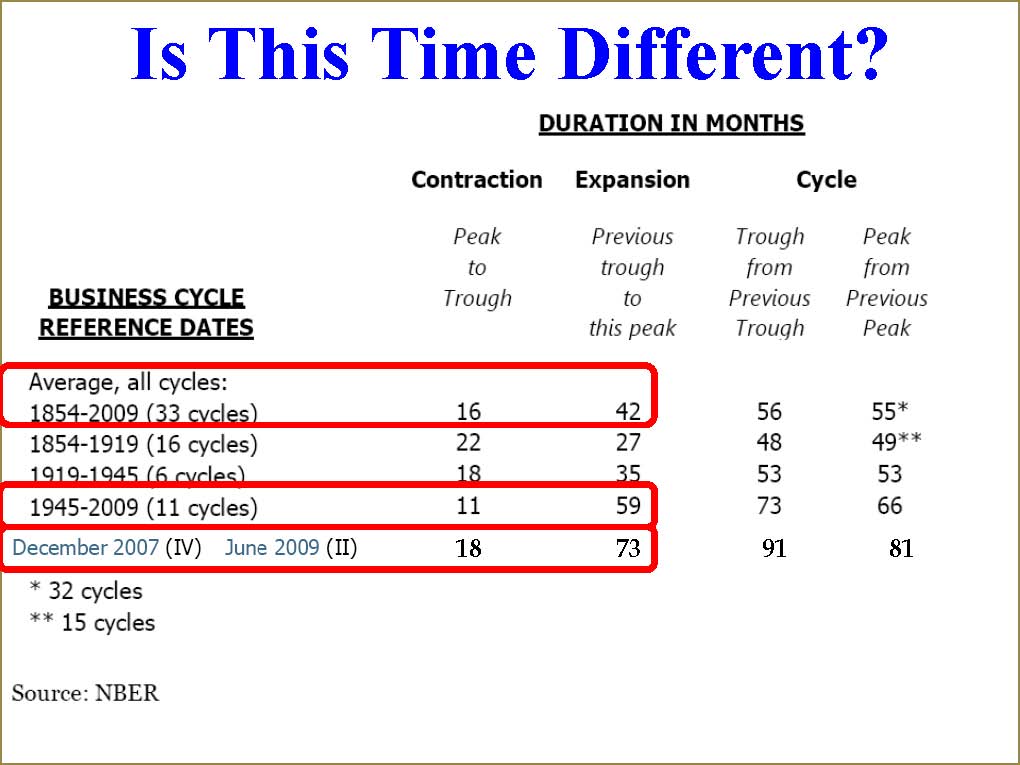
The Zombies would also have you believe this time is different, or in other words, historical economic cycles do not apply to the recent recession. I’ll stick with French novelist Alphonse Karr (1808-1890) who famously stated, “The more things change, the more things stay the same.”
As you can see from the data below, the recent recession lasted two months longer than the 16 month cycle average from 1854 – 2009. We have had 33 recessions and 33 recoveries, so I am going to go out on a limb and say this time will not be any different. Could we have a double dip recession? Sure, but odds are on our side for an average five year expansion, not the 18 month expansion experienced thus far.
The Grandma Sentiment Indicator
I love all these sentiment indicators, surveys, and various ratios that constantly get thrown around the blogosphere because it is never difficult to choose one matching a specific investment thesis. Strategists urge us to follow the actions of the “smart money” and do the opposite (like George Costanza) when looking at the “dumb money” indicators. The bears would also have you believe the world is coming to an end if you look at the current put/call data (see Smart Money Prepares for Sell Off). Instead, I choose to listen to my grandma, who has wisely reminded me that actions speak louder than words. Right now, those actions are screaming pure, unadulterated fear – a positive contrarian dynamic.
Over the last few years there has been more than $250 billion in equity outflows according to data from the Investment Company Institute (ICI). Bond funds on the other hand have taken in an unprecedented $376 billion in 2009 and about another $216 billion in 2010 through August.
As investment guru Sir John Templeton famously stated, “Bull markets are born on pessimism and they grow on skepticism, mature on optimism, and die on euphoria.” Judging by the asset outflows, I would say we haven’t quite reached the euphoria phase quite yet. I won’t complain though because the more fear out there, the more opportunity for me and my investors.
As I have consistently stated, I have no clue what equity markets are going to do over the next six to twelve months, nor does my bottom-up philosophy rely upon making market forecasts to succeed. Evaluating investor sentiment and timing economic cycles are difficult skills to master, but judging by the panicked actions and bond heavy asset inflows, investors are nervously awaiting another 100 year flood to occur in the next hundred minutes.
Wade W. Slome, CFA, CFP®
Plan. Invest. Prosper.
DISCLOSURE: Sidoxia Capital Management (SCM) and some of its clients own certain exchange traded funds, WMT, and AIG derivative security, but at the time of publishing SCM had no direct position in Bear Stearns, Lehman Brothers, JPM, Washington Mutual, Fannie Mae, Freddie Mac, GS, BP, GM, Chrysler, and any other security referenced in this article. No information accessed through the Investing Caffeine (IC) website constitutes investment, financial, legal, tax or other advice nor is to be relied on in making an investment or other decision. Please read disclosure language on IC “Contact” page.
Insider Trading Interview with Sidoxia Capital Management
I am recovering from one too many servings of turkey and pumpkin pie, so perhaps you can enjoy an interview I conducted with CNBC’s Erin Burnett on the subject of insider trading earlier this week (Minute 2:00).
Once I awake from the food-induced coma, I promise to return with a more typical article on Investing Caffeine’s site.
I hope everyone had a wonderful holiday…
Wade W. Slome, CFA, CFP®
Plan. Invest. Prosper.
DISCLOSURE: Sidoxia Capital Management (SCM) and some of its clients own certain exchange traded funds, but at the time of publishing SCM had no direct position in any other security referenced in this article. No information accessed through the Investing Caffeine (IC) website constitutes investment, financial, legal, tax or other advice nor is to be relied on in making an investment or other decision. Please read disclosure language on IC “Contact” page.
Shrewd Research or Bilking the System?

Information is power and some hedge funds, mutual funds, and investment managers will go to great lengths to obtain the lowdown.
Integrity of the financial markets is key and recently several hedge funds (Level Global Investors LP, Diamondback Capital Management LLC and Loch Capital Management LLC) have been raided by the Federal Bureau of Investigation (FBI). Other large investment players, including SAC Capital Advisors, Janus Capital Group Inc. (JNS) and Wellington Management Co. have also received inquiries as part of what some journalists are calling rampant industry insider trading activity. Even investment bank Goldman Sachs (GS) is allegedly being examined for potential unlawful leakage of merger information. Little is known about the allegations, so it is difficult to decipher whether this is the tip of the iceberg or standard investigative work?
Regardless of the scope of the investigation, there is a fine line between what scoop is considered fair versus illegal. The distinction becomes even more difficult to pinpoint with the evolution of faster and more voluminous trading (i.e., high frequency trading). The internet has accelerated the speed of information transfer faster than a politician’s promise to cut spending. Data is chewed up and spit out so quickly, meaning tradable information has a very short shelf life before it is profitably exploited by someone. In the old days of snail mail and private back-office meetings, security prices would require time for information to be completely reflected.
Expert Networks Questioned
Another ingredient introduced over the last decade is the advent of the “expert network,” which are firms that connect fund managers to industry specialists, in many cases as part of a “channel check” to gauge the health of a particular industry. About 10 years ago Regulation FD (Fair Disclosure) was introduced to prevent selective disclosure of “material non-public” information (tips that will likely cause security prices to go significantly up or down) by senior company officials and investor relation professionals to investor types. Greedy (and/or ingenious) institutional investors are Darwinian and as a result figured out a loophole around the system. Hedge funds and other investment managers figured out if the senior executives won’t cough up the good info, then why not target the junior executives and squeeze the inside story from them like informants? Expert networks (read thorough description here) serve as an informational channel to service this demand. Although I’m sure there have been a minority of cases where mid-level managers or junior executives have leaked material information (intentionally or unintentionally), I’m very confident that it is the exception more than the rule. In many instances when the beans were spilled, Regulation FD protects both the person disseminating the information and the investor receiving the information.
Rigged Game for Individuals?
OK sure…hedge funds and institutional managers may occasionally have privileged access to executive teams and can afford access to industry experts. I should know, since I managed a multi-billion fund and consistently had access to the upper rank of corporate executives. Hearing directly from the horse’s mouth and trying to interpret body language can provide insights and instill confidence in a trade, but these executives are not stupid enough to risk prison time by selectively disclosing material non-public information. This dynamic of privileged access will never change as long as CEOs and CFOs are allowed to communicate with investors. Corporate executives will naturally prioritize their limited investor communications towards the larger players.
So with the big-wig managers gaining access to the big-wig executives, has the game become rigged for the individual investors? The short answer is “no.” Over the last decade individual investors have experienced a tremendous leveling of the playing field versus institutional investors. While institutions have privileged access and have pushed to exploit HFT and expert networks, individual investors have gained access to institutional quality research (e.g., SEC filings, real-time conference calls, Wall Street reports, etc.) for free or affordable prices. With the ubiquity of technology and the internet, I only see that gap narrowing more over time.
There will always be cheaters who stretch themselves beyond legal boundaries and should be prosecuted to the full extent of the law. However, for the vast majority of institutional investors, they are using technology and other tools (i.e., expert networks) as shrewd resources to compete in a difficult game. I will reserve full judgment on the names pasted all over the press until the FBI and SEC reveal all their cards. So far there appears to be more noise than smoke coming from the barrel tip of the insider trading gun.
Wade W. Slome, CFA, CFP®
Plan. Invest. Prosper.
DISCLOSURE: Sidoxia Capital Management (SCM) and some of its clients own certain exchange traded funds, but at the time of publishing SCM had no direct position in GS, SAC Capital Advisors, Janus Capital Group Inc. (JNS), Wellington Management Co., or any other security referenced in this article. No information accessed through the Investing Caffeine (IC) website constitutes investment, financial, legal, tax or other advice nor is to be relied on in making an investment or other decision. Please read disclosure language on IC “Contact” page.
The Impoverished Global Babysitter

I don’t mind being a babysitter for the world, as long as I get paid for it. Unfortunately, not only are we paying to be the nation’s global defense babysitter, but we are also paying for the protection responsibility with unsustainable borrowings.
I don’t want to be a cold-hearted neighbor to our friends and allies, but it is all a matter of degree. Collecting a vacationing neighbor’s newspaper and mail, and watching for any potential suspicious activity is all part of being a conscientious, dependable neighbor, but where do you draw the line? As a good neighbor, should I also be responsible for paying for and installing a security system on their premises? Or how about getting my 16 year old nephew to spend the night at my neighbor’s because of some scary noises heard during the previous night?
For politicians to say we need to cut spending but defense spending is off the table is hypocritical. Bruce Bartlett, columnist at The Fiscal Time, had this to say on the subject:
“No one is saying the defense budget is the sole source of the deficit, but the fact is that it has risen from 3 percent of the gross domestic product in fiscal year 2001 to 4.7 percent this year. That additional 1.7 percent of GDP amounts to $250 billion in spending — almost 20 percent of this year’s budget deficit. And according to a recent Congressional Research Service report, the cost of wars in Iraq and Afghanistan alone accounted for 23 percent of the combined budget deficits between fiscal years 2003 and 2010.”
Even the government should have learned one of the prime lessons from the 2008-2009 financial crisis: tough times require the necessity to do more with less. Whether you are talking about a large corporation like $173 billion valued General Electric (GE), a small mom-and-pop coffee shop, or a middle-class family of four, the moral of the story is bad things eventually happen to individuals, corporations, and governments that live beyond their means. The crisis was exacerbated by excessive borrowing to achieve the higher standard of living and operations.
New Heightened Sensibility?
The initial deficit reduction proposals crafted by the bipartisan commission headed by Erskine Bowles and Alan Simpson should be lauded, regardless of how much Congress decides to dilute the $4 trillion in budget cuts over the next 10 years. The plan may not garner votes for politicians, but these types of necessary cuts will place our country on firmer ground and provide a more sustainable path to prosperity. More specifically, the plan would bring the federal budget deficit down to 2.2% of GDP (Gross Domestic Product) by 2015 and reduce the country’s debt to 60% of GDP by 2024.
Building Flying Rolls Royces
Bowles and Simpson appear to get it, but our bloated government doesn’t seem to understand. If I were running an unprofitable company with a lot of debt, would it be a good idea to develop a new flying Rolls Royce car fleet (with questionable utility) for my employees? Common fiscal sense would dictate the answer to be “NO.”
Regrettably our government has answered “yes” by building a ridiculously costly flying Rolls Royce fleet of its own under the name of Joint Strike Fighter (the F-35 program from Lockheed Martin Corp. [LMT]). This absurdly priced program – the costliest in our country’s history – is projected to cost up to $382 billion for 2,443 aircraft over the next two decades (Reuters). This translates into a whopping $156 million per aircraft. Cost overruns have already come in 40-90% higher than expected over the last nine years, and the price tag continues to rise. The state of the art jet program is touted as a Swiss army knife (flexibility to be used by all three branches of the military), but may actually turn out to be a butter knife due to the program’s questioned utility (see great PBS video here).
So like any company, individual, or government, there is something called prioritization. By cutting fat in less critical areas, a portion of those savings can be redeployed to INCREASE spending in the areas that matter. I won’t wade into the relative merits (or lack thereof) related to Afghanistan and Iraq expenditures or appropriate troop levels, but suffice it to say, I’m certain spending can be cut in many areas to make room for our country’s primary defense priorities.
I’m no defense expert but when faced to deal with a murky, inconspicuous issue of terrorism (cave dwelling insurgents and bomb-making sleeper cells), intelligence collection and international coordination make more sense than building $150 million flying Rolls Royces, which are better suited for fighting an obsolete cold war than finding terrorist needles in a global haystack.
Crotch Costs
Layer on the new TSA passenger flight costs associated with crotch fondling pat downs and the costs related to buying miniaturized shampoo and gel containers, one wonders if tax-payer money can be more efficiently spent. For what it’s worth, the FDA has approved the latest body scanning machines with no health concerns, so if an airport worker gets his/her jollies by ogling an overweight out of shape passenger like me, then so be it. The fact of the matter is that estimates show 99% of passengers choose the innocuous body scan, which displays a white, ghost-like naked computer image to the agent. For those worried about self image issues or privacy concerns, perhaps the airports can set up a meet-and-greet room option for passengers to become better acquainted with the agent before passing through the scanner.
Freeloaders Cutting Spend
Source: The Financial Times
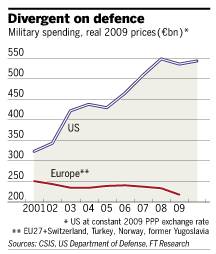
Domestic defense spending cuts become especially touchy when discussed in concert with European spending reductions. Take for example German plans to slash $10.7 billion in defense spending by 2014 and British spending cuts of 10% to 20% (around $6 – $12 billion). Europeans are labeled by Americans as socialists because of their lengthy paid vacations, maternity leaves, and generous healthcare benefits. More power to them and I desire all those things for myself and my family too, but I just don’t want my taxes to pay for others’ benefits when our country cannot afford those same wonderful benefits for ourselves.
While our Defense Secretary, Robert Gates, has been talking a good game with respect to a $100 billion in savings cuts, these cuts should be put in the context of a $567 billion budget for 2011 and a $700 billion estimated 2015 budget. As it turns out, these $100 billion in cuts are not cuts at all – Gates is also talking out of the other side of his mouth by saying he wants to continue increasing overall defense spending.
Is the size of spending appropriate? According to SIPRI, an independent international research institute, the U.S. defense budget accounts for 54% of the world’s total military spending, when our population only represents less than 5% of the world’s total. If that is not a disproportionate subsidy to the rest of the world, then I do not know what one is? The real longer term threat is not Iran or North Korea, but rather China. I’ll go out on a limb and say we can probably hold our own for a while, considering China is still only spending about 15% of what we spend on defense.
As I stated earlier, it is more important than ever to do more with less. Corporations are clearly doing that now by cutting spending, while still able to create record profits. The government has to get on board with trimming fat in all areas of our government…including defense. Coordinating intelligence and combining resources across the globe is crucial if we want to get more bang for our buck, while still devoting adequate resources to fend off the real and immediate evil threats of terrorism. Babysitting is an important duty and responsibility, but as impoverished Americans we are not capable of providing that service to the whole world free of charge.
Wade W. Slome, CFA, CFP®
Plan. Invest. Prosper.
DISCLOSURE: Sidoxia Capital Management (SCM) and some of its clients own certain exchange traded funds, but at the time of publishing SCM had no direct position in GE, LMT, Rolls Royce, or any other security referenced in this article. No information accessed through the Investing Caffeine (IC) website constitutes investment, financial, legal, tax or other advice nor is to be relied on in making an investment or other decision. Please read disclosure language on IC “Contact” page.
The Internet: The Fourth Necessity

The basic necessities for human life are food, water, shelter and most importantly…the internet. Imagine a world where you cannot: access your email; text your spouse or significant other in the same house; Twitter the contents of your lunch; or Facebook a YouTube video of a dancing meringue dog (see video). Scary thought.
Many people take the internet for granted, just like the air we breathe, but how important a role does the internet play in people’s lives? Mary Meeker, internet analyst from Morgan Stanley, takes a look at this question in a recently released presentation she completed. Earlier in the decade, Meeker was raked over the coals during the deflation of the internet bubble, but in many respects she has been redeemed in the subsequent years as hundreds of millions of people continue to plug into the internet.
According to the broad base of expert strategists, we apparently are living in an overvalued, “New Normal ” market with subdued growth for as far as the eye can see (check out New Abnormal). In the mean time Meeker shows how the top 15 global internet franchises have nearly quadrupled revenue from $33 billion in 2004 to $126 billion today. Perhaps abnormally outsized opportunities in the corporate internet universe will be the “New Normal” over the coming years?
Internet Ubiquity

Source: Morgan Stanley
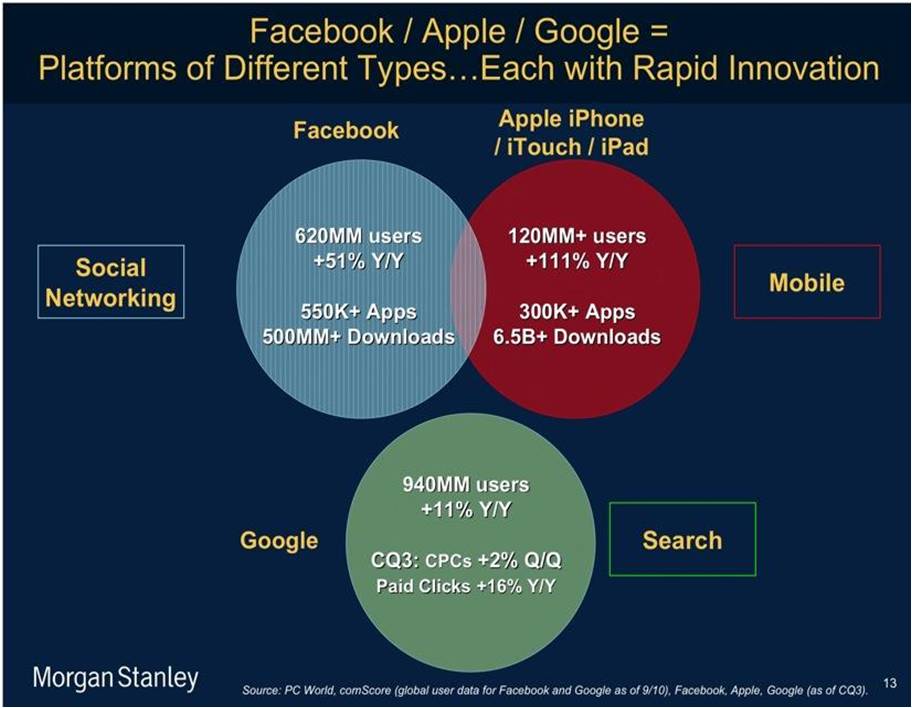
How ubiquitous is the internet becoming? Last year 1.8 billion people accessed this invisible global flattening medium we like to call the internet, and users spent 18.8 trillion minutes online, up +21% over the previous year. Many people are very familiar with the home-bred internet franchises of Facebook (620 million users), Google (940 million users), and Apple (120 million internet device users), but many investors under-appreciate the global scale of international internet franchises like Tencent (637 million users…more than Facebook by the way), Baidu ($40 billion market value), or Alibaba.com ($10 billion market value).
Source: Morgan Stanley
Mobile ubiquity is on the rise too. Connecting through a desktop or laptop is not enough these days, so internet addicts are increasingly attaching a mobile phone umbilical cord for such useful bathroom applications such as this (click here). Lugging a laptop around all over the place can be an inconvenience. So primal is the mobile instinct among internet users, Morgan Stanley expects mobile phone shipments to surpass PC and laptop shipments over the next 24 months.
What’s Next?
The party is just getting started. If you just consider eCommerce (purchases online), which only accounts for 4% of total commerce conducted in the U.S., then there is a lot of headroom for internet purchases to expand. The incredible potential rings true especially if you contemplate old traditional catalog, which peaked at more than 10% of overall commerce according to some industry executives. The rich feature functionality afforded to users through the internet, coupled with the increased convenience of mobility, augur well for future ecommerce sales growth.
The internet has been around for 15 years, but in the whole scheme of things this transformative medium is just a baby – especially if you consider the amount of time it took other revolutions like electricity, the rail network, and automobile proliferation to spread. That is why it is not too late to join the internet party. Food, water, and shelter are human necessities of life, just like exposure to the internet revolution is a necessity for your investment portfolio.
Read the Morgan Stanley Internet Presentation by Mary Meeker
Wade W. Slome, CFA, CFP®
Plan. Invest. Prosper.
DISCLOSURE: Sidoxia Capital Management (SCM) and some of its clients own certain exchange traded funds, AAPL and GOOG, but at the time of publishing SCM had no direct position in MS, BIDU, Tencent, Alibaba.com, Facebook, Twitter, or any other security referenced in this article. No information accessed through the Investing Caffeine (IC) website constitutes investment, financial, legal, tax or other advice nor is to be relied on in making an investment or other decision. Please read disclosure language on IC “Contact” page.
The Cyclical Seasons of Growth and Value

Continually the airwaves rotate through the growth and value managers du jour, and like religious zealots each one explains their philosophy with such confidence that Jersey Shore’s “The Situation” would even call them cocky. The fact of the matter is that styles go in and out of favor like the seasons of the year. What’s more, the consistency of the seasons is erratic and the duration of the style outperformance can in many instances extend for years. A major driver behind the relative outperformance of styles links back to where we stand in the economic cycle. Since these phases can last for years, meticulous precision is not required.
Case in point, take the “Go-Go” 1990s. In the back half of the decade, while the “New Economy” of technology companies propelled GDP to new heights, growth stocks witnessed historic price appreciation and P/E (Price-Earnings) multiple expansion. As members of our growth team high-fived each other on a daily basis, the “Four Horsemen” consistently jumped 2-3% like clockwork. Simultaneously, human resources had to keep sharp objects away from our value team colleagues and make sure the windows were locked shut. As you can see from the chart, growth stocks trounced value stocks during that period.

Source: INGdelivers.com
Karma can be a bi*ch however, because as the technology bubble burst in 2000, the coiled underperforming value stocks sprang to significant outperformance in the first half of the 2000s. The value managers were more than happy to hand over the straightjackets to us growth managers.
Since these style cycles can persist for long periods of time, and we managers get compensated based on performance versus peers, there is a strong incentive to cheat or style drift towards the outperforming style (see also Hail Mary Investing).
The pain threshold is increasing for value managers as the economic expansion matures and growth stocks have handily outperformed value stocks over the last five years. When value managers start piling into Apple Inc. (AAPL), maybe the value cycle will be ready to kick into gear again.

Growth consistently outperforming value (Source: Russell Investments)
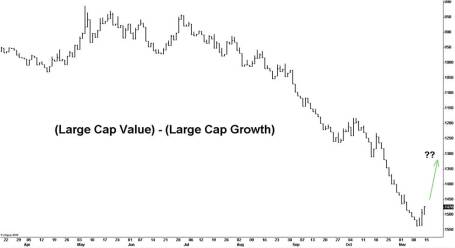
- Source: Dynamic Hedge – Is value on the comeback trail?

Arbitrary Style Buckets
Understanding the dynamics of style outperformance cycles is important, but understanding how the sausage is made at the micro level is essential too. One must appreciate that style categorizations are determined by arbitrary criteria by self-anointed “bucket deciders” (i.e., S&P, Barra, Russell Investments). Like ping pong balls, individual stocks will bounce around from one style bucket to the other based largely on share price volatility and financial metrics such as Price/Book, Price/Earnings, and EPS growth. Regrettably, these metrics can become temporarily distorted and lead to irrational trading patterns for benchmark hugging managers that become myopically focused on minor deviations from the herd.
Based on the stock bucket decision criteria, some questionable head-scratching stock categorizations may occur. For examples International Business Machines (IBM) is classified as a growth stock in the Russell 1000 Growth Index despite a cheap forward 11x P/E multiple, meager 3% revenue growth, and a 2% dividend. Phillip Morris Intl (PM) is also considered a growth stock even though its revenue growth has recently been even more sluggish at 2%, and has a mouth watering value-like dividend of 4.4%.
On the flip side, stocks like Microsoft Corp. (MSFT) are thrown in the value bucket, although the software king grew revenues +25% and earnings +55% in the recent quarter. Iconic value stock Berkshire Hathaway (BRKA/B) follows many growth stocks by not paying a dividend, and the Buffett controlled entity trades at a sky-high trailing P/E multiple of 20x, and ironically expanded sales and earnings by +21% and +28%, respectively.
All this talk of style seasons and bucket hopping only highlights the boring but crucial principle of diversification. It’s important to understand these cycles and categorizations, especially at extremes, but this does not get rid of the fact that an overly concentrated portfolio concentrated in an outperforming style is setting itself up for failure (see also Riding the Wave). We’ve reviewed cycle dynamics surrounding investment styles, but these varied securities come in all shapes and sizes – we will tackle the relative performance forces of small, mid, and large capitalization stocks during another season.
Wade W. Slome, CFA, CFP®
Plan. Invest. Prosper.
DISCLOSURE: Sidoxia Capital Management (SCM) and some of its clients own certain exchange traded funds, AAPL and CSCO, but at the time of publishing SCM had no direct position in ORCL, EMC, IBM, PM, MSFT, BRKA/B, or any other security referenced in this article. No information accessed through the Investing Caffeine (IC) website constitutes investment, financial, legal, tax or other advice nor is to be relied on in making an investment or other decision. Please read disclosure language on IC “Contact” page.




 Investing Caffeine
