My 10 Holiday Thank You’s of 2010

Source: Photobucket
10.) I am thankful for “QE2” (Quantitative Easing) because it broadens my thesaurus with another acronym meaning “printing press.”
9.) I am thankful for the Goldilocks “-flation” fears. Not too hot inflation and not too cold deflation makes Goldy feel just right.
8.) I am thankful for weak housing prices. Who wants to pay high property taxes?!
7.) I’m thankful to have another bloody, partisan midterm election behind us resulting in gridlock. Oops, I forgot, we just started a bloody, partisan 2012 Presidential election cycle.
6.) I am thankful for May’s “Flash Crash” because I’m an adrenaline junkie and the financial crisis did not provide enough excitement in 2008-2009.
5.) I am thankful for the Irish banking system bailout. Misery loves company.
4.) I am thankful for higher commodity prices, specifically my long wheat futures position. I’ve effectively hedged my daily breakfast bowl of Wheaties.
3.) I am thankful for the Chinese…for supporting our gluttonous consumerism by purchasing all our debt.
2.) I am thankful for a record year at Sidoxia. The launch and leading performance of Fusion added to a memorable 2010 (read more).
1.) I am thankful for the thousands of readers and followers who stopped by my site in 2010. Not only were the compliments appreciated by the die-hards (“Caffeiners”), but also the constructive feedback from casual visitors (i.e., “Slome, you’re a moron”).
Happy New Year and best wishes for a prosperous 2011!
Wade W. Slome, CFA, CFP®
Plan. Invest. Prosper.
DISCLOSURE: Sidoxia Capital Management (SCM) and some of its clients own certain exchange traded funds, but at the time of publishing SCM had no direct position in BP, wheat futures, or any security referenced in this article. No information accessed through the Investing Caffeine (IC) website constitutes investment, financial, legal, tax or other advice nor is to be relied on in making an investment or other decision. Please read disclosure language on IC “Contact” page.
Investor Wake-Up Call

Source: Photobucket
The Pre Wake-Up Conversation

“Hey Milfred, did you see our brokerage statement? There must be a misprint. It says our portfolio of bonds is down.”

“Buford, how can that be, when our bond portfolio has been up for 30 consecutive years? I hear Jim Bernanke is trying to artificially inflate the economy by printing money and using it to buy bonds.”
“Sweetheart, you got it wrong…it’s Ben Jernanke.”
“Ohhh, yeah honey, you’re right. I never expected prices to go down after government bond yields were up almost 50% in a few months.”
“Sweetie, maybe we should give our broker a call?”
“Oh you mean Skip? I think he wants us to call him a financial consultant or financial advisor now…not a broker.”
“Well anyway, I just read the largest fund manager in the world, Bill Gross, is trying to convert his bond fund into a stock fund (read article). I can’t imagine why Mr. Gross would want to do that (see PIMCO article), but maybe Skip knows? You know, after Skip sold us that high commission annuity and Class-A mutual fund with that 6.25% load, he decided to take his wife, kids, parents, and in-laws to Tahiti for the holidays.”
“Oh I know, Skip is such a nice young man, and so thoughtful.”
“You’re right Pumpkin, I just wish we could hear from him more than once every two years.”
“That’s right Snookum, but at least we get to talk to him when he drops off the paperwork, and his secretary is sure nice.”
“What I really like about Skip is that he always makes so much common sense – he always tells us to buy investments that have already done really well like bonds and gold.”
“Exactly Buford. I just wonder how much longer it will take for stocks to become popular again, given the stock market is already up about 100% from the beginning of 2009? Perhaps with another +30% or so, maybe Skip will switch all our money out of bonds back into stocks?”
“What I love even more about Skip is that not only does he have us buy the popular investments, but he really protects us from buying the low-priced investments that are selling at bargain prices.”
“I hear you Muffin – come to think of it, maybe I should return that sweater I recently purchased at Marshall’s for 50% off – there may be an awful reason I do not know about.”
“Good idea Sweet Pea. The other thing I love about Skip is that he is so knowledgeable…he says the exact same thing I hear from those smart news people on TV. Good thing we have a reliable professional to protect our entire life savings.”
“You’re right as usual dear. He may only have a high school GED, but we’re lucky he has these fancy letters behind his name that I never heard of like PFS, AFC, and RFC… those must be some important credentials.”
“I feel better after our conversation. Maybe we’ll hear from Skip, and if not, I’m sure he’ll drop-off some paperwork for a new investment, if our portfolio goes down by another 10%.”
The Wake-Up Reality
I make some of these comments with tongue firmly in cheek, but the fact remains we live in a financial world with a structurally flawed system of loosely regulated, banks, brokerage firms, insurance companies, ratings agencies, hedge funds, mutual funds, and other financial institutions that continue to repeatedly place their interests ahead of clients. If the 2008-2009 financial crisis hasn’t taught you anything, then you should realize it behooves you to take control of your financial situation. At least ask tough questions that result in answers you can understand – not a lot of technical mumbo-jumbo that makes an advisor sound smart. Make life easier on yourself and have a blunt wake-up call conversation, otherwise grab a pen and get ready for Skip’s call – he’s about to come over with some more paperwork.
Related articles:
Beating off the Financial Sharks
Fees, Exploitation and Confusion Hammer Investors
Investment Credentials: The Letter Shell Game
Wade W. Slome, CFA, CFP®
Plan. Invest. Prosper.
DISCLOSURE: Sidoxia Capital Management (SCM) and some of its clients own certain exchange traded funds, but at the time of publishing SCM had no direct position in TJX, or any security referenced in this article. No information accessed through the Investing Caffeine (IC) website constitutes investment, financial, legal, tax or other advice nor is to be relied on in making an investment or other decision. Please read disclosure language on IC “Contact” page.
Invisible Costs of Trading

Source: Photobucket
You can feel them, but you can’t see them. I’m talking about invisible trading costs. Although some single transaction trading costs can run as high as hundreds of dollars at the large brokerage firms, investors are generally aware of the bottom-basement commissions paid on trades executed at discount brokerage firms like Scottrade, TD Ameritrade (AMTD), E-Trade (ETFC), and Charles Schwab (SCHW) – generally less than $10 per trade. Unfortunately, these commissions are estimated to only account for 20% of total trading costs1. What most investors are unaware of are the host of invisible trading costs and expenses associated with active trading.
Here are some of the invisible costs:
Bid-Ask Spread: Besides the explicit commissions charged, traders must incur the implicit costs of the bid-ask spread. Let’s suppose you have a stock trading at $12.50 per share (ask price) and $12.25 per share (bid price). If you were to immediately buy one share for $12.50 (ask) and sell immediately for $12.25 (ask), then you would be -2% in the hole instantly – more than double the $7.95 commission paid on a $1,000 investment. Effectively, the investor would already be down about -3% the instant the small investment was made.
Impact Costs: The issue of impact costs is a bigger problem for larger institutional investors, although thinly traded stocks (those securities with relatively small trading volume) can even become expensive for retail investors. Suppose the same stock mentioned previously initially traded at $12.50 per share before you transacted, but reached $13.00 per share upon completion (with an average $12.75 price paid). The $.25 cent increase (average price minus initial price) translates into another -2% increase in the costs.
Taxes: It’s not what you make that matters, but rather what you keep that makes the difference. If you make a decent amount of money actively trading, but end up giving Uncle Sam more than potentially 40% of the gains, then your bank account may grow less than expected.
While my examples may shed some light on the costs of trading, an in-depth study using data from Morningstar and NYSE was conducted by three astute professors (Roger Edelen [University of California, Davis], Richard Evans [University of Virginia], and Gregory Kadlec [Virginia Polytechnic Institute]) showing that an average fund’s annual trading costs were estimated to be 1.44%, higher than an average fund’s overall expense ratio of 1.21%.
Unfortunately from an investor’s standpoint, as much as 30% of all trading costs can be attributed to money naturally pouring in and out of funds, due to fund share purchases and redemptions. Therefore, wildly popular or out-of-favor funds will have a detrimental impact on performance. I know firsthand the costs of managing a large fund, much like captaining a supertanker – you create a lot of waves and it can take a while to change directions. Smaller funds, however, can navigate trades more nimbly, much like a speedboat leaving behind smaller cost waves in its wake.
Style can also have an impact on trading costs. Value-based funds that sell into strength or buy into weakness can be considered liquidity providers, and therefore will experience lower trading costs. On the flip side, momentum strategies effectively pour gasoline on hot stocks purchases and pile on damaging sales to cratering losers.
Emotional Costs of Trading
More impactful, but more difficult to quantify, are the emotional trading costs of greed and fear (i.e., chasing extended winners out of greed and panicking out of losing positions due to fear). Constantly hounding winners and capitulating your losers may work in a few instances, but can lead to disastrous results in the long-run. Even if an investor is correct on the sale of a security, the investor must also be right on the subsequent buy transaction (no easy feat).
With that said, there are no hard and fast rules when buying/selling stocks. Buying a stock that has doubled or tripled in and of itself is not necessarily a bad idea, as long as you have credible assumptions and data to support adequate earnings/cash flow growth and/or multiple expansion. Consistent with that thought process, a plummeting stock is not reason enough to buy, and does not automatically mean the price will subsequently rebound. Reversion to the mean can be a powerful force in security selection, but you need a disciplined process to underpin those investment decisions.
Spiritual Savings
As I have stated in the past, investing is like a religion (read more Investing Religion). Most investors stubbornly believe their financial religion is the right way to make money. I personally believe there is more than one way to make money, just as I believe different religions can coexist to achieve their spiritual goals. Through academic research, and a lot of practical experience, my religion believes in the implementation of low-cost, tax efficient products and strategies used over longer-term time horizons. I use a blend of active and passive management that leverages my professional experience (see Sidoxia’s Fusion product), but I would fault nobody for pursuing a purely passive investment strategy. As John Bogle shows, and has proven with the financial success of his company Vanguard, passive investing by and large materially outperforms professional mutual fund managers (see Hammered Investors article).
Investing can be thrilling and exciting, but like a leaky faucet, the relatively small and apparently harmless list of trading costs have a way of collecting over the long-run before sinking long-term performance returns. Sure, there are some high-frequency traders that make a living by amassing a large sums of rebates for providing short-term liquidity, but for most investors, excessive exposure to invisible trading costs will lead to visible underperformance.
Read more about trading cost study here1
Wade W. Slome, CFA, CFP®
Plan. Invest. Prosper.
DISCLOSURE: Sidoxia Capital Management (SCM) and some of its clients own certain exchange traded funds (including Vanguard funds), but at the time of publishing SCM had no direct position in AMTD, ETFC, SCHW, Scottrade, MORN, or any other security referenced in this article. No information accessed through the Investing Caffeine (IC) website constitutes investment, financial, legal, tax or other advice nor is to be relied on in making an investment or other decision. Please read disclosure language on IC “Contact” page.
Eggs or Oatmeal: Binging on Over-Analysis
I about chuckled my way out of my chair when ESPN reminded me of the absurd over-analysis that takes place in the sports world (I can’t wait for the 8 hour pre-game show before the upcoming Super Bowl) through a 30-second, football commercial. Typically when sports analysts get together, the most irrelevant issues are scrutinized under a microscope. After endless wasted amounts of time, the viewer is generally left with lots of worthless information about an immaterial topic. In this particular video, San Diego NFL quarterback Phillip Rivers innocently asks Sunday Countdown football analysts Chris Berman, Mike Ditka, Keyshawn Johnson, Tom Jackson, and Cris Carter whether they would like some eggs or oatmeal for breakfast?
Mayhem ensues while the analysts breakdown everything from the pros of frittatas and brats to the cons of cholesterol and sauerkraut. After listening to all the jaw flapping, Phillip Rivers is left dejected, banging his head against the kitchen refrigerator. It is funny, I feel much the same way as Phillip Rivers does when I’m presented with same overkill analysis found plastered over the financial media and blogosphere.
Analysis of Over-Analysis
Just as I mock the excess analysis occurring in the financial world, I will move ahead and assess this same over-thinking (that’s what we bloggers do). If this much analysis takes place when examining simple options such as eggs vs. oatmeal, or AFC vs. NFC, just imagine the endless debate that arises when discussing the merits of investing in a simple, diversified domestic equity mutual fund. Sounds simple on paper, but if I want to be intellectually honest, I first need to compare this one fund versus the thousands of other equity fund offerings, not to mention the thousands of other ETFs (Exchange Traded Funds), bond funds, lifecycle funds, annuities, index funds, private equity funds, hedge funds, and other basket-related investment vehicles.
Mutual funds are only part of the investment game. We haven’t even scratched the surface of individual securities, futures, options, currencies, CDs, real estate, mortgage backed securities, or other derivatives.
The investment menu is virtually endless (see TMI – Too Much Information), and new options are created every day – many of which are indecipherable to large swaths of investors (including professionals).
Sidoxia’s Questions of Engagement
Not all analysis is psychobabble, but separating the wheat from the manure can be difficult. Before engaging in the never-ending over-analysis taking place in the financial world, answer these three questions:
1.) “Do I Care?” If the latest advance-decline statistics on the NYSE don’t tickle your fancy, or the latest “breaking news” headline on monthly pending home sales doesn’t float your boat, then maybe it’s time to do something more important like…absolutely anything else.
2.) “Do I Understand?” If conversation drifts towards complex currency swaptions comparing the Thai Baht against the Brazilian Real, then perhaps it’s time to leave the room.
3.) “Is This New News?” Not sure if you heard, but there’s this new shiny metal called gold, and it’s the cure-all for inflation, deflation, and any-flation (hyperbole for those not able to translate my written word sarcasm). The point being, ask yourself if the information you receive is valuable and actionable. Typically the best investment ideas are not discussed 24/7 over every media venue, but rather in the boring footnotes of an unread annual report.
Investing in the Stock Market
For individual securities it’s best to stick to your circle of competence with companies and industries you understand – masters like Peter Lynch and Warren Buffett appreciate this philosophy. Once you find an investment opportunity you understand, you need a way of appraising the value and gauging a company’s growth trajectory. As Charlie Munger and Warren Buffett have described, “value and growth are two sides of the same coin.” Cigar-butt investing solely using value-based metrics is not enough. Even value jock Warren Buffet appreciates the merit of a good business with sustainable expansion prospects. As a matter of fact, some of Buffett’s best performing stocks are considered the greatest growth stocks of all-time. If you cannot assign a price (or range), then you are merely playing the speculation game. Speculation often comes in the form of stock tips (i.e.,stock broker or Jim Cramer) and day trading (see Momentum Investing and Technical Analysis).
We live in a world of endless information, and the analysis can often become overkill. So when overwhelmed with data, do yourself a favor by asking yourself the three questions of engagement – that way you will not miss the forest for the trees. As for stocks, stick with industries and companies you understand and develop a disciplined investment process by appraising both the growth and valuation components of the investment. If making these decisions are too difficult, perhaps you should stay in the kitchen and have Phillip Rivers whip you up some scrambled eggs or serve you a bowl of oatmeal.
Wade W. Slome, CFA, CFP®
Plan. Invest. Prosper.
DISCLOSURE: Sidoxia Capital Management (SCM) and some of its clients own certain exchange traded funds, but at the time of publishing SCM had no direct position in DIS, BRKA/B, or any other security referenced in this article. No information accessed through the Investing Caffeine (IC) website constitutes investment, financial, legal, tax or other advice nor is to be relied on in making an investment or other decision. Please read disclosure language on IC “Contact” page.
Electrifying Profits from Car Prophet

Some people can talk the talk, and others can walk the walk. Well, Shai Agassi is a walker, and this 42 year old wunderkind has a modest goal: change the world radically by 2020. For a youngster who moved to California in 1995 to partner with Apple Inc. (AAPL), and who subsequently sold a company for $110 million before becoming first in line as next CEO at software giant SAP, no idea is too big for Agassi.
Electrifying Idea
When faced with the challenge to crush the world’s polluted addiction to oil powered cars, it didn’t take long for Israeli President Shimon Peres to convince Agassi there actually is a way to convert the world’s 600 million carbon-dirty, gas guzzling cars to electric vehicles (EVs). In 2007 Agassi quit his job at SAP and formed his new electric vehicle company, Better Place.
Better Place’s first challenge is converting two million cars to electric in Israel to get the ball rolling. Before executing this electrifying idea, Agassi needed to raise capital and secure a major auto manufacturing partner. In 2008, after knocking on all the major car makers’ doors at the World Economic Forum in Davos, the only person to answer was Carlos Ghosn, CEO Renault-Nissan Alliance. Not only was Ghosn committed to becoming a partner with Agassi, but Renault-Nissan was willing to pony up over $1.5 billion in capital to see the vision turn to reality.
If you haven’t heard of Shai Agassi or have not heard him speak, do yourself a favor and listen to this must see recent interview with Charlie Rose (approximately 28 minutes).
The Problem
The problem is fairly obvious. The U.S. imports about 2/3 of its oil, which translates into about $1 billion per day. Even if you are not a tree-hugger and do not care about the 33% of the country’s CO2 spewed into the air by cars and trucks, our ballooning trade deficits and our financing of countries harboring terrorists are reasons enough to move towards oil independence. So far, the introduction of hybrids has been a feeble attempt of denting the 98% of transportation vehicles powered by oil. The Toyota Prius has been around for about 15 years and hybrids have gained less than 2% of the overall automobile market share. For the electric car market to really take off, electric cars must cost $5,000 less than a comparable gas guzzler and also be just as, if not more, convenient and fast according to Agassi. What makes this oil addiction even scarier is the finite nature of this depleting resource. Fortunately the same cannot be said about alternative energy – we have virtually endless amounts of wind, solar and other biofuels.
The Solution
When it comes to politics, it was James Carville who famously quoted “It’s the economy, stupid” when referring to the 1992 Presidential election between George H.W. Bush and Bill Clinton. In other words, citizens vote with their wallets. Agassi feels the same way about consumers when it comes to car purchases. At the end of the day, car buyers vote with their wallets too and will not pay more for a car just because it is environmentally designed.
Better Place believes electric cars need to be $5,000 cheaper, faster, and more convenient. In forming the company, Agassi took a page from the cell phone industry in order to make his dream become a reality. Rather than sell a traditional hybrid car to consumers for a premium (like $35,000-$40,000 for a Prius), Better Place is subsidizing the hardware (i.e., phone or car) to attract the mass market buyers and then charge for the usage (i.e., collect for the minutes used or miles driven). If Agassi can execute this cell phone-like subsidization model, he is confident that 98% of car buyers will move to electric vehicles – predominantly for the reason of saving money (not altruism).
Logistically, a Better Place will design a network of “charge spots” that are placed across the country at workplaces, in public parking lots, and along urban streets so that EV drivers have convenient access to energy in addition to their homes. In addition to the charge spots, Better Place will also be installing “switching stations” that resemble car washes. At the switching stations, EV owners drive in and have drained batteries automatically replaced with fresh ones.
Besides environmental benefits, how would Agassi’s Better Place technology stack up on cost, speed, and convenience?
- EV is Faster: An electric car is two-times faster on acceleration versus a traditional combustible engine car equivalent. The electric car may not reach the top speeds of traditional gasoline cars, but out of the gate, EVs can leave traditional cars in the dust. Since EVs have no gears, instant acceleration is achieved.
- Improving Battery Technology: The cost of lithium-ion batteries has come down by over 75% in the past decade, creating a cost-effective, high-performance solution for EVs. The batteries are expected to perform for over 8 years and 2,000 recharges. If each charge gets 100 miles, the battery is projected to last 200,000 miles.
- Declining Cost Curve: Battery technology is improving at the pace of Moore’s Law, which means a doubling of battery performance every two years (i.e., speed, power, and battery life). For example, over the last 35 years battery life has traditionally doubled every 5-7 years. Now, the cost per unit of energy and number of cycles on a battery is doubling every two years. The consumer benefits because some of the cost savings are passed on to lower the cost of the car. On a total cost per mile basis, the cars built for Agassi can be 70% lower than a gas-powered vehicle in some markets, even after accounting for the amortized cost of the battery.
- Convenient Networks: The most common type of charge spot will provide a standard charge, which will take anywhere from 4-8 hours to fully recharge a typical EV lithium-ion battery, depending on the amount of charge remaining in the existing battery. As far as battery switching, in many cases the process will take less than a minute. At a minimum, there will be no more trips to gas stations and since Better Place will be selling miles to the EV owner, there will not be the traditional volatility in gasoline prices.
As mentioned previously, Better Place is leaning on Renault-Nissan to make this vision become a reality. Better Place has chosen to use Renault’s larger Fluence model in the full-scale Israeli network rollout. In total, Renault-Nissan is committed to rolling out nine different car models and producing 100,000 electric vehicles in the first year.
The Future
As stated earlier, Agassi walks the walk when it comes executing his vision. Besides Israel, Better Place has secured commitments from Denmark, Australia, Japan, Canada and the U.S. In the U.S., electric car networks will be built in Hawaii and California with further expansions in the works.
Agassi is not afraid to talk the talk either. Here are several bold predictions as it relates to the Israel network build out: 1) The nationwide Israeli network will be operational by January 1, 2012; 2) By 2015, more than 50% of new cars sold in Israel will be electric; and 3) By 2017 about 90% of new cars sold will be electric.
His bold predictions don’t stop there – he believes this technology will spread like wildfire. For instance, in 10 years he believes China will make and sell 40 million electric cars per year and the electricity for the car batteries will be generated from rings of solar power (not coal) surrounding various Chinese cities.
Shai Agassi has accomplished a lot in his young professional career, but his ambitions have grown even grander. So far he has been able to walk the talk, and if he is able to pull off this miraculous global electric vehicle conversion by 2020 as he plans, this is one electric prophet you do not want to ignore.
Wade W. Slome, CFA, CFP®
Plan. Invest. Prosper.
DISCLOSURE: Sidoxia Capital Management (SCM) and some of its clients own certain exchange traded funds and AAPL, but at the time of publishing SCM had no direct position in SAP, Renault-Nissan, or any other security referenced in this article. No information accessed through the Investing Caffeine (IC) website constitutes investment, financial, legal, tax or other advice nor is to be relied on in making an investment or other decision. Please read disclosure language on IC “Contact” page.
Opal Conference: Hedge Fund Heaven and Regulatory Rules

The recent Alternative Investment Summit held December 5-7 at the Ritz-Carlton in Laguna Niguel, California provided a little bit of everything for attendees – including a slice of hedge fund heaven and a less appetizing dollop of regulatory rules. If you are going to work hard, why not do it in an unrivaled, picturesque setting along the sandy shores of Dana Point? The well-attended conference, which was hosted by Opal Financial Group, was designed to address the interests of a broad set of constituents in the alternative investment food-chain, including representatives of hedge funds, fund of funds, endowments, consulting firms, private equity firms, venture capital firms, commodity trading advisors (CTAs), law firms, family offices, pension funds, along with various other vendors and service providers.
Although the topics and panel experts covered diverse areas, I found some interesting common themes emanating from the conference:
1) Waterboard Your Manager: In the wake of the Bernie Madoff Ponzi scheme and the recent sweeping insider trading investigations, institutional investors are having recurring nightmares. Consultants and other service-based intermediaries are feeling the heat in a fever-pitched litigation environment that is driving defensive behavior to avoid “headline risk” at any cost. As a result, institutional investors and fund of funds are demanding increased transparency and immediate liquidity in addition to conducting deeper, more thorough due diligence. One consultant jokingly said they will “waterboard” managers to obtain information, if necessary. In the hedge fund world, this risk averse stance is leading to a concentrated migration of funds to large established funds – even if those actions may potentially compromise return opportunities. In response to a question about insider trading investigations as they relate to client fund withdrawals, one nervous panel member advised clients to “shoot first, and ask questions later.”
2) Lurking Mountain of Maturity: Default rates in the overall bond markets have been fairly tame in the 2.0 – 2.5% range, however a mountain of previously issued debt is expected to mature over the next few years, meaning many of those corporate issuers will need to refinance the existing debt and issues longer term debt. For the most part, capital markets have been accommodating a large percentage of issuers, due to investors’ yield-hungry appetite. If the capital markets seize up and the banks continue lending like the Grinch, then the default rate could certainly creep up.
3) CLO Market Gaining Steam: The collateralized loan obligation market is still significantly below pre-crisis levels, however an estimated $3.5 billion 2010 new issue market is expected to gain even more momentum into 2011. New issuance levels are expected to register in at a more healthy $5.0 billion level next year.
4) Less Fruit in Debt Markets: The general sense among fund managers was that previously attractive bond prices have risen and bond yield spreads have narrowed. The low hanging fruit has been picked and earning similarly attractive returns will become even more challenging in the coming year, despite benign default rates. Even though bonds face a tough challenge of potential future interest rate increases, many managers believe selective opportunities can still be found in more illiquid, distressed debt markets.
5) Fund of Funds vs. Consultants: Playing in the sandbox is getting more crowded as some consultants are developing in-house investment solutions while fund of funds are advancing their own internal capabilities to target institutional investors directly. By doing so, the fund of funds are able to cut out the middle-man/woman consultant and keep more of the profit pie to themselves. From a plan sponsor perspective, institutional investors struggle with the trade-offs of investing in a diversified fund of funds vehicle versus aggregating the unique alpha generating capabilities of individual hedge fund managers.
6) Emerging Frontier Markets: There was plenty of debate about the dour state of global macroeconomic trends, but a healthy dose of optimism was injected into the discussion about emerging markets and the frontier markets. One panel member referred to the frontier markets as the Rodney Dangerfield (see Doug Kass) of the world (i.e., “get no respect”). The frontier markets are like the immature little brothers of the major emerging markets in China, India, Brazil, and Russia. Examples of frontier markets provided include Vietnam, Nigeria, Bangladesh, and Kenya. In general, these markets are heavily dependent on natural resources and will move in unison with supply-demand adjustments in larger markets like China. Of the approximately 80 frontier markets around the globe, 30 were described as uninvestable, with the remaining majority offering interesting prospects.
All in all the Opal Financial Group Alternative Investment Summit was a huge success. Besides becoming immersed in the many facets of alternative investments, I met leading thought leaders in the field, including an unexpected interaction with a world champion and living legend (read here for a hint). Many conferences are not worth the price of admission, but with global economic forces changing at breakneck speed and regulatory rules continually unfolding in response to the financial crisis, for those involved in the alternative investment field, this is one event you should not miss.
Wade W. Slome, CFA, CFP®
Plan. Invest. Prosper.
DISCLOSURE: Sidoxia Capital Management (SCM) is the General Partner of the Slome Sidoxia Fund, LP, a long-short hedge fund. SCM and some of its clients also own certain exchange traded funds (including emerging market ETFs), but at the time of publishing SCM had no direct position in any other security referenced in this article. No information accessed through the Investing Caffeine (IC) website constitutes investment, financial, legal, tax or other advice nor is to be relied on in making an investment or other decision. Please read disclosure language on IC “Contact” page.
Winning Coaches Telling Players to Quit

How would you feel if your coach told you not only are you going to lose, but you should quit and join the other team? Effectively, that is what Loomis Sayles bond legend Dan Fuss (read Fuss Making a Fuss), and fellow colleagues Margie Patel (Wells Fargo Advantage Funds), and Anthony Crescenzi (PIMCO) had to say about the chances of bonds winning at the recent Advisors’ Money Show.
This is what Fuss said regarding “statistically cheap” equities:
“I’ve never seen it this good in half a century.”
Patel went on to add:
“By any measure you want to look at, free cash flow, dividend yield, P/E ratio – stocks look relatively cheap for the level of interest rates.” Stock offer a “once-in-a-decade opportunity to buy and make some real capital appreciation.”
Crescenzi included the following comments about stocks:
“Valuations are not risky…P/E ratios have been fine for a decade, in part because of the two shocks that drove investors away from equities and compressed P/E ratios.”
Bonds Dynasty Coming to End
The bond team has been winning for three decades (see Bubblicious Bonds), but its players are getting tired and old. Crescenzi concedes the “30-year journey on rates is near its ending point” and that “we are at the end of the duration tailwind.” Even though it is fairly apparent to some that the golden bond era is coming to a close, there are ways for the bond team to draft new players to manage duration (interest rate/price sensitivity) and protect oneself against inflation (read Drowning TIPS).
Equities on the other hand have had a massive losing streak relative to bonds, especially over the last decade. The equity team had over-priced player positions that exceeded their salary cap and the old market leaders became tired and old. Nothing energizes a new team better than new blood and new talent at a much more attractive price, which leaves room in the salary cap to get the quality players to win. There is always a possibility that bonds will outperform in the short-run despite sky-high prices, and the introduction of any material, detrimental exogenous variable (large country bailout, terrorist attack, etc.) could extend bonds’ outperformance. Regardless, investors will find it difficult to dispute the relative attractiveness of equities relative to prices a decade ago (read Marathon Investing: Genesis of Cheap Stocks).
As I have repeated in the past, bonds and cash are essential in any portfolio, but excessively gorging on a buffet of bonds for breakfast, lunch, and dinner can be hazardous for your long-term financial health. Maximizing the bang for your investment buck means not neglecting volatile equity opportunities due to disproportionate conservatism and scary economic media headlines.
There are bond coaches and teams that believe the winning streak will continue despite the 30-year duration of victories. Fear, especially in this environment, is often used as a tactic to sell bonds. Conflicts of interest may cloud the advice of these bond coaches, but the successful experienced coaches like Dan Fuss, Margie Patel, Anthony Crescenzi are the ones to listen to – even if they tell you to quit their team and join a different one.
Read Full Advisor Perspectives Article
Wade W. Slome, CFA, CFP®
Plan. Invest. Prosper.
DISCLOSURE: Sidoxia Capital Management (SCM) and some of its clients own certain exchange traded funds (including TIP), but at the time of publishing SCM had no direct position in any other security referenced in this article. No information accessed through the Investing Caffeine (IC) website constitutes investment, financial, legal, tax or other advice nor is to be relied on in making an investment or other decision. Please read disclosure language on IC “Contact” page.
Females in Finance – Coming Out of Hibernation
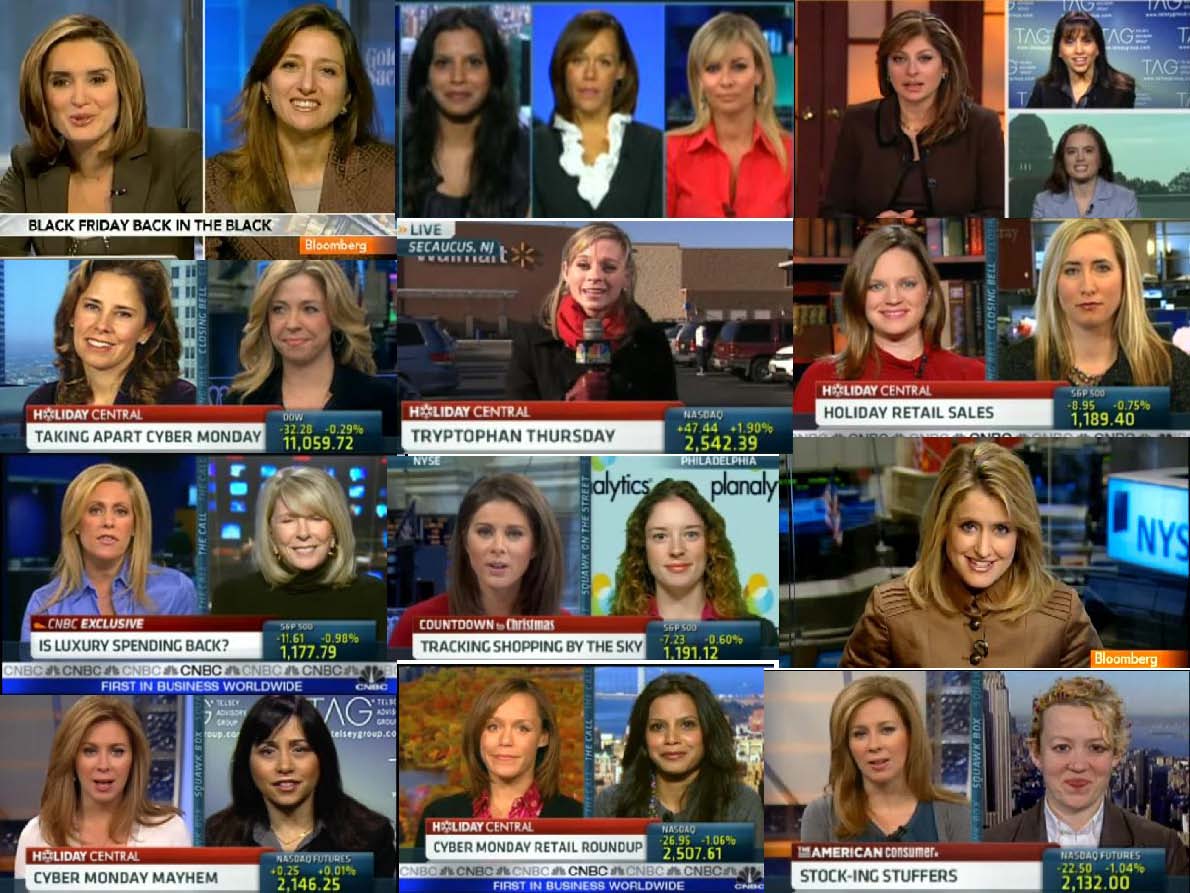
I’m not sure if you are like me, but the annual media ritual of myopically breaking down the sale of every shoe, belt, cell phone, television, and pair of underwear during the November/December holiday season can become very grating. What makes it a little easier for me to swallow is the stable of attractive female retail analysts who are finally unleashed from their long hibernation slumbers to review their mall traffic and parking satellite findings. I’m a happily married man, but I still cannot complain about seeing these multi-threat beauties dissect sales trends and fashion fads. However, in this day and age, I’m not so sure that females feel the same way about their under-representation in the finance field?
If there are 155.8 million females in the United States and 151.8 million males (Census Bureau: October 2009), then how come only 6% of hedge fund managers (BusinessWeek), 8% of venture capitalists, and 15% of investment bankers are female (Harvard Magazine)? Is the finance field just an ol’ boys network of chauvinist pig-headed males who only hire their own? Or do the severe time-demands of the field force females to opt-out of the industry due to family priorities?
Although I’m sure family choices and quality of life are factors that play into the decision of entering the demanding finance industry, from my experience I would argue women are notoriously underrepresented even at younger ages (well before family considerations would weigh into career decisions). Maybe cultural factors such as upbringing and education are other factors that make math-related jobs more appealing to men?
If underrepresentation in the finance field is not caused by female choice, then perhaps the male dominated industry is merely a function of more men opting into the field (i.e., men are better suited for the industry). More specifically, perhaps male brains are just wired differently? Some make the argument that all the testosterone permeating through male bodies leads them to positions involving more risk. If you look at other risk related fields like gambling, women too are dramatic minorities, making up about 1/3 of total compulsive gamblers.
Women Better than Men?
The funny part about the underrepresentation of females in finance is that one study actually shows female hedge fund managers outperforming their male counterparts. Here’s what a BusinessWeek article had to say about female hedge fund managers:
A new study by Hedge Fund Research found that, from January 2000 through May 31, 2009, hedge funds run by women delivered nearly double the investment performance of those managed by men. Female managers produced average annual returns of 9%, versus 5.82% for men and, in 2008, when financial markets were cratering, funds run by women were down 9.6%, compared with a 19% decline for men.
The article goes onto to theorize that women may not be afraid of risk, but actually are better able to manage risk. A UC Davis study found that male managers traded 45% more than female managers, thereby reducing returns by -2.65% (about 1% more than females).
Regardless of the theories or studies used to explain gender risk appetite, the relative underrepresentation of females in finance is a fact. I’ll let everyone else weigh in why that is the case, but in the meantime I will enjoy watching the female analysts explain the minute by minute account of UGG and iPad sales through the holiday shopping season.
Wade W. Slome, CFA, CFP®
Plan. Invest. Prosper.
Related Articles:
BusinessWeek article on female fund managers
Bashful Path to Female Bankruptcies
DISCLOSURE: Sidoxia Capital Management (SCM) and some of its clients own certain exchange traded funds and AAPL, but at the time of publishing SCM had no direct position in DECK or any other security referenced in this article. No information accessed through the Investing Caffeine (IC) website constitutes investment, financial, legal, tax or other advice nor is to be relied on in making an investment or other decision. Please read disclosure language on IC “Contact” page.
Another Year, Another Decade

Wade W. Slome, CFA, CFP®
Plan. Invest. Prosper.
DISCLOSURE: Sidoxia Capital Management (SCM) and some of its clients own certain exchange traded funds, but at the time of publishing SCM had no direct position in any other security referenced in this article. No information accessed through the Investing Caffeine (IC) website constitutes investment, financial, legal, tax or other advice nor is to be relied on in making an investment or other decision. Please read disclosure language on IC “Contact” page.
Waiting for the Hundred Minute Flood

Investors have been scarred over the last decade and many retirees have seen massive setbacks to their retirement plans. We have witnessed the proverbial “100 year flood” twice in the 2000s in the shape of a bursting technology and credit bubble in 2000 and 2008, respectively. The instantaneous transmission of data around the globe, facilitated by 24/7 news cycles and non-stop internet access, has only accelerated investor panic attacks – the 100 year flood is now expected every 100 minutes.
If drowning in the 100 year flood of events surrounding Bear Stearns, Lehman Brothers, Washington Mutual, AIG, Fannie Mae, Freddie Mac, TARP bank bailouts, Bernie Madoff’s Ponzi scheme, and Eliot Spitzer’s prostitute appreciation activities were not enough in 2008, investors (and many bearish bloggers) have been left facing the challenge of reconciling an +80% move in the S&P 500 index and +100% move in the NASDAQ index with the following outcomes (through the bulk of 2009 and 2010):
- Flash crash, high frequency traders, and “dark pools”
- GM and Chrysler’s bankruptcies
- Dubai debt crisis
- Goldman Sachs – John Paulson hearings
- Tiger Woods cheating scandal
- Greece bailout
- BP oil spill
- Healthcare reform
- China real estate bubble concerns
- Congressional leadership changes
- European austerity riots
- North Korea – South Korea provocations
- Insider trading raids
- Ireland bailout
- Next: ?????
With all this dreadful news, how in the heck have the equity markets about doubled from the lows of last year? The “Zombie Bears,” as Barry Ritholtz at The Big Picture has affectionately coined, would have you believe this is merely a dead-cat bounce in a longer-term bear-market. Never mind the five consecutive quarters of GDP growth, the 10 consecutive months of private job creation, or the record 2010 projected profits, the Zombie Bears attribute this fleeting rebound to temporary stimulus, short-term inventory rebuild, and unsustainable printing press activity by Federal Reserve Chairman Ben Bernanke.
Perhaps the Zombie Bears will change their mind once the markets advance another 25-30%? Regardless of the market action, individual investors have taken the pessimism bait and continue to hide in their caves. This strategy makes sense for wealthy retirees with adequate resources, but for the vast majority of Americans, earning next to nothing on their nest egg in cash and overpriced Treasuries isn’t going to help much in achieving your retirement goals. Unless of course, you like working as a greeter at Wal-Mart in your 80s and eating mac & cheese for breakfast, lunch, and dinner.
This Time is Different
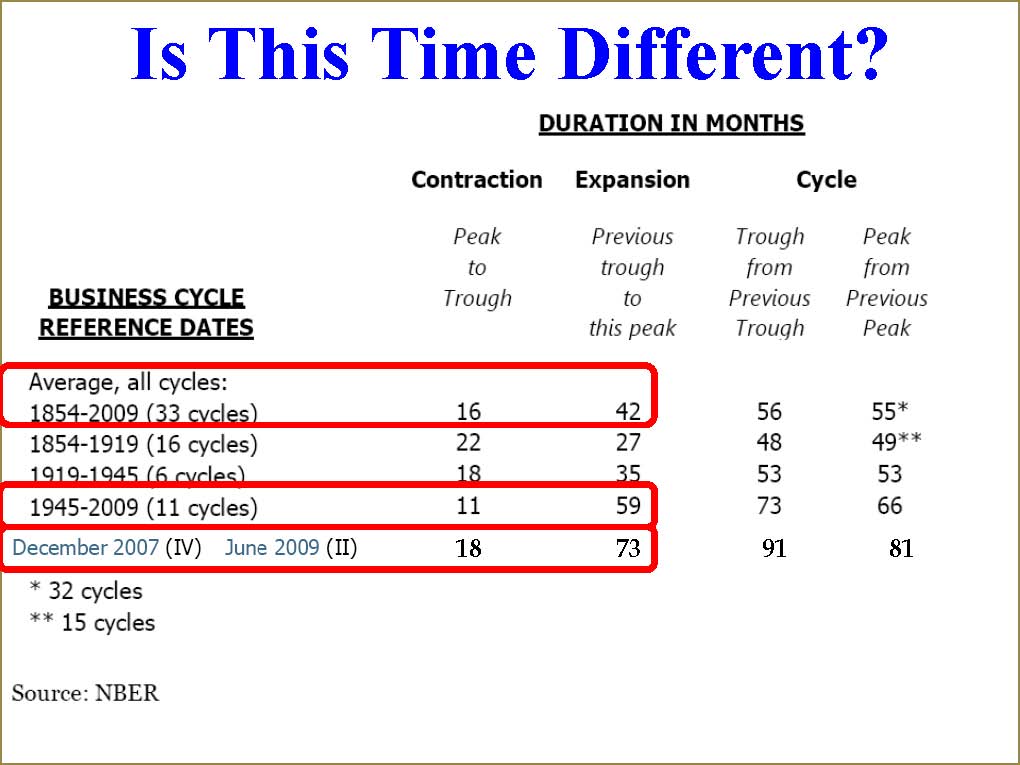
The Zombies would also have you believe this time is different, or in other words, historical economic cycles do not apply to the recent recession. I’ll stick with French novelist Alphonse Karr (1808-1890) who famously stated, “The more things change, the more things stay the same.”
As you can see from the data below, the recent recession lasted two months longer than the 16 month cycle average from 1854 – 2009. We have had 33 recessions and 33 recoveries, so I am going to go out on a limb and say this time will not be any different. Could we have a double dip recession? Sure, but odds are on our side for an average five year expansion, not the 18 month expansion experienced thus far.
The Grandma Sentiment Indicator
I love all these sentiment indicators, surveys, and various ratios that constantly get thrown around the blogosphere because it is never difficult to choose one matching a specific investment thesis. Strategists urge us to follow the actions of the “smart money” and do the opposite (like George Costanza) when looking at the “dumb money” indicators. The bears would also have you believe the world is coming to an end if you look at the current put/call data (see Smart Money Prepares for Sell Off). Instead, I choose to listen to my grandma, who has wisely reminded me that actions speak louder than words. Right now, those actions are screaming pure, unadulterated fear – a positive contrarian dynamic.
Over the last few years there has been more than $250 billion in equity outflows according to data from the Investment Company Institute (ICI). Bond funds on the other hand have taken in an unprecedented $376 billion in 2009 and about another $216 billion in 2010 through August.
As investment guru Sir John Templeton famously stated, “Bull markets are born on pessimism and they grow on skepticism, mature on optimism, and die on euphoria.” Judging by the asset outflows, I would say we haven’t quite reached the euphoria phase quite yet. I won’t complain though because the more fear out there, the more opportunity for me and my investors.
As I have consistently stated, I have no clue what equity markets are going to do over the next six to twelve months, nor does my bottom-up philosophy rely upon making market forecasts to succeed. Evaluating investor sentiment and timing economic cycles are difficult skills to master, but judging by the panicked actions and bond heavy asset inflows, investors are nervously awaiting another 100 year flood to occur in the next hundred minutes.
Wade W. Slome, CFA, CFP®
Plan. Invest. Prosper.
DISCLOSURE: Sidoxia Capital Management (SCM) and some of its clients own certain exchange traded funds, WMT, and AIG derivative security, but at the time of publishing SCM had no direct position in Bear Stearns, Lehman Brothers, JPM, Washington Mutual, Fannie Mae, Freddie Mac, GS, BP, GM, Chrysler, and any other security referenced in this article. No information accessed through the Investing Caffeine (IC) website constitutes investment, financial, legal, tax or other advice nor is to be relied on in making an investment or other decision. Please read disclosure language on IC “Contact” page.




 Investing Caffeine
