Operating Earnings: Half-Empty or Half-Full?

A continual debate goes on between bulls and bears about which earnings metric is more important: reported earnings based on GAAP (Generally Accepted Accounting Principles) or “operating earnings,” which exclude one-time charges and gains, along with non-cash charges, such as options expenses. Bulls generally prefer operating earnings (glass half-full) because they are typically higher than GAAP earnings (glass half-empty), and therefore operating earnings make valuation metrics more attractive. This disparity between earnings choice is even broader over the last few years due to the massive distortions created by the financial crisis – gigantic write-downs at the vast majority of financial institutions and enormous restructurings at non-financial companies.
Options Smoptions
The options expense issue can also become a religious argument, similar to the paradoxical question that asks if God can create a rock big enough that he himself cannot budge? Logic would dictate that operating earnings should adequately account for option issuance in the denominator of the earnings per share calculation (Net Income / Shares Outstanding). As far as I’m concerned, the GAAP method reducing the numerator of EPS (Earnings Per Share) with an expense, and increasing the denominator by increasing shares from option issuance is merely double counting the expense, thereby distorting reality. Reading through an annual report and/or proxy may not be a joyous experience, but the exercise will help you triangulate share issuance estimates to forecast the drag on future EPS.
On a trailing 12-month basis (Sep’09 – Sep’10), Standard & Poor’s calculated reported earnings with about a -9% differential from operating earnings, equating to approximately a 1.5 Price/Earnings multiple point differential (17.8x’s for reported earnings and 16.2 x’s for operating earnings). For the half-glass full bulls, the picture looks even prettier based on 2011 operating earnings forecasts – the S&P 500 index is priced at roughly 13.6x’s the 2011 index earnings value of $95.45.
Forward More Important Than Backwards
As I make the case in my P/E binoculars article, the market is like a game of chess – a good player doesn’t care nearly as much about an opponent’s last moves as he/she cares about the opponent’s future moves. Financial markets operate in the same fashion, future earnings are much more important than prior earnings. From a practical standpoint, GAAP earnings are relatively useless. Market purists can evangelize about the merits of GAAP earnings until they are blue in the face, but the fact of the matter is that investors are whipping prices all over the place based on Wall Street EPS forecasts – based on operating earnings (not GAAP). In many instances, especially throughout much of the financial crisis, operating earnings will more closely align with the cash flows of a company relative to GAAP earnings, but detailed fundamental analysis is needed.
As far as I’m concerned, much of this GAAP vs Non-GAAP earnings debate is moot because both reported earnings and operating earnings can both be manipulated and distorted. I prefer using cash flows (see Cash Flow Statement article) because cash register accounting – the analysis of money coming in and out of a company – limits the ability of bean counters to use smoke and mirror strategies traditionally saved for the income statement. In other words, you cannot compensate employees, do acquisitions, distribute dividends, or buyback stock with GAAP earnings…all these functions require cold, hard cash. The key metric, rather than EPS, should be free cash flow per share. Growth companies with high return prospects should be given some leeway, but if the projects don’t earn a return, eventually cash resources will dry up. When EPS is materially higher than free cash flow per share, yellow flags fly up and I do additional research to understand the dynamics causing the differential.
These earnings-based arguments will likely never get resolved, but if investors focus on bottom-up analysis on individual security cash flows, determining whether the glass is half-empty or half-full will become much easier.
Wade W. Slome, CFA, CFP®
Plan. Invest. Prosper.
DISCLOSURE: Sidoxia Capital Management (SCM) and some of its clients own certain exchange traded funds, but at the time of publishing SCM had no direct position in any security referenced in this article. The trailing 12 month data was calculated by S&P as of 1/19/2011. Forward 2011 operating earnings were calculated as of 1/18/2011. No information accessed through the Investing Caffeine (IC) website constitutes investment, financial, legal, tax or other advice nor is to be relied on in making an investment or other decision. Please read disclosure language on IC “Contact” page.
Bove on Goldman-Facebook Deal: Hug the Public!

In a recent research report titled, Has Goldman Learned Anything?, esteemed Rochdale Research analyst Richard Bove chimed in about the recent controversy surrounding the failed U.S. private offering of Facebook shares by Goldman Sachs (GS) to the bank’s wealthiest clients. In the note, Bove states the following:
“The company is embroiled in a ‘headline’ controversy surrounding its handling of a Facebook offering which implies that Goldman does not understand the public’s interest at all.”
Bove goes onto add:
“I fear that this company may not yet understand that those actions that do not appear to be in the public’s interest can, in fact, harm the company.”
I’m having a real difficult time understanding how Goldman privately raising funds for a private company has anything to do with the public? Am I wrong, or don’t millions of private companies raise capital every year without getting approval from Mr. Joe and Mrs. Josephine Public? What exactly does Bove want Goldman CEO Lloyd Blankfein to say to Facebook chief Mark Zuckerberg?
“Oh hello Mr. Zuckerberg, this is Lloyd Blankfein calling from Goldman Sachs, and if I understand it correctly, you are interested in raising $1.5 billion for your company. I know you are arguably the greatest internet brand on this planet, but unfortunately I do not think we can help you because I believe the broader public may not be happy with their lack of ability to participate in the offering. If you don’t have Morgan Stanley’s or JP Morgan’s phone number, just let me know because perhaps they can assist you. Have a great day!”
Come on…Goldman Sachs is not a charitable organization with a mission to make the world a better place – they are one of thousands of publicly traded companies attempting to grow profits. Sure, could Goldman have more discreetly pursued this offering without attracting the massive media barrage? Absolutely. But let’s be fair, the buzz around Facebook is deafening and the paparazzi are following Mark Zuckerberg around as closely as Raj Rajaratnam chases insider trading tips. New York Times columnist and reporter Andrew Ross Sorkin (see Too Big to Fail book review) summed it up best when he said, “You take the words Facebook and Goldman Sachs and put them in the same sentence, it becomes a media sensation unto itself. So I think this was bound to happen one way or the other.”
So while I have no reason to cheerlead for Goldman Sachs, and I’m sure there are plenty of other reasons for the investment bank to be crucified, attempting to raise money for a private company is not a felony in my book. I commend Richard Bove’s altruistic intentions in protecting the public from Goldman Sachs’s evil capital raising activities, and I may even contribute to a group hug with the mass investing public. If he catches me on the right day, I may even give CEO Lloyd Blankfein a hug.
Wade W. Slome, CFA, CFP®
Plan. Invest. Prosper.
DISCLOSURE: Sidoxia Capital Management (SCM) and some of its clients own certain exchange traded funds, but at the time of publishing SCM had no direct position in GS, MS, JPM, Facebook, or any other security referenced in this article. No information accessed through the Investing Caffeine (IC) website constitutes investment, financial, legal, tax or other advice nor is to be relied on in making an investment or other decision. Please read disclosure language on IC “Contact” page.
New Year’s Investing Resolutions

As we exit 2010 and enter 2011, many people go through the annual ritual of making personal New Year’s resolutions. Here is a list of go-to resolutions if you haven’t made one, or are having trouble coming up with one.
1) Lose weight
2) Spend More Time with Family & Friends
3) Quit Smoking
4) Quit Drinking
5) Enjoy Life More
6) Save Money & Get Out of Debt
7) Learn Something New
8) Help Others
9) Get Organized
10) Travel More
I have a few on the list above that I would like to work on, but when it comes to investing, there are a few other resolutions I am looking to make or maintain in 2011:
1) Don’t be a Hog. The last few years have produced excellent returns, but we all know that pigs get fat, and hogs get slaughtered. Cashing the register and banking some of my gains can be frustrating when positions charge higher, but sticking to a disciplined approach pays off handsomely in the long-run and helps navigate through the volatile times.
2) Follow Crash Litmus Test. Only buy what you would confidently purchase at lower prices. Sure, company or industry fundamentals can change over time, but for the vast majority of the time, companies and industries do not undergo paradigm shifts. Even though there are a 1,001 bombs that get launched daily, explaining why the world is coming to an end, I do my best to block out the useless noise and stick to the numbers and facts.
3) Remove Name Creep. It’s easy to fall in love with every new stock that walks by, but limiting the number requires a conviction discipline that pays off in the long run. Academic research and practical experience dictate diversification can be achieved without spreading yourself too thin. As Warren Buffett says, “I prefer to keep all my eggs in one basket and watch that basket closely.”
4) Tirelessly Turn Stones. I love my portfolio right now, but I know there are unique opportunities out there that can improve my results, if I take the time and make the effort.
5. Don’t Rush Into Tips. I’ve purchased or shorted securities recommended by respected investors, but it is important to do your own homework first. Even if these ideas work in the short-run, tips usually fall into loose hands and get punted at the worst times. Perform adequate due diligence to strengthen the roots of your thesis for volatile times.
6. Don’t Get Drunk on Story Stocks. There is never a shortage of great ideas, but many of them carry hefty price tags and have high expectations baked into future earnings growth estimates. Even if great stories exist in abundance, there is a shortage of great managers that can profit from great ideas. Associated high prices can however quickly turn a great story into a sad story – once excessively high expectations are not met, prices eventually will collapse.
7. Build Contingency Plan for Overconfidence. It’s important to have an exit strategy or contingency plan in place if things do not play out as planned. Overconfidence can be the pitfall for many investors, and this is not surprising when factoring in how highly people generally feel about themselves. Most believe they are better than average drivers, parents, and have superior intuition. This same overconfidence may not harm you in the real world, but in the financial markets, overconfidence can result in a woodshed beating. Confidence will not kill your portfolio, but arrogant confidence will.
8. Stick to Knitting. We all have our strengths and weaknesses. I do my best to stay away from my blind spots. As legendary baseball player Ted Williams discussed in his book The Science of Hitting, players are much better off by patiently waiting for the fat pitch in the sweet spot of the strike zone before swinging. Finding your sweet spot and not venturing out of your circle of competence is just as important in the investing world as it is in baseball hitting.
9. Trade Less. Trading is fun and exciting, but paying commissions on top of bid-ask spreads, impact costs, and other fees removes some of the enjoyment. Trading is a necessary evil to make profits, but requires the trader to be right twice – once on the sale, and another time on the purchase. Even if you are right on both sides of the trade, chances are the fees, taxes, commissions, and impact costs will remove most if not all of the profits.
10. Learn from Mistakes. Unfortunately, 2011 will be another year that I will not remain mistake-free. Conveniently forgetting investment mistakes is a great rationalization mechanism, but forever sweeping blunders under the rug without learning from them will not make you a better investor.
If you are able to set aside some of those Bonbons and pay off those credit card balances, then maybe you can join me and take on an investing resolution or two. Don’t worry, like all resolutions, you always have the option of making the resolution without following through!
Wade W. Slome, CFA, CFP®
Plan. Invest. Prosper.
DISCLOSURE: Sidoxia Capital Management (SCM) and some of its clients own certain exchange traded funds, but at the time of publishing SCM had no direct position in any other security referenced in this article. No information accessed through the Investing Caffeine (IC) website constitutes investment, financial, legal, tax or other advice nor is to be relied on in making an investment or other decision. Please read disclosure language on IC “Contact” page.
The Art of Weather Forecasting and Investing

Source: Photobucket
I’ve lived across the country and traveled around the world and have experienced everything from triple-digit desert heat to sub-zero wind chill. The financial markets experience the same variability over time.
Forecasting the weather is a lot like forecasting the stock market. In the short-run, volatility in patterns can be very difficult to predict, but if efforts are energized into analyzing long-term factors, trends can be identified.
For example, I live here in Southern California, and although weather is fairly homogenous, the variability can be significant on a day-to-day basis. I’m much more likely to be accurate in estimating the long-term climate than the forecast seven days from now. I’m not trying to rub salt in the wounds of those people freezing in Antarctica or the upper-Midwest, but forecasting a climate of 72 degrees, sunny, and blue skies is a good fall-back scenario if you are a television weatherman in Southern California.
Charles Ellis, author of the Winning the Loser’s Game – “WTLG” (see Investing Caffeine article #1 and article #2), highlights the weather analogy more convincingly:
“Weather is about the short run; climate is about the long run – and that makes all the difference. In choosing a climate in which to build a home, we would not be deflected by last week’s weather. Similarly, in choosing a long-term investment program, we don’t want to be deflected by temporary market conditions.”
Ellis adds:
“Like the weather, the average long-term experience in investing is never surprising, but the short-term experience is constantly surprising.”
In the financial markets the weather predicting principle applies to long-term economic forecasts as well. Predicting annual GDP growth can often be more accurate than the expected change in Dow Jones Industrial Index points tomorrow or the next day.
Economic Weathermen
As I outlined in Professional Guesses Probably Wrong, economists and strategists use several means of making their guesses.
- One method is to simply not make forecasts at all, but rather use some big words and current news to explain what currently is happening in the economy and financial markets.
- A second approach used by prognosticators is to constantly change forecasts. Consider a person making a weather forecast every minute…his/her forecast would be very accurate, but it would be changing constantly and not provide much more value than what an ordinary person could gather by looking out their own window.
- Thirdly, some use the “spaghetti approach” – throw enough scenarios out there against the wall and something is bound to stick – regardless of accuracy.
- Lastly, the “extend and pretend” method is often implemented. Forecasters make big bold economic predictions that garner lots of attention, but when the expectations don’t come true, the original forecast is either forgotten by investors or the original forecast just becomes extended further into the future.
Coin Flipping
If the weather analogy doesn’t work for you, how about a coin-flipping analogy? The short-term randomness surrounding the consecutive number of heads and tails may make no sense in the short-run, but will mean revert to an average over time. In other words, it is possible for someone to flip 10 consecutive “tails,” but in the long-run, the number of times a coin will land on “tails” will come close to averaging half of all coin tosses. The same dynamic is observed in the investment world. Often, short-term spikes or declines are short lived and return toward a mean average. IN WTLG, Ellis provides some more color on the topic:
“The manager whose favorable investment performance in the recent past appears to be ‘proving’ that he or she is a better manager is often – not always, but all too often – about to produce below-average results…A large part of the apparently superior performance was not due to superior skill that will continue to produce superior results but was instead due to that particular manager’s sector of the market temporarily enjoying above-average rates of return – or luck.”
Regardless of your interests in weather forecasting or coin-flipping, when it comes to investing you will be better served by following the long-term climate trends and probabilities. Otherwise, the performance outlook for your investment portfolio may be cloudy with a chance of thunderstorms.
Wade W. Slome, CFA, CFP®
Plan. Invest. Prosper.
DISCLOSURE: Sidoxia Capital Management (SCM) and some of its clients own certain exchange traded funds, but at the time of publishing SCM had no direct position in any other security referenced in this article. No information accessed through the Investing Caffeine (IC) website constitutes investment, financial, legal, tax or other advice nor is to be relied on in making an investment or other decision. Please read disclosure language on IC “Contact” page.
Ellis on Battling Demons and Mr. Market

A lot of ground was covered in the first cut of my review on Charles Ellis’s book, Winning the Loser’s Game (“WTLG”). His book covers a broad spectrum of issues and reasons that help explain why so many amateurs and professional investors dramatically underperform broad market indexes and other forms of passive investing (such as index funds).
A major component of investor underperformance is tied to the internal or emotional aspects to investing. As I have written in the past, successful investing requires as much emotional art as it does mathematical science. Investing solely based on numbers is like a tennis player only able to compete with a backhand – you may hit a few good shots, but will end up losing in the long-run to the well-rounded players.
Ellis recognizes these core internal shortcomings and makes insightful observations throughout his book on how emotions can lead investors to lose. As George J.W. Goodman noted, “If you don’t know who you are, the stock market is an expensive place to find out.” Hopefully by examining more of Ellis’s investment nuggets, we can all become better investors, so let’s take a deeper dive.
Mischievous Mr. Market
Why is winning in the financial markets so difficult? Ellis devotes a considerable amount of time in WTLG talking about the crafty guy called “Mr. Market.” Here’s how Ellis describes the unique individual:
“Mr. Market is a mischievous but captivating fellow who persistently teases investors with gimmicks and tricks such as surprising earnings reports, startling dividend announcements, sudden surges of inflation, inspiring presidential announcements, grim reports of commodities prices, announcements of amazing new technologies, ugly bankruptcies, and even threats of war.”
Investors can easily get distracted by Mr. Market, and Ellis makes the point of why we are simple targets:
“Our internal demons and enemies are pride, fear, greed, exuberance, and anxiety. These are the buttons that Mr. Market most likes to push. If you have them, that rascal will find them. No wonder we are such easy prey for Mr. Market with all his attention-getting tricks.”
The market also has a way of lulling investors into complacency. Somehow, bull markets manage to make geniuses not only out of professionals and amateur investors, but also cab drivers and hair-dressers. Here is Ellis’s observation of how we tend to look at ourselves:
“We also think we are ‘above average’ as car drivers, as dancers, at telling jokes, at evaluating other people, as friends, as parents, and as investors. On average, we also believe our children are above average.”
This overconfidence and elevated self-assessment generally leads to excessive risk-taking and eventually hits arrogant investors over the head like a sledgehammer. Michael Mauboussin, Legg Mason Chief Investment Strategist and author of Think Twice, is a current thought leader in the field of behavioral finance that tackles many of these behavioral finance issues (read my earlier piece).
The Collateral Damage
As mentioned by Ellis in the previous WTLG article I wrote, “Eighty-five percent of investment managers have and will continue over the long term to underperform the overall market.” When emotions take over our actions, Mr. Market has a way of making investors make the worst decisions at the worst times. Ellis describes this phenomenon in more detail:
“The great risk to individual investors is not that the market can plummet, but that the investor may be frightened into liquidating his or her investments at or near the bottom and miss all the recovery, making the loss permanent. This happens to all too many investors in every terrible market drop.”
With the market about doubling from the early 2009 equity market lows, this devastating problem has become more evident. With volatility rearing its ugly head throughout 2008 and early 2009, investors bailed into low-yielding cash and Treasuries at the nastiest time. Now the stock market has catapulted upwards and those same investors now face significant interest rate risk and still are experiencing meager yields.
The Winning Formula
Ellis acknowledges the difficulty of winning at the investing game, but experience has shown him ways to combat the emotional demons. Number one…know thyself.
“’Know thyself’ is the cardinal rule in investing. The hardest work in investing is not intellectual; it’s emotional.”
Knowing thyself is easier said than done, but experience and mistakes are tremendous aids in becoming a better investor – especially if you are an investor who spends time studying the missteps and learns from them.
From a practical portfolio construction standpoint, how can investors combat their pesky emotions? Probably the best idea is to follow Ellis’s sage advice, which is to “sell down to the sleeping point. Don’t go outside your zone of competence because outside that zone you may get emotional, and being emotional is never good for your investing.”
Finding good investment ideas is just half the battle – fending off the demons and Mr. Market can be just as, if not more, challenging. Fortunately, Mr. Ellis has been kind enough to share his insights, allowing investors of all types to take this valuable investment advice to help win at a losing game.
Wade W. Slome, CFA, CFP®
Plan. Invest. Prosper.
DISCLOSURE: Sidoxia Capital Management (SCM) and some of its clients own certain exchange traded funds, but at the time of publishing SCM had no direct position in any other security referenced in this article. No information accessed through the Investing Caffeine (IC) website constitutes investment, financial, legal, tax or other advice nor is to be relied on in making an investment or other decision. Please read disclosure language on IC “Contact” page.
Top 10 of 2010

Last year is over, but you can relive some of the memories by enjoying a few of the more popular Investing Caffeine articles of 2010. If you have already read all of these, you can always take a vacation and return 365 days from now and read the best of 2011 then. Happy (not so) New Year!
John Mauldin: The Man Who Cries Wolf
Professional Double–Dip Guesses are “Probably” Wrong
Technical Analysis – Astrology or Lob Wedge?
Marathon Investing: Genesis of Cheap Stocks
PIMCO – The Downhill Marathon Machine
Getting off the Market Timing Treadmill
TMI: The Age of Information Overload
Lessons Learned from Financial Crisis Management 101
Wade W. Slome, CFA, CFP®
Plan. Invest. Prosper.
DISCLOSURE: Sidoxia Capital Management (SCM) and some of its clients own certain exchange traded funds, but at the time of publishing SCM had no direct position in any other security referenced in this article. No information accessed through the Investing Caffeine (IC) website constitutes investment, financial, legal, tax or other advice nor is to be relied on in making an investment or other decision. Please read disclosure language on IC “Contact” page.
Sidoxia/Wall St. Cheat Sheet Webinar 1/6 @ 7 pm
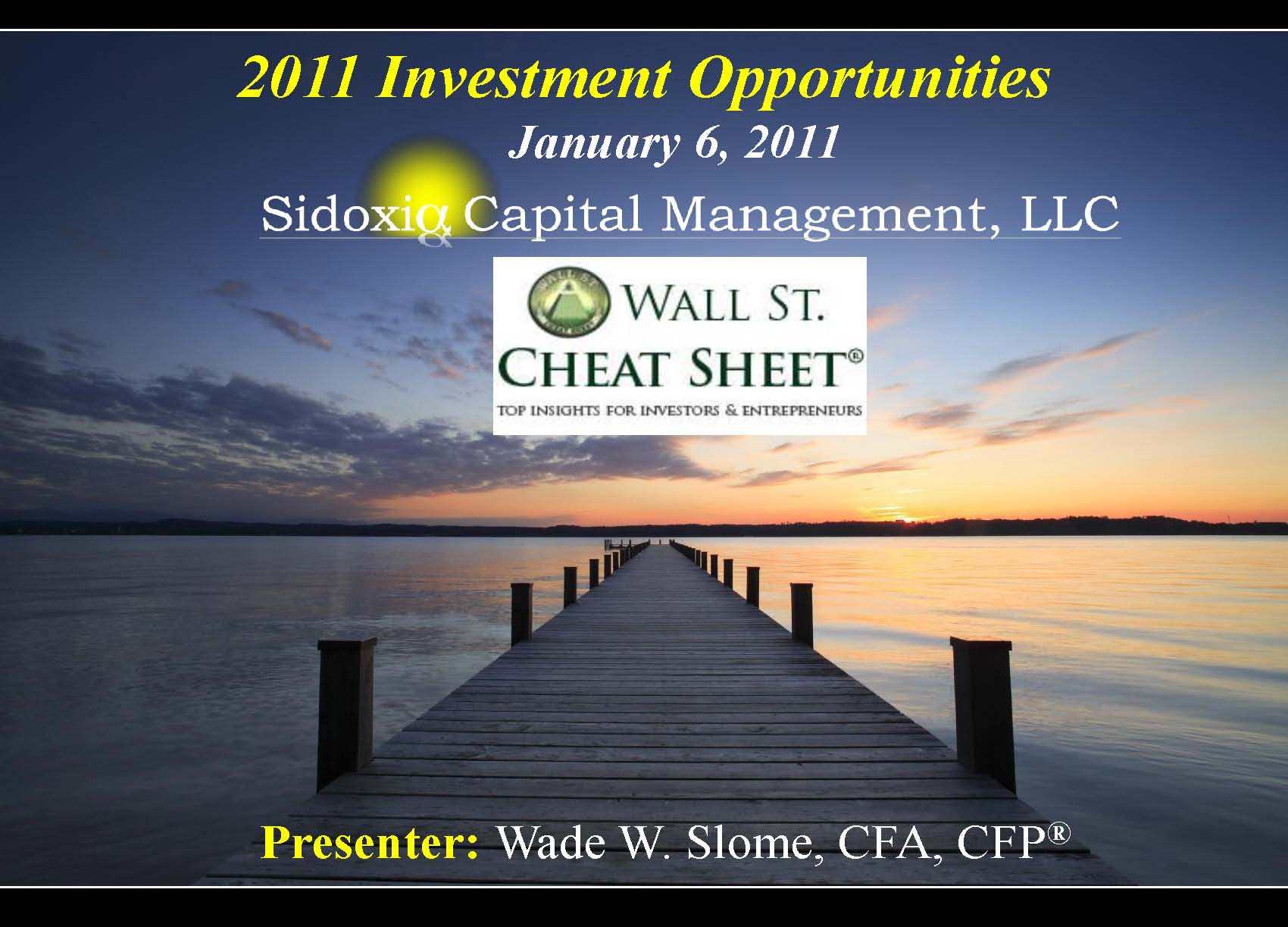
2011 Investment OpportunitiesDate: January 6, 2011 (Thursday) Time: 7:00 pm EST (4:00 pm PST) Duration:1 hour Click Here to Register |
|
|
| Wade W. Slome, CFA, CFP®
Plan. Invest. Prosper. DISCLOSURE: Sidoxia Capital Management (SCM) and some of its clients own certain exchange traded funds, but at the time of publishing SCM had no direct position in any security referenced in this article. No information accessed through the Investing Caffeine (IC) website constitutes investment, financial, legal, tax or other advice nor is to be relied on in making an investment or other decision. Please read disclosure language on IC “Contact” page. |
Winning the Loser’s Game

Besides hanging out with family and friends, and stuffing my face with endless amounts of food, the other benefit of the holidays is the quality time I’m afforded to dive into a few books. While sinking into the couch in my bloated state, I had the pleasure of reading an incredible, investment classic by Charles Ellis, Winning the Loser’s Game – “WTLG” (click here to view other remarkable book I read [non-investment related]). To put my enthusiasm in perspective, WTLG has even achieved the elite and privileged distinction of making the distinguished “Recommended Reading” list of Investing Caffeine (located along the right-side of the page). Wow…now I know you must be really impressed.
The Man, The Myth, the Ellis
 For those not familiar with Charley Ellis, he has a long, storied investment career. Not only has he authored 12 books, including compilations on Goldman Sachs (GS) and Capital Group, but his professional career dates back prior to 1972, when he founded institutional consulting firm Greenwich Associates. Besides earning a college degree from Yale University, and an MBA from Harvard Business School, he also garnered a PhD from New York University. Ellis also is a director at the Vanguard Group and served as Investment Committee chair at Yale University along investment great David Swensen (read also Super Swensen) from 1992 – 2008.
With this tremendous investment experience come tremendous insights. The original book, which was published in 1998, is already worth its weight in gold (even at $1,384 per ounce), but the fifth edition of WTLG is even more valuable because it has been updated with Ellis’s perspectives on the 2008-2009 financial crisis.
Because the breadth of topics covered is so vast and indispensable, I will break the WTLG review into a few parts for digestibility. I will start off with the these hand-picked nuggets:
Defining the “Loser’s Game”
Here is how Charles Ellis describes the investment “loser’s game”:
“For professional investors, “the ‘money game’ we call investment management evolved in recent decades from a winner’s game to a loser’s game because a basic change has occurred in the investment environment: The market came to be dominated in the 1970s and 1980s by the very institutions that were striving to win by outperforming the market. No longer is the active investment manager competing with cautious custodians or amateurs who are out of touch with the market. Now he or she competes with other hardworking investment experts in a loser’s game where the secret to winning is to lose less than others lose.”
Underperformance by Active Managers
Readers that have followed Investing Caffeine for a while understand how I feel about passive (low-cost do-nothing strategy) and active management (portfolio managers constantly buying and selling) – read Darts, Monkeys & Pros. Ellis’s views are not a whole lot different than mine – here is what he has to say while not holding back any punches:
“The basic assumption that most institutional investors can outperform the market is false. The institutions are the market. They cannot, as a group, outperform themselves. In fact, given the cost of active management – fees, commissions, market impact of big transactions, and so forth-85 percent of investment managers have and will continue over the long term to underperform the overall market.”
He goes on to say individuals do even worse, especially those that day trade, which he calls a “sucker’s game.”
Exceptions to the Rule
Ellis’s bias towards passive management is clear because “over the long term 85 percent of active managers fall short of the market. And it’s nearly impossible to figure out ahead of time which managers will make it into the top 15 percent.” He does, however, acknowledge there is a minority of professionals that can beat the market by making fewer mistakes or taking advantage of others’ mistakes. Ellis advocates a slow approach to investing, which bases “decisions on research with a long-term focus that will catch other investors obsessing about the short term and cavitating – producing bubbles.” This is the strategy and approach I aim to achieve.
Gaining an Unfair Competitive Advantage
According to Ellis, there are four ways to gain an unfair competitive advantage in the investment world:
1) Physical Approach: Beat others by carrying heavier brief cases and working longer hours.
2) Intellectual Approach: Outperform by thinking more deeply and further out in the future.
3) Calm-Rational Approach: Ellis describes this path to success as “benign neglect” – a method that beats the others by ignoring both favorable and adverse market conditions, which may lead to suboptimal decisions.
4) Join ‘em Approach: The easiest way to beat active managers is to invest through index funds. If you can’t beat index funds, then join ‘em.
The Case for Stocks
Investor time horizon plays a large role on asset allocation, but time is on investors’ side for long-term equity investors:
“That’s why in the long term, the risks are clearly lowest for stocks, but in the short term, the risks are just as clearly highest for stocks.”
Expanding on that point, Ellis points out the following:
“Any funds that will stay invested for 10 years or longer should be in stocks. Any funds that will be invested for less than two to three years should be in “cash” or money market instruments.”
While many people may feel stock investing is dead, but Ellis points out that equities should return more in the long-run:
“There must be a higher rate of return on stocks to persuade investors to accept risks of equity investing.”
The Power of Regression to the Mean
Investors do more damage to performance by chasing winners and punishing losers because they lose the powerful benefits of “regression to the mean.” Ellis describes this tendency for behavior to move toward an average as “a persistently powerful phenomenon in physics and sociology – and in investing.” He goes on to add, good investors know “that the farther current events are away from the mean at the center of the bell curve, the stronger the forces of reversion, or regression, to the mean, are pulling the current data toward the center.”
The Power of Compounding
For a 75 year period (roughly 1925 – 2000) analyzed by Ellis, he determines $1 invested in stocks would have grown to $105.96, if dividends were not reinvested. If, however, dividends are reinvested, the power of compounding kicks in significantly. For the same 75 year period, the equivalent $1 would have grown to $2,591.79 – almost 25x’s more than the other method (see also Penny Saved is Billion Earned).
Ellis throws in another compounding example:
“Remember that if investments increase by 7 percent per annum after income tax, they will double every 10 years, so $1 million can become $1 billion in 100 years (before adjusting for inflation).”
The Lessons of History
As philosopher George Santayana stated – “Those who cannot remember the past are condemned to repeat it.” Details of every market are different, but as Ellis notes, “The major characteristics of markets are remarkably similar over time.”
Ellis appreciates the importance of history plays in analyzing the markets:
“The more you study market history, the better; the more you know about how securities markets have behaved in the past, the more you’ll understand their true nature and how they probably will behave in the future. Such an understanding enables us to live rationally with markets that would otherwise seem wholly irrational.”
Home Sweet International Home
Although Ellis’s recommendation to diversify internationally is not controversial, his allocation recommendation regarding “full diversification” is a bit more provocative:
“For Americans, this would mean about half our portfolios would be invested outside the United States.”
This seems high by traditional standards, but considering our country’s shrinking share of global GDP (Gross Domestic Product), along with our relatively small share of the globe’s population (about 5% of the world’s total), the 50% percentage doesn’t seem as high at first blush.
Beware the Broker
This is not new territory for me (see Financial Sharks, Fees/Exploitation, and Credential Shell Game), and Ellis warns investors on industry sales practices:
“Those oh so caring and helpful salespeople make their money by convincing you to change funds. Friendly as they may be, they may be no friend to your long-term investment success.”
Unlike a lot of other investing books, which cover a few aspects to investing, Winning the Loser’s Game covers a gamut of crucial investment lessons in a straightforward, understandable fashion. A lot of people play the investing game, but as Charles Ellis details, many more investors and speculators lose than win. For any investor, from amateur to professional, reading Ellis’s Winning the Loser’s Game and following his philosophy will not only help increase the odds of your portfolio winning, but will also limit your losses in sleep hours.
Wade W. Slome, CFA, CFP®
Plan. Invest. Prosper.
DISCLOSURE: Sidoxia Capital Management (SCM) and some of its clients own certain exchange traded funds, but at the time of publishing SCM had no direct position in GS, or any other security referenced in this article. No information accessed through the Investing Caffeine (IC) website constitutes investment, financial, legal, tax or other advice nor is to be relied on in making an investment or other decision. Please read disclosure language on IC “Contact” page.
Dow Déjà Vu – Shining Rainbow or Bad Nightmare?

Excerpt from Free January Sidoxia Monthly Newsletter (Subscribe on right-side of page)
The Dow Jones Industrial Average is sitting at 11,577 points. Dick Fuld is still CEO of Lehman Brothers, AIG is still trading toxic CDS derivative contracts, and the $700 billion TARP bailout is a pre-idea about to be invented in the brain of Treasury Secretary Hank Paulson. Oops, wait a second, this isn’t the Dow 11,577of September 2008, but rather this is the Dow 11,577 of December 2010 (+11% for the year, excluding dividends). Was the -50% drop we experienced in the equity markets during 2008-2009 all just a bad dream? If not, how in the heck has the stock market climbed spectacularly? Most people don’t realize that stocks have about doubled over the last 21 months (and up roughly +20%-25% in the last 6 months) – all in the face of horrendously depressing news swirling around the media (i.e., jobs, debt, deficits, N. Korea, Iran, “New Normal,” etc.). Market volatility often does not make intuitive sense, and as a result, many market observers have been caught flat-footed.
Here are a few basic factors that average investors have not adequately appreciated:
1) Headlines are in Rearview Mirror: News that everyone reads in newspapers and magazines and hears on the television and radio is all backward looking. It’s always best to drive while looking forward through the windshield and try to anticipate what’s around the corner – not obsess with backward looking activity in the rearview mirror. That’s how the stock market works – tomorrow’s news (not yesterday’s or today’s) is what drives prices up or down. As the economy teetered on the verge of a “Great Depression-like” scenario in 2008-2009, investors became overly pessimistic and stocks became dramatically oversold. More recently, news has been perking up. Previous recessions have seen doubters slowly convert to believers and push prices higher – eventually stocks become overbought and euphoria slows the bull market. I believe we are in phase II of this three-part economic recovery.
2) Ignore Emerging Markets at Own Peril: We Americans tend to wear blinders when it comes to focusing on domestic issues. We focus more on healthcare reform and political issues, such as “Don’t Ask, Don’t Tell,” rather than the billions of foreigners chasing us as they climb the global economic ladder. Citizens in emerging markets are more concerned about out-competing and out-innovating us through educated workforces, so they can steal our jobs and buy more toasters, iPods, and cars – things we Americans have already taken for granted. The insatiable appetite of the expanding global middle class for a better standard of living is also driving ballooning commodity prices – everything from coal to copper and corn to cotton (the 4 Cs). This universal sandbox that we play in offers tremendous opportunities to grasp and tremendous threats to avoid, if investors open their eyes to these emerging market trends.
3) Capital Goes Where it’s Treated Best: Many voters are fed-up with the political climate in Washington and the sad state of economic affairs. The great thing about the global capitalistic marketplace we live in is that it does not discriminate – capital flows to where it is treated best. On a macro basis, money flows to countries that are fiscally responsible, support pro-growth initiatives, harbor educated work forces, control valuable natural resources, and honor the rule of law. On a micro basis, money flows to companies that are attractively priced and/or capable of sustainably growing earnings and cash flow. Voters and politicians will ultimately figure it out, or capital will go where it’s treated best.
Today’s Dow 11,577 is no bad dream, but rather resembles the emergence of a bright shining rainbow after a long, cold, and dark storm. The rainbow won’t stick around forever, but if investors choose to ignore the previously mentioned factors, like so many investors have overlooked, portfolio performance may turn into an ugly nightmare.
Wade W. Slome, CFA, CFP®
Plan. Invest. Prosper.
DISCLOSURE: Sidoxia Capital Management (SCM) and some of its clients own certain exchange traded funds, AAPL, and an AIG derivative security, but at the time of publishing SCM had no direct position in GS, any security referenced in this article. No information accessed through the Investing Caffeine (IC) website constitutes investment, financial, legal, tax or other advice nor is to be relied on in making an investment or other decision. Please read disclosure language on IC “Contact” page.
Strategist Predictions and MacGyver Credo
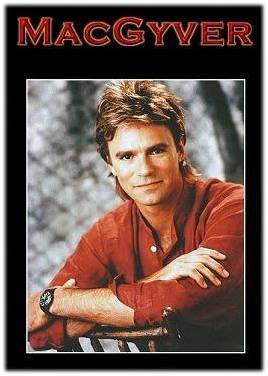
MacGyver: Resourceful dude with sweet mullet (Source: Photobucket).
“Only a fool is sure of anything, a wise man keeps on guessing.” – MacGyver
We have gotten to the part of the year when strategists gather for the annual dart throwing ritual of 2011 price targets. S&P projections get chucked around with the hopes of sticking – like cooked spaghetti to the wall. MacGyver appreciates the fine art of guessing, and so do Wall Street strategists.
How the Game’s Played
You don’t have to be a brain surgeon to figure out how the Wall Street astrology game works. When in doubt, just say the market will be up +10% next year. Hmmm, why +10%?
1) Well, first of all, these strategists work for employers who are in the business of hawking financial products and services to the masses, so if you want to generate revenues, you better attempt to line up some believers with some rosy scenarios.
2) History is on the strategists’ side. Equity markets move up about 70% of the time, so why not make an optimistic bet. Data from Crestmont Research and Roger Ibbotson support the average return over the last 100 years or so has averaged approximately +10% (with a lot of peaks and valleys). Obviously, that hasn’t been the case over the last decade. The PIMCO bond brothers of Bill Gross and Mohamed El-Erian blame the “New Normal” environment despite recently raising their 2011 GDP forecasts to a “Less Sluggish New Normal.” More likely, the decade of the 2000s is more like the “Old Normal” of boom-busts like we experienced in the 1930s and 1970s.
3) The other cardinal rule to be followed religiously: Forecasts made by any Wall Street type need to be made in tight packs like a herd. There is comfort in numbers, and why in the world would someone risk embarrassment or career risk. Fat paychecks abound for these strategists and hugging consensus views is OK, as long as a logical story can be patched together in explaining it.
With all this discussion about +10% average stock market returns, guess what type of returns this year’s Barron’s strategist survey is forecasting? You guessed it…+10% – what a shocker! Let’s hope this guess is more accurate than Barron’s +10% strategist return forecast for 2008 (S&P 500 was actually down -38.5% in 2008). Strategists don’t always get it wrong – the sanguine +12% outlook for 2010 is basically spot on with a few days left in the year. The sanguine 2002 outlook of +13%, however, was about -35% too sanguine (S&P plummeted about -23% that year).
Although most strategists feign absolute knowledge and precision, history shows these projections rarely prove accurate. Like predicting weather, guessers may get the long-term climate forecast fairly close, but the short-term estimates are generally pure speculation. In my book, 12 months is very short-term. Famed investor and author Charles Ellis captures the challenge of market forecasts:
“Predicting the stock market roughly is not hard, but predicting it accurately is truly impossible.”
I ascribe to the Peter Lynch view that speculating about the direction of the market is futile:
“If you spend more than 13 minutes analyzing economic and market forecasts, you’ve wasted 10 minutes.”
Kass Gets Hall Pass
Even though I may relish in flogging strategists, I provide certain professionals a hall pass under the following conditions:
- The educated guesser is putting real, hard-earned money behind their assertions.
- The guesses do not hug a tightly-knit herd.
- Guesses are made transparent and guessers make themselves accountable for bold statements.
- Those making guesses freely admit to the fallibility of making non-consensus suppositions.
One man whom embodies these principles is famed hedge fund manager Doug Kass, whom I have written about on several occasions (read more). Not only are Kass’s 2011 predictions provocative, they are also entertaining. His self proclaimed 40% batting average in 2010 may be a little higher than reality, but I will let you be the judge of his 2010 calls on the dollar, gold, Fed actions, Iran, Goldman Sachs, utilities, Warren Buffett, mutual funds, short-selling, New York Yankees, and more (read full 2010 Kass list).
The herd of strategists may continue having trouble making accurate market forecasts in the future, but perhaps resourcefully adding some duct tape and a Swiss Army knife to their repertoire like MacGyver will help improve accuracy. If not, rest assured, the strategists will sleep well making their +10% forecasts while continuing to collect big fat paychecks.
Wade W. Slome, CFA, CFP®
Plan. Invest. Prosper.
DISCLOSURE: Sidoxia Capital Management (SCM) and some of its clients own certain exchange traded funds, but at the time of publishing SCM had no direct position in any security referenced in this article. No information accessed through the Investing Caffeine (IC) website constitutes investment, financial, legal, tax or other advice nor is to be relied on in making an investment or other decision. Please read disclosure language on IC “Contact” page.




