Short Interest Coiled Springs

If short interest measures the amount of bearish bets against a particular stock, then what are you supposed to do with that data? The answer really depends on your view regarding the research quality of the bears. If you believe the bears have done excellent homework, then it will pay to pile onto the bearish bandwagon and short the stock. There’s just one problem…it’s virtually impossible to know whether the brains of Warren Buffett are leading the shorting brigade, or the boobs of Snookie from Jersey Shore are driving the negative bets.
The situations that I find especially appealing are the cases in which your research conclusions are extremely bullish, yet a large herd of traders have piled up their pessimistic short positions up to the sky in the belief share prices are going lower. These “crowded shorts” provide a large tailwind of pending buy orders – effectively pouring gasoline on the fire – if you are arrogant enough, like me, to believe your bullish thesis will play out. These “short squeezes” occur often when fundamental momentum lasts longer than the bears expect, or when downbeat expectations do not come to fruition. A classic short squeeze occurred when well-known investor Whitney Tilson recently covered his Netflix Inc. (NFLX) short position (see Whitney the Waffler), pushing a high priced stock even higher. Short interest reached almost 13 million shares in September 2010, and declined to a little more than 11 million shares a few weeks ago (compared to about 53 million shares outstanding). Given the stock’s price action, and Tilson’s response, the short interest has likely declined – at least temporarily.
The Challenge of Timing
Shorting is difficult enough with the theoretical unlimited losses hanging over your head, but timing is of the essence too. Often, a short-seller may be correct on their unconstructive view on a particular stock, but the heat in the kitchen gets too hot for them to stick around for the main course. Shorting stocks in a down market can be just as easy as buying in an up market – making money in your shorts in a rising market is that much more difficult.
Rather than follow the herd of short sellers as a trading strategy, I choose to stick with the credo of legendary investor Benjamin Graham, who stated:
“You’re neither right nor wrong because others agree with you. You’re right because your facts and reasoning are right.”
It’s my strong belief the long-term share price of a stock is driven by the sustainable earnings and cash flows of a company. The direction of price and earnings (cash flow) may diverge in the short-run, but in the long-run the relationship between price and profits converges.
Shorting Criteria
The criteria for shorting a stock are just as varied as the factors used to buy a stock, but these are some of the factors I consider when shorting a stock:
- Weak and/or deteriorating market share positioning.
- Excessive leverage – substandard financial positioning.
- Weak cash flow based quality of earnings.
- Management mis-execution and deteriorating fundamentals.
- Expensive valuations on an absolute and relative basis.
A stock is not required to exhibit all these characteristics simultaneously in order to generate a profitable short position, but the framework works for me.
If long investing is your main focus, then I urge you seek out those heavily shorted stocks that maintain attractive growth opportunities at attractive prices. If you are going to seek out rising stocks, you may as well use the assistance of a coiled spring to get you there.
Click Here to Check Out High Short Interest Stocks
Click Here for NYSE Shorts at WSJ
Wade W. Slome, CFA, CFP®
Plan. Invest. Prosper.
DISCLOSURE: Sidoxia Capital Management (SCM) and some of its clients own certain exchange traded funds and NFLX, but at the time of publishing SCM had no direct position in any other security referenced in this article. No information accessed through the Investing Caffeine (IC) website constitutes investment, financial, legal, tax or other advice nor is to be relied on in making an investment or other decision. Please read disclosure language on IC “Contact” page.
Whitney the Netflix Waffler

Source: Photobucket
No, I am not talking about Meredith Whitney (see Cloudy Crystal Ball), but rather Whitney Tilson, a well-known value and hedge fund manager at T2 Partners LLC. Less than eight weeks ago, Tilson boldly and brashly exclaimed why Netflix Inc. (NFLX) was an “exceptional short” and provided reasons to the world on why Netflix was his largest short position (read Tilson’s previous post). Fifty-five days later, Mr. Tilson evidently was overtaken by a waffle craving and decided to throw in the towel by covering his Netflix short position.
What Changed in Seven and Half Weeks?
Margin Thesis Compromised: Tilson explains, “The company reported a very strong quarter that weakened key pillars of our investment thesis, especially as it relates to margins.” Really? Netflix has grown revenues for nine straight years since its IPO (Initial Public Offering) in 2002, and growth has even accelerated for two whole years (as Netflix has shifted to streaming content over snail-mail), and just in Q4 he became surprised by this multi-year trend? The Q4 growth caught Tilson off-guard, but I guess Tilson wasn’t surprised by the 7.5 million subscribers Netflix added in 2009 and first three quarters of 2010. Never mind the five consecutive years of operating margin expansion either (source: ADVFN), nor the stealthy share price move from $30 to around $225. Apparently Tilson needed the recently reported Q4 financial results to hit him over the head.
Survey Provides Earth-Shattering Results: Tilson conducted an exhaustive study of “more than 500 Netflix subscribers, that showed significantly higher satisfaction with and usage of Netflix’s streaming service than we anticipated.” Come on…Netflix has more than 20 million subscribers, and you are telling me that a questionnaire of 500 subscribers (0.0025%) is representative. Even if these results are a cornerstone of Tilson’s modified thesis, I wonder also why the survey wasn’t taken before Netflix became Tilson’s largest negative short position. In addition, I can’t say it’s much of a revelation that Tilson found “significantly higher satisfaction” among paying subscribers. That’s like me going to a Justin Bieber concert and polling J-Beeb fans whether they like his music – I’ll go out on a limb and say paying customers will generally have a positive bias in their responses.
Feedback Tilts the Scales: Tilson received a “great deal of feedback, including an open letter from Netflix’s CEO, Reed Hastings.” If I received a penny for every time I heard a CEO speak positively about their company, I would be retired on a private island drinking umbrella drinks all day. Honestly, what does Tilson expect Hastings to say, “You know Whitney, you really hit the nail on the head with your analysis…I think you’re right and you should short our stock.”
Some other inconsistencies I’m still trying to figure out in Tilson’s new waffle thesis:
Valuation Head Scratcher: Also frustrating in Tilson’s 180 degree switch is his apparent incongruous treatment of valuation. In his initial bearish piece, Tilson explains how outrageously priced Netflix share are at 63.1x the high 2010 consensus estimate, but somehow a current 75.0x multiple (~20% richer) is reason enough for Tilson to blow out his short.
Competition: Although Tilson went from 100% short Netflix to 0% short Netflix, there does not appear to be any new information regarding Netflix’s competitive dynamics from the Q4 financial release to change his view. Here is what he said in his article eight weeks ago:
“Netflix’s brand and number of customers pale in comparison to its new, direct competitors like Apple (iTunes), Google (GOOG) (YouTube), Amazon.com (AMZN) (Amazon Video on Demand), Disney (DIS) and News Corp. (NWS) (part ownership of Hulu), Time Warner (TWX, TWC) (cable, HBO, etc.), Comcast (CMCSA) (cable, NBC Universal, part ownership of Hulu), and Coinstar’s Redbox (CSTR) (30,000 kiosks renting DVDs for $1/night and email addresses for 21 million customers).”
Little is said in his short covering note, other than these negative dynamics still exist and help explain why he is not long the stock.
Gently Under the Bus
Whitney Tilson was “against Netflix before he was for it,” a stance that could generate a tear of pride from fellow waffler John Kerry. However, I want to gently place Mr. Tilson under the bus with all my comments because his sudden strange reversal shouldn’t be blown out of proportion with respect to his full body of work. As a matter of fact, I have favorably profiled Tilson in several of my previous articles (read Tilson on BP and Tilson on Fat Lady Housing).
One would think given my profitable long position in Netflix that I would be congratulating Tilson for covering his short, but I must admit that I feel a little naked with fewer contrarians rooting against me. The herd is occasionally right, but the largest returns are made by not following the herd. Short interest was about 33% of the float (shares outstanding available for trading) mid-last month, and with the recent melt-up, my guess is that short percentage has shrunk with other short covering doubters. I haven’t decided how much, if any, profits I plan to lock-in with my Netflix positions, but as Tilson points out, they are not giving Netflix away for free.
Credit should also be given to Tilson for having the thickness of skin to openly flog himself and admit failure in such an open forum. I have been known to enjoy a waffle or two in my day as well (more often in the privacy of my own kitchen), and waffling on stocks can be preferable to loving stocks to the grave. Tilson has proven firsthand that eating waffles can be very expensive and detrimental to your profit waistline. By doing more homework on your stock consumption, your waffle eating should be spread further apart, making this habit not only cheaper, but also better for your long-term investment health.
Wade W. Slome, CFA, CFP®
Plan. Invest. Prosper.
DISCLOSURE: Sidoxia Capital Management (SCM) at the time of publishing had no direct position in DIS, NWS/Hulu, TWX, TWC, CMCSA, and CSTR but SCM and some of its clients own certain exchange traded funds, NFLX, AAPL, AMZN, AAPL, and GOOG, but did not own any other security referenced in this article. No information accessed through the Investing Caffeine (IC) website constitutes investment, financial, legal, tax or other advice nor is to be relied on in making an investment or other decision. Please read disclosure language on IC “Contact” page.
“1001 Truths about Investing” Released!

Hot off the printing presses, the much anticipated follow-up book, 1001 Truths about Investing, from Sidoxia Capital Management President and hedge fund manager Wade Slome has arrived.
With Valentine’s Day around the corner, what better way to tell your loved one or special friend that you truly care for them than by purchasing a copy of 1001 Truths. Okay, maybe the purchase wouldn’t be the most romantic gift, but investment portfolios need love too, and adding this to your book collection may be exactly what the investment doctor ordered.
Click Here for the 1001 Truths Press Release
Click Here to Purchase Book on Amazon.com

Wade W. Slome, CFA, CFP®
Plan. Invest. Prosper.
DISCLOSURE: Sidoxia Capital Management (SCM) and some of its clients own certain exchange traded funds and AMZN, but at the time of publishing SCM had no direct position in any other security referenced in this article. No information accessed through the Investing Caffeine (IC) website constitutes investment, financial, legal, tax or other advice nor is to be relied on in making an investment or other decision. Please read disclosure language on IC “Contact” page.
Yacktman’s Triangle of Success
Vodpod videos no longer available.
Donald Yacktman is no ordinary investor. As a matter of fact, he was a runner-up in Morningstar’s Fund Manager of the Decade award (see winner here). Besides stellar performance, how did Yacktman accomplish this honor? The answer is simple…a triangle. Yacktman wasn’t a geometry professor, but his investment philosophy is based on the three corners of this popular shape. Specifically, Yacktman looks to invest in companies trading at good prices, that are good businesses, with good management teams. Stated differently, one side of the investment philosophy represents a low purchase price, while the other sides represent good businesses and shareholder-oriented management.
Where the Magic Began
Like any legendary investor, experience plays a huge role in becoming a market master. Yacktman is no exception. Yacktman is the President and Co-Chief Investment Officer of Yacktman Asset Management Co., overseeing about $7 billion in assets. Prior to founding the firm in April 1992, he worked for 10 years as a portfolio manager at Selected Financial Services, Inc. and before then he served 14 years as a portfolio manager at Stein Roe & Farnham. Geographically, he has been all over the map. He earned his economics degree from the University of Utah and an MBA with distinction from Harvard University. After working for a longtime in Chicago, he decided to start the Yacktman Funds in Austin, Texas. Who knows, maybe the next stop will be Alaska or Hawaii?
Despite all the successes, life has not always been a bed of roses for Yacktman. As a matter of fact, during the late-1990s, the fund board attempted to oust him and investors left in a mass exodus. Even after posting stellar results in 2000-2003 relative to the S&P 500, Yacktman underperformed significantly in three out of four years from 2004 – 2007.
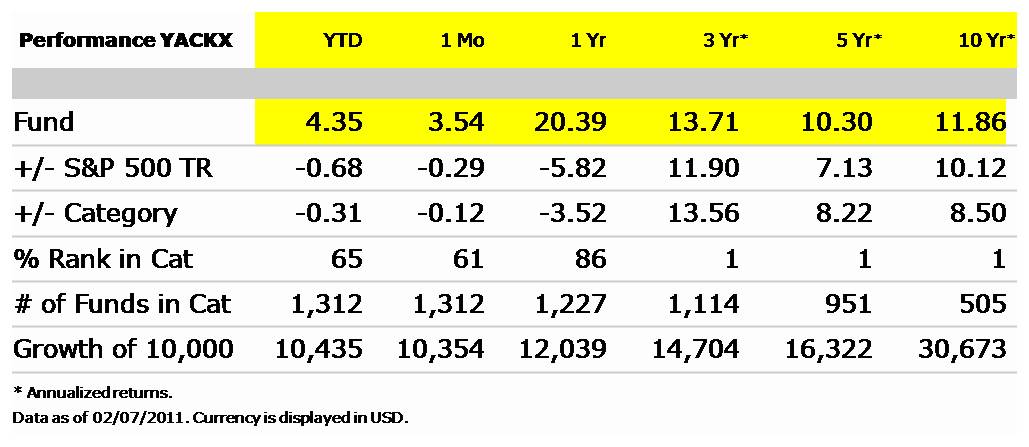
Managing to sidestep the technology bubble in 2000 and then the financial sector bubble in 2008 contributed tremendously to Yacktman’s outperformance (see graph).
Source: Morningstar.com
As you can see, the long-term track record of the Yacktman fund has been exceptional (#1 fund on a 3 yr., 5 yr., and 10 yr basis), but anyone can eventually lose the Midas touch – Bill Miller’s 15 consecutive market-beating returns subsequently reversed into a financial disaster in the following years (see Revenge of the Dunce). Even with all the boos and cheers Yacktman has received over the years, some of that attention should be directed towards his son Stephen Yacktman (Co-Manager of Yacktman funds) and other Co-Manager Jason Subotky.
More Yacktman Investment Nuts & Bolts
There are other key elements to the Yacktman strategy beyond the triangle philosophy. For example, Yacktman preaches the importance of patience, long-term thinking, and the ability to develop a repeatable process.
And how does Yacktman find these great opportunities for his funds? Driving the process of picking stocks is the ability to price equity securities like bonds. Using cash flows, inflation expectations, and forecasted growth, the Yacktman team derives a forward rate of return that they can compare against a broad set of investment alternatives, including bonds. This framework is very consistent with my free cash flow yield ranking system I use. If opportunities do not present themselves, Yacktman is not afraid to raise cash levels to unorthodox levels (e.g., around 30% cash near the 2007 peak).
Since the differential in return opportunities has narrowed between what Yacktman defines as high quality and low quality, he has shifted more of the portfolios toward Blue Chip companies, like News Corporation (NWS), PepsiCo, Inc. (PEP), Coca-Cola Company (KO), Procter & Gamble Company (PG), and Microsoft Corporation (MSFT). Since the return opportunity spreads have narrowed, Yacktman feels he can get more bang for his risk buck by investing in quality large capitalization stocks.
With a long-run magical track record like Donald Yacktman’s, it is difficult to critically critique his systematic investment process. By implementing a few cornerstones of Yacktman’s investment philosophy, we should all be able to triangulate a better investment strategy four ourselves.
Wade W. Slome, CFA, CFP®
Plan. Invest. Prosper.
DISCLOSURE: Sidoxia Capital Management (SCM) and some of its clients own certain exchange traded funds, but at the time of publishing SCM had no direct position in YACKX, YAFFX, NWS, PEP, PG, KO, MSFT, or any other security referenced in this article. No information accessed through the Investing Caffeine (IC) website constitutes investment, financial, legal, tax or other advice nor is to be relied on in making an investment or other decision. Please read disclosure language on IC “Contact” page.
Microsoft’s Hand Caught in Google Cookie Jar

Source: Photobucket
The globalized world we live in has become ever-more connected (see Globalization Train), and the recent events in Egypt where mass protests were organized, in large part by Facebook and Twitter, only goes to show the importance technology plays in our daily lives. As a result of our tight global links and the advancement of technology, product cycles have only become shorter and more competitive, raising the stakes for business success. The expanded field of cut-throat competitors in a digital age has also increased the value of intellectual property (IP). Increasingly, lawyers and judges are being forced to decipher the obscure realm of bits and bytes and vigorously defend unique IP from competitors.
If You Can’t Beat Them, Copy Them
Case in point is the current war of code-words between Google Inc. (GOOG) and Microsoft Corp. (MSFT). Google claims they have caught Microsoft’s hand in the corporate espionage cookie jar by watching Microsoft effectively steal Google’s algorithmic search code for the software giant’s Bing search service. How can Google make such harsh and direct accusations? Google claims to have set up “synthetic” searches, which were designed as digital booby traps. Based on Google’s story, Microsoft appears to have taken the bait…hook, line, and sinker.
You be the judge. Here was the synthetic search result for “indoswiftjobinproduction” when entered in Google:

Source: Search Engine Land
This is the response when the same search term “indoswiftjobinproduction” was keyed in on Microsoft’s Bing search service:

Source: Search Engine Land
Coincidence? Perhaps. Likely? No.
Well, maybe lightning just struck with the “indoswiftjobinproduction” search term gibberish – why not try another?
This is what Google’s search results created when “mbzrxpgjys” was entered:

Source: Search Engine Land
When the same “mbzrxpgjys” term was inputted into Microsoft’s Bing, here was the result:

Source: Search Engine Land
Hmmm, I seem to be detecting a pattern here.
Is Microsoft’s apparent copycat behavior illegal? The evidence for the moment doesn’t appear to be clear, thanks mostly to the fine-print legalese of confusing check boxes that nobody reads when downloading or using any internet service. Evidently, many Microsoft Internet Explorer (IE) users have unknowingly provided Google search information typed in through Microsoft’s IE browser, and the Redmond behemoth has been using this information to sharpen their search algorithms.
So if this behavior is not illegal, then should this activity be considered cheating? Here’s what Amit Singhal, a Google executive who oversees the company’s search engine ranking algorithm has to say about the issue:
“It’s cheating to me because we work incredibly hard and have done so for years but they just get there based on our hard work…I don’t know how else to call it but plain and simple cheating. Another analogy is that it’s like running a marathon and carrying someone else on your back, who jumps off just before the finish line.”
I’m sure this will not be the last we hear on the subject of technology and corporate cheating. As a matter of fact, in the field of intellectual property crimes, French-Japanese car giant Renault-Nissan recently brought the case of industrial espionage, corruption, theft, stolen goods, and conspiracy against three senior Renault executives. The allegations of selling crucial electric car information to the Chinese raised concerns to a feverish pitch in the tabloids because so much can be gained or lost by those involved in this estimated $2 trillion electric car market.
The committing of crimes is nothing new, but the types of new crimes are changing. In a globalized world increasingly dominated by technology, perpetrators better think twice about committing these invisible crimes. Cheating may taste sweet, until you get caught with your hand in the cookie jar.
Read More about the Google–Microsoft Tiff
Wade W. Slome, CFA, CFP®
Plan. Invest. Prosper.
DISCLOSURE: Sidoxia Capital Management (SCM) and some of its clients own certain exchange traded funds and GOOG, but at the time of publishing SCM had no direct position in MSFT, Facebook, Twitter, Renault, Nissan, or any other security referenced in this article. No information accessed through the Investing Caffeine (IC) website constitutes investment, financial, legal, tax or other advice nor is to be relied on in making an investment or other decision. Please read disclosure language on IC “Contact” page.
Creating Your Investment Dashboard

Navigating the financial markets can be difficult in this volatile environment we’ve experienced over the last few years, which is why it is more important than ever to have a financial dashboard to ensure you do not drive off a cliff. If investors do not have the time or focus to drive their financial future, then perhaps for the safety of themselves and others, they may consider taking the bus or hiring a chauffeur. For those committed to handling their finances on their own, the road may become rocky, so here are some important factors to monitor on your financial dashboard:
1) Fundamental Direction: Before you decide on an investment destination, it is important to know whether trends are accelerating (speeding up) or deteriorating (slowing down) – see also Forecasting – Trend Analysis.
2) Are You Going the Speed limit? Nobody wants to get a costly speeding ticket, therefore assessing valuation metrics on your dashboard is a beneficiary tool. If you are speeding along the highway at a 100 miles per hour in an expensive stock (e.g., trading at a 50x+ Price/Earnings multiple), then there is little room for error. When traveling that fast you can forget about the price of a speeding ticket, because hitting a pothole at those speeds (valuation) can be much more costly to your portfolio, if you are not careful.
3) Temperature Outside: There’s a huge difference between driving in the icy-cold snow and in 100 degree heat. Each environment has its own challenges. The same principle applies to the financial markets. On occasion, sentiment can become red hot, forcing heightened caution, whereas during other periods, chilling fear can scare everyone else off the roads, leaving clear sailing ahead.
4) Optimal Tire Pressure: Low pressure or bald tires can lead to treacherous driving conditions. A company with healthy cash flow generation relative to its market capitalization can make your investment ride a lot more stable (see also Cash Flow Register). Dividends and share buybacks are generated from healthy and stable cash flows…not earnings.
5) Driver Skill Level: People generally believe they are better than average drivers, however statistics tell a different story. By definition, half of all drivers must be below average. If you are going to put your life’s retirement assets into stocks, you might as well select those companies led by seasoned management teams with proven track records.
Many investors drive blindly without relying on a dashboard. In the investment world, visibility is not very clear. Often, weather conditions in the financial markets become rainy, dark, and/or foggy. If you don’t want your portfolio to crash, it makes sense to build a reliable dashboard to navigate through the hazardous investment road conditions.
Wade W. Slome, CFA, CFP®
Plan. Invest. Prosper.
DISCLOSURE: Sidoxia Capital Management (SCM) and some of its clients own certain exchange traded funds, but at the time of publishing SCM had no direct position in any other security referenced in this article. No information accessed through the Investing Caffeine (IC) website constitutes investment, financial, legal, tax or other advice nor is to be relied on in making an investment or other decision. Please read disclosure language on IC “Contact” page.
Foreign Frights & Debt Doubts

Excerpts from Sidoxia monthly newsletter (Subscribe on right side of page)
Over the last few years the globalized nature of the financial crisis has forced a diverse set of world leaders to deal with obscure international flare-ups in countries ranging from Iceland to Dubai, and Greece to Tunisia. The crisis du jour is the popular revolt in Egypt against 30-year president Hosni Mubarak and his autocratic, authoritarian government. The situation for the U.S. becomes a little sticky because Egypt, although creating a GDP (Gross Domestic Product) of less than the state of Illinois, is still the largest Arab country by population (approximately 82 million – even larger than Iran); a staunch ally with the U.S. in keeping peace with Israel; has contributed important intelligence to our country’s war on terror; and has been a responsible partner in controlling commerce through the all-important Suez Canal. The problem with Egypt and Mubarak’s regime is that the Egyptian economy is in relative shambles (they do not have oil reserves like their neighbors), unemployment is through the roof, and the government has been slow to push democratic advancements forward for the Egyptian people.
As emerging market “haves” increasingly join the ranks of the middle class, the people representing the “have-nots” of Yemen, Jordan, Algeria, Tunisia, Egypt, and others are thirsting for a cocktail of democracy and a higher standard of living, like some of their wealthier neighbors. These autocratic, authoritarian regimes can do their best to slow or delay the democratizations of their countries, but they cannot put the genie back in the bottle. Information is flowing faster than ever, and societies previously kept in the dark are now seeing the light of democracy.
Like any volatile government situation, there are threats and opportunities, depending on whether Mubarak stays in power, and if not, the nature of the new leadership. If an extremist government fills the leadership void, the U.S. may wish to rewind the clock and put the slow-moving reformist, Mubarak, back in power.
The short-term impact of the popular revolt may create additional volatility in the markets, but in the long-run, if the turmoil introduces more open, transparent, less corrupt, and democratic ideals to the new agenda, then the world will become a better place.
Bitter Debt Pill Tough to Swallow

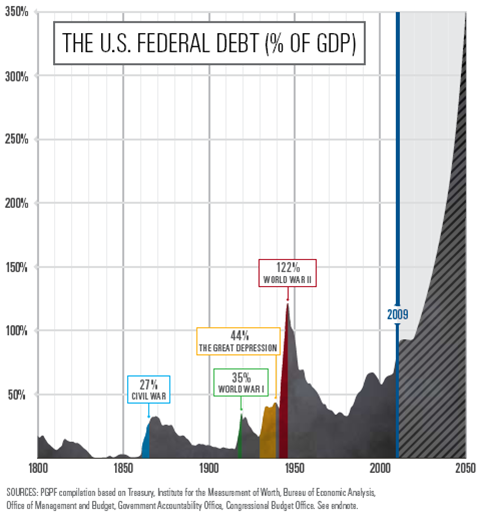
There is never a shortage of issues to worry about, and from an economic standpoint, the suffocating amount of debt our country is dealing with is at the top of the concern list. The 2008-2009 financial crisis hole that we are still climbing our way out of is a friendly reminder of what happens to countries adopting irresponsible fiscal policies. The choking amount of debt the U.S. is swallowing remains a central issue for the current administration and will be a core topic to be debated through the 2012 Presidential election cycle.
How serious is the issue? The problem is serious enough the Congressional Budget Office (CBO) just raised its budget deficit forecast for fiscal 2011 to hit a record $1.5 trillion (9.8% of GDP), a level higher than $1.3 trillion in fiscal 2010. The blame for the new record can be largely attributed to the recent extension of the $858 billion in Bush tax-cuts and other benefits/breaks. Kicking the can down the road recently led Moody’s Investors Services of threatening the U.S. with a downgrade of its triple-A rated debt.
Source: The Peterson Institute
The President addressed some of our fiscal problems in his State of the Union Address recently (e.g., proposing a freeze on discretionary spending), but the rubber really hits the road when he comes out with his budget proposal later this month. How serious is he about reducing our hemorrhaging deficits? We’ll soon find out when the individual budget line-items are distributed for everyone to see. Shortly thereafter, around the end of March, the debt ceiling impasse will become a game of political “chicken.” Each side, Democrats and Republicans, will attempt to withdraw concessions from the other party, in exchange for a vote that will prevent a disastrous default of our government’s debt payments. Basically, our government is effectively looking to expand its credit card credit line, because our government credit limit is maxed out.
The situation isn’t hopeless if our politicians can show leadership by making difficult, unpopular fiscal decisions, but if America ignores our painful debt problems and does not take its bitter medicine, then prepare for an economy on the verge of keeling over.
Wade W. Slome, CFA, CFP®
Plan. Invest. Prosper.
DISCLOSURE: Sidoxia Capital Management (SCM) and some of its clients own certain exchange traded funds, but at the time of publishing SCM had no direct position in any other security referenced in this article. No information accessed through the Investing Caffeine (IC) website constitutes investment, financial, legal, tax or other advice nor is to be relied on in making an investment or other decision. Please read disclosure language on IC “Contact” page.
Performance Beauty in Eye of Beholder

The average person may be a good judge in picking the winner of a beauty contest, but unfortunately your average investor is ill-equipped to sift through the thousands of mutual funds and hedge funds and thoughtfully discern the relevant performance metrics for investment purposes.
Investment firms however, are well-equipped with smoke, mirrors, and a tool-chest filled with numerous tricks. Here are a few of the investment firms’ gimmicks:
- Cherry Picking: Fund firms are notorious with cutting out the bad performance numbers and cherry picking the good periods. As investment guru Charles Ellis reminds us, the wow factor results of “investment performance become quite ordinary by simply adding or subtracting one or two years at the start or the end of the period shown. Investors should always get the whole record – not just selected excerpts.”
- Limited Time Period: Often the period highlighted by investment firms is insufficient to make a proper conclusion regarding a manager’s outperformance capabilities. Ellis acknowledges that gathering enough yearly performance information can be practically challenging:
“By the time you had gathered enough data to determine whether your fund manager really was skillful or just lucky, at least one of you would probably have died of old age.”
- Fee Disclosure: Some managers’ performance figures look stupendous until one realizes once hefty fees are subtracted from the reported figures, what previously looked top-notch is now average or below-average. It is important to read the small print or ask tough questions of the broker peddling a fund.
- Audited Figures: Legitimacy of performance is key, and there are different levels of audited figures. Global Investment Performance Standards (GIPS) compliance is an industry accepted standard. For pooled investment vehicles, audited results from regional or national accounting firms can be important too.
- Misused Rating Systems: Morningstar is the 800 pound gorilla in the mutual fund world and provides some useful data. Unfortunately, most Morningstar investors use the data incorrectly. A 2000 study by the Journal of Financial and Quantitative Analysis discovered, “There is little statistical evidence that Morningstar’s highest-rated funds outperform the medium-rated funds.” On this subject, Charles Ellis points out the following:
“While Morningstar candidly admits that its star ratings have little or no predictive power, 100 percent of net new investment money going into mutual funds goes to funds that were recently awarded five stars and four stars…Indeed, in the months after the ratings are handed out each year, the five-star funds generally earn less than half as much as the broad market index!…Morningstar ratings are misleading investors into buying high and selling low.”
Investors need to be careful in how they use the ratings – simply buying 4-5 star funds and selling star-losing funds can be a heartburning recipe for bad results. Buying high and selling low usually doesn’t turn out very well.
Find Winners…Then What?
Even if you are successful in identifying the winning funds, those same funds tend to underperform in subsequent periods. Ellis, a believer in passive index investing, noticed only 10% of active managers outperformed over 25 years, and the odds of sustaining outperformance in subsequent periods diminished even further.
Charles Ellis also noticed a fat-tail syndrome of losers versus winners. For example, Ellis found 2% of active managers outperformed over a set time period, but a whopping 16% underperformed the market over a similar timeframe. Consistent with these findings, Ellis stresses that past performance does not predict future results, with one exception: “The worst losers do tend to keep losing. If you do decide to select active investment managers, promise yourself you will stay with your chosen manager for many years…changing managers is not only expensive, but it usually doesn’t work.”
Professionals to the Rescue
Well, if individuals are not in a position to pick future winning fund managers, then thank heavens the professional consultants can help out…not exactly. Ellis was blunt about the capabilities of those professionals selecting active investment managers:
“Pension executives and investment consultants who specialize in selecting the best managers have, as a group, been unsuccessful at selecting managers who can beat the market.”
Ellis uses a respected firm as an example to prove his point:
“Cambridge Associates reports candidly, ‘There is no sound basis for hiring or firing managers solely on the basis of recent performance.’”
At the end of the day, finding current winners is not a problem, but sifting through the massive quantity of funds and selecting future winners is very challenging for individuals and professionals alike. The financial industry would like you to believe picking the future performance beauty winner is a simple task – the data seems to indicate otherwise. Rather than wasting your money attempting to pick the beauty winner, perhaps your money would be better spent on purchasing a tiara for yourself.
Wade W. Slome, CFA, CFP®
Plan. Invest. Prosper.
DISCLOSURE: Sidoxia Capital Management (SCM) and some of its clients own certain exchange traded funds, but at the time of publishing SCM had no direct position in MORN, Cambridge Associates, or any other security referenced in this article. No information accessed through the Investing Caffeine (IC) website constitutes investment, financial, legal, tax or other advice nor is to be relied on in making an investment or other decision. Please read disclosure language on IC “Contact” page.
Playing the Field with Your Investments

For some, casually dating can be fun and exciting. The same goes for trading and speculating – the freedom to make free- wheeling, non-committal purchases can be exhilarating. Unfortunately the costs (fiscally and emotionally) of short-term dating/investing often outweigh the benefits.
Fortunately, in the investment world, you can get to know an investment pretty well through fundamental research that is widely available (e.g., 10Ks, 10Qs, press releases, analyst days, quarterly conference calls, management interviews, trade rags, research reports). Unlike dating, researching stocks can be very cheap, and you do not need to worry about being rejected.
Dating is important early in adulthood because we make many mistakes choosing whom we date, but in the process we learn from our misjudgments and discover the important qualities we value in relationships. The same goes for stocks. Nothing beats experience, and in my long investment career, I can honestly say I’ve dated/traded a lot of pigs and gained valuable lessons that have improved my investing capabilities. Now, however, I don’t just casually date my investments – I factor in a rigorous, disciplined process that requires a serious commitment. I no longer enter positions lightly.
One of my investment heroes, Peter Lynch, appropriately stated, “In stocks as in romance, ease of divorce is not a sound basis for commitment. If you’ve chosen wisely to begin with, you won’t want a divorce.”
Charles Ellis shared these thoughts on relationships with mutual funds:
“If you invest in mutual funds and make mutual funds investment changes in less than 10 years…you’re really just ‘dating.’ Investing in mutual funds should be marital – for richer, for poorer, and so on; mutual fund decisions should be entered into soberly and advisedly and for the truly long term.”
No relationship comes without wild swings, and stocks are no different. If you want to survive the volatile ups and downs of a relationship (or stock ownership), you better do your homework before blindly jumping into bed. The consequences can be punishing.
Buy and Hold is Dead…Unless Stocks Go Up
If you are serious about your investments, I believe you must be mentally willing to commit to a relationship with your stock, not for a day, not for a week, or not for a month, but rather for years. Now, I know this is blasphemy in the age when “buy-and-hold” investing is considered dead, but I refute that basic premise whole-heartedly…with a few caveats.
Sure, buy-and-hold is a stupid strategy when stocks do nothing for a decade – like they have done in the 2000s, but buying and holding was an absolutely brilliant strategy in the 1980s and 1990s. Moreover, even in the miserable 2000s, there have been many buy-and-hold investments that have made owners a fortune (see Questioning Buy & Hold ). So, the moral of the story for me is “buy-and-hold” is good for stocks that go up in price, and bad for stocks that go flat or down in price. Wow, how deeply profound!
To measure my personal commitment to an investment prospect, a bachelorette investment I am courting must pass another test…a test from another one of my investment idols, Phil Fisher, called the three-year rule. This is what the late Mr. Fisher had to say about this topic:
“While I realized thoroughly that if I were to make the kinds of profits that are made possible by [my] process … it was vital that I have some sort of quantitative check… With this in mind, I established what I called my three-year rule.” Fisher adds, “I have repeated again and again to my clients that when I purchase something for them, not to judge the results in a matter of a month or a year, but allow me a three year period.”
Certainly, there will be situations where an investment thesis is wrong, valuation explodes, or there are superior investment opportunities that will trigger a sale before the three-year minimum expires. Nonetheless, I follow Fisher’s rule in principle in hopes of setting the bar high enough to only let the best ideas into both my client and personal portfolios.
As I have written in the past, there are always reasons of why you should not invest for the long-term and instead sell your position, such as: 1) new competition; 2) cost pressures; 3) slowing growth; 4) management change; 5) valuation; 6) change in industry regulation; 7) slowing economy; 8 ) loss of market share; 9) product obsolescence; 10) etc, etc, etc. You get the idea.
Don Hays summed it up best: “Long term is not a popular time-horizon for today’s hedge fund short-term mentality. Every wiggle is interpreted as a new secular trend.”
Peter Lynch shares similar sympathies when it comes to noise in the marketplace:
“Whatever method you use to pick stocks or stock mutual funds, your ultimate success or failure will depend on your ability to ignore the worries of the world long enough to allow your investments to succeed.”
Every once in a while there is validity to some of the concerns, but more often than not, the scare campaigns are merely Chicken Little calling for the world to come to an end.
Patience is a Virtue
In the instant gratification society we live in, patience is difficult to come by, and for many people ignoring the constant chatter of fear is challenging. Pundits spend every waking hour trying to explain each blip in the market, but in the short-run, prices often move up or down irrespective of the daily headlines. Explaining this randomness, Peter Lynch said the following:
“Often, there is no correlation between the success of a company’s operations and the success of its stock over a few months or even a few years. In the long term, there is a 100% correlation between the success of a company and the success of its stock. It pays to be patient, and to own successful companies.”
Long-term investing, like long-term relationships, is not a new concept. Investment time horizons have been shortening for decades, so talking about the long-term is generally considered heresy. Rather than casually date a stock position, perhaps you should commit to a long-term relationship and divorce your field-playing habits. Now that sounds like a sweet kiss of success.
Wade W. Slome, CFA, CFP®
Plan. Invest. Prosper.
DISCLOSURE: Sidoxia Capital Management (SCM) and some of its clients own certain exchange traded funds, but at the time of publishing SCM had no direct position in any other security referenced in this article. No information accessed through the Investing Caffeine (IC) website constitutes investment, financial, legal, tax or other advice nor is to be relied on in making an investment or other decision. Please read disclosure language on IC “Contact” page.
Your Portfolio’s Silent Killer

Shhh, if you listen closely enough, you may hear the sound of your portfolio disintegrating away due to the quiet killer…inflation. Inflation is especially worrisome with what we’ve seen happening with commodity prices and the drastic fiscal challenges our country faces. Quantitative Easing (read Flying to the Moon) has only added fuel to the inflation fear flames.
Whether you’re a conspiracy theorist who believes the government inflation data is cooked, or you are a Baby Boomer just looking to secure your retirement, it doesn’t take a genius to figure out that movies, pair of jeans, a tank of gas, concert tickets, or healthcare premiums are all going up in price (See also Bacon and Oreo Future).

Inflation starting to heat up. Source: IMF/Bloomberg via Financial Times
Companies are currently churning out quarterly results in volume and seeing the impact from commodity prices, whether you are McDonald’s Corp. (MCD) facing rising beef prices or luxury handbag maker Coach Inc. (COH) dealing with escalating leather costs, margins are getting crimped. Investors, especially those on fixed income streams, are experiencing the same pain as these corporations, but the problem is much worse. Unlike a market share leading company that can pass on price increases onto its customers, an investor with piles of cash, and low yielding CDs (Certificates of Deposit), and bonds runs the risk of getting eaten alive. Baby Boomers are beginning to reach retirement age in mass volume. Life spans are extending, and this demographic pool of individuals will become ever-large consumers of costlier and costlier healthcare services. If investments are not prudently managed, Baby Boomers will see their nest eggs evaporate, and be forced to work as Wal-Mart (WMT) greeters into their 80s…not that there’s anything wrong with that.
Every day investors are bombarded with a hundred different scary headlines on why the economy will collapse or the world will end. Most of these sensationalist scare tactics distort the truth and overstate reality. What is understated is what Charles Ellis (see Winning the Loser’s Game) calls a “corrosive power”:
“Over the long run, inflation is the major problem for investors, not the attention-getting daily or cyclical changes in securities prices that most investors fret about. The corrosive power of inflation is truly daunting: At 3 percent inflation – which most people accept as ‘normal’ – the purchasing power of your money is cut in half in 24 years. At 5 percent inflation, the purchasing power of your money is cut in half in less than 15 years – and cut in half again in 15 years to just one-quarter.”
In order to bolster his case, Ellis cites the following period:
“From 1977 to 1982, the inflation-adjusted Dow Jones Industrial Average took a five-year loss of 63 percent…In the 15 years from the late 1960s to the early 1980s the unweighted stock market, adjusted for inflation, plunged by about 80 percent. As a result, the decade of the 1970s was actually worse for investors than the decade of the 1930s.”
Solutions – How to Beat Inflation
Although the gold bugs would have you believe it, we are not resigned to live in a world with worthless money, which only has a useful purpose as toilet paper. There are ways to protect your portfolio, if you are properly invested. Here are some strategies to consider:
- TIPS (Treasury Inflation Protection Securities): These government-guaranteed tools are a useful way to protect yourself against rising inflation (see Drowning TIPS).
- Equities (including real estate): Bond issuers do not generally call up there investors and say, “You are such a great investor, so we have decided to increase your interest payments.” However, many publicly traded stocks do exactly that. Wal-Mart Stores (WMT) is an example of such a company that has increased its dividend for 37 consecutive years. As alluded to earlier, stocks are unique in that they allow inflationary pressures placed on operating profits to be relieved somewhat by the ability to pass on price increases to customers.
- Commodities: Whether you are talking about petroleum products, precious metals (those with a commercial purpose), or agricultural goods, commodities in general act as a great inflationary hedge. Another reason that commodities broadly perform better in an inflationary environment is because the U.S. dollar can often depreciate, which commonly increases the value of commodities.
- Short Duration Bonds: Rising rates are usually tied to escalating inflation, therefore investors would be best served by reducing maturity length and increasing coupon.
There are other ways of battling the inflation problem, but number one is saving and investing across a broadly diversified portfolio. If you want to secure and grow your nest egg, you need to use the silent power of compounding (see Penny Saved is Billion Earned) to combat the silent killer of inflation.
Wade W. Slome, CFA, CFP®
Plan. Invest. Prosper.
DISCLOSURE: Sidoxia Capital Management (SCM) and some of its clients own certain exchange traded funds, WMT, TIP, equities, commodities, and short duration bonds, but at the time of publishing SCM had no direct position in any other security referenced in this article. No information accessed through the Investing Caffeine (IC) website constitutes investment, financial, legal, tax or other advice nor is to be relied on in making an investment or other decision. Please read disclosure language on IC “Contact” page.