The Illusion of the Reverse Split

Source: Photobucket
“Citi is a fundamentally different company than it was three years ago. The reverse stock split and intention to reinstate a dividend are important steps as we anticipate returning capital to shareholders starting next year.”
Okay, so Citigroup is paying out a whopping 1/10 of one penny per your current share price (compared to $.49 per share before the financial crisis) and Vikram is telling me I should be excited. Maybe additional ecstasy should be kicking in once shareholders learn they will receive 1 pie with no slices, rather than 1 pie with 10 slices? These same share-slicing and re-piecing gimmicks were implemented in the pre and post dot-com era with no beneficial value. If this truly was such a novel idea, I wonder why smart people like Warren Buffett have chosen not put such amazing, whiz-bang ideas to use. The lauded 1-10 reverse split planned by Citigroup could also be used to raise Berkshire Hathaway’s share price from $127,766 per share to $1,277,660 per share. One share of post reverse-split BRKA could buy you 288,410 shares of Citigroup today.
Proponents of the reverse split cite the institutional benefits provided by the move. Not only will institutions previously prohibited from buying single digit equity securities now be able to buy Citigroup shares, but institutions will also be able to pay lower commissions because the current 29 billion shares outstanding will be reduced to a measly 2,900,000,000 shares. In reality, reducing share count through a reverse split may fool a few unknowledgeable speculators, but prudent investors understand a reverse split does not impact the value of the company one iota.
The fact of the matter is that earnings and cash flow growth will be the main drivers behind institutional shareholder buying of Citigroup’s stock.
Famous investor John Templeton simply stated, “In the long run, the stock market indexes fluctuate around the long-term upward trend of earnings per share.”
Peter Lynch appreciated the importance of earnings too: “People may bet on hourly wiggles of the market but it’s the earnings that waggle the wiggle long term.”
So while Citigroup may not be a horrible stock, the announcing of a 1 for 10 reverse stock split will not be a share price savior. So rather than let the illusion of capital structure gimmicks inform your decisions, investors would be better served by focusing on the sustainability and growth of earnings and cash flows.
Wade W. Slome, CFA, CFP®
Plan. Invest. Prosper.
DISCLOSURE: Sidoxia Capital Management (SCM) and some of its clients own certain exchange traded funds, but at the time of publishing SCM had no direct position in BRKA/B, C, or any other security referenced in this article. No information accessed through the Investing Caffeine (IC) website constitutes investment, financial, legal, tax or other advice nor is to be relied on in making an investment or other decision. Please read disclosure language on IC “Contact” page.
Nuclear Knee-Jerk Reaction

It’s amazing how quickly the long-term secular growth winds can reverse themselves. Just a week ago, nuclear energy was thought of as a safe, clean, green technology that would assist the gasoline pump pain in our wallets and purses. Now, given the events occurring in Japan, “nuclear” has become a dirty word equated to a life-threatening game of Russian roulette.
Despite the spotty information filtering in from the Dai-Ichi plant in Japan, we are already absorbing knee-jerk responses out of industrial heavyweight countries like Germany and China. Germany has temporarily closed seven nuclear power centers generating about a quarter of its nuclear capacity, and China has instituted a moratorium on all new facilities being built. How big a deal is this? Well, China is one country, and it alone currently accounts for 44% of the 62 global nuclear reactor projects presently under construction (see chart below).
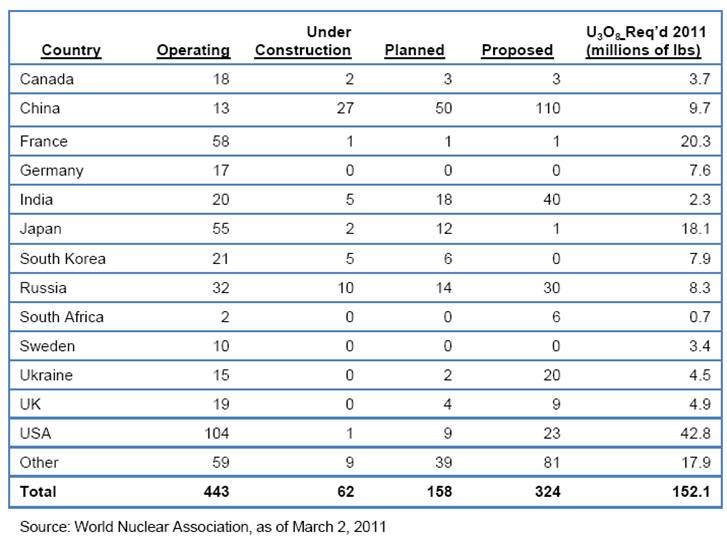
Source: World Nuclear Association (URRE Presentation)
As a result of the damaged Fukushima reactors, coupled with various governmental announcements around the globe, Uranium prices have dropped a whopping -30% within a month – plunging from about $70 per pound to around $50 per pound today.
Where does U.S. Nuclear Go from Here?
As you can see from the chart below, the U.S. is the largest producer of nuclear energy in the world, but since our small population is such power hogs, this relatively large nuclear capability only accounts for roughly 20% of our country’s total electricity needs. France, on the other hand, manages about half the reactors as we do, but the French derive a whopping 75% of their total electricity needs from nuclear power. According to the Nuclear Energy Institute, Japanese reliance on nuclear power falls somewhere in between – 29% of their electricity demand is filled by nuclear energy. Like Japan, the U.S. imports most of its energy needs, so if nuclear development slows, guess what, other resources will need to make up the difference. OPEC and various other oil-rich, dictators in the Middle East are licking their chops over the future prospects for oil prices, if a cost-effective alternative like nuclear ends up getting kicked to the curb.
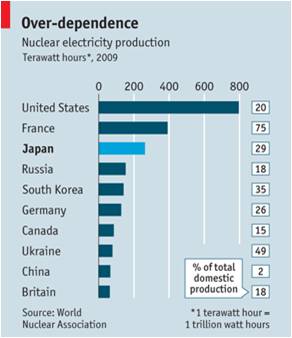
Source: The Economist
As I alluded to above, there is, however, a silver lining. As long as oil prices remain elevated, any void created by a knee-jerk nuclear backlash will only create heightened demand for alternative energy sources, including natural gas, solar, wind, biomass, clean coal, and other creative substitutes. While we Americans may be addicted to oil, we also are inventive, greedy capitalists that will continually look for more cost-efficient alternatives to solve our energy problems (see also Electrifying Profits). Unlike other countries around the world, it looks like the private sector will have to do the heavy lifting to solve these resources on their own dime. Limited subsidies have been introduced, but overall our government has lacked a cohesive energy plan to kick-start some of these innovative energy alternatives.
Déjà Vu All Over Again
We saw what happened on our soil in March 1979 when the Three Mile Island nuclear accident in Pennsylvania consumed the hearts and minds of the country. Pure unadulterated panic set in and new nuclear production ground to a virtual halt. When the subsequent Chernobyl incident happened in April 1986 insult was added to injury. As you can see from the chart below, nuclear reactor capacity has plateaued for some twenty years now.
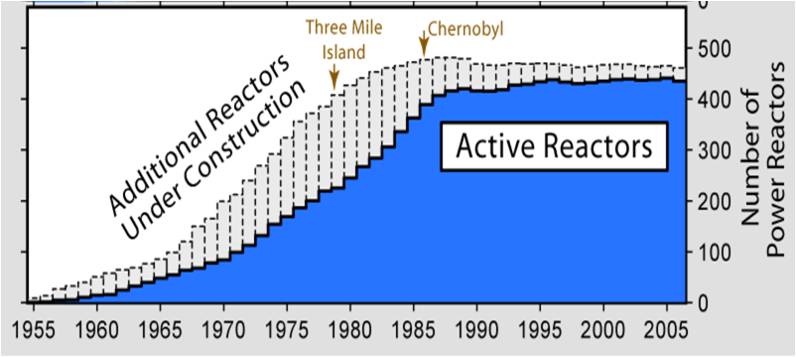
Source: Wikipedia
The driving force behind the plateauing nuclear facilities is the NIMBY (Not In My Back Yard) phenomenon. The Three Mile Island incident is still fresh in people’s minds, which explains why only one nuclear plant is currently under construction in our country, on top of a base of 104 U.S. reactors in 31 states. I point this out as an ambivalent NIMBY-er since I work 30 miles away from one of the riskiest, 30-year-old nuclear plants in the country (San Onofre).
Unintended Consequences
The Sendai disaster is home to the worst Japanese earthquake in 140 years, by some estimates, but history will prove once again what unintended consequences can occur when impulsive knee-jerk decisions are made. Just consider what has happened to oil prices since the moratorium on offshore drilling (post-BP disaster) was instituted. Sure we have witnessed a dictator or two topple in the Middle East, and there currently is adequate supply to meet demand, but I would make the case that we should be increasing domestic oil supplies (along with alternative energy sources), not decreasing supplies because it is politically safe.
Time will tell if the Japanese earthquake/tsunami-induced nuclear disaster will create additional unintended consequences, but I am hopeful the recent events will at a minimum create a serious dialogue about a comprehensive energy policy. If the comfortable, knee-jerk reaction of significantly diminishing nuclear production is broadly adopted around the world, then an urgent alternative supply response needs to occur. Otherwise, you may just need to enjoy that bike ride to work in the morning, along with that nice, romantic candle-lit dinner at night.
Wade W. Slome, CFA, CFP®
Plan. Invest. Prosper.
DISCLOSURE: Sidoxia Capital Management (SCM) and some of its clients own certain exchange traded funds and alternative energy securities, but at the time of publishing SCM had no direct position in BP, URRE, or any other security referenced in this article. No information accessed through the Investing Caffeine (IC) website constitutes investment, financial, legal, tax or other advice nor is to be relied on in making an investment or other decision. Please read disclosure language on IC “Contact” page.
Shoring Up Your Investment Stool from Collapse

With March Madness just kicking into full gear, there’s a chance that your gluteal assets may be parked on a stool in the next two weeks. When leaning on a bar countertop, while seated on a stool, we often take for granted the vital support this device provides, so we can shovel our favorite beverage and pile of nachos into our pie holes. OK, maybe I speak for myself when it comes to my personal, gluttonous habits. But the fact remains, whether you are talking about your rump, or your investment portfolio, you require a firm foundation.
The main problem, when it comes to investments, is the lack of a tangible, visible stool to analyze. Sure, you are able to see the results of a portfolio collapse when there is no foundation to support it, or you may even be able to ignore the results when they remain above water. But many investors do not evenperform the basic due diligence to determine the quality of their investment stool. Before you place your life savings in the hands of some brokerage salesman, or in your personal investment account, you may want to make sure your stool has more than one or two legs.
In the money management world, investors typically choose to buy the stool, rather than build it, which makes perfect common sense. Many people do not have the time or emotional make-up to manage their finances. If left to do it themselves, more often than not, investors usually do a less than stellar job. Unfortunately, when many investors do outsource the management of their investments, they neglect to adequately research the investment stool they buy. Usually the wobbly industry stool operates on the two legs of performance chasing and commission generation (see Fees, Exploitation, and Confusion). For most average investors, it doesn’t take long before that investment strategy teeters and collapses.
If the average investor does not have time to critically evaluate managers that take a long-term, low-cost, tax-efficient strategy to investing, those individuals would be best served by following Warren Buffet’s advice about passive investments, “A very low-cost index is going to beat a majority of the amateur-managed money or professionally-managed money.”
The Four Legs of the Investment Stool
For DIY-ers (Do-It-Yourself-ers), you do not need to buy a stool – you can build it. There are many ways to build a stool, but these are the four crucial legs of investing that have saved my hide over my career, and can be added as support for your investment stool:
1.) Valuation: I love sustainable growth as much as anything, just as much as I would like a shiny new Ferrari. But there needs to be a reasonable price paid for growth, and paying an attractive or fair price for a marquis asset will improve your odds for long-term success.
“Valuations do matter in the stock market, just as good pitching matters in baseball.”
-Fred Hickey (High Tech Strategist)
2.) Cash Flows: Cash flows, and more importantly free cash flows (cash left over after money is spent on capital expenditures), should be investors’ metric of choice. Companies do not pay for dividends, share buybacks, and capital expenditures with pro forma earnings, or non-GAAP earnings. Companies pay for these important outlays with cash.
“In looking for stocks to buy, why do you put so much emphasis on free cash flow? Because it makes the most sense to me. My first job was at a little corner grocery store, and it seemed pretty simple. Cash goes into the register; cash comes out.”
-Bruce Berkowitz (The Fairholme Fund)
3.) Interest Rates: Money goes where it is treated best, so capital will look at the competing yields paid on bonds. Intuitively, interest factors also come into play when calculating the net present value of a stock. Just look at the low Price-Earnings ratios of stocks in the early 1980s when the Fed Funds reached about 20% (versus effectively 0% today). In the long run, higher interest rates (and higher inflation) are bad for stocks, but worse for bonds.
“I don’t know any company that has rewarded any bondholder by raising interest rates [payments] – unlike companies raising dividends.”
-Peter Lynch (Former manager of the Fidelity Magellan Fund)
4.) Quality: This is a subjective factor, but this artistic assessment is as important, if not more important than any of the previous listed factors. In searching for quality, it is best to focus on companies with market share leading positions, strong management teams, and durable competitive advantages.
“If you sleep with dogs, you’re bound to get fleas.”
-Old Proverb
These four legs of the investment stool are essential factors in building a strong investment portfolio, so during the next March Madness party you attend at the local sports bar, make sure to check the sturdiness of your bar stool – you want to make sure your assets are supported with a sturdy foundation.
Wade W. Slome, CFA, CFP®
Plan. Invest. Prosper.
DISCLOSURE: Sidoxia Capital Management (SCM) and some of its clients own certain exchange traded funds, but at the time of publishing SCM had no direct position in Fairholme, Ferrari, or any other security referenced in this article. No information accessed through the Investing Caffeine (IC) website constitutes investment, financial, legal, tax or other advice nor is to be relied on in making an investment or other decision. Please read disclosure language on IC “Contact” page.
Killing Patients to Investment Prosperity

All investors are optimistic, every time they open up a position, but just like surgeons, sometimes the outcome doesn’t turn out as well as initially anticipated. When it comes to investing, I think this old Hindu proverb puts things into perspective:
“No physician is really good before he has killed one or two patients.”
So too, an investor does not become really good until he kills off some investment positions. But like surgeons, investors also have to understand the most important aspect of tragic events is learning from them. In many cases, unexpected outcomes are out of our control and cannot be prevented. This conclusion, in and of itself, can provide valuable insights. But on many occasions, there are procedures, processes, and facts that were missed or botched, and learning from those mistakes can prove invaluable when it comes to refining the process in the future – in order to further minimize the probability of a tragic outcome.
My Personal Killers
Professionally, I have killed some stocks in my career too, or they have killed me, depending on how you look at the situation. How did these heartrending incidents occur? There are several categories that my slaughtered stocks fell under:
- Roll-Up, Throw-Up: Several of my investment mistakes have been tied to roll-up or acquisition-reliant growth stories, where the allure of rapid growth shielded the underlying weak fundamentals of the core businesses. Buying growth is easier to create versus organically producing growth. Those companies addicted to growth by acquisition eventually experience the consequences firsthand when the game ends (i.e., the quality of deals usually deteriorates and/or the prices paid for the acquisitions become excessive).
- Technology Kool-Aid: Another example is the Kool-Aid I drank, during the technology bubble days, related to a “story” stock – Webvan, a grocery delivery concept. How could mixing Domino’s pizza delivery (DZP) with Wal-Mart’s (WMT) low-priced goods not work? I’m just lazy enough to demand a service like that. Well, after spending hundreds of millions of dollars and never reaching the scale necessary to cover the razor thin profit margins, Webvan folded up shop and went bankrupt. But don’t give up hope yet, Amazon (AMZN) is refocusing its attention on the grocery space (mostly non-perishables now) and could become the dominant food delivery retailer.
- Penny Stocks = Dollars Lost: Almost every seasoned investor carries at least one “penny stock” horror story. Unfortunately for me, my biotech miracle stock, Saliva Diagnostics (SALV), did not take off to the moon and provide an early retirement opportunity as planned. On the surface it sounded brilliant. Spit in a cup and Saliva Diagnostic’s proprietary test would determine whether patients were infected with the HIV virus. With millions of HIV/AIDS patients spread around the world, the profit potential behind ‘Saliva’ seemed virtually limitless. The technology unfortunately did not quite pan out, and spit turned into tears.
The Misfortune Silver Lining
These stock tragedies are no fun, but I am not alone. Fortunately for me, and other professionals, there is a nine-lives feline element to investing. One does not need to be right all the time to outperform the indices. “If you’re terrific in this business you’re right 6 times out of 10 – I’ve had stocks go from $11 to 7 cents (American Intl Airways),” admitted investment guru Peter Lynch. Growth stock investing expert, Phil Fisher, added: “Fortunately the long-range profits earned from really good common stocks should more than balance the losses from a normal percentage of such mistakes.”
Warren Buffett takes a more light-hearted approach when he describes investment mistakes: “If you were a golfer and you had a hole in one on every hole, the game wouldn’t be any fun. At least that’s my explanation of why I keep hitting them in the rough.”
Some investors purposely forget traumatic investment experiences, but explicitly sweeping the event under the rug will do more harm than good. So the next time you suffer a horrendous stock price decline, do your best to log the event and learn from the situation. That way, when the patient (stock) has been killed (destroyed), you will become a better, more prosperous doctor (investor).
Wade W. Slome, CFA, CFP®
Plan. Invest. Prosper.
DISCLOSURE: Sidoxia Capital Management (SCM) and some of its clients own certain exchange traded funds, WMT, and AMZN but at the time of publishing SCM had no direct position in DZP, Webvan, Saliva Diagnostics, American intl Airways, or any other security referenced in this article. No information accessed through the Investing Caffeine (IC) website constitutes investment, financial, legal, tax or other advice nor is to be relied on in making an investment or other decision. Please read disclosure language on IC “Contact” page.
Buffett on Gold Fondling and Elephant Hunting
Warren Buffett is kind enough to occasionally grace investors with his perspectives on a wide range of subjects. In his recently released annual letter to shareholders he covered everything from housing and leverage to liquidity and his optimistic outlook on America (read full letter here). Taking advice from the planet’s third wealthiest person (see rankings) is not a bad idea – just like getting basketball pointers from Hall of Famer Michael Jordan or football tips from Pro Bowler Tom Brady isn’t a bad idea either.
Besides being charitable with billions of his dollars, the “Oracle of Omaha” was charitable with his time, spending three hours on the CNBC set (a period equal to $12 million in Charlie Sheen dollars) answering questions, all at the expense of his usual money-making practice of reading through company annual reports and 10Qs.
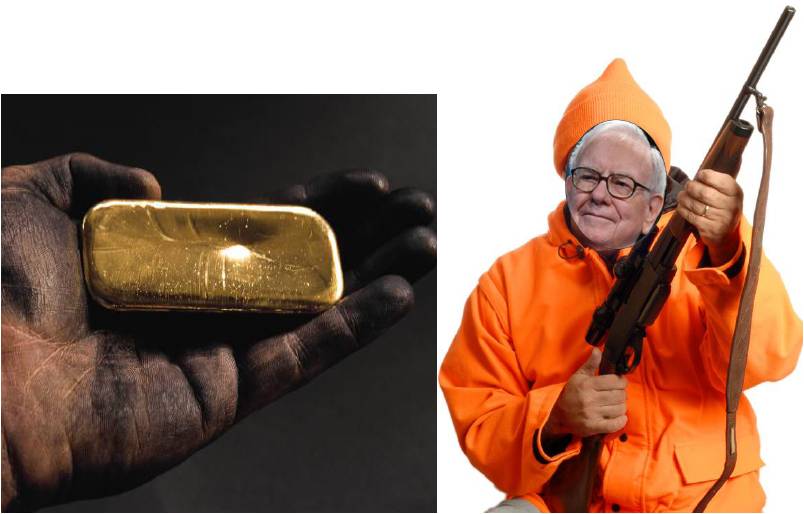
Buffett’s interviews are always good for a few quotable treasures and he didn’t disappoint this time either with some “gold fondling” and “elephant hunting” quotes.
Buffett on Gold & Commodities
Buffett doesn’t hold back on his disdain for “fixed-dollar investments” and isn’t shy about his feelings for commodities when he says:
“The problem with commodities is that you are betting on what someone else would pay for them in six months. The commodity itself isn’t going to do anything for you….it is an entirely different game to buy a lump of something and hope that somebody else pays you more for that lump two years from now than it is to buy something that you expect to produce income for you over time.”
Here he equates gold demand to fear demand:
“Gold is a way of going long on fear, and it has been a pretty good way of going long on fear from time to time. But you really have to hope people become more afraid in a year or two years than they are now. And if they become more afraid you make money, if they become less afraid you lose money, but the gold itself doesn’t produce anything.”
Buffett goes on to say this about the giant gold cube:
“I will say this about gold. If you took all the gold in the world, it would roughly make a cube 67 feet on a side…Now for that same cube of gold, it would be worth at today’s market prices about $7 trillion dollars – that’s probably about a third of the value of all the stocks in the United States…For $7 trillion dollars…you could have all the farmland in the United States, you could have about seven Exxon Mobils (XOM), and you could have a trillion dollars of walking-around money…And if you offered me the choice of looking at some 67 foot cube of gold and looking at it all day, and you know me touching it and fondling it occasionally…Call me crazy, but I’ll take the farmland and the Exxon Mobils.”
Although not offered up in this particular interview, here is another classic quote by Buffett on gold:
“[Gold] gets dug out of the ground in Africa, or someplace. Then we melt it down, dig another hole, bury it again and pay people to stand around guarding it. It has no utility. Anyone watching from Mars would be scratching their head.”
For the most part I agree with Buffett on his gold commentary, but when he says commodities “don’t do anything for you,” I draw the line there. Many commodities, outside of gold, can do a lot for you. Steel is building skyscrapers, copper is wiring cities, uranium is fueling nuclear facilities, and corn is feeding the masses. Buffett believes in buying farms, but without the commodities harvested on that farm, the land would not be producing the income he so emphatically cherishes. Gold on the other hand, while providing some limited utility, has very few applications…other than looking shiny and pretty.
Buffett on Elephant Hunting
Another subject that Buffett addresses in his annual shareholder letter, and again in this interview, is his appetite to complete large “elephant” acquisitions. Since Berkshire Hathaway (BRKA/B) is so large now (total assets over $372 billion), it takes a sizeable elephant deal to be big enough to move the materiality needle for Berkshire.
“We’re looking for elephants. For one thing, there aren’t many elephants out there, and all the elephants don’t want to go in our zoo…It’s going to be rare that we are going find something selling in the tens of billions of dollars; where I understand the business; where the management wants to join up with Berkshire; where the price makes the deal feasible; but it will happen from time to time.”
Buffett’s target universe is actually fairly narrow, if you consider his estimate of about 50 targets that meet his true elephant definition. He has been quite open about the challenges of managing such a gigantic portfolio of assets. The ability to outperform the indexes becomes more difficult as the company swells because size becomes an impediment – “gravity always wins.”
With experience and age comes quote-ability, and Warren Buffett has no shortage in this skill department. The fact that Buffett’s investment track record is virtually untouchable is reason enough to hang upon his every word, but his uncanny aptitude to craft stories and analogies – such as gold fondling and elephant hunting – guarantees I will continue waiting with bated breath for his next sage nuggets of wisdom.
Wade W. Slome, CFA, CFP®
Plan. Invest. Prosper.
DISCLOSURE: Sidoxia Capital Management (SCM) and some of its clients own certain exchange traded funds (including commodities) and commodity related equities, but at the time of publishing SCM had no direct position in BRKA/B, XOM or any other security referenced in this article. No information accessed through the Investing Caffeine (IC) website constitutes investment, financial, legal, tax or other advice nor is to be relied on in making an investment or other decision. Please read disclosure language on IC “Contact” page.
Share Buybacks and Bathroom Violators

We all have our own unique pet peeves that drive us crazy, and I am no exception. More grating than fingernails scraping down the chalkboard or rude drivers who refuse to let you merge lanes are those citizens that unabashedly exercise poor public bathroom etiquette. The only thing worse than listening to the loud-mouth cell phone talker in the neighboring stall is watching a restroom participant move straight from zipper closure (if they remember), immediately to the bathroom exit. I mean really, would it kill you at a minimum to pay a visit to the sink and feign a phantom hand-swipe under some running water? Don’t those people understand that I have to grab the same handle they use to exit the facility after they conduct their bathroom business? OK, now that I have gotten this issue off my chest, I feel better and I can get off my soapbox (no pun intended).
Something Stinks in Share Buyback Land
Beyond potty etiquette, there is another maddening pet peeve that drives me nuts in the realm of corporate capital allocation. I like to call this particular scheme the “empty share buyback.” Those companies that announce the empty share buyback do it with the intention of either getting a quick, short-term jump in stock price, or use the ploy as a way to indirectly line their pockets with future stock and option grants.
Here are a few ways on how the ruse works:
Scheme #1 – The Empty Pump-Fake: In one form or another, here is what the CEO basically says, “We plan to buyback zillions of shares from time to time, based on market conditions, and do not have any set expiration date for the plan.” In other words, the company executives are committing to absolutely nothing, but are hoping to confuse traders into buying shares to temporarily increase the stock price, so management can unload their shares for a swift profit. In actuality the management team is not obligated to purchase one share and may keep the pseudo-share buyback plan in place for years with no benefit to shareholders.
Scheme #2 – The Pocket Swap: Another one of my favorites, I like to call the pocket swap. Management effectively exchanges money from one pocket to the other. Typically management starts off by stating, “We treasure investor feedback, so we have initiated a new program to return capital to our valued shareholders in the form of a share buyback.” What they usually don’t tell investors is that the shares are being purchased (with shareholder money), so the executives can give more shares back to themselves (and a few other fortunate employees). That’s great for them, but what about me?!
At the end of the day, if the management team is truly working for the shareholder, the game is all about reducing the outstanding share count, which thereby increases earnings per share (and better yet free cash flow per share). Despite the recent climb in interest rates, yields are still near multi-decade lows. Corporations are flush with cash after cutting expenses to the bone, delaying hiring, and riding the global recovery wave. For those real investors not trading a position for a few days, weeks, or months, it behooves you to hold management’s feet to the fire to make sure “empty pump-fakes” or “pocket swap” share buybacks are not occurring.
If you have difficulty gauging the integrity of those management teams announcing share buybacks, I have a litmus test that can be used to judge the executive’s true intentions. It’s quite simple – just follow the CEO into the bathroom (same gender required) and see whether they honorably follow bathroom etiquette by washing their hands after completing their duty. Sleuth work can be tricky, but failure in determining the genuine purpose of management’s capital allocation decisions can lead to a share buyback program that will get flushed down the toilet.
Wade W. Slome, CFA, CFP®
Plan. Invest. Prosper.
DISCLOSURE: Sidoxia Capital Management (SCM) and some of its clients own certain exchange traded funds, but at the time of publishing SCM had no direct position in any other security referenced in this article. No information accessed through the Investing Caffeine (IC) website constitutes investment, financial, legal, tax or other advice nor is to be relied on in making an investment or other decision. Please read disclosure language on IC “Contact” page.
Spreading the Seeds of Democracy

Excerpt from Free March Sidoxia Monthly Newsletter (Subscribe on right-side of page)
As we bathe ourselves in petroleum products, it is moments like these that highlight our deeply engrained addiction to oil. The flames of fundamental human rights, freedom, and democracy are spreading like wildfire throughout the Middle East and North Africa, and as a result, the cost of living and doing business has gone up. What started as a random plea by a Tunisian fruit merchant in response to insidious corruption (26 year old Mohammed Bouazizi burned himself to death in revolt to continuous crooked government bribes) has resulted in a broad wave of protesters removing two authoritarian, autocratic Arab leaders. Egyptian President Hosni Mubarak and Tunisian President Zine al-Abidine Ben Ali have been swiftly cast out by energized protesters, and other repressive leaders are likely bound to topple as well.
Who’s next and when? You’ll have to stay tuned, but Colonel Muammar Gaddafi, the Libyan leader, is on the short list. Leaders in Yemen, Bahrain, Jordan, and Algeria are among the other countries that are feeling the heat too. Even though Egypt, Libya, Tunisia, and other aforementioned countries remain relative oil lightweights, fear over a political contagion spreading to more substantive countries like Saudi Arabia has gotten speculators frothing at the mouth, which pushed oil prices above $100 per barrel and gasoline prices to an average of $3.37 per gallon (about $3.60 in California according to AAA motor club).

Source: FT.com - The U.S. population is a fraction of the size of China and India, but we continue guzzling dramatically more crude.
While the bloodshed on the streets has created fodder for great sensationalist headlines for the media outlets, the fact of the matter is that the spread of democracy is nothing new, and the innate desire for basic human rights has never died. Going back to 1900 the world housed about 10 practicing democracies, and today there are arguably more than 100 democratic (and quasi-democratic) countries (see blue line in chart below).
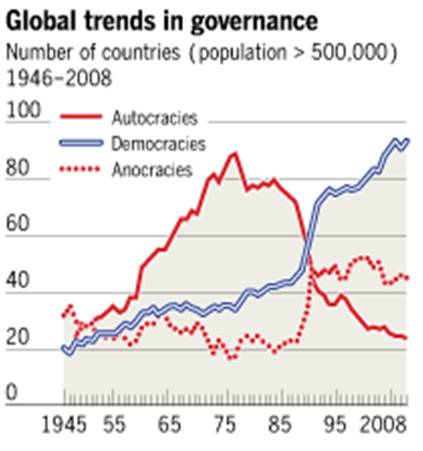
Source: The Financial Times.com
In the U.S., our standard of living has exploded for more than a generation. The internet – and applications like Facebook and Twitter – have flattened the planet and connected the rest of the world to the pleasures available to free, transparent, and open societies. As we have experienced firsthand in Iraq, however, regime changes and moves towards democracy can be messy and costly. Ultimately, the native populations must spearhead the drive toward democratic, political change. Regime change solely rammed through by the U.S. will only create temporary change, and with our fiscal wallets empty, we frankly cannot afford it (see Global Babysitter).
Embracing Alternatives
We didn’t run out of stones in the Stone Age, and we did not run out of steel in the Industrial Revolution. When it comes to oil, the same principle applies. As globalization accelerates the expansion of democratic, emerging middle classes around the world, other oil-rich countries, like Saudi Arabia, understand the havoc that $100-$125 dollar a barrel has on demand destruction. Just like a drug dealer does not want to scare its addicted users, so too oil producers do not want to price consumers out of the market with high prices. Oil may be the lubricant for global commerce, but unlike the empty promises offered by the Jimmy Carter era in the 1970s, technology advancements in the alternative energy industry have reached critical mass. If you don’t believe me, just take a gander at the $17 billion the Chinese are pouring into electric vehicle technology (see Electrifying Profits), or the 20% total energy mandate from renewable sources being instituted in Europe by 2020. Even if we choose to watch from the sidelines and pick our noses, our foreign competitors will wave with delight as they embrace alternative energy resources and race past us. Even if political turmoil temporarily worsens in the Middle East, any additional oil price increases will only make alternative energy resources more economical, and thereby accelerate adoption and make disciples of alternative energy less dependent on some of these oil-rich, corrupt regimes.
Wade W. Slome, CFA, CFP®
Plan. Invest. Prosper.
DISCLOSURE: Sidoxia Capital Management (SCM) and some of its clients own certain exchange traded funds, but at the time of publishing SCM had no direct position in any other security referenced in this article. No information accessed through the Investing Caffeine (IC) website constitutes investment, financial, legal, tax or other advice nor is to be relied on in making an investment or other decision. Please read disclosure language on IC “Contact” page.
Alligators, Airplane Crashes, and the Investment Brain

“Neither a man nor a crowd nor a nation can be trusted to act humanely or think sanely under the influence of a great fear…To conquer fear is the beginning of wisdom.” – Bertrand Russell
Fear is a powerful force, and if not harnessed appropriately can prove ruinous and destructive to the performance of your investment portfolios. The preceding three years have shown the poisonous impacts fear can play on the average investor results, and Jason Zweig, financial columnist at The Wall Street Journal presciently wrote about this subject aptly titled “Fear,” just before the 2008 collapse.
Fear affects us all to differing degrees, and as Zweig points out, often this fear is misguided – even for professional investors. Zweig uses the advancements in neuroscience and behavioral finance to help explain how irrational decisions can often be made. To illustrate the folly in human’s thought process, Zweig offers up a multiple examples. Here is part of a questionnaire he highlights in his article:
“Which animal is responsible for the greatest number of human deaths in the U.S.?
A.) Alligator; B.) Bear; C.) Deer; D.) Shark; and E.) Snake
The ANSWER: C) Deer.
The seemingly most docile creature of the bunch turns out to cause the most deaths. Deer don’t attack with their teeth, but as it turns out, deer prance in front of speeding cars relatively frequently, thereby causing deadly collisions. In fact, deer collisions trigger seven times more deaths than alligators, bears, sharks, and snakes combined, according to Zweig.
Another factoid Zweig uses to explain cloudy human thought processes is the fear-filled topic of plane crashes versus car crashes. People feel very confident driving in a car, yet Zweig points out, you are 65 times more likely to get killed in your own car versus a plane, if you adjust for distance traveled. Hall of Fame NFL football coach John Madden hasn’t flown on an airplane since 1979 due to his fear of flying – investors make equally, if not more, irrational judgments in the investment world.
Professor Dr. Paul Slovic believes controllability and “knowability” contribute to the level of fear or perception of risk. Handguns are believed to be riskier than smoking, in large part because people do not have control over someone going on a gun rampage (i.e., Jared Loughner Tuscon, Arizona murders), while smokers have the power to just stop. The reality is smoking is much riskier than guns. On the “knowability” front, Zweig uses the tornadoes versus asthma comparison. Even though asthma kills more people, since it is silent and slow progressing, people generally believe tornadoes are riskier.
The Tangible Cause
Deep within the brain are two tiny, almond-shaped tissue formations called the amygdala. These parts of the brain, which have been in existence since the period of early-man, serve as an alarm system, which effectively functions as a fear reflex. For instance, the amygdala may elicit an instinctual body response if you encounter a bear, snake, or knife thrown at you.
Money fears set off the amygdala too. Zweig explains the linkage between fiscal and physical fears by stating, “Losing money can ignite the same fundamental fears you would feel if you encountered a charging tiger, got caught in a burning forest, or stood on the crumbling edge of a cliff.” Money plays such a large role in our society and can influence people’s psyches dramatically. Neuroscientist Antonio Damasio observed, “Money represents the means of maintaining life and sustaining us as organisms in our world.”
The Solutions
So as we deal with events such as the Lehman bankruptcy, flash crashes, Greek civil unrest, and Middle East political instability, how should investors cope with these intimidating fears? Zweig has a few recommended techniques to deal with this paramount problem:
1) Create a Distraction: When feeling stressed or overwhelmed by risk, Zweig urges investors to create a distraction or moment of brevity. He adds, “To break your anxiety, go for a walk, hit the gym, call a friend, play with your kids.”
2) Use Your Words: Objectively talking your way through a fearful investment situation can help prevent knee-jerk reactions and suboptimal outcomes. Zweig advises to the investor to answer a list of unbiased questions that forces the individual to focus on the facts – not the emotions.
3) Track Your Feelings: Many investors tend to become overenthusiastic near market tops and show despair near market bottoms. Long-term successful investors realize good investments usually make you sweat. Fidelity fund manager Brian Posner rightly stated, “If it makes me feel like I want to throw up, I can be pretty sure it’s a great investment.” Accomplished value fund manager Chris Davis echoed similar sentiments when he said, “We like the prices that pessimism produces.”
4) Get Away from the Herd: The best investment returns are not achieved by following the crowd. Get a broad range of opinions and continually test your investment thesis to make sure peer pressure is not driving key investment decisions.
Investors can become their worst enemies. Often these fears are created in our minds, whether self-inflicted or indirectly through the media or other source. Do yourself a favor and remove as much emotion from the investment decision-making process, so you do not become hostage to the fear du jour. Worrying too much about alligators and plane crashes will do more harm than good, when making critical decisions.
Read Other Jason Zweig Article from IC
Wade W. Slome, CFA, CFP®
Plan. Invest. Prosper.
DISCLOSURE: Sidoxia Capital Management (SCM) and some of its clients own certain exchange traded funds, but at the time of publishing SCM had no direct position in any other security referenced in this article. No information accessed through the Investing Caffeine (IC) website constitutes investment, financial, legal, tax or other advice nor is to be relied on in making an investment or other decision. Please read disclosure language on IC “Contact” page.
Bears Hibernate During Melt-Up

Source: Photobucket
Here we are 719 days from the market bottom of March 2009, and the S&P 500 has more than doubled from its index low value of 666 to 1343 today. Noticeably absent during the meteoric rise have been the hibernating bears, like economist Nouriel Roubini (aka “Dr. Doom”) or Peter Schiff (see Emperor Schiff Has No Clothes), who blanketed the airwaves in 2008-2009 when financial markets were spiraling downwards out of control. The mere fact that I am writing about this subject may be reason enough to expect a 5-10% correction, but with a +100% upward move in stock prices I am willing to put superstition aside and admire the egg on the face of the perma-bears.
Shape of Recovery
After it became clear that the world was not coming to an end, in late 2009 and throughout 2010, the discussion switched from the likelihood of a “Great Depression” to a debate over the shape of the alphabet letter economic recovery. Was the upturn going to be an L-shaped, V-shaped, square root-shaped, or what Roubini expected – a U-shaped (or bathtub-shaped) recovery? You be the judge — does six consecutive quarters of GDP expansion with unemployment declining look like a bathtub recovery to you?
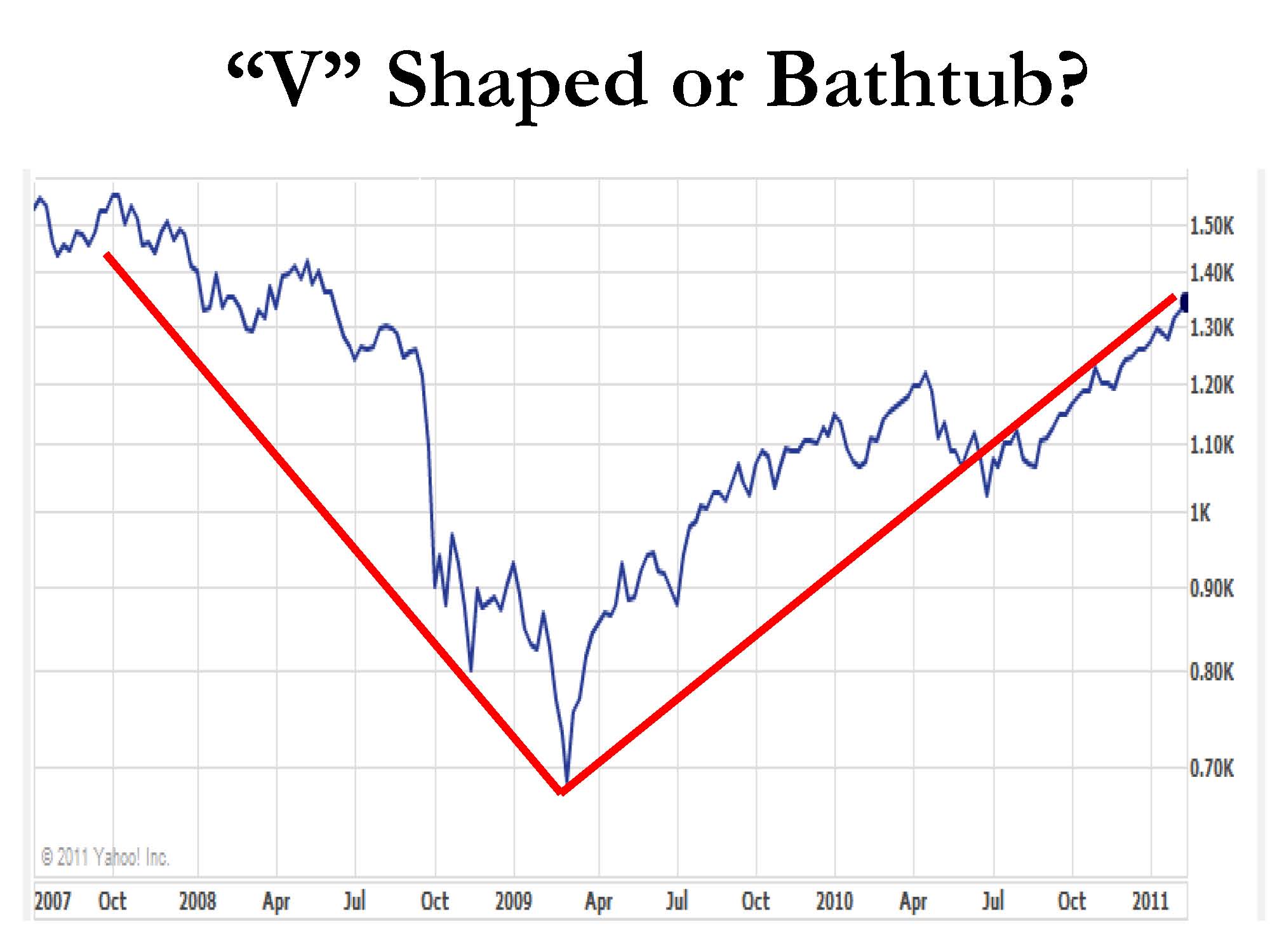
Chart Source: Yahoo Finance
This picture above looks more like a “V” to me, and the recently reported Institute for Supply Management’s (ISM) manufacturing index figure of 60.8 in January (the highest reading in seven years) lends credence to a stronger resurgence in the economy. Apparently the PIMCO bear brothers, Mohamed El-Erian and Bill Gross, are upwardly adjusting their view of a “New Normal” environment as well. Just recently, the firm raised its 2011 GDP forecast by 40-50% to a growth rate of 3-3.5% in 2011.
The Bears’ Logic
Bears continually explain away the market melt-up as a phenomenon caused by excessive and artificial liquidity creation (i.e., QE2 money printing, and 0% interest rate policy) Bernanke has provided the economy. Similar logic could be used to describe the excessive and artificial debt creation generated by individuals, corporations, and governments during the 2008-2009 meltdown. Now that leveraged positions are beginning to unwind (banks recapitalizing, consumers increasing savings rate, state and government austerity and tax measures, etc.), the bears still offer little credit to these improving trends.
Are we likely to experience another +100% upward move in stock prices in the broader indexes over the next two years? Unlikely. Our structural government debt and deficits, coupled with elevated unemployment and fiercer foreign competition are all factors creating economic headwinds. Moreover, inflation is starting to heat up and a Federal Funds rate policy cannot stay at 0% forever.
The Shapes of Rebounds
To put the two-year equity market recovery in historical perspective, the Financial Times published a 75-year study which showed the current market resurgence (solid red line) only trailing the post-Great Depression rebound of 1935-1938.
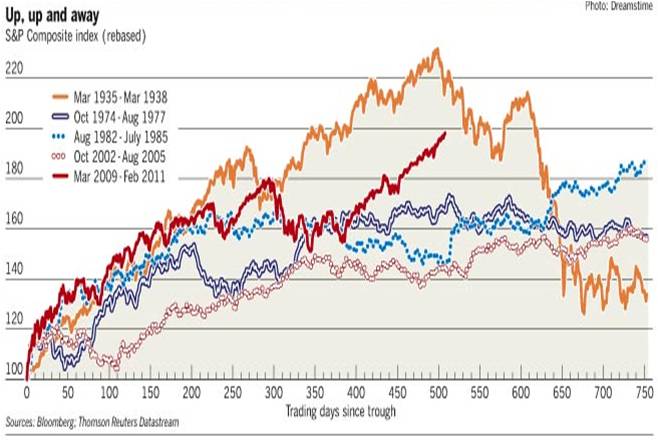
Source: Financial Times
Although we are absolutely not out of the economic woods and contrarian sentiment indicators (i.e., Volatility Index and Put-Call ratio) are screaming for a pullback, the foundation of a sustainable global recovery has firmed despite the persisting chaos occurring in the Middle East. Fourth quarter 2010 corporate profits (and revenues) once again exceeded expectations, valuations remain attractive, and floods of itchy retail cash still remain on the sidelines just waiting to jump in and chase the upward march in equity prices. Although the trajectory of stock prices over the next two years is unlikely to look like the last two years, there is still room for optimism (as I outlined last year in Genesis of Cheap Stocks). The low-hanging equity fruit has been picked over the last few years, and I’m certain that bears like Roubini, Schiff, El-Erian, Gross, et.al. will eventually come out of hibernation. For those investors not fully invested, I believe it would be wise to wait for the inevitable growls of the bears to resurface, so you can take further advantage of attractive market opportunities.
Click Here for More on the PIMCO Downhill Marathon Machine
Wade W. Slome, CFA, CFP®
Plan. Invest. Prosper.
DISCLOSURE: Sidoxia Capital Management (SCM) and some of its clients own certain exchange traded funds, but at the time of publishing SCM had no direct position in any other security referenced in this article. No information accessed through the Investing Caffeine (IC) website constitutes investment, financial, legal, tax or other advice nor is to be relied on in making an investment or other decision. Please read disclosure language on IC “Contact” page.
Historical Trampoline Cycles of Fear & Greed

What goes up, eventually comes down, and what goes down, eventually comes up. Like an adolescent jumping on a trampoline, emotions in the financial markets jump sky high before crashing down to earth…and then the process repeats itself. The underlying reasons behind every market gyration are different, but the emotions of fear and greed are similar. Since 1919, there have been 29 recessions, and 29 recoveries (pretty good recovery batting average). Over that 92 year period we have also witnessed the Dow Jones Industrial Average go from around 100 in 1919 to over 12,300 today – not too shabby.
The blood curdling panic experienced in 2008 and early 2009 has turned to ordinary fear among retail investors – although the doubling of the equity markets from two years ago has instilled a good dosage of animal spirits into professional traders and speculators. When trillions of low yielding cash and Treasuries ultimately come barreling into equity markets, thereby extending equity valuations, then I will become extra nervous. Until then, plenty of opportunities still exist – there just is not nearly as much low-hanging fruit as two years ago.
More of the Same
To make the point that “the more things change, the more things stay the same,” you can go all the way back to 1932 and read the words of Dean Witter – I also wrote about the history of panic in the 1970s (see Rhyming History).
Even some 80 years ago, Witter was keenly aware of the doomsday bears:
“People are deterred from buying good stocks and bonds now only because of an unwarranted terror…All sorts of bugaboos are paraded to destroy the last vestige of confidence. Stories of disaster which are incredible and untrue are told to foolish and credulous listeners, who appear willing to believe the worst.”
The bugaboo purveyors I called out in 2009 included Peter Schiff, Nouriel Roubini, Meredith Whitney, and Jimmy Rogers. I’m not sure who the next genius du jour(s) will be, but I am confident they will be prominently paraded over the media airwaves.
Cherry Price for Consensus
As firmer signs of an economic recovery finally take hold, investors slowly regain confidence about investing in risky assets. The only problem is that prices have skyrocketed! Witter captures this dynamic beautifully back in 1932:
“Some people say that they wish to await a clearer view of the future. When the future is again clear the present bargains will no longer be available. Does anyone think that present prices will continue when confidence has been fully restored? Such bargains exist only because of terror and distress.”
Herd Gets Slaughtered
History proves over and over again…the general investing public suffers the consequences of following the herd of fear and greed. Or as Witter states:
“It is easy to run with the crowd. The path of least resistance is to join in the wailings that are now so popular. The constructive policy, however, is to maintain your courage and your optimism, to have faith in the ultimate future of your country and to proclaim your faith and to recommend the purchase of good bonds and good stocks, which are inordinately depreciated.”
In the short-run, markets move up and down in an unpredictable fashion, like an irresponsible teenager jumping on a trampoline. In the long-run, investors can do themselves a favor by ignoring the masses, and sticking to a disciplined, systematic investment approach that includes controlled valuation metrics and contrarian sentiment factors. That way, you won’t fall off the investment trampoline and permanently break your portfolio.
Wade W. Slome, CFA, CFP®
Plan. Invest. Prosper.
DISCLOSURE: Sidoxia Capital Management (SCM) and some of its clients own certain exchange traded funds, but at the time of publishing SCM had no direct position in any other security referenced in this article. No information accessed through the Investing Caffeine (IC) website constitutes investment, financial, legal, tax or other advice nor is to be relied on in making an investment or other decision. Please read disclosure language on IC “Contact” page.




