Posts filed under ‘Stocks’
Darkest Before Dawn – Gaming Industry Waiting for Sunrise

It is always darkest before dawn, and right now the days are dark in the video game industry.
The industry is facing multiple challenges ranging from the migration of players from console games to digital online games; the growth of the iPhone and mobile devices as a free and discounted gaming platform; sky-rocketing development and marketing costs; and not to mention a consumer recession in which coughing up $50-$60 bucks a pop for a next generation platform game can be quite painful (read more on economy).
Recent console price cuts are a welcomed positive, but industry leading Electronic Arts CEO (Ticker: ERTS), John Riccitiello’s sober assessment of the industry was summarized as followed:
“While the recent hardware price reductions are driving higher console sales, the improvement is not enough to get the industry back to flat software sales for the calendar year. We now expect packaged goods software to be down mid-to-high single digits in North America and Europe combined. This is well below our initial expectations for the year.”
Not all is lost, however. I am amazed out how gaming has expanded since I was a kid. I may be dating myself, but I vividly recall the endless summer days of playing Adventure and Pac-Man on my Atari 2600 and heading over to the arcade to play Defender with my buddies. Since the 1970s, the industry has matured dramatically.
If you don’t believe me, check out the trailer from the new industry megahit Call of Duty: Modern Warfare 2. Industry analysts are calling for an amazing $500 million in sales…in the first week! By way of comparison, this year’s top-grossing film in the U.S., “Transformers: Revenge of the Fallen,” generated over $200 million in sales over the first five days of its release.
If you have more time to burn, you can take a walk down memory lane to look at the history of video games from 1972 to 2007.
Electronic Arts (ERTS) a Long-Term Winner
As the complexity of the video game industry rises, the barriers to entry become even tougher, and weaker competitors fall to the way side. Industry leaders like Electronic Arts (EA), with approximately $4 billion in revenues and $2 billion in cash and securities on their balance sheet (with virtually no debt), stand to be powerful survivors once the industry finds its way through the valley. Not a large percentage of companies have about a third of its market capitalization in cash. Financial strength alone does not mean much if a company were in continual decline, but I strongly believe the industry will eventually rebound and EA will be pulled up with the tide. In their most recent quarter, the company highlighted their growing market share in North America and Europe couple with their #1 software publisher positioning on the PlayStation3 (PS3) and Microsoft Xbox 360 platforms.
Given all the swirling shifts in the industry, EA is not sitting on its hands either. In conjunction with the company’s earnings release, EA simultaneously announced their acquisition of Playfish, the largest social networking game provider on the internet, attracting over 60 million players per month and securing the #2 game provider position on Facebook. On the cost front, the company is implementing a targeted headcount reduction by approximately 1,500 employees, which will reduce costs by at least $100 million. This austerity plan will make EA more competitive and allow the company to invest more in growth initiatives and better handle the curveballs thrown at them. EA has become more focused too. As part of the cuts, the company will reduce the number of game titles from the mid-60 count last year to the high-30s next year. Quality, not quantity is the new emphasis and more resources will be diverted to EA’s online digital efforts.
The traditional video game packaged-game industry is very hit-driven, much like the movie industry. One way EA deals with this challenge is by creating franchises that keep consumers wanting more, whether it’s sequels to the Sims, Harry Potter, or other titles. Better yet, EA has created a razor blade replacement model with their sports franchises. For example, in Electronic Art’s Madden NFL franchise football game, players need to update their athlete rosters to account for the annual post-season blockbuster trades and fresh rookie signees. EA’s Sports division has a built-in mechanism to drive recurring demand for new content.
With the stock over $60 less than 24 months ago, a large percentage of the industry and company warts have already been discovered and discounted into the current stock price (~$18). As with all my stock picks, I leave dry powder as ammunition for any future purchases at lower prices. The critical two week selling season has historically accounted for up to 1/3 of a company’s total annual sales – that’s what I call a back-end loaded revenue stream! Or put another way, the software industry traditionally generates almost half of its annual sales during the holiday season. The tightly concentrated timeline for sales may bring heightened volatility to the stock’s trading pattern in the coming weeks.
For those with an extended time horizon, one need only look at EA’s cash pile, market positioning, normalized earnings, and long-term industry prospects in order to take a closer examination at Electronic Arts. Times are dark in the video game industry, but dawn will be here soon enough and Electronic Arts is positioned to benefit when the time comes.
Read EA’s Fiscal Q2 Earnings Call Transcript from Seeking Alpha
Wade W. Slome, CFA, CFP®
Plan. Invest. Prosper.
DISCLOSURE: Sidoxia Capital Management (SCM) and its clients have a long position in ERTS and AAPL at the time this article was originally posted. SCM and its clients own certain exchange traded funds, but currently have no direct position in ATVI, SNE, MSFT, or Facebook. No information accessed through the Investing Caffeine (IC) website constitutes investment, financial, legal, tax or other advice nor is to be relied on in making an investment or other decision. Please read disclosure language on IC “Contact” page.
From Pooches to Profits

Oh, I’m sure you’ve seen them – those nauseating people that willingly accept facial tongue baths from their pets and dress them up in ridiculous costumes. Hey, wait a second… I guess I’m one of those annoying people too. My wife and I were just debating which Halloween attire we should get for our dog…Cound Dogula or Barkenstein? But we are not the only fanatics humanizing our pets, as Petsmart (PETM) recently outlined in their recent analyst day. Sixty-two percent of U.S. households own a pet and if you just add up all the cats and dogs, the total reaches 171 million pets.
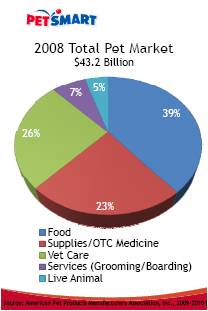
This is no small business – according to PETM, the industry exceeded $43 billion in 2008, spanning a whole variety of products and services, including food, veterinary care, supplies, and grooming/boarding services. PETM is collecting its growing share of the market at 14%, and I expect this share to increase over time.
What’s fueling the growth of the sector? For one, demographics is a contributor. As many Baby Boomers have become “empty-nesters” (kids move on) over time, they tend to fill that void with a pet. In addition, many working marriages have pushed having kids to the back-burner and choose to substitute a furry baby as a surrogate.
These trends have translated into vibrant growth for PETM over the years. The company has over 1,150 stores and 738 Banfield veterinary partnership locations, not to mention a significant rise in hotels. No, these are not the Four Seasons, but rather pet hotels that you can board Fido in when you take that family vacation to Hawaii or where guilt-ridden families can drop your friend off for doggy Day camp. These 156 pet hotels, which are included as part of PETM’s “Services,” continue to gain traction as they plan to open 20 new locations per year. Currently, services represents 11% of PETM’s sales (up from 8.8% in 2006), growing faster than overall sales with a significantly higher profit margins than the corporate average.
Source: Petsmart 2009 Analyst Day
Not everything is peachy keen as the company acknowledges the negative impact of unemployment, lower discretionary consumer spending and higher savings rate. As a result, PETM’s high margin “Hardgoods” category has gotten clobbered lately – even with more stable sales in non-discretionary categories like “Food.” Despite the economic developments, the company is not sitting on its hands. Not only are they focusing on driving sales through store pet adoptions (approaching four million on a cumulative basis), but the company is also reaping the rewards of its Pet Perks customer database to optimize sales performance. Petsmart has even taken a page out of Costco’s (COST) book with its focus on private label brands.
Beyond sales growth initiatives, the company has also been tightening their spending belt. For example, PETM is reducing capital expenditures from 6.4% of sales ($294 million) in 2007 to an estimated 2.2% ($120 million) this year. In addition, PETM is working on process improvements, space optimization, labor scheduling, and other cost-cutting initiatives.
The fruits of these labors are creating results. Just last week at their analyst meeting, PETM raised their 2009 earnings per share forecast to a range of $1.43 – $1.51 (from previous estimate of $1.37 – $1.45). Based on 2010 Wall Street estimate of $1.54, PETM’s stock currently trades at a reasonable 16.5x P/E multiple. On a free cash flow basis, the multiple on the estimated $226 million this year is even more attractive (see my article on cash flow investing).
Halloween is just around the corner, so maybe beyond picking up a doggie cardigan for the crisp fall weather, maybe you should consider some PETM shares too.
Wade W. Slome, CFA, CFP®
Plan. Invest. Prosper.
DISCLOSURE: Sidoxia Capital Management and its client accounts have no direct position in COST shares at the time this article was originally posted. Slome Sidoxia Fund does have a long position in PETM shares at the time this article was originally posted. No information accessed through the Investing Caffeine (IC) website constitutes investment, financial, legal, tax or other advice nor is to be relied on in making an investment or other decision. Please read disclosure language on IC “Contact” page.
Siegel Digs in Heels on Stocks

Jeremy Siegel, Wharton University Professor and author of Stocks for the Long Run, is defending his long-term thesis that stocks will outperform bonds over the long-run. Mr. Siegel in his latest Financial Times article vigorously defends his optimistic equity belief despite recent questions regarding the validity and accuracy of his long-term data (see my earlier article).
He acknowledges the -3.15% return of U.S. stock performance over the last decade (the fourth worst period since 1871), so what gives him confidence in stocks now? Let’s take a peek on why Siegel is digging in his heels:
Since 1871, the three worst ten-year returns for stocks have ended in the years 1974, 1920, and 1978. These were followed, respectively, by real, after-inflation stock returns of more than 8 per cent, 13 per cent, and 9 per cent over next ten years. In fact for the 13 ten-year periods of negative returns stocks have suffered since 1871, the next ten years gave investors real returns that averaged over 10 per cent per year. This return has far exceeded the average 6.66 per cent real return in all ten years periods, and is twice the return offered by long-term government bonds.
Siegel’s bullish stock stance has also been attacked by Robert Arnott, Chairman of Research Affiliates, when he noted a certain bond strategy bested stocks over the last 40 years. Here’s what Mr. Siegel has to say about stock versus bond performance:
Even with the recent bear market factored in, stocks have always done better than Treasury bonds over every 30-year period since 1871. And over 20-year periods, stocks bested Treasuries in all but about 5 per cent of the cases… In fact, with the recent stock market recovery and bond market decline, stock returns now handily outpace bond returns over the past 30 and 40 years.
If you’re 50, 60, or older, then Siegel’s time horizons may not fit into your plans. Nonetheless, in any game one chooses to play (including the game of money), I, like many, prefer to have the odds stacked in my favor.
In addressing the skeptics, such as Bill Gross who believes the U.S. is entering a “New Normal” phase of sluggish growth, Mr. Siegel notes this commentary even if true does not account for the faster pace of international growth – Siegel goes on to explain that the S&P 500 corporations garner almost 50% of revenues from these faster growing areas outside the U.S.
On the subject of valuation, Mr. Siegel highlights the market is trading at roughly 14x’s 2010 estimates, well below the 18-20x multiples usually associated with low-interest rate periods like these.
In periods of extreme volatility (upwards or downwards), the prevailing beliefs fight reversion to the mean arguments because trend followers believe “this time is different.” Just think of the cab drivers who were buying tech stocks in the late 1990s, or of the neighbor buying rental real estate in 2006. Bill Gross with his “New Normal” doesn’t buy the reversion argument either. Time will tell if we have entered a new challenging era like Mr. Gross sees? Regardless, Professor Siegel will be digging in his heels as he invests in stocks for the long run.
Read the Whole Financial Times Article Written by Professor Siegel
Wade W. Slome, CFA, CFP®
Plan. Invest. Prosper.
EPS House of Cards: Tricks of the Trade

As we enter the quarterly ritual of the tsunami of earnings reports, investors will be combing through the financial reports. Due to the flood of information, and increasingly shorter and shorter investment time horizons, much of investors’ focus will center on a few quarterly report metrics – primarily earnings per share (EPS), revenues, and forecasts/guidance (if provided).
Many lessons have been learned from the financial crisis over the last few years, and one of the major ones is to do your homework thoroughly. Relying on a AAA ratings from Moody’s (MCO) and S&P (when ratings should have been more appropriately graded D or F) or blindly following a “Buy” rating from a conflicted investment banking firm just does not make sense.
FINANCIAL SECTOR COLLAPSE
Given the severity of the losses, investors need to be more demanding and comprehensive in their earnings analysis. In many instances the reported earnings numbers resemble a deceptive house of cards on a weak foundation, merely overlooked by distracted investors. Case in point is the Financial sector, which before the financial collapse saw distorted multi-year growth, propelled by phantom earnings due to artificial asset inflation and excessive leverage. One need look no further than the weighting of Financial stocks, which ballooned from 5% of the total S&P 500 Index market capitalization in 1980 to a peak of 23% in 2007. Once the credit and real estate bubble burst, the sector subsequently imploded to around 9% of the index value around the March 2009 lows. Let’s be honest, and ask ourselves how much faith can we put in the Financial sector earnings figures that moved from +$22.79 in 2007 to a loss of -$21.24 in 2008? Current forecasts for the sector are looking for a rebound back up to +$11.91 in 2010. Luckily, the opacity and black box nature of many of these Financials largely kept me out of the 2009 sector implosion.
WHAT TO WATCH FOR
But the Financial sector is not the only fuzzy areas of accounting manipulation. Thanks to our friends at the FASB (Financial Accounting Standards Board), company management teams have discretion in how they apply different GAAP (Generally Accepted Accounting Principles) rules. Saj Karsan, a contributing writer at Morningstar.com, also writes about the “Fallacy of Earnings Per Share.”
“EPS can fluctuate wildly from year to year. Writedowns, abnormal business conditions, asset sale gains/losses and other unusual factors find their way into EPS quite often. Investors are urged to average EPS over a business cycle, as stressed in Security Analysis Chapter 37, in order to get a true picture of a company’s earnings power.”
These gray areas of interpretation can lead to a range of distorted EPS outcomes. Here are a few ways companies can manipulate their EPS:
Distorted Expenses: If a $10 million manufacturing plant is expected to last 10 years, then the depreciation expense should be $1 million per year. If for some reason the Chief Financial Officer (CFO) suddenly decided the building would last 40 years rather than 10 years, then the expense would only be $250,000 per year. Voila, an instant $750,000 annual gain was created out of thin air due to management’s change in estimates.
Magical Revenues: Some companies have been known to do what’s called “stuffing the channel.” Or in other words, companies sometimes will ship product to a distributor or customer even if there is no immediate demand for that product. This practice can potentially increase the revenue of the reporting company, while providing the customer with more inventory on-hand. The major problem with the strategy is cash collection, which can be pushed way off in the future or become uncollectible.
Accounting Shifts: Under certain circumstances, specific expenses can be converted to an asset on the balance sheet, leading to inflated EPS numbers. A common example of this phenomenon occurs in the software industry, where software engineering expenses on the income statement get converted to capitalized software assets on the balance sheet. Again, like other schemes, this practice delays the negative expense effects on reported earnings.
Artificial Income: Not only did many of the trouble banks make imprudent loans to borrowers that were unlikely to repay, but the loans were made based on assumptions that asset prices would go up indefinitely and credit costs would remain freakishly low. Based on the overly optimistic repayment and loss assumptions, banks recognized massive amounts of gains which propelled even more imprudent loans. Needless to say, investors are now more tightly questioning these assumptions. That said, recent relaxation of mark-to-market accounting makes it even more difficult to estimate the true values of assets on the bank’s balance sheets.
Like dieting, there are no easy solutions. Tearing through the financial statements is tough work and requires a lot of diligence. My process of identifying winning stocks is heavily cash flow based (see my article on cash flow investing) analysis, which although lumpier and more volatile than basic EPS analysis, provides a deeper understanding of a company’s value-creating capabilities and true cash generation powers.
As earnings season kicks into full gear, do yourself a favor and not only take a more critical” eye towards company earnings, but follow the cash to a firmer conviction in your stock picks. Otherwise, those shaky EPS numbers may lead to a tumbling house of cards.
Read Saj Karsan’s Full Article
Wade W. Slome, CFA, CFP®
Plan. Invest. Prosper.
DISCLOSURE: Sidoxia Capital Management has no direct position in MCO or MHP at the time this article was originally posted. No information accessed through the Investing Caffeine (IC) website constitutes investment, financial, legal, tax or other advice nor is to be relied on in making an investment or other decision. Please read disclosure language on IC “Contact” page.
Amazon: Growing Up to be Wal-Mart

Wal-Mart (WMT) got its start almost 50 years ago with its first store in Rogers, Arkansas (1962). Since then, the company has expanded to create a global franchise generating more than $400 billion in revenues with a market capitalization valued at about $190 billion. Amazon.com Inc. (AMZN) is a relative toddler (founded in 1995 by CEO Jeff Bezos) generating about $20 billion in revenue with a market cap about 1/5th that of Wal-Mart. Mr. Bezos graduated summa cum laude, Phi Beta Kappa in electrical engineering and computer science from Princeton University in 1986, and we know he has no problem in thinking big. The evidence can be found in his space travel company, Blue Origin, which is expected to initiate human travel in the upcoming years. Beyond space, Mr. Bezos is presented with a multitude of growth opportunities that have the potential of elevating Amazon from a young toddler into a mature adult like its cousin Wal-Mart.
So how does Mr. Bezos get the company through puberty to adulthood? Well actually, all I believe it will take is just more of the same. The company has created an incredible franchise with huge barriers to entry, if you consider the billions spent on the technology, infrastructure, and its distribution dominance as compared to its e-commerce brethren. Bolting on new categories (whether its jewelry, sporting goods, groceries, private label or digital downloads) can be extremely profitable since unlike Wal-Mart, Amazon doesn’t need to build or reconfigure thousands of stores to expand into new categories. For example, Wal-Mart has opened over 600 Sam’s stores nationally in order to target the wholesale club market. Once a new category is added, the blue-print is rolled out nationally and then eventually internationally. And just like Wal-Mart, as economies of scale are achieved, the cost savings are rolled back into lower prices, which then brings more customers, and even more scale advantages. This virtuous cycle then creates deeper and deeper moats separating itself from competitors.
GROWTH OPPORTUNITIES
Besides just the natural expansion of users purchasing more online and Amazon adding to existing categories, here are some other fertile areas for future growth:
- Amazon Prime (Free shipping membership is driving incremental revenue and usage).
- Kindle (This digital reader is already estimated to account for 35% of Amazon’s book sales and some analysts see $2 billion in Kindle revenues by 2012).
- Zappos.com (This acquisition provides instant dominance in shoes and adjacent product lines).
- International Expansion (Joyco.com acquisition in China is an example of how Amazon is expanding into emerging markets).
- New Categories (There are virtually limitless potential categories, but the migration to digital will be key).
- Cloud Computing, Storage & Other Services (EC2 cloud computing, S3 storage, and other outsourced technology services offer promising opportunities).
TREND IS AMAZON’S FRIEND

Source: U.S. Department of Commerce
E-Commerce sales account for only about 3.6% of total retail sales ($32.4 billion in Q2’09), but as you can see from the chart, the upward sloping trend is the friend of Amazon. With the proliferation of broadband and the natural aging of our next generation of computer-savvy internet users, not only is the number of online shoppers increasing, but the amount of time spent online is escalating as well. If you consider catalog sales (e.g. Land’s End, L.L. Bean, Eddie Bauer, etc.) have represented about 7-8% of total retail sales, there is a lot of head-room left for online sales to catch-up or replace these sales. Mr. Bezos believes online industry sales can ultimately reach 15% of total retail sales (double catalog sales). Top-rate online franchises like Amazon will be natural beneficiaries of these trends and funnel shoppers through their internet aisles, as a function of these demographic and behavioral tailwinds.
CAPITAL ADVANTAGE
Even when you account for the significantly higher revenue growth rates and growth initiatives (e.g., Kindle, E3, digital, etc) for Amazon relative to Wal-Mart, the capital intensity (as measured by CAPEX/Sales) is still about 70% higher for Wal-Mart as compared to Amazon. For one thing, Amazon does not need to support the some 8,100 stores in 15 countries that Wal-Mart is saddled with, and in turn Amazon can redeploy that capital into areas such as new products, services, and lower delivery costs. Surviving the dot-com bubble bursting, along with paying down billions of debt has afforded Amazon even more capital flexibility.
VALUATION
Valuation can be tricky, especially when you’re talking about a high growth company like Amazon. The exercise becomes a little easier once you realize Amazon is generating about $1.5 billion in free cash flow per year, with $4.3 billion in cash/investments on the balance sheet with virtually no debt in the middle of one of the worst recessions in a generation. At roughly $90 per share, AMZN is trading at over 53x’s Wall Street analysts’ projected earnings of $1.68 for 2009. Jeff Bezos and the rest of the management make it very clear the company is managing their business to one key goal – maximize free cash flow per share (music to my ears – see my article on cash flow). On that basis, AMZN trades at about 25x’s trailing free cash flow and closer to 22x’s if you strip out the $4 billion+ in cash on the balance sheet. If AMZN can grow 15% for the next 5 years (not a given), the valuations just mentioned above could be chopped in half, if price levels and share count remained constant.
With the large run-up in 2009, I have locked in some gains this year, but tactically I will be doing what “Deep Throat” advised in the movie All the President’s Men, and that is to follow the money (cash). If Bezos and Amazon can continue on its current growth trajectory in the coming years, this toddler will mature into a company more closely resembling its cousin Wal-Mart.
Wade S. Slome, CFA, CFP®
Plan. Invest. Prosper.
DISCLOSURE: Sidoxia Capital Management and client accounts do have direct long positions in AMZN and WMT at the time article was originally posted. No information accessed through the Investing Caffeine (IC) website constitutes investment, financial, legal, tax or other advice nor is to be relied on in making an investment or other decision. Please read disclosure language on IC “Contact” page.
Taking Facebook and Twitter Public

Facebook CEO Mark Zuckerberg
Valuing high growth companies is similar to answering a typical open-ended question posed to me during business school interviews: “Wade, how many ping pong balls can you fit in an empty 747 airplane?” Obviously, the estimation process is not an exact science, but rather an artistic exercise in which various techniques and strategies may be implemented to form a more educated guess. The same estimation principles apply to the tricky challenge of valuing high growth companies like Facebook and Twitter.
Cash is King
Where does one start? Conceptually, one method used to determine a company’s value is by taking the present value of all future cash flows. For growth companies, earnings and cash flows can vary dramatically and small changes in assumptions (i.e., revenue growth rates, profit margins, discount rates, taxes, etc.) can lead to drastically different valuations. As I have mentioned in the past, cash flow analysis is a great way to value companies across a broad array of industries – excluding financial companies (see previous article on cash flow investing).
Mature companies operating in stable industries may be piling up cash because of limited revenue growth opportunities. Such companies may choose to pay out dividends, buyback stock, or possibly make acquisitions of target competitors. However, for hyper-growth companies earlier in their business life-cycles, (e.g., Facebook and Twitter), discretionary cash flow may be directly reinvested back into the company, and/or allocated towards numerous growth projects. If these growth companies are not generating a lot of excess free cash flow (cash flow from operations minus capital expenditures), then how does one value such companies? Typically, under a traditional DCF (discounted cash flow model), modest early year cash flows are forecasted until more substantial cash flows are generated in the future, at which point all cash flows are discounted back to today. This process is philosophically pure, but very imprecise and subject to the manipulation and bias of many inputs.
To combat the multi-year wiggle room of a subjective DCF, I choose to calculate what I call “adjusted free cash flow” (cash flow from operations minus depreciation and amortization). The adjusted free cash flow approach provides a perspective on how much cash a growth company theoretically can generate if it decides to not pursue incremental growth projects in excess of maintenance capital expenditures. In other words, I use depreciation and amortization as a proxy for maintenance CAPEX. I believe cash flow figures are much more reliable in valuing growth companies because such cash-based metrics are less subject to manipulation compared to traditional measures like earnings per share (EPS) and net income from the income statement.
Rationalizing Ratios
Other valuation methods to consider for growth companies*:
- PE Ratio: The price-earnings ratio indicates how expensive a stock is by comparing its share price to the company’s earnings.
- PEG Ratio (PE-to-Growth): This metric compares the PE ratio to the earnings growth rate percentage. As a rule of thumb, PEG ratios less than one are considered attractive to some investors, regardless of the absolute PE level.
- Price-to-Sales: This ratio is less precise in my mind because companies can’t pay investors dividends, buy back stock, or make acquisitions with “sales” – discretionary capital comes from earnings and cash flows.
- Price-to-Book: Compares the market capitalization (price) of the company with the book value (or equity) component on the balance sheet.
- EV/EBITDA: Enterprise value (EV) is the total value of the market capitalization plus the value of the debt, divided by EBITDA (Earnings Before Interest Taxes Depreciation and Amortization). Some investors use EBITDA as an income-based surrogate of cash flow.
- FCF Yield: One of my personal favorites – you can think of this percentage as an inverted PE ratio that substitutes free cash flow for earnings. Rather than a yield on a bond, this ratio effectively provides investors with a discretionary cash yield on a stock.
*All The ratios above should be reviewed both on an absolute basis and relative basis in conjunction with comparable companies in an industry. Faster growing industries, in general, should carry higher ratio metrics.
Taking Facebook and Twitter Public
Before we can even take a stab at some of these growth company valuations, we need to look at the historical financial statements (income statement, balance sheet, and cash flow statement). In the case of Facebook and Twitter, since these companies are private, there are no publically available financial statements to peruse. Private investors are generally left in the dark, limited to public news related to what other early investors have paid for ownership stakes. For example, in July, a Russian internet company paid $100 million for a stake in Facebook, implying a $6.5 billion valuation for the total company. Twitter recently obtained a $100 million investment from T. Rowe Price and Insight Venture Partners thereby valuing the total company at $1 billion.
Valuing growth companies is quite different than assessing traditional value companies. Because of the earnings and cash flow volatility in growth companies, the short-term financial results can be distorted. I choose to find market leading franchises that can sustain above average growth for longer periods of time (i.e., companies with “long runways”). For a minority of companies that can grow earnings and cash flows sustainably at above-average rates, I will take advantage of the perception surrounding current short-term “expensive” metrics, because eventually growth will convert valuation perception to “cheap.” Google Inc. (GOOG) is a perfect example – what many investors thought was ridiculously expensive, at the $85 per share Initial Public Offering (IPO) price, ended up skyrocketing to over $700 per share and continues to trade near a very respectable level of $500 per share.
The IPO market is heating up and A123 Systems Inc (AONE) is a fresh example. Often these companies are volatile growth companies that require a deep dive into the financial statements. There is no silver bullet, so different valuation metrics and techniques need to be reviewed in order to come up with more reasonable valuation estimates. Valuation measuring is no cakewalk, but I’ll take this challenge over estimating the number of ping pong balls I can fit in an airplane, any day. Valuing growth companies just requires an understanding of how the essential earnings and cash flow metrics integrate with the fundamental dynamics surrounding a particular company and industry. Now that you have graduated with a degree in Growth Company Valuation 101, you are ready to open your boutique investment bank and advise Facebook and Twitter on their IPO price (the fees can be lucrative if you are not under TARP regulations).
DISCLOSURE: Sidoxia Capital Management and client accounts do not have direct long positions AONE, however some Sidoxia client accounts do hold GOOG securities at the time this article was published. No information accessed through the Investing Caffeine (IC) website constitutes investment, financial, legal, tax or other advice nor is to be relied on in making an investment or other decision. Please read disclosure language on IC “Contact” page.
How to Make Money in Stocks Using Cash Flows
 There you are in front of your computer screen, and lo and behold you notice one of your top 10 positions is down -11% (let’s call it ticker: ABC). With sweaty palms and blood rushing from your head, you manage to click with trembling hands on the ticker symbol that will imminently deliver the dreadful news. A competitor (ticker: XYZ) just pre-announced negative quarterly earnings results, and an investment bank, Silverman Sax, has decided to downgrade ABC on fears of a negative spill-over effect. What do you do now? Sell immediately on the cockroach theory – seeing one piece of bad news may mean there are many more dreadful pieces of information lurking behind the scenes? Or, should you back up the truck to take advantage of a massive buying opportunity?
Thank goodness to our good friend, cash flow, which can help supply answers to these crucial questions. Without an ability to value the shares of stock, any decision to buy or sell will be purely based on gut-based emotions. Many Wall Street analysts follow this lemming based analysis when whipping around their ratings (see The Yuppie Bounce & the Lemming Leap). As I talk about in my book, How I Managed $20,000,000,000.00 by Age 32, I strongly believe successful investing requires a healthy balance between the art and the science. Using instinct to tap into critical experience acknowledges the importance of the artistic aspects of investing. Unfortunately, I know few (actually zero) investors that have successfully invested over the long-run by solely relying on their gut.
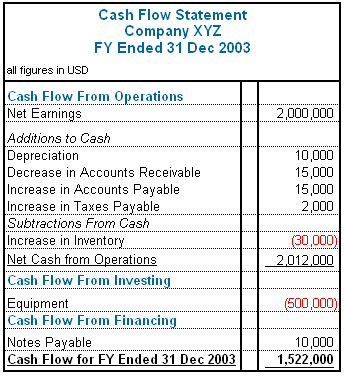
A winning investment strategy, I argue, includes a systematic, disciplined approach with objective quantitative measures to help guide decision making. For me, the science I depend on includes a substantial reliance on cash flow analysis (See Cash Flow Components Here). What I also like to call this tool is my cash register. Any business you look at will have cash coming into the register, and cash going out of it. Based on the capital needs, cash availability, and growth projects, money will furthermore be flowing in and out of the cash register. By studying these cash flow components, we gain a much clearer lens into the vitality of a business and can quickly identify the choke points.
ACCOUNTING GAMES
The other financial statements definitely shed additional light on the fitness of a company as well, but the income statement, in particular, is subject to a lot more potential manipulation. Since the management teams have more discretion in how GAAP (Generally Accepted Accounting Principles) is applied to the income statement, multiple levers can be pulled by the executives to make results look shinier than reality. For example, simply extending the useful life of an asset (e.g., a factory, building, computer, etc.) will have no impact on a company’s cash flow, yet it will instantaneously and magically raise a companies’ earnings out of thin air…voila!
“Stuffing the channel” is another manipulation strategy that can accelerate revenue recognition for a company. For example, let’s assume Company X ships goods to a distributor, Company Y, for the exclusive purpose of recognizing sales. Company X wins because they just increased their sales, Company Y wins because they have more inventory on hand (even if there is no immediate plan for the distributor to pay for that inventory), and the investor gets “hoodwinked” because they are presented artificially inflated sales and income results.
JOINT STRATEGY
These are but just a few examples of why it’s important to use the cash flow statement in conjunction with the income statement to get a truer picture of a company’s valuation and “quality of earnings.” If you don’t believe me, then check out the work done by reputable academics (Konan Chan, Narasimhan Jegadeesh, Louis Chan, and Josef Lakonishok) that show negative differentials between accounting earnings and cash flow are significantly predictive of future stock price performance (Read more).
So the next time a holding craters (or sky-rockets), take an accounting on the state of the company’s cash flows before making any rash decisions to buy or sell. By doing a thorough cash flow analysis, you’ll be well on your way to racking up gains into your cash register.
Wade W. Slome, CFA, CFP®
Plan. Invest. Prosper.
History Never Repeats Itself, But It Often Rhymes

As Mark Twain said, “History never repeats itself, but it often rhymes.” There are many bear markets with which to compare the current financial crisis we are working through. By studying the past we can understand the repeated mistakes of others (caused by fear and greed), and avoid making similar emotional errors.
Do you want an example? Here you go:
“Today there are thoughtful, experienced, respected economists, bankers, investors and businessmen who can give you well-reasoned, logical, documented arguments why this bear market is different; why this time the economic problems are different; why this time things are going to get worse — and hence, why this is not a good time to invest in common stocks, even though they may appear low.”– Jim Fullerton, former chairman of the Capital Group of the American Funds (written November 7, 1974)
Although the quote above seems appropriate for 2009, it actually is reflective of the bearish mood felt in most bear markets. We have been through wars, assassinations, banking crises, currency crises, terrorist attacks, mad-cow disease, swine flu, and yes, even recessions. And through it all, most have managed to survive in decent shape. Let’s take a deeper look.
1973-1974 Case Study:
For those of you familiar with this period, recall the prevailing circumstances:
- Exiting Vietnam War
- Undergoing a recession
- 9% unemployment
- Arab Oil Embargo
- Watergate: Presidential resignation
- Collapse of the Nifty Fifty stocks
- Rising inflation
Not too rosy a scenario, yet here’s what happened:
S&P 500 Price (12/1974): 69
S&P 500 Price (8/2009): 1,021
That is a whopping +1,380% increase, excluding dividends.
What Investors Should Do:
- Avoid Knee-Jerk Reactions to Media Reports: Whether it’s radio, television, newspapers, or now blogs, the headlines should not emotionally control your investment decisions. Historically, media venues are lousy at identifying changes in price direction. Reporters are excellent at telling you what is happening or what just happened – not what is going to happen.
- Save and Invest: Regardless of the market direction, entitlements like Medicare and social security are under stress, and life expectancies are increasing (despite the sad state of our healthcare system), therefore investing is even more important today than ever.
- Create a Systematic, Disciplined Investment Plan: I recommend a plan that takes advantage of passive, low-cost, tax-efficient investment strategies (e.g. exchange-traded and index funds) across a diversified portfolio. Rather than capitulating in response to market volatility, have a systematic process that can rebalance periodically to take advantage of these circumstances.
For DIY-ers (Do-It-Yourselfers), I suggest opening a low-cost discount brokerage account and research firms like Vanguard Group, iShares, or Select Sector SPDRs. If you choose to outsource to a professional advisor, I recommend interviewing several fee-only* advisers – focusing on experience, investment philosophy, and potential compensation conflicts of interest.
If you believe, like some economists, CEOs, and investors, we have suffered through the worst of the current “Great Recession” and you are sitting on the sidelines, then it might make sense to heed the following advice: “Some people say they want to wait for a clearer view of the future. But when the future is again clear, the present bargains will have vanished.” Dean Witter made those comments 77 years ago – a few weeks before the end of worst bear market in history. The market has bounced quite a bit since March of this year, but if history is on our side, there might be more room to go.
Wade W. Slome, CFA, CFP®
Plan. Invest. Prosper.
*For disclosure purposes: Wade W. Slome, CFA, CFP is President & Founder of Sidoxia Capital Management, LLC, a fee-only investment adviser based in Newport Beach, California.
Gold Market Lunacy Kicking Into Gear

So wait a second, let me get this right. A company pays billions of dollars to buy insurance, and then decides to sell $3.5 billion in dilutive ownership rights (current stockholders losing more than 10% of their ownership) so that they can pay somebody else another $5.6 billion to take that same insurance they previously loved away. In my book, I call that lunacy. This madness is exactly what Barrick Gold (ABX) just decided to do. The world’s largest gold miner issued approximately 95 million common shares at $37 per share to remove gold price hedges (used to lock in gold prices at a certain level), so if gold prices spike Barrick will now be able to participate fully without the drag of the hedges.
Effectively, management has decided to turn the mining company into a Vegas casino, where shareholders can now freely speculate in the price of gold without the volatility reducing hedges in place. Does this outlandish behavior signal a top in gold prices (now hovering around $1,000 per ounce)? I’m not stupid enough to call the end of frothing, speculative behavior – just witness Alan Greenspan’s “irrational exuberance” speech in 1996 when the NASDAQ traded at 1,300 (then went on to peak above 5,000). But what I am bold enough to do is call a spade a spade and to point out how ridiculous this reverse hedging activity is.
Other signs of speculation beyond the 4x price increase over the last 8 years or so, is the fact that gold prices have risen in the face of incredibly weak gold jewelry demand, -22% year-over-year globally in Q2 according to the Gold Demand Trends. This leaves the remaining demand coming largely from speculators and global central banks. If you need more evidence for the gold speculation, just turn on your local AM radio station and listen for the endless number of get-rich-quick on gold advertisements – some stations need to fill the gaping hole once held by those advertisers hawking mortgages.
From a gold investors’ perspective, I would say I fall more into Warren Buffett camp of thinking. Unlike other commodities (some of which I believe will be driven upwards by my emerging market demand and other forces) , gold is something dug up from the dirt in South Africa, melted, transported to another hole, buried in the ground (central bank), and then storage costs are incurred to guard the shiny metal. Sure, jewelry and small commercial applications are drivers for real demand, but the majority of demand is derived from intangible desires. Other commodities, for example oil, copper, uranium, and natural gas offer a lot more utility.
So what’s next when it comes to the price of gold? Peter Schiff an uber-gold bull broker at Euro Pacific Capital believes Armageddon is coming for the U.S. economy and hyper-inflation will drive gold upwards to the $4,000 per ounce price range (See How Peter Schiff’s Other Forecasts Have Performed). Another possibility to consider is a complete collapse in gold prices (and surge in the dollar) like we saw in the early 1980s after Paul Volcker raised interest rates and gold prices did not appreciate for a 25 year period. Hmmm, I wonder what direction interest rates are going next with the Federal Funds rate currently at effectively 0%? Could we see a repeat of the early ‘80s? Seems like a possibility to me. Certainly if you fall into the civil unrest, soup kitchen, and bread line camp, like Schiff and other U.S. bears, then piling into the diluted Barrick Gold shares may not be a bad strategy.
Inflation
Given the massive stimulus, debt loads, money supply growth and legislative agendas currently in place, inflation is a major medium and long-term concern. My remedy is government guaranteed Treasury Inflated Protection Securities (TIPS) that not only compensates investors with interest payments (unlike gold), but will also see principal values increase in tandem with principal if inflation indeed rears its ugly head. For those conspiracy theorists that believe the Consumer Price Index (CPI) is rigged, there are alternative international flavors of TIPs that reset according to other inflation benchmarks. As a kicker, some of these particular securities offer a hedge against a sliding U.S. dollar, which may or may not continue.
So as I lie in my recliner with my popcorn and TIPs, I’ll watch Barrick and other speculators continue the gold buying frenzy, wondering when and how ugly the gold finale will be?
Wade W. Slome, CFA, CFP®
Plan. Invest. Prosper.
DISCLOSURE: Sidoxia Capital Management and client accounts do not have direct long or short positions in ABX or gold related securities or BRKA/B at the time the article was published. Sidoxia Capital Management and its clients do have long exposure to TIP shares. No information accessed through the Investing Caffeine (IC) website constitutes investment, financial, legal, tax or other advice nor is to be relied on in making an investment or other decision. Please read disclosure language on IC “Contact” page.
Goldman Sachs in Talks to Acquire Treasury Department
 Andy Borowitz from the Borowitz Report published an article a few months ago satirizing the ever increasing conspiracy theories being spread regarding Goldman Sachs’ (GS) role in the global financial crisis. Spearheading the scapegoating Goldman Sachs brigade is Matt Taibbi of Rolling Stone who wrote Inside The Great American Bubble Machine. Megan McArdle at The Atlantic has a detailed critique of Taibbi’s loose facts and outlandish generalizations.
On a lighter note, here’s what Mr. Borowitz has to say about the Goldman Sachs/Treasury Department merger, with tongue firmly in cheek:
According to Goldman spokesperson Jonathan Hestron, the merger between Goldman and the Treasury Department is “a good fit” because “they’re in the business of printing money and so are we.” The Goldman spokesman said that the merger would create efficiencies for both entities: “We already have so many employees and so much money flowing back and forth, this would just streamline things.” Mr. Hestron said the only challenge facing Goldman in completing the merger “is trying to figure out which parts of the Treasury Dept. we don’t already own.” Goldman recently celebrated record earnings by roasting a suckling pig over a bonfire of hundred-dollar bills.
If Matt Taibbi is having difficulty coming up with some fresh new material, perhaps he could target some of these hotly debated areas of contention:
- The 40 year anniversary of NASA faking the moon landing.
- The CIA assassination of John F. Kennedy and the 4th shot from the “grassy knoll.”
- Crashed UFO aircraft remains stored at Area 51, Air Force base in Nevada.
- Elvis still alive.
- Paul McCartney actually dead.
- 9/11 terrorist attacks government cover-up.
- The creation of HIV/AIDS by the CIA.
If Bill Clinton can’t suppress sexual relations with Monica Lewinsky and Dick Cheney can’t hide the fact he shot someone in the face with a shotgun, I guess the Goldman crew is just better at pulling the wool over the eyes of 6.5 billion people…less one smart cookie, Matt Taibbi.
Wade W. Slome, CFA, CFP®
Plan. Invest. Prosper.
DISCLOSURE: Sidoxia Capital Management and client accounts do not have direct positions in GS at the time the article was published. No information accessed through the Investing Caffeine (IC) website constitutes investment, financial, legal, tax or other advice nor is to be relied on in making an investment or other decision. Please read disclosure language on IC “Contact” page.




 Investing Caffeine