Posts filed under ‘Stocks’
Sports & Investing: Why Strong Earnings Can Hurt Stock Prices

There are many similarities between investing in stocks and handicapping in sports betting. For example, investors (bettors) have opposing views on whether a particular stock (team) will go up or down (win or lose), and determine if the valuation (point spread) is reflective of the proper equilibrium (supply & demand). And just like the stock market, virtually anybody off the street can place a sports bet – assuming one is of legal age and in a legal betting jurisdiction.
Right now investors are poring over data as part of the critical, quarterly earnings ritual. Thus far, roughly 20% of the companies in S&P 500 index have reported their results and 78% of those companies have beaten Wall Street expectations (CNBC). Unfortunately for the bulls, this trend has not been strong enough to push market prices higher in 2010.
So how and why can market prices go down on good news? There are many reasons that short-term price trends can diverge from short-run fundamentals. One major reason for the price-fundamental gap is the following factor: expectations. Just last week, the market had climbed over +70% in a ten month period, before issues surrounding the Massachusetts Senatorial election, President Obama’s banking reform proposals, and Federal Reserve Bank Chairman Ben Bernanke’s re-appointment surfaced. With such a large run-up in the equity markets come loftier expectations for both the economy and individual companies. So when corporate earnings unveiled from companies like Google (GOOG), J.P. Morgan (JPM), and Intel (INTC) outperform relative to forecasts, one explanation for an interim price correction is due to a significant group of investors not being surprised by the robust profit reports. In sports betting lingo, the sports team may have won the game this week, but they did not win by enough points (“cover the spread”).
Some other reasons stock prices move lower on good news:
- Market Direction: Regardless of the underlying trends, if the market is moving lower, in many instances the market dip can overwhelm any positive, stock- specific factors.
- Profit Taking: Many times investors holding a long position will have price targets or levels, if achieved, that will trigger selling whether positive elements are in place or not.
- Interest Rates: Certain valuation techniques (e.g. Discounted Cash Flow and Dividend Discount Model) integrate interest rates into the value calculation. Therefore, a climb in interest rates has the potential of lowering stock prices – even if the dynamics surrounding a particular security are excellent.
- Quality of Earnings: Sometimes producing winning results is not enough (see also Tricks of the Trade article). On occasion, items such as one-time gains, aggressive revenue recognition, and lower than average tax rates assist a company in getting over a profit hurdle. Investors value quality in addition to quantity.
- Outlook: Even if current period results may be strong, on some occasions a company’s outlook regarding future prospects may be worse than expected. A dark or worsening outlook can pressure security prices.
- Politics & Taxes: These factors may prove especially important to the market this year, since this is a mid-term election year. Political and tax policy changes today may have negative impacts on future profits, thereby impacting stock prices.
- Other Exogenous Items: Natural disasters and security attacks are examples of negative shocks that could damage price values, irrespective of fundamentals.
Certainly these previously mentioned issues do not cover the full gamut of explanations for temporary price-fundamental gaps. Moreover, many of these factors could be used in reverse to explain market price increases in the face of weaker than anticipated results.
For those individuals traveling to Las Vegas to place a wager on the NFL Super Bowl, betting on the hot team may not be enough. If expectations are not met and the hot team wins by less than the point spread, don’t be surprised to see a decline in the value of the bet.
Wade W. Slome, CFA, CFP®
Plan. Invest. Prosper.
DISCLOSURE: Sidoxia Capital Management (SCM) and some of its clients own certain exchange traded funds and GOOG, but at the time of publishing had no direct positions in JPM and INTC. No information accessed through the Investing Caffeine (IC) website constitutes investment, financial, legal, tax or other advice nor is to be relied on in making an investment or other decision. Please read disclosure language on IC “Contact” page.
The Invisible Giant

Bruce Berkowitz has not exactly been a household name (he apparently is not even Wikipedia-worthy). With his boyish looks, nasally voice, and slicked-back hair, one might mistake Berkowitz for a graduate student. However, his results are more than academic, which explains why this invisible giant was recently named the equity fund manager of the decade by Morningstar. It’s difficult to argue with long-term results, especially in the roller coaster market like we’ve experienced over the last ten years. The Fairholme Fund (FAIRX) fund earned a 13% annualized return over the ten-year period ending in 2009, beating the S&P 500 index by an impressive 14%.
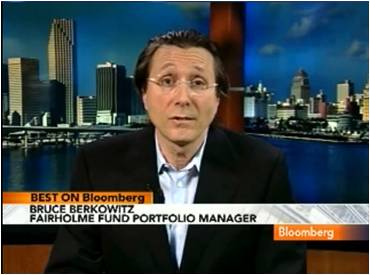 Click here to view Bloomberg invterview with Bruce Berkowitz
How He Did It
Berkowitz states the stellar performance was achieved by
“Ignoring the crowd and going towards stressed areas that many people are running from…We make our judgments based on the cash that securities generate.”
Fairholme is effectively a “go anywhere” fund that adheres tightly to the value-based philosophy. Berkowitz’s portfolio is centered on equity securities, but his team has also shown willingness to go up and down the capital structure, if they find value elsewhere.
The Fund and its History
Berkowitz started the fund in 1999 as an extension of his separate account business, which was created in his previous life at Smith Barney and Lehman Brothers. The Fairholme fund tends to concentrate around 15 to 25 securities on average, with some holdings accounting for more than 10% of the portfolio. An example of Fairholmes concentration is evidenced by its favorably timed trade in the energy sector, which resulted in a 35% weighting in the fund. Fortunately Berkowitz redeployed that winning position – before energy prices cratered in 2008 – into unloved areas like healthcare and defense stocks.
Berkowitz models his investment style after Warren Buffett, focused on good businesses with prolific cash flows. Like many value investors, Berkowitz fishes for contrarian based ideas residing in pockets of the market that are out of favor. He also likes to have a significant weighting in “special situations,” which are limited to about 25% of the portfolio. In order to take advantage opportunities, Berkowitz is not shy or bashful about carrying around a good chunk of cash in his pocket. He likes to keep about 15% on average to scoop up out of favor opportunities.
The Future of Fairholme
I commend Berkowitz for his admirable record, but I caution investors to not go hog wild over outperforming funds. He has crushed the market over an extremely challenging investment period, but investors need to remember that “mean reversion,” the tendency for a trend to move towards averages, applies to investing styles too. Concentrated, go-anywhere, large cap value, market timing funds that outperform for ten years at a time may underperform or outperform less dramatically over the next ten years. Just ask Bill Miller (see also Bill Miller Revenge of the Dunce article), concentrated value manager at Legg Mason, about mean reversion. Miller beat the market for 15 consecutive years before recently ending up in the bottom 10-year decile (1-star Morningstar rated) after some bad concentrated bets and poor investment timing. Another challenge for Fairholme is size (currently around $10.5 billion in assets under management). Having managed a multi-billion fund myself (see also my book), I can attest to the complexities Berkowitz faces in managing a much larger fund now.
Regardless, Berkowitz’s performance should not be ignored given his sound philosophy and achievement over an unprecedented period. Already, just a few weeks into 2010, Fairholme is ranked #1 in its fund category by Morningstar.
This is one invisible man you should not let disappear off your radar.
Wade W. Slome, CFA, CFP®
Plan. Invest. Prosper.
DISCLOSURE: Sidoxia Capital Management (SCM) and some of its clients own certain exchange traded funds, but at time of publishing had no direct positions in FAIRX, LM, BRKA/B or MORN. No information accessed through the Investing Caffeine (IC) website constitutes investment, financial, legal, tax or other advice nor is to be relied on in making an investment or other decision. Please read disclosure language on IC “Contact” page.
Google vs. China: Running Away from 660 Million Eyeballs?

Wait, let me get this straight. Google, the $185 billion behemoth that wants to take over the world is seriously considering turning its back on a rapidly growing cluster of 660 million eyeballs (330 million Chinese internet users according to BusinessWeek)? After hitting their head on an obscenely high market share in the U.S. (67% search share based on Nielsen data) and looking for new geographies to expand, I’m supposed to believe Google will walk away from the third largest economy on this planet (see China: Trade of the Century)? The explanation given for Google’s capitulation is discontent related to unknown hackers and censorship concerns. If that’s not enough, this alleged saint-like posturing comes after Google sold its censorship soul for years, before seeing the free speech light. Although the company’s mission is to “do no evil,” Google had no qualms aggressively poaching Microsoft (MSFT) miracle maker, Kai-Fu Lee, to kick-start their Chinese presence. If free speech is truly at the root of the Google’s unease, then why wait four whole years and a hack-attack before laying down an ultimatum on the Chinese government?
I Smell a Rat
In a blog post written by Google’s Chief Legal Officer, David Drummond, the company explains how their iron curtain digital defense was bent but not broken:
“We have evidence to suggest that a primary goal of the attackers was accessing the Gmail accounts of Chinese human rights activists. Based on our investigation to date we believe their attack did not achieve that objective. Only two Gmail accounts appear to have been accessed, and that activity was limited to account information (such as the date the account was created) and subject line, rather than the content of emails themselves.”
I’m no exterminator, but I smell a rat. All this feels a lot more like politics and business tactics then it does an altruistic display of free-speech martyrdom. The Chinese government and Google executives know what is at risk, as they both play a high stakes game of “chicken.”
Google goes onto say:
“As part of our investigation we have discovered that at least twenty other large companies from a wide range of businesses–including the Internet, finance, technology, media and chemical sectors–have been similarly targeted.”
I’m confused. These unknown hackers attacked 20 different companies and only unsuccessfully cracked two Gmail accounts. The evidence sounds pretty harmless on the surface, if this language is representative of reality. Maybe I’m wrong, and a foiled cyber-attack is reason enough to cease operations in a country inhabiting a potential 1.3 billion customers.
Sure China represents a relatively small portion of Google’s revenues (estimated at less than $1 billion and a single digit percentage of revenues), but Google would be insane to walk away from this massive long-term growth market, even if Baidu (BIDU) is currently eating their lunch. Although Google has a smaller #2 position in China, it still has a respectable 35.6% search market share (according to BusinessWeek).
Not Just About Search – Cell Phones Too
Even if they claimed they were throwing in the white towel on their Chinese search business, I don’t think they really want to flush their newly minted cell phone prospects down the toilet. Even if 275 million or so cell phone users in the U.S. is fertile ground for Google to target their new Android-based phones, I’m guessing they have penciled out the gigantic mobile potential of the rapidly expanding 700 million+ Chinese mobile phone user market.
While I can’t take the scenario of Google ceasing China operations off the table, I consider the chance of Google shutting its doors in China significantly less than 50%. While the bold Google statement of feasibility review regarding their Chinese business existence has gained a lot of attention, I think calmer heads will eventually prevail and Google will resume their targeting of 660 million Chinese eyeballs. Who knows, the high stake game of “chicken” may even benefit their bottom-line as they win the hearts and minds of more future free-speech users.
DISCLOSURE: Sidoxia Capital Management (SCM) and some of its clients own GOOG shares and China based exchange traded funds at the time of this article’s publishing, but did not have a direct position in MSFT and BIDU shares. No information accessed through the Investing Caffeine (IC) website constitutes investment, financial, legal, tax or other advice nor is to be relied on in making an investment or other decision. Please read disclosure language on IC “Contact” page.
NVEC: Profiting from Electronic Eyes, Nerves & Brains

Recently, Seeking Alpha Editor-in-Chief Mick Weinstein interviewed me with the purpose of reviewing an equity investment I find attractive. For the “stock-jock” Investing Caffeine followers, I am publishing the January 5th interview below.
What is your highest conviction stock position in your fund – long or short?
I don’t really have a highest conviction stock, per se, in my fund since I treat all my stocks like children – I love them all. Having said that, NVE Corp. (ticker: NVEC) is a holding of mine that exhibits many of the characteristics I look for in an investment. The Eden Prairie, Minnesota based company is named after “Nonvolatile Electronics,” which refers to memory technology that retains data even when power is removed – a critical attribute for certain applications.
Tell us a bit about the company and what it does.
NVE Corp. is a market leader in nanotechnology sensors, couplers, and MRAM intellectual property (Magnetoresistive Random Access Memory). NVE’s microscopic technology enables the transmission, acquisition, and storage of data across a broad array of applications, including implantable medical devices, mission critical defense weapons, and industrial robots. Major customers include: St. Jude Medical, Inc. (STJ), Starkey Laboratories, Inc., and the U.S. Government.
The company’s coupler and sensor businesses have been ridiculously profitable. Even over a period covering one of the worst global financial crisis in decades, NVE managed to increase its operating margins from an already very respectable 40% range in Fiscal 2007 (ending March) to a stunning 56%+ level in Fiscal 2009.
Beyond sensors and couplers, NVE Corp. is optimistic about the potential for the MRAM market. However, outside of a few one-time licensing fees, NVE is currently generating effectively $0 revenues from this nascent storage technology. Outside of producing small MRAM devices for niche applications such as tamper prevention, NVE Corp. is looking to leverage their IP portfolio by licensing out the patents and subsequently receiving royalties from MRAM device manufacturers. MRAM technology uses magnetic fields to record information, but unlike tape recorders in which a short section of tape holds magnetic information, with MRAM data is held by electrons with out the need of moving parts to read or write data. Believe it or not, this method is highly reliable and is very power-efficient relative to other storage technology alternatives. Currently, the problem with MRAM is the cost prohibitive manufacturing requirements relative to other memories (such as DRAM, SRAM, and Flash), but costs are expected to come down over time. For some MRAM believers, the technology is considered the “Holy Grail” because it may have the potential to combine the speed of SRAM, the density of DRAM, and the non-volatility of Flash memory in a universal source.
If the unproven potential of MRAM ever blossoms, the broad portfolio of NVE Corp.’s MRAM patents should represent a very sizeable profit opportunity. Of course, NVE Corp. must first establish the validity of its MRAM intellectual property and appropriately charge and collect royalties for IP usage. How big can the MRAM market be? Some size the MRAM market in the billions and Toshiba has stated they expect the MRAM market to surpass the size of the traditional memory markets by 2015.
No matter how one measures the size of the market, there will be a substantial revenue opportunity for NVE Corp. if every smart-phone, gaming device and laptop exclusively uses universal MRAM – rather than a combination of DRAM, SRAM, and Flash technologies.
Can you talk a bit about the industry/sector? How much is this an “industry pick” as opposed to a pure bottom-up pick?
Generally speaking, I am a bottom-up investor. I may have concrete views on a particular industry, but the fundamentals of a company will be the main determinant of my investment thesis. Overall, I am looking for market leading franchises that can sustain above-average growth rates for extended periods of time. These traits can come from either a company operating in a mature, sleepy industry (take for example Google in the advertising world) or from a more dynamic growth industry like nanotechnology in the case of NVE Corp.
I believe the nanotechnology industry is in the very early innings of an innovation revolution with regard to new applications and products. Like semiconductors, the economies of scale and technological advances of NVE Corp.’s “spintronic” technology should continually allow faster, smaller, more reliable solutions at lower bit prices. In my view, this snowballing effect will only increase the penetration of nanotechnology solutions and introduce an ever increasing list of new applications.
Can you describe the company’s competitive environment? How is this company positioned vis a vis its competitors?
NVE Corp. has competitors along all three of its spintronic businesses. In their sensor business, most of the competition comes from the makers of legacy electromechanical magnetic sensors, including HermeticSwitch, Inc., Meder Electronic AG (Germany), and Memscap SA (France).
In the coupler space, NVE Corp. faces a larger list of well capitalized, household semiconductor names, including Avago (AVGO), Fairchild Semiconductor International (FCS), NEC Corporation, Sharp Corporation, Toshiba Corporation, Vishay Intertechnology (VSH), Analog Devices, Inc. (ADI), Silicon Laboratories Inc. (SLAB), and Texas Instruments Incorporated (TXN).
A different set of competitors are searching for the MRAM holy grail, including the following companies: Crocus Technology SA (France), Grandis, Inc., MagSil Corporation, Spintec (France), Spintron (France), Spintronics Plc (UK), and IBM.
There is undoubtedly a ton of competition in the spintronics space, but as of October 2009, NVE Corp. has 52 issued U.S. patents and over 100 patents worldwide (either issued, pending, or licensed from others) – many focused on the potentially lucrative MRAM field. Although NVE Corp. has many competitors, they have dominant share in the coupler/sensor market when it comes to high-end, merchant supplied solutions. Moreover, on the MRAM side of the business, the company has already licensed its intellectual property to several companies, including Cypress Semiconductor (CY), Honeywell International Inc. (HON), and Motorola, Inc. (MOT).
Can you talk about valuation? How does valuation compare to the competitors?
Valuation is a key component for all my stock investments. In my valuation work I pore over the income statement, balance sheet and cash flow statement in deriving my price targets.
One area helping NVE Corp.’s valuation case is its improving trend-line of profitability. Over the last 5 years alone, gross margins have gone from 40% to over 70% – not a bad business model if you can execute it. The company also has a pristine balance sheet. Not only does NVE Corp. have no debt, but it also is sitting on a growing mound of cash/investments (over $43 million), representing more than 20% of the company’s market capitalization. Lastly, the company in my view is attractively priced on a free cash flow basis (cash from operations minus capital expenditures), yielding around 6% of the total company value.
What is the current sentiment on the stock? How does your view differ from the consensus?
With small cap stocks like NVE Corp., sentiment and lack of liquidity can create gut-wrenching volatility. Unlike many growth investors who pay more attention to positive momentum factors (price direction), I welcome volatility as it allows me to find more attractive entry and exit points.
With that said, NVE Corp. hit a peak stock price north of $63 per share in early September fueled by 41% revenue growth in their June quarter (fiscal Q1). Subsequently, in fiscal Q2 (ending September 30th), revenue growth decelerated to +14% causing momentum investors to take NVE Corp.’s shares to the woodshed. With the stock down about -35% from its recent crest, I find the valuation only that much more attractive.
Wall Street estimates are calling for further slowing in revenue growth in the coming quarter, so the short term sentiment may or may not continue to sour? Timing bottoms is inherently dangerous and not something I consider myself an expert at. Absent a major deterioration in fundamentals, I stand ready to add to my position if NVE Corp.’s share price falls and valuation metrics improve.
I would argue the typical consensus view advocates selling shares when revenue growth slows. Many of my best performing stocks have been purchased during transitory periods of slowing or cyclical downturns. Let’s hope that’s the case with NVE Corp.
Does the company’s management play a role in your position? If so, how?
Absolutely. There is a continual debate over what is more important, the jockey or the horse? My investment philosophy puts more weight on the jockey than the horse. Obviously, I’m looking for the combination of a talented management team and a solid business model.
When it comes to NVE Corp., Daniel Baker, Ph.D. has done a phenomenal job managing the hyper-growth profile of the company, while preserving prudent and conservative financial values. For the third year in a row, Dr. Baker was also recognized as one of the best U.S. CEOs in the semiconductors and semiconductor equipment industry by investment research and financial consulting firm DeMarche Associates.
At the end of the day, it’s difficult to argue with a track record of success. Since Dr. Baker took over, revenues have more than tripled and earnings have grown from $0.05 in fiscal 2001 to $2.04 in Fiscal 2009.
What catalysts do you see that could move the stock?
Since I hold a longer term investment horizon, catalysts are not a driving aspect to my investment process. But clearly, any additional evidence unearthed in the marketplace validating the growth in the MRAM market, or announcements confirming the value of NVE Corp.’s MRAM intellectual property, should provide support to the stock price.
Beyond that, given where the stock is trading now, I believe merely continuing the execution on their sensor and coupler business provides adequate upside prospects.
What could go wrong with this stock pick?
Investing in small cap technology stocks comes with a whole host of risks. Although I don’t believe the positive scenario of critical mass MRAM commercialization is baked into the current stock price, nevertheless I understand any setbacks announced relative to NVE Corp.’s MRAM prospects or the industry’s MRAM expectations, will likely result in stock price pressure.
NVE also has significant customer concentration, therefore a loss or cutback in sales from a lead customer will probably contribute to price volatility.
From a macro perspective, the company has battled successfully through the economic crisis and proven itself somewhat recession resistant. Nonetheless, the company has sizeable exposure to the industrial segment and would not be immune from the “double-dip” economic recession scenario.
Surely there are additional hazards to this investment, however these are some of the risks I am currently focused on.
Do you have any closing thoughts?
NVE Corp. is not a stock for the faint of heart. However, for those who can stomach the volatility, I encourage you to do some more homework on NVE Corp. Not only will you learn about a phenomenally managed, very profitable, attractively priced nanotechnology company, but you will also gain insight into a leading force behind the eyes, nerves, and brains powering the electronic systems of our future.
Wade W. Slome, CFA, CFP®
Plan. Invest. Prosper.
DISCLOSURE: Sidoxia Capital Management (SCM) and some of its clients own shares in NVEC (and certain exchange traded funds), but did not have any direct positions in the following companies or stocks mentioned in this article at time of publication: STJ, HermeticSwitch, Inc., Meder Electronic AG, and Memscap SA, AVGO, FCS, NEC Corporation, Sharp Corporation, Toshiba Corporation, VSH, ADI, SLAB, TXN, Crocus Technology SA, Grandis, Inc., MagSil Corporation, Spintec, Spintron, and Spintronics Plc, IBM, CY, HON, and MOT. No information accessed through the Investing Caffeine (IC) website constitutes investment, financial, legal, tax or other advice nor is to be relied on in making an investment or other decision. Please read disclosure language on IC “Contact” page.
Can the Lost Decade Strike Twice?

There is an old saying that lightning does not strike twice in the same place. I firmly believe this principle will apply to stock returns over the next decade. Josh Brown, investor and writer for The Reformed Broker highlighted a chart published by Bloomberg showing the 10-year return for various asset classes. Statisticians and market commentators have been quick to point out that stocks, as measured by various benchmarks, have not only underperformed bonds for the last 10 years, but stock performance has actually also been negative for the trailing decade.
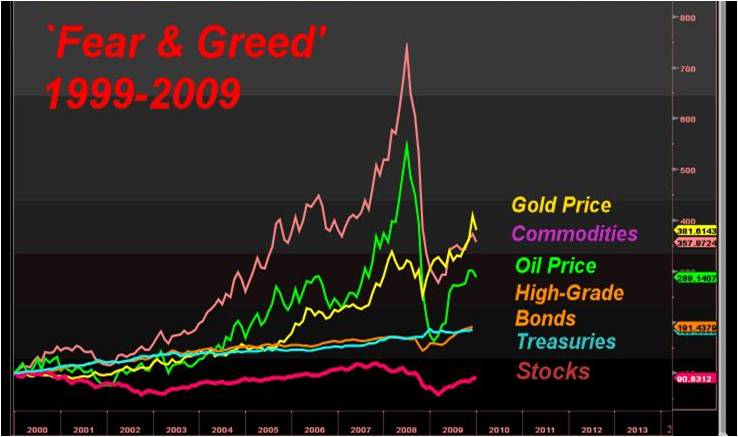
Source: Bloomberg via The Reformed Broker
Will this trend persist during the next decade? Will the lost decade in stocks be repeated again, similar to the deflation death spiral experienced by the Japanese? (Read more regarding Japanese market on IC). With the Fed Funds rate at effectively zero, is it possible bonds can pull off a miracle over the next 10 years? I suppose anything is possible, but I seriously doubt it.
Let’s not forget that the P/E ratio (Price-Earnings) pegged by some to be at about 14-15x’s 2010 expected earnings – nestled comfortably within historical bands. Granted, financials and some other sectors were overheated (e.g. certain Consumer industries), but based on next year’s estimates, some industries are already expected to exceed the peak earnings achieved during 2007 (e.g., Technology).
History on Our Side

Source: Crestmont Research. Dated graph over the last century showing stock returns rarely result in negative returns over a rolling 10 year period.
For the trailing decade using December 20, 2009 as an end point, I arrive at a marginally negative return for the S&P 500 index assuming an average dividend yield of 2.5% for the period. Certainly the negative return would be pronounced by any fees, commissions or taxes related to a 10-year buy-and-hold strategy of the broad market index. This chart gets chopped off in 2005, nonetheless history is on our side, lending support that stock returns have a good chance of improving on the results over the last 10 years.
Equity Risk Premium
The bubbles and scandals that have blanketed corporate America over the last 10 years have made the average investor extremely skeptical. What does this mean for the pricing of risk? Well, if you rewind to the year 2000 when technology exceeded 50% of some indexes, and many investors thought technology was a low risk endeavor, there was virtually no equity risk premium discounted into many stock prices. If you fast forward to today, the reverse is occurring. Investors despise market volatility and arguably demand a much higher risk premium for taking on the instability of stocks. This is the exact environment investors should desire – lots of skepticism and money piled into bonds (See IC article on investor queasiness). As Warren Buffett says, “Be fearful when others are greedy and greedy when others are fearful.” I believe the next 10 years will be a time to be greedy.
The analysis above is obviously very narrow in scope, since we are only discussing domestic stock markets. In my client portfolios I advocate a broadly diversified portfolio across asset classes (including bonds), geographies, and styles. However, in managing bonds across portfolios, I am forced to tactfully include strategies such as inflation protection and shorter duration techniques. With the year-end fast approaching, now is a good time to review your financial goals and asset allocation.
Lightning definitely negatively impacted stocks this decade, but betting for lightning to strike twice this decade could very well turn out to be a losing wager.
Wade W. Slome, CFA, CFP®
Plan. Invest. Prosper.
DISCLOSURE: Sidoxia Capital Management (SCM) and some of its clients own certain exchange traded funds, but at time of publishing had no direct positions in BRKA. No information accessed through the Investing Caffeine (IC) website constitutes investment, financial, legal, tax or other advice nor is to be relied on in making an investment or other decision. Please read disclosure language on IC “Contact” page.
Running with the Bulls

Guest Contributing Writer: Bruce Wimberly
No matter where you turn some “expert” is espousing his or her view on the direction of the market. The reality is none of them know. My advice to anyone is avoid the fallacy of experts. Those that purport to know, donʼt. It is a mere exercise in futility to justify charging higher fees. Letʼs be honest if anyone knew the future direction of asset prices they would be beyond rich (Iʼm talking John Paulson – Trade of the Century rich!). Nice job John who would have thought you could make that much money betting against mortgages.
As investors our best bet is to accept that fact that market timing is a losing strategy. Timing the market is similar to a coin flip. Pure and simple, the cost of getting it wrong wipes out the occasional gain of getting it right. Remember, every time you listen to the perma-bears and try to time the market, there is big time investment professional on the other side of that trade who is by definition taking the opposite view.
Good investors expand their timeframes. They do not get sucked into the news of the day. Let the perma-bears worry about Dubai, currency devaluation, or whatever else is todayʼs fear. Keep in mind there is always something to worry about. For long term investors the greatest fear is not being in the market. For example, if inflation were to average 3% and you are sitting in cash earning nothing your money will be cut in half by 2033. Grandmaʼs mattress is not an option for most people.
Now back to the question of bulls versus bears and the direction of the markets. Who is right? The simplest way to think about this comes from Oracle of Omaha himself, Warren Buffett. Buffett thinks of the market as a reflection of total market cap relative to US GNP (gross national product). After all, in the long run the market should approximate some measure of overall corporate profitability or in this case overall economic growth. If you accept Buffettʼs argument then the market is neither overly expensive or cheap. As of yesterday the total market index is at $11,296.2 billion which is about 79% of the last reported GDP. (I know the perma-bulls will find some reason to bash the reported GDP number). Nevertheless, this simple formula provides a good long term context on which to gage the relative attractiveness of the overall market. To put todayʼs number in context (79%) at the peak of the market bubble in 1999, the ratio of total market cap/GDP was 150% or almost double todayʼs reading. Yes, the market has made a major move from depressed levels earlier in the year but that is irrelevant. Donʼt anchor on that number or you will never get off the sidelines.
My advice is simple, ignore the perma-bears and avoid market timing like the plague for it is a suckers bet (see also article on passive vs. active investing). If the market does pull back (and it will at some point) this is great news for the long term investor. Anytime you can buy a stock on sale – this is a good thing! So enjoy the Christmas holidays, donʼt believe the hyped up bears and as always:
Plan. Invest. Prosper.
DISCLOSURE: Sidoxia Capital Management (SCM) and some of its clients own certain exchange traded funds and equity securities in client and personal portfolios at the time of publishing, but had no direct position in BRKA/B. No information accessed through the Investing Caffeine (IC) website constitutes investment, financial, legal, tax or other advice nor is to be relied on in making an investment or other decision. Please read disclosure language on IC “Contact” page.
Passive vs. Active Investing: Darts, Monkeys & Pros

Bob Turner is founder of Turner Investments and a manager of several funds at the investment company. In a recent article he reintroduces the all-important, longstanding debate of active management (“hands-on”) versus passive management (“hands off”) approaches to investing.
Mr. Turner makes some good arguments for the active management camp, however some feel differently – take for example Burton Malkiel. The Princeton professor theorizes in his book A Random Walk Down Wall Street that “a blindfolded monkey throwing darts at a newspaper’s stock page could select a portfolio that would do just as well as one carefully selected by experts.” In fact, The Wall Street Journal manages an Investment Dartboard contest that stacks up amateur investors’ picks against the pros’ and random stock picks selected by randomly thrown darts. In many instances, the dartboard picks outperform the professionals.
Given the controversy, who’s right…the darts, monkeys, or pros? Distinguishing between the different categorizations can be difficult, but we will take a stab nevertheless.
Arguments for Active Management
Turner contends, active management outperforms in periods of high volatility and he believes the industry will be entering such a phase:
“Active managers historically have tended to perform best in a market in which the performance of individual stocks varies widely.”
He also acknowledges that not all active managers outperform and admits there are periods where passive management will do better:
“The reason why most active investors fail to outperform is because they in fact constitute most of the market. Even in the best of times, not all active managers can hope to outperform…The business of picking stocks is to some degree a zero-sum game; the results achieved by the best managers will be offset at least somewhat by the subpar performance of other managers.”
Buttressing his argument for active management, Turner references data from Advisor Perspectives showing an inconclusive percentage (40.5%-67.8%) of the actively managed funds trailing the passively managed indexes from 2000 to 2008.
The Case for Passive Management
Turner cites one specific study to support his active management cause. However, my experience gleaned from the vast amounts of academic and industry data point to approximately 75% of active managers underperforming their passively managed indexes, over longer periods of time. Notably, a recent study conducted by Standard & Poor’s SPIVA division (S&P Indices Versus Active Funds) discovered the following conclusions over the five year market cycle from 2004 to 2008:
- S&P 500 outperformed 71.9% of actively managed large cap funds;
- S&P MidCap 400 outperformed 79.1% of mid cap funds;
- S&P SmallCap 600 outperformed 85.5% of small cap funds.
Read more about the dirty secrets shrinking your portfolio.
According to the Vanguard Group and the Investment Company Institute, about 25% of institutional assets and about 12% of individual investors’ assets are currently indexed (passive strategies). If you doubt the popularity of passive investment strategies, then look no further than the growth of Exchange Traded Funds (ETFs – see chart), index funds, or Vanguard Groups more than $1 trillion dollars in assets under management.
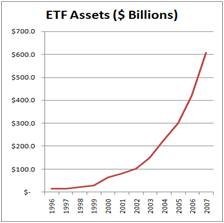
Although I am a firm believer in passive investing, one of its shortcomings is mean reversion. This is the idea that upward or downward moving trends tend to revert back to an average or normal level over time. Active investing can take advantage of mean reversion, conversely passive investing cannot. Indexes can get very top-heavy in weightings of outperforming sectors or industries, meaning theoretically you could be buying larger and larger shares of an index in overpriced glamour stocks on the verge of collapse. We experienced these lopsided index weightings through the technology bubbles in the late 1990s and financials in 2008. Some strategies may be better than other over the long run, but every strategy, even passive investing, has its own unique set of deficiencies and risks.
Professional Sports and Investing
As I discuss in my book, there are similarities that can be drawn between professional sports and investing with respect to active vs. passive management. Like the scarce number of .300 hitters in baseball, I believe there are a select few investment managers who can consistently outperform the market. In 2007, AssociatedContent.com did a study that showed there were only 22 active career .300 hitters in Major League Baseball. I recognize in the investing world there can be a larger role for “luck,” which is difficult, if not impossible, to measure (luck won’t help me much in hitting a 100 mile per hour fastball thrown by Nolan Ryan). Nonetheless, in the professional sports arena, there are some Hall of Famers (prospects) that have proved they could (can) consistently outperform their peers for extended durations of time.
Experience is another distinction I would highlight in comparing sports and investing. Unlike sports, in the investment world I believe there is a positive correlation between age and ability. The more experience an investor gains, generally the better long-term return achieved. Like many professions, the more experience you gain, the more valuable you become. Unfortunately, in many sports, ability deteriorates and muscles atrophy over time.
Size Matters
Experience alone will not make you a better investor. Some investors are born with an innate gift or intellect that propels them ahead of the pack. However, most great investors eventually get cursed by their own success thanks to accumulating assets. Warren Buffet knows the consequences of managing large amounts of dollars, “gravity always wins.” Having managed a $20 billion fund, I fully appreciate the challenges of investing larger sums of money. Managing a smaller fund is similar to navigating a speed boat – not too difficult to maneuver and fairly easy to dodge obstacles. Managing heftier pools of money can be like captaining a supertanker, but unfortunately the same rapid u-turn expectations of the speedboat remain. Managing large amounts of capital can be crippling, and that’s why captaining a supertanker requires the proper foresight and experience.
Room for All
As I’ve stated before, I believe the market is efficient in the long run, but can be terribly inefficient in the short-run, especially when the behavioral aspects of emotion (fear and greed) take over. The “wait for me, I want to play too” greed from the late 1990s technology craze and the credit-based economic collapse of 2008-2009 are further examples of inefficient situations that can be exploited by active managers. However, due to multiple fees, transaction costs, taxes, not to mention the short-term performance/compensation pressures to perform, I believe the odds are stacked against the active managers. For those experienced managers that have played the game for a long period and have a track record of success, I feel active management can play a role.
At Sidoxia Capital Management, I choose to create investment portfolios that blend a mixture of passive and active investment strategies. Although my hedge fund has outperformed the S&P 500 in 2009, that fact does not necessarily mean it’s the appropriate sole approach for all clients. As Warren Buffet states, investors should stick to their “circle of competence” so they can confidently invest in what they know. That’s why I generally stick to the areas of my expertise when I’m actively investing in stocks, and fill in the remainder of client portfolios with transparent, low-cost, tax-efficient equity and fixed income products (i.e., Exchange Traded Funds).
Even though the actively managed Turner Funds appear to have a mixed-bag of performance numbers relative to passively managed strategies, I appreciate Bob Turner’s article for addressing this important issue. I’m sure the debate will never fully be resolved. In the meantime, my client portfolios will aim to mix the best of both worlds within active and passive management strategies in the eternal quest of outwitting the darts, monkeys, and other pros.
Read the full Bob Turner article on Morningstar.com
Wade W. Slome, CFA, CFP®
Plan. Invest. Prosper.
DISCLOSURE: Sidoxia Capital Management (SCM) and some of its clients own certain exchange traded funds but had no direct position in stocks mentioned in this article. No information accessed through the Investing Caffeine (IC) website constitutes investment, financial, legal, tax or other advice nor is to be relied on in making an investment or other decision. Please read disclosure language on IC “Contact” page.
The Economics and Consequences of Obesity

‘Tis the season to consume a lot of calories, and my tighter fitting, post turkey-day trousers can attest to that fact. Healthcare reform is front and center in the national debate, as well, and the rising epidemic of obesity should play a significant role in the discussion. Why is this issue so important? According to female financial guru, Suze Orman, we are already spending $57 billion more on obesity than cancer. Obesity-related health care costs totaled about $117 billion in 2000, according to the CDC (Center of Disease Control). One study on obesity estimates the problem will cost the United States $344 billion in health costs by 2018.
Although it may be an uncomfortable issue to talk about, this matter has had a direct personal impact on my family, making the problem all the more tangible to me. Regardless of the function of genetics or what lifestyle choices are made, the negative consequences are indisputable.
Take a look at the table of negative outcomes provided by the CDC:

These consequences obviously take a large toll on the individuals, but they also have a massive impact on our healthcare system. And the CDC has the data to backup the severity of this intensifying problem:
“More than one third of U.S. adults—more than 72 million people—and 16% of U.S. children are obese. Since 1980, obesity rates for adults have doubled and rates for children have tripled. Obesity rates among all groups in society—irrespective of age, sex, race, ethnicity, socioeconomic status, education level, or geographic region—have increased markedly.”
Before solutions can be created, the root problems need to be addressed. One of the factors contributing to increased incidence of obesity is our unhealthy dietary habits (myself included). A chart from the New York Times highlights the economic impact of our food choices has been impacted by inflation trends. Over the last 30 years, unhealthy foods (beer, butter, and soda) have become much cheaper than healthy foods (fresh fruits and vegetables), on a relative basis (see chart below). Making a trip to fast food chains has not only become more convenient, but the practice has also become more affordable.

Source: Bureau of Labor Statistics (NY Times)
With our work lives stretched even further and stress levels rising, the picture below highlights the relationship between obesity (as measured by the Body Mass Index) and minutes spent per day eating. Our unhealthy, indoor, sedentary lifestyles take away from our healthy eating habits as well. The U.S. is the country with the highest percentage of individuals who are obese and the country that spends the third fewest minutes per day eating (eating more fast food). Seems like a fairly tight correlation.
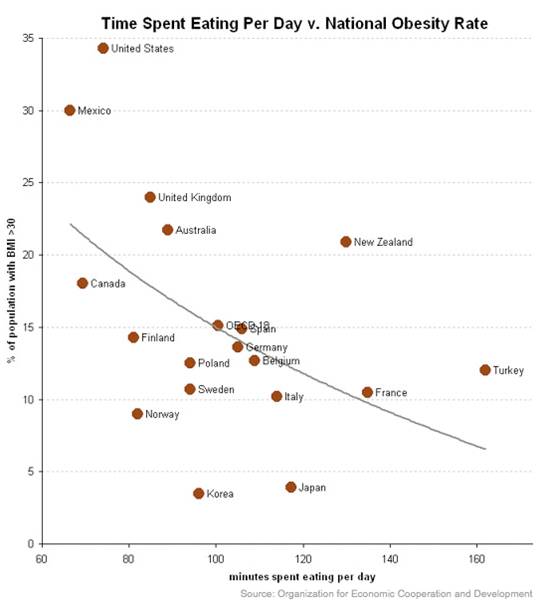
Data Source: OECD (Organization for Economic Cooperation and Development)
Solutions?
Education / Government: Educational support through cooperation with the government is necessary to spread the word regarding the consequences of obesity. Incentives also need to be integrated into our healthcare system so individuals can responsibly attack obesity head-on.
Behavioral Modification: Healthier diet and exercise lifestyles need to be evangelized. Implementation of economic incentives can possibly improve behavior by lowering insurance premiums in exchange for better health compliance.
Medications: Research needs to continue so innovative medications can help prevent and control obesity. Arena Pharmaceuticals (ARNA), VIVUS (VVUS), and Orexigen Therapeutics (OREX) are in the late stages in an attempt of getting their obesity drugs approved by the FDA. There is tremendous profit potential if the proper mix of efficacy and safety can be proven, however the detection of side-effects can potentially derail adoption and approval.
Surgery: Advancements have been introduced through medical technologies as well. Allergan’s (AGN) Lap-Band device is an example of an FDA approved device that effectively wraps around the stomach like a rubber-band to control excessive eating urges.
Obviously this is not an easy problem to deal with, as evidenced by the skyrocketing numbers. Many face inherent genetic hurdles in conquering diabetes, while others may have other health issues that contribute to overweight problems.
With the holidays upon us, I still plan on responsibly splurging on occasion, but I’m praying I will have the discipline to mix in some veggies and a run around the block with my eggnog and turkey leg. In the meantime, perhaps I’ll help support the economy by running to the mall and burning some holiday calories by doing some shopping!
Wade W. Slome, CFA, CFP®
Plan. Invest. Prosper.
DISCLOSURE: Sidoxia Capital Management (SCM) and some of its clients own certain exchange traded funds and AGN, but at time of publishing had no direct positions in ARNA, VVUS, or OREX. No information accessed through the Investing Caffeine (IC) website constitutes investment, financial, legal, tax or other advice nor is to be relied on in making an investment or other decision. Please read disclosure language on IC “Contact” page.
Equities Up, But Investors Queasy

The market may have recovered partially from its illness over the last two years, but investors are still queasy when it comes to equities. The market is up by more than +60% since the March 2009 lows despite the unemployment rate continuing to tick higher, reaching 10.2% in October. Even though equity markets have rebounded, recovering investors have flocked to the drug store with their prescriptions for bonds. Mark Dodson, CFA, from Hays Advisory published a telling chart that highlights the extreme aversion savers have shown towards stocks.
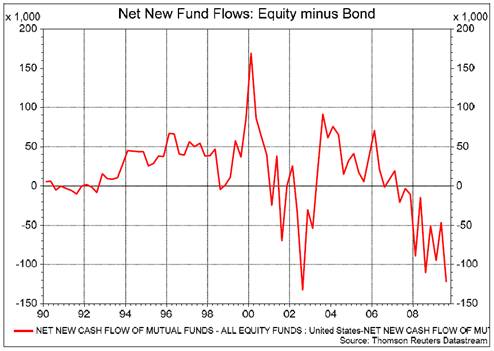
Source: Hays Advisory LLC (Thomson Reuters Datastream)
Dodson adds:
“Net new fund mutual fund flows favor bonds over stocks dramatically, so much so that flows are on the cusp of breaking into record territory, with the previous record occurring back in the doldrums of the 2002 bear market. Given nothing but the chart (above), we would never in a million years guess that the stock market has rallied 50-60% off the March lows. It looks more like what you would see right in the throes of a nasty stock market decline.”
Checking and savings data from the Federal Reserve Bank of Saint Louis further corroborates the mood of the general public as the nausea of the last two years has yet to wear off. The mountains of cash on the sidelines have the potential of fueling further gains under the right conditions (see also Dry Powder Piled High story).
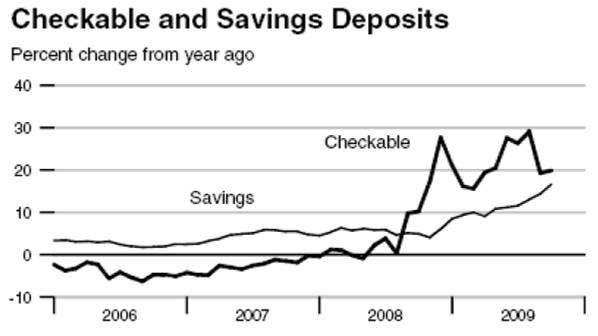
As Dodson notes in the Hays Advisory note, not everything is doom and gloom when it comes to stocks. For one, insider purchases according to the Emergent Financial Gambill Ratio is the highest since the recent bear market came to a halt. This trend is important, because as Peter Lynch emphasizes, “There are many reasons insiders sell shares but only one reason they buy, they feel the price is going up.”
What’s more, the yield curve is the steepest it has been in the last 25 years. This opposing signal should provide comfort to those blue investors that cried through inverted yield curves (T-Bill yields higher than 10-Year Notes) that preceded the recessions of 2000 and 2008.
Equity investors are still feeling ill, but time will tell if a dose of bond selling and a prescription for “cash-into-stocks” will make the queasy patient feel better?
Wade W. Slome, CFA, CFP®
Plan. Invest. Prosper.
DISCLOSURE: No information accessed through the Investing Caffeine (IC) website constitutes investment, financial, legal, tax or other advice nor is to be relied on in making an investment or other decision. Please read disclosure language on IC “Contact” page.
A Rare Breed: Father of Growth Investing

The man, the myth, the legend.
Successful long-term growth managers are part of a rare breed, but Thomas Rowe Price, Jr. – also known as the “Father of Growth Investing” – certainly qualifies. Too often, value legends like Warren Buffett and Benjamin Graham are highlighted in media circles. Using a baseball analogy, growth heroes like Mr. Price are more akin to atypical knuckleball pitchers, like Hall of Famer Phil Neikro. Writing about Mr. Price is consistent with my belief that investors striving to improve performance will be served well by studying great investors (for other growth superstars, see also Phil Fisher, Ron Baron, and John Calamos, Sr.).
History
T. Rowe Price was born in Linwood, Maryland, in 1898 and died in 1983. Price graduated from Swathmore College in 1919 with a degree in Chemistry, and then went onto work at Baltimore-based Mackubin Goodrich, which eventually became Legg Mason Inc. (LM). In 1937 he founded T. Rowe Price Associates (TROW) and successfully ramped up the company before the launch of the T. Rowe Price Growth Stock Fund in 1950. Expansion ensued until he made a timely sale of his company in the late 1960s (fortuitously before the 1973-1974 crash).
Philosophy
How did Price feel about growth investing?
“The growth stock theory of investing requires patience, but is less stressful than trading, generally has less risk, and reduces brokerage commissions and income taxes.”
This philosophy makes perfect sense to me; however it runs contrary to the strategies implemented by many managers whom are categorized in the “growth” style box today. In the hyper-sensitive, short-term focused performance world, many “momentum” managers play in this same “growth” sandbox. Typically this means managers buy stocks that are going up and sell stocks that are going down (see “momentum” article) over relatively short time frames, on average.
Price also firmly believed in fundamental research. As part of the investment process, Price believed in the “Life Cycle Theory of Companies,” meaning companies followed the phases of a human (birth, maturity, and decline). Price expands on this idea by stating the following: “An understanding of the life cycle of earnings growth and judgment in appraising future earnings trends are essential to investing.” He placed emphasis on investing in quality companies in good times and bad. In order to strip out economic cycle impacts, he compared company performance to peer performance – regardless of macroeconomic conditions.
John Train, the writer of “The Money Masters,” maintained the following factors were key underpinnings of Price’s investments:
- Superior research to develop products and markets.
- A lack of cutthroat competition.
- A comparative immunity from government regulation.
- Low total labor costs, but well-paid employees.
- At least a 10% return on invested capital, sustained high profit margins, and a superior growth of earnings per share.
Buy and Hold
The proof was in the pudding when it came to the “patience” referenced in Price’s quote above. For example, in the early 1970s, Price had accumulated gains of +6,184% in Xerox (XRX), which he held for 12 years, and gains of +23,666% in Merck (MRK), which he held for 31 years (Lessons from the Legends of Wall Street, Nikki Ross). Timing was not the most important factor in pulling the decision trigger:
“It is better to be early than too late in recognizing the passing of one era, the waning of old investment favorites and the advent of a new era affording new opportunities for the investor.”
In the polluted world of mass information that we sift through every day, I recommend reviewing the strategies of greats, including the “Father of Growth Investing” (T. Rowe Price). That’s my fatherly advice for you.
Wade W. Slome, CFA, CFP®
Plan. Invest. Prosper.
DISCLOSURE: Sidoxia Capital Management (SCM) and its clients owns certain exchange traded funds, but currently have no direct position in LM, TROW, XRX or MRK. No information accessed through the Investing Caffeine (IC) website constitutes investment, financial, legal, tax or other advice nor is to be relied on in making an investment or other decision. Please read disclosure language on IC “Contact” page.




 Investing Caffeine
