Posts filed under ‘Stocks’
Google Caught Naked: Their Loss, Your Gain?

Google Inc. (GOOG) got caught naked yesterday with the early release of its lackluster numbers and “Pending Larry Quote,” but is Google’s loss your gain? An endless number of bloggers and media outlets were quick to jump on the bandwagon, highlighting the sophomor-ish early dissemination of quarterly results, and then simultaneously headlines were blasted about a -20% drop in profits.
I love these sensationalist headlines that I hear chirped in the local Starbucks (SBUX), on the elevator, or at the grocery store. The Armageddon headlines and cascading minute-by-minute charts make for entertaining viewing, but the gaudy $40 billion in cash piling up on Google’s balance sheet, including the measly $3 billion it added in the quarter, may also be news-worthy. Fear sells more than greed, which may explain why there is little mention of Google’s +45% revenue growth (equally misleading because of the Motorola deal). Let me remind you, the $3 billion of cold hard cash created in a single 90 day period is the equivalent size of many large established companies – companies like Groupon Inc. (GRPN), Tesla Motors Inc. (TSLA), and Weight Watchers International Inc. (WTW).
If people could take off their panic caps for a minute, they would be able to see the explosion in smart phones (now around 1 billion) is on pace to swell to 5 billion over the next decade. What will that mean for a market leader like Google with over ½ billion Android devices that is activating 1.3 million more every day? I don’t know for sure, but I’m willing to venture it is going to mean a lot of dough for Google. What further inspires my confidence? Well, the fact that Google’s mobile related revenues have gone from $2.5 billion run rate last year to over $8 billion today indicates they are on the right track.
Google got caught naked with its press release flub, and the frail Motorola acquisition may cause a little indigestion in the coming quarters, but any short-run Google losses may be your opportunity for long-term gains.
Wade W. Slome, CFA, CFP®
Plan. Invest. Prosper.
DISCLOSURE: Sidoxia Capital Management (SCM) and some of its clients hold positions in certain exchange traded funds (ETFs) and GOOG, but at the time of publishing SCM had no direct positions in SBUX, TSLA, GRPN, WTW, or any other security referenced in this article. No information accessed through the Investing Caffeine (IC) website constitutes investment, financial, legal, tax or other advice nor is to be relied on in making an investment or other decision. Please read disclosure language on IC Contact page.
Dividend Floodgates Widen

The recently reported lackluster, monthly employment report made stockholders grumpy (as measured by the recent -168 point decline in the Dow Jones Industrial index) and bondholders ecstatic (as measured by the surge in the 10-year Treasury note price and plunge in yield to a meager 1.88% annual rate). Stocks on the other hand are yielding a much more attractive rate of approximately 7.70% based on 2012 earnings estimates (see chart below) and are also offering a dividend yield of about 2.25%.
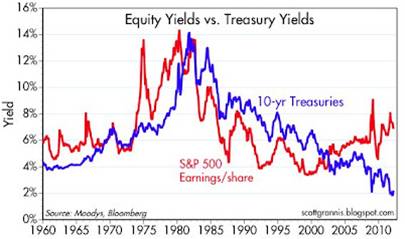
S&P 500 earnings yields trouncing bond yields despite historical correlation.
In my view, either stock prices go higher and drive equity yields lower; bonds sell off and Treasury yields spike higher; or a combination of the two. Either way, there are not many compelling reasons to pile into Treasuries, although I fully understand some Treasuries are needed in many investors’ portfolios for income, diversification, and risk tolerance reasons.
Not only are equity earnings yields beating Treasury yields, but so are dividend yields. It has been a generation, or more than 50 years, since the last time stock dividends were yielding more than 10-year Treasuries (see chart below). If you invested in stocks back when dividend yields outpaced bond yields, and held onto your shares, you did pretty well in stocks (the Dow Jones Industrial index traded around 600 in 1960 and over 13,000 today).
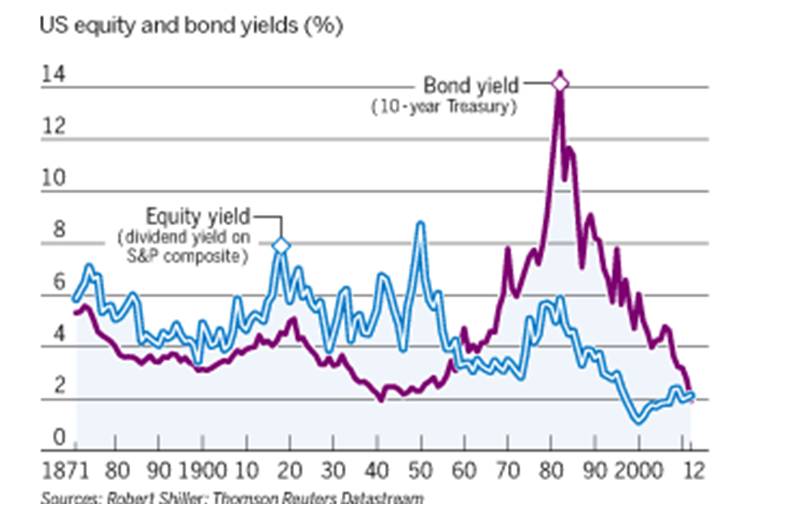
Source: The Financial Times
The Dynamic Dividend Payers
The problem with bond payments (coupons), in most cases, is that they are static. I have never heard of a bond issuer sending a notice to a bond holder stating they wanted to increase the size of interest payments to their investors. On the flip side, stocks can and do increase payments to investors all the time. In fact here is a list of some of the longest paying dividend dynamos that have incredible dividend hike streaks:
• Procter & Gamble (PG – 55 consecutive years)
• Emerson Electric (EMR – 54 years)
• 3M Company (MMM – 53 years)
• The Coca-Cola Company (KO – 49 years)
• Johnson & Johnson (JNJ – 49 years)
• Colgate-Palmolive Company (CL – 48 years)
• Target Corporation (TGT – 43 years)
• PepsiCo Inc. (PEP – 39 years)
• Wal-Mart Stores Inc. (WMT – 38 years)
• McDonald’s Corporation (MCD – 35 years)
This is obviously a small number of the long-term consecutive dividend hikers, but on a shorter term basis, more and more players are joining the dividend paying team. So far, in 2012 alone through April, there have been 152 companies in the S&P 500 index that have raised their dividend (a +11% increase over the same period a year ago). Of those 152 companies that increased the dividend this year, the average boost was more than +23%. Some notable names that have had significant dividend increases in 2012 include the following companies:
• Macy’s Inc. (M: +100% dividend increase)
• Mastercard Inc. (MA: +100%)
• Wells Fargo & Company (WFC: +83%)
• Comcast Corp. (CMCSA: +44%)
• Cisco Systems Inc. (CSCO: +33%)
• Goldman Sachs Group Inc. (GS: +31%)
• Freeport McMoran (FCX: +25%)
• Harley Davidson Inc. (HOG: +24%)
• Exxon Mobil Corp. (XOM: +21%)
• JP Morgan Chase & Co. (JPM: +20%)
Lots of Dividend Headroom
The nervous mood of investors is not much different from the temperament of uneasy business executives, so companies have been slow to hire; unhurried to acquire; and deliberate with their expansion plans. Rather than aggressively spend, corporations have chosen to cut costs, hoard cash, grow earnings, buy back shares, and pay out ever increasing dividends from the trillions in cash piling up.
When a company on average is earning an 8% yield on their stock price, there is plenty of headroom to increase the dividend. As a matter of fact, a company paying a 2% yield could increase its dividend by 10% for about 15 consecutive years and still pay a quadrupling dividend with NO earnings growth. Simply put, there is a lot of room for companies to increase dividends further despite the floodgate of dividend increases we have experienced over the last few years. If you look at the chart below, the dividend yield is the lowest it has been in more than a century (1900).
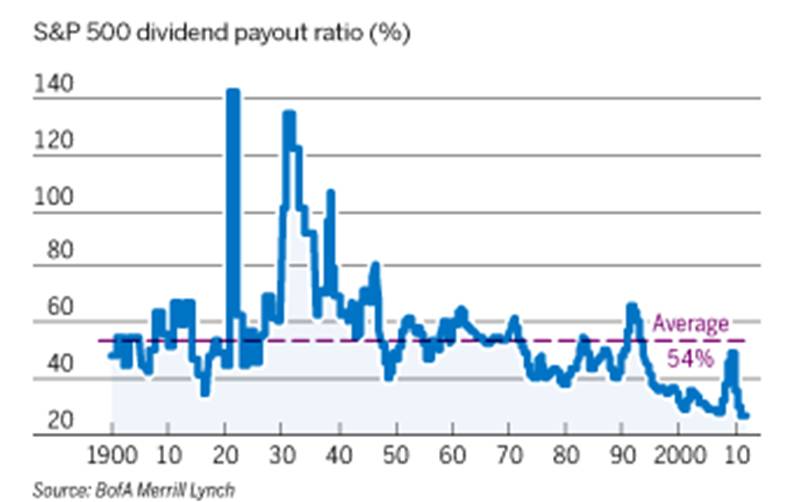
Source: The Financial Times
Perhaps we will experience another “Summer Swoon” this year, but for those selective and patient investors that sniff out high-quality, dividend paying stocks, you will be getting “paid to wait” while the dividend floodgates continue to widen.
Wade W. Slome, CFA, CFP®
Plan. Invest. Prosper.
DISCLOSURE: Sidoxia Capital Management (SCM) and some of its clients own certain exchange traded funds (including Treasury bond ETFs), CMCSA and WMT, but at the time of publishing SCM had no direct position in PG, EMR, MMM, KO, JNJ, CL, TGT, PEP, MCD, M, MA, WFC, CSCO, GS, FCX, HOG, XOM, JPM, or any other security referenced in this article. No information accessed through the Investing Caffeine (IC) website constitutes investment, financial, legal, tax or other advice nor is to be relied on in making an investment or other decision. Please read disclosure language on IC “Contact” page.
Cash Security Blanket Turns Into Tourniquet

Article is an excerpt from Sidoxia Capital Management’s April 2012 newsletter. Subscribe on right side of page.
That warm safety blanket of cash that millions of Americans have clutched on to during the 2008-09 financial crisis; the 2010 “Flash Crash”; and the 2011 U.S. credit downgrade felt cozy during the bumpy ride we experienced over the last three years. Now with domestic stocks (S&P 500) up +12% in the first quarter of 2012, that same comfy blanket of CDs, money market, and checking accounts is switching into a painful tourniquet, cutting off the lucrative blood and oxygen supply to millions of Americans’ future retirement plans.
Earning next to nothing by stuffing your money under the mattress (0.7% average CD rate – Bankrate.com) isn’t going to make many financial dreams a reality. The truth of the matter is that due to inflation (running +2% to +3% per year), blanket holders are losing about -2% per year in the true value of their savings.
Your Choice: 3 Years or 107 years?
If you like to accumulate money, would you prefer doubling your money in 3 years or 107 years? Although the S&P 500 has more than doubled over the last three years, based on fund flows data and cash balances at the banks, apparently more individuals prefer waiting until the year 2119 (107 years from now) for their money to double – SEE CHART BELOW.
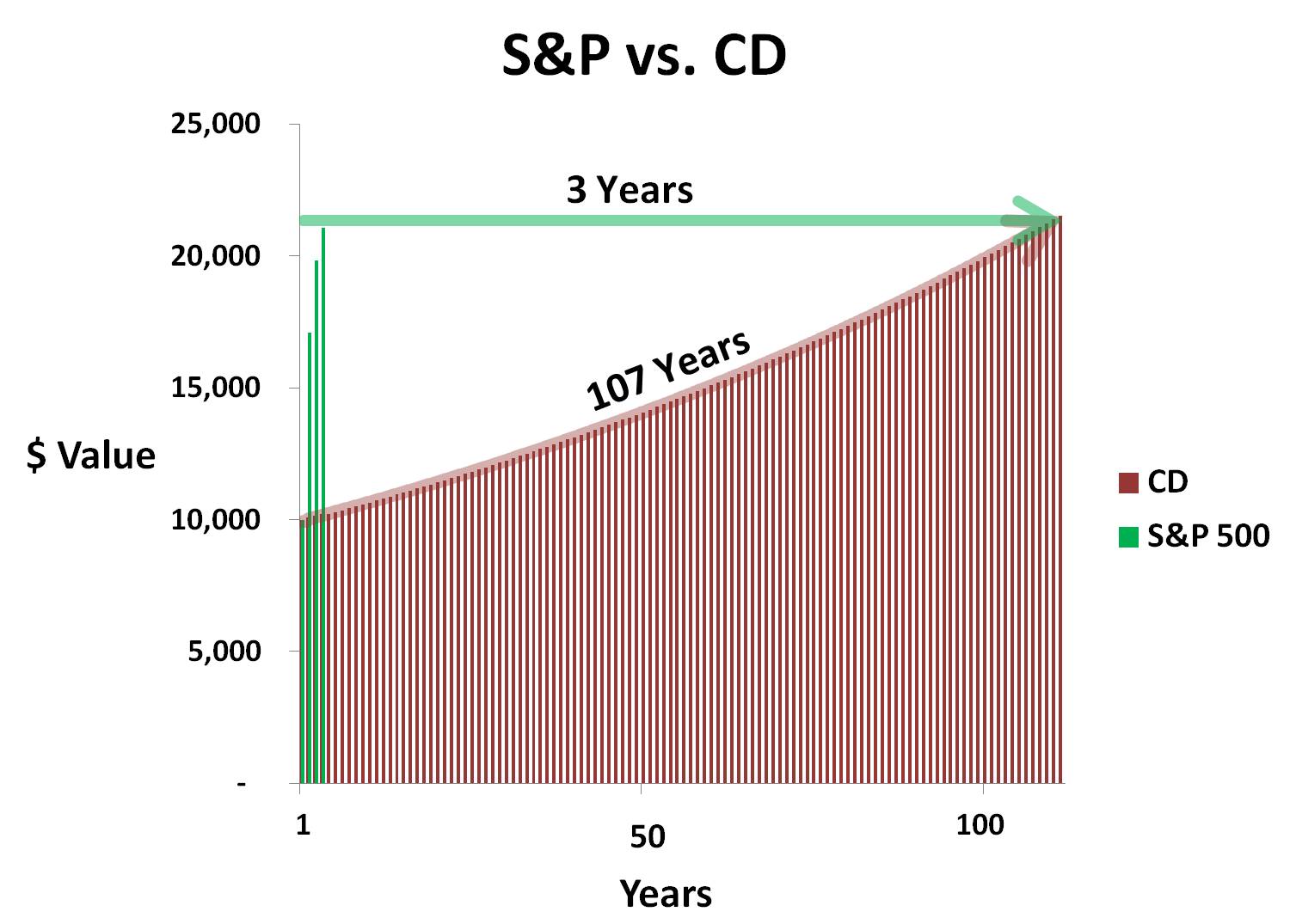
Obviously the massive underperformance of CDs cherry picks the time-period a bit, given the superb performance of stocks from 2009 – 2012 year-to-date. Over 1999-2012 stock performance hasn’t been as spectacular, but what we do know is that despite the lackluster performance of stocks over the last 12 years, corporate profits have about doubled in a similar timeframe, making equity prices that much more attractive relative to 1999.
With the economy and employment picture improving, some doomsday scenarios have temporarily been put on the backburner. As the recovery has gained some steam, many people are opening their bank statements with the painful realization, “I just made $31.49 on my checking maximizer account last year! Wow, how incredible…I can now go out and buy a half-tank of gas.” Never mind that healthcare premiums are exploding, food costs are skyrocketing, and that vacation you were planning is now out of reach. If you’re a mega-millionaire, perhaps you can make these stingy rates work for you, but for most of the other people, successful retirements will require more efficient use of their investment dollars. Or of course you can always work at Wal-Mart (WMT) as a greeter in your 80s.
Rationalizing with a Teen
Some people get it and some don’t. Trying to time the market, by getting in and out at the right times is a losing battle (see Getting Off the Market Timing Treadmill). Even the smartest professionals in the industry have little accuracy and cannot consistently predict the direction of the markets. Rationalizing the ups and downs of the financial markets is equivalent to rationalizing the actions of a teenager. Sometimes the outcomes are explainable, but most of the times they are not.
What an astute investor does know is that higher long-term returns come with higher volatility. So while the last four years have been a bumpy ride for investors, this is nothing new for an experienced investor who has studied the history of financial markets. There have been a dozen or so recessions since World War II, and we’ll have a dozen or so more over the next 50-60 years. Wars, banking crises, currency crises, and political turmoil have been a constant over history. Despite all these setbacks, the equity markets have climbed over +1,300% over the last 30 years or so. The smartest financial minds on the planet (e.g., the Ben Bernankes and Alan Greenspans of the world) haven’t been able to figure it out, so if they couldn’t do it, how is an average Joe supposed to be able to time the market? The answer is nobody can predict the direction of the market reliably.
As my clients and Investing Caffeine followers know, for those individuals with adequate savings and shorter time horizons, much of this conversation is irrelevant. However, based on our country’s low savings rate and the demographics of longer Baby Boomer life expectancies, most individuals can’t afford to stuff all their money under the mattress. As famous investor Sir John Templeton stated, “The only way to avoid mistakes is not to invest – which is the biggest mistake of all.” Earning 0.7% on your nest egg is difficult to call investing.
Ignoring the Experts
Why is the investing game so difficult? For starters, individuals are constantly bombarded by so-called experts through television, radio, and newspapers. Not only did Federal Reserve Chairmen Alan Greenspan and Ben Bernanke get the economy, financial markets, and housing markets wrong, the most powerful and smart financial institution CEOs were dead wrong as well. Look no further than Lehman Brothers (Dick Fuld), Citigroup Inc. (Chuck Prince), and American International Group (Martin Sullivan), which were believed to house some of the shrewdest executives – they too completely missed the financial crisis.
Rather than listening to shoddy predictions from pundits who have little to no investing experience, it makes more sense to listen to successful long-term investors who have survived multiple investment cycles and lived to tell the tale. Those people include the great fund manager Peter Lynch who said it is better to “assume the market is going nowhere and invest accordingly,” rather than try to time the market.
What You Hear
As the market has more than doubled over the last 37 months, here are some clouds of pessimism that these same shoddy economists, strategists, and analysts have described for investors:
* Europe and Greece’s impending fiscal domino collapse
* Excessive money printing at the Federal Reserve through quantitative easing and other programs
* Imminent government disintegration due to unresolved structural debts and deficits
* Elevated unemployment rates and pathetic job creation statistics
* Rigged high frequency trading and “Flash Crash”
* Credit downgrade and political turmoil in Washington
* Looming Chinese real estate bubble and subsequent hard economic landing
Unfortunately, many investors got sucked up in these ominous warnings and missed most, if not all, of the recent doubling in equity markets.
What You Don’t Hear
What you haven’t heard from the popular press are the following headlines:
* 10 consecutive quarters of GDP growth
* Record corporate profits and profit margins
* Equity valuations attractively priced below 50-year average (14.4 < 16.6 via Calafia Beach Pundit)
* Rising dividends with yields approaching 3%, if you consider recent bank announcements
* Record low interest rates and moderate inflation make earnings streams and dividends that much more valuable
* Four million new jobs created over the last three years
* S&P Smallcap near all-time highs (21 years); S&P Midcap index near all-time highs (20 years); NASDAQ is at 11-year highs; Dow Jones Industrials and S&P 500 near 4-year-highs.
* Record retail sales with a consumer that has reduced household debt
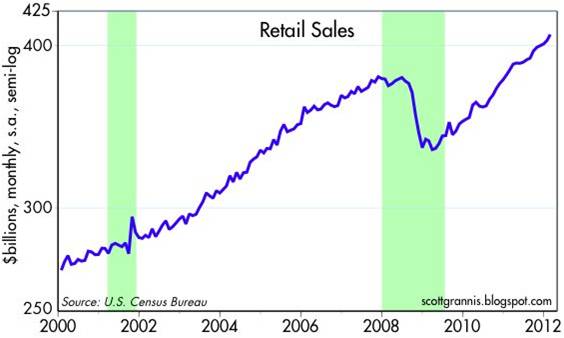
Source: Calafia Beach Pundit
Given the massive upward run in the stock market over the last few years (and a complacent short-term VIX reading of 15), stocks are ripe for a breather. With that said, I would advise any blanket holders to not get too comfy with that money decaying away in a CD, money market, or savings account. Waiting too long may turn that security blanket into a tourniquet – forcing investors to amputate a portion of their future retirement savings.
Wade W. Slome, CFA, CFP®
Plan. Invest. Prosper.
DISCLOSURE: Sidoxia Capital Management (SCM) and some of its clients own certain exchange traded funds and WMT, but at the time of publishing SCM had no direct position in C, AIG, RATE, Lehman Brothers, or any other security referenced in this article. No information accessed through the Investing Caffeine (IC) website constitutes investment, financial, legal, tax or other advice nor is to be relied on in making an investment or other decision. Please read disclosure language on IC “Contact” page.
Box Wine, Facebook and PEG Ratios

I’m no wine connoisseur, but I do know I would pay more for a bottle of Dom Pérignon champagne than I would pay for a container of Franzia box wine. In the world of stocks, the quality disparity is massive too. In order to navigate the virtually infinite number of stocks, we need to have an instrument in our toolbox that can assist us in accurately comparing stocks across the quality spectrum. Thank goodness we have the handy PEG ratio (Price/Earnings to Growth) that elegantly marries the price paid for a stock (as measured by the P/E ratio) with the relative quality of the stock (as measured by its future earnings growth rate).

Famed investor Peter Lynch (see Inside the Brain of an Investing Genius) understood the PEG concept all too well as he used this tool religiously in valuing and analyzing different companies. Given that Lynch earned a +29% annual return from 1977-1990, I’ll take his word for it that the PEG ratio is a useful tool. As highlighted by Lynch (and others), the key factor in using the PEG ratio is to identify companies that trade with a PEG ratio of less than 1. All else equal, the lower the ratio, the better potential for future price appreciation. Facebook Vs. Eastman Kodak
To illustrate the concept of how a PEG ratio can be used to compare stocks with two completely different profiles, let’s start by answering a few questions. Would a rational investor pay the same price (i.e., Price-Earnings [P/E] ratio) for a company with skyrocketing profits as they would for a company going into bankruptcy? Look no further than the lofty expected P/E multiple to be afforded to the shares of the widely anticipated Facebook (FB) initial public offering (IPO). That same rational investor is unlikely to pay the same P/E multiple for a money losing company like Eastman Kodak Co. (EKDKQ.PK) that faces product obsolescence. The contrasting values for these two companies are stark. Some pundits are projecting that Facebook shares could fetch upwards of a 100x P/E ratio, while not too long ago, Kodak was trading at a P/E ratio of 4x. Plenty of low priced stocks have outperformed expensive ones, but remember, just because a “value” stock may have a lower absolute P/E ratio in the recent past, does not mean it will be a better investment than a “growth” stock sporting a higher P/E ratio (see Fallacy of High P/Es).
Price, Earnings, and Dividends
As I’ve written in the past, a key determinant of future stock prices is future earnings growth (see It’s the Earnings Stupid). The higher the P/E multiple, the more important future earnings growth becomes. The lower the future growth, the more important valuation and dividends become.
We can look at various money-making scenarios that incorporate these factors. If my goal were to double my money in 5 years (i.e., earn a 100% return), there are numerous ways to skin the profit-making cat. Here are four examples:
1) Buy a non-dividend paying stock of a company that achieves earnings growth of 15%/year and maintains its current P/E ratio over time.
2) Buy a stock of a company that has a 5% dividend and achieves earnings growth of 11%/year and maintains its current P/E ratio over time.
3) Buy a value stock with a 5% dividend that achieves earnings growth of 5%/year and increase its P/E ratio by 10% each year.
4) Buy a non-dividend paying growth stock that achieves earnings growth of 20%/year and decreases its P/E ratio by about 5% each year.
I think you get the idea, but as you can see, in addition to earnings growth, dividends and valuation do play a significant role in how an investor can earn excess returns.
Lynch’s Adjusted PEG
Peter Lynch added a slight twist to the traditional PEG analysis by accounting for the role of dividends in the denominator of the PEG equation:
PEG (adjusted by Lynch) = PE Ratio/(Earnings Growth Rate + Dividend Yield)
This “adjusted PEG” ratio makes intuitive sense under various perspectives. For starters, if two different companies both had a PEG ratio of 0.8, but one of the two stocks paid a 3% dividend, Lynch’s adjusted PEG would register in at a more attractive level of 0.6 for the dividend paying stock.
Looked at under a different lens, let’s suppose there are two lemonade stands that IPO their stocks at the same time, and both companies use the exact same business model. Moreover, let us assume the following:
• Lemonade stand #1 has a P/E of 14x and growth rate of 15%.
• Lemonade stand #2 has a P/E of 12x and growth rate of 8%, but it also pays a dividend of 3%.
Given this information, which one of the two lemonade stands would you invest in? Many investors see the lower P/E of Lemonade stand #2, coupled with a nice dividend, as the more attractive opportunity of the two. But as we can see from Lynch’s “adjusted PEG” ratio, Lemonade stand #1 actually has the lower, more attractive value (.9 or 14/15 vs 1.1 or 12/(8+3)).
This analysis may be delving into the weeds a bit, but this framework is critical nonetheless. Valuation and earnings projections should be essential components of any investment decision, and with record low interest rates, dividend yields are playing a much more important role in the investment selection process. Regardless of your purchase decision thought process, whether deciding between Dom Perignon and box wine, or Facebook and Kodak shares, having the PEG ratio at your disposal should help you make wise and lucrative decisions.
Wade W. Slome, CFA, CFP®
Plan. Invest. Prosper.
DISCLOSURE: Sidoxia Capital Management (SCM) and some of its clients own certain exchange traded funds, but at the time of publishing SCM had no direct position in FB, EKDKQ.PK, or any other security referenced in this article. No information accessed through the Investing Caffeine (IC) website constitutes investment, financial, legal, tax or other advice nor is to be relied on in making an investment or other decision. Please read disclosure language on IC “Contact” page.
The $100 Billion Facebook Man

Source: Photobucket
If you don’t pay close enough attention, you may miss the Facebook initial public offering (IPO) in the blink of an eye. Since computer programming or Botox has frozen Facebook CEO Mark Zuckerberg’s face into a wide-eyed, blink-free state, you may have bought yourself a little more time to buy shares in this imminent IPO, which is estimated to value the company at upwards of $100 billion.
We don’t know a lot of details about the financial health of Facebook right now, but what we do know is that this snot-nosed, 27-year-old Mark Zuckerberg has created one of the most powerful companies on this planet and his estimated net worth is currently around $17 billion. Not bad for a college drop-out who started Facebook in 2004 as a freshman at Harvard University. Hmmm, maybe I should have dropped out of college like Mark Zuckerberg, Steve Jobs, and Bill Gates, and I too could have become a billionaire? OK, maybe not, but sometimes living in dreamland can be fun.
Speaking of dreams, Zuckerberg has a dream of connecting the whole world, and with more than 800 million-plus Facebook users, he is well on his way. If Facebook users made their own own country, it would be #3 behind only China and India – I’ll check back in a few years to see if Facebook can climb to the top position.
The Pre-IPO Interview
Charlie Rose recently ditched the tie and headed to Silicon Valley to conduct an interview at Facebook headquarters with Mark Zuckerberg and his Chief Operating Officer Sheryl Sandberg. If you fast forward to MINUTE 9:30 you can listen to the official Facebook IPO response:
Vodpod videos no longer available.
The Hype Machine
The hype surrounding the Facebook IPO is palpable and feels a lot like the Google Inc. (GOOG) IPO in 2004, but that capital raising event only resulted in proceeds of $1.9 billion for Google. The recent chatter surrounding the pending Facebook IPO places the value to be raised closer to $10 billion. Partial offerings seem to be the trend du jour in the social media IPO world, where companies like LinkedIn Corp. (LNKD), Groupon Inc. (GRPN), and Zillow Inc. (Z) all sold just a sliver of their shares to the public in order to create artificial scarcity, thereby pumping up short-term demand for their respective stocks. These companies trade at or above their initial offering price, but significantly below the early investor mouth-frothing spikes in share prices near the time of the IPOs. Facebook appears to be using the same playbook to build up hype for its eventual offering.
Even at an estimated value of $100 billion, Facebook still has some wood to chop if wants to pass Google (about $185 billion in value) and Apple Inc’s (AAPL) approximate $415 billion, but Zuckerberg is no stranger to ambition. When Facebook unveils its inevitable IPO prospectus in the not too distant future, we will have a better idea of whether Facebook and the 2010 Time magazine Person of the Year deserve all the mega-billion dollar accolades, or will an IPO feeding frenzy bring tears to those investors’ eyes that are not privileged enough to receive IPO allocated shares? Regardless of your faith or skepticism, we’re likely to find out the answer to these critical questions in a blink of an eye.
Wade W. Slome, CFA, CFP®
Plan. Invest. Prosper.
DISCLOSURE: Sidoxia Capital Management (SCM) and some of its clients own certain exchange traded funds, AGN, AAPL, GOOG but at the time of publishing SCM had no direct position in Facebook, MSFT, LNKD, GRPN, Z, TWX, or any other security referenced in this article. No information accessed through the Investing Caffeine (IC) website constitutes investment, financial, legal, tax or other advice nor is to be relied on in making an investment or other decision. Please read disclosure language on IC “Contact” page.
Munger: Buffett’s Wingman & the Art of Stock Picking
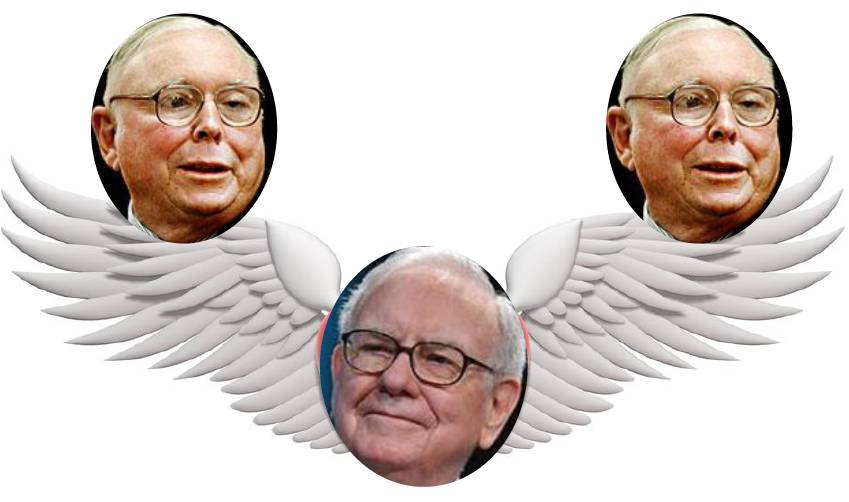
Simon had Garfunkel, Batman had Robin, Hall had Oates, Dr. Evil had Mini Me, Sonny had Cher, and Malone had Stockton. In the investing world, Buffett has Munger. Charlie Munger is one of the most successful and famous wingmen of all-time – evidenced by Berkshire Hathaway Corporation’s (BRKA/B) outperformance of the S&P 500 index by approximately +624% from 1977 – 2009, according to MarketWatch. Munger not only provides critical insights to his legendary billionaire boss, Warren Buffett, but he also is Chairman of Berkshire’s insurance subsidiary, Wesco Financial Corporation. The magic of this dynamic duo began when they met at a dinner party during 1959.
In an article he published in 2006, the magnificent Munger describes the “Art of Stock Picking” in a thorough review about the secrets of equity investing. We’ll now explore some of the 88-year-old’s sage advice and wisdom.
Model Building
Charlie Munger believes an individual needs a solid general education before becoming a successful investor, and in order to do that one needs to study and understand multiple “models.”
“You’ve got to have models in your head. And you’ve got to array your experience both vicarious and direct on this latticework of models. You may have noticed students who just try to remember and pound back what is remembered. Well, they fail in school and in life. You’ve got to hang experience on a latticework of models in your head.”
Although Munger indicates there are 80 or 90 important models, the examples he provides include mathematics, accounting, biology, physiology, psychology, and microeconomics.
Advantages of Scale
Great businesses in many cases enjoy the benefits of scale, and Munger devotes a good amount of time to this subject. Scale advantages can be realized through advertising, information, psychological “social proofing,” and structural factors.
The newspaper industry is an example of a structural scale business in which a “winner takes all” phenomenon applies. Munger aptly points out, “There’s practically no city left in the U.S., aside from a few very big ones, where there’s more than one daily newspaper.”
General Electric Co. (GE) is another example of a company that uses scale to its advantage. Jack Welch, the former General Electric CEO, learned an early lesson. If the GE division is not large enough to be a leader in a particular industry, then they should exit. Or as Welch put it, “To hell with it. We’re either going to be # 1 or #2 in every field we’re in or we’re going to be out. I don’t care how many people I have to fire and what I have to sell. We’re going to be #I or #2 or out.”
Bigger Not Always Better
Scale comes with its advantages, but if not managed correctly, size can weigh on a company like an anchor. Munger highlights the tendency of large corporations to become “big, fat, dumb, unmotivated bureaucracies.” An implicit corruption also leads to “layers of management and associated costs that nobody needs. Then, while people are justifying all these layers, it takes forever to get anything done. They’re too slow to make decisions and nimbler people run circles around them.”
Becoming too large can also create group-think, or what Munger calls “Pavlovian Association.” Munger goes onto add, “If people tell you what you really don’t want to hear what’s unpleasant there’s an almost automatic reaction of antipathy…You can get severe malfunction in the high ranks of business. And of course, if you’re investing, it can make a lot of difference.”
Technology: Benefit or Burden?
Munger recognizes that technology lowers costs for companies, but the important question that many managers fail to ask themselves is whether the benefits from technology investments accrue to the company or to the customer? Munger summed it up here:
“There are all kinds of wonderful new inventions that give you nothing as owners except the opportunity to spend a lot more money in a business that’s still going to be lousy. The money still won’t come to you. All of the advantages from great improvements are going to flow through to the customers.”
Buffett and Munger realized this lesson early on when productivity improvements gained from technology investments in the textile business all went to the buyers.
Surfing the Wave
When looking for good businesses, Munger and Buffett are looking to “surf” waves or trends that will generate healthy returns for an extended period of time. “When a surfer gets up and catches the wave and just stays there, he can go a long, long time. But if he gets off the wave, he becomes mired in shallows,” states Munger. He notes that it’s the “early bird,” or company that identifies a big trend before others that enjoys the spoils. Examples Munger uses to illustrate this point are Microsoft Corp. (MSFT), Intel Corp. (INTC), and National Cash Register from the old days.
Large profits will be collected by those investors that can identify and surf those rare large waves. Unfortunately, taking advantage of these rare circumstances becomes tougher and tougher for larger investors like Berkshire. If you’re an elephant trying to surf a wave, you need to find larger and larger waves, and even then, due to your size, you will be unable to surf as long as small investors.
Circle of Competence
Circle of competence is not a new subject discussed by Buffett and Munger, but it is always worth reviewing. Here’s how Munger describes the concept:
“You have to figure out what your own aptitudes are. If you play games where other people have the aptitudes and you don’t, you’re going to lose. And that’s as close to certain as any prediction that you can make. You have to figure out where you’ve got an edge. And you’ve got to play within your own circle of competence.”
For Munger and Buffett, sticking to their circle of competence means staying away from high-technology companies, although more recently they have expanded this view to include International Business Machines (IBM), which they invested in late last year.
Market Efficiency or Lack Thereof
Munger acknowledges that financial markets are quite difficult to beat. Since the markets are “partly efficient and partly inefficient,” he believes there is a minority of individuals who can outperform the markets. To expand on this idea, he compares stock investing to the pari-mutuel system at the racetrack, which despite the odds stacked against the bettor (17% in fees going to the racetrack), there are a few individuals who can still make decent money.
The transactional costs are much lower for stocks, but success for an investor still requires discipline and patience. As Munger declares, “The way to win is to work, work, work, work and hope to have a few insights.”
Winning the Game – 10 Insights / 20 Punches
As the previous section implies, outperformance requires patience and a discriminating eye, which has allowed Berkshire to create the bulk of its wealth from a relatively small number of investment insights. Here’s Munger’s explanation on this matter:
“How many insights do you need? Well, I’d argue: that you don’t need many in a lifetime. If you look at Berkshire Hathaway and all of its accumulated billions, the top ten insights account for most of it….I don’t mean to say that [Warren] only had ten insights. I’m just saying, that most of the money came from ten insights.”
Chasing performance, trading too much, being too timid, and paying too high a price are not recipes for success. Independent thought accompanied with selective, bold decisions is the way to go. Munger’s solution to these problems is to provide investors with a Buffett 20-punch ticket:
“I could improve your ultimate financial welfare by giving you a ticket with only 20 slots in it so that you had 20 punches ‑ representing all the investments that you got to make in a lifetime. And once you’d punched through the card, you couldn’t make any more investments at all.”
The great thing about Munger and Buffett’s advice is that it is digestible by the masses. Like dieting, investing can be very simple to understand, but difficult to execute, and legends like these always remind us of the important investing basics. Even though Charlie Munger may be slowing down a tad at 88-years-old, Warren Buffett and investors everywhere are blessed to have this wingman around spreading his knowledge about investing and the art of stock picking.
Wade W. Slome, CFA, CFP®
Plan. Invest. Prosper.
DISCLOSURE: Sidoxia Capital Management (SCM) and some of its clients own certain exchange traded funds, but at the time of publishing SCM had no direct position in BRKA/B, GE, MSFT, INTC, National Cash Register, IBM, or any other security referenced in this article. No information accessed through the Investing Caffeine (IC) website constitutes investment, financial, legal, tax or other advice nor is to be relied on in making an investment or other decision. Please read disclosure language on IC “Contact” page.
No Respect: The Rodney Dangerfield of the Investment World

Source: Photobucket
Ask any average Joe off the street what investment category is at or near record all-time highs, and a good number of them will confidently answer “gold,” as prices recently eclipsed $1,600 per ounce. But of course this makes perfect sense, right? The Fed is printing money like it’s going out of style, the dollar is collapsing like a drunken sailor, inflation is about to sky-rocket to the moon, and China is on the verge of becoming the world’s new reserve currency. Never mind that Greece, Portugal and Ireland are in shambles with the Euro on its death bed. Or Japan has achieved a debt to GDP ratio that would even make U.S. vote grubbing politicians blush. A sub-3% 10-Year Treasury Note doesn’t appear to discourage fervent gold-bugs either.
No Respect
While gold has experienced an incredible sextupling in prices over the last decade and hit new-all time highs, believe it or not, there is an unlikely asset class that is reaching new historic highs and has outperformed gold for almost 2.5 years. Can you guess what asset class star I am talking about? If I said U.S. “stocks,” would you believe me? OK, well maybe I’m not referring to large capitalization stocks like Johnson & Johnson (JNJ), Microsoft Corp. (MSFT), Wal-Mart Stores (WMT), Intel Corp. (INTC), and AT&T Inc. (T), all of which have effectively gone nowhere in the 21st Century. However, the story is quite different if you look at small and mid capitalization stocks, which have received about as much respect as Rodney Dangerfield.
As a matter of fact, the S&P 400 (MidCap Index) and S&P 600 Index (SmallCap Index) have more than doubled gold’s performance since the lows of March 2009 (SmallCap +149.0%; MidCap +145.1%; Gold/GLD +71.0%). Given the spectacular performance of small and mid-sized companies, I’m still waiting with bated breath for a telemarketer call asking me if I have considered selling my small and mid cap stock certificates for cash – since everyone has melted their gold chains and fillings, a new hobby is needed.
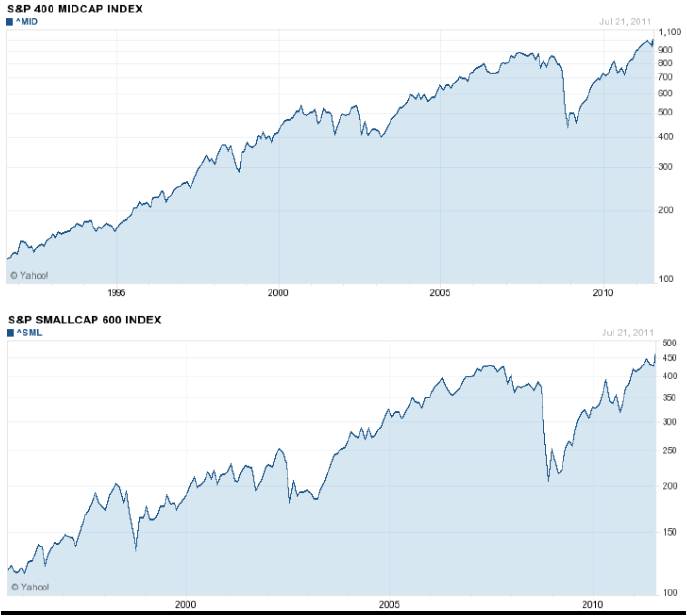
S&P 400 MidCap and S&P 600 SmallCap (Source: Yahoo! Finance)
What Next?
Has the fear trade ended? Perhaps not, if you consider European sovereign debt and U.S. debt ceiling concerns, but what happens if the half empty glass becomes half full. The early 1980s may be a historical benchmark period for comparison purposes. An interesting thing happened from 1980-1982 when Federal Reserve Chairman Paul Volcker began raising interest rates to fight inflation – gold prices dropped -65% (~$800/oz. to under $300/oz.) from 1980-1982 and the shiny metal lived through approximately a 25 year period with ZERO price appreciation. Since there is only one direction for the Fed’s zero interest rate policy (ZIRP) to go, conceivably history will repeat itself once again?
In hindsight gold was a beautiful safe haven vehicle during the panic-filled, nail-biting period during late-2007 throughout 2008. Since then, small and mid cap stocks have trounced gold. Like stocks, Rodney Dangerfield may have gotten no respect, but once fear has subsided and rates start increasing, maybe stocks will steal the show and get the respect they deserve.
See also Rodney Dangerfield’s perspective on Doug Kass and the Triple Lindy
Wade W. Slome, CFA, CFP®
Plan. Invest. Prosper.
DISCLOSURE: Performance data from Morningstar.com. Sidoxia Capital Management (SCM) and some of its clients own certain exchange traded funds (including small cap and mid cap ETFs), and WMT, but at the time of publishing SCM had no direct position in JNJ, MSFT, INTC, T, or any other security referenced in this article. No information accessed through the Investing Caffeine (IC) website constitutes investment, financial, legal, tax or other advice nor is to be relied on in making an investment or other decision. Please read disclosure language on IC “Contact” page.
Innovative Bird Keeps All the Worms

Source: Photobucket
As the old saying goes, “The early bird gets the worm,” but in the business world this principle doesn’t always apply. In many cases, the early bird ends up opening a can of worms while the innovative, patient bird is left with all the spoils. This concept has come to light with the recent announcement that social networking site MySpace is being sold for a pittance by News Corp. (NWS) to Specific Media Inc., an advertising network company. Although Myspace may have beat Facebook to the punch in establishing a social network footprint, Facebook steamrolled Myspace into irrelevance with a broader more novel approach. Rather than hitting a home run and converting a sleepy media company into something hip, Rupert Murdoch, CEO of News Corp. struck out and received crumbs for the Myspace sale (News Corp. sold it for $35 million after purchasing for $540 million in 2005, a -94% loss).
Other examples of “winner takes all” economics include:
Kindle vs. Book Stores: Why are Borders and Waldenbooks (BGPIQ.PK) bankrupt, and why is Barnes and Noble Inc. (BKS) hemorrhaging in losses? One explanation may be people are reading fewer books and reading more blogs (like Investing Caffeine), but the more credible explanation is that Amazon.com Inc. (AMZN) built an affordable, superior digital mousetrap than traditional books. I’ll go out on a limb and say it is no accident that Amazon is the largest bookseller in the world. Within three years of Kindle’s introduction, Amazon is incredibly selling more digital books than they are selling physical hard copies of books.
iPod vs. Walkman/MP3 Players: The digital revolution has shaped our lives in so many ways, and no more so than in the music world. It’s hard to forget how unbelievably difficult it was to fast-forward or rewind to a particular song on a Sony Walkman 30 years ago (or the hassle of switching cassette sides), but within a matter of a handful of years, mass adoption of Apple Inc.’s (AAPL) iPod overwhelmed the dinosaur Walkman player. Microsoft Corp.’s (MSFT) foray into the MP3 market with Zune, along with countless other failures, have still not been able to crack Apple’s overpowering music market positioning.
Google vs. Yahoo/Microsoft Search: Google Inc. (GOOG) is another company that wasn’t the early bird when it came to dominating a new growth industry, like search engines. As a matter of fact, Yahoo! Inc (YHOO) was an earlier search engine entrant that had the chance to purchase Google before its meteoric rise to $175 billion in value. Too bad the Yahoo management team chose to walk away…oooph. Some competitive headway has been made by the likes of Microsoft’s Bing, but Google still enjoys an enviable two-thirds share of the global search market.
Dominance Not Guaranteed
Dominant market share may result in hefty short-term profits (see Apple’s cash mountain), but early success does not guarantee long-term supremacy. Or in other words, obsolescence is a tangible risk in many technology and consumer related industries. Switching costs can make market shares sticky, but a little innovation mixed with a healthy dose of differentiation can always create new market leaders.
Consider the number one position American Online (AOL) held in internet access/web portal business during the late nineties before its walled gardens came tumbling down to competition from Yahoo, Google, and an explosion of other free, advertisement sponsored content. EBay Inc. (EBAY) is another competition casualty to the fixed price business model of Amazon and other online retailers, which has resulted in six and a half years of underperformance and a -44% decline in its stock price since the 2004 peak. Despite questionable execution, and an overpriced acquisition of Skype, eBay hasn’t been left for complete death, thanks to a defensible growth business in PayPal. More recently, Research in Motion Ltd. (RIMM) and its former gargantuan army of “CrackBerry” disciples have felt the squeeze from new smart phone clashes with Apple’s iPhone and Google’s Android operating system.
With the help of technology, globalization, and the internet, never in the history of the world have multi-billion industries been created at warp speed. Being first is not a prerequisite to become an industry winner, but evolutionary innovation, and persistently differentiated products and services are what lead to expanding market shares. So while the early bird might get the worm, don’t forget the patient and innovative second mouse gets all the cheese.
Wade W. Slome, CFA, CFP®
Plan. Invest. Prosper.
DISCLOSURE: Performance data from Morningstar.com. Sidoxia Capital Management (SCM) and some of its clients own certain exchange traded funds, AAPL, AMZN, and GOOG, but at the time of publishing SCM had no direct position in BGPIQ.PK, NWS, YHOO, MSFT, SNE, AOL, EBAY, RIMM, Facebook, Skype, or any other security referenced in this article. No information accessed through the Investing Caffeine (IC) website constitutes investment, financial, legal, tax or other advice nor is to be relied on in making an investment or other decision. Please read disclosure language on IC “Contact” page.
Soft Patch Creating Hard-Landing Nightmares

Boo! Was that a ghost, or was that just some soft patch talk scaring you during a nightmare? The economic data hasn’t been exactly rosy over the last month, and as a result, investors have gotten spooked and have chosen to chainsaw their equity positions. Since late April, nervous investors had already yanked more than $15 billion from U.S. equity mutual funds and shoved nearly $29 billion toward bond funds (Barron’s). Jittery emotions are evidenced by the recently released June Consumer Confidence numbers (Conference Board), which came in at a dismal 58.5 level – significantly above the low of 25.3 in 2009, but a mile away from the pre-crisis high of 111.9 in 2007.
Economic Monsters under the Bed
Why are investors having such scary dreams? Look no further than the latest terror-filled headlines du Jour referencing one (if not all) of the following issues:
• Inevitable economic collapse of Greece.
• End of QE2 (Quantitative Easing Part II) monetary stimulus program.
• Excessive state deficits, debt, and pension obligations.
• Housing market remains in shambles.
• Slowing in economic growth – lethargic +1.9% GDP growth in Q1.
• Accelerating inflation.
• Anemic auto sales in part caused by Japanese supply chain disruptions post the nuclear disaster.
Surely with all this horrible news, the equity markets must have suffered some severe bloodletting? Wait a second, my crack research team has just discovered the S&P 500 is up +5.0% this year and its sister index the Dow Jones Industrial Average is up +7.2%. How can bad news plus more bad news equal an up market?
OK, I know the sarcasm is oozing from the page, but the fact of the matter is investing based on economic headlines can be hazardous for your investment portfolio health. The flow of horrendous headlines was actually much worse over the last 24 months, yet equity markets have approximately doubled in price. On the flip-side, in 2007 there was an abundant amount of economic sunshine (excluding housing), right before the economy drove off a cliff.
Balanced Viewpoints
Being purely Pollyannaish and ignoring objective soft patch data is certainly not advisable, but with the financial crisis of 2008-2009 close behind us in the rear-view mirror, it has become apparent to me that fair and balanced analysis of the facts by TV, newspaper, radio, and blogging venues is noticeably absent.
Given the fact that the stock market is up in 2011 in the face of dreadful news, are investors just whistling as they walk past the graveyard? Or are there some positive countervailing trends hidden amidst all the gloom?
I could probably provide some credible contrarian views to the current pessimistically accepted outlook, but rather than recreating the wheel, why not choose a more efficient method and leave it to a trusted voice of Scott Grannis at the Calafia Beach Report, where he resourcefully notes the market positives:
“Corporate profits are very strong; the economy has created over 2 million private sector jobs since the recession low; swap spreads are very low; the implied volatility of equity options is only moderately elevated; the yield curve is very steep (thus ruling out any monetary policy threat to growth); commodity prices are very strong (thus ruling out any material slowdown in global demand); the US Congress is debating how much to cut spending, rather than how much to increase spending; oil prices are down one-third from their 2008 recession-provoking highs; exports are growing at strong double-digit rates; the number of people collecting unemployment insurance has dropped by 5 million since early 2010; federal revenues are growing at a 10% annual rate; households’ net worth has risen by over $9 trillion in the past two years; and the level of swap and credit spreads shows no signs of being artificially depressed (thus virtually ruling out excessive optimism or Fed-induced asset price distortions). When you put the latest concerns about the potential fallout from a Greek default (which is virtually assured and has been known and expected for months) against the backdrop of these positive and powerful fundamentals, the world doesn’t look like a very scary place.”
Wow, that doesn’t sound half bad, but rock throwing Greek vandals, nude politicians Tweeting pictures, and anti-terrorist war campaigns happen to sell more newspapers.
It’s the Earnings Stupid
Grannis’s view on corporate profits supports what I recently wrote in It’s the Earnings, Stupid. What really drives stock prices over the long-term is earnings and cash flows (with a good dash of interest rates). Given the sour stock market sentiment, little attention has been placed on the record growth in corporate profits – up +47% in 2010 on an S&P 500 operating basis and estimated +17% growth in 2011. Few people realize that corporate profits have more than doubled over the last decade (see chart below) in light of the feeble stock market performance. Despite the much improved current profit outlook, cynical bears question the validity of this year’s profit forecasts as we approach the beginning of Q2 earnings reporting season. However, if recent results from the likes of Nike Inc. (NKE), FedEx Corp (FDX), Oracle Corp. (ORCL), Caterpillar Inc. (CAT), and Bed Bath & Beyond Inc. (BBBY) are indicators of what’s to come from the rest of corporate America, then profit estimates may actually get adjusted upwards…not downwards?

Source: Scott Grannis - Calafia Report
There is plenty to worry about and there is never a shortage of scary headlines (see Back to the Future magazine covers), but reacting to news with impulsive emotional trades will produce fewer sweet dreams and more investment nightmares.
Wade W. Slome, CFA, CFP®
Plan. Invest. Prosper.
DISCLOSURE: Performance data from Morningstar.com. Sidoxia Capital Management (SCM) and some of its clients own certain exchange traded funds and FDX, but at the time of publishing SCM had no direct position in NKE, CAT, ORCL, BBY or any other security referenced in this article. No information accessed through the Investing Caffeine (IC) website constitutes investment, financial, legal, tax or other advice nor is to be relied on in making an investment or other decision. Please read disclosure language on IC “Contact” page.
Snoozing Your Way to Investment Prosperity

When it comes to investing, do you trade like Jim Cramer on Red Bull – grinding your teeth to every tick or news headline? With the advent of the internet, an unrelenting, real-time avalanche of news items spreads like a furious plague – just ask Anthony Weiner. As fear and greed incessantly permeate the web, and day-trading systems and software are increasingly peddled as profit elixirs, investors are getting itchier and itchier trading fingers. Just consider that investment holding periods have plummeted from approximately 10 years around the time of World War II to 8 months today (see GMO chart below). Certainly, the reduction in trading costs along with the ever-proliferating trend of technology advancements (see Buggy Whip Déjà Vu) is a contributor to the price of trading, but the ADHD-effect of information overload cannot be underestimated (see The Age of Information Overload).

Source: GMO (James Montier)
But fear not, there is a prescription for those addicted, nail-biting day-traders who endlessly pound away on their keyboards with bloody hangnails. The remedy is a healthy dosage of long-term growth investing in quality companies and sustainably expanding trends. I know this is blasphemy in the era of “de-risking” (see It’s All Greek to Me), short-term “risk controls” (i.e. panicking at bottoms and chasing performance), and “benchmark hugging,” but I believe T. Rowe Price had it right:
“The growth stock theory of investing requires patience, but is less stressful than trading, generally has less risk, and reduces brokerage commissions and income taxes.”
This assessment makes intuitive sense to me, but how can one invest for the long-term when there are structural deficits, inflation, decelerating GDP growth, international nuclear catastrophes, escalated gasoline prices, and Greek debt concerns? There are always concerns, and if there none, then you should in fact be concerned (e.g., when investors piled into equities during the “New Economy” right before the bubble burst in 2000). In order to gain perspective, consider what happened at other points in history when our country was involved in war; came out of recession; faced high employment; experienced Middle East supply fears; battled banking problems; handled political scandals; and dealt with rising inflation trends. One comparably bleak period was the 1974 bear market.
Let’s take a look at how that bear market compared to the current environment:
Then (1974) Now (2011)
End of Vietnam War End of Iraq War (battles in Afghanistan and Libya)
Exiting recession Exiting recession
9% Unemployment 9% Unemployment
Arab Oil Embargo Arab Spring and Israeli-Palestinian tensions
Watergate political scandal Anthony Weiner political scandal
Franklin National Bank failure Banking system bailout
Rising inflation trends Rising inflation trends
We can debate the comparability of events and degree of pessimism, but suffice it to say the outlook was not very rosy 37 years ago, nor is it today. History never repeats itself, but it does tend to rhyme. Although attitudes were dour four decades ago, the Dow Jones exploded from 627 in late 1974 to 12,004 today. I’m not calling for another near 20-fold increase in prices over the next 37 years, but a small fraction of that improvement would put a smile on equity investors’ faces. Jim Fullerton, the former chairman of the Capital Group of the American Funds understood pundits’ skepticism during times of opportunity when he wrote the following in November 1974:
“Today there are thoughtful, experienced, respected economists, bankers, investors and businessmen who can give you well-reasoned, logical, documented arguments why this bear market is different; why this time the economic problems are different; why this time things are going to get worse — and hence, why this is not a good time to invest in common stocks, even though they may appear low.”
Rather than getting glued to the TV horror story headline du jour, perhaps investors should take some of the sage advice provided by investment Hall of Famer, Peter Lynch (Lynch averaged a +29% annual return from 1977-1990 while at Fidelity Investments). Rather than try to time the market, he told investors to “assume the market is going nowhere and invest accordingly.” And Lynch offered these additional words of wisdom to the many anxious investors who fret about macroeconomics and timing corrections:
• “It’s lovely to know when there’s recession. I don’t remember anybody predicting 1982 we’re going to have 14 percent inflation, 12 percent unemployment, a 20 percent prime rate, you know, the worst recession since the Depression. I don’t remember any of that being predicted. It just happened. It was there. It was ugly. And I don’t remember anybody telling me about it. So I don’t worry about any of that stuff. I’ve always said if you spend 13 minutes a year on economics, you’ve wasted 10 minutes.”
• “Far more money has been lost by investors preparing for corrections, or trying to anticipate corrections, than has been lost in corrections themselves.”
• “Whatever method you use to pick stocks or stock mutual funds, your ultimate success or failure will depend on your ability to ignore the worries of the world long enough to allow your investments to succeed.”
Real money is not made by following the crowd. Real money is made by buying quality companies and securities at attractive prices. The prescription to generating above-average profits is finding those quality market leaders (or sustainable trends) that can compound earnings growth for multiple years, not chasing every up-tick and panicking out of every down-tick. Following these doctor’s orders will lead to a strong assured mind and a healthy financial portfolio – key factors allowing you to peacefully snooze to investment prosperity.
Wade W. Slome, CFA, CFP®
Plan. Invest. Prosper.
DISCLOSURE: Performance data from Morningstar.com. Sidoxia Capital Management (SCM) and some of its clients own certain exchange traded funds, but at the time of publishing SCM had no direct position in TROW, or any other security referenced in this article. No information accessed through the Investing Caffeine (IC) website constitutes investment, financial, legal, tax or other advice nor is to be relied on in making an investment or other decision. Please read disclosure language on IC “Contact” page.




 Investing Caffeine
