Posts filed under ‘Government’
Plucking the Feathers of Taxpaying Geese

“The art of taxation consists in so plucking the goose as to get the most feathers with the least hissing.” ~Jean Baptist Colbert
With exploding deficits, multiple wars, healthcare reform, and a sluggish economy, there are two logical immediate choices on how to improve our current financial situation:
1) Cut spending. This is not a desirable option for politicians since benefit cuts to voters are not appreciated come re-election period.
2) Raise Taxes. Not desirable from a voter standpoint either, but the Obama administration has chosen to target the rich – the smaller voting population. This can of course backfire, when many of these wealthy individuals are campaign contributors or have ties to lobbyists who are backing the President’s agendas.
The tax-paying geese are getting fatter, but before the goose can be put in the oven, the feathers need plucking with the goal of minimizing hissing. Sure, I am an advocate for tax cuts like most taxpayers. I’m even a larger proponent, if Congress had the political gumption to cut spending to fund the tax drops. Unfortunately, politicians view expense reduction as suicide because cutting programs or benefits will only lead to fewer reelection votes. Congressmen are perfectly fine letting taxpayers live high on the hog for now, and just saddle future generations with our mounting debt problems.
What’s Fair?
The current strategy is based on taxing the wealthy to fund deficits, healthcare, wars, debt, etc. Since the rich represent a smaller proportion of voters, from the egotistical politician standpoint (reelection is paramount), this wealth distribution strategy appears more palatable to incumbent legislators. Democrats would rather focus on squeezing a narrower demographic footprint of voters versus an across the board tax increase, which would impact all taxpayers. Merely taxing the rich can certainly backfire however, especially if the wealthy demographic getting taxed is the exact population paying for the politicians’ reelection and lobbying agendas.
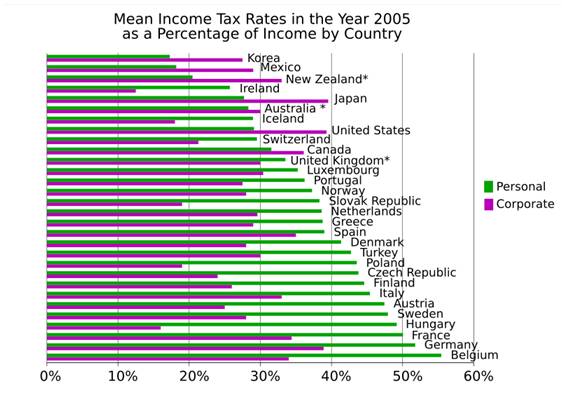
Source: Alan’s Money Blog (U.S. has high corporate tax rate)
But at what point is taxing the rich unfair and counterproductive? Currently the top 10% of the nation that earns more than $92,400 a year, pay about 72% of the country’s income taxes. Ari Fleischer, former G.W. Bush Press Secretary compares the current tax policy to an “inverted pyramid scheme” in a Wall street Journal Op-Ed earlier this year. Like an upside spinning top, the whirling pyramid is supported by a narrow, pointy pinnacle.
Fleischer goes onto add:
“According to the CBO, those who made less than $44,300 in 2001 — 60% of the country — paid a paltry 3.3% of all income taxes. By 2005, almost all of them were excused from paying any income tax. They paid less than 1% of the income tax burden. Their share shrank even when taking into account the payroll tax. In 2001, the bottom 60% paid 16.3% of all taxes; by 2005 their share was down to 14.3%. All the while, this large group of voters made 25.8% of the nation’s income. When you make almost 26% of the income and you pay only 0.6% of the income tax, that’s a good deal, courtesy of those who do pay income taxes.”
Cheaters Should Not Be Exempt (See Celebrity Tax Evader Article)
Certainly loopholes and undeserving credits for multinationals and the wealthy should be removed as well. The House of Representatives recently approved a $387 million boost for the IRS to fund a high-wealth unit focusing on trusts, real estate investments, privately held companies and other business entities controlled by rich individuals (read Reuters article). The IRS is also opening new criminal offices in Beijing, Panama City and Sydney to focus on international enforcement of tax cheaters. At the center of the IRS’ offshore effort is the legal cases against Swiss banking giant UBS (stands for Union Bank of Switzerland), which resulted in UBS agreeing to turn over almost 5,000 client names and pay $780 million to settle tax evasion charges.
Taxes in 2010 and Beyond
When it comes to future taxes, a lot of details remain up in the air. What we do know is that the 2001 Bush tax cuts are set to expire in 2010 and the Obama administration has indicated they want to raise taxes on the rich (those earning more than $250,000) and keep the cuts static for those in the lower paying tax brackets.
- Healthcare: If healthcare reform will indeed pass, those benefits won’t be free. The Obama administration is backing a House bill that creates a 5.4% surtax on income over $500,000 for single filers or $1 million for couples.
- Income Taxes: On the income tax front, Obama and some Democrats are pushing to have the two highest tax brackets revert back to the pre-2001 levels of 36% and 39.6%.
- Capital Gains: If the Obama administration gets its way, capital-gains tax rates would go back to 20% for wealthier individuals and qualified dividends would be taxed as ordinary income up to the top rate of 39.6%.
- Estate Taxes: The House passed a bill earlier this month that makes the 2009 estate tax provisions permanent (i.e., a 45% top marginal rate on estates larger than $3.5 million or $7 million for married couples). If the Senate were not to pass the bill, current law has the estate tax rate reverting to a 55% rate on estates worth more than $1 million after next year.
Given the exploding deficits and weary economy, which is recovering from a severe economic crisis, getting our tax policy situation back in order is critical. Having politicians make tough tax policy decisions runs contrary to their partisan reelection agendas, however our country needs to pluck more feathers from our taxpaying geese to face these monumental economic challenges…even if it requires listening to irritating hissing from our citizens.
Ari Fleischer WSJ Op-Ed From Earlier This Year
Article on Tax Policy Issues for 2010 and Beyond
Wade W. Slome, CFA, CFP®
Plan. Invest. Prosper.
DISCLOSURE: Sidoxia Capital Management (SCM) and some of its clients own certain exchange traded funds, but at time of publishing had no direct positions in an security referenced, including UBS. No information accessed through the Investing Caffeine (IC) website constitutes investment, financial, legal, tax or other advice nor is to be relied on in making an investment or other decision. Please read disclosure language on IC “Contact” page.
Rogers: Fed Following in Path of Dodo
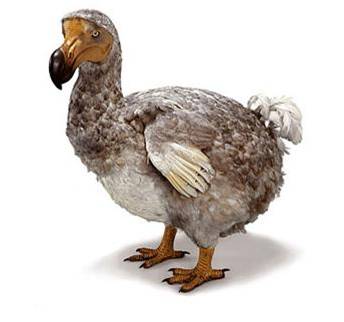
Jimmy Rogers, the bow-tie boss of Rogers Holdings and past co-founder of the successful Quantum Fund with George Soros, is no stranger to making outrageous predictions. His latest prophetic assessment is the Federal Reserve Bank is on the path of the Dodo bird to extinction:
“Don’t worry – the Fed is going to abolish itself. Between Bernanke and Greenspan, they’ve made so many mistakes that within the next few years the Fed will disappear.”
Given the shock and awe that transpired from the Lehman Brothers collapse, I can only wonder how investors might react to this scenario….hmmm. If this doozy of an outlandish call catches you off guard, please don’t be surprised – Rogers is not shy about sharing additional ones (Read other IC article on Rogers). For example, just six months ago Rogers said the Dow Jones could collapse to 5,000 (currently around 10,472) or skyrocket to 30,000, but “of course it would be in worthless money.” Oddly, the printing presses that Rogers keeps talking about have actually produced deflation (-0.2%) in the most recently reported numbers, not the same 79,600,000,000% inflation from Zimbabwe (Cato Institute), he expects.
I suppose Rogers will either point to a data conspiracy, or use the “just you wait” rebuttal. I eagerly await, with bated breath, the ultimate outcome.
Is U.S. Fed Alone?
If the U.S. Federal Reserve system is indeed about to disappear after over nine decades of operations, does that mean Rogers advocates shutting all of the other 166 global reserve banks listed by the Bank for International Settlement? Should the 3 ½ century old Swedish Riksbank (origin in 1668) and the Bank of England (1694) central banks also be terminated? Or does the U.S. Federal Reserve Bank have a monopoly on incompetence and/or corruption?
Sidoxia’s Report Card on Fed
I must admit, I believe we would likely be in a much better situation than we are today if the Federal Reserve board let Adam Smith’s “invisible hand” self adjust short-term interest rates. Rather, we drank from the spiked punch bowls filled with low interest rates for extended periods of time. The Federal Reserve gets too much attention/credit for the impact of its decisions. There is a much larger pool of global investors that are buying/selling Treasury securities daily, across a wide range of maturities along the yield curve. I think these market participants have a much larger impact on prices paid for new capital, relative to the central bank’s decision of cutting or raising the Federal funds rate a ¼ point.
Although I believe the Fed gets too much attention for its monetary policies, I think Bernanke and the Fed get too little credit for the global Armageddon they helped avoid. I agree with Warren Buffett that Bernanke acted “very promptly, very decisively, very big” in helping us avert a second depression while we were on the “brink of going into the abyss.”
Beyond the monetary policy of fractional rate setting, the Fed also has essential other functions:
- Supervise and regulate banking institutions.
- Maintain stability of the financial system and control systemic risk of financial markets.
- Act as a liaison with depository institutions, the U.S. government, and foreign institutions.
- Play a major role in operating the country’s payments system.
I will go out on a limb and say these functions play an important role, and the Fed has a good chance of being around for the 2012 London Olympic Games (despite Jimmy Rogers’ prediction).
Sidoxia’s Report Card on Rogers
As I have pointed out in the past, I do not necessarily disagree (directionally) with the main points of his arguments:
- Is inflation a risk? Yes.
- Will printing excessive money lower the value of our dollar? Yes.
- Is auditing the Federal Reserve Bank a bad idea? No.
My beef with Rogers is merely in the magnitude, bravado, and overconfidence with which he makes these outrageous forecasts. Furthermore, the U.S. actions do not happen in a vacuum. Although everything is not cheery at home, many other international rivals are in worse shape than we are.
From a media ratings and entertainment standpoint, Rogers does not disappoint. His amusing and outlandish predictions will keep the public coming back for more. Since according to Rogers, Bernanke will have no job at the Fed in a few years, I look forward to their joint appearance on CNBC. Perhaps they could discuss collaboration on a new book – Extinction: Lessons Learned from the Fed and Dodo Bird.
Wade W. Slome, CFA, CFP®
Plan. Invest. Prosper.
DISCLOSURE: Sidoxia Capital Management (SCM) and some of its clients own certain exchange traded funds (VFH) at the time of publishing, but had no direct ownership in BRKA/B. No information accessed through the Investing Caffeine (IC) website constitutes investment, financial, legal, tax or other advice nor is to be relied on in making an investment or other decision. Please read disclosure language on IC “Contact” page.
Getting Debt Binge Under Control

Given the endless daily reminders about our federal government’s insatiable appetite for debt, the inevitable collapse of the dollar, and the potential for civil unrest, the average citizen might be surprised to find out the overall debt situation has actually improved. While our federal debt has been exploding (see also Investing Caffeine D-E-B-T article), households and businesses have been tightening their belts and cutting down on the debt binge of recent years. In fact, the overall debt for the U.S. grew at the slowest rate in a decade according to The Business Insider.
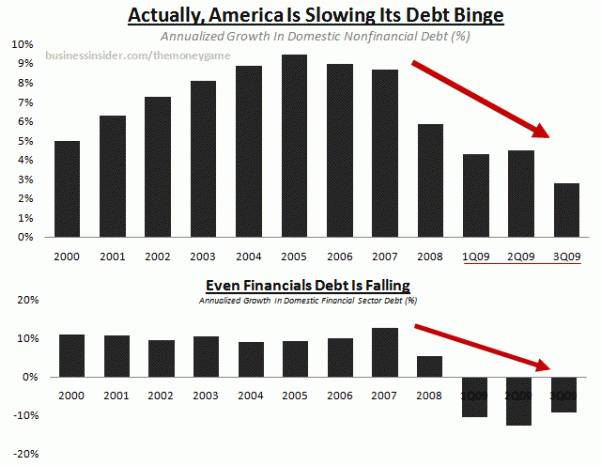
Source: The Business Insider. Steady debt growth decline.
As you can see from the nitty-gritty in the Federal Reserve chart below, total Nonfinancial Debt grew at +2.8% in the 3rd quarter of 2009 (comprised of -2.6% Household Debt; -2.6% Business Debt; +5.1% State & Local Government Debt; and +20.6% Federal Debt).
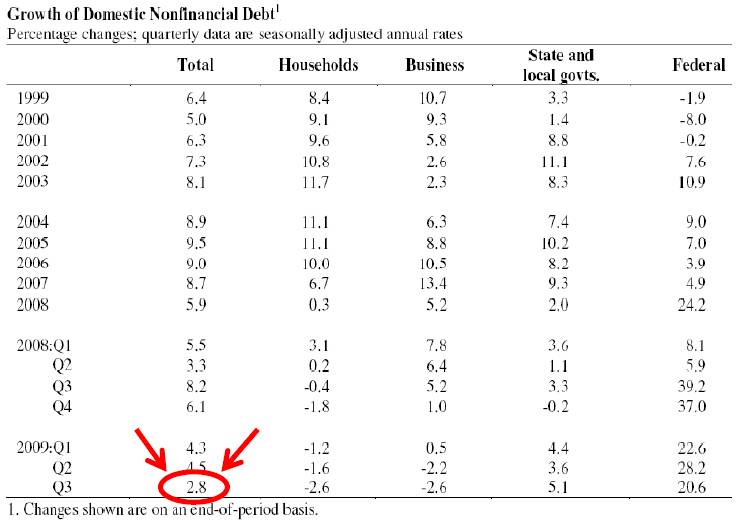
What does this all mean? Not surprisingly, we are seeing the same trends in the debt figures that we are seeing in the components of our GDP (Gross Domestic Product). We learned from our Economics 101 class that the equation for GDP = C + I + G + (NX), which explains the components of economic growth.
- C = Consumer spending (or private consumption)
- I = Investment (or business spending)
- G = Government spending
- NX = Net exports (or exports – imports)
Consumer spending has been the biggest driver of growth before the financial crisis (fueled in part by the contribution of debt growth), accounting for more than 2/3 of our GDP. Now, with the consumer retrenching dramatically – spending less and saving more – we are seeing government spending (i.e., stimulus) pick up the slack.
These same dynamics are playing out in the total debt figures. Since the consumer is retrenching, they are saving more and paying down debt. Business owner debt has been chopped too, either by choice or because the banks simply are not lending. Here again, the government is picking up the slack by ramping up the debt growth.
Encouragingly, all is not lost. Economic principles, like the laws of physics, eventually take hold. Fortunately consumers and businesses have gone on a crash diet from debt – and the banks haven’t accommodated the pleading cash-starved either. Now legislators in our nation’s capital must do their part in dealing with the weighty spending. The overall debt progress is heartening, but Uncle Sam still needs to get off the Ho-Hos and Twinkies and start shedding some of that binge-related debt.
Read Full Business Insider Article
Wade W. Slome, CFA, CFP®
Plan. Invest. Prosper.
DISCLOSURE: Sidoxia Capital Management (SCM) and some of its clients own certain exchange traded funds and equity securities in client and personal portfolios at the time of publishing. No information accessed through the Investing Caffeine (IC) website constitutes investment, financial, legal, tax or other advice nor is to be relied on in making an investment or other decision. Please read disclosure language on IC “Contact” page.
China Executes Wall Street Solution

China is taking an innovative approach to white collar crime…execution. Yang Yanming, a rogue securities trader, completed his death sentence this week for embezzling $9.52 million (a daily rounding error for Goldman Sachs, I might add). Not exactly a cheery topic for the holiday season, but nonetheless, apparently an effective technique for cracking down on illegal behavior. Last I heard, there has been no mention of a $65 billion Chinese version of the Madoff Ponzi scheme? I wonder what kind of risks the financial division of AIG would have undertaken, if involuntary death sentences were considered as viable options in the back of their minds? China in fact carries out more annual executions (via lethal injection and gun) than any other country in the world.
Part of the recent financial crisis can be attributed to the culture of Wall Street and the investment industry, which centers on exploiting “OPM,” an acronym I use to describe “other people’s money.” Often, industry professionals (I use the term loosely) assume undue amounts of risk in hopes of securing additional income, no matter the potential impact on the client. The thought process generally follows: “Why should I risk my own capital to make a mega-bonus, when I can swing for the fences using someone else’s?” And if OPM cannot be secured from individuals, perhaps the capital can be borrowed from the banks – at least before the bailouts occurred.
OPM does come with some caveats, however. Say for example the OPM comes from the government. When TARP (Troubled Asset Relief Program) funds got crammed down the throats of the banking industry, the auspice of reduced bonuses didn’t sit very well with many of the fat-cat Wall Street executives. Financial institutions prefer their OPM with few strings and little to no accountability. Goldman Sachs (GS), JP Morgan (JPM), and Morgan Stanley (MS) weren’t big fans of the government’s pay scale, so these banks paid back the TARP funds at mid-year. Citigroup (C) is still negotiating with the U.S. Treasury and regulators to remove the scarlet phrase of “exceptional assistance” from their chests.
This subject of accountability brings up additional doses of blame to distribute. Not only are the gun-slinging bankers and advisers the ones to blame, but in many cases the clients themselves shoulder some of the responsibility. Either the clients’ start drinking the speculative “Kool-Aid” of their advisor or they neglect to ask a few basic questions for accountability. Just as Ronald Reagan stressed in his conversations with the Soviets, it is also imperative for clients to “trust but verify” the relationship with their advisor (read how to get your financial house in order).
One thing we learned from the crisis of 2008-2009 is that trust is a scarce resource. Investors can “luck” into a trustworthy relationship, but more often than not, just like anything else, it takes time and effort to build a worthy partnership.
The suppliers of OPM have gotten smarter and more skeptical after the crisis, however the managers of OPM haven’t discarded risk from their toolboxes. In addition to the general rebound in domestic equities, we have seen emerging markets, commodities, high-yield bonds, and foreign currencies (to name a few areas), also vault higher.
Regulatory reform for the financial industry is a hot topic for discussion, although virtually nothing substantive has been implemented yet. Incentives, accountability, and adequate capital requirements need to be put in place, so excessive risk-taking (like we saw at the AIG division handling Credit Default Swaps) doesn’t compromise the safety of our financial system. Also, traders need to be incentivized for making responsible decisions and punished adequately for participating in illegal activities. I know the President has a lot on his plate right now, but perhaps the Obama administration could set up a brief meeting with the capital punishment committee in Beijing. I’m confident the Chinese could assist us in “executing” a financial regulatory system solution.
Read Full Reuters Article on Rogue Chinese Trader
Wade W. Slome, CFA, CFP®
Plan. Invest. Prosper.
DISCLOSURE: Sidoxia Capital Management (SCM) and some of its clients own certain exchange traded funds (VFH) and BAC, but at time of publishing had no direct positions in GS, AIG, JPM, MS and C. No information accessed through the Investing Caffeine (IC) website constitutes investment, financial, legal, tax or other advice nor is to be relied on in making an investment or other decision. Please read disclosure language on IC “Contact” page.
FDIC: Busted Piggy Bank

Just as Bank of America (BAC) has decided to pay back $45 billion in TARP (Troubled Asset Relief Program) money, and the employment picture brightened with the recent improvement in the unemployment rate, our banking piggy bank, FDIC (Federal Deposit Insurance Corporation), has been busted. Recovering macroeconomic indicators haven’t allowed our banking system to get out of the woods quite yet. This struggling FDIC news comes even before the inexorable collapse expected in commercial real estate (see Wilbur Ross’ comments on the subject).
Sheila Bair, the Chairwoman of the FDIC, indicated with her sobering remarks that these trends will not disappear overnight:
“For now the credit adversity we have been discussing for some time remains with us, and we have been discussing for some time remains with us, and we expect that it will be at least a couple of more quarters before we see a meaningful improvement in that trend.”
With the FDIC adding 136 banks to its “problem list” in the third quarter (bringing the total to 552), the regulator was forced to pull out $38.9 billion from the piggy bank, officially draining the rainy day fund into the red.
Fixing the Problem
How will the FDIC replenish its hollow piggy bank? Ms. Bair has recently endorsed a letter sent to House Financial Services Committee Chairman (Barney Frank) that would force secured creditors (mainly banks) to create a slush fund for potential large bank failures that pose a threat to the system. Ms. Bair designed the program this way because all banks – big or small – would be forced to “evaluate the solvency of our largest financial firms.”
Due to the continuation of bank failures and loan loss deterioration, the FDIC fund balance slipped to a negative -$8.2 billion (the first time since dealing with the failing thrifts in 1992) for the September period. Therefore, Ms. Bair put forth an emergency measure that requires insured banks to prepay three years of insurance premiums by the end of 2009. This action is expected to raise approximately $45 billion in funds. Although the reserve piggy bank had an upside down balance, the FDIC can still keep the lights on and cover employee payroll because the regulatory entity still has $23.3 billion in cash and marketable securities on its balance sheet.
With the taxpayers flipping the bill for bailouts galore over the last two years, and Goldman Sachs (GS) wheelbarrowing out bonuses to their employees, Ms. Bair and politicians are looking to the industry to now shoulder more of the bank failure burden. Let’s hope the piggybank can be replenished so taxpayers don’t have to go scraping through their wallets again.
Wade W. Slome, CFA, CFP®
Plan. Invest. Prosper.
DISCLOSURE: Sidoxia Capital Management (SCM) and some of its clients own certain exchange traded funds (VFH) and BAC, but at time of publishing had no direct positions in GS. No information accessed through the Investing Caffeine (IC) website constitutes investment, financial, legal, tax or other advice nor is to be relied on in making an investment or other decision. Please read disclosure language on IC “Contact” page.
Too Big to Sink

If I got paid a nickel for every time I heard the phrase “too big to fail” to describe the state of affairs of our major financial institutions, I’d be retired on my private island by now. Jeremy Grantham, famed value investor and Chairman of Grantham Mayo Van Otterloo, recently compared the redesigning of our financial system to the Titanic and aptly described the hubris surrounding the ship’s voyage as “too big to sink!”
Mr. Grantham argues that many of the financial institution reform proposals have an irrelevant, misguided focus on improving the safety of the Titanic’s lifeboats rather than the structural design or competence of the captain. Maybe it’s better to plan for disaster prevention rather than disaster preparation? Grantham adds:
“By working to mitigate the pain of the next catastrophe, we allow ourselves to downplay the real causes of the disaster and thereby invite another one.”
When analyzing system failures, incentives are important to understand too. For example, the ship was “under-designed” and the captain had an ill-advised reward baked into a compensation bonus, if he beat the speed record (see article on compensation).
The Solution
Rather than protecting the bankers’ interests, Grantham contends we need “smaller, simpler banks that are not too big to fail.” At the heart of these massive financial conglomerates, pruning is necessary to separate the risky, proprietary trading departments, thereby ridding an “egregious conflict of interest with their clients.” As a former fund manager for a $20 billion fund, I was acutely aware of how my fund trading information and my conversations were being tracked by investment bankers and traders for themselves and their clients’ benefit. When the banks are managing your money alongside their own money, greed has a way of creeping in.
Beyond the prop trading desk legislation, Grantham believes those financial institutions “too big to fail” should be cut down into smaller pieces that can actually fail. Many of these entities are already what I like to call, “too complex to succeed,” evidenced by the stupefied responses provided by Congressmen and the CEOs of the banking institutions during the aftermath of the crisis. Reintroduction of some form of Glass-Steagall legislation (separation of investment banks from commercial banks) is another recommendation made by Grantham.
These suggestions sound pretty reasonable to me, but the bankers scream “If we become smaller and simpler and more regulated, the world will end and all serious banking will go to London, Switzerland, Bali Hai, or wherever,” Grantham adds in a mocking voice. If the foreigners want to operate irresponsibly, then Grantham says let them suffer the negative consequences every 15 years, or so.
The political will of legislators will be tested if substantive financial reforms actually come to pass. Jeremy Grantham understands the extreme importance of reform as explained concisely here, “A simpler, more manageable financial system is much more than a luxury. Without it we shall surely fail again.” Fail that is…like a sinking Titanic.
Read Jeremy Grantham’s Full Quarterly Newsletter
Wade W. Slome, CFA, CFP®
Plan. Invest. Prosper.
DISCLOSURE: No information accessed through the Investing Caffeine (IC) website constitutes investment, financial, legal, tax or other advice nor is to be relied on in making an investment or other decision. Please read disclosure language on IC “Contact” page.
Compensation: Pitchforks or Penalties

Currently there is witch hunt under way to get rid of excessive compensation levels, especially in the financial and banking industries. Members of Congress and their constituents are looking to reign in the exorbitant paychecks distributed to the fat-cat executives at the likes of Goldman Sachs, Bank of America and the rest of the banking field. According to The Financial Times, Goldman has set aside $16.7 billion so far this year for compensation and benefits and pay is on track to meet or exceed the $661,000 employee average in 2007. The public is effectively calling these executive bankers “cheaters” because they are receiving benefits they don’t deserve. The backlash resembles the finger-pointing we see directed at the wealthy steroid abusers in football or cork-bat swingers in baseball. Americans seem OK with big payouts as long as they are achieved in a fair manner. No one quibbles with the billions made by Bill Gates or Warren Buffett, but when you speak of other wealth cheaters like Jeff Skilling (Enron), Bernie Ebbers (WorldCom), or Dennis Kozlowski (Tyco), then the public cringes. The reaction to corporate crooks is similar to the response provoked by steroid use allegations tied to Major League Baseball players (i.e., Barry Bonds and Roger Clemens).
Less clear are the cases in which cheaters take advantage of a system run by regulators (referees) who are looking the other way or have inadequate rules/procedures in place to monitor the players. Take for example the outrage over $165 million in bonuses paid to the controversial AIG employees of the Financial Products division. Should AIG employees suffer due to lax rules and oversight by regulators? There has been no implication of illegal behavior conducted by AIG, so why should employees be punished via bonus recaptures? The rules in place allowed AIG to issue these lucrative Credit Default Swap (CDS) products (read more about CDS) with inadequate capital requirements and controls, so AIG was not shy in exploiting this lack of oversight. Rule stretchers and breakers are found in all professions. For example, Lester Hayes, famed All-Pro cornerback from the Oakland Raiders, used excessive “Stickum” (hand glue) to give himself an advantage in covering his opponents. If professionals legally operate within the rules provided, then punishments and witch hunts should be ceased.
Regulators, or league officials in sports, need to establish rules and police the players. Retroactively changing the rules after the game is over is not the proper thing to do. What the industry referees need is not pitchforks, but rather some yellow flags and a pair of clear glasses to oversee fair play.
Cash Givers Should Make the Rules
What should regulators and the government do when it comes to compensation? Simply let the “cash givers” make the rules. In the case of companies trading in the global financial markets, the shareholders should drive the rules and regulations of compensation. “Say on pay” seems reasonable to me and has already gained more traction in the U.K. On the other hand, if shareholders don’t want to vote on pay and feel more comfortable in voting for independent board members on a compensation committee, then that’s fine by me as well. If worse comes to worse, shareholders can always sell shares in those companies that they feel institute excessive compensation plans. At the end of the day, investors are primarily looking for companies whose goal it is to maximize earnings and cash flows – if compensation plans in place operate against this goal, then shareholders should have a say.
When it comes to government controlled entities like AIG or Citigroup, the cash givers (i.e., the government) should claim their pound of flesh. For instance, Kenneth Feinberg, the Treasury official in charge of setting compensation at bailed-out companies, decided to cut compensation across the board at American International Group, Citigroup, Bank of America, General Motors, GMAC , Chrysler, and Chrysler Financial for top executives by more than 90% and overall pay by approximately 50%.
Put Away the Pitch Forks
In my view, too much emphasis is being put on executive pay. Capital eventually migrates to the areas where it is treated best, so for companies that are taking on excessive risk and using excessive compensation will find it difficult to raise capital and grow profits, thereby leading to lower share prices – all else equal. Government’s job is to partner with private regulators to foster an environment of transparency and adequate risk controls, so investors and shareholders can allocate their capital to the true innovators and high-profit potential companies. Too big to fail companies, like AIG with hundreds of subsidiaries operating in over 100 countries, should not be able to hide under the veil of complexity. Even in hairy, convoluted multi-nationals like AIG, half a trillion CDS exposure risks need to be adequately monitored and disclosed for investors. That why regulators need to take a page from other perfectly functioning derivatives markets like options and futures and get adequate capital requirements and transparency instituted on exchanges. I’m confident that market officials will penalize the wrongdoers so we can safely put away the pitch forks and pull out more transparent glasses to oversee the industry with.
Wade W. Slome, CFA, CFP®
Plan. Invest. Prosper.
DISCLOSURE: Sidoxia Capital Management and its clients do not have a direct position in Goldman Sachs (GS), AIG, Berkshire Hathaway, BRKA/B, Citigroup (C), Enron, General Motors, GMAC , Chrysler, WorldCom, or Tyco International (TYC) shares at the time this article was originally posted. Sidoxia Capital Management and its clients do have a direct position in Bank of America (BAC). No information accessed through the Investing Caffeine (IC) website constitutes investment, financial, legal, tax or other advice nor is to be relied on in making an investment or other decision. Please read disclosure language on IC “Contact” page.
Insider Trading: Raj Rajaratnam vs. Pete Rose

A recent Wall Street Journal article written by Donald J. Boudreaux, a professor of Economics at George Mason University, makes the case that insider trading is actually healthy for the operations of the financial markets. The arrest of Galleon Group founder and hedge fund manager, Raj Rajaratnam, is a tragedy according to the article’s author. Specifically he says, “Insiders buying and selling stocks based on their knowledge play a critical role in keeping asset prices honest—in keeping prices from lying to the public about corporate realities.”
Oh really? Then I suppose Professor Boudreaux would be fine with all-time leading hitter and former Cincinnati Reds Manager betting on his own baseball team to win or lose.
Another disputed aspect of insider trading by Boudreaux is the inability to monitor the crime. “Insider trading is impossible to police and…parsing the difference between legal and illegal insider trading is futile—and a disservice to all investors.” Maybe heroin and cocaine should be legalized too, since we can’t completely police these crimes either? Seems to me the insider trading laws are pretty clear what insiders can and cannot do with material information. The digital world we live in today only empowers investigators more than ever to discover clear electronic footprint trails connecting trading and banking accounts. Certainly, there will be creative crooks like Bernie Madoff that can slyly succeed for a period of time, but those that grasp too far will eventually get caught.
Professor Boudreaux goes on to describe the scenario of an unscrupulous CEO at a hypothetical company (Acme Inc.) driving a company into bankruptcy. He argues employees, creditors, and investors would be better served by a CEO enriching himself with insider trading in the name of price efficiency. Capital productivity would be enhanced for creditors/investors thanks to information efficiency and employees could manage their job hunting effectively.
Sounds great Don, but in a legal insider trading world, don’t you think inefficient, unscrupulous behavior for siphoning information from executives might lead to distracting and wasteful corporate actions? If I’m an employee at ACME Inc. and I can make more money trading ACME stock, rather than being a productive employee making widgets, then it doesn’t take a genius to figure out where my 40 hour work week concentration will reside. Moreover, how is a sabotaging CEO, who is raking in millions by shorting his company’s stock ,supposed to be a good thing for stakeholders? I strongly disagree. Stakeholders will be jeopardized more by an unfocused, greed-absorbed workforce than by the current enforcement structure, which strives for an even playing field of information.
After forcefully arguing trading on insider information should not be prohibited, the professor hedges his stance by saying there are exceptions: “There are, of course, situations in which it is in the interest of both a company and the public for that company to delay the release of information.” For example, he describes a merger situation where early information leakage could “jeopardize the prospect of achieving greater efficiencies.” If according to Boudreaux, policing of insider information is impossible, then determining what he calls “proprietary” versus “non-proprietary” information is only going to stir up a worse hornet’s nest.
In the end, if price efficiency (see story on market efficiency) and cheaper cost of capital is Professor Boudreaux’s central aim, then perhaps disclosing inside information, rather than selfishly profiting from trading on inside information, is a more suitable approach. For Pete Rose, I recommend sticking to legalized sports betting in Las Vegas as a superior strategy.
Read Full Professor Boudreaux WSJ Article
Wade W. Slome, CFA, CFP®
Plan. Invest. Prosper.
DISCLOSURE: No information accessed through the Investing Caffeine (IC) website constitutes investment, financial, legal, tax or other advice nor is to be relied on in making an investment or other decision. Please read disclosure language on IC “Contact” page.
Now You See It, Now You Don’t: TARP

Elizabeth Warren, who oversees the TARP (Troubled Asset Relief Program), along with being the Chair on the Congressional Oversight Panel and a professor at the Harvard Law School, goes out on a limb and candidly states, “ We not only don’t know [where the TARP money is], Maria, we’re not ever going to know.”
Ms. Warren is quick to blame former Treasury Secretary Henry “Hank” Paulson for not implementing accountability for the TARP funds handed to the large commercial and investment banks (see my earlier TARP article). How do you prove the money handed over to the banks was used for non-lending activities, such as marketing, compensation, television advertising, dividends, acquisitions or other corporate purposes other than lending? The short answer…you can’t! Even if TARP capital tracking was instituted, I think it would have been a fruitless effort since even legitimate use of the TARP funds would only free up additional capital for other suboptimal purposes. If my mom gave me $100 while I was struggling for money in college and told me to use it for food – well I, like a good chunk of students, would have eaten anyways without the handout. The windfall $100 bailout would likely be used for a guys trip to Las Vegas or some Laker basketball tickets. The banks will certainly lend, but not at the same pre-Lehman bankruptcy levels, regardless of whether TARP tracking was instituted or not. Ms. Warren correctly points out that regulators are speaking out of both sides of their mouths. The government wants banks to lend more (which reduces the bank’s capital base) and also raise their sickly reserve levels at the same time.
See TARP commentary on CNBC video interview at minute 2:48
Maria Bartiromo also probes the topic of executive pay compensation given a recent Congressional proposal that TARP recipients cut salaries of the top 25 executives by -90%. Seems like a reasonable request given the circumstances. However, having the government force banks into making bad loans is probably not the right answer. This stance will only force the banks to take higher loan deliquency provisions and recognize more potential writedowns in the future. Eventually the Fed will cut interest rates paid to banks on the reserves held at the central bank, thereby invcentivizing the banks to take advantage of the steeper yield curve and make handsome spreads on loans.
Until then, some of the banks will sit patiently on their TARP capital (not lending) while Ms. Warren and government officials will wonder how the billions of TARP bailouts magically disappeared.
Wade W. Slome, CFA, CFP®
Plan. Invest. Prosper.
DISCLOSURE: Sidoxia Capital Management and its clients had a direct position in VFH and BAC shares at the time this article was originally posted. No information accessed through the Investing Caffeine (IC) website constitutes investment, financial, legal, tax or other advice nor is to be relied on in making an investment or other decision. Please read disclosure language on IC “Contact” page.
Spitzer the Pot Calling the Fed Kettle Black
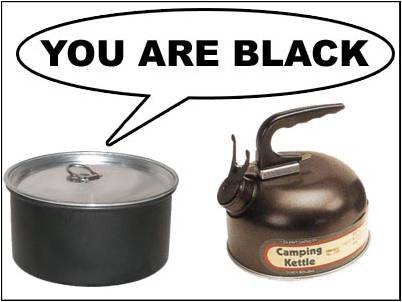
Eliot Spitzer, whose job as the former Attorney General of New York was to convict criminals, was forced to quit himself as Governor for his illegal solicitation of prostitutes that he funded with secretive ATM withdrawals of government funds. Now, Mr. Spitzer is getting on his soapbox and telling others the Federal Reserve has been committing a Ponzi Scheme.
There are a lot of conspiracy theories floating around regarding the Fed’s motives and questions relating to the benefits of those receiving government bailout funds. Dylan Ratigan’s interview of Mr. Spitzer on MSNBC feeds into these conspiracy views. I can buy into conflicts of interests and the need for more transparency arguments, but let’s be realistic, this is not the DaVinci Code, this is the slow, bureaucratic Federal Government. Even if you buy into this skeptical belief, the Fed isn’t exactly a “black box.” The Fed proactively provides the minutes from its private meetings and systematically releases a full accounting of the Fed’s balance sheet (assets).
Mr. Spitzer and other critics point to the egregious benefits handed down to the banks and financial institutions through the bailouts and monetary system actions. Well, wasn’t that the idea? I thought our banking system (and the global banking system) was on the verge of collapse and we were trying to save the world from impending disaster? So, I think most people get the fact that our financial institutions needed a lifeline to prevent worse outcomes from occurring.
Should the Fed have carte blanche on all financial system decisions? Certainly not, but extreme situations like this generational financial crisis we are slogging through now, requires extreme measures.
Accountability I believe is even more important than the micro-managing transparency details Ron Paul (Republican/Libertarian Congressman from Texas) and others are asking for. If indeed it is the Fed’s job to remain an independent body, then maybe it’s not Congress’ job to question every word and minor decision. However, when it comes to these massive bailouts (AIG, Fannie Mae, Freddie Mac, etc.), additional details and accountability should be provided and seems fair. What we don’t need are more regulatory bodies and committees creating more inefficiencies in an already tangled system of regulatory fiefdoms.
Before Mr. Spitzer starts pointing his finger at the black Fed-kettle, perhaps he should get his illegal decision making pot in order first?
Read Full Daniel Tencer Spitzer-Ponzi Scheme Article
Wade W. Slome, CFA, CFP®
Plan. Invest. Prosper.




