Posts filed under ‘Government’
PPIP Becomes Miniaturized “Mini Me”

Mini-Me and Dr. Evil from famed Austin Powers movies
In two of Mike Myer’s Austin Powers movies, Verne Troyer plays Dr. Evil’s miniature clone, Mini-Me. At a “breathtaking” one-eighth the size of the fully-sized villain, Mini-Me didn’t quite pack the same evil punch as his surrogate daddy, Dr. Evil. The same can be said of the government’s PPIP (Public Private Investment Program), which was originally designed to unclog the financial system by removing toxic and illiquid investments from owners desiring liquidity.
Unfortunately, the PPIP size has been reduced to ppip dimensions. The Fundamental Analyst (FA) blogger (www.fundamentalanalyst.com) points out that the program’s scope has likely shrunk to $100 billion from the original goal of $1 trilllion – a proportion even smaller than Mini-Me’s relative size to Dr. Evil. Treasury Secretary Timothy Geithner’s explanation for the decline in program size is due to the improving financial market conditions and the capital raising activities of the banks. Perhaps partially true, but “not so fast” says FA – he blames the suspension of mark-to-market accounting as the driver for positive overstated banking earnings, which allowed the banks to hoodwink investors and raise capital under false pretenses.
Read the Fundamental Analyst’s Article on PPIP Here
FA goes onto highlight what little skin the participants (including, AllianceBernstein, BlackRock, Invesco, Oaktree Capital Management, TCW Group, and Wellington Management) have in the game relative to the other 93% of capital fronted by the taxpayers. I agree – the surplus taxpayer exposure is evil. Time will tell how effective the Mini-Me ppip program will be…

Original PPIP plan drawn up by the Financial Times
TARP: Squeezing Blood from Banking Stones

Collecting Bank Dividends Will Become Tougher
There was a sense of relief in the financial markets when it was announced that 10 banks repaid Troubled Asset Relief Program (TARP) funds in the amount of $68 billion back to the federal government. The ten banks included JPMorgan Chase, Goldman Sachs, Morgan Stanley and American Express. Timothy Geithner, the Treasury Secretary, said the repayments were encouraging, but warned that the crisis in the banking industry was not over yet (Economist).
Unfortunately, the falling tide has left some banks stranded, unable to repay TARP loans or the dividends on the preferred shares issued to the government.
The Wall Street Journal reported the following:
At least three small, cash-strapped banks have stopped paying the U.S. government dividends that they owe because they got $315.4 million in capital infusions under the Troubled Asset Relief Program. Pacific Capital Bancorp, a Santa Barbara, Calif., lender that got $180.6 million from the Treasury Department in November, has since posted net losses of $49.7 million. Pacific Capital said … that it suspended dividend payments on its common and preferred stock as part of a wider effort to save about $8 million per quarter. A bank spokeswoman confirmed that the U.S.’s preferred shares are included in the dividend freeze.
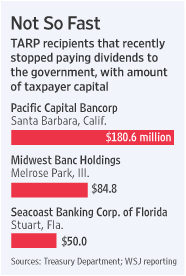 With around 40 bank failures already in 2009, these TARP dividend suspensions may be more the trend rather than the exception. Maybe next time the Treasury will ask for a deposit or driver’s license to guarantee dividend payments before they fork over more TARP money?
Wade W. Slome, CFA, CFP®
Plan. Invest. Prosper.
DISCLOSURE: Sidoxia Capital Management (SCM) and some of its clients own certain exchange traded funds, but at the time of publishing SCM had no direct position in JPMorgan Chase (JPM), Goldman Sachs (GS), Morgan Stanley (MS), American Express (AXP), or any other security referenced in this article. No information accessed through the Investing Caffeine (IC) website constitutes investment, financial, legal, tax or other advice nor is to be relied on in making an investment or other decision. Please read disclosure language on IC “Contact” page.
California the Golden State Turning Brown
 California is facing a significant cash crunch as the state attempts the narrowing of its $24 billion budget deficit. The crisis will come to a head now that the fiscal year, June 2009, budget deadline has passed. Without a budget resolution and in order to fill the budget gap, the California government will need to start issuing billions of government IOUs to contractors and vendors, local agencies handling health programs, as well as some receiving state aid.
Moodys rates the Golden State as the lowest rated state of all 50 at A2. The average rating for all states is AA2 and only two other states besides California are rated below AA. At the beginning of 2009 the state bought some breathing room by delaying cash tax refunds, but that cushion has rapidly deteriorated as the economy and employment outlook have deteriorated. Making things worse for the state, relative to other states, is the state constitutional inflexibility requiring voter approval for deficit borrowing.
Time will tell if Governor Schwarzenegger can gather the votes necessary to prevent bond defaults. President Obama and other states are watching closely as the actions (or inactions) will have a ripple through effect for everyone. At 13% of the nation’s GDP, California’s economy impacts the overall country in a significant manner.
Let’s hope the state maintains its “golden” status and does not get burnt.
Healthcare Reform: The Brutal Reality of Aging Demographics

The global population is aging and that is a bad trend for healthcare costs.
There’s no question healthcare reform is required. The Economist’s cover story, This is Going to Hurt, addresses this problem head-on:
“Even though one dollar in every six generated by the world’s richest economy is spent on health—almost twice the average for rich countries—infant mortality, life expectancy and survival-rates for heart attacks are all worse than the OECD average. Meanwhile, because health insurance is so expensive, nearly 50m Americans, an obscene number in such a rich place, have none; those that are insured pay through the nose for their cover, and often find it bankruptingly inadequate if they get seriously ill or injured.”
The real question is not whether we have a problem, but rather how are we going to approach it? Estimates of the current healthcare congressional plans put estimates for reform between $1.2 trillion and $1.6 trillion over 10 years. I tend to side with George Will when discussions center on costs, “If you think health care is expensive now, just wait until it is free.”
One of the reasons healthcare costs are exploding is because of our aging demographics. The 76 million “Baby Boomers” are entering their golden years, and as a result are consuming more healthcare products and services. Because our system is so convoluted and opaque, true healthcare competition cannot flourish. Rather, patients expect a cheap “all-you-can-eat” smorgasbord of services without consideration of cost. Unfortunately, the aging trend of our global population (especially in the developed countries like the U.S.) has put our economy on track for a disastrous train-wreck.
The Economist’s article, A Slow Burning Fuse, crystallizes the aging trend into proper perspective by providing some interesting statistics. At the beginning of the last century, in 1900, the average life expectance at birth was approximately 30. Today, the average life expectancy has more than doubled to 67 years (and 78 years in richer developed countries).
Read Full Economist Article, A Slow Burning Fuse
A second major cause of aging societies is the decline in number of children families are having. During the early 1970s, women on average were having 4.3 children each. Now the average is about 2.6 children (and 1.6 children in developed countries). What these statistics mean is that the taxable younger workforce is shrinking (growing slower), therefore unable to adequately feed the swelling appetites of the aging, healthcare-hungry global populations.
My solution would focus on the following:
Technology: Yes, chopping down trees, wasting years of our lives filling out and storing library-esque piles of medical forms is so 20th Century.
Consolidation of Insurers: And do we need dozens of different insurers on different billing platforms? Reducing inefficient and undercapitalized competitors down to a common technological digital record and billing platform makes common sense to me. Although I love competition, if I look at things like cell phones, cable, or even local grocery stores, there is a law of diminishing return whereby inefficiencies eventually outweigh benefits of competition.
Fewer Late Life Benefits: Nearly 30 percent of Medicare spending pays for care in the final year of patients’ lives, according to George Will. Does it really make sense to pay such a high proportion of costs for the last 1-2% of our lives? Other countries, including European ones, deny certain costly services for elderly patients. Does spending over $50,000 on certain cancer treatments for a few extra months of life seem equitable? If elderly ill patients are in the financial position to pay, then that’s great. Otherwise, at some point, the ethical question has to be faced – what is an extra month of human life worth?
Not really a rosy subject, but an important one. I’m confident we can solve these problems, if addressed immediately, or else future generations will be saddled with a more disastrous problem to heal.
Wade W. Slome, CFA, CFP® www.Sidoxia.com
Cap and Tax Passes in the House

The U.S. House of Representatives passed The American Clean Energy and Security Act of 2009 (ACES), also named the “Waxman- Markey” bill, by a 219-212 vote. The masses are calling it the “Cap and Trade” bill, while detractors are blasting it as the “Cap and Tax” bill.
Joe Petrowsky, CEO of Gulf Oil, sees this bill costing businesses $50-100 per ton of carbon created, which will be passed through as a tax to energy consumers in the form of an annual $1,000+ tax (about $250-$350 per individual). Robert Murray, CEO of Murray Energy Corporation, calls it a $2 trillion tax on consumers over 8 years.
The House passed this bill just as the economy is shuttering on its knees and a rising skepticism is brewing over the validity of global warming – see Kimberley Strassel’s, journalist at The Wall Street Journal, article entitled, The Climate Change Climate Change dated June 26, 2009. Australia is in the process of killing its “Cap and Trade” proposals and many critics point to Spain’s failing carbon initiatives and 18% unemployment as evidence for the program’s shortcomings.
Despite one’s views on the validity of global warming, what cannot be disputed is our reliance (addiction) to oil as we import 70% of our oil demand. Is the time and scope of this bill the silver bullet for our crude dependence as we try to survive through this “Great Recession?” I think not.
Billions of humans across the globe are aspiring to achieve our standard of living here in the U.S., so even those against a “Cap and Trade” system, including myself, need to appreciate the massive energy investment we need to make. The U.S. is considered the “Saudi Arabia” of coal due to our vast reserves, and therefore we must find efficient and cleaner ways to use this abundant commodity. We need to throw the kitchen sink at nuclear, wind, solar, hydrogen, bio-fuels and other alternative energy technologies, even as we look to expand our fossil fuel resources.
But rather than forming randomly created silos of hoarded research across hundreds of universities, why not create domestic centers of excellence that collaborate with both academic and private sector participants. By integrating monetary incentives (i.e., exclusive commercial patent rights), incredible advancements and breakthroughs can be achieved. Historically, when the United States has focused on a task, we’ve been able to achieve greatness – for example sending a man to the moon. Heck, recently NASA mastered the art of converting urine into water!
Bold new steps need to be taken to solve our energy crisis, but I’m afraid this “Cap and Tax” bill is not the right answer.
The Governator: Terminate the Deficit or the Pooches?

Picture Source: Clusterstock
The only way you get to save dollars is by saving nickels and dimes, so if saving overpaid bureaucrat wages requires Governor Arnold Schwarzenegger sending pooches to doggy heaven a little early, then so be it. California’s Legislative Analyst’s Office seems to believe $23 million can be saved by accelerating the pet euthanizing process for sheltered pets by three days.
Riding the California housing train was an enjoyable ride in California as home prices more than tripled from the late 1990s until the beginning of 2007. However, after rolling in piles of house tax collection receipts from exploding prices, the bubble based binge of tax revenue has now come to a screeching halt as home prices have declined by more than 50% from peak levels a few years ago (see chart below). Facing an 11.5% unemployment rate, the state is being kicked while it’s down on the ground – income tax collections are declining and businesses dealing with the relatively high cost of operations forcing businesses to run for the hills and leave the state.
Things obviously appear gloomy in California, but the Governator is showing his resolve to get the job done – as evidenced by his contemplation of the pet destruction option. My dog is sleeping inside tonight.
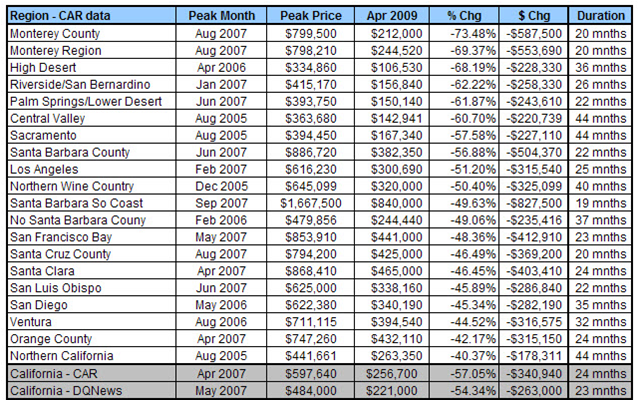
Home Prices Down Dramatically from Peak
Wade W. Slome, CFA, CFP www.Sidoxia.com
U.S. to China, “What’s Wrong With a Little Porn and Anarchy?”
The U.S. recently scheduled talks with the Chinese government to discuss the appropriateness of automated personal computer (PC) content filtering (including, pornography, Falun Gong, and governmental protest content). Falun Gong is a meditatitve spiritual discipline frowned down upon by the Chinese government.
I can picture it now, U.S. officials calling up Chinese President Hu Jintao and saying, “Hey Hu, why not lighten up a bit on the freedom crackdowns – what’s the big deal with a little pornography and anarchy?” The Chinese government feels that in the absence of structured laws, which would limit access to inappropriate content, the natives will become restless and ultimately disruptive. PC manufacturers would prefer not to reengineer PCs and increase the embedded costs to consumers by adding additional components. However, given the size of the Chinese PC market, the dominant foreign manufacturers are likely to cave to Chinese government demands, given the massive long-term potential of this Asian market. We have already seen Google (GOOG), Yahoo (YHOO), and Microsoft (MSFT) make concessions to the Chinese government in the algorithmic search arena.
 The thematic parallels presently occurring in China apply to William Golding’s Lord of the Flies (1954) as well. Lord of the Flies is a story about a group of stranded kids (surviving a plane crash) that battle for survival on a deserted island. Due to the lack of law, adult supervision and questionable tendencies, all hell eventually breaks loose. The Chinese government, managing a population of 1.3 billion people, fears a similarly hellacious outcome if an uncontrolled, lawless population consumes unfettered, unhealthy content. Given mistakes we’ve made abroad (e.g., Abu Ghraib, and Guantanomo), the Chinese and other countries are questioning the strength of our moral compass in judging or guiding other countries’ policies.
Although the U.S. government’s intentions are in the right place to protect the personal freedoms of people globally, we are not currently in the strongest moral position right now to cram our beliefs down other’s throats. Even the freest of societies such as our own limits certain actions – such as underage voting, underage drinking, and public nudity (O.K., I’m stretching a bit).
Regardless of your political views, one can appreciate the fear of anarchy in the hearts of the Chinese government. Practically speaking however, given the openness and rapid expansion of the global internet, the Chinese can only slow the expansion of individuals’ freedoms – recent events in the Middle East just provide additional evidence to this premise.
DISCLOSURE: At the time of publishing, in addition to owning certain exchange traded funds, Sidoxia Capital Management and some of its clients also owned GOOG, but had no direct positions in YHOO, MSFT, or any other security referenced. No information accessed through the Investing Caffeine (IC) website constitutes investment, financial, legal, tax or other advice nor is to be relied on in making an investment or other decision. Please read disclosure language on IC “Contact” page.
Government Looks to Strengthen Regulatory Web

As the chart from the Financial Times shows (BELOW), our messy regulatory cobweb system needs to be straightened out, so it can efficiently function. Not only to encourage risk taking and capitalism, but to also deter and punish those that take advantage of the U.S. system and its citizens. The President and Treasury Secretary Timothy Geithner will address the inefficient, entangled set of regulatory issues surrounding the intertwined agencies in our financial regulatory system. With a mix of federal, regional, and state- driven oversight, the current structure leaves potential gaps for rule-breakers to slide through.

Source: The Financial Times
As the FT article explains (http://is.gd/13YuS), a “council of regulators,” comprised of the agency heads, will be formed along with another consumer-related agency designed to protect areas such as home mortgages and credit cards. Will new unproductive layers be added to merely bog down risk-taking and innovation (i.e., Sarbanes-Oxley legislation), or will substantive reform occur, thereby allowing businesses to innovate and grow. The proof will be in the pudding when Geithner reveals the details of his plan.
What should regulatory reform include?
1) Consolidation: You can call me crazy, but simply looking at the layers of agencies cries for consolidation. Do we really need six different sets of regulators overseeing the banks?
2) Transparency/Capital Requirement Changes: When it comes to derivatives, heightened transparency and capital requirements feel like moves in the right direction. We have perfectly functioning options and futures markets that integrate margin and capital requirements for the various constituencies; I do not see why Credit Default Swaps should be any different. For more customized, exotic over-the-counter products, you could avoid much of the AIG debacle by increasing the capital requirements of the counterparties. I believe these aims without stifling innovation.
3) FDIC of Mega-Institutions: FDIC insurance has succeeded in managing the failures of retail depository institutions, so I see no reason why the same model for mega financial institutions. Certainly, managing the collapse of a global money center bank would be more convoluted; however a system to handle an orderly failure would limit the fallout effect we experienced with the folding of Lehman and crumbling of Bear Stearns.
Although many lawmakers will hunt for a silver bullet, we all know that in this complex global economy a path for reform will involve more evolution rather than revolution. Most controversial will be the consumer protection agency, as details still remain sparse. In my a healthy regulatory system boils down to more simplified structures with tighter oversight, mixed in with proper incentives and harsher punishments for criminals. We’ll know soon enough whether the government can weave a solution tight enough to capture the Bernie Madoffs and Allen Stanfords of the world without sacrificing our position as the global financial capitol of the world.
GM Fatigue Setting In

Yaaaawn. Sorry to be cold-hearted and insensitive, but I have to admit all this bankruptcy car talk is making me tired and fatigued. According to the Associated Press, General Motors is cutting 21,000 jobs in North America, about 34% of the total workforce – these cuts include pending dealership, plant, and warehouse closings. Twenty-one thousand certainly is not a minor number, but how do you think the other 6,000,000 Americans feel who have lost their jobs in this economic recession since the beginning of 2008?
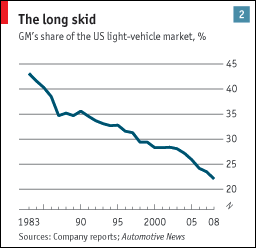
Chart Source: The Economist
Don’t get me wrong, I like every other American do not want to see our historic industry vanish into thin air, but as the chart above shows, we have been witnessing this slow motion train wreck developing for decades. Detroit’s combined market share in 1980 was around 75%, and today that share amounts to less than 50%…ouch. Our auto industry needs to become more competitive, and to do so will require tough decisions like the ones being made today.
Does $65 billion in government bailout feel right? Definitely not, especially vis-a-vis the industry track record of government bailouts (i.e., 1980 Chrysler lifeline). History and current industry trends tell us that the odds of taxpayers earning any reasonable return off our bailout contributions will be extremely challenging to salvage.
Politics and votes always play a role when large numbers of jobs are impacted by government decisions, and this case has proved no different. On the flip side, nobody can say the automakers are not suffering tremendously from this bankruptcy solution. I truly believe the surviving entities will be much leaner and meaner to compete in this dog-eat-dog global economy. Sacrifices have been immense, but we’ll never know the true net economic effect had the administration not bestowed the billions and billions upon this selective slice of industries.
Money goes where it is treated best, and I would have preferred seeing the capital naturally migrating to its most productive use. Perhaps the $65 billion could have provided 65,000 different companies access to $1,000,000 each in financing for creative, and innovative job creating purposes? Only time will tell if our billions in taxes were properly used, but in the mean time I’m going to turn off the CNBC car debate and take a nap. Zzzzzz….
U.S. the Next Zimbabwe? Faber Thinks So…

Imagine paying $2 for a tube of toothpaste today and then $4,600,000 for that same tube one year from now – well that’s what happened in Zimbabwe. Zimbabwe is the first country in the 21st century to hyperinflate. In February 2007, Zimbabwe’s inflation rate topped 50% per month and according to Bloomberg, the latest official figures on Zimbabwe’s inflation rate registered 231 million percent in July 2008.
“I am 100 percent sure that the U.S. will go into hyperinflation,” Marc Faber, a.k.a. “Dr Doom”, creator of the Gloom Boom & Doom Report said. “The problem with government debt growing so much is that when the time will come and the Fed should increase interest rates, they will be very reluctant to do so and so inflation will start to accelerate.”
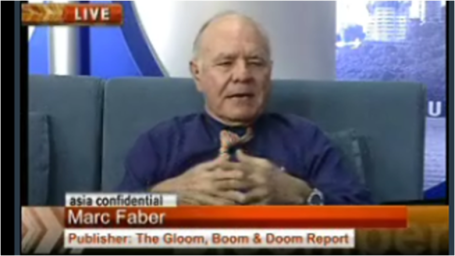
Dr. Gloom - Marc Faber
Click Here For Video (Bloomberg)
Faber goes on to say the U.S. economy will enter “hyperinflation” approaching the levels in Zimbabwe because the Federal Reserve will be reluctant to raise interest rates, investor Faber said. Prices may increase at rates “close to” Zimbabwe’s gains, Faber said in an interview in Hong Kong. Zimbabwe’s inflation rate reached 231 million percent in July, the last annual rate published by the statistics office.
I’m not sure if the United States should be included in the same camp as Zimbabwe? Haven’t check recently, but do they have a comparable financial system producing the likes of Microsoft, Genentech, Starbucks, and Pfizer? I think not. Our economic situation is no box of chocolates, as our deficits expand and national debt balloons, but our problems are well documented. More appropriately, I would say we are the tallest midget (or “little people” to be politically correct) and some growth hormone is on the way.