Posts filed under ‘Financial Markets’
Soros on the Super Bubble

Like a bubble formed from chewing gum, the gradual expansion of the spherical formation occurs much slower than the immediacy of the pop. A minority of investors identified the treacherous, credit-induced bubble of 2008 before it burst, however not included in that group are financial regulators. Now we’re left with the task of cleaning up the sticky mess on our faces and establishing measures to prevent future blow-ups.
George Soros, Chairman of Soros Fund Management and author of The Crash of 2008, has been around the financial market block a few times, so I think it pays to heed the regulatory reform recommendations as it relates to the “Super bubble” of 2008. As you probably know, financial bubbles are not a new concept. Beyond the oft-mentioned technology and real estate bubbles of this decade, bubbles such as the “Tulip-mania” of the 1630s serve as a gentle reminder of the everlasting existence of irrational economic behavior. If the Dutch were willing to pay $76,000 for a tulip bulb (inflation-adjusted) almost 400 years ago, then virtually any mania is possible.
Bubbles and Efficiency
Efficient markets are somewhat like UFOs. Some people believe in them, but many do not. In order to believe in the existence of bubbles, one needs to question the validity of the pure form of efficient markets (read more about market efficiency). Here’s how Soros feels about market efficiency:
“I contend that financial markets always present a distorted picture of reality.”
I believe we will be in a hyper-sensitive period of bubble witch-hunting for a while, as the fresh wounds of 2008-09 heal themselves. If you get in early enough, bubbles can be profitable. Unfortunately, like a distracted teen fixated on the sunbathers at a nude beach, the excitement can lead to a painful burn if preventative sunscreen measures are not taken. Most bubble participants are too exhilarated to carry out a thoughtful exit strategy – the news can just be too tempting to jump off the top.
In his analysis of market regulation, Soros lays some of the “Great Recession” blame on the Federal Reserve and Alan Greenspan (Chairman of Fed):
“Instead of a tendency towards equilibrium, financial markets have a tendency to develop bubbles. Bubbles are not irrational: it pays to join the crowd, at least for a while. So regulators cannot count on the market to correct its excesses…The crash of 2008 was caused by the collapse of a super-bubble that has been growing since 1980. This was composed of smaller bubbles. Each time a financial crisis occurred the authorities intervened, took care of the failing institutions, and applied monetary and fiscal stimulus, inflating the super-bubble even further.”
Soros’ Recipe for Reform
What is Soros’ solution for the “Super bubble?” Here are some recommendations from his Op-Ed in the Financial Times:
- Regulator Accountability: First of all, financial authorities need to accept responsibility for preventing excesses – excuses are not an acceptable response.
- Control Credit: Rather than having static monetary targets such as margin requirements, capital reserve requirements, and loan-to-value ratios, Soros argues these metrics can be adjusted in accordance with the swinging moods of economic cycles. He punctuates the point by saying, “To control asset bubbles it is not enough to control the money supply; you must also control credit.”
- Limit Overheating in Specific Sectors: Had regulators limited lending during the real estate explosion or had the SEC limited technology IPOs in the late 1990s, perhaps our country would be in better financial health today.
- Manage Derivatives and Systemic Risk: Basically what Soros is saying here is that many market participants can become overwhelmed by certain exposures or exotic instruments, therefore it behooves regulators to proactively step in and regulate.
- Manage Too Big to Fail (read related Graham IC article): According to Soros a big reason we got into this trouble relates to the irresponsible proprietary trading departments at some of the larger banks. Responsibly separating these departments and limiting the amount of risk undertaken is an important element to the safety of our financial system.
- Reformulate Asset Holding Rules: Underestimating the risk profile of a certain security can lead to concentration issues, which can potentially generate systemic risk. Soros highlights the European Basel Accord rules as an area that can use some improvement.
Soros admits most, if not all, the measures he proposes will choke off the profitability of banks. For this reason, regulators must be very careful with the implementation and timing of these financial strategies. If employed too aggressively, the economy could find itself in a deflationary spiral. Move too slowly, and the loose monetary measures instituted by the Fed could fan the flames of inflation.
Bubbles will never go away. Eventually, the recent panic-induced fear will fade away and the entrepreneurial seeds of greed will germinate into new budding flowers of optimism. As investors nervously chomp away at their chewing gum, I will patiently await for the next financial bubble to form. I echo George Soros’s hope that regulators prick future “mini-bubbles” before they become “super-bubbles.”
Read Full George Soros Op-Ed on The Financial Times 10/25/09
Wade W. Slome, CFA, CFP®
Plan. Invest. Prosper.
DISCLOSURE: Sidoxia Capital Management (SCM) and some of its clients own certain exchange traded funds, but at time of publishing had no direct positions in an security referenced. No information accessed through the Investing Caffeine (IC) website constitutes investment, financial, legal, tax or other advice nor is to be relied on in making an investment or other decision. Please read disclosure language on IC “Contact” page.
Making Safer Asbestos: Einhorn on CDS

David Einhorn, founding hedge fund manager of Greenlight Capital, exploited Credit Default Swaps (CDS) derivative contracts to their fullest in the midst of the financial crisis and now he says any effort to keep them in existence is like making “safer asbestos.” Hypocritical?
As toxic debt devices that profit from credit default triggers, CDSs have created “large correlated and asymmetrical risks,” which have “scared authorities into spending hundreds of billions of taxpayer money to prevent speculators who made bad bets from having to pay,” according to Einhorn.
The abolishment of the CDS market would have no impact on me (I have never traded a CDS in my life), but in principle Einhorn has no leg to stand on. Just because these unregulated insurance contracts were not properly disclosed or collateralized by American International Group, Inc. (AIG) does not mean a transparent, properly collateralized, central clearing exchange could not be created to efficiently meet the needs of counterparties.
Derivatives Description
Conceptually, a CDS is no different than a derivatives option contract. Take for example a put contract. Like a CDS, a put contract can be purchased as insurance (hedging against price declines on a current holding) or it can be purchased for speculative purposes (profit from future potential price declines if there is no underlying ownership position). All derivatives are structured for hedging or speculation, whether you are talking about options, futures, swaps, or other exotic forms of derivatives (i.e., swaptions). CDSs are no different.
Einhorn is not the first person to disingenuously speak about derivatives. The “do as I say, not as I do” principle holds true for Warren Buffett too. Buffett blasted derivatives as “weapons of mass destruction,” yet he has made billions of dollars (read about Buffett on derivatives) in premiums from writing (selling) multi-year options on various indexes.
Derivatives History
Derivative trading goes as far back as Roman and Greek history when similar contracts were used for crop insurance and shipping purposes. After the Great Depression, the Investment Act of 1934 legitimized options under the watchful eye of the Securities and Exchange Commission (SEC). Subsequently, the Chicago Board Options Exchange (CBOE) began trading listed options in 1973. Since then, the investment banks and other financial players have created derivative products making up many different flavors.
The Solution
How does Einhorn feel about central clearing exchanges?
“The reform proposal to create a CDS clearing house does nothing more than maintain private profits and socialised risk by moving the counterparty risk from the private sector to a newly created too big to fail entity.”
Oh really? If the utility of hedging contracts has been documented for hundreds of years, then why wouldn’t we create a standardized, transparent, adequately capitalized central clearing house for these tools? Whether Einhorn is asking for the eradication of all derivatives, I cannot be sure. If his extermination comments apply equally to all derivatives, then I guess we’ll just have to shutter entities like the CBOE, which handled 1.19 billion options contracts last year alone. If eliminating speculation was the focal point of Einhorn’s argument, then perhaps regulators could simply raise the reserve requirements for those merely gambling on price declines or default triggers.
In the end, if what Einhorn recommended came to fruition, he would only be throwing the baby out with the bathwater. CDSs, and other derivatives, serve a healthy and useful purpose towards the aim of creating more efficient financial markets. I agree that the AIG flavor of CDSs were like lethal asbestos, so let’s see if we can now replace it with some safer insulation protection.
Read Financial Times Editorial on David Einhorn
Wade W. Slome, CFA, CFP®
Plan. Invest. Prosper.
DISCLOSURE: Sidoxia Capital Management (SCM) or its clients owns certain exchange traded funds, but currently has no direct position in AIG, or BRKA/BRKB. No information accessed through the Investing Caffeine (IC) website constitutes investment, financial, legal, tax or other advice nor is to be relied on in making an investment or other decision. Please read disclosure language on IC “Contact” page.
Back to the Future: Mag Covers (Part III)

Congratulations to those who have graduated through my first two articles (Part I and Part II) regarding the use of media magazine covers as contrarian investment indicator tools. We’ve reviewed magazine’s horrendous ability of predicting market shifts during the 1970s and Tech Bubble of 2000, and now we will take a peek at the “Great Recession” of 2008 and 2009. If you have the stamina to complete this final article, your diploma and selfless glory will be waiting for you at the end.
This magazine cover series was not designed to be utilized as an exploitable investment strategy, but rather to increase awareness and raise skepticism surrounding investment content. Just because something is written or said by journalist or blogger does not mean it is a fact (although I fancy facts). In the field of investing, along with other behavioral disciplines, there are significant gray areas left open to interpretation. A more educated, critical eye exercised by the general public will perhaps release us from the repetitive boom-bust cycles we’ve become accustomed to. Perhaps my goal is naïve and idealistic, nonetheless I dare to dream.
The wounds from a year ago are still fresh, and we have not fully escaped from the problems that originally got us into this mess, but it is amazing what a 60%+ market move since March can do to the number of “Great Depression” references. Let’s walk down calamity memory lane over the last year:
Great Depression Redux?

Months ago we were in the midst of a severe recession, and the media was not shy about jumping on the “pessimism porn” bandwagon for the sake of ratings. Like a Friday the 13th sequel (nice tie in!), CNBC just weeks ago was plugging the crisis anniversary of the Lehman Brothers failure. Time magazine’s portrayal of the financial crisis as the next Great Depression, including the soup kitchen lines, mass unemployment, and collapse of thousands of banks, was used like chum to feed the frenzy of shocked investing onlookers. Unemployment rates are still creeping up, albeit at a slower rate, but we are nowhere near the 25% levels seen in the Great Depression.
American Disintegration
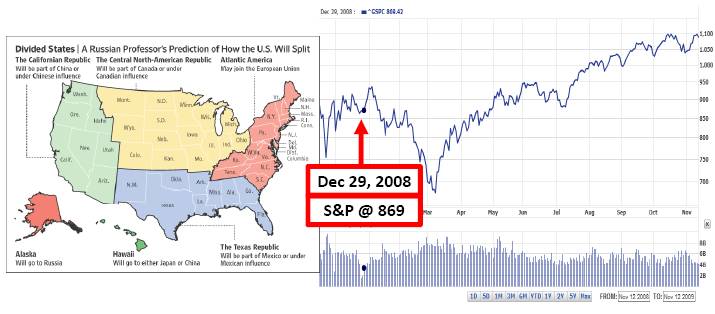
One of my favorite articles (read here) of the global crisis was written by The Wall Street Journal late last year about a Russian Professor, Igor Panarin (also a former KGB analyst). I find it absurdly amusing that the WSJ would even give credence to this story, but perhaps now I can look forward to an Op-Ed in their newspaper from Iranian President Mahmoud Ahmadinejad or North Korean Leader Kim Jong Ill. Not only did Professor Panarin pronounce the complete evaporation of the United States, but he also provided a specific timeframe. In late June or early July 2010, he expects the U.S. to fall into civil war and subsequently get carved up into six pieces by particular foreign regions, including China, Mexico, E.U., Japan, Canada, and Russia (which will control Alaska of course). I guess Sarah Palin will not be a happy camper?
Other Crisis Souvenirs

Hey Georgy, let me know when you turn bullish…so I can sell!
Market Mayhem
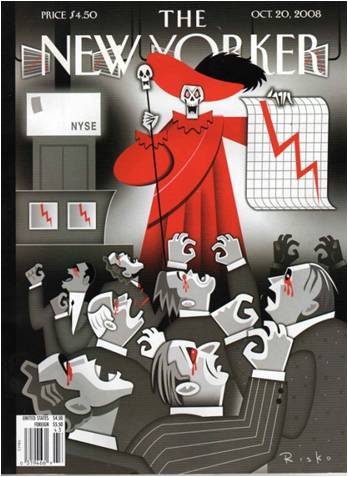
- Who’s that on the cover? Nancy Pelosi?!
Lessons Learned
Contrarianism for the sake of contrarianism is not necessarily a good thing. Trend can be your friend too. Bubbles take much longer to inflate than they burst, so it may be in your best interest to ride the wave of ecstasy for longer than the early alarm ringers. Take for example Alan Greenspan’s infamous irrational exuberance speech in 1996, when the NASDAQ index was trading around 1300. As we all know, the NASDAQ went on to pierce the 5000 mark, four years later. Sorry Al…right idea, but a tad early. Although he may have been correct directionally, his timing and degree were way off. Pundits like Nouriel Roubini and Peter Schiff are other examples of prognosticators who identified the financial crisis many years before the catastrophe actually hit. As I noted previously, trading based on magazine covers was not conceived as a legitimate investable strategy, but as I’ve shown they can be indicators of sentiment. And these sentiment indicators can be used as a valuable apparatus in your toolbox to prevent harmful decisions at the worst possible times.
Thanks for coming Back to the Future on this historical tour of cover stories. Now that you have graduated with honors, next time you are in line at the grocery store, feel free to flash your diploma to receive a discount on a magazine purchase.
Class dismissed.
Wade W. Slome, CFA, CFP®
Plan. Invest. Prosper.
DISCLOSURE: No information accessed through the Investing Caffeine (IC) website constitutes investment, financial, legal, tax or other advice nor is to be relied on in making an investment or other decision. Please read disclosure language on IC “Contact” page.
Back to the Future: Mag Covers (Part II)
In my most recent article, I went Back to the Future to examine the role magazine covers play as a contrarian indicator in fear-driven markets like we experienced in the 1970s (see previous story). Investing is both an art and science. While measuring the scientific aspects of the market can be more straight-forward, the behavioral and emotional sides to investing are more subjective. Magazines act as sentiment sensors to gauge the fear and froth pulses of the general investing public. Since last time we explored fear, let’s check out some froth from the 1990s technology boom.
How to Invest in the Hottest Market Ever
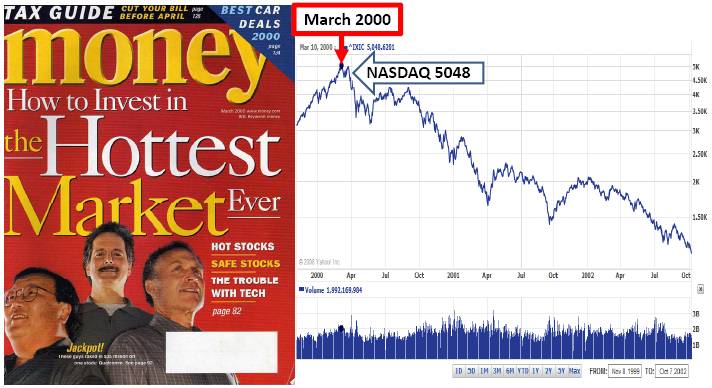
Seeing the forest from the trees can be difficult when you’re trapped in the thick of it, but the March 2000 issue of Money magazine’s “How to Invest in the Hottest Market Ever” is a classic example of the mentality that reigned supreme in the late 1990s technology bubble. Objective, fact-filled articles that challenge the status quo are not necessary to generate sales, but articles and magazine covers that pander to the raw emotions of fear and greed keep the cash register ringing. If you don’t believe me, just read the sensational headlines at your local grocery store explaining how swine flu will kill us all and how there are millions to be made in melting gold coins and jewelry (read gold article).
I love some of the quotes from the article, especially from Pam, the 51 year old divorced New York City art museum volunteer who bought AOL, Microsoft, and Qualcomm (which rose +2,621% in 1999) who dismisses diversification: “I feel pretty safe now. I think we are in a new paradigm now.” Yeah, a “new economy” that catapulted Yahoo to a Price/Earnings ratio of 400x’s earnings; Cisco 109x’s earnings; and Sun Microsystems practically a bargain basement steal at 88x’s earnings. For reference purposes, the S&P 500 index currently trades for about 14.6x’s estimated 2010 earnings and 19.5x on 2009 estimates.
GetRich.com
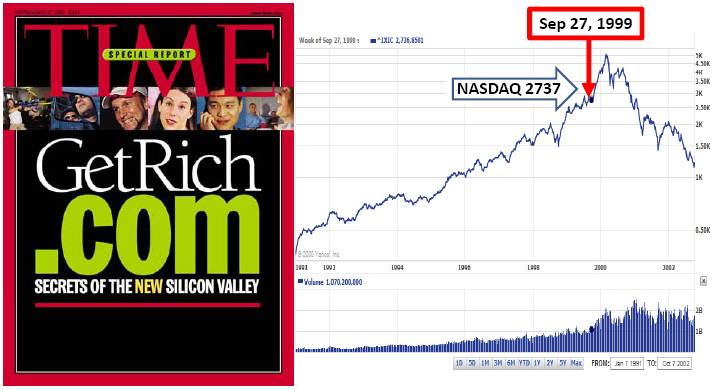
Another landmark masterpiece I love is the September 1999 Time cover, “GetRich.com.” Never mind the unabated technology boom (excluding a brief hiccup in 1998) that inflated the bubble for a decade – Time still managed to unearth the “Secrets of the New Silicon Valley.” The article goes onto to express the get-rich formula:
“Can’t program a computer? Not a techno savvy? Not a problem. If you’ve got a hot Internet business idea, Silicon Valley’s astonishing start-up machine will do the rest.”
Like a drug dealer pushing heroin on an addict, the article goes on to entice its readers to question “Why have a boss when you and three buddies can build your own publicly traded company in two years? Windows this big don’t open very often.”
A Few More Favorites
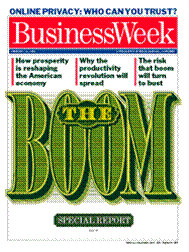
Great timing on this February 2000 cover…a month before the crash!

This July 1999 cover captures envy. Everyone's getting rich!
As we saw during the technology boom, media outlets have no shame in shoveling greed inducing slop to the hungry general public. Like all historical events that end tragically, valuable lessons can be learned from our mistakes. Developing a discerning palette for the news we digest is a critical quality to generating an informed investment decision process. With the 1970s and 1990s behind us, as the last of my three part series, we’ll use time travel to another period to see if modern magazine editors fare any better in market timing as compared to their predecessors. Please excuse me while I jump in my time machine.
Wade W. Slome, CFA, CFP®
Plan. Invest. Prosper.
DISCLOSURE: Sidoxia Capital Management (SCM) or its clients has a long position in CSCO and QCOM at the time this article was originally posted. SCM owns certain exchange traded funds, but currently has no direct position in YHOO, MSFT, or JAVA. No information accessed through the Investing Caffeine (IC) website constitutes investment, financial, legal, tax or other advice nor is to be relied on in making an investment or other decision. Please read disclosure language on IC “Contact” page.
Back to the Future: Mag Covers (Part I)
Magazine Covers Part II – – – Magazine Covers Part III
I’m not referring to the movie, Back to the Future, about a plutonium-powered DeLorean time machine that finds Marty McFly (played by Michael J. Fox) traveling back in time. Rather, I am shining the light on the uncanny ability of media outlets (specifically magazines) to mark key turning points in financial markets – both market bottoms and market tops. This will be the first in a three part series, providing a few examples of how magazines have captured critical periods of maximum fear (buying opportunities) and greed (selling signals).
People tend to have short memories, especially when it comes to the emotional rollercoaster ride we call the stock market. Thanks to globalization, the internet, and the 24/7 news cycle, we are bombarded with some fear factor to worry about every day. Although I might forget what I had for breakfast, I have been a student of financial market history and have experienced enough cycles to realize as Mark Twain famously stated, “History never repeats itself, but it often rhymes” (read previous market history article). In that vein, let us take a look at a few covers from the 1970s:
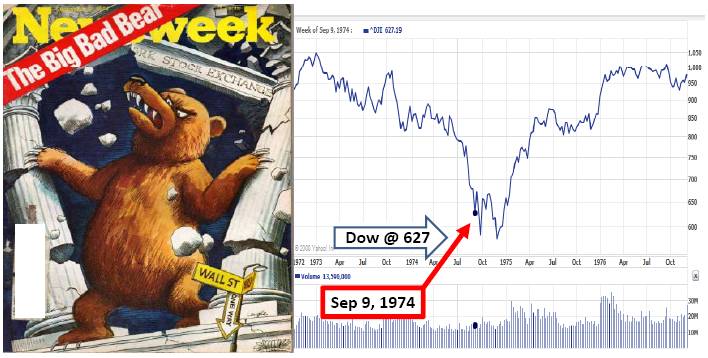
Newsweek’s “The Big Bad Bear” issue came out on September 9, 1974 when the collapse of the so-called “Nifty Fifty” (the concentrated set of glamour stocks or “Blue Chips”) was in full swing. This group of stocks, like Avon, McDonalds, Polaroid, Xerox, IBM and Disney, were considered “one-decision” stocks investors could buy and hold forever. Unfortunately, numerous of these hefty priced stocks (many above a 50 P/E) came crashing down about 90% during the1973-74 period.
Why the glum sentiment? Here are a few reasons:
- Exiting Vietnam War
- Undergoing a Recession
- 9% Unemployment
- Arab Oil Embargo
- Watergate: Presidential Resignation
- Franklin National Failure
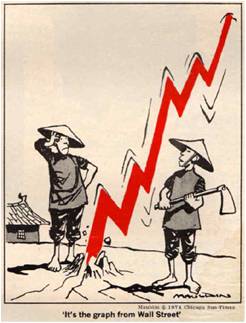
A cartoon from the same bearish 1974 cover article.
Not a rosy backdrop, but was this scary and horrific phase the ideal time to sell, as the magazine cover may imply? No, actually this was a shockingly excellent time to purchase equities. The Dow Jones Industrial Average, priced at 627 when the magazine was released, is now trading around 10,247…not too shabby a return considering the situation looked pretty darn bleak at the time.
Reports of the Market’s Death Greatly Exaggerated
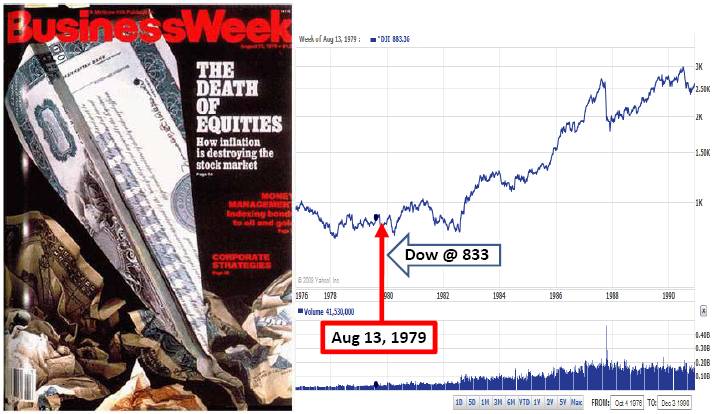
Sticking with the Mark Twain theme, the reports of the market’s demise was greatly exaggerated too – much the same way we experienced the overstated reaction to the financial crisis early in 2009. BusinessWeek’s August 13, 1979 magazine captured the essence of the bearish mood in the article titled, “The Death of Equities.” This article came out, of course, about 18 months before a multi-decade upward explosion in prices that ended in the “Dot-com” crash of 2000. In the late 1970s, inflation reached double digit levels; gold and oil had more than doubled in price; Paul Volcker became the Federal Reserve Chairman and put on the economic brakes via a tough, anti-inflationary interest rate program; and President Jimmy Carter was dealing with an Iranian Revolution that led to the capture of 63 U.S. hostages. Like other bear market crashes in our history, this period also served as a tremendous time to buy stocks. As you can see from the chart above, the Dow was at 833 at the time of the magazine printing – in the year 2000, the Dow peaked at over 14,000.
The walk down memory lane is not over yet. Conveniently, the Back to the Future story was designed as a trilogy (just like my three-part magazine review), so stay tuned for “Part II” – coming soon to your future.
Wade W. Slome, CFA, CFP®
Plan. Invest. Prosper.
DISCLOSURE: Sidoxia Capital Management (SCM) has a short position in MCD at the time this article was originally posted. SCM owns certain exchange traded funds, but currently has no direct position in Avon (AVP), Polaroid, Xerox (XRX), IBM or Disney (DIS). No information accessed through the Investing Caffeine (IC) website constitutes investment, financial, legal, tax or other advice nor is to be relied on in making an investment or other decision. Please read disclosure language on IC “Contact” page.
Drought in Higher Rates May Be Over

The drought in higher interest rates may be nearing an end? Ever since the global financial crisis accelerated into full force in the fall of 2008, there were a constant flow of coordinated interest rate cuts triggered around the world with the aim of stimulating global GDP (Gross Domestic Product) and improving credit flow through the clogged financial pipes. Central banks across the world cut key benchmark interest rate levels and the impact of these reductions has a direct influence on what consumers pay for their financial products and services. More recently, we have begun to see the reversal of previous cuts with rate hikes witnessed in several international markets. Last week we saw Norway become the first western European country to raise rates, following an earlier October rate lift by Australia and another by Israel in August. For some countries, the sentiment has switched from global collapse fears to a stabilization posture coupled with future inflation concerns. In the U.S., the data has been more mixed (read article here) and the Federal Reserve has been clear on its intention to keep short-term rates at abnormally low levels for an extended period of time. That stance would likely change with evidence of inflationary pressures or improved job market conditions.
What Does This Mean for Consumers?
Prior to the financial crisis, credit availability flourished at affordably low rates. Now, with signs of a potential global recovery matched with regulatory overhauls, consumers may be impacted in several financial areas:
1) Credit Card Rates: Beyond regulatory changes in Washington (read more), the interest rate charged on unpaid credit card balances may be on the rise. When the Federal Reserve inevitably raises the targeted Federal Funds Rate (the interest rate for loans made between banks) from the current target rate range of 0.00% and 0.25%, this action will likely have direct upward pressure on consumer credit card rates. The associated increase in key benchmark rates such as the Prime Rate (the rate charged to a bank’s most creditworthy customers) and LIBOR (London Interbank Offer Rate) would result in higher monthly interest payments for consumers.
2) Other Consumer Loans: Many of the same forces impacting credit card rates will also impact other consumer loans, like home mortgages and auto loans. Pull out your loan documents – if you have floating or variable rate loans then you may be exposed to future hikes in interest rates.
3) Business Loans / Lines of Credit: Business owners -not just consumers – can also be impacted by rising rates. When the cost of funding goes up (.i.e., interest rates), the banks look to pass on those higher costs to the customer so the account profitability can be maintained.
4) Dollar & Import Prices: To the extent subsequent United States rate hikes lag other countries around the world, our dollar runs the risk of depreciating more in value (currency investors, all else equal, prefer currencies earning higher interest rates). A weaker dollar translates into foreign goods and services costing more. If international central banks continue to raise rates faster than the U.S., then imported good inflation could become a larger reality.
5) Hit to Bond Prices: Higher interest rates can also result in a negative hit to your bond portfolio. Higher duration bonds, those typically with longer maturities and lower relative coupon payments, are the most vulnerable to a rise in interest rates. Consider shortening the duration of your portfolio and even contemplate floating rate bonds.
Interest rates are the cost for borrowed money and even with the recent increase in consumers’ savings rate, consumers generally are still saddled with a lot of debt. Do yourself a favor and review any of your credit card agreements, loan documents, and bond portfolio so you will be prepared for any future interest rate increases. Shopping around for better rates and/or consolidating high interest rate debt into cheaper alternatives are good strategies as we face the inevitable end in the drought of higher global interest rates.
Wade W. Slome, CFA, CFP®
Plan. Invest. Prosper.
DISCLOSURE: No information accessed through the Investing Caffeine (IC) website constitutes investment, financial, legal, tax or other advice nor is to be relied on in making an investment or other decision. Please read disclosure language on IC “Contact” page.
The Halloween Indicator Buried at Cemetery in 2009

Boo!
Statisticians, economists, speculators, and superstitious investors have been known to get spooked by scary patterns. Tomorrow marks the end of the menacing six month period of supposed underperformance that starts in May and ends on Halloween. The so-called “Halloween Indicator” has popularized the expression of “sell in May and walk away.” The indicator obviously has not followed the alleged tendency in 2009, as there has been more “treat” than “trick” for investors over the last six months. The S&P has rallied about +22% (excluding dividends) with only one day left in the trading period. Numerous academics have studied the phenomenon and not surprisingly there is some debate regarding the validity of various studies (see past study) – differing opinions have risen to the surface, depending on the number of years compiled in the data.
Here is what Mark Hulbert at MarketWatch had to say on the subject:
“Over the Dow’s history up until the last 12 months, there were no fewer than 17 occasions (15% of the years) in which both the winter months turned in a net loss for the stock market and the summer months produced a gain. There furthermore were 45 years (41% of the time) in which the stock market during the summer period did better than it did over the winter months that immediately preceded it. So the stock market’s performance over the last 12 months is hardly exceptional. It would take a lot more than the recent seasonal missteps to convince a statistician that this long-term pattern has stopped working for good. “
Other calendar effects besides the Halloween Indicator include, the January Effect, Monday Effect, and Presidential Cycle. Even though some pundits point to evidence supporting calendar effects, in many cases the data is proved to be statistically insignificant.
With Halloween just around the corner, here’s Sidoxia Capital Management wishing you a larger bag of treats rather than tricks in your quest in following calendar effects.
Wall Street Halloween Costume Ideas:
Short of ideas for Halloween costumes this year? No need to fear. Here are a few bloodcurdling Wall Street costume ideas with the help of Joshua Brown at The Reformed Broker and our friends at Forbes:

Top Ten Scariest Wall Street Halloween Costumes
Halloween Index:
For those that would rather get there treats from the stock market rather than a candy bowl, perhaps you may find a sweet idea from Stockerblog’s Halloween Stock Index.
Have a happy and safe Halloween!
Wade W. Slome, CFA, CFP®
Plan. Invest. Prosper.
DISCLOSURE: Sidoxia Capital Management and client accounts do not have direct positions in any of the Halloween Stock Index companies with the exception of long positions in WMT for some Sidoxia accounts. No information accessed through the Investing Caffeine (IC) website constitutes investment, financial, legal, tax or other advice nor is to be relied on in making an investment or other decision. Please read disclosure language on IC “Contact” page
The Not So Good, Bad, and Ugly
There’s a new bounty hunter in town, and it’s not Clint Eastwood from the legendary western film The Good, the Bad and the Ugly. Rather, it’s John Carney from Clusterstock who is keeping the bold bears honest, even though they have received their heads handed to them in this supposed “sucker, bear-market rally.” Perhaps, the bears will ultimately be proven right, but in the mean time, these tape fighters are losing blood by the quart.
Music from what Quentin Tarantino calls the best-directed film of all-time.
I find the existence of accountability sheriffs in the business media world rejuvenating since these roles are sorely lacking. Too often, so-called pundits spout off bold assertive predictions and industry commentators make no effort to review the track records of those prognosticators. I commend many of the industry practitioners for putting their necks out on the line, but viewers need some sort of historical batting average to judge the odds of forecast reliability. The game of predictions is no science, but there can be some objective responsibility instituted by media researchers and commentators. Media outlets provide carte blanche to predictors without doing homework on the guests. Unfortunately, time-strapped viewers have little to no time to research commentator track records.
Typically how it works, especially in the massively fragmented media world (which I admittedly participate in on a relatively small scale), you have countless voices making extreme predictions across the broad economic and financial globe. Eventually, some forecasts will be right, including those correct for the wrong reasons – just think back to your statistics class where you learned about the “law of large numbers” or the family living room where the broken clock provides correct time twice a day (see my other article on bold predictions). Since any human likes to be associated with greatness, these future-seers are strolled into media studios, put on a pedestal and asked to share their brilliance, all without critically reviewing the past record of the purported expert.
Rather than make bold predictions about market direction, which is virtually impossible to predict with accuracy on a sustainable basis, I choose to look at the market with a perspective similar to the greats. For example, Peter Lynch who earned +29% per year from 1977 – 1990 (achieving about double the market return) says it’s best to “assume the market is going nowhere and invest accordingly.” Realizing your fallibility is important also. Even with Lynch’s incredible track record, he knows “you’re terrific in this business [if] you’re right six times out of 10.” According to Lynch fretting about the market direction is also useless: “If you spend more than 14 minutes a year worrying about the market, you’ve wasted 12 minutes.” Interestingly, even Warren Buffett, arguably the greatest investor of all-time, never comments on short-term directions of the market, despite being hailed as the “Oracle of Omaha.”
Predictions and forecasts will never go away, but I will sleep better at night knowing sheriffs like John Carney are keeping track of the good, the bad and the ugly. Who knows, maybe he’ll even take me on as a deputy.
View John Carney’s Full Article
Wade W. Slome, CFA, CFP®
Plan. Invest. Prosper.
DISCLOSURE: No information accessed through the Investing Caffeine (IC) website constitutes investment, financial, legal, tax or other advice nor is to be relied on in making an investment or other decision. Sidoxia Capital Management (SCM) and some of its clients own certain exchange traded funds, and at the time of publishing had no direct positions in BRKA/B. Please read disclosure language on IC “Contact” page.
Dry Powder Piled High

Money goes where it is treated best. Sometimes idle cash contributes to the inflation of speculative bubbles, while sometimes that same capital gets buried in a bunker out of fear. The mood-swing pendulum is constantly changing; however with the Federal Funds Rate at record lows, some of the bunker money is becoming impatient. With the S&P 500 up +60% since the March lows, investors are getting antsy to put some of the massive mounds of dry powder back to work – preferably in an investment vehicle returning more than 1%.
How much dry powder is sloshing around? A boatload. Bloomberg recently referenced data from ICI detailing money market accounts flush with a whopping $3.5 trillion. This elevated historical number comes despite a $439.5 million drop from the record highs experienced in January of this year.
From a broader perspective, if you include cash, money-market, and bank deposits, the nation’s cash hoard reached $9.55 trillion in September. What can $10 trillion dollars buy? According to Bloomberg, you could own the whole S&P 500 index, which registers in at a market capitalization price tag of about $9.39 trillion. The article further puts this measure in context:
“Since 1999, so-called money at zero maturity has on average accounted for 62 percent of the stock index’s worth. … Before the collapse of New York-based Lehman Brothers Holdings Inc. last year, the amount of cash never exceeded the value of U.S. equities.”
Cash levels remain high, but the 60% bounce from the March lows is slowly siphoning some money away. According to ICI data, $15.8 billion has been added to domestic-equity funds since March. Trigger shy fund managers, fearful of the macro-economic headlines, have been slow to put all their cash to work, as well. Jeffrey Saut, chief investment strategist at Raymond James & Associates adds “Many of the fund managers I talk to that have missed this rally or underplayed this rally are sitting with way too much cash.”
With so much cash on the sidelines, what do valuations look like since the March rebound?
“The index [S&P 500] trades for 2.18 times book value, or assets minus liabilities, 33 percent below its 15-year average, data compiled by Bloomberg show. The S&P 500 was never valued below 2 times net assets until the collapse of Lehman, data starting in 1994 show. The index fetches 1.15 times sales, 22 percent less than its average since 1993.”
On a trailing P/E basis (19x’s) the market is not cheap, but the Q4 earnings comparisons with last year are ridiculously easy and companies should be able to trip over expectations. The proof in the pudding comes in 2010 when growth in earnings is projected to come in at +34% (Source: Standard & Poor’s), which translates into a much more attractive multiple of 14 x’s earnings. Revenue growth is the missing ingredient that everyone is looking for – merely chopping an expense path to +34% earnings growth will be a challenging endeavor for corporate America.
Growth outside the U.S. has been the most dynamic and asset flows have followed. With some emerging markets up over +100% this year, the sustainability will ultimately depend on the shape of the global earnings recovery. At the end of the day, with piles of dry powder on the sidelines earning next to nothing, eventually that capital will operate as productive fuel to drive prices higher in the areas it is treated best.
Read the Complete Bloomberg Article Here.
Wade W. Slome, CFA, CFP®
Plan. Invest. Prosper.
Time to Take Out the Trash: From Garbage to Cream

As we saw with the +50% move in the 2003 NASDAQ recovery when there was a flight to garbage (lower quality stocks), eventually the cream rose to the top in the later stages of the 2002-2007 bull market. Usually investors get what they pay for, yet many of the companies that were left for dead in 2008 (including bankruptcy fears) have rebounded the fiercest. As the “anti-Great Depression” trade has paid off handsomely for those low quality stocks, high quality stocks have patiently waited on the sidelines eager to jump along for the escalating ride. Ben Levisohn, Business Week writer, thinks it’s time for high quality stock’s to outperform their junky brethren. Here’s what Mr. Levisohn had to say:
“The stock market has gained 58% since its bear-market low Mar. 9, but the rally hasn’t lifted all equities equally. As is typical in many market bouncebacks, the worst recovered first. Low-quality companies, those with weak or nonexistent profits, mediocre return on equity, and less-than-stellar balance sheets, outpaced their more solidly profitable peers by nearly a 2-to-1 margin, according to research from Baird Private Wealth Management.”
Intuitively, the “garbage” rally makes sense from the standpoint, the harder you fall, the faster you will bounce. However, the sustainability of such rapid, fierce moves should be questioned. Eventually, fundamentals move up investors’ priority list and the “cream” (quality stocks) rises to the top.
Mr. Levisohn further highlights the disparity between “garbage” and “cream” by noting:
“Baird found that companies not earning a profit gained 92% from the Mar. 9 lows through the end of August, compared with a 47% rise for companies that had the highest profit margins. Companies with the lowest return on equity outperformed those with the highest by more than 2 to 1, according to Baird.”
With the sickly stock rally and the removal of the “global meltdown” scenario apparently behind us, I concur with Mr. Levisohn that now is the time to focus on “quality” stocks. What does “quality” mean? From a quantitative perspective, concentrating on those companies with high returns on invested capital (ROIC), high returns on equity (ROE), companies with low levels of debt (leverage), generating healthy levels of cash flow (See Cash Flow Article), represents “quality” investing to me. From a fundamental standpoint, management teams with a clear track record of success, and companies with deep barriers to entry, and a healthy pipeline of growth opportunities are other quality characteristics I look for.
Companies retaining these higher quality traits generally are not held hostage to the capital markets and banking system (i.e., no bailouts necessary). As a result, these companies have the flexibility to invest additional resources into areas like research & development, marketing, manufacturing, and mergers & acquisitions. Superior companies have the ability to step on the throats of weaker competitors, thereby extending their competitive advantage and garnering additional market share.
We have experienced a massive rebound in the markets since the March lows, but now it’s time to take out the garbage. As I search for high quality stocks through my computer terminal, I’ll be enjoying my delicious coffee…with extra cream.
Read Entire Business Week Article Here
Wade W. Slome, CFA, CFP®
Plan. Invest. Prosper.




