Posts filed under ‘Financial Markets’
The Not So Good, Bad, and Ugly
There’s a new bounty hunter in town, and it’s not Clint Eastwood from the legendary western film The Good, the Bad and the Ugly. Rather, it’s John Carney from Clusterstock who is keeping the bold bears honest, even though they have received their heads handed to them in this supposed “sucker, bear-market rally.” Perhaps, the bears will ultimately be proven right, but in the mean time, these tape fighters are losing blood by the quart.
Music from what Quentin Tarantino calls the best-directed film of all-time.
I find the existence of accountability sheriffs in the business media world rejuvenating since these roles are sorely lacking. Too often, so-called pundits spout off bold assertive predictions and industry commentators make no effort to review the track records of those prognosticators. I commend many of the industry practitioners for putting their necks out on the line, but viewers need some sort of historical batting average to judge the odds of forecast reliability. The game of predictions is no science, but there can be some objective responsibility instituted by media researchers and commentators. Media outlets provide carte blanche to predictors without doing homework on the guests. Unfortunately, time-strapped viewers have little to no time to research commentator track records.
Typically how it works, especially in the massively fragmented media world (which I admittedly participate in on a relatively small scale), you have countless voices making extreme predictions across the broad economic and financial globe. Eventually, some forecasts will be right, including those correct for the wrong reasons – just think back to your statistics class where you learned about the “law of large numbers” or the family living room where the broken clock provides correct time twice a day (see my other article on bold predictions). Since any human likes to be associated with greatness, these future-seers are strolled into media studios, put on a pedestal and asked to share their brilliance, all without critically reviewing the past record of the purported expert.
Rather than make bold predictions about market direction, which is virtually impossible to predict with accuracy on a sustainable basis, I choose to look at the market with a perspective similar to the greats. For example, Peter Lynch who earned +29% per year from 1977 – 1990 (achieving about double the market return) says it’s best to “assume the market is going nowhere and invest accordingly.” Realizing your fallibility is important also. Even with Lynch’s incredible track record, he knows “you’re terrific in this business [if] you’re right six times out of 10.” According to Lynch fretting about the market direction is also useless: “If you spend more than 14 minutes a year worrying about the market, you’ve wasted 12 minutes.” Interestingly, even Warren Buffett, arguably the greatest investor of all-time, never comments on short-term directions of the market, despite being hailed as the “Oracle of Omaha.”
Predictions and forecasts will never go away, but I will sleep better at night knowing sheriffs like John Carney are keeping track of the good, the bad and the ugly. Who knows, maybe he’ll even take me on as a deputy.
View John Carney’s Full Article
Wade W. Slome, CFA, CFP®
Plan. Invest. Prosper.
DISCLOSURE: No information accessed through the Investing Caffeine (IC) website constitutes investment, financial, legal, tax or other advice nor is to be relied on in making an investment or other decision. Sidoxia Capital Management (SCM) and some of its clients own certain exchange traded funds, and at the time of publishing had no direct positions in BRKA/B. Please read disclosure language on IC “Contact” page.
Dry Powder Piled High

Money goes where it is treated best. Sometimes idle cash contributes to the inflation of speculative bubbles, while sometimes that same capital gets buried in a bunker out of fear. The mood-swing pendulum is constantly changing; however with the Federal Funds Rate at record lows, some of the bunker money is becoming impatient. With the S&P 500 up +60% since the March lows, investors are getting antsy to put some of the massive mounds of dry powder back to work – preferably in an investment vehicle returning more than 1%.
How much dry powder is sloshing around? A boatload. Bloomberg recently referenced data from ICI detailing money market accounts flush with a whopping $3.5 trillion. This elevated historical number comes despite a $439.5 million drop from the record highs experienced in January of this year.
From a broader perspective, if you include cash, money-market, and bank deposits, the nation’s cash hoard reached $9.55 trillion in September. What can $10 trillion dollars buy? According to Bloomberg, you could own the whole S&P 500 index, which registers in at a market capitalization price tag of about $9.39 trillion. The article further puts this measure in context:
“Since 1999, so-called money at zero maturity has on average accounted for 62 percent of the stock index’s worth. … Before the collapse of New York-based Lehman Brothers Holdings Inc. last year, the amount of cash never exceeded the value of U.S. equities.”
Cash levels remain high, but the 60% bounce from the March lows is slowly siphoning some money away. According to ICI data, $15.8 billion has been added to domestic-equity funds since March. Trigger shy fund managers, fearful of the macro-economic headlines, have been slow to put all their cash to work, as well. Jeffrey Saut, chief investment strategist at Raymond James & Associates adds “Many of the fund managers I talk to that have missed this rally or underplayed this rally are sitting with way too much cash.”
With so much cash on the sidelines, what do valuations look like since the March rebound?
“The index [S&P 500] trades for 2.18 times book value, or assets minus liabilities, 33 percent below its 15-year average, data compiled by Bloomberg show. The S&P 500 was never valued below 2 times net assets until the collapse of Lehman, data starting in 1994 show. The index fetches 1.15 times sales, 22 percent less than its average since 1993.”
On a trailing P/E basis (19x’s) the market is not cheap, but the Q4 earnings comparisons with last year are ridiculously easy and companies should be able to trip over expectations. The proof in the pudding comes in 2010 when growth in earnings is projected to come in at +34% (Source: Standard & Poor’s), which translates into a much more attractive multiple of 14 x’s earnings. Revenue growth is the missing ingredient that everyone is looking for – merely chopping an expense path to +34% earnings growth will be a challenging endeavor for corporate America.
Growth outside the U.S. has been the most dynamic and asset flows have followed. With some emerging markets up over +100% this year, the sustainability will ultimately depend on the shape of the global earnings recovery. At the end of the day, with piles of dry powder on the sidelines earning next to nothing, eventually that capital will operate as productive fuel to drive prices higher in the areas it is treated best.
Read the Complete Bloomberg Article Here.
Wade W. Slome, CFA, CFP®
Plan. Invest. Prosper.
Time to Take Out the Trash: From Garbage to Cream

As we saw with the +50% move in the 2003 NASDAQ recovery when there was a flight to garbage (lower quality stocks), eventually the cream rose to the top in the later stages of the 2002-2007 bull market. Usually investors get what they pay for, yet many of the companies that were left for dead in 2008 (including bankruptcy fears) have rebounded the fiercest. As the “anti-Great Depression” trade has paid off handsomely for those low quality stocks, high quality stocks have patiently waited on the sidelines eager to jump along for the escalating ride. Ben Levisohn, Business Week writer, thinks it’s time for high quality stock’s to outperform their junky brethren. Here’s what Mr. Levisohn had to say:
“The stock market has gained 58% since its bear-market low Mar. 9, but the rally hasn’t lifted all equities equally. As is typical in many market bouncebacks, the worst recovered first. Low-quality companies, those with weak or nonexistent profits, mediocre return on equity, and less-than-stellar balance sheets, outpaced their more solidly profitable peers by nearly a 2-to-1 margin, according to research from Baird Private Wealth Management.”
Intuitively, the “garbage” rally makes sense from the standpoint, the harder you fall, the faster you will bounce. However, the sustainability of such rapid, fierce moves should be questioned. Eventually, fundamentals move up investors’ priority list and the “cream” (quality stocks) rises to the top.
Mr. Levisohn further highlights the disparity between “garbage” and “cream” by noting:
“Baird found that companies not earning a profit gained 92% from the Mar. 9 lows through the end of August, compared with a 47% rise for companies that had the highest profit margins. Companies with the lowest return on equity outperformed those with the highest by more than 2 to 1, according to Baird.”
With the sickly stock rally and the removal of the “global meltdown” scenario apparently behind us, I concur with Mr. Levisohn that now is the time to focus on “quality” stocks. What does “quality” mean? From a quantitative perspective, concentrating on those companies with high returns on invested capital (ROIC), high returns on equity (ROE), companies with low levels of debt (leverage), generating healthy levels of cash flow (See Cash Flow Article), represents “quality” investing to me. From a fundamental standpoint, management teams with a clear track record of success, and companies with deep barriers to entry, and a healthy pipeline of growth opportunities are other quality characteristics I look for.
Companies retaining these higher quality traits generally are not held hostage to the capital markets and banking system (i.e., no bailouts necessary). As a result, these companies have the flexibility to invest additional resources into areas like research & development, marketing, manufacturing, and mergers & acquisitions. Superior companies have the ability to step on the throats of weaker competitors, thereby extending their competitive advantage and garnering additional market share.
We have experienced a massive rebound in the markets since the March lows, but now it’s time to take out the garbage. As I search for high quality stocks through my computer terminal, I’ll be enjoying my delicious coffee…with extra cream.
Read Entire Business Week Article Here
Wade W. Slome, CFA, CFP®
Plan. Invest. Prosper.
Walking on Egg Shells

The recent stock market rally has investors walking on egg shells. “Nervous Nelly” investors panicked on the way down last year, and now they are fearful and skeptical about the sustainability of the fierce six-month rally. The S&P 500 is up about 60% from the latest bear market lows, but I think the recent New Jersey Business News (NJBN) article captures the investor sentiment perfectly, “I’m scared, I’m scared, I’m scared,” investor Dania Leon said. “Why are we up, especially with unemployment as high as it is? I don’t feel great because I worry that we could have a 500- or 600-point drop in a day and I won’t be quick enough to pull out of it in time.”
Will investors ever be comfortable? Well yes, of course, exactly at the right time to sell. Calm and complacency will most likely settle in once the economic headlines are on a clear path to recovery. At that point, the market, like a game of chess, will likely have already anticipated the recovery.
Until then, the whipsaw syndrome seems to have taken effect on investors. The NJBN article goes onto expand on investors’ emotional scars:
“They’ve been traumatized twice,” said Michal Strahilevitz, a business professor at Golden Gate University who studies the psychology of individual investors. “First they lost a lot and got out. And now they’ve watched it climb up. It’s a lot of regret, and for people who are investing for their family, it’s a lot of guilt.”
Trillions of low yielding cash continues to sit on the sidelines, waiting for the inevitable 10% “pullback.” Strategist Laszlo Birinyi sees little evidence for an imminent correction, “Give me the evidence…in 1982 we went 424 days before we had a correction. In 2000, we went seven years before we had a 10% correction. In 2002, we went three or four years.” (For more on Mr. Birinyi, see http://is.gd/3xS5u)
At the end of the day, as great growth investor Peter Lynch said, it’s the direction of corporate earnings that will ultimately drive the market higher or lower. “People may bet on hourly wiggles of the market but it’s the earnings that waggle the wiggle long term.” Right now based on the strength of the rally, the market is telling us that third quarter corporate earnings should come in better than analyst expectations. Perhaps we get a yawner response (sell on the news reaction), or if improvement outright stalls, perhaps we will get the mother of all expected corrections?
All these mind games make for an extremely tiresome investing mental tug-of-war. I choose not to get caught up in this game of market timing, but rather I choose to let the investment opportunity-set drive my investment decisions. I have taken some chips off the table during this rebound but I am still finding plenty of other fertile opportunities to redeploy capital. As others nervously walk on egg shells, I opt to clean up the mess and look for a clearer investment path.
Read the Full NJBN Article Here
Wade W. Slome, CFA, CFP®
Plan. Invest. Prosper.
Goldman Sachs in Talks to Acquire Treasury Department
 Andy Borowitz from the Borowitz Report published an article a few months ago satirizing the ever increasing conspiracy theories being spread regarding Goldman Sachs’ (GS) role in the global financial crisis. Spearheading the scapegoating Goldman Sachs brigade is Matt Taibbi of Rolling Stone who wrote Inside The Great American Bubble Machine. Megan McArdle at The Atlantic has a detailed critique of Taibbi’s loose facts and outlandish generalizations.
On a lighter note, here’s what Mr. Borowitz has to say about the Goldman Sachs/Treasury Department merger, with tongue firmly in cheek:
According to Goldman spokesperson Jonathan Hestron, the merger between Goldman and the Treasury Department is “a good fit” because “they’re in the business of printing money and so are we.” The Goldman spokesman said that the merger would create efficiencies for both entities: “We already have so many employees and so much money flowing back and forth, this would just streamline things.” Mr. Hestron said the only challenge facing Goldman in completing the merger “is trying to figure out which parts of the Treasury Dept. we don’t already own.” Goldman recently celebrated record earnings by roasting a suckling pig over a bonfire of hundred-dollar bills.
If Matt Taibbi is having difficulty coming up with some fresh new material, perhaps he could target some of these hotly debated areas of contention:
- The 40 year anniversary of NASA faking the moon landing.
- The CIA assassination of John F. Kennedy and the 4th shot from the “grassy knoll.”
- Crashed UFO aircraft remains stored at Area 51, Air Force base in Nevada.
- Elvis still alive.
- Paul McCartney actually dead.
- 9/11 terrorist attacks government cover-up.
- The creation of HIV/AIDS by the CIA.
If Bill Clinton can’t suppress sexual relations with Monica Lewinsky and Dick Cheney can’t hide the fact he shot someone in the face with a shotgun, I guess the Goldman crew is just better at pulling the wool over the eyes of 6.5 billion people…less one smart cookie, Matt Taibbi.
Wade W. Slome, CFA, CFP®
Plan. Invest. Prosper.
DISCLOSURE: Sidoxia Capital Management and client accounts do not have direct positions in GS at the time the article was published. No information accessed through the Investing Caffeine (IC) website constitutes investment, financial, legal, tax or other advice nor is to be relied on in making an investment or other decision. Please read disclosure language on IC “Contact” page.
Wealth Creation Using the Demi-Ashton Ratio

Ajay Kapur at Mirae Asset Securities is bullish on the global markets in the short-run (he sees the S&P 500 index reaching 1250 by March 2010), but even more optimistic in the long-run due to a demographic shift occurring in particular markets. According to this Chief Global Strategist, the more Demi Moores and less Ashton Kutchers we have populating the earth, the better our financial markets will perform.
Mr. Kapur’s Demi-Ashton argument is based on the belief that the higher the ratio of middle aged workers in their 40s (Demis) versus those in their 20s (Ashtons) will result in higher stock prices. Basically, those in their 40s generally have accumulated more wealth to invest and are very concerned about their impending retirement, while those in their 20s have little savings to invest and are more concerned about going to clubs and chasing the opposite sex. Seems to make logical sense.
Even though he is bullish in the domestic markets in the short-run, he sees the U.S., Canada, and Western Europe persisting through a secular bear market that began in 2000 and will last through 2015. Mr. Kapur is quick to point out these markets generally maxed-out when the Demi-Ashton ratios peaked in the 2000 timeframe. When these ratios were rising, for example as in Japan in the 1980s and the U.S. in the 1990s, the respective markets went on an upwards tear. Kapur sees emerging markets like Russia, Eastern Europe, and Latin America benefitting from the rising Demi-Ashton ratios in the coming years.
Whether his hypothesis proves correct or not, I admire the strategist’s bold call on the market direction. Typically economists and strategists herd together due to fear of being an outlier. As for Demi Moore and Ashton Kutcher, they should sleep fine with respect to their retirement plans, as long as they do not go on M.C. Hammer, Michael Jackson, or Mike Tyson spending binges.
Wade W. Slome, CFA, CFP®
Plan. Invest. Prosper.
Measuring Chaos

An interesting study was done by Morgan Stanley Europe, in which they looked at the last 19 bear markets and subsequent rallies. I’m not sure how much weight you can put on these results since every bear market is unique in its own right, nonetheless it provides a good frame of reference for debates.
What the Morgan Stanley team found was that the median bear market resulted in a -57% decline over 30 months and the ensuing rally equaled about +71% over 17 months. The problem is that our bear market in the U.S. was much shorter than the median timeframe despite its steepness – the fall effectively began in October 2007 and bottomed in March 2009 (about 17 months in duration). Since the decline was faster in duration, does that mean the advance will be as well? Not sure. Our current rally has lasted about six months, which implies there is about another year for the rally to continue based on this data.
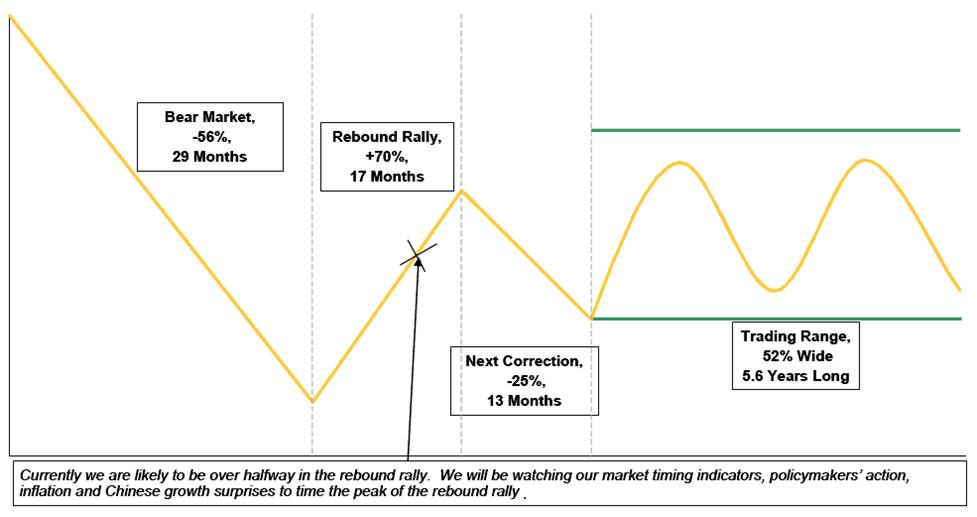
Prieur du Plessis wrote about the Morgan Stanley work for Seeking Alpha
As I alluded to earlier, it’s hard to compare an average to a period in which we had financial institutions dropping like flies (i.e., Bear Stearns, Lehman Brothers, WaMu, Fannie Mae, AIG, etc.) and people were hiding in caves – you knew it was really serious when it even caused voracious consumers to save money…imagine that. At the end of the day, stock and index prices eventually follow earnings. Because of the severity of this downfall, earnings came down faster than prices because fundamentals deteriorated faster than cost cutting could take place. When the economy begins to recover, the opposite will occur – businesses will not be able to hire and spend as fast as earnings are growing. It will be a nice problem to have, but nonetheless characteristic of a typical economic recovery.
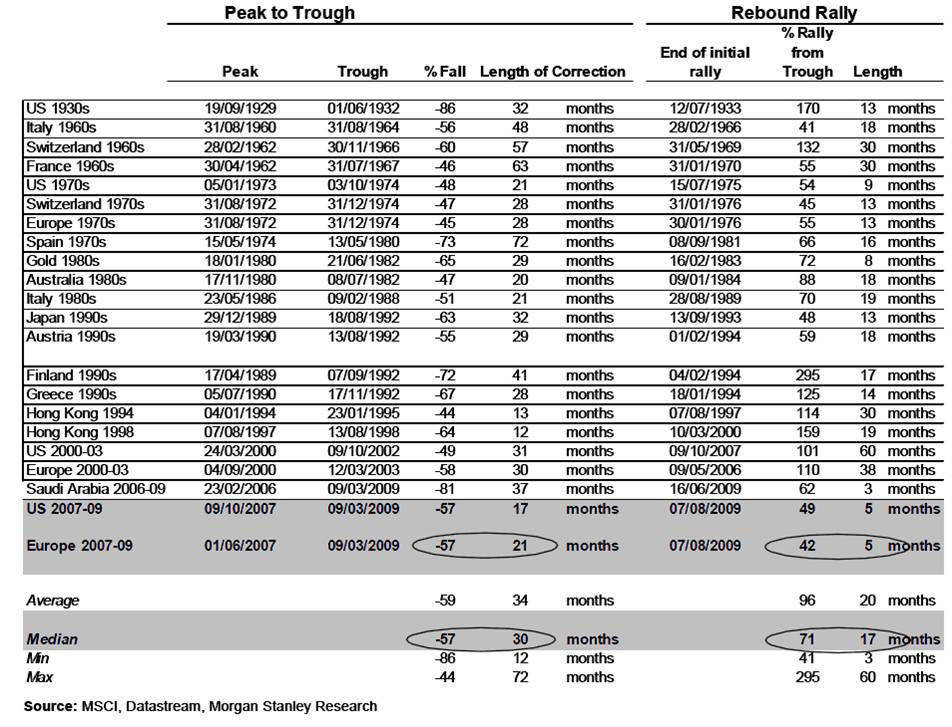
In the U.S., the consumer will have a lot to say about the shape of the recovery since they account for about 2/3 of our country’s economic activity. The other “X” factor will be to what extent government legislation will have an impact on the economy. There will be opportunities available domestically and internally, but in order to survive the chaos, one needs to have a diversified and balanced global approach.
Read the Full Seeking Alpha Article Here
Wade W. Slome, CFA, CFP®
Plan. Invest. Prosper.
Business Theory: Voodoo or Value?

Michael E. Porter, a former aeronautical engineer graduate turned Harvard Economics PhD professor, came out with a revolutionary article thirty years ago (How Competitive Forces Shape Strategy) in which he describes the Five Forces of competition that shape the profitability dynamics of an industry. Since then, Porter’s management theories have continued to spread and his knowledge is continually sought after. Some people believe Porter’s Five Forces, and other management business theories, are pure voodoo.
In a recent HBR (Harvard Business Review) article, Andrew O’Connell completed a book review of The Management Myth: Why the “Experts” Keep Getting it Wrong written by Matthew Stewart, a former consultant. Mr. Stewart (a former consultant turned non-believer) exposes the sham of the business consulting industry by outlining the outrageous fees paid by clients and the “mumbo-jumbo” language spouted out by newly minted MBAs.
In a similarly titled article (the Management Myth) written in 2006, Mr. Stewart goes on to say:
“The impression I formed of the M.B.A. experience was that it involved taking two years out of your life and going deeply into debt, all for the sake of learning how to keep a straight face while using phrases like “out-of-the-box thinking,” “win-win situation,” and “core competencies.”… M.B.A.s have taken obfuscatory jargon—otherwise known as bullshit—to a level that would have made even the Scholastics blanch.”
Some other interesting comments include his views on failing companies:
“In fact, we kind of liked failing businesses: there was usually plenty of money to be made in propping them up before they finally went under. After Enron, true enough, Arthur Andersen sank. But what happened to such stalwarts as McKinsey, which generated millions in fees from Enron and supplied it with its CEO?”
Too often with many books, a silver bullet or holy-grail is searched for. The true answer – there is no easy solution. I believe tools or frameworks, like Porter’s Five Forces, can create significant benefits by forcing practitioners into thinking about competition and profits in new ways. Although the lessons may not be worth millions in consulting fees, the education may be worth the $21.95 cost of a book (including free shipping) from Amazon. Mr. Stewart would likely take umbrage with these views, especially since I have an MBA from Cornell.
Wade W. Slome, CFA, CFP®
Plan. Invest. Prosper.
Social Media Revolution Taking Over World

When I speak of revolution I’m not talking about religion, politics, or wars; rather I am talking about “social media.” Should I care that Ashton Kutcher and Ellen DeGeneres have more twitter followers than the populations of Ireland, Norway, and Panama? Some say social networking is just a fad, but if you blindly sit along the sidelines, the whole world may pass you by in a blink of an eye. Erik Qualman, author of the book and blog Socialnomics, has a must see video that details the revolutionary growth of social media and explains how it is changing the world.
Ever since the early 1900s when the commercialization of radio took hold, millions of people were able to connect all over the world through the spread of technology – in this case the spread of AM (Amplitude Modulation) and FM (Frequency Modulation). Other technologies, such as the telephone, television, and now the internet, have also allowed people to connect. Mr. Qualman details how social media is spreading faster than ever.
Through a chain of details, Qualman highlights the following facts: the invention of the radio took 38 years to reach 50 million users; the television 13 years; the internet 4 years; and the iPod 3 years. Pretty staggering figures until you realize it only took less than 1 year – actually 9 months – for Facebook to add 100 million users! We know the trend is real when my mom (in her seventies) asked me last week how she can register on facebook. Currently, the 55-65 year old female segment is the fastest growing member segment on facebook.
Facebook is just one of many social media networks, which includes twitter, orkut, bebo, flickr, digg, myspace, YouTube, and countless others. The networks are expanding at break-neck speed, and the types of networks are becoming more focused and strange (for example, Spot-a-Potty, or Weird Beard).
Regardless of your view – fad or revolution – the younger generation is consuming more of it. It doesn’t take a genius to follow consumers where they are spending more time. The smart advertisers and businesses are moving to where the action is. As Mr. Qualman notes, Generation Y (the so-called “Echo-Boomers) already outnumbers the Baby Boomers – hmmm, I think advertisers are slowly getting the picture. Investors should be paying attention too. I am investing my own money (and my clients’) in areas like these, where I see companies benefitting from technological change. If pushed to make a choice regarding social media, I pick revolution over fad.
Wade W. Slome, CFA, CFP®
Plan. Invest. Prosper.
DISCLOSURE: At the time of publishing, Sidoxia Capital Management and some of its clients owned certain exchange traded funds, AAPL, and GOOG, but had no direct positions in twitter, Facebook, orkut, bebo, flickr, digg, myspace, or any other security referenced. No information accessed through the Investing Caffeine (IC) website constitutes investment, financial, legal, tax or other advice nor is to be relied on in making an investment or other decision. Please read disclosure language on IC “Contact” page.
Technology Does Not Sleep in a Recession

Our economy may be coming out of a long economic hibernation; however technology does not sleep through a recession. Gordon Moore, co-founder of Intel Corporation, has proven this trend true through his groundbreaking piece written in the April 1965 issue of Electronics Magazine. In the article Mr. Moore predicted transistor densities would double about every two years (“Moore’s Law”). Transistors can be thought of as the brains of electronics devices, and the industry (Intel and other semiconductor manufacturers) has been boosting the brain power of electronics for decades. How far has the industry come? The number of transistors contained on a chip has gone from 16 in 1960s to over 600 million today – now that’s what I call progress!
These achievements have been nothing short of revolutionary, and many people consider the introduction of the transistor as the greatest invention of the 20th century. According to many industry experts, Mr. Moore’s forecasts have been shockingly accurate and many believe “Moore’s Law” will hold true for years to come – despite challenging technological limitations.

Source: The Financial Times
We may curse at our computers (I absolutely despise Vista), but there is no arguing with the huge productivity and standard of living improvements we have experienced over the last forty years – since the introduction of the transistor. Many take their GPS, Tivo, WiFi laptop, iPhone, and HiDef TVs for granted, however I for one thank Gordon Moore and those diligent engineers for making my geeky tech dreams come true.
However the cost of further advancements is becoming pricier. As line widths (the ability to add more transistors) narrow, the costs of building fabrication plants (“fabs”) with the necessary equipment are running in the multi-billion range. The Financial Times (FT) article talking about semiconductor trends mentions a $4.2 billion state-of-the-art factory in upstate New York that is just beginning construction. The FT notes that only two players (Intel and Samsung) have firm plans to build 20 nanometer fabs. For comparison purposes, one nanometer is equal to one-billionth of a meter and a human hair is 100,000 nanometers wide. In other words, a nanometer is pretty darn tiny. To further illustrate the point, Intel has managed to fit up to 11 Intel Atom processors – each packed with 47 million transistors – on the face of an American penny.
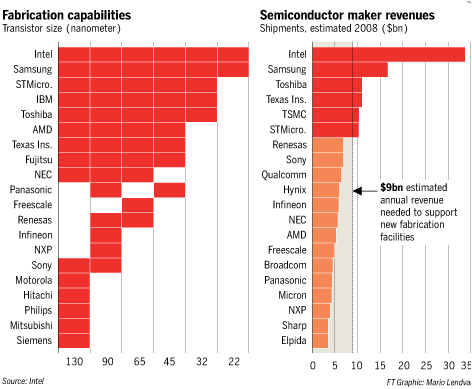
Source: The Financial Times
As the chip making industry become more costly, fewer semiconductor manufacturers will be playing in the sandbox:
“Intel argues that only companies with about $9bn in annual revenues can afford to be in the business of building new fabs, given the costs of building and operating the factories and earning a decent 50 per cent margin. That leaves just Intel, Samsung, Toshiba, Texas Instruments and STMicroelectronics.”
The economy may still be in the doldrums, but the $60 trillion global economy (as measured by Gross Domestic Product) never sleeps – technologies created by Gordon Moore and others continue to propel amazing advancements.
Wade W. Slome, CFA, CFP®
Plan. Invest. Prosper.




 Investing Caffeine
