Posts tagged ‘Trading’
January a Ball After Year-End Fall

Investors were cheerfully dancing last month after the stock market posted its best January in 30 years and the best monthly performance since October 2015 (see chart below). More specifically, the S&P 500 index started the year by catapulting +7.9% higher (the best January since 1987), and the Dow Jones Industrial Average climbed 1,672 points to 25,000, or +7.2%. But over the last few months there has been plenty of heartburn and volatility. The December so-called Santa Claus rally did not occur until a large pre-Christmas pullback. From the September record high, stocks temporarily fell about -20% before the recent jolly +15% post-Christmas rebound.
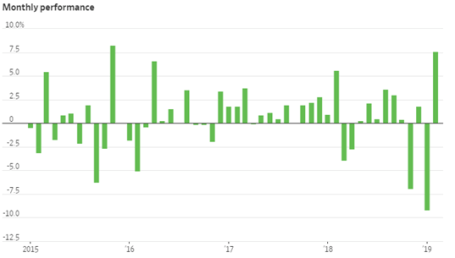
Source: FactSet via The Wall Street Journal
Although investors have been gleefully boogying on the short-run financial dance floor, there have been plenty of issues causing uncomfortable blisters. At the top of the list is China-U.S. trade. The world is eagerly watching the two largest global economic powerhouses as they continue to delicately dance through trade negotiations. Even though neither country has slipped or fallen since the 90-day trade truce, which began on December 1 in Buenos Aires, the stakes remain high. If an agreement is not reached by March 2, tariffs on imported Chinese goods would increase to 25% from 10% on $200 billion worth of Chinese goods, thereby raising prices for U.S. consumers and potentially leading to further retaliatory responses from Beijing.
When it comes to the subjects of intellectual property protection and forced technology transfers of American companies doing business in China, President Xi Jinping has been uncomfortably stepping on President Donald Trump’s toes. Nothing has been formally finalized, however Chinese officials have signaled they are willing to make some structural reforms relating to these thorny issues and have also expressed a willingness to narrow the trade deficit with our country by purchasing more of our exports. Besides procuring more American energy goods, the Chinese have also committed to buy 5,000,000 tons of our country’s soybeans to feed China’s hungry population of 1.4 billion people.
Reaching a trade settlement is important for both countries, especially in light of the slowing Chinese economy (see chart below) and the dissipating stimulus benefits of the 2018 U.S. tax cuts. Slowing growth in China has implications beyond our borders as witnessed by slowing growth in Europe as evidenced by protests we have seen in France and the contraction of German manufacturing (the first time in over four years). Failed Brexit talks of the U.K. potentially leaving the European Union could add fuel to the global slowdown fire if an agreement cannot be reached by the March 29th deadline in a couple months.
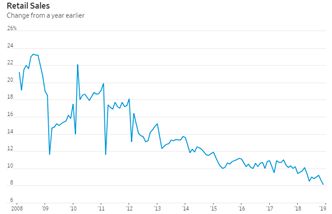
Source: Wind via The Wall Street Journal
While the temporary halt to the longest partial federal government shutdown in history (35 days) has brought some short-term relief to the 800,000 government workers/contractors who did not receive pay, the political standoff over border security may last longer than expected, which may further dampen U.S. economic activity and growth. Whether the hot-button issue of border wall funding is resolved by February 15th will determine if another shutdown is in the cards.
Despite China trade negotiations and the government shutdown deadlock placing a cloud over financial markets, brighter skies have begun to emerge in other areas. First and foremost has been the positive shift in positioning by the Federal Reserve as it relates to monetary policy. Not only has Jay Powell (Fed Chairman) communicated a clear signal of being “patient” on future interest rate target increases, but he has also taken the Fed off of “autopilot” as it relates to shrinking the Fed’s balance sheet – a process that can hinder economic growth. Combined, these shifts in strategy by the Fed have been enthusiastically received by investors, which has been a large contributor to the +15% rebound in stock prices since the December lows. Thanks to this change in stance, the inverted yield curve bogeyman that typically precedes post-World War II recessions has been held at bay as evidenced by the steepening yield curve (see chart below).
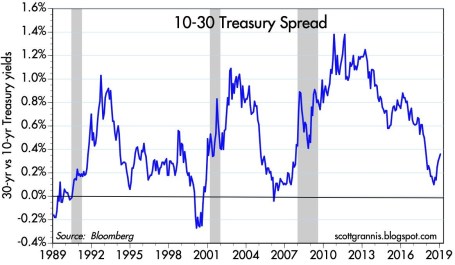
Source: Calafia Beach Pundit
Other areas of strength include the recent employment data, which showed 304,000 jobs added in January, the 100th consecutive month of increased employment. Fears of an imminent recession that penetrated psyches in the fourth quarter have abated significantly in January in part because of the notable strength seen in 4th quarter corporate profits, which so far have increased by +12% from last year, according to FactSet. The strength and rebound in overall commodity prices, including oil, seem to indicate any potential looming recession is likely further out in time than emotionally feared.
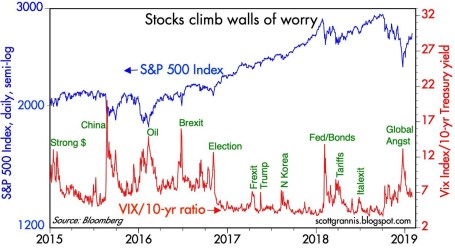
Source: Calafia Beach Pundit
As the chart above shows, over the last four years, spikes in fear (red line) have represented beneficial buying opportunities of stocks (blue line). The pace of gains in January is just as unsustainable as the pace of fourth-quarter losses were in stock prices. Uncertainties may remain on trade, shutdowns, geopolitics, and other issues but don’t throw away your investing dance shoes quite yet…the ball and music experienced last month could continue for a longer than expected period of time.

Wade W. Slome, CFA, CFP®
Plan. Invest. Prosper.
This article is an excerpt from a previously released Sidoxia Capital Management complimentary newsletter (February 1, 2018). Subscribe on the right side of the page for the complete text.
DISCLOSURE: Sidoxia Capital Management (SCM) and some of its clients hold positions and certain exchange traded funds (ETFs), but at the time of publishing had no direct position in any other security referenced in this article. No information accessed through the Investing Caffeine (IC) website constitutes investment, financial, legal, tax or other advice nor is to be relied on in making an investment or other decision. Please read disclosure language on IC Contact page.
Searching for the Growth Stock Holy Grail

Remember Research in Motion (now Blackberry Limited – BBRY)? What about Krispy Kreme Doughnuts? How about Crocs (CROX)? Or maybe even Webvan, the online grocery delivery company that went bankrupt during the bursting of the dot-com bubble? These are all examples of once heralded growth companies that lost their mojo along their growth expansion ways.
Not every stock can grow to the $80+ billion market cap stratosphere like Apple Inc. (AAPL), Starbucks Corp. (SBUX), and Wal-Mart Stores (WMT), so finding companies with the right mixture of growth characteristics can be challenging. Objective stock market observers can disagree on the ingredients of a successful growth stock recipe, but generally speaking, the real explosive appreciation in stock prices come from those companies that can compound earnings growth over longer periods of time.
But how can one discover the Holy Grail of compounding earnings? At Sidoxia Capital Management, there are a handful of key factors we look for in successful growth companies. In the hyper-competitive global marketplace, these are crucial questions we want adequately answered before we invest our clients’ money:
- Does the company sell a product or service that cuts costs?
- Does the company offer a product or service with unique entertainment value?
- Does the company offer a superior product or service compared to its competitors?
Even if a target investment can affirmatively answer two or three of these questions, often the most important question is the following:
- Does the company have a sustainable competitive advantage in providing a product or service?
If the company does not have some type of durable competitive advantage, then some other company can just copy the product or service, and sell it at a lower price. This sadly leads to margin and P/E (Price-Earnings) multiple compression – both negative outcomes.
The aforementioned factors are not the end-all, be-all for successful growth stocks, but rather the minimum price of admission. Even if the previous criteria boxes are sufficiently checked off, the company being researched must still be fairly or attractively priced. For example, it doesn’t take a genius to figure out Apple is a successful company with unique advantages. More specifically, the company has $240 billion in cash, $50 billion in profits, and $215 billion in revenue. The real question becomes, is the stock fairly or attractively priced?
Although Apple appears attractively valued at current prices, in many other instances that is not the case. Often, great companies have been discovered by a large swath of investors, and therefore trade at significant premiums, which increases the risk profile or reduces the upside potential of the investment.
Sucking the Last Puff
If a company’s product or service isn’t superior, cut costs, or entertain at a reasonable/attractive valuation, then investing is like taking the last puff or drag out of a cigarette butt. Some value investors are good at this craft, but often these managers get caught into so-called “value traps” – ask Bill Ackman about Valeant Pharmaceuticals (VRX). Many value investors thought they found a bargain when they bought Valeant shares after it fell -80% in price. The stock subsequently has fallen another -50%…ouch!.
It’s worth noting that growth can come from many different areas. Even mature industries can produce periods of cyclical growth, however identifying cyclical winners is challenging. The art for the investment manager is determining whether growth in a target investment is sustainable. In many instances, companies temporarily benefit from a rising tide that lifts all boats, before the tide goes out and sinks fundamentals down to lower levels.
Growth investing can be a dangerous hobby for short-term traders because the price volatility stemming from ever-changing earnings growth expectations creates excessive trading, taxes, and transaction costs. However, for long-term investors, the great growth manager, T. Rowe Price, summed it up best here:
“The growth stock theory of investing requires patience, but is less stressful than trading, generally has less risk, and reduces brokerage commissions and income taxes.”
Growth investing is both a science and an art, but does not require a degree in rocket science. If you can focus on the important growth criteria, and combine it with a long-term disciplined valuation process, you will be well on your way to discovering the growth stock Holy Grail.

Wade W. Slome, CFA, CFP®
Plan. Invest. Prosper.
DISCLOSURE: Sidoxia Capital Management (SCM) and some of its clients hold positions in AAPL and certain exchange traded funds (ETFs), but at the time of publishing had no direct position in VRX, BBRY, SBUX, WMT, CROX, Krispy Kreme, Webvan, or any other security referenced in this article. No information accessed through the Investing Caffeine (IC) website constitutes investment, financial, legal, tax or other advice nor is to be relied on in making an investment or other decision. Please read disclosure language on IC Contact page.
Technical Analysis – Astrology or Lob Wedge?

Investing comes in many shapes and sizes. And like religion (see Investing Religion article), most investment strategies are built on the essential belief that following certain rules and conventions will eventually lead to profit enlightenment. When it comes to technical analysis (TA), a discipline used with the principal aim of predicting future prices from past patterns, some consider it a necessity for making money in the market. Others, regard the practice of TA as a pseudoscience, much like astrology.
I feel there is a proper place for TA on selective basis, which I will describe later, but for the most part I agree with some of the legendary investors who have chimed in on the subject:
Warren Buffett: “I realized technical analysis didn’t work when I turned the charts upside down and didn’t get a different answer.”
Peter Lynch: “Charts are great for predicting the past.”
Technical Analysis Linguistics
Fundamental analysis, the antithesis of technical analysis, strives to predict future price direction by analyzing facts and data surrounding a company, industry, and/or economy. It too comes with its own syntax and versions, for example: value, growth, top-down, bottom-up, quantitative, etc.
I do not claim to be a TA expert, however in my many years of investing I have come across a smorgasbord of terms and flavors surrounding the discipline. Describing and explaining the density of material surrounding TA would encompass too large of a scope for this article, but here are some prevalent terms one should come to grips with if you want to become a technical analysis guru:
Technical Analysis Approaches
- Elliot Wave
- Relative strength / Momentum (see Momentum Investing article)
- MACD (Moving Average Convergence / Divergence)
- Fibonacci retracement
- Dow Theory
- Stochastics
- Bollinger bands
Price Patterns
- Head and shoulders
- Double bottom
- Cup and handle
- Channels
- Breakouts
- Pivot points
- Candlesticks
- Resistance/Support
- Dead cat bounce (my personal favorite)
Each of these patterns are supposes to provide insight into the future direction of price. At best, I would say the academic research surrounding the subject is “inconclusive,” and at worst I’d say it’s considered a complete “sham.”
The Lob Wedge

As I’ve stated earlier, I fall in the skeptical camp when it comes to TA, since fundamental analysis is the main engine I use for generating and tracking my investment ideas. For illustrative purposes, you may consider fundamental analysis as my group of drivers and irons. I do, however, utilize selective facets of TA much like I use a lob wedge in golf for a limited number of specific situations (e.g., shots over high trees, downhill lies, and fast greens). When it comes to trading, I do believe there is some value in tracking the relationship of extreme trading volume (high or low), especially when it is coupled with extreme price movement (high or low). The economic laws of supply and demand hold true for stock trades just as they do for guns and butter, and sharp moves in these components can provide insights into the psychological mindset of investors with respect to a security (or broader market). Beyond trading volume, there are a few other indicators that I utilize as part of my trading strategies, but these tactics play a relatively minor role, since most of my core positions are held on a multi-year time horizon.
Overall, there is a stream of wasteful noise, volatility, and misinformation that permeates the financial markets on a daily basis. A major problem with technical analysis is the many false triggered signals, which in many cases lead to excessive trading, transaction costs, and ultimately subpar investment returns. Although I remain a skeptic on the subject of technical analysis and I may not read my horoscope today, I will continue to keep a lob wedge in my golf bag with the hopes of finding new, creative ways of using it to my advantage.
Wade W. Slome, CFA, CFP®
Plan. Invest. Prosper.
DISCLOSURE: Sidoxia Capital Management (SCM) and some of its clients own exchange traded funds and various securities, including BRK.B, but at time of publishing had no direct position in BRK.A or any company mentioned in this article. No information accessed through the Investing Caffeine (IC) website constitutes investment, financial, legal, tax or other advice nor is to be relied on in making an investment or other decision. Please read disclosure language on IC “Contact” page.
Cleaning Out Your Investment Fridge

This article is an excerpt from a previously released Sidoxia Capital Management complimentary newsletter (June 1, 2016). Subscribe on the right side of the page for the complete text.
Summer is quickly approaching, but it’s not too late to do some spring cleaning. This principle not only applies to your cluttered refrigerator with stale foods but also your investment portfolio with moldy investments. In both cases, you want to get rid of the spoiled goods. It’s never fun discovering a science experiment growing in your fridge.
Over the last three months, the stock market has been replenished after a rotten first two months of the year (S&P 500 index was down -5.5% January through February). The +1.5% increase in May added to a +6.6% and +0.3% increase in March and April (respectively), resulting in a three month total advance in stock prices of +8.5%. Not surprisingly, the advance in the stock market is mirroring the recovery we have seen in recent economic data.
After digesting a foul 1st quarter economic Gross Domestic Product (GDP) reading of only +0.8%, activity has been smelling better in the 2nd quarter. A recent wholesome +3.4% increase in April durable goods orders, among other data points, has caused the Atlanta Federal Reserve Bank to raise its 2nd quarter GDP estimate to a healthier +2.9% growth rate (from its prior +2.5% forecast).
Consumer spending, which accounts for roughly 70% of our country’s economic activity, has been on the rise as well. The improving employment picture (5.0% unemployment rate last month) means consumers are increasingly opening their wallets and purses. In addition to spending more on cars, clothing, movies, and vacations, consumers are also doling out a growing portion of their income on housing. Housing developers have cautiously kept a lid on expansion, which has translated into limited supply and higher home prices, as evidenced by the Case-Shiller indices charted below.
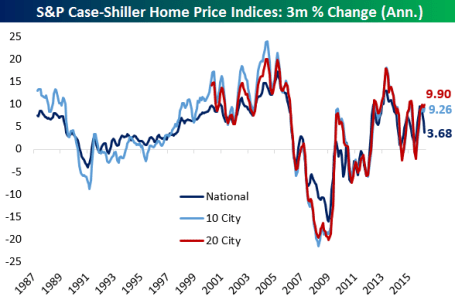
Source: Bespoke
Spoiling the Fun?
While the fridge may look like it’s fully stocked with fresh produce, meat, and dairy, it doesn’t take long for the strawberries to get moldy and the milk to sour. Investor moods can sour quickly too, especially as they fret over the impending “Brexit” (British Exit) referendum on June 23rd when British voters will decide whether they want to leave the European Union. A “yes” exit vote has the potential of roiling the financial markets and causing lots of upset stomachs.
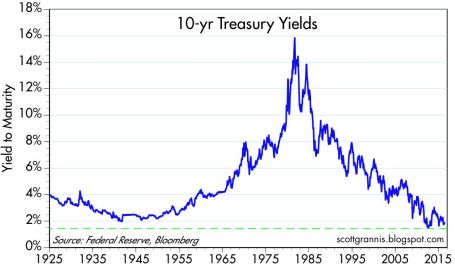
Another financial area to monitor relates to the Federal Reserve’s monetary policy and its decision when to further increase the Federal Funds interest rate target at its June 14th – 15th meeting. With the target currently set at an almost insignificantly small level of 0.25% – 0.50%, it really should not matter whether Chair Janet Yellen decides to increase rates in June, July, September and/or November. Considering interest rates are at/near generational lows (see chart below), a ¼ point or ½ point percentage increase in short-term interest rates should have no meaningfully negative impact on the economy. If your fridge was at record freezing levels, increasing the temperature by a ¼ or ½ degree wouldn’t have a major effect either. If and when short-term interest rates increase by 2.0%, 3.0%, or 4.0% in a relatively short period will be the time to be concerned.
Source: Scott Grannis
Keep a Fresh Financial Plan
As mentioned earlier, your investments can get stale too. Excess cash sitting idly earning next-to-nothing in checking, savings, CDs, or in traditional low-yielding bonds is only going to spoil rapidly to inflation as your savings get eaten away. In the short-run, stock prices will move up and down based on frightening but insignificant headlines. However, in the long-run, the more important issues are determining how you are going to reach your retirement goals and whether you are going to outlive your savings. This mindset requires you to properly assess your time horizon, risk tolerance, income needs, tax situation, estate plan, and other unique circumstances. Like a balanced diet of various food groups in your refrigerator, your key personal financial planning factors are dependent upon you maintaining a properly diversified asset allocation that is periodically rebalanced to meet your long-term financial goals.
Whether you are managing your life savings, or your life-sustaining food supply, it’s always best to act now and not be a couch potato. The consequences of sitting idle and letting your investments spoil away are a lot worse than letting the food in your refrigerator rot away.
Wade W. Slome, CFA, CFP®
Plan. Invest. Prosper.
DISCLOSURE: Sidoxia Capital Management (SCM) and some of its clients hold positions in certain exchange traded funds (ETFs), but at the time of publishing had no direct position in any other security referenced in this article. No information accessed through the Investing Caffeine (IC) website constitutes investment, financial, legal, tax or other advice nor is to be relied on in making an investment or other decision. Please read disclosure language on IC Contact page.
Twinkie Investing – Sweet but Unhealthy

Source: Photobucket
It’s a sad day indeed in our history when the architect of the Twinkies masterpiece cream-filled sponge cakes (Hostess Brands) has been forced to close operations and begin bankruptcy liquidation proceedings. Food snobs may question the nutritional value of the artery-clogging delights, but there is no mistaking the instant pleasure provided to millions of stomachs over the 80+ years of the Twinkies dynasty. Most consumers understand that a healthy version of an organic Twinkie will not be found on the shelves of a local Whole Foods Market (WFM) store anytime soon. The reason people choose to consume these 150-calorie packages of baker bliss is due to the short-term ingestion joy, not the vitamin content (see Nutritional Facts below). Most people agree the sugar high gained from devouring half a box of Twinkies outweighs the long-term nourishing benefits reaped by eating a steamed serving of alfalfa sprouts.

Much like dieting, investing involves the trade-offs between short-term impulses and long-term choices. Unfortunately, the majority of investors choose to react to and consume short-term news stories, very much like the impulse Twinkie gorging, rather than objectively deciphering durable trends that can lead to outsized gains. Day trading and speculating on the headline du jour are often more exciting than investing, but these emotional decisions usually end up being costlier to investors over the long-run. Politically, we face the same challenges as Washington weighs the simple, short-term decisions of kicking the fiscal debt and deficits down the road, versus facing the more demanding, long-term path of dealing with these challenges.
With controversial subjects like the fiscal cliff, entitlement reform, taxation, defense spending, and gay marriage blasting over our airwaves and blanketing newspapers, no wonder individuals are defaulting to reactionary moves. As you can see from the chart below, the desire for a knee jerk investment response has only increased over the last 70 years. The average holding period for equity mutual funds has gone from about 5 years (20% turnover) in the mid 1960s to significantly less than 1 year (> 100% turnover) in the recent decade. Advancements in technology have lowered the damaging costs of transacting, but the increased frequency, coupled with other costs (impact, spread, emotional, etc.), have been shown to be detrimental over time, according to John Bogle at the Vanguard Group.

Source: John Bogle (Vanguard Group)
During volatile periods, like this post-election period, it is always helpful to turn to the advice of sage investors, who have successfully managed through all types of unpredictable periods. Rather than listening to the talking heads on TV and radio, or reading the headline of the day, investors would be better served by following the advice of great long-term investors like these:
“In the short run the market is a voting machine. In the long run it’s a weighing machine.” -Benjamin Graham (Famed value investor)
“Excessive short-termism results in permanent destruction of wealth, or at least permanent transfer of wealth.” -Jack Gray (Grantham, Mayo, Van Otterloo)
“The stock market serves as a relocation center at which money is moved from the active to the patient.” – Warren Buffett (Berkshire Hathaway)
“It was never my thinking that made big money for me. It always was my sitting.” – Jesse Livermore (Famed trader)
“The farther you can lengthen your time horizon in the investment process, the better off you will be.”- David Nelson (Legg Mason)
“The growth stock theory of investing requires patience, but is less stressful than trading, generally has less risk, and reduces brokerage commissions and income taxes.” T. Rowe Price (Famed Growth Investor)
“Time arbitrage just means exploiting the fact that most investors…tend to have very short-term time horizons.” -Bill Miller (Famed value investor)
“Long term is not a popular time-horizon for today’s hedge fund short-term mentality. Every wiggle is interpreted as a new secular trend.” -Don Hays (Hays Advisory – Investor/Strategist)
A legendary growth investor who had a major impact on how I shaped my investment philosophy is Peter Lynch. Mr. Lynch averaged a +29% return per year from 1977-1990. If you would have invested $10,000 in his Magellan fund on the first day he took the helm, you would have earned $280,000 by the day he retired 13 years later. Here’s what he has to say on the topic of long-term investing:
“Your ultimate success or failure will depend on your ability to ignore the worries of the world long enough to allow your investments to succeed.”
“Far more money has been lost by investors preparing for corrections, or trying to anticipate corrections, than has been lost in corrections themselves.”
“My best stocks performed in the 3rd year, 4th year, 5th year, not in the 3rd week or 4th week.”
“The key to making money in stocks is not to get scared out of them.”
“Worrying about the stock market 14 minutes per year is 12 minutes too many.”
It is important to remember that we have been through wars, assassinations, banking crises, currency crises, terrorist attacks, mad-cow disease, swine flu, recessions, and more. Through it all, our country and financial markets most have managed to survive in decent shape. Hostess and its iconic Twinkies brand may be gone for now, but removing these indulgent impulse items from your diet may be as beneficial as eliminating detrimental short-term investing urges.
Wade W. Slome, CFA, CFP®
Plan. Invest. Prosper.
DISCLOSURE: Sidoxia Capital Management (SCM) and some of its clients hold positions in certain exchange traded funds (ETFs), but at the time of publishing SCM had no direct positions in WFM, BRKA/B, LM, TROW or any security referenced in this article. No information accessed through the Investing Caffeine (IC) website constitutes investment, financial, legal, tax or other advice nor is to be relied on in making an investment or other decision. Please read disclosure language on IC Contact page.
Trading Obama, Romney and Extraterrestrials

Source: Photobucket
Investors vote on stocks every day by buying shares in favored positions and selling shares in those out-of-favor. But shouldn’t voting on stocks be different from voting for politicians? Actually, no! Now, politicians can be traded just like traditional stocks or other liquid securities. If you don’t believe me, then you should check out www.Intrade.com. Intrade is an online trading platform that is home to various prediction markets that forecast the probability of outcomes of various real-world events, including who will win the 2012 U.S. Presidential election. Just like investors can trade IBM on the New York Stock Exchange (NYSE) or Apple Inc. (AAPL) on the NASDAQ exchange, so too can individuals trade election shares in Barack Obama (ticker: OBMA) and Mitt Romney (ticker: RMNY) on the Intrade platform (see chart below).

Source: Intrade.com
By definition, the trading mechanics of Intrade involve a resolution of a particular event structured as a binary “Yes” or “No” result. Similar to a sports bet, Intrade eventually declares a winning or losing outcome – but there are no ties. For example, by November 6, 2012, we will know whether Obama’s shares will be trading either at $10 per share, if he becomes re-elected, or $0 per share if he loses to Romney. Just like a stock, traders can go long Obama shares, if they think he will win, or short Obama shares, if they think he will lose. Analogous to stocks, holding periods may vary too. Traders can either hold their position until the event expiration, and realize a gain or loss, or instead traders can lock in shorter-term profits/losses by closing a position before the official outcome ends.
Another great thing about Intrade’s prediction markets is that each event share price can be quickly converted to an outcome probability. So as you can see from Obama’s Intrade chart above, the current $5.28 share price signifies a 52.8% probability of Obama winning the 2012 Presidential election. No need to worry about distracting stock-splits, share offerings, or stock buybacks that could distort the true underlying dynamics of the Intrade event fundamentals.
Bizarre Bets and Over-the-Top Trades
Crazy Super Bowl “prop” bets have been around for ages, and the senseless nature of the bets did not disappoint this year, if you consider the following ridiculous Super Bowl XLVI prop bets:
• Will it take Kelly Clarkson longer or shorter than 1 minute 34 seconds to sing the National Anthem?
• Will Madonna’s hair color be blonde when she begins the Super Bowl Halftime show?
• How many times will model Giselle Bundchen be shown on TV during the game?
• What Color will the Gatorade be that is dumped on the Head Coach of the Winning Super Bowl Team?
I think you get the idea from these examples, and I believe Intrade figured out the quirky benefits as well. Betting on unusual or strange outcomes can be a lucrative endeavor.
Here are just a few of the bizarre and remarkable events you can trade on Intrade:
• NASA to announce discovery of extraterrestrial life before midnight Dec. 31, 2012
• Arctic sea ice area for Sep. 2012 to be less than 4.3 million square kilometers?
• Magnitude 9.0 (or higher) earthquake to occur anywhere before midnight Dec. 31, 2012
• The Dark Knight Rises to break the all-time opening weekend box-office record
• The US debt limit to be raised before midnight Dec. 31, 2012
• Bashar al-Assad to no longer be President of Syria before midnight Dec. 31, 2012
• The US Supreme Court to rule individual mandate unconstitutional before midnight Dec. 31, 2012
• Higgs Boson Particle to be observed on/before Dec. 31, 2013
Rules of the Game
You may be asking yourself, “All this betting/trading sounds like fun, but isn’t this Intrade thing illegal gambling?” If your thought process went in this direction, you are not alone – I asked myself the same question. I’m no attorney, but the apparent loophole for Intrade’s business operation appears to be tied to its foreign incorporation in Ireland. Less apparent is how American law applies to Intrade as referenced in a recent New York Times article that states, “It is unclear whether American law applies to Intrade.”
Although U.S. residents may not be able to trade legally on Intrade, roaming the site may provide some quirky entertainment and provide profound answers to critical questions like, “Do extraterrestrials exist?; How much money will the new Batman movie make at the box office?; And which President are we going to get stuck with for the next four years?” Surfing around on Intrade can be a blast, but if it gets too boring, you can always go back to trading regular stocks.
Wade W. Slome, CFA, CFP®
Plan. Invest. Prosper.
DISCLOSURE: Sidoxia Capital Management (SCM) and Wade Slome have no affiliation with Intrade. SCM and some of its clients own certain exchange traded funds and AAPL, but at the time of publishing SCM had no direct position in NYX, IBM any other security referenced in this article. No information accessed through the Investing Caffeine (IC) website constitutes investment, financial, legal, tax or other advice nor is to be relied on in making an investment or other decision. Please read disclosure language on IC “Contact” page.
Snoozing Your Way to Investment Prosperity

When it comes to investing, do you trade like Jim Cramer on Red Bull – grinding your teeth to every tick or news headline? With the advent of the internet, an unrelenting, real-time avalanche of news items spreads like a furious plague – just ask Anthony Weiner. As fear and greed incessantly permeate the web, and day-trading systems and software are increasingly peddled as profit elixirs, investors are getting itchier and itchier trading fingers. Just consider that investment holding periods have plummeted from approximately 10 years around the time of World War II to 8 months today (see GMO chart below). Certainly, the reduction in trading costs along with the ever-proliferating trend of technology advancements (see Buggy Whip Déjà Vu) is a contributor to the price of trading, but the ADHD-effect of information overload cannot be underestimated (see The Age of Information Overload).

Source: GMO (James Montier)
But fear not, there is a prescription for those addicted, nail-biting day-traders who endlessly pound away on their keyboards with bloody hangnails. The remedy is a healthy dosage of long-term growth investing in quality companies and sustainably expanding trends. I know this is blasphemy in the era of “de-risking” (see It’s All Greek to Me), short-term “risk controls” (i.e. panicking at bottoms and chasing performance), and “benchmark hugging,” but I believe T. Rowe Price had it right:
“The growth stock theory of investing requires patience, but is less stressful than trading, generally has less risk, and reduces brokerage commissions and income taxes.”
This assessment makes intuitive sense to me, but how can one invest for the long-term when there are structural deficits, inflation, decelerating GDP growth, international nuclear catastrophes, escalated gasoline prices, and Greek debt concerns? There are always concerns, and if there none, then you should in fact be concerned (e.g., when investors piled into equities during the “New Economy” right before the bubble burst in 2000). In order to gain perspective, consider what happened at other points in history when our country was involved in war; came out of recession; faced high employment; experienced Middle East supply fears; battled banking problems; handled political scandals; and dealt with rising inflation trends. One comparably bleak period was the 1974 bear market.
Let’s take a look at how that bear market compared to the current environment:
Then (1974) Now (2011)
End of Vietnam War End of Iraq War (battles in Afghanistan and Libya)
Exiting recession Exiting recession
9% Unemployment 9% Unemployment
Arab Oil Embargo Arab Spring and Israeli-Palestinian tensions
Watergate political scandal Anthony Weiner political scandal
Franklin National Bank failure Banking system bailout
Rising inflation trends Rising inflation trends
We can debate the comparability of events and degree of pessimism, but suffice it to say the outlook was not very rosy 37 years ago, nor is it today. History never repeats itself, but it does tend to rhyme. Although attitudes were dour four decades ago, the Dow Jones exploded from 627 in late 1974 to 12,004 today. I’m not calling for another near 20-fold increase in prices over the next 37 years, but a small fraction of that improvement would put a smile on equity investors’ faces. Jim Fullerton, the former chairman of the Capital Group of the American Funds understood pundits’ skepticism during times of opportunity when he wrote the following in November 1974:
“Today there are thoughtful, experienced, respected economists, bankers, investors and businessmen who can give you well-reasoned, logical, documented arguments why this bear market is different; why this time the economic problems are different; why this time things are going to get worse — and hence, why this is not a good time to invest in common stocks, even though they may appear low.”
Rather than getting glued to the TV horror story headline du jour, perhaps investors should take some of the sage advice provided by investment Hall of Famer, Peter Lynch (Lynch averaged a +29% annual return from 1977-1990 while at Fidelity Investments). Rather than try to time the market, he told investors to “assume the market is going nowhere and invest accordingly.” And Lynch offered these additional words of wisdom to the many anxious investors who fret about macroeconomics and timing corrections:
• “It’s lovely to know when there’s recession. I don’t remember anybody predicting 1982 we’re going to have 14 percent inflation, 12 percent unemployment, a 20 percent prime rate, you know, the worst recession since the Depression. I don’t remember any of that being predicted. It just happened. It was there. It was ugly. And I don’t remember anybody telling me about it. So I don’t worry about any of that stuff. I’ve always said if you spend 13 minutes a year on economics, you’ve wasted 10 minutes.”
• “Far more money has been lost by investors preparing for corrections, or trying to anticipate corrections, than has been lost in corrections themselves.”
• “Whatever method you use to pick stocks or stock mutual funds, your ultimate success or failure will depend on your ability to ignore the worries of the world long enough to allow your investments to succeed.”
Real money is not made by following the crowd. Real money is made by buying quality companies and securities at attractive prices. The prescription to generating above-average profits is finding those quality market leaders (or sustainable trends) that can compound earnings growth for multiple years, not chasing every up-tick and panicking out of every down-tick. Following these doctor’s orders will lead to a strong assured mind and a healthy financial portfolio – key factors allowing you to peacefully snooze to investment prosperity.
Wade W. Slome, CFA, CFP®
Plan. Invest. Prosper.
DISCLOSURE: Performance data from Morningstar.com. Sidoxia Capital Management (SCM) and some of its clients own certain exchange traded funds, but at the time of publishing SCM had no direct position in TROW, or any other security referenced in this article. No information accessed through the Investing Caffeine (IC) website constitutes investment, financial, legal, tax or other advice nor is to be relied on in making an investment or other decision. Please read disclosure language on IC “Contact” page.
Reasoning with Investment Confusion

Some things never change, and in the world of investing many of the same principles instituted a century ago are just as important today. So while we are dealing with wars, military conflicts, civil unrest, and natural disasters, today’s process of filtering and discounting all these events into stock prices is very similar to the process that George Selden describes in his 1912 book, “Psychology of the Stock Market.”
Snub the Public
Investing in stocks is nowhere close to a risk-free endeavor, and 2008-2009 was a harsh reminder of that fact. Since a large part of the stock market is based on emotions and public opinion, stock prices can swing wildly. Public opinion may explain why the market is peaking or troughing, but Selden highlights the importance of the silent millionaires (today’s billionaires and institutional investors), and that the true measurement of the stock market is dollars (not opinions of the masses):
“Public opinion in a speculative market is measured in dollars, not in population. One man controlling one million dollars has double the weight of five hundred men with one thousand dollars each. Dollars are the horsepower of the markets–the mere number of men does not signify.”
When the overwhelming consensus of participants is bullish, by definition, the small inexperienced investors and speculators are supplied stock from someone else – the silent, wealthy millionaires.
The newspaper headlines that we get bombarded with on a daily basis are a mirror reflection of the general public’s attitudes and when the euphoria or despondency reaches extreme levels, these points in time have been shown to correlate with market tops and bottoms (see Back to the Future Magazine Covers).
In the short-run, professional traders understand this dynamic and will often take a contrarian approach to news flow. Or as Seldon explains:
“A market which repeatedly refuses to respond to good news after a considerable advance is likelely to be ‘full of stocks.’ Likewise a market which will not go down on bad news is usually ‘bare of stock.’”
This contrarian dynamic in the market makes it virtually impossible for the average investor to trade the market based on the news flow of headlines and commentator. Before the advent of the internet, 98 years ago, Selden prophetically noted that the increasing difficulty of responding to sentiment and tracking market information:
“Public opinion is becoming more volatile and changeable by the year, owing to the quicker spread of information and the rapid multiplication of the reading public.”
Following what the so-called pundits are saying is fruitless, or as Gary Helms says, “If anybody really knew, they wouldn’t tell you.”
Selden’s Sage Advice
If trading was difficult in 1912, it must be more challenging today. Selden’s advice is fairly straightforward:
“Stick to common sense. Maintain a balanced, receptive mind and avoid abstruse deductions…After a prolonged advance, do not call inverted reasoning to your aid in order to prove that prices are going still higher; likewise after a big break do not let your bearish deductions become too complicated.”
The brain is a complex organ, but we humans are limited in the amount and difficulty of information we can assimilate.
“When it comes to so complicated a matter as the price of stocks, our haziness increases in proportion to the difficulty of the subject and our ignorance of it.”
The mental somersault that investors continually manage is due to the practice of “discounting.” Discounting is a process that adjusts today’s price based on future expected news. Handicapping sports “spreads” involves a very similar methodology as discounting stock prices (read What Happens in Vegas). But not all events can be discounted, for instance the recent earthquake and tsunami in Japan. When certain factors are over-discounted or under-discounted, these are the situations to profit from on a purchase or shorting basis.
The Dow Jones Industrial Average traded below a value of 100 versus more than 12,000 today, but over that period some things never change, like the emotional and mental aspects of investing. George Selden makes this point clear in his century old writings – it’s better to focus on the future rather than fall prey to the game of mental somersault we call the stock market.
Wade W. Slome, CFA, CFP®
Plan. Invest. Prosper.
DISCLOSURE: Sidoxia Capital Management (SCM) and some of its clients own certain exchange traded funds, but at the time of publishing SCM had no direct position in any other security referenced in this article. No information accessed through the Investing Caffeine (IC) website constitutes investment, financial, legal, tax or other advice nor is to be relied on in making an investment or other decision. Please read disclosure language on IC “Contact” page.
New Year’s Investing Resolutions

As we exit 2010 and enter 2011, many people go through the annual ritual of making personal New Year’s resolutions. Here is a list of go-to resolutions if you haven’t made one, or are having trouble coming up with one.
1) Lose weight
2) Spend More Time with Family & Friends
3) Quit Smoking
4) Quit Drinking
5) Enjoy Life More
6) Save Money & Get Out of Debt
7) Learn Something New
8) Help Others
9) Get Organized
10) Travel More
I have a few on the list above that I would like to work on, but when it comes to investing, there are a few other resolutions I am looking to make or maintain in 2011:
1) Don’t be a Hog. The last few years have produced excellent returns, but we all know that pigs get fat, and hogs get slaughtered. Cashing the register and banking some of my gains can be frustrating when positions charge higher, but sticking to a disciplined approach pays off handsomely in the long-run and helps navigate through the volatile times.
2) Follow Crash Litmus Test. Only buy what you would confidently purchase at lower prices. Sure, company or industry fundamentals can change over time, but for the vast majority of the time, companies and industries do not undergo paradigm shifts. Even though there are a 1,001 bombs that get launched daily, explaining why the world is coming to an end, I do my best to block out the useless noise and stick to the numbers and facts.
3) Remove Name Creep. It’s easy to fall in love with every new stock that walks by, but limiting the number requires a conviction discipline that pays off in the long run. Academic research and practical experience dictate diversification can be achieved without spreading yourself too thin. As Warren Buffett says, “I prefer to keep all my eggs in one basket and watch that basket closely.”
4) Tirelessly Turn Stones. I love my portfolio right now, but I know there are unique opportunities out there that can improve my results, if I take the time and make the effort.
5. Don’t Rush Into Tips. I’ve purchased or shorted securities recommended by respected investors, but it is important to do your own homework first. Even if these ideas work in the short-run, tips usually fall into loose hands and get punted at the worst times. Perform adequate due diligence to strengthen the roots of your thesis for volatile times.
6. Don’t Get Drunk on Story Stocks. There is never a shortage of great ideas, but many of them carry hefty price tags and have high expectations baked into future earnings growth estimates. Even if great stories exist in abundance, there is a shortage of great managers that can profit from great ideas. Associated high prices can however quickly turn a great story into a sad story – once excessively high expectations are not met, prices eventually will collapse.
7. Build Contingency Plan for Overconfidence. It’s important to have an exit strategy or contingency plan in place if things do not play out as planned. Overconfidence can be the pitfall for many investors, and this is not surprising when factoring in how highly people generally feel about themselves. Most believe they are better than average drivers, parents, and have superior intuition. This same overconfidence may not harm you in the real world, but in the financial markets, overconfidence can result in a woodshed beating. Confidence will not kill your portfolio, but arrogant confidence will.
8. Stick to Knitting. We all have our strengths and weaknesses. I do my best to stay away from my blind spots. As legendary baseball player Ted Williams discussed in his book The Science of Hitting, players are much better off by patiently waiting for the fat pitch in the sweet spot of the strike zone before swinging. Finding your sweet spot and not venturing out of your circle of competence is just as important in the investing world as it is in baseball hitting.
9. Trade Less. Trading is fun and exciting, but paying commissions on top of bid-ask spreads, impact costs, and other fees removes some of the enjoyment. Trading is a necessary evil to make profits, but requires the trader to be right twice – once on the sale, and another time on the purchase. Even if you are right on both sides of the trade, chances are the fees, taxes, commissions, and impact costs will remove most if not all of the profits.
10. Learn from Mistakes. Unfortunately, 2011 will be another year that I will not remain mistake-free. Conveniently forgetting investment mistakes is a great rationalization mechanism, but forever sweeping blunders under the rug without learning from them will not make you a better investor.
If you are able to set aside some of those Bonbons and pay off those credit card balances, then maybe you can join me and take on an investing resolution or two. Don’t worry, like all resolutions, you always have the option of making the resolution without following through!
Wade W. Slome, CFA, CFP®
Plan. Invest. Prosper.
DISCLOSURE: Sidoxia Capital Management (SCM) and some of its clients own certain exchange traded funds, but at the time of publishing SCM had no direct position in any other security referenced in this article. No information accessed through the Investing Caffeine (IC) website constitutes investment, financial, legal, tax or other advice nor is to be relied on in making an investment or other decision. Please read disclosure language on IC “Contact” page.
Sentiment Indicators: Reading the Tea Leaves

Market commentators and TV pundits are constantly debating whether the market is overbought or oversold. Quantitative measures, often based on valuation measures, are used to support either case. But the debate doesn’t stop there. As a backup, reading the emotional tea leaves of investor attitudes is relied upon as a fortune telling stock market ritual (see alsoTechnical Analysis article). Generally these tools are used on a contrarian basis when deciding about purchase or sale timing. The train of thought follows excessive optimism is tied to being fully invested, therefore the belief is only one future direction left…down. The thought process is also believed to work in reverse.
Actions Louder Than Words
When it comes to investing, I believe actions speak louder than words. For example, words answered in a subjective survey mean much less to me in gauging optimism or pessimism than what investors are really doing with their cool, hard cash. Asset flow data indicates where money is in fact going. Currently the vast majority of money is going into bonds, meaning the public hates stocks. That’s fine, because without pessimism, there would be fewer opportunities.
Most sentiment indicators are an unscientific cobbling of mood surveys designed to check the pulse of investors. How is the data used? As mentioned above, the sentiment indicators are commonly used as a contrarian tool…meaning: sell the market when the mood is hot and buy the market when it is cold.
Here are some of the more popular sentiment indicators:
1) Sentiment Surveys (AAII/NAAIM/Advisors): Each measures different bullish/bearish opinions regarding the stock market.
2) CBOE Volatility Index (VIX): The “fear gauge” developed using implied option volatility (read also VIX article).
3) Breadth Indicators (including Advanced-Decline and High-Low Ratios): Measures the number of up stocks vs. down stocks. Used as measurement device to identify extreme points in a market cycle.
4) NYSE Bullish Percentage: Calculates the percentage of bullish stock price patterns and used as a contrarian indicator.
5) NYSE 50-Day and 200-Day Moving Average: Another technical price indicator that is used to determine overbought and oversold price conditions.
6) Put/Call Ratio: The number of puts purchased relative to calls is used by some to measure the relative optimism/pessimism of investors.
7) Volume Spikes: Optimistic or pessimistic traders will transact more shares, therefore sentiment can be gauged by tracking volume metrics versus historical averages.
Sentiment Shortcomings
From a ten thousand foot level, the contrarian premise of sentiment indicators makes sense, if you believe as Warren Buffett does that it is beneficial to buy fear and sell greed. However, many of these indicators are more akin to reading tea leaves, than utilizing a scientific tool. Investors enjoy black and white simplicity, but regrettably the world and the stock market come in many shades of gray. Even if you believe mood can be accurately measured, that doesn’t account for the ever-changing state of human temperament. For instance, in a restaurant setting, my wife will change her menu choice four times before the waiter/waitress takes her order. Investor sentiment can be just as fickle depending on the Dubai, Greece, Swine Flu, or foreclosure headline du jour.
Other major problems with these indicators are time horizon and degree of imbalance. Yeah, an index or stock may be oversold, but by how much and over what timeframe? Perhaps a security is oversold on an intraday chart, but dramatically overbought on a monthly basis? Then what?
The sentiment indicators can also become distorted by a changing survey population. Average investors have fled the equity markets and have followed the pied piper Bill Gross to fixed income nirvana. What we have left are a lot of unstable high frequency traders who often change opinions in a matter of seconds. These loose hands are likely to warp the sentiment indicator results.
Strange Breed
Investors are strange and unique animals that continually react to economic noise and emotional headlines in the financial markets. Despite the infinitely complex world we live in, people and investors use everything available at their disposal in an attempt to make sense of our endlessly random financial markets. One day interest rate declines are said to be the cause of market declines because of interest rate concerns. The next day, interest rate declines due to “quantitative easing” comments by Federal Reserve Chairman Ben Bernanke are attributed to the rise in stock prices. So, which one is it? Are rate declines positive or negative for the market?
On a daily basis, the media outlets are arrogant enough to act like they have all the answers to any price movement, rather than chalking up the true reason to random market volatility, sensationalistic noise, or simply more sellers than buyers. Virtually any news event will be handicapped for its market impact. If Ben Bernanke farts, people want to know what he ate and what impact it will have on Fed policy.
Sentiment indicators are some of the many tools used by professionals and non-professionals alike. While these indicators pose some usefulness, overreliance on reading these sentiment tea leaves could prove hazardous to your fortune telling future.
Wade W. Slome, CFA, CFP®
Plan. Invest. Prosper.
DISCLOSURE: Sidoxia Capital Management (SCM) and some of its clients own certain exchange traded funds, but at the time of publishing SCM had no direct position in any other security referenced in this article. No information accessed through the Investing Caffeine (IC) website constitutes investment, financial, legal, tax or other advice nor is to be relied on in making an investment or other decision. Please read disclosure language on IC “Contact” page.




 Investing Caffeine
