Posts tagged ‘Stocks’
Stocks…Bonds on Steroids

With all the spooky headlines in the news today, it’s no wonder everyone is piling into bonds. The Investment Company Institute (ICI), which tracks mutual fund data, showed -88% of the $14 billion in weekly outflows came from equity funds relative to bonds and hybrid securities. With the masses flocking to bonds, it’s no wonder yields are hovering near multi-decade historical lows. Stocks on the other hand are the Rodney Dangerfield (see Doug Kass’s Triple Lindy attempt) of the investment world – they get “no respect.” By flipping stock metrics upside down, we will explore how hated stocks can become the beloved on steroids, if viewed in the proper context.
Davis on Debt Discomfort
Chris Davis, head of the $65 billion in assets at the Davis Funds, believes like I do that navigating the “bubblicious” bond market will be a treacherous task in the coming years. Davis directly states, “The only real bubble in the world is bonds. When you look out over a 10-year period, people are going to get killed.” In the short-run, inflation is not a real worry, but it if you consider the exploding deficits coupled with the exceedingly low interest rates, bond investors are faced with a potential recipe for disaster. Propping up the value of the dollar due to sovereign debt concerns in Greece (and greater Europe) has contributed to lower Treasury rates too. There’s only one direction for interest rates to go, and that’s up. Since the direction of bond prices moves the opposite way of interest rates, mean reversion does not bode well for long-term bond holders.
Earnings Yield: The Winning Formula
Average investors are freaked out about the equity markets and are unknowingly underestimating the risk of bonds. Investors would be in a better frame of mind if they listened to Chris Davis. In comparing stocks and bonds, Davis says, “If people got their statement and looked at the dividend yield and earnings yield, they might do things differently right now. But you have to be able to numb yourself to changes in stock prices, and most people can’t do that.” Humans are emotional creatures and can find this a difficult chore.
What us finance nerds learn through instruction is that a price of a bond can be derived by discounting future interest payments and principle back to today. The same concept applies for dividend paying stocks – the value of a stock can be determined by discounting future dividends back to today.
A favorite metric for stock jocks is the P/E (Price-Earnings) ratio, but what many investors fail to realize is that if this common ratio is flipped over (E/P) then one can arrive at an earnings yield, which is directly comparable to dividend yields (annual dividend per share/price per share) and bond yields (annual interest/bond price).
Earnings are the fuel for future dividends, and dividend yields are a way of comparing stocks with the fixed income yields of bonds. Unlike virtually all bonds, stocks have the ability to increase dividends (the payout) over time – an extremely attractive aspect of stocks. For example, Procter & Gamble (PG) has increased its dividend for 54 consecutive years and Wal-Mart (WMT) 37 years – that assertion cannot be made for bonds.
As stock prices drop, the dividend yields rise – the bond dynamics have been developing in reverse (prices up, yields down). With S&P 500 earnings catapulting upwards +84% in Q1 and the index trading at a very reasonable 13x’s 2010 operating earnings estimates, stocks should be able to outmuscle bonds in the medium to long-term (with or without steroids). There certainly is a spot for bonds in a portfolio, and there are ways to manage interest rate sensitivity (duration), but bonds will have difficulty flexing their biceps in the coming quarters.
Read the full article on Chris Davis’s bond and earnings yield comments
Wade W. Slome, CFA, CFP®
Plan. Invest. Prosper.
*DISCLOSURE: Sidoxia Capital Management (SCM) and some of its clients own certain exchange traded funds and WMT, but at the time of publishing SCM had no direct positions in PG, or any other security referenced in this article. No information accessed through the Investing Caffeine (IC) website constitutes investment, financial, legal, tax or other advice nor is to be relied on in making an investment or other decision. Please read disclosure language on IC “Contact” page.
Digging for iPad Gold with Simplicity

We live in a hyper global competitive world, yet some companies manage to find gold while others unsuccessfully dig for their dreams. What is a major determinant of great companies? Apple Inc. (AAPL), and other companies, may include “simplicity” as a key ingredient. Take the iPad for example. Already the company has successfully exceeded iPad sales target thanks to the shrewd marketing of the simple touch-screen technology. Some call it a glorified iPhone because the iPad uses a very similar interface on a larger scale. Nonetheless, the device is getting rave reviews from the likes of US Today, The Wall Street Journal, The New York Times, Newsweek, and as Stephen Colbert smartly pointed out in his video (below), the iPad even makes salsa to boot. Many estimates point to more than a half million units sold in the first few weeks, making the 2010 estimates of 3-4 million units sold likely too low.

Competition Not a Game Killer
How much more competitive can the personal computer and cell phone markets be? According to the United Nations, we will reach 5 billion subscribers in 2010. With pricing pressure galore, and new Asian competitors popping up all over the place, how can companies grow, let alone make profits? Ever since the revolutionary iPhone was introduced in 2007, rivals have attempted to copy-cat the device. In the meantime, Apple continues to gain market share while they sit on close to $40 billion in cash, not to mention the flood of new cash rolling in the doors ($10+ billion in free cash flow generated in calendar 2009).
Innovation and the Remote Control
One key driver of profitability is innovation, but an elegant solution driven by an out-of-touch engineer with consumer demands will only lead to share losses and headaches. I mean how many times have you pulled your hair out trying to navigate through a 100-button TV remote control or screamed in frustration from attempting to learn a non-Wii videogame?
But Apple is not the only company to find simplicity in its quest for profit domination. In order to be a massive juggernaut like Apple Inc., a company’s product or service must gain mass appeal. A key determinant for mass appeal is simplicity. Beyond Apple, think of other dominant franchises that also operate in massively competitive markets like Wal-Mart Stores (WMT) in retail; Starbucks Corp. (SBUX) in coffee; Google Inc. (GOOG) in internet advertising; Coca Cola Co. (KO) in soda; Netflix Inc. (NFLX) in video rentals, among a host of other category killers. Many of these corporate giants offer products we cannot function or live without. I still find it utterly amazing that my children will never know what life was really like without an internet search on Google or a Caffe Misto Caramel Frappuccino from Starbucks.
All Good Things Come to an End
It’s not clear how much longer these titans of corporate America can thrive. By innovating new products that improve lives in some way, these Dancing Elephants will continue to prosper. But nothing in the stock market is static, so investors should pay attention to several potential derailing factors:
- Valuations: Valuations are extremely important in determining long-run appreciation potential, and chasing winners solely based on momentum (see related article) can lead to problems.
- Market Share Losses: What will be the next computer, cell phone, or e-reader killer? I don’t know right now, but eventually the day will come where these leaders will lose market share to a new kid on the block.
- Rising Costs: Competition is not the only factor in leading to slowing sales and declining profit margins. Inflation either related to labor or other input costs can crimp profits and decay investor appetites.
- Too Big to Succeed: There has been a lot of talk about “too big to fail,” but I strongly believe companies reach a point where they become “too big to succeed.” Either the law of large numbers catches up with these companies making simple math more challenging (think of the supertanker Wal-Mart growing its $400+ billion revenue base), or regulatory scrutiny kicks in (think of Microsoft Corp. [MSFT] and Intel Corp [INTC]).
Size: Peeling More of the Onion
Success can continue for these giants, however at some point “size” becomes a headwind rather than a tailwind. Just as simply as a train can speed down a railway at over 100+miles per hour, under the right conditions the train can derail as well. As Warren Buffett states, when referring to a company’s growth prospects relative to size, “Gravity always wins.”
However, investors should remind themselves that gains can last longer than expected too. Finding “ginormous” winners in many ways is like finding a needle in a haystack. But even if you find the needle in the haystack relatively late in a company’s growth cycle (see Equity Life Cycle story), in many instances there can be a lot of appreciation potential still available. Take Wal-Mart (WMT) for example. If you bought Wal-Mart shares after it rose 10-fold during its first 10 years, you still could have achieved a 60x return over the next 30 years.
Time will tell if Apple will strike additional gold with its iPad introduction, nonetheless Steve Jobs has found an element present in many long-term successful companies…simplicity.
Wade W. Slome, CFA, CFP®
Plan. Invest. Prosper.
*DISCLOSURE: Sidoxia Capital Management (SCM) and some of its clients own certain exchange traded funds and AAPL, WMT, GOOG, but at the time of publishing SCM had no direct positions in MSFT, SBUX, KO, INTC, NFLX, Nintendo or any security referenced in this article. No information accessed through the Investing Caffeine (IC) website constitutes investment, financial, legal, tax or other advice nor is to be relied on in making an investment or other decision. Please read disclosure language on IC “Contact” page.
Sidoxia Introduces “Fusion”

With the quote machines taking a temporary breather, what better time than now to talk about a new product creation from Sidoxia Capital Management – Fusion. For those readers following Investing Caffeine for some time, you likely have an informed understanding of Sidoxia Capital Management’s investment philosophy (www.Sidoxia.com). Well, now Sidoxia has formalized its investment product through the introduction of Fusion, a hybrid product integrating low-cost, tax-efficient investment vehicles and strategies, including individual stocks, individual bonds, equity ETFs (Exchange Traded Funds), and fixed income ETFs. Rather than being boxed into a simplistic life cycle fund, Fusion offers a customized investment vehicle that can meet investors’ wide ranging objectives and constraints. A key differentiating component of Fusion is its inclusion of some of the same stocks and securities employed in the Slome Sidoxia Fund (a hedge fund also managed by Sidoxia Capital Management for accredited investors). The aim of Fusion is to maximize the risk-adjusted returns in the context of a broadly diversified balanced portfolio (including international exposure).
Client Product Process
For those qualified investors, a one-on-one interview is conducted with each separate account investor to determine the objectives and constraints associated with the account. Subsequently, a customized Investment Policy Statement (IPS) is created for each client, effectively creating a blueprint for how the account will be managed. Depending on the risk-tolerance, time horizon, and objectives of the client, an equity allocation will be customized to meet the client’s needs. The balance of the portfolio will be invested in fixed-income, cash/liquid assets, and hybrid securities – including convertible bonds and alternative investments on a more limited basis. Individual security selection is derived from implementing fundamental and quantitative screening tools, leveraging the investment experience of the investment manager (Wade Slome), and the ranking of securities on a risk-adjusted valuation basis. Lower ranked securities are generally used as funding sources for purchases of higher ranked investment candidates.
Buy Discipline
A systematic, disciplined process is performed before the inclusion of any security is finalized into a portfolio. With respect to the selected equity securities, particular emphasis is placed on valuation metrics, including cash flows, earnings growth, dividend yields, price-earnings ratios, and other important fundamental statistics. In regards to equity related exchange traded funds (ETFs), some of the previously mentioned factors will be considered in addition to a top-down view of a funds underlying long-term growth potential. The buy discipline, established for the fixed income allocation of the portfolio, carefully considers dynamics such as yield, duration, maturity, income, inflation-protection, currency risk, and other factors. Compared to other competing domestic-centric products, Fusion has the ability and willingness to invest globally to explore attractive risk-reward investment opportunities abroad.
Portfolio Construction
Within the parameters of the various Fusion product versions (aggressive, conservative, and moderate), each portfolio is constructed with flexibility in meeting the unique objectives and constraints of each account – including any liquidity or income requirements indicated by the client. Every portfolio is constructed from the same menu of underlying investment options, thereby assuring relative consistency across accounts. Allocations across investment selections will vary based upon the Fusion product version selected.
Trading Strategies
Under normal economic circumstances, Fusion invests with a long-term time horizon of three to five years for its equity positions. As a result, factors such as transaction costs, impact costs, opportunity costs, bid-ask spreads, tax consequences, are considered before conducting trades. Regarding fixed income portfolios, the previously mentioned factors along with the underlying yield, duration, and fundamental factors will determine the holding period. Trading frequency may fluctuate, depending on financial market and client-specific circumstances, but generally speaking heightened volatility will lead to additional opportunistic portfolio activity.
Sell Discipline
The Fusion sell discipline is fairly straight forward. If a security reaches a designated price target, provides an inferior risk-adjusted return profile relative to other opportunities, or if the original investment rationale negatively changes, then the investment becomes a sell candidate. If Fusion discovers opportunities with superior investment characteristics, the sell candidates, in addition to cash, will be utilized to fund new purchases.
Product Fee Structure
The annual fee charged for portfolio management services is rendered on a percentage of assets under management basis. As a fee-only investment advisor, inherent incentives are built-in to preserve and grow client account values – a principle not practiced by many commissioned based brokers/advisors. Contact a Sidoxia Capital Management representative by phone (949-258-4322) or e-mail (info@Sidoxia.com) to learn more about Fusion’s fee structure and account minimum threshold.
Wade W. Slome, CFA, CFP®
Plan. Invest. Prosper.
*DISCLOSURE: Sidoxia Capital Management (SCM) and some of its clients own certain exchange traded funds, but at the time of publishing SCM had no direct positions in any security referenced in this article. No information accessed through the Investing Caffeine (IC) website constitutes investment, financial, legal, tax or other advice nor is to be relied on in making an investment or other decision. Please read disclosure language on IC “Contact” page.
Bankruptcy: Where are You on the Capital Structure Totem Pole?
 The media likes to focus in on the microscopic universe of 30 stocks we like to call the Dow Jones Industrial Average, or the “market.” The reality is the Dow is like a drop in the ocean if you consider the global opportunity set across the capital structure. What is the capital structure? Well, you can think of the capital structure like a totem pole. The actual universe of investment opportunities spans everything from Blue Chip dividend paying stocks to illiquid international convertible preferred securities. The selection of the security type will determine where you sit on the capital structure (totem pole), and the location is especially important when the topic shifts to the dreaded word…B-A-N-K-R-U-P-T-C-Y.
Opening the Chapter Book on Bankruptcy
From a security or safety standpoint, the preferred investor location is at the top of the totem pole (capital structure). Why? Because once an entity declares Chapter 7 and begins asset liquidation, the bondholders/creditors at the top of the structure get paid first – whereas the equity holders at the bottom of the pole get paid last (if there are any asset proceeds remaining to be distributed). Here is a general ranking, from top to bottom, of the major security categories along the capital structure (more specialized hybrid security versions can fit in between the listed items):
1) Secured Bonds
2) Unsecured Bonds
3) Convertible Bonds
4) Preferred Stocks
5) Common Stock/Equity
Bankruptcy is a legal process that provides relief to many individuals who can no longer pay all of their debts. A potential outcome in the bankruptcy process is “debtor discharge,” which wipes away some or all of an individual’s debt. Here is a brief synopsis of the bankruptcy flavors:
Chapter 11: Designed primarily for businesses, Chapter 11 bankruptcy law allows financially distressed businesses to remain in business as debt payments are reorganized under the supervision of the courts. Technically, individuals can also choose to file for Chapter 11 bankruptcy, however practically speaking, individuals generally choose other paths. High profile examples of Chapter 11 bankruptcies include Lehman Brothers, Enron Corp., WorldCom Inc., General Motors Co., and Chrysler Group.
Chapter 7 & 13: These segments of the bankruptcy code are principally constructed for individuals. A means test reviewing an individual’s financial situation will determine which plan is most feasible. Here are brief descriptions:
- Chapter 7 is often referred to as the liquidating bankruptcy. This bankruptcy strategy is often used by individuals to save assets like a home and/or car. Although non-exempt assets will be liquidated by the owner to pay off creditors, many of a debtors assets are categorized as exempt – meaning the owner will not be forced to sell assets and creditors are held at bay.
- Chapter 13 allows individuals to retain assets by following a court sanctioned payment plan. Typically debt payments are made by the individual over years, and as long as payments remain current, the owner can retain assets.
More to Gain, More to Lose at the Bottom
Being at the bottom of the capital structure totem pole (owning stocks) involves relatively more price volatility. If you combine the wild swings with the fact that about 50% of households own stock in some shape or form (Edward N. Wolff at New York University – 2009), then you create a recipe of intrigue. Theoretically, stocks have unlimited profit potential (not the case for most bonds). The media loves to report on the daily fortunes won and lost on the global stock exchanges, in addition to following the bigwig billionaires.
More Boredom, Less to Lose at the Top
Being at the top of the capital structure totem pole (owning bonds) comes with more security (less volatility), but also more boredom (less profit potential). That’s not to say healthy returns cannot be achieved in the bond market. We saw firsthand, during the financial crisis, how bankruptcy fears rocked certain areas of the bond market (e.g., high yield bonds), creating extraordinary investment opportunities. With liquidity returning to the market, and signs of economic stability coming back, investors will need to climb much higher up the tree to grab the hanging fruit.
Although there is plenty of room for optimism given certain macroeconomic and corporate indicators, the global economy is certainly not out of the woods. Business bankruptcies remain elevated, just as investors are piling into the perceived safe arms of corporate bonds. Interest rates, along with industry and company-specific factors will obviously impact the price performance of corporate bonds. If the economy hits choppy waters again, it behooves investors in higher yielding bonds to get a better understanding of where they sit on the capital structure totem pole. If not, those bond investors will slide down the capital structure, left commiserating about losses with their neighboring risk-loving stockholders.
Wade W. Slome, CFA, CFP®
Plan. Invest. Prosper.
*DISCLOSURE: Sidoxia Capital Management (SCM) and some of its clients own certain exchange traded funds, but at the time of publishing had no direct positions in Lehman Brothers, Enron Corp., WorldCom Inc., General Motors Co., and Chrysler Group or any security mentioned in this article. No information accessed through the Investing Caffeine (IC) website constitutes investment, financial, legal, tax or other advice nor is to be relied on in making an investment or other decision. Please read disclosure language on IC “Contact” page.
Inside the Brain of an Investing Genius

Photo Source: Boston.com
Those readers who have frequented my Investing Caffeine site are familiar with the numerous profiles on professional investors of both current and prior periods (See Profiles). Many of the individuals described have a tremendous track record of success, while others have a tremendous ability of making outrageous forecasts. I have covered both. Regardless, much can be learned from the successes and failures by mirroring the behavior of the greats – like modeling your golf swing after Tiger Woods (O.K., since Tiger is out of favor right now, let’s say Phil Mickelson). My investment swing borrows techniques and tips from many great investors, but Peter Lynch (ex-Fidelity fund manager), probably more than any icon, has had the most influence on my investing philosophy and career as any investor. His breadth of knowledge and versatility across styles has allowed him to compile a record that few, if any, could match – outside perhaps the great Warren Buffett.
Consider that Lynch’s Magellan fund averaged +29% per year from 1977 – 1990 (almost doubling the return of the S&P 500 index for that period). In 1977, the obscure Magellan Fund started with about $20 million, and by his retirement the fund grew to approximately $14 billion (700x’s larger). Cynics believed that Magellan was too big to adequately perform at $1, $2, $3, $5 and then $10 billion, but Lynch ultimately silenced the critics. Despite the fund’s gargantuan size, over the final five years of Lynch’s tenure, Magellan outperformed 99.5% of all other funds, according to Barron’s. How did Magellan investors fare in the period under Lynch’s watch? A $10,000 investment initiated when he took the helm would have grown to roughly $280,000 (+2,700%) by the day he retired. Not too shabby.
Background
Lynch graduated from Boston College in 1965 and earned a Master of Business Administration from the Wharton School of the University of Pennsylvania in 1968. Like the previously mentioned Warren Buffett, Peter Lynch shared his knowledge with the investing masses through his writings, including his two seminal books One Up on Wall Street and Beating the Street. Subsequently, Lynch authored Learn to Earn, a book targeted at younger, novice investors. Regardless, the ideas and lessons from his writings, including contributing author to Worth magazine, are still transferrable to investors across a broad spectrum of skill levels, even today.
The Lessons of Lynch
Although Lynch has left me with enough financially rich content to write a full-blown textbook, I will limit the meat of this article to lessons and quotations coming directly from the horse’s mouth. Here is a selective list of gems Lynch has shared with investors over the years:
Buy within Your Comfort Zone: Lynch simply urges investors to “Buy what you know.” In similar fashion to Warren Buffett, who stuck to investing in stocks within his “circle of competence,” Lynch focused on investments he understood or on industries he felt he had an edge over others. Perhaps if investors would have heeded this advice, the leveraged, toxic derivative debacle occurring over previous years could have been avoided.
Do Your Homework: Building the conviction to ride through equity market volatility requires rigorous homework. Lynch adds, “A company does not tell you to buy it, there is always something to worry about. There are always respected investors that say you are wrong. You have to know the story better than they do, and have faith in what you know.”
Price Follows Earnings: Investing is often unnecessarily made complicated. Lynch fundamentally believes stock prices will follow the long-term trajectory of earnings growth. He makes the point that “People may bet on hourly wiggles of the market, but it’s the earnings that waggle the wiggle long term.” In a publicly attended group meeting, Michael Dell, CEO of Dell Inc. (DELL), asked Peter Lynch about the direction of Dell’s future stock price. Lynch’s answer: “If your earnings are higher in 5 years, your stock will be higher.” Maybe Dell’s price decline over the last five years can be attributed to its earnings decline over the same period? It’s no surprise that Hewlett-Packard’s dramatic stock price outperformance (relative to DELL) has something to do with the more than doubling of HP’s earnings over the same time frame.
Valuation & Price Declines: “People Concentrate too much on the P (Price), but the E (Earnings) really makes the difference.” In a nutshell, Lynch believes valuation metrics play an important role, but long-term earnings growth will have a larger impact on future stock price appreciation.
Two Key Stock Questions: 1) “Is the stock still attractively priced relative to earnings?” and 2) “What is happening in the company to make the earnings go up?” Improving fundamentals at an attractive price are key components to Lynch’s investing strategy.
Lynch on Buffett: Lynch was given an opportunity to write the foreword in Buffett’s biography, The Warren Buffett Way. Lynch did not believe in “pulling out flowers and watering the weeds,” or in other words, selling winners and buying losers. In highlighting this weed-flower concept, Lynch said this about Buffett: “He purchased over $1 billion of Coca-Cola in 1988 and 1989 after the stock had risen over fivefold the prior six years and over five-hundredfold the previous sixty years. He made four times his money in three years and plans to make a lot more the next five, ten, and twenty years with Coke.” Hammering home the idea that a few good stocks a decade can make an investment career, Lynch had this to say about Buffett: “Warren states that twelve investments decisions in his forty year career have made all the difference.”
You Don’t Need Perfect Batting Average: In order to significantly outperform the market, investors need not generate near perfect results. According to Lynch, “If you’re terrific in this business, you’re right six times out of 10 – I’ve had stocks go from $11 to 7 cents (American Intl Airways).” Here is one recipe Lynch shares with others on how to beat the market: “All you have to do really is find the best hundred stocks in the S&P 500 and find another few hundred outside the S&P 500 to beat the market.”
The Critical Element of Patience: With the explosion of information, expansion of the internet age, and the reduction of trading costs has come the itchy trading finger. This hasty investment principle runs contrary to Lynch’s core beliefs. Here’s what he had to say regarding the importance of a steady investment hand:
- “In my investing career, the best gains usually have come in the third or fourth year, not in the third or fourth week or the third or fourth month.”
- “Whatever method you use to pick stocks or stock mutual funds, your ultimate success or failure will depend on your ability to ignore the worries of the world long enough to allow your investments to succeed.”
- “Often, there is no correlation between the success of a company’s operations and the success of its stock over a few months or even a few years. In the long term, there is a 100% correlation between the success of a company and the success of its stock. It pays to be patient, and to own successful companies.”
- “The key to making money in stocks is not to get scared out of them.”
Bear Market Beliefs: “I’m always more depressed by an overpriced market in which many stocks are hitting new highs every day than by a beaten-down market in a recession,” says Lynch. The media responds in exactly the opposite manner – bear markets lead to an inundation of headlines driven by panic-based fear. Lynch shares a similar sentiment to Warren Buffett when it comes to the media holding a glass half full view in bear markets.
Market Worries: Is worrying about market concerns worth the stress? Not according to Lynch. His belief: “I’ve always said if you spend 13 minutes a year on economics, you’ve wasted 10 minutes.” Just this last March, Lynch used history to drive home his views: “We’ve had 11 recessions since World War II and we’ve had a perfect score — 11 recoveries. There are a lot of natural cushions in the economy now that weren’t there in the 1930s. They keep things from getting out of control. We have the Federal Deposit Insurance Corporation [which insures bank deposits]. We have social security. We have pensions. We have two-person, working families. We have unemployment payments. And we have a Federal Reserve with a brain.”
Thoughts on Cyclicals: Lynch divided his portfolio into several buckets, and cyclical stocks occupied one of the buckets. “Cyclicals are like blackjack: stay in the game too long and it’s bound to take all your profit,” Lynch emphasized.
Selling Discipline: The rationale behind Lynch’s selling discipline is straightforward – here are some of his thoughts on the subject:
- “When the fundamentals change, sell your mistakes.”
- “Write down why you own a stock and sell it if the reason isn’t true anymore.”
- “Sell a stock because the company’s fundamentals deteriorate, not because the sky is falling.”
Distilling the genius of an investing legend like Peter Lynch down to a single article is not only a grueling challenge, but it also cannot bring complete justice to the vast accomplishments of this incredible investment legend. Nonetheless, his record should be meticulously studied in hopes of adding jewels of investment knowledge to the repertoires of all investors. If delving into the head of this investing mastermind can provide access to even a fraction of his vast knowledge pool, then we can all benefit by adding a slice of this greatness to our investment portfolios.
Wade W. Slome, CFA, CFP®
Plan. Invest. Prosper.
DISCLOSURE: Sidoxia Capital Management (SCM) and some of its clients own certain exchange traded funds, but at time of publishing had no direct positions in DELL, KO, HPQ or any other security mentioned. No information accessed through the Investing Caffeine (IC) website constitutes investment, financial, legal, tax or other advice nor is to be relied on in making an investment or other decision. Please read disclosure language on IC “Contact” page.
Metrics Mix-Up: Stocks and Real Estate Valuation

When it comes to making money, investors choose from a broad menu of investment categories, ranging all the way from baseball cards and wines to collectible cars and art. Two of the larger and more popular investment categories are stocks and real estate. Unfortunately for those poor souls (such as me) analyzing these two classes of assets, the stock and real estate investor bigwigs have not come together to create an integrated metric system. Much the same way the United States has chosen to go it alone on a proprietary customary unit measurement system with Burma and Liberia – choosing inches and feet over centimeters and meters. On the subject of stock and real estate valuation, investors and industry professionals have been stubbornly defiant in designing unique and cryptic terminology, despite sharing the exact same financial principles.
Who Cares About Real Estate?
Well, apparently everyone. Southern California doesn’t have a monopoly on real estate, but through my practice in Orange County, I find it difficult to not trip over real estate investors on a daily basis. I work in effectively what was “ground zero” of the subprime debacle and the commercial real estate pains continue to ripple through “the OC.”
Ramping up the real estate learning curve reminds me of my high school Spanish class – I understood enough Spanish to work my way through a Taco Bell menu but little else. In order to actually learn Spanish I had to completely immerse myself in the language, even if it meant continually speaking to my classmates in Spanish through my alias (Paco).
Real Estate Foundational Terms
Despite being a relative new resident in the Orange County area, engrossing myself in real estate hasn’t been much of a challenge. Over a brief period, my interactions and conversations taught me my financial degrees and credentials were just as applicable in the realty world as they were in the stock market world. While evaluating real estate valuation techniques, I discovered two new key terms:
1) NOI (Net Operating Income): Unlike stock analysis, which uses “Net Income” as a core driver in determining an asset’s value, real estate relies on NOI. Net operating income is generally derived by calculating income before depreciation and interest expense. In finance, there are many versions of income. I’m sure there are more explanations, but two reasons behind the selection of NOI in real estate valuation over other metrics is due to the following: a) NOI may be used as a proxy for cash flow, which can be integral in many valuation techniques; and b) NOI is “capital structure neutral” if comparing multiple properties. Therefore, NOI allows an investor to compare varying properties on an apples-to-apples basis regardless of whether a property is massively leveraged or debt-free.
2) Cap Rate (Capitalization Rate): This ratio is computed by taking the NOI and dividing it by a property’s initial cost (or value). In stock market language, you can think of a “cap rate” as an inverted P/E (Price – Earnings) ratio – an inverted P/E ratio has also been called the “earnings yield.” Complicating terminology matters is the interchangeable use of income and earnings in the investment world. In the case of the P/E ratio, the denominator generally used is “Net Income.”
A shortcoming to the cap rate ratio, in my view, is the failure to deduct taxes. Although comparability across properties may get muddied, if determining profit availability to investors is the main goal, then I think an adjusted NOI (subtracting taxes) would be a more useful proxy for valuation purposes. Tax benefits associated with REITS (Real Estate Investment Trusts) complicates the metric usage issue further.
The simplistic beauty of marrying NOI and a cap rate is that a crude valuation estimate can be constructed by merely blending these two metrics together. For example, a commercial real estate property generating $500,000 in NOI that applies a 5% cap rate to the property can arrive at a valuation estimate of $10,000,000 ($500,000/.05).
Similarities between Stocks & Real Estate
At the end of the day, the theoretical value of ANY asset can be calculated by taking the projected after-tax cash flows and discounting that stream back into today’s dollars – whether we are talking about a stock, bond, derivative, real estate property, or other asset. Both stock and real estate analysis use readily available income numbers and price ratios to estimate cash flows and valuations. Regrettably, since real estate and equity investors generally play in different leagues, the rules and language are different.
The lingo used for analyzing separate asset classes may be unique, but the math and fundamental examination are the same. The formula for learning real estate is similar to that of Spanish – you need to dive in and immerse yourself into the new language. If you don’t believe me, just ask Paco.
Wade W. Slome, CFA, CFP®
Plan. Invest. Prosper.
DISCLOSURE: Sidoxia Capital Management (SCM) and some of its clients own certain exchange traded funds, but at the time of publishing had no direct positions in YUM or any other security mentioned. No information accessed through the Investing Caffeine (IC) website constitutes investment, financial, legal, tax or other advice nor is to be relied on in making an investment or other decision. Please read disclosure language on IC “Contact” page.
Sports & Investing: Why Strong Earnings Can Hurt Stock Prices

There are many similarities between investing in stocks and handicapping in sports betting. For example, investors (bettors) have opposing views on whether a particular stock (team) will go up or down (win or lose), and determine if the valuation (point spread) is reflective of the proper equilibrium (supply & demand). And just like the stock market, virtually anybody off the street can place a sports bet – assuming one is of legal age and in a legal betting jurisdiction.
Right now investors are poring over data as part of the critical, quarterly earnings ritual. Thus far, roughly 20% of the companies in S&P 500 index have reported their results and 78% of those companies have beaten Wall Street expectations (CNBC). Unfortunately for the bulls, this trend has not been strong enough to push market prices higher in 2010.
So how and why can market prices go down on good news? There are many reasons that short-term price trends can diverge from short-run fundamentals. One major reason for the price-fundamental gap is the following factor: expectations. Just last week, the market had climbed over +70% in a ten month period, before issues surrounding the Massachusetts Senatorial election, President Obama’s banking reform proposals, and Federal Reserve Bank Chairman Ben Bernanke’s re-appointment surfaced. With such a large run-up in the equity markets come loftier expectations for both the economy and individual companies. So when corporate earnings unveiled from companies like Google (GOOG), J.P. Morgan (JPM), and Intel (INTC) outperform relative to forecasts, one explanation for an interim price correction is due to a significant group of investors not being surprised by the robust profit reports. In sports betting lingo, the sports team may have won the game this week, but they did not win by enough points (“cover the spread”).
Some other reasons stock prices move lower on good news:
- Market Direction: Regardless of the underlying trends, if the market is moving lower, in many instances the market dip can overwhelm any positive, stock- specific factors.
- Profit Taking: Many times investors holding a long position will have price targets or levels, if achieved, that will trigger selling whether positive elements are in place or not.
- Interest Rates: Certain valuation techniques (e.g. Discounted Cash Flow and Dividend Discount Model) integrate interest rates into the value calculation. Therefore, a climb in interest rates has the potential of lowering stock prices – even if the dynamics surrounding a particular security are excellent.
- Quality of Earnings: Sometimes producing winning results is not enough (see also Tricks of the Trade article). On occasion, items such as one-time gains, aggressive revenue recognition, and lower than average tax rates assist a company in getting over a profit hurdle. Investors value quality in addition to quantity.
- Outlook: Even if current period results may be strong, on some occasions a company’s outlook regarding future prospects may be worse than expected. A dark or worsening outlook can pressure security prices.
- Politics & Taxes: These factors may prove especially important to the market this year, since this is a mid-term election year. Political and tax policy changes today may have negative impacts on future profits, thereby impacting stock prices.
- Other Exogenous Items: Natural disasters and security attacks are examples of negative shocks that could damage price values, irrespective of fundamentals.
Certainly these previously mentioned issues do not cover the full gamut of explanations for temporary price-fundamental gaps. Moreover, many of these factors could be used in reverse to explain market price increases in the face of weaker than anticipated results.
For those individuals traveling to Las Vegas to place a wager on the NFL Super Bowl, betting on the hot team may not be enough. If expectations are not met and the hot team wins by less than the point spread, don’t be surprised to see a decline in the value of the bet.
Wade W. Slome, CFA, CFP®
Plan. Invest. Prosper.
DISCLOSURE: Sidoxia Capital Management (SCM) and some of its clients own certain exchange traded funds and GOOG, but at the time of publishing had no direct positions in JPM and INTC. No information accessed through the Investing Caffeine (IC) website constitutes investment, financial, legal, tax or other advice nor is to be relied on in making an investment or other decision. Please read disclosure language on IC “Contact” page.
Can the Lost Decade Strike Twice?

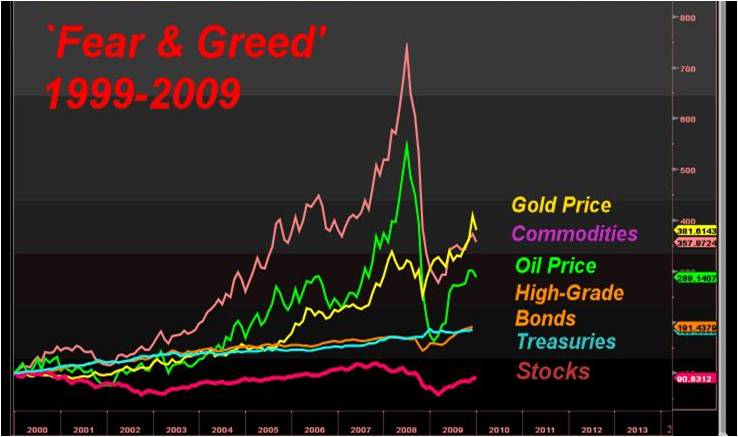
There is an old saying that lightning does not strike twice in the same place. I firmly believe this principle will apply to stock returns over the next decade. Josh Brown, investor and writer for The Reformed Broker highlighted a chart published by Bloomberg showing the 10-year return for various asset classes. Statisticians and market commentators have been quick to point out that stocks, as measured by various benchmarks, have not only underperformed bonds for the last 10 years, but stock performance has actually also been negative for the trailing decade.
Source: Bloomberg via The Reformed Broker
Will this trend persist during the next decade? Will the lost decade in stocks be repeated again, similar to the deflation death spiral experienced by the Japanese? (Read more regarding Japanese market on IC). With the Fed Funds rate at effectively zero, is it possible bonds can pull off a miracle over the next 10 years? I suppose anything is possible, but I seriously doubt it.
Let’s not forget that the P/E ratio (Price-Earnings) pegged by some to be at about 14-15x’s 2010 expected earnings – nestled comfortably within historical bands. Granted, financials and some other sectors were overheated (e.g. certain Consumer industries), but based on next year’s estimates, some industries are already expected to exceed the peak earnings achieved during 2007 (e.g., Technology).
History on Our Side

Source: Crestmont Research. Dated graph over the last century showing stock returns rarely result in negative returns over a rolling 10 year period.
For the trailing decade using December 20, 2009 as an end point, I arrive at a marginally negative return for the S&P 500 index assuming an average dividend yield of 2.5% for the period. Certainly the negative return would be pronounced by any fees, commissions or taxes related to a 10-year buy-and-hold strategy of the broad market index. This chart gets chopped off in 2005, nonetheless history is on our side, lending support that stock returns have a good chance of improving on the results over the last 10 years.
Equity Risk Premium
The bubbles and scandals that have blanketed corporate America over the last 10 years have made the average investor extremely skeptical. What does this mean for the pricing of risk? Well, if you rewind to the year 2000 when technology exceeded 50% of some indexes, and many investors thought technology was a low risk endeavor, there was virtually no equity risk premium discounted into many stock prices. If you fast forward to today, the reverse is occurring. Investors despise market volatility and arguably demand a much higher risk premium for taking on the instability of stocks. This is the exact environment investors should desire – lots of skepticism and money piled into bonds (See IC article on investor queasiness). As Warren Buffett says, “Be fearful when others are greedy and greedy when others are fearful.” I believe the next 10 years will be a time to be greedy.
The analysis above is obviously very narrow in scope, since we are only discussing domestic stock markets. In my client portfolios I advocate a broadly diversified portfolio across asset classes (including bonds), geographies, and styles. However, in managing bonds across portfolios, I am forced to tactfully include strategies such as inflation protection and shorter duration techniques. With the year-end fast approaching, now is a good time to review your financial goals and asset allocation.
Lightning definitely negatively impacted stocks this decade, but betting for lightning to strike twice this decade could very well turn out to be a losing wager.
Wade W. Slome, CFA, CFP®
Plan. Invest. Prosper.
DISCLOSURE: Sidoxia Capital Management (SCM) and some of its clients own certain exchange traded funds, but at time of publishing had no direct positions in BRKA. No information accessed through the Investing Caffeine (IC) website constitutes investment, financial, legal, tax or other advice nor is to be relied on in making an investment or other decision. Please read disclosure language on IC “Contact” page.
Equities Up, But Investors Queasy

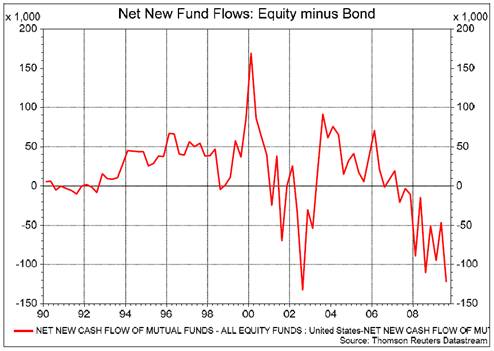
The market may have recovered partially from its illness over the last two years, but investors are still queasy when it comes to equities. The market is up by more than +60% since the March 2009 lows despite the unemployment rate continuing to tick higher, reaching 10.2% in October. Even though equity markets have rebounded, recovering investors have flocked to the drug store with their prescriptions for bonds. Mark Dodson, CFA, from Hays Advisory published a telling chart that highlights the extreme aversion savers have shown towards stocks.
Source: Hays Advisory LLC (Thomson Reuters Datastream)
Dodson adds:
“Net new fund mutual fund flows favor bonds over stocks dramatically, so much so that flows are on the cusp of breaking into record territory, with the previous record occurring back in the doldrums of the 2002 bear market. Given nothing but the chart (above), we would never in a million years guess that the stock market has rallied 50-60% off the March lows. It looks more like what you would see right in the throes of a nasty stock market decline.”
Checking and savings data from the Federal Reserve Bank of Saint Louis further corroborates the mood of the general public as the nausea of the last two years has yet to wear off. The mountains of cash on the sidelines have the potential of fueling further gains under the right conditions (see also Dry Powder Piled High story).
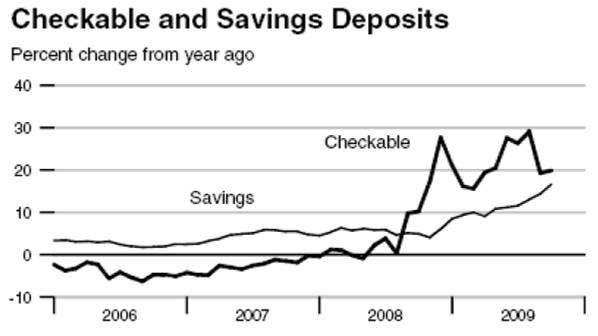
As Dodson notes in the Hays Advisory note, not everything is doom and gloom when it comes to stocks. For one, insider purchases according to the Emergent Financial Gambill Ratio is the highest since the recent bear market came to a halt. This trend is important, because as Peter Lynch emphasizes, “There are many reasons insiders sell shares but only one reason they buy, they feel the price is going up.”
What’s more, the yield curve is the steepest it has been in the last 25 years. This opposing signal should provide comfort to those blue investors that cried through inverted yield curves (T-Bill yields higher than 10-Year Notes) that preceded the recessions of 2000 and 2008.
Equity investors are still feeling ill, but time will tell if a dose of bond selling and a prescription for “cash-into-stocks” will make the queasy patient feel better?
Wade W. Slome, CFA, CFP®
Plan. Invest. Prosper.
DISCLOSURE: No information accessed through the Investing Caffeine (IC) website constitutes investment, financial, legal, tax or other advice nor is to be relied on in making an investment or other decision. Please read disclosure language on IC “Contact” page.
Siegel Digs in Heels on Stocks

Jeremy Siegel, Wharton University Professor and author of Stocks for the Long Run, is defending his long-term thesis that stocks will outperform bonds over the long-run. Mr. Siegel in his latest Financial Times article vigorously defends his optimistic equity belief despite recent questions regarding the validity and accuracy of his long-term data (see my earlier article).
He acknowledges the -3.15% return of U.S. stock performance over the last decade (the fourth worst period since 1871), so what gives him confidence in stocks now? Let’s take a peek on why Siegel is digging in his heels:
Since 1871, the three worst ten-year returns for stocks have ended in the years 1974, 1920, and 1978. These were followed, respectively, by real, after-inflation stock returns of more than 8 per cent, 13 per cent, and 9 per cent over next ten years. In fact for the 13 ten-year periods of negative returns stocks have suffered since 1871, the next ten years gave investors real returns that averaged over 10 per cent per year. This return has far exceeded the average 6.66 per cent real return in all ten years periods, and is twice the return offered by long-term government bonds.
Siegel’s bullish stock stance has also been attacked by Robert Arnott, Chairman of Research Affiliates, when he noted a certain bond strategy bested stocks over the last 40 years. Here’s what Mr. Siegel has to say about stock versus bond performance:
Even with the recent bear market factored in, stocks have always done better than Treasury bonds over every 30-year period since 1871. And over 20-year periods, stocks bested Treasuries in all but about 5 per cent of the cases… In fact, with the recent stock market recovery and bond market decline, stock returns now handily outpace bond returns over the past 30 and 40 years.
If you’re 50, 60, or older, then Siegel’s time horizons may not fit into your plans. Nonetheless, in any game one chooses to play (including the game of money), I, like many, prefer to have the odds stacked in my favor.
In addressing the skeptics, such as Bill Gross who believes the U.S. is entering a “New Normal” phase of sluggish growth, Mr. Siegel notes this commentary even if true does not account for the faster pace of international growth – Siegel goes on to explain that the S&P 500 corporations garner almost 50% of revenues from these faster growing areas outside the U.S.
On the subject of valuation, Mr. Siegel highlights the market is trading at roughly 14x’s 2010 estimates, well below the 18-20x multiples usually associated with low-interest rate periods like these.
In periods of extreme volatility (upwards or downwards), the prevailing beliefs fight reversion to the mean arguments because trend followers believe “this time is different.” Just think of the cab drivers who were buying tech stocks in the late 1990s, or of the neighbor buying rental real estate in 2006. Bill Gross with his “New Normal” doesn’t buy the reversion argument either. Time will tell if we have entered a new challenging era like Mr. Gross sees? Regardless, Professor Siegel will be digging in his heels as he invests in stocks for the long run.
Read the Whole Financial Times Article Written by Professor Siegel
Wade W. Slome, CFA, CFP®
Plan. Invest. Prosper.