Posts tagged ‘Stocks’
Short Interest Coiled Springs

If short interest measures the amount of bearish bets against a particular stock, then what are you supposed to do with that data? The answer really depends on your view regarding the research quality of the bears. If you believe the bears have done excellent homework, then it will pay to pile onto the bearish bandwagon and short the stock. There’s just one problem…it’s virtually impossible to know whether the brains of Warren Buffett are leading the shorting brigade, or the boobs of Snookie from Jersey Shore are driving the negative bets.
The situations that I find especially appealing are the cases in which your research conclusions are extremely bullish, yet a large herd of traders have piled up their pessimistic short positions up to the sky in the belief share prices are going lower. These “crowded shorts” provide a large tailwind of pending buy orders – effectively pouring gasoline on the fire – if you are arrogant enough, like me, to believe your bullish thesis will play out. These “short squeezes” occur often when fundamental momentum lasts longer than the bears expect, or when downbeat expectations do not come to fruition. A classic short squeeze occurred when well-known investor Whitney Tilson recently covered his Netflix Inc. (NFLX) short position (see Whitney the Waffler), pushing a high priced stock even higher. Short interest reached almost 13 million shares in September 2010, and declined to a little more than 11 million shares a few weeks ago (compared to about 53 million shares outstanding). Given the stock’s price action, and Tilson’s response, the short interest has likely declined – at least temporarily.
The Challenge of Timing
Shorting is difficult enough with the theoretical unlimited losses hanging over your head, but timing is of the essence too. Often, a short-seller may be correct on their unconstructive view on a particular stock, but the heat in the kitchen gets too hot for them to stick around for the main course. Shorting stocks in a down market can be just as easy as buying in an up market – making money in your shorts in a rising market is that much more difficult.
Rather than follow the herd of short sellers as a trading strategy, I choose to stick with the credo of legendary investor Benjamin Graham, who stated:
“You’re neither right nor wrong because others agree with you. You’re right because your facts and reasoning are right.”
It’s my strong belief the long-term share price of a stock is driven by the sustainable earnings and cash flows of a company. The direction of price and earnings (cash flow) may diverge in the short-run, but in the long-run the relationship between price and profits converges.
Shorting Criteria
The criteria for shorting a stock are just as varied as the factors used to buy a stock, but these are some of the factors I consider when shorting a stock:
- Weak and/or deteriorating market share positioning.
- Excessive leverage – substandard financial positioning.
- Weak cash flow based quality of earnings.
- Management mis-execution and deteriorating fundamentals.
- Expensive valuations on an absolute and relative basis.
A stock is not required to exhibit all these characteristics simultaneously in order to generate a profitable short position, but the framework works for me.
If long investing is your main focus, then I urge you seek out those heavily shorted stocks that maintain attractive growth opportunities at attractive prices. If you are going to seek out rising stocks, you may as well use the assistance of a coiled spring to get you there.
Click Here to Check Out High Short Interest Stocks
Click Here for NYSE Shorts at WSJ
Wade W. Slome, CFA, CFP®
Plan. Invest. Prosper.
DISCLOSURE: Sidoxia Capital Management (SCM) and some of its clients own certain exchange traded funds and NFLX, but at the time of publishing SCM had no direct position in any other security referenced in this article. No information accessed through the Investing Caffeine (IC) website constitutes investment, financial, legal, tax or other advice nor is to be relied on in making an investment or other decision. Please read disclosure language on IC “Contact” page.
Creating Your Investment Dashboard

Navigating the financial markets can be difficult in this volatile environment we’ve experienced over the last few years, which is why it is more important than ever to have a financial dashboard to ensure you do not drive off a cliff. If investors do not have the time or focus to drive their financial future, then perhaps for the safety of themselves and others, they may consider taking the bus or hiring a chauffeur. For those committed to handling their finances on their own, the road may become rocky, so here are some important factors to monitor on your financial dashboard:
1) Fundamental Direction: Before you decide on an investment destination, it is important to know whether trends are accelerating (speeding up) or deteriorating (slowing down) – see also Forecasting – Trend Analysis.
2) Are You Going the Speed limit? Nobody wants to get a costly speeding ticket, therefore assessing valuation metrics on your dashboard is a beneficiary tool. If you are speeding along the highway at a 100 miles per hour in an expensive stock (e.g., trading at a 50x+ Price/Earnings multiple), then there is little room for error. When traveling that fast you can forget about the price of a speeding ticket, because hitting a pothole at those speeds (valuation) can be much more costly to your portfolio, if you are not careful.
3) Temperature Outside: There’s a huge difference between driving in the icy-cold snow and in 100 degree heat. Each environment has its own challenges. The same principle applies to the financial markets. On occasion, sentiment can become red hot, forcing heightened caution, whereas during other periods, chilling fear can scare everyone else off the roads, leaving clear sailing ahead.
4) Optimal Tire Pressure: Low pressure or bald tires can lead to treacherous driving conditions. A company with healthy cash flow generation relative to its market capitalization can make your investment ride a lot more stable (see also Cash Flow Register). Dividends and share buybacks are generated from healthy and stable cash flows…not earnings.
5) Driver Skill Level: People generally believe they are better than average drivers, however statistics tell a different story. By definition, half of all drivers must be below average. If you are going to put your life’s retirement assets into stocks, you might as well select those companies led by seasoned management teams with proven track records.
Many investors drive blindly without relying on a dashboard. In the investment world, visibility is not very clear. Often, weather conditions in the financial markets become rainy, dark, and/or foggy. If you don’t want your portfolio to crash, it makes sense to build a reliable dashboard to navigate through the hazardous investment road conditions.
Wade W. Slome, CFA, CFP®
Plan. Invest. Prosper.
DISCLOSURE: Sidoxia Capital Management (SCM) and some of its clients own certain exchange traded funds, but at the time of publishing SCM had no direct position in any other security referenced in this article. No information accessed through the Investing Caffeine (IC) website constitutes investment, financial, legal, tax or other advice nor is to be relied on in making an investment or other decision. Please read disclosure language on IC “Contact” page.
New Year’s Investing Resolutions

As we exit 2010 and enter 2011, many people go through the annual ritual of making personal New Year’s resolutions. Here is a list of go-to resolutions if you haven’t made one, or are having trouble coming up with one.
1) Lose weight
2) Spend More Time with Family & Friends
3) Quit Smoking
4) Quit Drinking
5) Enjoy Life More
6) Save Money & Get Out of Debt
7) Learn Something New
8) Help Others
9) Get Organized
10) Travel More
I have a few on the list above that I would like to work on, but when it comes to investing, there are a few other resolutions I am looking to make or maintain in 2011:
1) Don’t be a Hog. The last few years have produced excellent returns, but we all know that pigs get fat, and hogs get slaughtered. Cashing the register and banking some of my gains can be frustrating when positions charge higher, but sticking to a disciplined approach pays off handsomely in the long-run and helps navigate through the volatile times.
2) Follow Crash Litmus Test. Only buy what you would confidently purchase at lower prices. Sure, company or industry fundamentals can change over time, but for the vast majority of the time, companies and industries do not undergo paradigm shifts. Even though there are a 1,001 bombs that get launched daily, explaining why the world is coming to an end, I do my best to block out the useless noise and stick to the numbers and facts.
3) Remove Name Creep. It’s easy to fall in love with every new stock that walks by, but limiting the number requires a conviction discipline that pays off in the long run. Academic research and practical experience dictate diversification can be achieved without spreading yourself too thin. As Warren Buffett says, “I prefer to keep all my eggs in one basket and watch that basket closely.”
4) Tirelessly Turn Stones. I love my portfolio right now, but I know there are unique opportunities out there that can improve my results, if I take the time and make the effort.
5. Don’t Rush Into Tips. I’ve purchased or shorted securities recommended by respected investors, but it is important to do your own homework first. Even if these ideas work in the short-run, tips usually fall into loose hands and get punted at the worst times. Perform adequate due diligence to strengthen the roots of your thesis for volatile times.
6. Don’t Get Drunk on Story Stocks. There is never a shortage of great ideas, but many of them carry hefty price tags and have high expectations baked into future earnings growth estimates. Even if great stories exist in abundance, there is a shortage of great managers that can profit from great ideas. Associated high prices can however quickly turn a great story into a sad story – once excessively high expectations are not met, prices eventually will collapse.
7. Build Contingency Plan for Overconfidence. It’s important to have an exit strategy or contingency plan in place if things do not play out as planned. Overconfidence can be the pitfall for many investors, and this is not surprising when factoring in how highly people generally feel about themselves. Most believe they are better than average drivers, parents, and have superior intuition. This same overconfidence may not harm you in the real world, but in the financial markets, overconfidence can result in a woodshed beating. Confidence will not kill your portfolio, but arrogant confidence will.
8. Stick to Knitting. We all have our strengths and weaknesses. I do my best to stay away from my blind spots. As legendary baseball player Ted Williams discussed in his book The Science of Hitting, players are much better off by patiently waiting for the fat pitch in the sweet spot of the strike zone before swinging. Finding your sweet spot and not venturing out of your circle of competence is just as important in the investing world as it is in baseball hitting.
9. Trade Less. Trading is fun and exciting, but paying commissions on top of bid-ask spreads, impact costs, and other fees removes some of the enjoyment. Trading is a necessary evil to make profits, but requires the trader to be right twice – once on the sale, and another time on the purchase. Even if you are right on both sides of the trade, chances are the fees, taxes, commissions, and impact costs will remove most if not all of the profits.
10. Learn from Mistakes. Unfortunately, 2011 will be another year that I will not remain mistake-free. Conveniently forgetting investment mistakes is a great rationalization mechanism, but forever sweeping blunders under the rug without learning from them will not make you a better investor.
If you are able to set aside some of those Bonbons and pay off those credit card balances, then maybe you can join me and take on an investing resolution or two. Don’t worry, like all resolutions, you always have the option of making the resolution without following through!
Wade W. Slome, CFA, CFP®
Plan. Invest. Prosper.
DISCLOSURE: Sidoxia Capital Management (SCM) and some of its clients own certain exchange traded funds, but at the time of publishing SCM had no direct position in any other security referenced in this article. No information accessed through the Investing Caffeine (IC) website constitutes investment, financial, legal, tax or other advice nor is to be relied on in making an investment or other decision. Please read disclosure language on IC “Contact” page.
The Art of Weather Forecasting and Investing

Source: Photobucket
I’ve lived across the country and traveled around the world and have experienced everything from triple-digit desert heat to sub-zero wind chill. The financial markets experience the same variability over time.
Forecasting the weather is a lot like forecasting the stock market. In the short-run, volatility in patterns can be very difficult to predict, but if efforts are energized into analyzing long-term factors, trends can be identified.
For example, I live here in Southern California, and although weather is fairly homogenous, the variability can be significant on a day-to-day basis. I’m much more likely to be accurate in estimating the long-term climate than the forecast seven days from now. I’m not trying to rub salt in the wounds of those people freezing in Antarctica or the upper-Midwest, but forecasting a climate of 72 degrees, sunny, and blue skies is a good fall-back scenario if you are a television weatherman in Southern California.
Charles Ellis, author of the Winning the Loser’s Game – “WTLG” (see Investing Caffeine article #1 and article #2), highlights the weather analogy more convincingly:
“Weather is about the short run; climate is about the long run – and that makes all the difference. In choosing a climate in which to build a home, we would not be deflected by last week’s weather. Similarly, in choosing a long-term investment program, we don’t want to be deflected by temporary market conditions.”
Ellis adds:
“Like the weather, the average long-term experience in investing is never surprising, but the short-term experience is constantly surprising.”
In the financial markets the weather predicting principle applies to long-term economic forecasts as well. Predicting annual GDP growth can often be more accurate than the expected change in Dow Jones Industrial Index points tomorrow or the next day.
Economic Weathermen
As I outlined in Professional Guesses Probably Wrong, economists and strategists use several means of making their guesses.
- One method is to simply not make forecasts at all, but rather use some big words and current news to explain what currently is happening in the economy and financial markets.
- A second approach used by prognosticators is to constantly change forecasts. Consider a person making a weather forecast every minute…his/her forecast would be very accurate, but it would be changing constantly and not provide much more value than what an ordinary person could gather by looking out their own window.
- Thirdly, some use the “spaghetti approach” – throw enough scenarios out there against the wall and something is bound to stick – regardless of accuracy.
- Lastly, the “extend and pretend” method is often implemented. Forecasters make big bold economic predictions that garner lots of attention, but when the expectations don’t come true, the original forecast is either forgotten by investors or the original forecast just becomes extended further into the future.
Coin Flipping
If the weather analogy doesn’t work for you, how about a coin-flipping analogy? The short-term randomness surrounding the consecutive number of heads and tails may make no sense in the short-run, but will mean revert to an average over time. In other words, it is possible for someone to flip 10 consecutive “tails,” but in the long-run, the number of times a coin will land on “tails” will come close to averaging half of all coin tosses. The same dynamic is observed in the investment world. Often, short-term spikes or declines are short lived and return toward a mean average. IN WTLG, Ellis provides some more color on the topic:
“The manager whose favorable investment performance in the recent past appears to be ‘proving’ that he or she is a better manager is often – not always, but all too often – about to produce below-average results…A large part of the apparently superior performance was not due to superior skill that will continue to produce superior results but was instead due to that particular manager’s sector of the market temporarily enjoying above-average rates of return – or luck.”
Regardless of your interests in weather forecasting or coin-flipping, when it comes to investing you will be better served by following the long-term climate trends and probabilities. Otherwise, the performance outlook for your investment portfolio may be cloudy with a chance of thunderstorms.
Wade W. Slome, CFA, CFP®
Plan. Invest. Prosper.
DISCLOSURE: Sidoxia Capital Management (SCM) and some of its clients own certain exchange traded funds, but at the time of publishing SCM had no direct position in any other security referenced in this article. No information accessed through the Investing Caffeine (IC) website constitutes investment, financial, legal, tax or other advice nor is to be relied on in making an investment or other decision. Please read disclosure language on IC “Contact” page.
Winning Coaches Telling Players to Quit

How would you feel if your coach told you not only are you going to lose, but you should quit and join the other team? Effectively, that is what Loomis Sayles bond legend Dan Fuss (read Fuss Making a Fuss), and fellow colleagues Margie Patel (Wells Fargo Advantage Funds), and Anthony Crescenzi (PIMCO) had to say about the chances of bonds winning at the recent Advisors’ Money Show.
This is what Fuss said regarding “statistically cheap” equities:
“I’ve never seen it this good in half a century.”
Patel went on to add:
“By any measure you want to look at, free cash flow, dividend yield, P/E ratio – stocks look relatively cheap for the level of interest rates.” Stock offer a “once-in-a-decade opportunity to buy and make some real capital appreciation.”
Crescenzi included the following comments about stocks:
“Valuations are not risky…P/E ratios have been fine for a decade, in part because of the two shocks that drove investors away from equities and compressed P/E ratios.”
Bonds Dynasty Coming to End
The bond team has been winning for three decades (see Bubblicious Bonds), but its players are getting tired and old. Crescenzi concedes the “30-year journey on rates is near its ending point” and that “we are at the end of the duration tailwind.” Even though it is fairly apparent to some that the golden bond era is coming to a close, there are ways for the bond team to draft new players to manage duration (interest rate/price sensitivity) and protect oneself against inflation (read Drowning TIPS).
Equities on the other hand have had a massive losing streak relative to bonds, especially over the last decade. The equity team had over-priced player positions that exceeded their salary cap and the old market leaders became tired and old. Nothing energizes a new team better than new blood and new talent at a much more attractive price, which leaves room in the salary cap to get the quality players to win. There is always a possibility that bonds will outperform in the short-run despite sky-high prices, and the introduction of any material, detrimental exogenous variable (large country bailout, terrorist attack, etc.) could extend bonds’ outperformance. Regardless, investors will find it difficult to dispute the relative attractiveness of equities relative to prices a decade ago (read Marathon Investing: Genesis of Cheap Stocks).
As I have repeated in the past, bonds and cash are essential in any portfolio, but excessively gorging on a buffet of bonds for breakfast, lunch, and dinner can be hazardous for your long-term financial health. Maximizing the bang for your investment buck means not neglecting volatile equity opportunities due to disproportionate conservatism and scary economic media headlines.
There are bond coaches and teams that believe the winning streak will continue despite the 30-year duration of victories. Fear, especially in this environment, is often used as a tactic to sell bonds. Conflicts of interest may cloud the advice of these bond coaches, but the successful experienced coaches like Dan Fuss, Margie Patel, Anthony Crescenzi are the ones to listen to – even if they tell you to quit their team and join a different one.
Read Full Advisor Perspectives Article
Wade W. Slome, CFA, CFP®
Plan. Invest. Prosper.
DISCLOSURE: Sidoxia Capital Management (SCM) and some of its clients own certain exchange traded funds (including TIP), but at the time of publishing SCM had no direct position in any other security referenced in this article. No information accessed through the Investing Caffeine (IC) website constitutes investment, financial, legal, tax or other advice nor is to be relied on in making an investment or other decision. Please read disclosure language on IC “Contact” page.
Rams Butting Heads: Rosenberg vs. Paulsen

Source: Photobucket
After a massive decline in financial markets during 2008, followed by a significant rebound in during 2009, should it be a surprise to anyone that economists hold directly opposing views? Financial markets are Darwinian in many respects, and Bloomberg was not bashful about stirring up a battle between David Rosenberg (Chief Economist & Strategist at Gluskin Sheff) and James Paulsen (Chief Investment Strategist at Wells Capital Management). The two economists, like the equivalent of two rams, lowered their horns and butted heads regarding their viewpoints on the economy. Rams butt heads (two words) together as a way to create a social order and hierarchy, so depending on your views, you can determine for yourself whom is the survival of the fittest. Regardless of your opinion, the exchange is an entertaining clash:
Paulsen’s Case (see also Unemployment Hypochondria): Paulsen makes the case that although the recovery has not been a gangbuster, nonetheless, the rebound has been the strongest in 25 years if you look at real GDP growth in the first year after a recession ends. He blames demographic atrophy in labor force growth (i.e., less job growth from Baby Boomers and fewer women joining the workforce relative to the mid-1980s) for the less than stellar absolute number.
Rosenberg’s Case: Rosenberg explains that the last two recoveries bear no resemblance to the recent recovery. The recent recession was one of the worst of all-time, therefore we should have experienced a sharper V-shaped recovery. All the major economic statistics are at dismal levels, and nowhere near the levels experienced in late 2007. He goes on to add that the stimulus, monetary policy, and bailouts have not produced the bang for our buck. Rosenberg says he will put on his bull hat once we enter a credit creation cycle that allows the economy to grow on an organic, sustained basis without artificial stimuli.
Like other pre-crisis bears who have floated to the top of the media mountain, Rosenberg has had difficulty adjusting his doom and gloom playbook as markets have rebounded approximately +80% from March 2009. Rosenberg maintained his pessimistic outlook as he transitioned from Merrill Lynch to Gluskin Sheff and has been wrong ever since. How wrong? Let’s take a look at Rosenberg’s first letter at his new employer, Gluskin Sheff (dated May 19th 2009):
Statement #1: “It stands to reason that this was just another counter-trend rally.” Reality: Dow Jones Industrial Average was at 8,475 then, and 11,114 today.
Statement #2: “It now looks as though the major averages are about to embark on the fabled retesting phase towards the March lows.” Reality: Dow never got close to 6,470 and stands at 11,114 today.
Statement #3: “It is unlikely that we have crossed the Rubicon into new bull market terrain and that the fundamental lows have been put in.” Reality: Dow just needs to fall -42% and Rosenberg will be right.
Statement #4: “[Unemployment] looks like we will likely get back to that old peak of 10.8% in coming quarters.” Reality: We peaked at 10.1% in October a year ago, and stand at 9.6% today.
Statement #5: “Deflation risks continue to trump inflation risks, at least over the near- and intermediate-term.” Reality: Commodity prices are dramatically escalating (CRB commodity index skyrocketing) across many categories, including the four-Cs (copper, corn, cotton, and crude oil).
I don’t pretend to be whistling past the graveyard, because we indeed have serious structural problems (deficits, debt, unsustainable entitlements, high unemployment, etc., etc., etc.), but when was there never something to worry about? See 1963 article? Like the endless “double dip” economists before him (see also Double-Dip Guesses). As the evidence shows, Rosenberg’s anything-but-rosy outlook is a tad extreme and has been dead wrong…at least for the last 1 and ½ years or almost 3,000 Dow Points. Just a few months ago, Rosenberg raised the odds of a double-dip recession from 45% to 67%.
Perhaps the sugar high stimulus will wear off, the steroid side-effects will kick in, and the Fed’s printing presses will break down and cause an economic fire? Until then, corporate profits continue to swell, cash is piling higher, valuations have been chopped in half from a decade ago (see Marathon Investing), and money stuffed under the mattress earning 0.5% will eventually leak back into the market.
I do however agree with Rosenberg in a few respects, and that revolves around his belief that banking industry will not be the leading group out of this cyclical recovery, and housing headwinds will remain in place for a extended period of time. Moreover, I agree with many of the bears when it comes to government involvement. Artificially propping up sectors like housing makes no sense. Why delay the inevitable by flushing taxpayer money down the toilet. Did you see the government running cash for clunker servers and storage in 2000 when the tech bubble burst? Does incentivizing capacity expansion with free money in an industry with boatloads of excess capacity already really make sense? Although media commentators and gloomy economists like Rosenberg paint everything as black and white, most reasonable people understand there are many shades of gray.
Gray that is…like the color of two rams butting heads.
Wade W. Slome, CFA, CFP®
Plan. Invest. Prosper.
DISCLOSURE: Sidoxia Capital Management (SCM) and some of its clients own certain exchange traded funds, but at the time of publishing SCM had no direct position in any other security referenced in this article. No information accessed through the Investing Caffeine (IC) website constitutes investment, financial, legal, tax or other advice nor is to be relied on in making an investment or other decision. Please read disclosure language on IC “Contact” page.
September Surge: Stop, Go, or Proceed Cautiously?

The stock market just posted its strongest September and third quarter performance in more than seven decades (S&P 500 +8.8% and +10.7%, respectively), yet people are still waiting for a clear green light to signal blue investment skies ahead. Well of course, once it is apparent to everyone that the economy is obviously back on track, the opportunities persisting today will either be gone or vastly diminished. I’m not a blind optimist, but a sober realist that understands, like Warren Buffett, that it pays to “buy fear and sell greed.” And fear is exactly what we are witnessing today. The $2.6 trillion sitting in CDs earning a horrendously low 1% is simple proof (Huffington Post).
Like the fresh memory of a recent hand burned on the stove, the broader general public is still feeling the pain and recovering from the financial crisis. Each gloomy real estate or unemployment headline triggers agonizing flashbacks (read Unemployment Hypochondria) of the 2008-2009 financial collapse and leads to harmful emotional investment decisions. However, for some of us finance geeks that have cut through the monotony of “pessimism porn” blasted over the airwaves, we have discovered plenty of positive leading economic indicators bubbling up below the surface, like the following:
- Continued Economic Growth: Gross Domestic Product (GDP) grew +1.7% in the second quarter and current estimates stand in the +2.0% to +2.5% range for third quarter GDP, which will mark the fifth consecutive quarter of growth.
- Growing Corporate Profits: S&P 500 earnings are estimated to expand by +45.6% in 2010 and are estimated to grow by another +15% or so next year (Standard & Poor’s September 2010).
- Escalating M&A: Mergers and acquisitions activity increased to $566.5 billion in the third quarter. The value of announced transactions is up +60% from a year ago according to Bloomberg. If you have a tough time comprehending the pickup in M&A, then take a peek here.
- Record Cash Piles: The top 1,000 largest global corporations held a whopping $2.87 trillion in cash (Bloomberg).
- Accelerating Share Buybacks: Share buybacks totaled $77.6 billion in the second quarter, up +221% from a record low last year – Barron’s).
- Dividends Galore: S&P 500 companies have lifted their payouts by $15 billion so far this year versus a reduction of $40 billion for the same period last year (The Wall Street Journal). Tech giant Cisco Systems Inc. (CSCO) announced the pending initiation of a dividend, while Microsoft Corp. (MSFT) increased its dividend by a significant +23%.
I’m not naïve enough to believe choppy waters will disappear for good, but despite the depressing headlines there are constructive undercurrents. Beyond the points above, equity market prices remain attractive relative to the broader fixed-income markets (see Bubblicious Bonds) . More specifically, the S&P 500 is priced at about a 25% discount to historic valuation averages over the last 55 years (currently trading at about 12.5 Price/Earnings ratio vs 16.5x historic Price/Earnings ratio – Bloomberg). Now may not be the time to recklessly run a red light, but if you fearfully remain halted in front of the green light then prepare to receive a pricey ticket.
Wade W. Slome, CFA, CFP®
Plan. Invest. Prosper.
DISCLOSURE: Sidoxia Capital Management (SCM) and some of its clients own certain exchange traded funds and CSCO, but at the time of publishing SCM had no direct position in MSFT, or any other security referenced in this article. No information accessed through the Investing Caffeine (IC) website constitutes investment, financial, legal, tax or other advice nor is to be relied on in making an investment or other decision. Please read disclosure language on IC “Contact” page.
Dividends: From Sapling to Abundant Fruit Tree

Dividends are like fruit and an investment in stock is much like purchasing a sapling. When purchasing a stock (sapling) the goal is two-fold: 1) Buy a sapling (tree) that is expected to bear a lot of fruit; and 2) Pay a cheap or fair price. If the right saplings are purchased at the right prices, then investors can enjoy a steady diet of fruit that has the potential of producing more fruit each year. Fruit can come in the form of future profits, but as we will see, the sweetness of a profitable company also paying dividends can prove much more fruitful over the long-term.
Investing in growth equities at reasonable prices seems like a pretty intelligent strategy, but of late the vast majority of fresh investor capital has been piling into bonds. This is not a flawed plan for retirees (and certain wealthy individuals) and should be a staple in all investment portfolios, to a degree (some of my client portfolios contain more than 80%+ in fixed income-like securities), but for many investors this overly narrow bond focus can lead to suboptimal outcomes. Right now, I like to think of bonds like a reliable bag of dried fruit, selling for a costly price. However, unlike stocks, bonds do not have the potential of raising periodic payments like a sapling with strong growth prospects. “Double-dippers” who are expecting the economy to spiral into a tailspin, along with nervous snakebit equity investors, prefer the reliability of the bagged dry fruit (bonds)… no matter how high the price.
How Sweet is the Fruit? How Does a +2,300% Yield Sound?
Not only do equities offer the potential of capital appreciation, but they also present the prospect of dividend hikes in the future – important characteristics, especially in inflationary environments. Bonds, on the other hand, offer static fixed payments (no hope of interest rate hikes) with declining purchasing power during periods of escalating general prices.
Given the possibility of a “double-dip” recession, one would expect corporate executives to be guarding their cash with extreme stinginess. On the contrary, so far in 2010, companies have shown their confidence in the recovery by increasing or initiating dividends at a +55% higher clip versus the same period last year. Underpinning these announcements, beyond a belief in an economic recovery, are large piles of cash growing on the balance sheets of nonfinancial companies. According to Standard & Poor’s (S&P), cash hit a record $837 billion at the end of March, up from $665 billion last year.
The S&P 500 dividend yield at 2.06% may not sound overwhelmingly high, but with CDs and money markets paying next to nothing, the Federal Funds rate at effectively 0%, and the 10-Year Treasury Note yielding an uninspiring 3.11%, the S&P yield looks a little more respectable in that light.
If the stock market yield doesn’t enthuse you, how does a +2,300% yield sound to you? That’s roughly what a $.05 (split adjusted) purchase of Wal-Mart (WMT) stock in 1972 would be earning you today based on the current $1.21 dividend per share paid today. That return alone is mind-blowing, but this analysis doesn’t even account for the near 1,000-fold increase in the stock price over the similar timeframe. That’s what happens if you can find a company that increases its dividend for 37 consecutive years.
Procter & Gamble (PG) is another example. After PG increased its dividend for 54 consecutive years, from a split-adjusted $.01 per share in 1970 to a $1.93 payout today, original shareholders are earning an approximate 245% yield on their initial investment (excluding again the massive capital appreciation over 40 years). There’s a reason investment greats like Warren Buffett have invested in great dividend franchises like WMT, PG, KO, BUD, WFC, and AXP.
Bad Apples do Exist
Dividend payment is not guaranteed by any means, as evidenced by the dividend cuts by financial institutions during the 2008-2009 crisis (e.g., BAC, WFC, C) or the discontinuation of BP PLC’s (BP) dividend after the Gulf of Mexico oil spill disaster. Bonds are not immune either. Although bonds are perceived as “safe” investments, the interest and principal payment streams are not fully insured – just ask bondholders of bankrupt companies like Lehman Brothers, Visteon, Tribune, or the countless other companies that have defaulted on their debt promises.
This is where doing your homework by analyzing a company’s competitive positioning, financial wherewithal, and corporate management team can lead you to those companies that have a durable competitive advantage with a corporate culture of returning excess capital to shareholders (see Investing Caffeine’s “Education” section). Certainly finding a WMT and/or PG that will increase dividends consistently for decades is no easy chore, but there are dozens of budding possibilities that S&P has identified as “Dividend Aristocrats” – companies with a multi-year track record of increasing dividends. And although there is uncertainty revolving around dividend taxation going into 2011, I believe it is fair to assume dividend payment treatment will be more favorable than bond income.
Apple Allocation
Growth companies that reinvest profits into new value-expanding projects and/or hoard cash on the balance sheet may make sense conceptually, but dividend paying cultures instill a self-disciplining credo that can better ensure proper capital stewardship by corporate boards. All too often excess capital is treated as funny money, only to be flushed away by overpaying for some high-profile acquisition, or meaningless share buybacks that merely offset generous equity grants to employees.
So, when looking at new and existing investments, consider the importance of dividend payments and dividend growth potential. Investing in an attractively priced sapling with appealing growth prospects can lead to incredibly fruitful returns.
Read the Whole WSJ Article on Dividends
Wade W. Slome, CFA, CFP®
Plan. Invest. Prosper.
*DISCLOSURE: Sidoxia Capital Management (SCM) and some of its clients own certain exchange traded funds and WMT, but at the time of publishing SCM had no direct positions in BAC, WFC, C, BP, PG, KO, BUD, WFC, AXP, Lehman Brothers, Visteon, Tribune, or any other security referenced in this article. No information accessed through the Investing Caffeine (IC) website constitutes investment, financial, legal, tax or other advice nor is to be relied on in making an investment or other decision. Please read disclosure language on IC “Contact” page.
Forecasting Recipe: Trend Analysis & Sustainability

Forecasting financial performance of a company requires a fairly simple recipe: one part trend analysis and one part determining sustainability. On the surface, forecasting sounds pretty easy. While discovering certain financial trends can be straightforward, the ability to ascertain the durability of a trend can become endlessly complex.
Before you become Nostradamus and spreadsheet your way to the Wall Street Hall of Fame, an accurate forecaster must first build a firm understanding of a company and the underlying industry. Unfortunately for the predictor, not all companies and industries are created equally. Evaluating the profit dynamics of Cheesecake Factory Inc. (CAKE), an upscale casual chain of restaurants, is quite different from deciphering the financials of 3SBio (SSRX), a Chinese biotech company focused on recombinant products. Regardless of the thorniness of the company or industry, before you can truly look out into the future, the investor should learn the language of the company. For example, learning the importance of “comparable store sales” and “sales per square foot” for CAKE may be just as important as learning about the “Phase III FDA trial endpoint” and “pipeline” for SSRX.
Because you could spend a lifetime following just one company – for instance General Electric Co. (GE) or Microsoft Corp. (MSFT) – and never make an investment, you would probably be better served by applying a framework that allows you to research and analyze multiple industries and companies. There are various tools, whether you consider Harvard professor Michael Porter’s Five Forces or SWOT analysis (Strengths Weaknesses Opportunities Threats), and each provides a template or process to use when tearing apart specific companies and industries.
Nuts & Bolts of Forecasting
Before you can identify a trend, you first need to gather the data. For all companies I examine, I first compile a quarterly and annual income statement, balance sheet, and cash flow statement – those that have followed me know the extreme importance I place on the cash flows of a business. In general a good start is to create common size financial statements for the income statement and balance sheet. Basically, this exercise creates an income statement and balance sheet in percentage terms – usually expressed as a percentage of net sales (income statement) and as a percentage of total assets (balance sheet). Earnings forecasts are often used as a logical starting point for driving the shape of future results across the financials, but further insight can be gleaned by comparing year-over-year (this year vs. last) and sequential (this quarter vs. last quarter) growth rates for key figures.
These common statements will then serve as the foundation of identifying the trends, and force the forecaster to seek answers to random questions like these?
- Why is depreciation expense going down even though the company is expanding retail stores?
- Gross margins increased for seven consecutive quarters for a total of 250 basis points (2.5%), however in the recent quarter margins declined by 175 basis points…why?
- Long-term debt increased by $200 million in the current quarter, but if the company just issued $325 million in equity last quarter, then why do they need new capital?
Many of these types of questions may have logical explanations, but by getting answers the analyst will be in a position to better understand the business issues affecting financial performance and to better forecast future economic values.
Forecasting Your Way to Wrongness
A lot can go wrong with forecasting, principally in the assumptions used for the forecast. As the character Felix Unger from the Odd Couple stated, “You should never “assume.” You see, when you “assume,” you make an “ass”… out of “you”… and “me.”” Often assumptions do not consider the inclusion of important economic shocks or unexpected factors, such as recessions, currency fluctuations, management turnover, lawsuits, accounting changes, new products, restructurings, acquisitions, divestitures, flash crashes, Greek debt downgrades, regulatory reform…yada…yada…yada (you get the idea). To get a better sense for a range of outcomes, sensitivity analysis can be employed to determine a “base case” outcome in conjunction with a rosier “upside case” and more conservative “downside case.” Worth noting is the impact debt levels can have on the variance of outcomes – I think Bear Stearns and Lehman Brothers would concur with this point.
Pinpointing variable financial figures is quite difficult. Different companies and industries inherently have more or less predictable attributes. Predicting when the sun will rise and set is quite a bit more predictable than predicting what Intel Corp’s (INTC) gross margins will be on a quarterly basis. As mentioned earlier, layering on debt can increase the volatility of earnings forecasts as well.
Forecasting is essential in the investment world, but even if you were the best forecaster in the world, investors cannot disregard the importance of valuation skills. The art of valuation is just as important, if not more important than being right on your financial scenarios.
All in all, the recipe of forecasting sounds simple if you look at the basic ingredients of trend and sustainability analysis. However, before the ultimate forecast comes out of the oven, this straightforward recipe requires a lot of preparation, whether it is slicing and dicing cash flow figures, whipping up some margin trends, or measuring up sales growth. Any way you cut it, systematically following a recipe of trend and sustainability analysis is a non-negotiable requirement if you want to heat up superior financial results.
Wade W. Slome, CFA, CFP®
Plan. Invest. Prosper.
*DISCLOSURE: Sidoxia Capital Management (SCM) and some of its clients own certain exchange traded funds, but at the time of publishing SCM had no direct positions in GE, MSFT, CAKE, SSRX, INTC, JPM/Bear Stearns, Lehman Brothers, or any other security referenced in this article. No information accessed through the Investing Caffeine (IC) website constitutes investment, financial, legal, tax or other advice nor is to be relied on in making an investment or other decision. Please read disclosure language on IC “Contact” page.
Gravity Takes Hold in May
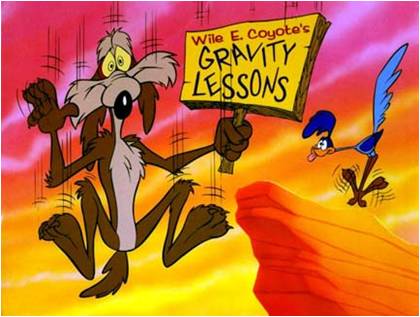
Warner Bros. picture of Wile E. Coyote’s failed apprehension of Roadrunner
Wile E. Coyote, the bumbling, roadrunner-loving carnivore from Warner Bros.’ Looney Tunes series spends a lot of time in the air chasing his fine feathered prey. Unfortunately for Mr. Coyote his genetic make-up and Acme purchases could not cure the ills caused by gravity (although user error was the downfall of Wile E’s effective Bat-Man flying outfit purchase). Just as gravity hampered the coyote’s short-term objectives, so too has gravity hampered the equity markets’ performance this May.
So far the adage of “Sell in May and walk away” has been the correct course of action. Just one day prior to the end of the month, the Dow Jones Industrial and S&P 500 indexes were on pace of recording the worst May decline in almost 50 years. If the -6.8% monthly decline in the S&P and the -7.8% drop in the S&P remains in place through the end of the month, these declines would mark the worst performance in a May month since 1962.
Should we be surprised by the pace and degree of the recent correction? Flash crash and Greece worries aside, any time a market increases +70-80% within a year, investors should not be caught off guard by a subsequent 10%+ correction. In fact corrections are a healthy byproduct of rapid advances. Repeated boom-bust cycles are not market characteristics most investors crave.
It was a volatile, choppy month of trading for the month as measured by the Volatility Index (VIX). The fear gauge more than doubled to a short-run peak of around 46, up from a monthly low close of about a reading of 20, before settling into the high 20s at last close. Digesting Greek sovereign debt issues, an impending Chinese real estate bubble bursting, budget deficits, government debt, and financial regulatory reform will determine if elevated volatility will persist. Improving macroeconomic indicators coupled with reasonable valuations appear to be factoring in a great deal of these concerns, however I would not be surprised if this schizophrenic trading will persist until we gain certainty on the midterm elections. As Wile E. Coyote has learned from his roadrunner chasing days, gravity can be painful – just as investors realized gravity in the equity markets can hurt too. All the more reason to cushion the blow to your portfolio through the use of diversification in your portfolio (read Seesawing Through Chaos article).
Happy long weekend!
Wade W. Slome, CFA, CFP®
Plan. Invest. Prosper.
*DISCLOSURE: Sidoxia Capital Management (SCM) and some of its clients own certain exchange traded funds, but at the time of publishing SCM had no direct positions in TWX, VXX, or any other security referenced in this article. No information accessed through the Investing Caffeine (IC) website constitutes investment, financial, legal, tax or other advice nor is to be relied on in making an investment or other decision. Please read disclosure language on IC “Contact” page.




