Posts tagged ‘bubble’
V-Shaped Recovery or Road to Japan Lost Decades?
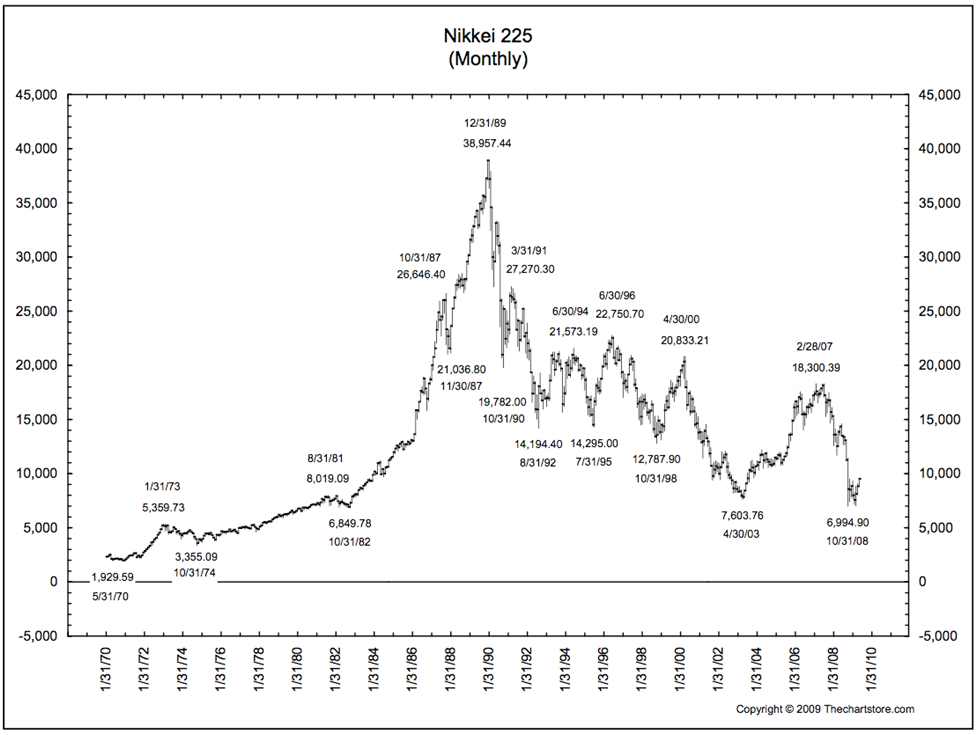
The Lost Decades from the 1989 Peak
On the 6th day of March this year, the S&P 500 reached a devilish low of 666. Now the market has rebounded more than 50% over the last five months. So is this a new bull market throttled into gear, or is it just a dead-cat bounce on route to a lost two decades, like we saw in Japan?
Smart people like Nobel Prize winner and economist Paul Krugman make the argument that like Japan, the bigger risk for the U.S. is deflation (NY Times Op-Ed), not inflation.
Now I’m no Nobel Prize winner, but I will make a bold argument of why Professor Krugman is out to lunch and why we will not go in a Japanese death-like, deflationary spiral.
Let’s review why our situation is dissimilar from our South Pacific friends.
Major Differences:
- Japanese Demographics: The Japanese population keeps getting older (see UN chart), which will continue to pressure GDP growth. According to the National Institute of Population and Social Security Research, by 2055 the Japanese population will fall 30% to 90 million (equivalent to 1955 level). Over the same time frame, the number of elderly under age 65 is expected to halve. To minimize the effects of the contraction of the working population, it will be necessary both to increase labor productivity, loosen immigration laws, and to promote the employment of woman and people over 65. Japan’s population is expected to expected contraction in Japan’s labor force of almost 1% a year in 2009-13.

Source: The Financial Times/UN (Declining Workforce Per 65 Year Old)
- Bank of Japan Was Slow to React: Japan recognized the bubble occurring and as a result hiked its key lending discount rate from 1989 through May 1991. The move had the desired effect by curbing the danger of inflation and ultimately popped the Nikkei-225 bubble. Stock prices soon plummeted by 50% in 1990, and the economy and land prices began to deteriorate a year later. Belatedly, Japan’s central bank began a series of interest rate-cuts, lowering its discount rate by 500-basis points to 1% by 1995. But the Japanese economy never recovered, despite $1-trillion in fiscal stimulus programs.
- The Higher You Fly, the Farther You Fall: The relative size of the Japanese bubble was gargantuan in scale compared to what we experienced here in the United States. The Nikkei 225 Index traded at an eye popping Price-Earnings ratio of about 60x before the collapse. The Nikkei increased over 450% in the eight years leading up to the peak in 1989, from the low of about 6,850 in October 1982 to its peak of 38,957 in December 1989. Compare those extreme bubble-icious numbers with the S&P 500 index, which rose approximately a more meager 20% from the end of 1999 to the end of 2007 (U.S. peak) and was trading at more reasonable 18x’s P-E ratio.
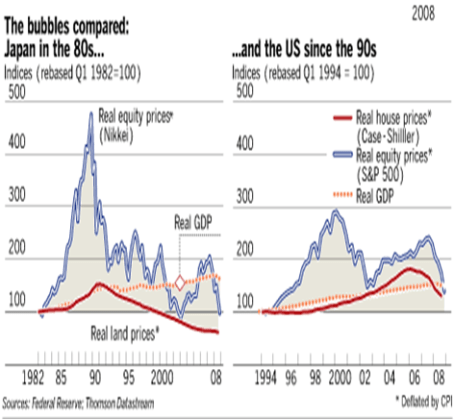
Source: Dow Jones
- Debt Levels not Sustainable: Japan is the most heavily indebted nation in the OECD. Japan is moving towards that 200% Debt/GDP level rapidly and the last time Japanese debt went to 200% of GDP (during WWII), hyper-inflation ensued and forced many fixed income elderly into poverty. Although our debt levels have yet to reach the extremes seen by Japan, we need to recognize the inflationary pressure building. Japan’s debt bubble cannot indefinitely sustain these debt increases, leaving little option but to eventually inflate their way out of the problem.
- Banking System Prolongs Japanese Deflation: Despite the eight different stimulus plans implemented in the 1990s, Japan lacked the fortitude to implement the appropriate corrective measures in their banking system by writing off bad debts. An article from July 2003 Barron’s article put it best:


After the collapse of the property bubble, many families and businesses had debts that far exceeded their devalued assets. When a version of this happened in America in the savings-and-loan crisis, the resulting mess was cleaned up quickly. The government seized assets, sold them off, bankrupted ailing banks and businesses, sent a few crooks to jail and everything started fresh, so that deserving new businesses could get loans. The process is like a tooth extraction — painful but mercifully short. In Japan this process has barely begun. Dynamic new businesses cannot get loans, because banks use available credit to lend to bankrupt businesses, so they can pretend they are paying their debts and avoid the pain of write-offs. This is self-deception. The rotten tooth is still there. And the Japanese people know it.
The Future – Rise of the Rest: Fareed Zakaria, Newsweek editor wrote about the “Rise of the Rest” in an incredible article (See Sidoxia Website) describing the rising tide of globalization that is pulling up the rest of the world. The United States population represents only 5% of the global total, and as the technology revolution raises the standard of living for the other 95%, this trend will only accelerate the demand of scarce resources, which will create a constant inflationary headwind.
For those countries in decline, like Japan, demand destruction raises the risk of deflation, but historically the innovative foundation of capitalism has continually allowed the U.S. to grow its economic pie. Economic legislation by our Congress will help or hinder our efforts in dealing with these inflationary pressures. One way is to incentivize investment in innovation and productive technologies. Another is to expand our targeted immigration policies towards attracting college educated foreigners, thereby relieving aging demographics pressures (as seen in Japan). These are only a few examples, but regardless of political leanings, our country has survived through wars, assassinations, terrorist attacks, banking crises, currency crises, and yes recessions, to only end up in a stronger global position.
This crisis has been extremely painful, but so have the many others we have survived. I believe time will heal the wounds and we will eventually conquer this crisis. I’m confident that historians will look at the coming years in favorable light, not the lost decades of pain as experienced in Japan.
Wade W. Slome, CFA, CFP®
Plan. Invest. Prosper.
Pinning Down Roubini Requires a Lasso

Pinning down a Nouriel Roubini forecast is like lassoing a frenzied cow. They say a broken clock is right twice a day, and maybe the same principle applies to renowned economist, Professor Roubini (NYU)? Sure, credit should be given where credit is due. He nailed the forecast relating to the housing led financial bubble and subsequent financial collapse – even if the prediction was years early.
Here’s where I have a beef. Now that Roubini has become a celebrated rock star with frequent television interviews and speaking engagements, his touring views are becoming more fluid and slippery as time progresses. Sure it’s more comfortable to ride the fence and lean in whatever direction the weekly economic winds are blowing. I suppose if you throw out enough changing viewpoints, which adjust to evolving moods, you can never be wrong.
Let’s examine some of his views:
- Out of Context: Just last week, Mr. Roubini said the “worst is behind us,” but in order to retain his “Dr. Doom” celebrity status he felt compelled to issue a press release clarifying his statements. He noted his “views were taken out of context,” and added, “I have said on numerous occasions that the recession would last roughly 24 months.” That’s funny, because he just stated last year it would be 12-18 months (Click Here for Video).
- Sweating Out Rebound: Maybe the 41% bounce in the S&P 500 or the 49% jump in the NASDAQ from March 9th lows compelled Roubini to make the “worst is behind us” comments, but why then at the beginning of this year did he say, “We are still only in the early stages of this crisis. My predictions for the coming year, unfortunately, are even more dire: The bubbles, and there were many, have only begun to burst.” Hmmm…excuse me while I scratch my head.
- Alphabet Soup Recovery: Also frustrating are the John Kerry-esque waffling comments relating to whether this economic recovery will be a U, W, or L-shaped economic recovery. Last April he was in the U-camp: “My view is closer to a U-shaped recession as I expect that the economic contraction will last at least 12 months and possibly as long as 18 months through the middle of 2009.” Now, as early as last month Roubini is warning of a double dip or “W-shaped” recovery with the rising possibility of a “perfect storm” in 2010 (Click Here for Video). He sees the expiration of tax cuts, rising oil prices, inflating debt and interest rates leading to another downturn. So is it U or W, or will we hear more about an “L” shaped recovery? Maybe the worst is not behind us? I’m confused.
- Doomsday Earnings Yet to Arrive: Still early in the quarterly earnings reporting season but Roubini’s call for a downside in corporate earnings has yet to materialize. As a matter of fact, Zacks Investment Research reported last week that early second quarter upside surprises are beating downside surprises by a ratio of 7 to 1. So far not too “Doom-full.”
I’m no economist or recovery expert, but what I do know is that I’m having difficulty pinning down Professor Roubini’s ever-changing views. I suppose I will just mail CNBC, Bloomberg, or the bevy of other Roubini media groupies a lasso in hopes they will pin Mr. Roubini down.
Wade W. Slome, CFA, CFP®
Wade W. Slome, CFA, CFP®
Plan. Invest. Prosper.
DISCLOSURE: Sidoxia Capital Management (SCM) and some of its clients own certain exchange traded funds, but at the time of publishing SCM had no direct position in any other security referenced in this article. No information accessed through the Investing Caffeine (IC) website constitutes investment, financial, legal, tax or other advice nor is to be relied on in making an investment or other decision. Please read disclosure language on IC “Contact” page.
Treasury Bubble Hasn’t Burst….Yet

10-Year Treasury Chart (5-14-09)
Clusterstlock’s Joe Weisenthal’s takes a historical look on 10-year Treasury yields going back to 1962. As you can see, the yield is still below 1962 levels, despite the massive inflationary steps the Federal Reserve and Treasury have taken over the last 18 months (6-26-09 yield was 3.51%). These trends can also be put into perspective by reading Vincent Fernando’s post at http://www.researchreloaded.com. Take a peek.
Ways to take advantage of this trend include purchases of TBT (UltraShort 20+ Year Treasury ProShares) or short TLT (iShares Barclays 20+ Year Treasury Bond)*.

Reverse View of Historical 10-Year Treasury Yield
*Disclosure: Sidoxia Capital Management clients and/or Slome Sidoxia Fund may have a short position in TLT.




