Posts tagged ‘bonds’
Siegel & Co. See “Bubblicious” Bonds


Source: Wall Street Journal - March 14, 2000
Siegel compares 1999 stock prices with 2010 bonds
Unlike a lot of economists, Jeremy Siegel, Professor at the Wharton School of Business, is not bashful about making contrarian calls (see other Siegel article). Just days after the Nasdaq index peaked 10 years ago at a level above 5,000 (below 2,200 today), Siegel called the large capitalization technology market a “Sucker’s Bet” in a Wall Street Journal article dated March 14, 2000. Investors were smitten with large-cap technology stocks at the time, paying balloon-like P/E (Price-Earnings) ratios in excess of 100 times trailing earnings (see table above).
Bubblicious Boom

Today, Siegel has now switched his focus from overpriced tech-stock bubbles to “Bubblicious” bonds, which may burst at any moment. Bolstering his view of the current “Great American Bond Bubble” is the fact that average investors are wheelbarrowing money into bond funds. Siegel highlights recent Investment Company Institute data to make his point:
“From January 2008 through June 2010, outflows from equity funds totaled $232 billion while bond funds have seen a massive $559 billion of inflows.”
The professor goes on to make the stretch that some government bonds (i.e., 10-year Treasury Inflation-Protected Securities or TIPS) are priced so egregiously that the 1% TIPS yield (or 100 times the payout ratio) equates to the crazy tech stock valuations 10 years earlier. Conceptually the comparison of old stock and new bond bubbles may make some sense, but let’s not lose sight of the fact that tech stocks virtually had a 0% payout (no dividends). The risk of permanent investment loss is much lower with a bond as compared to a 100-plus multiple tech stock.
Making Rate History No Mystery
What makes Siegel so nervous about bonds? Well for one thing, take a look at what interest rates have done over the last 30 years, with the Federal Funds rate cresting over 20%+ in 1981 (View RED LINE & BLUE LINE or click to enlarge):
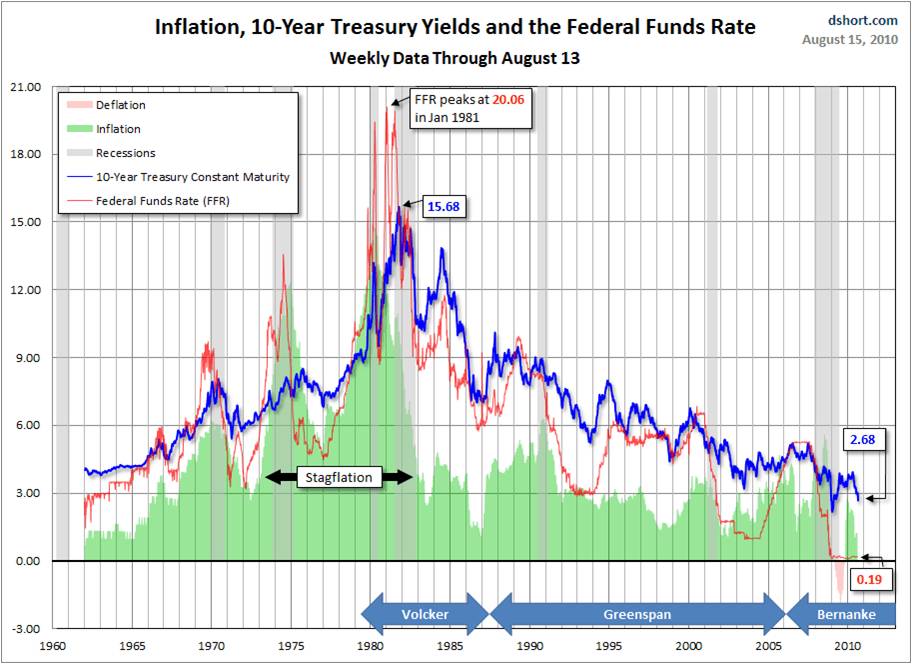
Source: dshort.com
As I have commented before, there is only one real direction for interest rates to go, since we currently sit watching rates at a generational low. Rates have a minute amount of wiggle room, but Siegel rightfully understands there is very little wiggle room for rates to go lower. How bad could the pain be? Siegel outlines the following scenario:
“If over the next year, 10-year interest rates, which are now 2.8%, rise to 3.15%, bondholders will suffer a capital loss equal to the current yield. If rates rise to 4% as they did last spring, the capital loss will be more than three times the current yield.”
Siegel is not the only observer who sees relatively less value in bonds (especially government bonds) versus stocks. Scott Grannis, author of the Calafia Report artfully shows the comparisons of the 10-Year Treasury Note yield relative to the earnings yield on the S&P 500 index:
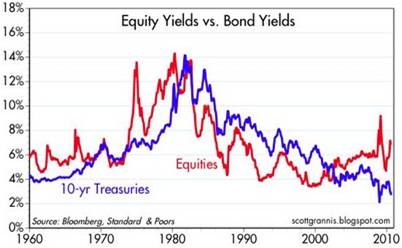
Source: Calafia Report (Scott Grannis)
As you can see, rarely have there been periods over the last five decades where bonds were so poorly attractive relative to equities.
Grannis mirrors Siegel’s view on government bond prices through his chart on TIPS pricing:
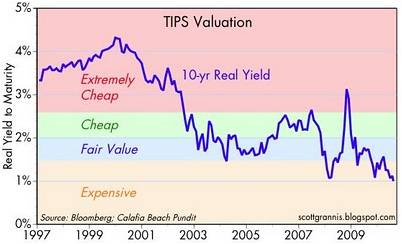
Source: Calafia Report (Scott Grannis)
Pricey Treasuries is not a new unearthed theme, however, Siegel and Grannis make compelling points to highlight bond risks. Certainly, the economy could soften further, and trying to time the bottom to a multi-decade bond bubble can be hazardous to your investing health. Having said that, effectively everyone should desire some exposure to fixed income securities, depending on their objectives and constraints (retirees obviously more). The key is managing duration and the risk of inflation in a prudent fashion. If you believe Siegel is correct about an impending bond bubble bursting, you may consider lightening your Treasury bond load. Otherwise, don’t be surprised if you do not collect on another “sucker’s bet.”
Wade W. Slome, CFA, CFP®
Plan. Invest. Prosper.
*DISCLOSURE: Sidoxia Capital Management (SCM) and some of its clients own certain exchange traded funds (including TIP and other fixed income ETFs), but at the time of publishing SCM had no direct position in any security referenced in this article. No information accessed through the Investing Caffeine (IC) website constitutes investment, financial, legal, tax or other advice nor is to be relied on in making an investment or other decision. Please read disclosure language on IC “Contact” page.
Baseball, Hot Dogs, and Fixed Income Securities

Having just celebrated another 4th of July holiday, I reflected on the historical importance of our country’s independence finalized 234 years ago, the defining birthday of our great country that permanently marked the separation of our nation from Great Britain. In honor of this revolutionary milestone, our culture has added a few American traditions over the centuries, including watching baseball, and gorging ourselves on hot dogs, and apple pie.There is no better symbol of the importance our culture places on overindulgence than Nathan’s International Hot Dog Eating Contest, held each year on July 4th in Coney Island, Brooklyn, New York. The 95th annual contest winner was Joey Chestnut with a total of 54 HDBs (Hot Dogs & Buns) consumed, but not without some controversy thanks to the arrest of former Nathan’s champ Takeru Kobayashi, who watched from the sidelines this year due to a contract dispute with event organizers. Chestnut holds the world record set in 2009 with 68 HDBs, equivalent to about 20,000 calories. In setting the unmatched record, the winner of wiener eating contest inhaled in 10 minutes what an average human should consume in 10 days.
Bond Binge
In the financial markets, Americans have been pigging out on something else over the last few decades, and that is bonds. The craving for bonds has not changed since the end of the financial crisis either. According to Morningstar, since the end of 2008, investors have placed a net $390 billion into taxable bond funds and withdrawn -$45 billion out of U.S. stock funds. A continuation of these trends can be seen in the latest ICI (Investment Company Institute) fund flow data, in which we saw a +$6.3 billion inflow into bonds and a -$1.3 billion abandonment of stocks from the hands of jittery stock investors.
Beyond the endless checklist of worries (Europe default, China slowing, twin deficits, elections, etc.), there has been a consistent exodus of capital from money market funds due to the ridiculously low yields – the seven-day yield on taxable money-market funds, as measured by IMoneyNet, has recently held steady around 0.04%. For yield-hungry investors, bondholders are not getting a lot of bang for their buck if you consider the 10-Year Treasury Note is trading at 2.98%. Nothing in life comes for free, so in the case of Treasuries, bond investors are predominantly swapping market risk for interest rate risk. As I have repeatedly stated in the past, bonds are not evil, however fixed income exposure in a portfolio should be customized for an individual in the context of a diversified portfolio that meets investors’ objectives and risk tolerance.
Although the inflation skies are sunny now, there are clouds on the horizon and the stimulative monetary policies conducted over the last few years do not augur well for a likely climb in future interest rates.
Reversal of Fortune
In the competitive eating world, there is a so-called “reversal of fortune” that disqualifies eaters. At some point, you can only consume so much before the forces of nature take over.
I don’t know when the day of regurgitation will come for many fixed income securities, but managing your consumption of bonds, and the associated duration, becomes crucial as bond bellies continue to bulge. Takeru Kobayashi discovered this first hand at the Nathan’s 2007 championship event.
Baseball, hot dogs, and apple pie have been essential components to the unique aspects of the great American culture. In the world of investing, we have witnessed an acceleration in investors’ appetite for bonds – I just hope for the sake of overzealous bond investors, they will not suffer a reversal of fortune.
Wade W. Slome, CFA, CFP®
Plan. Invest. Prosper.
*DISCLOSURE: Sidoxia Capital Management (SCM) and some of its clients own certain exchange traded funds (including fixed income ETFs), but at the time of publishing SCM had no direct positions in any other security referenced in this article. No information accessed through the Investing Caffeine (IC) website constitutes investment, financial, legal, tax or other advice nor is to be relied on in making an investment or other decision. Please read disclosure language on IC “Contact” page.
Stocks…Bonds on Steroids

With all the spooky headlines in the news today, it’s no wonder everyone is piling into bonds. The Investment Company Institute (ICI), which tracks mutual fund data, showed -88% of the $14 billion in weekly outflows came from equity funds relative to bonds and hybrid securities. With the masses flocking to bonds, it’s no wonder yields are hovering near multi-decade historical lows. Stocks on the other hand are the Rodney Dangerfield (see Doug Kass’s Triple Lindy attempt) of the investment world – they get “no respect.” By flipping stock metrics upside down, we will explore how hated stocks can become the beloved on steroids, if viewed in the proper context.
Davis on Debt Discomfort
Chris Davis, head of the $65 billion in assets at the Davis Funds, believes like I do that navigating the “bubblicious” bond market will be a treacherous task in the coming years. Davis directly states, “The only real bubble in the world is bonds. When you look out over a 10-year period, people are going to get killed.” In the short-run, inflation is not a real worry, but it if you consider the exploding deficits coupled with the exceedingly low interest rates, bond investors are faced with a potential recipe for disaster. Propping up the value of the dollar due to sovereign debt concerns in Greece (and greater Europe) has contributed to lower Treasury rates too. There’s only one direction for interest rates to go, and that’s up. Since the direction of bond prices moves the opposite way of interest rates, mean reversion does not bode well for long-term bond holders.
Earnings Yield: The Winning Formula
Average investors are freaked out about the equity markets and are unknowingly underestimating the risk of bonds. Investors would be in a better frame of mind if they listened to Chris Davis. In comparing stocks and bonds, Davis says, “If people got their statement and looked at the dividend yield and earnings yield, they might do things differently right now. But you have to be able to numb yourself to changes in stock prices, and most people can’t do that.” Humans are emotional creatures and can find this a difficult chore.
What us finance nerds learn through instruction is that a price of a bond can be derived by discounting future interest payments and principle back to today. The same concept applies for dividend paying stocks – the value of a stock can be determined by discounting future dividends back to today.
A favorite metric for stock jocks is the P/E (Price-Earnings) ratio, but what many investors fail to realize is that if this common ratio is flipped over (E/P) then one can arrive at an earnings yield, which is directly comparable to dividend yields (annual dividend per share/price per share) and bond yields (annual interest/bond price).
Earnings are the fuel for future dividends, and dividend yields are a way of comparing stocks with the fixed income yields of bonds. Unlike virtually all bonds, stocks have the ability to increase dividends (the payout) over time – an extremely attractive aspect of stocks. For example, Procter & Gamble (PG) has increased its dividend for 54 consecutive years and Wal-Mart (WMT) 37 years – that assertion cannot be made for bonds.
As stock prices drop, the dividend yields rise – the bond dynamics have been developing in reverse (prices up, yields down). With S&P 500 earnings catapulting upwards +84% in Q1 and the index trading at a very reasonable 13x’s 2010 operating earnings estimates, stocks should be able to outmuscle bonds in the medium to long-term (with or without steroids). There certainly is a spot for bonds in a portfolio, and there are ways to manage interest rate sensitivity (duration), but bonds will have difficulty flexing their biceps in the coming quarters.
Read the full article on Chris Davis’s bond and earnings yield comments
Wade W. Slome, CFA, CFP®
Plan. Invest. Prosper.
*DISCLOSURE: Sidoxia Capital Management (SCM) and some of its clients own certain exchange traded funds and WMT, but at the time of publishing SCM had no direct positions in PG, or any other security referenced in this article. No information accessed through the Investing Caffeine (IC) website constitutes investment, financial, legal, tax or other advice nor is to be relied on in making an investment or other decision. Please read disclosure language on IC “Contact” page.
Seesawing Through Organized Chaos

Still fresh in the minds of investors are the open wounds created by the incredible volatility that peaked just a little over a year ago, when the price of insurance sky-rocketed as measured by the Volatility Index (VIX). Even though equity markets troughed in March of 2009, earlier the VIX reached a climax over 80 in November 2008. With financial institutions falling like flies and toxic assets clogging up the lending pipelines, virtually all asset classes moved downwards in unison during the frefall of 2008 and early 2009. The traditional teeter-totter phenomenon of some asset classes rising simultaneously while others were falling did not hold. With the recent turmoil in Greece coupled with the “Flash Crash” (read making $$$ trading article) and spooky headline du jour, the markets have temporarily reverted back to organized chaos. What I mean by that is even though the market recently dove about +8% in 8 days, we saw the teeter-totter benefits of diversification kick in over the last month.
Seesaw Success
While the S&P fell about -4.5% over the studied period below, the alternate highlighted asset classes managed to grind out positive returns.
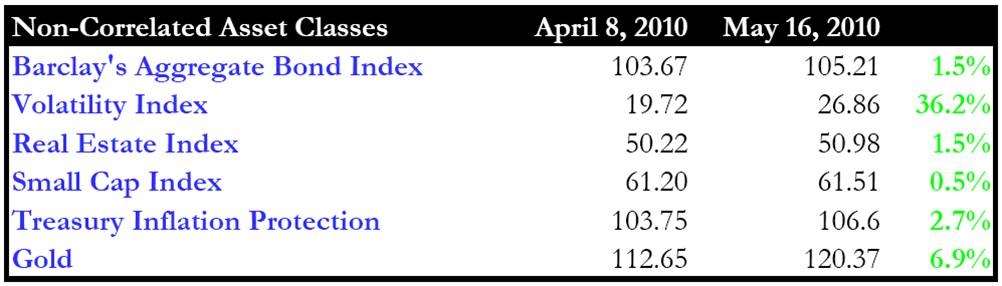
While traditional volatility has returned after a meteoric bounce in 2009, there should be more investment opportunities to invest around. With the VIX hovering in the mid-30s after a brief stay above 40 a few weeks ago, I would not be surprised to see a reversion to a more normalized fear gauge in the 20s – although my game plan is not dependent on this occurring.
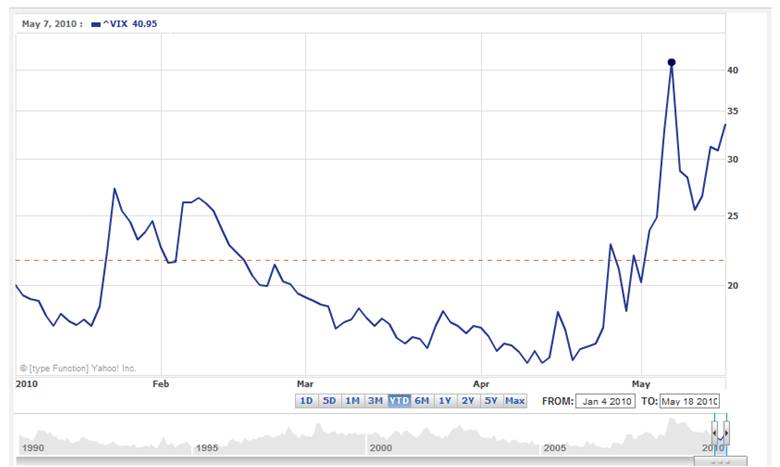
VIX Chart Source: Yahoo! Finance
Regardless of the direction of volatility, I’m encouraged that even during periods of mini-panics, there are hopeful signs that investors are able to seesaw through periods of organized chaos with the assistance of good old diversification.
Wade W. Slome, CFA, CFP®
Plan. Invest. Prosper.
*DISCLOSURE: Sidoxia Capital Management (SCM) and some of its clients own certain exchange traded funds (including AGG, BND, VNQ, IJR and TIP), but at the time of publishing SCM had no direct positions in VXX, GLD, or any security referenced in this article. No information accessed through the Investing Caffeine (IC) website constitutes investment, financial, legal, tax or other advice nor is to be relied on in making an investment or other decision. Please read disclosure language on IC “Contact” page.
Filet or Mac & Cheese? Investing for Retirement

The financial crisis of 2008-2009 placed a large swath of investors into paralysis based on a fear the United States and the rest of the world was on the verge of irreversible destruction. Regardless of what the newspaper headlines are reading and television pundits are spouting, individuals have to shrewdly plan for retirement no matter what the economy is doing. So then the question becomes, do you want to be eating macaroni & cheese in retirement, or does filet mignon or alternate five-star cuisine sound more appealing? I vote for the latter.
Despite what the government statistics are saying about the current state of benign inflation, you do not need to be a genius to see medical costs are exploding, energy charges have skyrocketed, and even more innocuous items such as movie ticket prices continue to rise. If that’s not a burden enough, depending on your age, there’s a legitimate concern the Social Security and Medicare safety nets may not be there for you in retirement. It is more important than ever to take control of your financial future by investing your money in a more efficient manner (see Fusion), focusing on long-term, low-cost, tax-efficient strategies. Whatever the direction of the financial markets (up, down, or sideways), if you don’t wisely invest your money, you will run the risk of working as a Wal-Mart (WMT) greeter into your 80s and relegated to eating mac & cheese (for lunch and dinner).
Broaden Your Horizons
The last decade has been tough for domestic equities. It’s true that not a lot of compounding of returns has occurred in the domestic equity markets over the last decade (see Lost Decade), but that weakness is not necessarily representative of the next decade’s performance or the past relative strength seen in areas like emerging markets, materials and certain fixed income markets. These alternatives, including cash, would have added significant diversification benefits to investor portfolios during previous years. Rather than focusing on what’s best for the investor, so much financial industry attention has been placed on high cost, high fee, high commission domestic stock funds or insurance-based products. Due to many inherent conflicts of interest, many individual investors have lost sight of other more attractive opportunities, like exchange traded funds, international strategies, and fixed-income investment vehicles.
Rule of 72
Depending on your risk profile, objectives and constraints, the “Rule of 72” implies your retirement portfolio should double from a $100,000 investment now to roughly $200,000 in seven years (to $400,000 in 14 years, $800,000 in 21 years, etc.), assuming your portfolio can earn a 10% annual return. Unfortunately, this snowballing effect of money growth does not work if you are paying out significant chunks of your returns to aggressive brokers and salespeople in the forms of high commissions, fees, and taxes (see a Penny Saved is Billions Earned). For example, if you are paying out total annual expenses of 2-3% to a broker, advisor, or investment manager, the doubling effect of the Rule of 72 will be stretched out to 9-10 years (rather than the above mentioned seven years). If you do not know what you are paying in fees and expenses (like the majority of people), then do yourself a favor and educate yourself about the fee structures and tax strategies utilized in your investments (see also Investor Confusion). If you haven’t started investing, or you are shoveling out a lot of money in fees, expenses, and taxes, then you should reconsider your current investment stretegy. Otherwise, you may just want to begin stockpiling a lot of macaroni & cheese in your retirement pantry.
Wade W. Slome, CFA, CFP®
Plan. Invest. Prosper.
*DISCLOSURE: Sidoxia Capital Management (SCM) and some of its clients own certain exchange traded funds and shares in WMT, but at the time of publishing SCM had no direct positions in any security referenced in this article. No information accessed through the Investing Caffeine (IC) website constitutes investment, financial, legal, tax or other advice nor is to be relied on in making an investment or other decision. Please read disclosure language on the IC “Contact” page for more information.
Sidoxia Introduces “Fusion”

With the quote machines taking a temporary breather, what better time than now to talk about a new product creation from Sidoxia Capital Management – Fusion. For those readers following Investing Caffeine for some time, you likely have an informed understanding of Sidoxia Capital Management’s investment philosophy (www.Sidoxia.com). Well, now Sidoxia has formalized its investment product through the introduction of Fusion, a hybrid product integrating low-cost, tax-efficient investment vehicles and strategies, including individual stocks, individual bonds, equity ETFs (Exchange Traded Funds), and fixed income ETFs. Rather than being boxed into a simplistic life cycle fund, Fusion offers a customized investment vehicle that can meet investors’ wide ranging objectives and constraints. A key differentiating component of Fusion is its inclusion of some of the same stocks and securities employed in the Slome Sidoxia Fund (a hedge fund also managed by Sidoxia Capital Management for accredited investors). The aim of Fusion is to maximize the risk-adjusted returns in the context of a broadly diversified balanced portfolio (including international exposure).
Client Product Process
For those qualified investors, a one-on-one interview is conducted with each separate account investor to determine the objectives and constraints associated with the account. Subsequently, a customized Investment Policy Statement (IPS) is created for each client, effectively creating a blueprint for how the account will be managed. Depending on the risk-tolerance, time horizon, and objectives of the client, an equity allocation will be customized to meet the client’s needs. The balance of the portfolio will be invested in fixed-income, cash/liquid assets, and hybrid securities – including convertible bonds and alternative investments on a more limited basis. Individual security selection is derived from implementing fundamental and quantitative screening tools, leveraging the investment experience of the investment manager (Wade Slome), and the ranking of securities on a risk-adjusted valuation basis. Lower ranked securities are generally used as funding sources for purchases of higher ranked investment candidates.
Buy Discipline
A systematic, disciplined process is performed before the inclusion of any security is finalized into a portfolio. With respect to the selected equity securities, particular emphasis is placed on valuation metrics, including cash flows, earnings growth, dividend yields, price-earnings ratios, and other important fundamental statistics. In regards to equity related exchange traded funds (ETFs), some of the previously mentioned factors will be considered in addition to a top-down view of a funds underlying long-term growth potential. The buy discipline, established for the fixed income allocation of the portfolio, carefully considers dynamics such as yield, duration, maturity, income, inflation-protection, currency risk, and other factors. Compared to other competing domestic-centric products, Fusion has the ability and willingness to invest globally to explore attractive risk-reward investment opportunities abroad.
Portfolio Construction
Within the parameters of the various Fusion product versions (aggressive, conservative, and moderate), each portfolio is constructed with flexibility in meeting the unique objectives and constraints of each account – including any liquidity or income requirements indicated by the client. Every portfolio is constructed from the same menu of underlying investment options, thereby assuring relative consistency across accounts. Allocations across investment selections will vary based upon the Fusion product version selected.
Trading Strategies
Under normal economic circumstances, Fusion invests with a long-term time horizon of three to five years for its equity positions. As a result, factors such as transaction costs, impact costs, opportunity costs, bid-ask spreads, tax consequences, are considered before conducting trades. Regarding fixed income portfolios, the previously mentioned factors along with the underlying yield, duration, and fundamental factors will determine the holding period. Trading frequency may fluctuate, depending on financial market and client-specific circumstances, but generally speaking heightened volatility will lead to additional opportunistic portfolio activity.
Sell Discipline
The Fusion sell discipline is fairly straight forward. If a security reaches a designated price target, provides an inferior risk-adjusted return profile relative to other opportunities, or if the original investment rationale negatively changes, then the investment becomes a sell candidate. If Fusion discovers opportunities with superior investment characteristics, the sell candidates, in addition to cash, will be utilized to fund new purchases.
Product Fee Structure
The annual fee charged for portfolio management services is rendered on a percentage of assets under management basis. As a fee-only investment advisor, inherent incentives are built-in to preserve and grow client account values – a principle not practiced by many commissioned based brokers/advisors. Contact a Sidoxia Capital Management representative by phone (949-258-4322) or e-mail (info@Sidoxia.com) to learn more about Fusion’s fee structure and account minimum threshold.
Wade W. Slome, CFA, CFP®
Plan. Invest. Prosper.
*DISCLOSURE: Sidoxia Capital Management (SCM) and some of its clients own certain exchange traded funds, but at the time of publishing SCM had no direct positions in any security referenced in this article. No information accessed through the Investing Caffeine (IC) website constitutes investment, financial, legal, tax or other advice nor is to be relied on in making an investment or other decision. Please read disclosure language on IC “Contact” page.
Bankruptcy: Where are You on the Capital Structure Totem Pole?
 The media likes to focus in on the microscopic universe of 30 stocks we like to call the Dow Jones Industrial Average, or the “market.” The reality is the Dow is like a drop in the ocean if you consider the global opportunity set across the capital structure. What is the capital structure? Well, you can think of the capital structure like a totem pole. The actual universe of investment opportunities spans everything from Blue Chip dividend paying stocks to illiquid international convertible preferred securities. The selection of the security type will determine where you sit on the capital structure (totem pole), and the location is especially important when the topic shifts to the dreaded word…B-A-N-K-R-U-P-T-C-Y.
Opening the Chapter Book on Bankruptcy
From a security or safety standpoint, the preferred investor location is at the top of the totem pole (capital structure). Why? Because once an entity declares Chapter 7 and begins asset liquidation, the bondholders/creditors at the top of the structure get paid first – whereas the equity holders at the bottom of the pole get paid last (if there are any asset proceeds remaining to be distributed). Here is a general ranking, from top to bottom, of the major security categories along the capital structure (more specialized hybrid security versions can fit in between the listed items):
1) Secured Bonds
2) Unsecured Bonds
3) Convertible Bonds
4) Preferred Stocks
5) Common Stock/Equity
Bankruptcy is a legal process that provides relief to many individuals who can no longer pay all of their debts. A potential outcome in the bankruptcy process is “debtor discharge,” which wipes away some or all of an individual’s debt. Here is a brief synopsis of the bankruptcy flavors:
Chapter 11: Designed primarily for businesses, Chapter 11 bankruptcy law allows financially distressed businesses to remain in business as debt payments are reorganized under the supervision of the courts. Technically, individuals can also choose to file for Chapter 11 bankruptcy, however practically speaking, individuals generally choose other paths. High profile examples of Chapter 11 bankruptcies include Lehman Brothers, Enron Corp., WorldCom Inc., General Motors Co., and Chrysler Group.
Chapter 7 & 13: These segments of the bankruptcy code are principally constructed for individuals. A means test reviewing an individual’s financial situation will determine which plan is most feasible. Here are brief descriptions:
- Chapter 7 is often referred to as the liquidating bankruptcy. This bankruptcy strategy is often used by individuals to save assets like a home and/or car. Although non-exempt assets will be liquidated by the owner to pay off creditors, many of a debtors assets are categorized as exempt – meaning the owner will not be forced to sell assets and creditors are held at bay.
- Chapter 13 allows individuals to retain assets by following a court sanctioned payment plan. Typically debt payments are made by the individual over years, and as long as payments remain current, the owner can retain assets.
More to Gain, More to Lose at the Bottom
Being at the bottom of the capital structure totem pole (owning stocks) involves relatively more price volatility. If you combine the wild swings with the fact that about 50% of households own stock in some shape or form (Edward N. Wolff at New York University – 2009), then you create a recipe of intrigue. Theoretically, stocks have unlimited profit potential (not the case for most bonds). The media loves to report on the daily fortunes won and lost on the global stock exchanges, in addition to following the bigwig billionaires.
More Boredom, Less to Lose at the Top
Being at the top of the capital structure totem pole (owning bonds) comes with more security (less volatility), but also more boredom (less profit potential). That’s not to say healthy returns cannot be achieved in the bond market. We saw firsthand, during the financial crisis, how bankruptcy fears rocked certain areas of the bond market (e.g., high yield bonds), creating extraordinary investment opportunities. With liquidity returning to the market, and signs of economic stability coming back, investors will need to climb much higher up the tree to grab the hanging fruit.
Although there is plenty of room for optimism given certain macroeconomic and corporate indicators, the global economy is certainly not out of the woods. Business bankruptcies remain elevated, just as investors are piling into the perceived safe arms of corporate bonds. Interest rates, along with industry and company-specific factors will obviously impact the price performance of corporate bonds. If the economy hits choppy waters again, it behooves investors in higher yielding bonds to get a better understanding of where they sit on the capital structure totem pole. If not, those bond investors will slide down the capital structure, left commiserating about losses with their neighboring risk-loving stockholders.
Wade W. Slome, CFA, CFP®
Plan. Invest. Prosper.
*DISCLOSURE: Sidoxia Capital Management (SCM) and some of its clients own certain exchange traded funds, but at the time of publishing had no direct positions in Lehman Brothers, Enron Corp., WorldCom Inc., General Motors Co., and Chrysler Group or any security mentioned in this article. No information accessed through the Investing Caffeine (IC) website constitutes investment, financial, legal, tax or other advice nor is to be relied on in making an investment or other decision. Please read disclosure language on IC “Contact” page.
Can the Lost Decade Strike Twice?

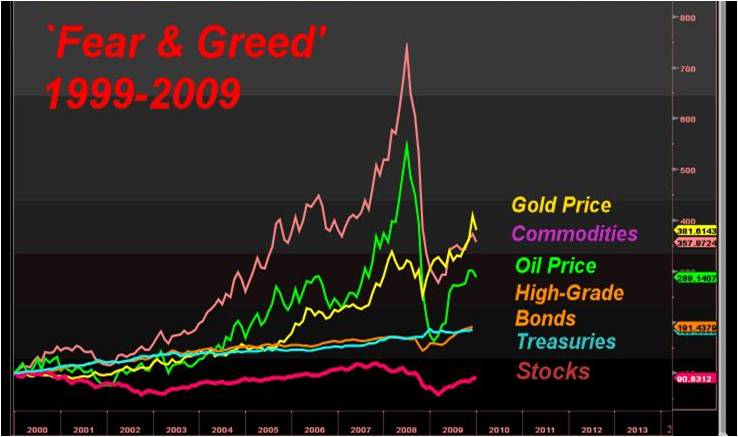
There is an old saying that lightning does not strike twice in the same place. I firmly believe this principle will apply to stock returns over the next decade. Josh Brown, investor and writer for The Reformed Broker highlighted a chart published by Bloomberg showing the 10-year return for various asset classes. Statisticians and market commentators have been quick to point out that stocks, as measured by various benchmarks, have not only underperformed bonds for the last 10 years, but stock performance has actually also been negative for the trailing decade.
Source: Bloomberg via The Reformed Broker
Will this trend persist during the next decade? Will the lost decade in stocks be repeated again, similar to the deflation death spiral experienced by the Japanese? (Read more regarding Japanese market on IC). With the Fed Funds rate at effectively zero, is it possible bonds can pull off a miracle over the next 10 years? I suppose anything is possible, but I seriously doubt it.
Let’s not forget that the P/E ratio (Price-Earnings) pegged by some to be at about 14-15x’s 2010 expected earnings – nestled comfortably within historical bands. Granted, financials and some other sectors were overheated (e.g. certain Consumer industries), but based on next year’s estimates, some industries are already expected to exceed the peak earnings achieved during 2007 (e.g., Technology).
History on Our Side

Source: Crestmont Research. Dated graph over the last century showing stock returns rarely result in negative returns over a rolling 10 year period.
For the trailing decade using December 20, 2009 as an end point, I arrive at a marginally negative return for the S&P 500 index assuming an average dividend yield of 2.5% for the period. Certainly the negative return would be pronounced by any fees, commissions or taxes related to a 10-year buy-and-hold strategy of the broad market index. This chart gets chopped off in 2005, nonetheless history is on our side, lending support that stock returns have a good chance of improving on the results over the last 10 years.
Equity Risk Premium
The bubbles and scandals that have blanketed corporate America over the last 10 years have made the average investor extremely skeptical. What does this mean for the pricing of risk? Well, if you rewind to the year 2000 when technology exceeded 50% of some indexes, and many investors thought technology was a low risk endeavor, there was virtually no equity risk premium discounted into many stock prices. If you fast forward to today, the reverse is occurring. Investors despise market volatility and arguably demand a much higher risk premium for taking on the instability of stocks. This is the exact environment investors should desire – lots of skepticism and money piled into bonds (See IC article on investor queasiness). As Warren Buffett says, “Be fearful when others are greedy and greedy when others are fearful.” I believe the next 10 years will be a time to be greedy.
The analysis above is obviously very narrow in scope, since we are only discussing domestic stock markets. In my client portfolios I advocate a broadly diversified portfolio across asset classes (including bonds), geographies, and styles. However, in managing bonds across portfolios, I am forced to tactfully include strategies such as inflation protection and shorter duration techniques. With the year-end fast approaching, now is a good time to review your financial goals and asset allocation.
Lightning definitely negatively impacted stocks this decade, but betting for lightning to strike twice this decade could very well turn out to be a losing wager.
Wade W. Slome, CFA, CFP®
Plan. Invest. Prosper.
DISCLOSURE: Sidoxia Capital Management (SCM) and some of its clients own certain exchange traded funds, but at time of publishing had no direct positions in BRKA. No information accessed through the Investing Caffeine (IC) website constitutes investment, financial, legal, tax or other advice nor is to be relied on in making an investment or other decision. Please read disclosure language on IC “Contact” page.
New Normal is the Old Normal

By Bruce Wimberly (Contributing Writer to Investing Caffeine)
Pimco bond gurus love to talk about the “new normal” as if there is such a thing in financial markets. The problem with promoting such a view is that it assumes markets are static. Ask John Meriwether and his pack of Nobel Prize winning colleagues at LTCM how static the markets are? The point is nothing is normal about the markets or the economy for that matter. No one has a magic crystal ball that can predict the future and if you did you would certainly not promote it on CNBC. Mohamed El-Erian and his bond fund mavens (see also article on Bill Gross) are the poster children for the “new normal.” I will give them credit it is a great marketing gimmick. Not only does it sound cool but it covers just about everything while packaging it into a nice neat sound bite. Talk about media hounds –does El-Erian actually have time to run Pimco after spending hours getting his make-up ready for the countless interviews he gives each day? And what is up with the 1970ʼs mustache?
In the world according to Pimco the new normal, “reflects a growing realization that some of the recent abrupt changes to markets, households, institutions, and government policies are unlikely to be reversed in the next few years. Global growth will be subdued for a while and unemployment high; a heavy hand of government will be evident in several sectors…. But, hold on, I am getting ahead of myself here. I still have a few more preambles”! Iʼll bet he does.
 El-Erian is never short on opinions. As an investor all I really care about is what does this mean for asset prices? Ok, so global GDP is going to slow as consumers and institutions repair balance sheets, government policies are becoming more burdensome, and unemployment stays high. Check. Got it. While I am not El-Erain I think what he really meant to say is, “We have already established our bond positions and if you want to help our shareholders you should follow our example and invest on the short end of the curve and be wary of inflation. The Fed is printing money and history suggests this will end badly.”
As a formal multi-billion dollar fund manager, I happen to agree with the guy. While I think he could have been more direct with his message, there is no way the fed can inflate us out of this mess without their being some pain down the road. The United States cannot print its way to a recovery. Todayʼs long bond auction is just the first shot against the bow. The 4 3/8% coupon went off at a price of $97.6276 for a 4.52% yield versus a 4.49% prior. In other words, the so-called “new normal” really is the old normal and rates are heading higher my friends.
In this so- called “new normal” of higher rates what should an investor do? First, avoid the treasury bubble like the plague. This is where irrational exuberance is occurring the most. Wake-up people. What Pimco bond managers should be telling you is, “Donʼt buy our funds” (except Reits, Tips and Commodities). Bonds are going to get killed. That is the “new normal”. The “new normal” is inflation is your worst nightmare for bonds and bond buyers. Yes, bonds had a great run the last decade and that is the point! History will not repeat itself. The “new normal” is stocks will outperform bonds over the next ten years handily. Yes, stocks might get hit in the short run as rates rise but in the long run they are a far better asset class to weather inflation. The simple truth is businesses can raise prices. That is all you need to know. Donʼt anchor to the last ten years, as Pimco would like you to do. Donʼt worry about slick slogans – like the “new normal”. Just think about all the assets that have poured into Pimcoʼs funds over the last 10-15 and ask yourself “is this likely to continue?”
To paraphrase Wayne Gretzky great investors “skate to where the puck will be”. In my opinion, that leads you away from the mutual fund behemoth that is Pimco and the safe haven of bonds and back into equities. Yes, the S&P 500 has gone nowhere the last 11 years and that is my point…. the “new normal” is the old normal and equities regain their long term return advantage over other asset classes.
Plan. Invest. Prosper.
DISCLOSURE: Sidoxia Capital Management (SCM) and some of its clients own certain exchange traded funds and equity securities in client and personal portfolios at the time of publishing. No information accessed through the Investing Caffeine (IC) website constitutes investment, financial, legal, tax or other advice nor is to be relied on in making an investment or other decision. Please read disclosure language on IC “Contact” page.
Fuss Making a Fuss About Bonds

Photo Source: Evan Kafka (BusinessWeek)
Dan Fuss has been managing bond investments since 1958, longer than many of his competing managers have lived on this planet. At 75 years old, he is as sharp, if not sharper, than ever as he manages the flagship $18.7 billion Loomis Sayles Bond Fund (LSBRX). Over his 33-year tenure at Loomis, Sayles & Company (he started in 1976), he has virtually seen it all. After a challenging 2008, which saw his bond fund fall -22%, the bond markets have been kinder to him this year – Fuss’s fund performance registers in the top quartile on a 1-year, 5-year, and 10-year basis, according to Morningstar.com (through 12/3/09). With a track record like that, investors are listening. Unfortunately, based on his outlook, he now is making a loud fuss about the dreadful potential for bonds.
Rising Yields, Declining Prices
Fuss sees the bond market at the beginning stages of a rate-increase cycle. In his Barron’s interview earlier this year, Fuss made a forecast that the 10-Year Treasury Note yield will reach 6.25% in the next 4-5 years (the yield currently is at 3.38%). Not mincing words when describing the current dynamics of the federal and municipal bond markets, Fuss calls the fundamentals “absolutely awful.” Driving the lousy environment is a massive budget deficit that Fuss does not foresee declining below 4.5% of (GDP) Gross Domestic Product – approximately two times the historical average. Making matters worse, our massive debt loads will require an ever increasing supply of U.S. issuance, which is unsustainable in light of the aggressive domestic expansion plans in emerging markets. This issuance pace cannot be maintained because the emerging markets will eventually need to fund their development plans with excess reserves. Those foreign reserves are currently funding our deficits and Fuss believes our days of going to the foreign financing “well” are numbered.
Fuss also doesn’t see true economic expansion materializing from the 2007 peak for another four years due to lackluster employment trends and excess capacity in our economy. What does a bond guru do in a situation like this? Well, if you follow Fuss’ lead, then you need to shorten the duration of your bond portfolio and focus on individual bond selection. In July 2009, the average maturity of Fuss’ portfolio was 12.8 years (versus 13.8 years in the previous year) and he expects it to go lower as his thesis of higher future interest rates plays out. Under optimistic expectations of declining rates, Fuss would normally carry a portfolio with an average maturity of about 20 years. In Barron’s, he also discussed selling longer maturity, high-grade corporate bonds and buying shorter duration high-yield bonds because he expects spreads to narrow selectively in this area of the market.
Unwinding Carry Trade – Pricking the Bubble
How does Fuss envisage the bond bubble bursting? Quite simply, the carry trade ending. In trading stocks, the goal is to buy low and sell high. In executing a bond carry trade, you borrow at low rates (yields), and invest at high rates (yields). This playbook looks terrific on paper, especially when money is essentially free (short-term interest rates in the U.S. are near 0%). Unfortunately, just like a stock-based margin accounts, when investment prices start moving south, the vicious cycle of debt repayment (i.e., margin call) and cratering asset prices builds on itself. Most investors think they can escape before the unwind occurs, but Fuss intelligently underscores, “Markets have a ferocious tendency to get there before you think they should.” This can happen in a so-called “crowded trade” when there are, what Fuss points out, “so many people doing this.”
The Pro Predictor
Mr. Fuss spoke to an audience at Marquette University within three days of the market bottom (March 12, 2009), and he had these prescient remarks to make:
“I’ve never seen markets so cheap…stocks and bonds…not Treasury bonds.”
He goes on to rhetorically ask the audience:
“Is there good value in my personal opinion? You darn bethcha!”
Bill Gross, the “Bond King” of Newport Beach (read more) receives most of the media accolades in major bond circles for his thoughtful and witty commentary on the markets, but investors should start making a larger fuss about the 75 year-old I like to call the “Leader of Loomis!”
Adviser Perspectives Article on Dan Fuss and Interest Rates
Wade W. Slome, CFA, CFP®
Plan. Invest. Prosper.
DISCLOSURE: Sidoxia Capital Management (SCM) and some of its clients own certain exchange traded funds (including fixed-income) and is short TLT. At time of publishing, SCM had no positions in LSBRX. No information accessed through the Investing Caffeine (IC) website constitutes investment, financial, legal, tax or other advice nor is to be relied on in making an investment or other decision. Please read disclosure language on IC “Contact” page.




