You and Your 401K are Not Alone

You have choices when it comes to managing your 401k.
A large majority of individual investors watched their 401k retirement accounts crater throughout 2008 and the beginning of 2009. For some, prudently managing these accounts, while attempting to decipher historic, unimaginable events, proved to be a difficult challenge. Fortunately for investors there are alternatives beyond managing a narrow 401k menu of options by yourself.
One option to consider is the establishment of a Self Directed 401k account, sometimes called a Self Directed Brokerage Account (SDBA). This is an option offered by a minority of plan sponsors (employers) to their employees, so make sure to ask your human resources department if you are interested in exploring this selection. By opening a separate Self Directed 401k account at a third party brokerage firm the investor should have access to a broader set of investment options relative to traditional 401k offerings. The retirement plan documents may however limit investment choices to certain investment products, in part due to litigation concerns created by potentially poor plan participant decisions. Increased trading and administrative charges are other potential costs to mull over.
Opening up one of these self directed accounts also avails a 401k investor to work with an outside advisor who can assist with managing the external brokerage account. Of course, nothing in life comes for free, so the individual will be paying the advisor for these services rather than managing the account solo.
Instead of creating a whole new external Self Directed account, 401k investors can also hire companies for personal 401k management advice in their existing accounts. One such firm, Financial Engines, made famous by its academic all-star founder Bill Sharpe, provides advice to investing participants for a fee, based on the dollar value of the account.
Financial Engines claims to work with more than 750 large employers (including 112 of the FORTUNE 500 and 8 of the FORTUNE 20) and 8 of the largest retirement plan providers serving the retirement market. The problem with services like these (including Guided Choice, also a brainchild of a finance guru – Harry Markowitz) is that no matter how great the advice may be, the investor is stuck with the limited investment options provided by the employer on the 401k company menu.
Other players in the financial industry are swirling around to advise participants on a piece of this $3 trillion 401k U.S. retirement asset market (ICI 2007 estimate), including some brokerage and mutual fund companies, and even independent financial planners. Also, don’t forget if you ever leave an employer, you have the ability to roll over your 401k account into a personal IRA (Individual Retirement Account) – an account you fully control with a buffet of options.
Regardless of the money you may have lost or the amount of confusion you feel, realize that you are not alone (if you choose not to be). Make sure to contact the appropriate human resource professional in charge of retirement benefits, and discover your 401k options.
TARP: Squeezing Blood from Banking Stones

Collecting Bank Dividends Will Become Tougher
There was a sense of relief in the financial markets when it was announced that 10 banks repaid Troubled Asset Relief Program (TARP) funds in the amount of $68 billion back to the federal government. The ten banks included JPMorgan Chase, Goldman Sachs, Morgan Stanley and American Express. Timothy Geithner, the Treasury Secretary, said the repayments were encouraging, but warned that the crisis in the banking industry was not over yet (Economist).
Unfortunately, the falling tide has left some banks stranded, unable to repay TARP loans or the dividends on the preferred shares issued to the government.
The Wall Street Journal reported the following:
At least three small, cash-strapped banks have stopped paying the U.S. government dividends that they owe because they got $315.4 million in capital infusions under the Troubled Asset Relief Program. Pacific Capital Bancorp, a Santa Barbara, Calif., lender that got $180.6 million from the Treasury Department in November, has since posted net losses of $49.7 million. Pacific Capital said … that it suspended dividend payments on its common and preferred stock as part of a wider effort to save about $8 million per quarter. A bank spokeswoman confirmed that the U.S.’s preferred shares are included in the dividend freeze.
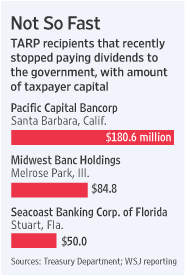 With around 40 bank failures already in 2009, these TARP dividend suspensions may be more the trend rather than the exception. Maybe next time the Treasury will ask for a deposit or driver’s license to guarantee dividend payments before they fork over more TARP money?
Wade W. Slome, CFA, CFP®
Plan. Invest. Prosper.
DISCLOSURE: Sidoxia Capital Management (SCM) and some of its clients own certain exchange traded funds, but at the time of publishing SCM had no direct position in JPMorgan Chase (JPM), Goldman Sachs (GS), Morgan Stanley (MS), American Express (AXP), or any other security referenced in this article. No information accessed through the Investing Caffeine (IC) website constitutes investment, financial, legal, tax or other advice nor is to be relied on in making an investment or other decision. Please read disclosure language on IC “Contact” page.
Banking Pigs Back at the Trough

Sooey! With some of the TARP (Troubled Asset Relief Program) government loans paid back, it appears that the malnourished pigs of the banking sector are hungry again and back at the trough for loftier pay packages. A recent Wall Street Journal article pointed out Goldman Sachs is on track to pay its employees $20 billion in 2009, almost double the compensation of 2008, and forking out even a higher average ($700,000 per employee) than 2007.
Beyond gluttonous appetites, these banking execs are attempting to make pigs fly as well. Like a magician using the art of illusion to move an object from one shell to the next, or divert attention with smoke and mirrors, these large Wall Street banks are shuffling around their compensation plans. A recent Bloomberg article noted that Citigroup Inc. is moving to raise base salaries by as much as 50% to help counterbalance reductions in annual bonuses. Citigroup is particularly in hot water because the U.S. bank received $45 billion in government fund assistance. According to the Wall Street Journal, similar trends are bubbling up at Zurich-based UBS, where executives raised banker base pay by 50%. Bank of America also said in March 2009 it may boost salaries as a percentage of total compensation. The banks are hoping that reducing bonuses tied to risky behavior, while raising salaries, will appease the regulators.
The governments “pay czar,” Kenneth Feinberg, may have something to say about these inflating compensation trends. The WSJ points out:
Feinberg will have the authority to regulate compensation for 175 executives at seven companies, including Citigroup, that received “exceptional” government help.

As a rule of thumb, securities firms generally pay out approximately 50% of revenue in employee compensation. Bonuses have traditionally made up about two-thirds of bankers’ total compensation. Compensation consultant Alan Johnson in New York says salaries typically range from $80,000 to $300,000, with bonuses often adding millions of dollars. The article goes onto highlight the five biggest Wall Street firms awarded their employees a record $39 billion of bonuses in 2007. Sparking some of this heated debate stems from the eye-popping bonuses paid out to Merrill employees before the Bank of America merger. Merrill Lynch emptied $14.8 billion out of its wallet for pay and benefits last year before it was acquired by Bank of America – the New York Attorney General Andrew Cuomo is investigating $3.6 billion of the bonuses (tied mostly to payments made in December 2008).
To protect themselves, firms like Morgan Stanley and UBS have also added “clawback” provisions that allow portions of a worker’s bonus to be recouped under certain scenarios if the firms are harmed by an employee in the future. Perhaps this will create a disincentive for harmful behavior, but likely not enough to pacify the regulators
The pigs have regained their appetites and are eagerly awaiting for some more fixings at the trough. Time will tell if 2009 can produce squeals of swinish satisfaction or will regulators take the bankers to an unfortunate visit to the butchers?
Slome Takes Pre-4th of July Pitstop

Slome on the Airwaves with Dare to Dream
President and Founder of Sidoxia Capital Management, Wade Slome CFA, CFP®, recently sat down for an interview with Dare to Dream radio host Deborah Dachinger. Slome spoke about his book, How I Managed $20,000,000,000.00 by Age 32, along with life experiences that shaped his career and financial trends occurring in the marketplace.
California the Golden State Turning Brown
 California is facing a significant cash crunch as the state attempts the narrowing of its $24 billion budget deficit. The crisis will come to a head now that the fiscal year, June 2009, budget deadline has passed. Without a budget resolution and in order to fill the budget gap, the California government will need to start issuing billions of government IOUs to contractors and vendors, local agencies handling health programs, as well as some receiving state aid.
Moodys rates the Golden State as the lowest rated state of all 50 at A2. The average rating for all states is AA2 and only two other states besides California are rated below AA. At the beginning of 2009 the state bought some breathing room by delaying cash tax refunds, but that cushion has rapidly deteriorated as the economy and employment outlook have deteriorated. Making things worse for the state, relative to other states, is the state constitutional inflexibility requiring voter approval for deficit borrowing.
Time will tell if Governor Schwarzenegger can gather the votes necessary to prevent bond defaults. President Obama and other states are watching closely as the actions (or inactions) will have a ripple through effect for everyone. At 13% of the nation’s GDP, California’s economy impacts the overall country in a significant manner.
Let’s hope the state maintains its “golden” status and does not get burnt.
Is the Recession Over?

Dennis Kneale, bullish commentator on CNBC presented his case on why he thinks the recession is over:
Positive Technical Indicators: Kneale points out that in recent history when the 50-day moving price average cuts upward through the 200-day moving average there is a positive directional bias for the market in the ensuing months.
Personal Income: +1.4% in May for 2 consecutive months.
Personal Spending: Consumer spending was up again in May, and up more than in April.
University of Michigan Consumer Sentiment: The survey rose again to a reading of 70.8 in the recent measurement period.
VIX Volatity Index: The so called “Fear Index” is down -43% in about 3 months – stabilizing to a more normalized level. He argues this should bring in some cash on the sidelines into the stock market.
Eric Schmidt Positive: CEO of search giant, Google, says the worst is behind for the U.S. economy.
Most of the guests rang a more cautious tone, not the least of which, Peter Schiff sees Armageddon ahead for the U.S. economy. Mr. Schiff goes on to compare CNBC to the Gardening channel with all the talk about “green shoots.” Not to mention, he sees the trillions of stimulus dollars only providing a temporary, artificial boost that will eventually cause a horrible economic hangover. Lucky for Peter, he has perfectly timed the international rebound in 2009…cough, cough.
Healthcare Reform: The Brutal Reality of Aging Demographics

The global population is aging and that is a bad trend for healthcare costs.
There’s no question healthcare reform is required. The Economist’s cover story, This is Going to Hurt, addresses this problem head-on:
“Even though one dollar in every six generated by the world’s richest economy is spent on health—almost twice the average for rich countries—infant mortality, life expectancy and survival-rates for heart attacks are all worse than the OECD average. Meanwhile, because health insurance is so expensive, nearly 50m Americans, an obscene number in such a rich place, have none; those that are insured pay through the nose for their cover, and often find it bankruptingly inadequate if they get seriously ill or injured.”
The real question is not whether we have a problem, but rather how are we going to approach it? Estimates of the current healthcare congressional plans put estimates for reform between $1.2 trillion and $1.6 trillion over 10 years. I tend to side with George Will when discussions center on costs, “If you think health care is expensive now, just wait until it is free.”
One of the reasons healthcare costs are exploding is because of our aging demographics. The 76 million “Baby Boomers” are entering their golden years, and as a result are consuming more healthcare products and services. Because our system is so convoluted and opaque, true healthcare competition cannot flourish. Rather, patients expect a cheap “all-you-can-eat” smorgasbord of services without consideration of cost. Unfortunately, the aging trend of our global population (especially in the developed countries like the U.S.) has put our economy on track for a disastrous train-wreck.
The Economist’s article, A Slow Burning Fuse, crystallizes the aging trend into proper perspective by providing some interesting statistics. At the beginning of the last century, in 1900, the average life expectance at birth was approximately 30. Today, the average life expectancy has more than doubled to 67 years (and 78 years in richer developed countries).
Read Full Economist Article, A Slow Burning Fuse
A second major cause of aging societies is the decline in number of children families are having. During the early 1970s, women on average were having 4.3 children each. Now the average is about 2.6 children (and 1.6 children in developed countries). What these statistics mean is that the taxable younger workforce is shrinking (growing slower), therefore unable to adequately feed the swelling appetites of the aging, healthcare-hungry global populations.
My solution would focus on the following:
Technology: Yes, chopping down trees, wasting years of our lives filling out and storing library-esque piles of medical forms is so 20th Century.
Consolidation of Insurers: And do we need dozens of different insurers on different billing platforms? Reducing inefficient and undercapitalized competitors down to a common technological digital record and billing platform makes common sense to me. Although I love competition, if I look at things like cell phones, cable, or even local grocery stores, there is a law of diminishing return whereby inefficiencies eventually outweigh benefits of competition.
Fewer Late Life Benefits: Nearly 30 percent of Medicare spending pays for care in the final year of patients’ lives, according to George Will. Does it really make sense to pay such a high proportion of costs for the last 1-2% of our lives? Other countries, including European ones, deny certain costly services for elderly patients. Does spending over $50,000 on certain cancer treatments for a few extra months of life seem equitable? If elderly ill patients are in the financial position to pay, then that’s great. Otherwise, at some point, the ethical question has to be faced – what is an extra month of human life worth?
Not really a rosy subject, but an important one. I’m confident we can solve these problems, if addressed immediately, or else future generations will be saddled with a more disastrous problem to heal.
Wade W. Slome, CFA, CFP® www.Sidoxia.com
Cap and Tax Passes in the House

The U.S. House of Representatives passed The American Clean Energy and Security Act of 2009 (ACES), also named the “Waxman- Markey” bill, by a 219-212 vote. The masses are calling it the “Cap and Trade” bill, while detractors are blasting it as the “Cap and Tax” bill.
Joe Petrowsky, CEO of Gulf Oil, sees this bill costing businesses $50-100 per ton of carbon created, which will be passed through as a tax to energy consumers in the form of an annual $1,000+ tax (about $250-$350 per individual). Robert Murray, CEO of Murray Energy Corporation, calls it a $2 trillion tax on consumers over 8 years.
The House passed this bill just as the economy is shuttering on its knees and a rising skepticism is brewing over the validity of global warming – see Kimberley Strassel’s, journalist at The Wall Street Journal, article entitled, The Climate Change Climate Change dated June 26, 2009. Australia is in the process of killing its “Cap and Trade” proposals and many critics point to Spain’s failing carbon initiatives and 18% unemployment as evidence for the program’s shortcomings.
Despite one’s views on the validity of global warming, what cannot be disputed is our reliance (addiction) to oil as we import 70% of our oil demand. Is the time and scope of this bill the silver bullet for our crude dependence as we try to survive through this “Great Recession?” I think not.
Billions of humans across the globe are aspiring to achieve our standard of living here in the U.S., so even those against a “Cap and Trade” system, including myself, need to appreciate the massive energy investment we need to make. The U.S. is considered the “Saudi Arabia” of coal due to our vast reserves, and therefore we must find efficient and cleaner ways to use this abundant commodity. We need to throw the kitchen sink at nuclear, wind, solar, hydrogen, bio-fuels and other alternative energy technologies, even as we look to expand our fossil fuel resources.
But rather than forming randomly created silos of hoarded research across hundreds of universities, why not create domestic centers of excellence that collaborate with both academic and private sector participants. By integrating monetary incentives (i.e., exclusive commercial patent rights), incredible advancements and breakthroughs can be achieved. Historically, when the United States has focused on a task, we’ve been able to achieve greatness – for example sending a man to the moon. Heck, recently NASA mastered the art of converting urine into water!
Bold new steps need to be taken to solve our energy crisis, but I’m afraid this “Cap and Tax” bill is not the right answer.
Water…the Next Oil?
Water engulfs our daily lives – we drink, bathe, wash clothes, soak our lawns and brush our teeth with it on a consistent basis. We notice our reliance in our monthly water bills. The earth is covered by approximately 70% water, so if this commodity is so abundant, then how could it be such a scarce, valuable resource? Water is so important; the majority of our body mass consists of the fluid (about 60% in males and 55% in females). Although our planet is covered with this liquid, the main problem surrounding the issue is that only about 2% of the water supply is considered fresh water (predominantly located in Antarctica). Desalinization of salt water is one solution to the limited amount of fresh water, but unfortunately the current technology and energy requirements make it a cost prohibitive process. As a result of the inadequate supply, over an estimated 1 billion people do not have access to clean water and 2.4 billion people are subject to stressed water conditions.

In the “Golden State” of California, budgetary problems are not the only concern on people’s minds – the state is in the middle of a water shortage. Certain water jurisdictions are escalating prices by upwards of +15%. Regardless of your view on “climate change,” objective data points to declining water levels and heightened scarcity. By 2030, OECD predicts that half of the world’s population will live in areas under severe water stress.
I’m certainly not the only believer in this theme as an investment opportunity. T. Boone Pickens, renowned commodity investor, is spending over $100 million on water investments (including access to water rights) because he believes that H2O is the next oil. Water, like oil, is a depleting resource that will experience intensified demand over time.
How to Invest in Water:
Not everyone has millions of dollars like Pickens to invest in land and water rights, so there are different ways for the average investor to participate in the rising demand for water. For example, investors, like Sidoxia Capital Management, can invest in ETFs (exchange traded funds) with a water focus. ETF options include, PowerShares Water Resources (PHO), PowerShares Global Water ETF (PIO), and/or Claymore S&P Global Water (CGW). For those wishing to invest in individual stocks, some water related companies include, Nalco Holding Company (NLC), Danaher Corporation (DHR), Itron Inc. (ITRI), and Valmont Industries, Inc. (VMI).
Water Demand Drivers
- The globe’s population of approximately 6.5 billion people is growing and becoming thirstier. Water demand is expanding much faster than population growth.
- Climate change exacerbates the growing water supply problem.
- Agriculture and irrigation needs are driving the majority of global water demand.
- There is no substitute for water at any price.
Conservation, technology, and efficiency are tools to improve the usage of our finite water resources. As the water problem becomes more acute, profiting from water investments is a way to offset the inevitably higher costs of usage. Now if you’ll please excuse me, I’m thirsty for a glass of water.
Wade W. Slome, CFA, CFP® www.Sidoxia.com
DISCLOSURE: At the time of publishing, Sidoxia Capital Management and some of its clients owned certain exchange traded funds (including PHO & CGW), but had no direct positions in PIO, CGW, NLC, DHR, ITRI, VMI, or any other security referenced. No information accessed through the Investing Caffeine (IC) website constitutes investment, financial, legal, tax or other advice nor is to be relied on in making an investment or other decision. Please read disclosure language on IC “Contact” page.
The Governator: Terminate the Deficit or the Pooches?

Picture Source: Clusterstock
The only way you get to save dollars is by saving nickels and dimes, so if saving overpaid bureaucrat wages requires Governor Arnold Schwarzenegger sending pooches to doggy heaven a little early, then so be it. California’s Legislative Analyst’s Office seems to believe $23 million can be saved by accelerating the pet euthanizing process for sheltered pets by three days.
Riding the California housing train was an enjoyable ride in California as home prices more than tripled from the late 1990s until the beginning of 2007. However, after rolling in piles of house tax collection receipts from exploding prices, the bubble based binge of tax revenue has now come to a screeching halt as home prices have declined by more than 50% from peak levels a few years ago (see chart below). Facing an 11.5% unemployment rate, the state is being kicked while it’s down on the ground – income tax collections are declining and businesses dealing with the relatively high cost of operations forcing businesses to run for the hills and leave the state.
Things obviously appear gloomy in California, but the Governator is showing his resolve to get the job done – as evidenced by his contemplation of the pet destruction option. My dog is sleeping inside tonight.
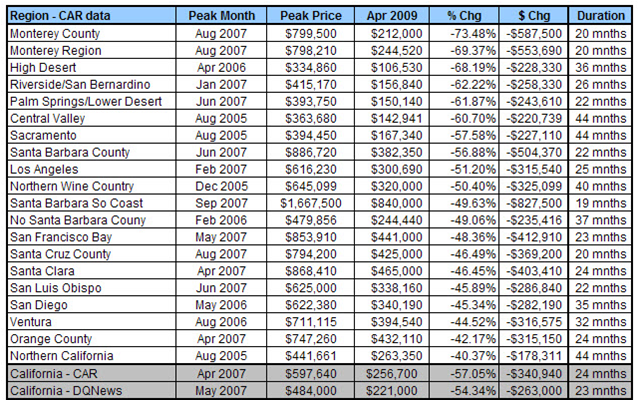
Home Prices Down Dramatically from Peak
Wade W. Slome, CFA, CFP www.Sidoxia.com




 Investing Caffeine
