Ron Baron Swinging for Long Term Home Runs
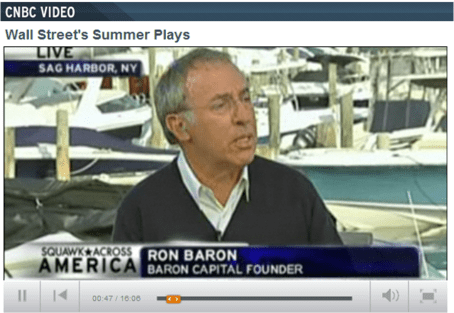
Growth Guru Ron Baron
Click Here to Watch Ron Baron CNBC Interview
The CNBC interview is a tad long with the first eight minutes better than the last eight. I can’t say I agree with a lot of his political rants, but his long-term success (BPTRX) is difficult to argue with despite his challenging track record over the last few years.
Ron Baron is considered one of the greatest growth investors of all-time, but unlike many of his modern growth peers he chooses not to play the quick trigger, momentum-based, “buy high, sell higher” strategy that merely purchases what’s working and sells what’s not. Rather he is investing in growth businesses that create long-term value, and focusing on those securitities trading at attractive prices. Seems like a very reasonable strategy to me, and an approach other historic investors like Peter Lynch followed. Like Lynch, Baron appreciates the impact of long-term home run stocks (Lynch called them “multi-baggers”). For example, in the interview Baron talks about the 30x return he earned on his Devry (DV) investment from the early 1990s; his 50x return on Charles Schwab (SCHW) from 1990; or Manor Care, up 100x from 1969 to its acquisition. Lynch enjoyed similar successes, but had an itchier trading trigger finger – his multi “bucket” strategy was quite unique (another day, another blog post).
When it comes to passive investing, Ron Baron like other active fund managers discredits the powers of index investing:
“With index funds, you are going to be investing in the most successful businesses at that point in time, and at the top of the market you will be massively over-weighted in those companies.”
Like the scarce number of .300 hitters in baseball, I believe there are a select few investment managers who can consistently outperform the market (a study in 2007 showed only 12 active career .300 hitters in Major League Baseball). I believe Baron is one of those .300 hitters in the investment world. The problems with analyzing manager performance are luck and “law of large numbers.” These phenomena wreak havoc on the examinations of short-run performance. The wheat ultimately gets separated from the chaff over the long-haul, but with the “Great Recession” of 2008-2009, many long-term investors are still hiding or shaking in their boots.
Ultimately, I believe the horse trading game of actively managed funds is a tough game to win. Most investors end up chasing performance and rotating in and out of positions at the wrong times. Nonetheless, Ron Baron has proved his ability to generate above average returns over the long haul. Taking a swing with Ron Baron might not be a bad idea.
Wade W. Slome, CFA, CFP
Plan. Invest. Prosper.
Ooops…Siegel Data Questioned

Professor Jeremy Siegel is well-known in large part due to his famed book, “Stocks for the Long Run,” which Siegel uses as a foundation for his assertion that stocks have dramatically outperformed bonds since 1802. Siegel has four versions of his book, but the basic conclusion is that stocks have averaged about a 7% annual return (approximately 10% after accounting for inflation) versus around 4% for bonds, over a two hundred plus year timeframe. One problem – the validity of 69 years of the data (1802 – 1870) are now being questioned.

Any Utopian study or mathematical model is only as valuable as the data that goes into it. “Garbage in” will result in “garbage out.” According to a Wall Street Journal article (Does Stock-Market Data Really Go Back 200 Years?) written by Jason Zweig, the index data used by Siegel was too narrow on an industry basis and involved too few stocks (e.g., primarily banks, insurance and transportation stocks). In addition, the reliability of the conclusions is being second guessed because the data used by Professor Siegel starting back as far as 1802 were compiled decades ago by two separate economists, Walter Buckingham Smith and Arthur Harrison Cole.
According to Zweig, another area of concern is the fluctuating dividend yield used by Professor Siegel:
In an article published in 1992, he estimated the average annual dividend yield from 1802-1870 at 5.0%. Two years later in his book, it had grown to 6.4% — raising the average annual return in the early years from 5.7% to 7.0% after inflation. Why does that matter? By using the higher number for the earlier period, Prof. Siegel appears to have raised his estimate of the rate of return for the entire period by about half a percentage point annually.
I’m sure Professor Siegel has a rebuttal to all these accusations, but we’ll just have to wait and see how credible the response is. Maybe Siegel’s next book will be entitled, “Bonds for the Long Run”?
Wade W. Slome, CFA, CFP®
Plan. Invest. Prosper.
DISCLOSURE: Sidoxia Capital Management (SCM) and some of its clients own certain exchange traded funds, but at the time of publishing SCM had no direct position in any other security referenced in this article. No information accessed through the Investing Caffeine (IC) website constitutes investment, financial, legal, tax or other advice nor is to be relied on in making an investment or other decision. Please read disclosure language on IC “Contact” page.
Pinning Down Roubini Requires a Lasso

Pinning down a Nouriel Roubini forecast is like lassoing a frenzied cow. They say a broken clock is right twice a day, and maybe the same principle applies to renowned economist, Professor Roubini (NYU)? Sure, credit should be given where credit is due. He nailed the forecast relating to the housing led financial bubble and subsequent financial collapse – even if the prediction was years early.
Here’s where I have a beef. Now that Roubini has become a celebrated rock star with frequent television interviews and speaking engagements, his touring views are becoming more fluid and slippery as time progresses. Sure it’s more comfortable to ride the fence and lean in whatever direction the weekly economic winds are blowing. I suppose if you throw out enough changing viewpoints, which adjust to evolving moods, you can never be wrong.
Let’s examine some of his views:
- Out of Context: Just last week, Mr. Roubini said the “worst is behind us,” but in order to retain his “Dr. Doom” celebrity status he felt compelled to issue a press release clarifying his statements. He noted his “views were taken out of context,” and added, “I have said on numerous occasions that the recession would last roughly 24 months.” That’s funny, because he just stated last year it would be 12-18 months (Click Here for Video).
- Sweating Out Rebound: Maybe the 41% bounce in the S&P 500 or the 49% jump in the NASDAQ from March 9th lows compelled Roubini to make the “worst is behind us” comments, but why then at the beginning of this year did he say, “We are still only in the early stages of this crisis. My predictions for the coming year, unfortunately, are even more dire: The bubbles, and there were many, have only begun to burst.” Hmmm…excuse me while I scratch my head.
- Alphabet Soup Recovery: Also frustrating are the John Kerry-esque waffling comments relating to whether this economic recovery will be a U, W, or L-shaped economic recovery. Last April he was in the U-camp: “My view is closer to a U-shaped recession as I expect that the economic contraction will last at least 12 months and possibly as long as 18 months through the middle of 2009.” Now, as early as last month Roubini is warning of a double dip or “W-shaped” recovery with the rising possibility of a “perfect storm” in 2010 (Click Here for Video). He sees the expiration of tax cuts, rising oil prices, inflating debt and interest rates leading to another downturn. So is it U or W, or will we hear more about an “L” shaped recovery? Maybe the worst is not behind us? I’m confused.
- Doomsday Earnings Yet to Arrive: Still early in the quarterly earnings reporting season but Roubini’s call for a downside in corporate earnings has yet to materialize. As a matter of fact, Zacks Investment Research reported last week that early second quarter upside surprises are beating downside surprises by a ratio of 7 to 1. So far not too “Doom-full.”
I’m no economist or recovery expert, but what I do know is that I’m having difficulty pinning down Professor Roubini’s ever-changing views. I suppose I will just mail CNBC, Bloomberg, or the bevy of other Roubini media groupies a lasso in hopes they will pin Mr. Roubini down.
Wade W. Slome, CFA, CFP®
Wade W. Slome, CFA, CFP®
Plan. Invest. Prosper.
DISCLOSURE: Sidoxia Capital Management (SCM) and some of its clients own certain exchange traded funds, but at the time of publishing SCM had no direct position in any other security referenced in this article. No information accessed through the Investing Caffeine (IC) website constitutes investment, financial, legal, tax or other advice nor is to be relied on in making an investment or other decision. Please read disclosure language on IC “Contact” page.
The China Vacuum, Sucking Up Assets

That's not Hoover making that sucking noise - it's China
Shhh, if you listen hard enough you can hear a faint sucking sound coming from the other side of the Pacific Ocean. In the midst of the greatest economic collapse since the Great Depression, China is rolling around the globe sucking up international assets as if it were a Hoover vacuum cleaner. As a member of the current account and budget surplus club, China is enjoying the membership privileges. Evidence is apparent in several forms.
Most recently, Chinese state oil and gas company, Sinopec (China Petrochemical Corporation) has bid close to $7 billion for Addax Petroleum, an oil explorer with significant energy assets in the Kurdistan region of northern Iraq.
Another deal, newly announced not too long ago, occurred on our own soil when another Chinese company (Sichuan Tengzhong Heavy Industrial Machinery Co.) made a bid for the ailing Hummer unit of bankrupt General Motors. Just as we have begun exporting our obesity to China through McDonald’s and KFC, now we are sharing our lovely gas guzzling habits.
In May, The Wall Street Journal reported the following:
Chinese companies and banks have also agreed to a string of credit and oil supply deals worth more than US$40 billion with countries such as Brazil, Russia and Kazakhstan, in line with efforts to secure its energy supply.
Beyond the oil markets, China is also hungry for other hard assets. The failed $20 billion investment in Chinalco (Aluminum Corporation of China) by Rio Tinto garnered a lot of press. But other deals are making headlines too. Metallurgical Corp. of China Ltd. (MCC) is planning a $5.15 billion thermal coal project in Queensland state, Australia in conjunction with Waratah Coal Pty Ltd. China has a voracious appetite for coal -its coal imports are estimated to surpass 50 million tons in 2009.
Cash is king, especially in crises like we are experiencing now, however we want to be careful that we don’t give away the farm out of desperation. Making tough decisions to preserve assets, like cutting expenditures and expenses, is a better strategy versus making fire sale disposals of crown jewels. Becoming energy independent and investing in environmentally sustaining technologies will serve our long term economic interests better as well.
If we’re not careful, that active Chinese Hoover vacuum cleaner is going to come over to our home turf and suck up more than just our loose change.
Wade W. Slome, CFA, CFP®
Plan. Invest. Prosper.
*DISCLOSURE: Sidoxia Capital Management (SCM) and some of its clients own certain exchange traded funds, RTP and was short MCD, but at the time of publishing SCM had no direct position in YUM, Sinopec (China Petrochemical Corporation), Addax Petroleum, Chinalco (Aluminum Corporation of China), Metallurgical Corp. of China Ltd. (MCC),Waratah Coal Pty Ltd or any security referenced in this article. No information accessed through the Investing Caffeine (IC) website constitutes investment, financial, legal, tax or other advice nor is to be relied on in making an investment or other decision. Please read disclosure language on IC “Contact” page.
PPIP Becomes Miniaturized “Mini Me”

Mini-Me and Dr. Evil from famed Austin Powers movies
In two of Mike Myer’s Austin Powers movies, Verne Troyer plays Dr. Evil’s miniature clone, Mini-Me. At a “breathtaking” one-eighth the size of the fully-sized villain, Mini-Me didn’t quite pack the same evil punch as his surrogate daddy, Dr. Evil. The same can be said of the government’s PPIP (Public Private Investment Program), which was originally designed to unclog the financial system by removing toxic and illiquid investments from owners desiring liquidity.
Unfortunately, the PPIP size has been reduced to ppip dimensions. The Fundamental Analyst (FA) blogger (www.fundamentalanalyst.com) points out that the program’s scope has likely shrunk to $100 billion from the original goal of $1 trilllion – a proportion even smaller than Mini-Me’s relative size to Dr. Evil. Treasury Secretary Timothy Geithner’s explanation for the decline in program size is due to the improving financial market conditions and the capital raising activities of the banks. Perhaps partially true, but “not so fast” says FA – he blames the suspension of mark-to-market accounting as the driver for positive overstated banking earnings, which allowed the banks to hoodwink investors and raise capital under false pretenses.
Read the Fundamental Analyst’s Article on PPIP Here
FA goes onto highlight what little skin the participants (including, AllianceBernstein, BlackRock, Invesco, Oaktree Capital Management, TCW Group, and Wellington Management) have in the game relative to the other 93% of capital fronted by the taxpayers. I agree – the surplus taxpayer exposure is evil. Time will tell how effective the Mini-Me ppip program will be…

Original PPIP plan drawn up by the Financial Times
Leveraged ETFs…Too Much Adrenaline?

Do we really need extra levered ETF risk?
Isn’t the market volatile enough without leverage? I believe the vast majority of individuals have plenty of adrenaline in their daily investment lives without the necessity of exotic inverse ETFs (Exchange Traded Funds) or other leveraged investment vehicles. FINRA (Financial Industry Regulatory Authority), the largest regulating body overseeing U.S. securities firms feels much the same way. Many of these ETFs seek to earn a daily return double or triple a designated index – the inverse instruments strive to mirror the return in the opposite direction.
Read WSJ Article (FINRA Urges Caution on Leveraged Funds)
No doubt, many exchange traded funds have some key advantages over actively managed mutual funds such as lower costs, tax efficiency, and improved liquidity; however most investors have no business in trading these crazy leveraged gimmicks. For example, I wouldn’t recommend average investors speculating in the Direxion 3X Inverse Financial Bull (FAS) ETF, which was down more than 95% in its first four months of existence. Do yourself a favor and heed the advice of stuntmen that advise, “Please, do not try this at home.”
FINRA conveyed this sentiment in a recent notice:
“While such products may be useful in some sophisticated trading strategies, they are highly complex financial instruments that are typically designed to achieve their stated objectives on a daily basis. Due to effects of compounding, their performance over longer periods of time can differ significantly from their stated daily objective.”
The Wall Street Journal article goes on to show a return example of how three different funds performed (vanilla index fund, double long fund, double inverse fund) under alternating positive and negative +/-10% day scenarios. After 60 days of alternating up +10% and down -10% on an initial investment of $100, the index fund ended at a value of $40.47 while the double inverse funds finished worth a meager $2.54 each. The example proves that the correlation between the leveraged ETF and the underlying target index can vary dramatically when invested for longer periods than a day.
These levered products make for excellent brokerage and trading software commercials, but rather than getting sucked in to talking baby traders and fast moving graphics, the average day trader or casual investor would be better served by bungee jumping or sky diving to get their adrenaline fix.
Wade W. Slome, CFA, CFP®
Plan. Invest. Prosper.
DISCLOSURE: Sidoxia Capital Management (SCM) and some of its clients own certain exchange traded funds, but at the time of publishing SCM had no direct position in FAS, or any other security referenced in this article. No information accessed through the Investing Caffeine (IC) website constitutes investment, financial, legal, tax or other advice nor is to be relied on in making an investment or other decision. Please read disclosure language on IC “Contact” page.
UFC 100 Lesnar-Mir: Pro Fighting or Cockfighting?

Brock Lesnar vs. Frank Mir
“Mayhem” may be the best word to describe UFC 100 – the mixed martial arts (MMA) event held in Las Vegas on July 11th was attended by 11,000 wound up fans. Regardless of the controversy related to the brutality of the sport – John McCain at one point called it “human cockfighting” – people are opening their wallets up in droves to watch these roided beasts bludgeon each other for $44.95 on Pay-Per-View.

In the Heavyweight class Brock “The Next Big Thing” Lesnar, a 6’3” – 265 pound monster destroyed his lesser foe Frank Mir in two rounds. For his winning demolition, Lesnar is estimated to rake in more than $2 million for his two round mauling. Despite Mir’s earlier victory over Lesnar, he earned a shockingly low $45,000 for the main event. With over $5 million collected from the gates in Las Vegas, an estimated 1.5 million Pay-Per-View watchers, and key advertisers like Bud Light and Harley Davidson, UFC executives had a little loose change to pay the stable of barbarian fighters.
After walloping Mir and flipping two prominently displayed birds (i.e., middle fingers) to the Las Vegas fans, Lesnar also KO’d UFC sponsor Bud Light by saying he was thirsty for a Coors. Lesnar held a grudge because he was not compensated for his victory by Bud Light. As the old saying goes, “There is no such thing as bad publicity.” Well, we’ll have to wait and see what impact Lesnar’s shenanigans will have on future UFC sponsorships.
Debate still lingers on whether MMA will go mainstream, and based on the force of this juggernaut, I would have to say the Magic 8-ball says the “Possibilities are strong.” Not only has 60 Minutes done a story on UFC here in the states, but the popularity of the sport is spreading rapidly globally. Evidence includes the beaming of the live fights to 75 countries and the large 20-member Japanese media group that travelled to Nevada to follow UFC star Yoshihiro Akiyama.
Whether you agree with the raw violence of the sport or not, there is no denying the momentum of this express train. UFC has come a long way in a relatively short period of time. UFC President Dana White and business partners purchased UFC in 2001 for $2 million – CNBC estimates the value of the company at $1 billion today. The IPO markets have been pretty stingy of late, but with a few more successful events like UFC 100, don’t be surprised to see Dana White offering shares via a road show through your local financial center. If Lesnar gets a cut of the shares, he might even celebrate the IPO with a swig of Bud Light.
Are Two Stimulus Packages Really Enough?

Plenty of talk of a 2nd stimulus adrenaline shot.
Am I the only one getting nauseated with all this debate regarding another potential stimulus package? Laura Tyson (Obama advisor), James Galbraith (collegiate professor), Paul Krugman (economist), and Warren Buffett, among other pundits, have recently suggested that the current multi-hundred billion plan doesn’t pack enough punch. I think I’m going to jump in front of all these experts and start screaming for a 3rd stimulus package. Why stop at two when we can just print some more money.
Isn’t the gargantuan $11 trillion in debt and massive projected $1.8 trillion budget deficit large enough? Call me crazy, but if we currently have only spent 10% of the current $787 billion package, then shouldn’t we focus on spending the other $700 billion first before we plan a 2nd stimulus and choke our children and grandchildren with $100s of billions in additional debt. Judging by the slow implementation of stimulus disbursements and spending, I guess we still need to buy all the shovels at The Home Depot before all the “shovel-ready” projects commence.
Click Here for Bloomberg Interview with James Galbraith
Here’s another thought – perhaps we can cut wasteful inefficient spending that has grown out of control and invest those dollars into innovative research and education. Investing into the brainpower of our country will create jobs now and even higher paying ones in the future. Of course cutting spending (and jobs) doesn’t get you more votes and lobbyists are quick to remind our elected officials of this fact. We live in a society that desires instant gratification, but before lurching into a panicked state let’s collectively take a deep breath and realize this economic mess took us a while to get into and therefore will take a while to get out.
Rather than spending more in additional stimulus, possibly the current spending programs can be more efficiently prioritized. Not all spending is created equally, and therefore temporarily stuffing our houses with more cars, TVs, and clothing probably is not going to sustainably grow our economy in a country dealing with harsh realities. For example, globalization, energy dependence, and escalating healthcare costs are just a few issues that our nation needs to address.
If none of these ideas seem to gain traction, then you can join me at the trough in a push for a 3rd economic stimulus.
Wade W. Slome, CFA, CFP® www.Sidoxia.com
DISCLOSURE: Sidoxia Capital Management and client accounts do not have direct positions in BRKA/B or HD at the time the article was published. No information accessed through the Investing Caffeine (IC) website constitutes investment, financial, legal, tax or other advice nor is to be relied on in making an investment or other decision. Please read disclosure language on IC “Contact” page.
Cash Strapped Bond Issuers Should Follow Willie Sutton
![940614_83408820[1]](https://investingcaffeine.com/wp-content/uploads/2009/07/940614_834088201.jpg "940614_83408820[1]")
When infamous bank robber Willie Sutton was asked why he robs banks, he coyly responded, “Because that’s where the money is.” Willie Sutton was one of the more prominent bank robbers in American history. During his long career he had robbed close to 100 banks from the late 1920s to 1952. He was known as “Slick Willie” or “The Actor.” As a master of disguise the FBI files show that Sutton masqueraded himself as a mailman, policeman, telegraph messenger, maintenance man and a host of other personas. The Credit Default Swap market has also been disguised in mystery and opaqueness.
With many cash strapped bond issuers looking for ways to negotiate more favorable credit terms during these tough economic times, one strategy has been to approach holders of the CDS instruments. However, CDS holders have no reason to negotiate with corporate bond issuers (for pennies on the dollar) when they stand to collect a full dollar from their bank (due to terms in the CDS contracts). Cash starved corporations rather should listen to Willie Sutton and go straight to the money source – the banks that issued the CDS to the investors. As bankruptcies increase, and bank failures rise, the trio of bond holders, bond issuers, and CDS issuers (banks) will become closer friends (and/or enemies).
Research Reloaded delved more into this issue by discussing the tactics used by media companies, Gannett and McClatchy (Read Article Here). Lots of wrinkles need to be ironed out in the CDS market, measured in the tens of trillions in notional value, but part of the solution involves the bond issuer and investor going straight to the money source (the bank issuer of the CDS). Willie would be proud.
Wade W. Slome, CFA, CFP® www.Sidoxia.com
Treasury Bubble Hasn’t Burst….Yet

10-Year Treasury Chart (5-14-09)
Clusterstlock’s Joe Weisenthal’s takes a historical look on 10-year Treasury yields going back to 1962. As you can see, the yield is still below 1962 levels, despite the massive inflationary steps the Federal Reserve and Treasury have taken over the last 18 months (6-26-09 yield was 3.51%). These trends can also be put into perspective by reading Vincent Fernando’s post at http://www.researchreloaded.com. Take a peek.
Ways to take advantage of this trend include purchases of TBT (UltraShort 20+ Year Treasury ProShares) or short TLT (iShares Barclays 20+ Year Treasury Bond)*.

Reverse View of Historical 10-Year Treasury Yield
*Disclosure: Sidoxia Capital Management clients and/or Slome Sidoxia Fund may have a short position in TLT.




 Investing Caffeine
