Business Theory: Voodoo or Value?

Michael E. Porter, a former aeronautical engineer graduate turned Harvard Economics PhD professor, came out with a revolutionary article thirty years ago (How Competitive Forces Shape Strategy) in which he describes the Five Forces of competition that shape the profitability dynamics of an industry. Since then, Porter’s management theories have continued to spread and his knowledge is continually sought after. Some people believe Porter’s Five Forces, and other management business theories, are pure voodoo.
In a recent HBR (Harvard Business Review) article, Andrew O’Connell completed a book review of The Management Myth: Why the “Experts” Keep Getting it Wrong written by Matthew Stewart, a former consultant. Mr. Stewart (a former consultant turned non-believer) exposes the sham of the business consulting industry by outlining the outrageous fees paid by clients and the “mumbo-jumbo” language spouted out by newly minted MBAs.
In a similarly titled article (the Management Myth) written in 2006, Mr. Stewart goes on to say:
“The impression I formed of the M.B.A. experience was that it involved taking two years out of your life and going deeply into debt, all for the sake of learning how to keep a straight face while using phrases like “out-of-the-box thinking,” “win-win situation,” and “core competencies.”… M.B.A.s have taken obfuscatory jargon—otherwise known as bullshit—to a level that would have made even the Scholastics blanch.”
Some other interesting comments include his views on failing companies:
“In fact, we kind of liked failing businesses: there was usually plenty of money to be made in propping them up before they finally went under. After Enron, true enough, Arthur Andersen sank. But what happened to such stalwarts as McKinsey, which generated millions in fees from Enron and supplied it with its CEO?”
Too often with many books, a silver bullet or holy-grail is searched for. The true answer – there is no easy solution. I believe tools or frameworks, like Porter’s Five Forces, can create significant benefits by forcing practitioners into thinking about competition and profits in new ways. Although the lessons may not be worth millions in consulting fees, the education may be worth the $21.95 cost of a book (including free shipping) from Amazon. Mr. Stewart would likely take umbrage with these views, especially since I have an MBA from Cornell.
Wade W. Slome, CFA, CFP®
Plan. Invest. Prosper.
Social Media Revolution Taking Over World

When I speak of revolution I’m not talking about religion, politics, or wars; rather I am talking about “social media.” Should I care that Ashton Kutcher and Ellen DeGeneres have more twitter followers than the populations of Ireland, Norway, and Panama? Some say social networking is just a fad, but if you blindly sit along the sidelines, the whole world may pass you by in a blink of an eye. Erik Qualman, author of the book and blog Socialnomics, has a must see video that details the revolutionary growth of social media and explains how it is changing the world.
Ever since the early 1900s when the commercialization of radio took hold, millions of people were able to connect all over the world through the spread of technology – in this case the spread of AM (Amplitude Modulation) and FM (Frequency Modulation). Other technologies, such as the telephone, television, and now the internet, have also allowed people to connect. Mr. Qualman details how social media is spreading faster than ever.
Through a chain of details, Qualman highlights the following facts: the invention of the radio took 38 years to reach 50 million users; the television 13 years; the internet 4 years; and the iPod 3 years. Pretty staggering figures until you realize it only took less than 1 year – actually 9 months – for Facebook to add 100 million users! We know the trend is real when my mom (in her seventies) asked me last week how she can register on facebook. Currently, the 55-65 year old female segment is the fastest growing member segment on facebook.
Facebook is just one of many social media networks, which includes twitter, orkut, bebo, flickr, digg, myspace, YouTube, and countless others. The networks are expanding at break-neck speed, and the types of networks are becoming more focused and strange (for example, Spot-a-Potty, or Weird Beard).
Regardless of your view – fad or revolution – the younger generation is consuming more of it. It doesn’t take a genius to follow consumers where they are spending more time. The smart advertisers and businesses are moving to where the action is. As Mr. Qualman notes, Generation Y (the so-called “Echo-Boomers) already outnumbers the Baby Boomers – hmmm, I think advertisers are slowly getting the picture. Investors should be paying attention too. I am investing my own money (and my clients’) in areas like these, where I see companies benefitting from technological change. If pushed to make a choice regarding social media, I pick revolution over fad.
Wade W. Slome, CFA, CFP®
Plan. Invest. Prosper.
DISCLOSURE: At the time of publishing, Sidoxia Capital Management and some of its clients owned certain exchange traded funds, AAPL, and GOOG, but had no direct positions in twitter, Facebook, orkut, bebo, flickr, digg, myspace, or any other security referenced. No information accessed through the Investing Caffeine (IC) website constitutes investment, financial, legal, tax or other advice nor is to be relied on in making an investment or other decision. Please read disclosure language on IC “Contact” page.
Technology Does Not Sleep in a Recession

Our economy may be coming out of a long economic hibernation; however technology does not sleep through a recession. Gordon Moore, co-founder of Intel Corporation, has proven this trend true through his groundbreaking piece written in the April 1965 issue of Electronics Magazine. In the article Mr. Moore predicted transistor densities would double about every two years (“Moore’s Law”). Transistors can be thought of as the brains of electronics devices, and the industry (Intel and other semiconductor manufacturers) has been boosting the brain power of electronics for decades. How far has the industry come? The number of transistors contained on a chip has gone from 16 in 1960s to over 600 million today – now that’s what I call progress!
These achievements have been nothing short of revolutionary, and many people consider the introduction of the transistor as the greatest invention of the 20th century. According to many industry experts, Mr. Moore’s forecasts have been shockingly accurate and many believe “Moore’s Law” will hold true for years to come – despite challenging technological limitations.

Source: The Financial Times
We may curse at our computers (I absolutely despise Vista), but there is no arguing with the huge productivity and standard of living improvements we have experienced over the last forty years – since the introduction of the transistor. Many take their GPS, Tivo, WiFi laptop, iPhone, and HiDef TVs for granted, however I for one thank Gordon Moore and those diligent engineers for making my geeky tech dreams come true.
However the cost of further advancements is becoming pricier. As line widths (the ability to add more transistors) narrow, the costs of building fabrication plants (“fabs”) with the necessary equipment are running in the multi-billion range. The Financial Times (FT) article talking about semiconductor trends mentions a $4.2 billion state-of-the-art factory in upstate New York that is just beginning construction. The FT notes that only two players (Intel and Samsung) have firm plans to build 20 nanometer fabs. For comparison purposes, one nanometer is equal to one-billionth of a meter and a human hair is 100,000 nanometers wide. In other words, a nanometer is pretty darn tiny. To further illustrate the point, Intel has managed to fit up to 11 Intel Atom processors – each packed with 47 million transistors – on the face of an American penny.
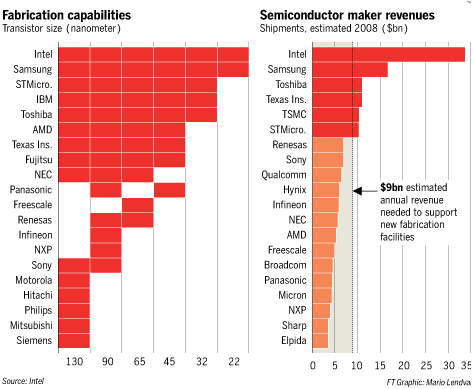
Source: The Financial Times
As the chip making industry become more costly, fewer semiconductor manufacturers will be playing in the sandbox:
“Intel argues that only companies with about $9bn in annual revenues can afford to be in the business of building new fabs, given the costs of building and operating the factories and earning a decent 50 per cent margin. That leaves just Intel, Samsung, Toshiba, Texas Instruments and STMicroelectronics.”
The economy may still be in the doldrums, but the $60 trillion global economy (as measured by Gross Domestic Product) never sleeps – technologies created by Gordon Moore and others continue to propel amazing advancements.
Wade W. Slome, CFA, CFP®
Plan. Invest. Prosper.
Walking Down “Money Honey” Memory Lane

Don’t shoot the messenger, even if it means walking down “money-honey” memory lane. Maria Bartiromo has been a staple for business television viewers since she joined CNBC in 1993. The broad hair-styles of Maria Bartiromo, ranging from the “Tease” and “Business Mullet” to the “Classic” and the “Librarian,” have been more volatile than the CBOE Volatility Index (VIX). Word has it that the Chicago Mercantile Exchange (CME) is working on a hair futures contract, designed to hedge against potential price spikes in the hairspray market.
Click Here For Clusterstock’s Random Walk Through Bartiromo’s Hairstyles
To avoid any sexist comment critics, and if there are enough requests, I will submit a “dew dude” montage of Wade Slome’s past cranial mop designs. For those outraged by the hair-dew review, rest assured knowing Mrs. Bartiromo has been quoted as saying, “Frankly, I’m flattered” by the “money-honey” reference.
Like a day trader adapting to the changing markets, Mrs. Bartiromo has shown tremendous versatility in adjusting to the ever-changing business style demands. Some may debate whether her journalistic intensity has kept pace with the times. Change is a constant when considering financial markets and hairstyle trends – I’ll be watching Mrs. Bartiromo work her craft in both areas.
Wade W. Slome, CFA, CFP®
Plan. Invest. Prosper.
Tortuous Path to Productivity

There is a silver lining to the deep, tortuous job cuts in this severe recession and it is called “productivity.” Those fortunate enough to retain their jobs are forced to become more productive. In layman’s terms, productivity simply is output divided by hours worked.
Unemployment dropped to 9.4% in July, thanks in part to a decline in the job losses to -247,000 from a peak in January of -741,000 job losses. During this period of job-loss cratering, we managed to sustain a decline of a mere -1% in Q2 Gross Domestic Product (GDP). How could we lose more than 6 million jobs since the beginning of 2008 and still be on a path to recovery? A large contributor is our friend, productivity, which came in at a whopping +6.4% in Q2 – the highest in six years.
Productivity increased in part because of a slashing of work-hours by employers. Employees that have maintained employment are therefore forced to produce more output (goods and services) per unit hour of employment. In this severe recession that we are pulling out of, the American worker is being stretched like a rubber band. At some point, the “Law of Diminishing Returns” kicks in and employers are forced to hire new employees to meet demand levels, or the rubber band will snap.
The prime ways of increasing productivity are raising the amount of capital per worker (capital intensity) and also elevating the workers’ average level of skill, education, and training (labor quality).
Not only are the surviving U.S. workers toiling harder, they are not getting pay increases large enough to offset inflation. For example, Q2 hourly compensation increased +0.2%, but after accounting for inflation, real hourly compensation was actually down -1.1%.
As the MarketWatch article points out:
The early stages of recovery are typically the best for productivity: Output is rising, but cost-cutting plans are still being implemented… Productivity gains are the key to higher living standards, higher wages, increased profits and low inflation… Productivity averaged about 2.7% annually from 1948 to 1970, then slowed to 1.6% from 1971 to 1995. Since then, productivity has grown about 2.5% annually. In 2008, productivity increased 1.8%.
Productivity allows the U.S. to produce more goods and services with fewer workers. For instance, the MarketWatch article also highlights the U.S. is producing 20% more output relative to a decade ago, yet employment has not changed at all over that time period.
We are certainly not out of the woods when it comes to the recession, and for those lucky enough to maintain employment, they are being asked (forced) to work more for less pay. These productivity improvements feel like torture to the survivors, however this pain will eventually lead to economic gain.
Wade W. Slome, CFA, CFP
Plan. Invest. Prosper.
Buffett Sells Insurance: Weapons of ANTI-Destruction

Writing Options is the Opposite of Mass Destruction
Those same “Weapons of Mass Destruction” that Warren Buffett so ardently warned investors against are the same derivatives that catapulted Berkshire Hathaways (BRKA) Q2 earnings performance. Chris McKhann at OptionMonster summarized Buffet’s moves:
Buffett has sold a large number of puts on four major indexes starting in 2007: the S&P 500, the FTSE 100, the Euro Stoxx 50, and the Nikkei 225. He took in $4.9 billion, with a potential loss of more than $35 billion–but only if all four indexes were at zero come the expiration date (at which point we would be worrying about other things).
Derivatives are like a gun, if used responsibly for gaming or for self-defense, then they can be a useful tool. Unfortunately, like guns, these derivatives are used irresponsibly in many instances. This point is especially true in areas like Credit Default Swaps where there were inadequate regulations and capital requirements to prevent disastrous outcomes (e.g., AIG’s collapse). With proper transparency, capital requirements, and proper regulation, derivatives can be used to manage risk rather than create additional risk.
Although I wouldn’t categorize myself as a value investor like Warren, I would prefer to call myself a growth investor with a value conscience. With that said, if you incorporate valuation within your investment discipline, I believe writing (selling) options is a brilliant idea. I can make this assertion because I’ve used this strategy for myself and my hedge fund. Volatility has a direct impact on the amount of premiums collected; therefore the trading levels of the CBOE Volatility Index (VIX) will have a directly correlated impact on option writing profitability. For example, if I’m selling flood insurance, I’m going to collect much higher rates in the period right after Katrina occurred.
If you are willing to accept free money from speculators betting on short-term swings in prices (Warren sold long-term, multi-year options), while being forced to sell/buy stock at price levels you like, then why not?! However, buying and selling puts and calls is a different game in my book, and one I personally do NOT excel at. I’ll keep to utilizing “Weapons of Anti-Destruction” and collect premiums up-front, like Warren, from speculators and leave the rest of the options strategies to others.
Wade W. Slome, CFA, CFP®
Plan. Invest. Prosper.
DISCLOSURE: Sidoxia Capital Management and client accounts do not have direct positions in AIG or BRKA/B at the time the article was published. Sidoxia Capital Management and its clients do have long exposure to TIP shares. No information accessed through the Investing Caffeine (IC) website constitutes investment, financial, legal, tax or other advice nor is to be relied on in making an investment or other decision. Please read disclosure language on IC “Contact” page.
Bernanke Portfolio Takes Painful Hit

As a former tenured economics professor at Princeton University, I would believe Ben Bernanke would understand and appreciate the power of diversification, but apparently not. The bulk of his $1.2 million to $2.5 million (only a broad range was disclosed) was invested in a large-cap stock fund and a fixed-rate annuity from TIAA-CREF. Some would say his portfolio could use a higher dosage of small-cap, mid-cap, international and alternative asset classes, including real estate. With arguably the highest ranking finance job in the universe, wouldn’t you expect him to have a smoking hot portfolio? The data paints a different picture.
According to publicly disclosed data, Bernanke’s assets were down -29% (about -$600,000) in 2008, better than the S&P 500, but not comparable since his portfolio also included fixed income securities like Canadian treasury bonds and an annuity fund. For whatever reason, the global money czar couldn’t or wouldn’t use his knowledge to outmaneuver the markets. Why didn’t he use the Yen carry trade to buy crude oil up to $140 per barrel, then short emerging markets during 2008 before going long technology stocks beginning on March 9, 2009?
Certainly, Bernanke does not want to create a conflict of interest, whether real or implied. I’m sure Bernanke is not day trading options and shorting levered Exchange Traded Funds (ETFs) on E-Trade, because the headaches it would create for him would undoubtedly outweigh any short-term financial benefits earned from his investment ideas. Even if Bernanke felt he could exploit profit opportunities, the real bucks will come from speaking events and consulting prospects after he leaves his position of Federal Reserve Chairman. If Bernanke does a better job with his portfolio, perhaps he can retire at a younger age…
Read Article on Bernanke Portfolio
Wade W. Slome CFA, CFP®
Plan. Invest. Prosper.
Maher Cheerleads No Profit Healthcare

Bill Maher, shock-comedian and host of Real Time with Bill Maher on HBO, has made up a new rule in a recent article, “Not Everything in America Has to Make a Profit.”
Hey Bill, that sounds intriguing. I’ve got an idea – how about you decide to work for no profit? If free healthcare is a right for every American, then why should people pay for your stupid jokes? If I have a right to free healthcare, then why not a right to free laughs?
Don’t get me wrong, our system is broke and needs to be fixed. The real question, is insuring an additional 50 million uninsured, by the same bureaucratic healthcare system leading the Medicare train-wreck, our best approach in solving our healthcare crisis? Sure, doing nothing should not be a fallback, but I’m not sure a trillion dollar healthcare plan with Washington bureaucrats is the best idea either? I’m not against government involvement, but before we dive headfirst into the deep-end with additional deficit exploding plans, why not wade in the shallow end and slowly roll-out success-based models that prove their superiority first.
I’m no medical expert, but let’s take the best structures, whether it’s the Mayo Clinic, Cleveland Clinic, or other leading structures and have the government manage a steady roll-out. If the government can prove a lower-cost, more efficient way of serving higher quality care, then by all means…let’s see it. Some argue we don’t have time to test new models, well unfortunately our disastrous system took decades to create and a pork-filled bill through Congress is not going to be an immediate silver-bullet for our dire healthcare problems.
Getting back to Mr. Maher’s profit objections on healthcare, I wonder if he’s ever complained or contemplated the innovations created by the profit-laden healthcare system. Whether it’s an MRI, hip replacement, cholesterol drug, cancer test, glaucoma treatment, ADHD medication or the hundreds of other beneficial advancements, maybe Mr. Maher should ask and understand where all these innovations came from? The answer: good old profits that were invested in critical research and development. Without those profits, there would be fewer and less impactful healthcare innovation for millions of Americans.
As for the firemen who do not “charge” or make a profit, I would like to remind Mr. Maher who is paying their fair share for those services consumed by hundreds of millions of Americans – it’s those same “soulless vampires making money off human pain” that you castigate. Profitable corporations are funding those essential government services with tax dollars derived from, you guessed it, profits. If we can find a lower-cost, more efficient way of serving the public services by the government, then as Phil Knight from Nike (NKE) says, “Just Do It!” Unfortunately, I prefer to see some tangible proof first, before spending hundreds of billions of tax dollars.
Healthy Incentives
From an early age, even as babies, we are incentivized for certain behavior. Whether it’s offering M&Ms to potty-train a two year old, or submitting six-figure bonuses to a fifty-two year old for hitting department profit targets, incentives always plays a central role in shaping behavior. Figure out the desired behavior and create incentives for your subjects (and penalties for non-compliance).
As the government comes up with a public solution, I have no problem with Washington pressuring insurance companies and the medical industry to become more efficient and provide a higher threshold of care. I’m confident that structures can be put in place that mitigate conflicts of interest (i.e., pure profit motive), while increasing the standard of care and efficiency. Rewarding the healthcare industry with incentives, rather than just simply beating them over the head with lower reimbursements under a single-payer system, may produce longer-lasting, sustainable benefits.
In certain areas of society, such as policemen/women, firefighters, national defense, and doctors there has always been a view that government is better suited for handling certain services. However, sometimes government does not implement the proper incentive plans, which then leads to bureaucracy, inefficiency, and excessive costs. Eventually, these negative trends overwhelm the system into failure, much like sand grinding engine gears to a halt.
Bill, I appreciate your viewpoint, and I like you would love if everything was free. For starters, I’ll look for your press release announcing the cancellation of your multi-million contract with HBO, closely followed by the revelation of your pro-bono comedy work. Here’s to profitless prosperity.
Wade W. Slome, CFA, CFP®
Plan. Invest. Prosper.
DISCLOSURE: Sidoxia Capital Management (SCM) and some of its clients own certain exchange traded funds, but at the time of publishing SCM had no direct position in NKE, or any other security referenced in this article. No information accessed through the Investing Caffeine (IC) website constitutes investment, financial, legal, tax or other advice nor is to be relied on in making an investment or other decision. Please read disclosure language on IC “Contact” page.
Is Trump’s Business Better than His Hair?

Should Trump's Hair or Business Acumen be Fired?!
Fiery debate still swirls around the authenticity of Donald Trump’s hair (piece), but what about his business acumen? Just this year in February, Trump Entertainment filed for Chapter 11 bankruptcy. Maybe “The Donald” should be “fired?!”
If this was his only economic fatality in Trump’s career, one might cut him a little slack. I however am not enslaved into his glorified status in the media and press. My critical eye lacks the generosity necessary to honor him a free hall pass. When looking at Trump’s career, the tabloids must not forget that Trump’s Taj Mahal Casino was also run into bankruptcy purgatory in 1991. Number #11 must be Trump’s magic number because in less than a year, Trump filed for Chapter 11 on the Trump Plaza Hotel and Casino and Trump’s Castle (March 1992).
Like an infomercial, “But wait, there’s more!” In November 2004, Trump Hotels & Casino Resorts Inc. filed for Chapter 11 bankruptcy. This company reemerged out of bankruptcy as a new operating company, Trump Entertainment Resorts Inc., only to…you guessed it, file bankruptcy again. I think I see a pattern here.
With the vast bankruptcy experience Trump holds and with him and his daughter Ivanka Trump quitting from Trump Entertainment earlier this year, Donald is now trying to scoop up this company for a $100 million steal. The bankruptcy court and creditors will determine if it’s a fair deal. If not approved, rest assured, Donald will have an extra $100 million to spend wisely – possibly building another company into bankruptcy failure or perhaps…better hair care?
Wade W. Slome, CFA, CFP®
Plan. Invest. Prosper.
How Sweet it Is: Sugar Prices Near 30-Year High
The Cap'n Hangin' with the Crunch Berry Beast
The cost of a sugar coma has gone up, making my Cap’n Crunch with Crunch Berries craving a pricier endeavor. It’s seems like almost yesterday when I was crouched over my sugar cereal on a Saturday morning watching cartoons – hey wait, maybe that was last weekend? Regardless of the timeframe, prices for sugar have not been this high since Coke and Pepsi used sugar, rather than corn syrup, in their 1970s formulations and Cuba was the world’s largest sugar producer.
What’s the reason for the +67% price rise in sugar this year*? There are several reasons:
1) Disappointing Crops: India is the largest consumer of sugar at 23.5 million tons and a very significant producer of the sweetener. Due to deficient rainfall in the northeast and southern regions in India (caused in part by El Niño conditions), the country is estimated to need more than double the imports of the good this year. Disappointing crops in Brazil have also contributed to the tightening global supply. India and Brazil account for about 40% of global sugar supplies.
2) Forward Buying / Hedging: The supply-demand dynamics of the sugar market have caused certain high sugar-consuming countries, like Egypt and Mexico, to buy large stockpiling purchases – further pushing up prices. Beyond consumer and speculators, global food and beverage companies from the likes of Kraft, General Mills and ConAgra Foods have been purchasing futures to hedge the risk of additional price hikes.
3) Oil Increase Buoys Ethanol: Oil’s +59% price increase this year to about $70 per barrel has provided additional price support through increased demand for sugar-based ethanol.
Weather, oil demand, and sentiment may change thereby easing the cost burden of higher priced sugar goods, but irrespective of sugar prices you can rest assured my Cap’n Crunch with Crunch Berries addiction will remain resilient.
*Source: The Financial Times (8-7-09).
Read Financial Times Article on Sugar Here
Wade W. Slome, CFA, CFP®
Plan. Invest. Prosper.




 Investing Caffeine
