Gold Market Lunacy Kicking Into Gear

So wait a second, let me get this right. A company pays billions of dollars to buy insurance, and then decides to sell $3.5 billion in dilutive ownership rights (current stockholders losing more than 10% of their ownership) so that they can pay somebody else another $5.6 billion to take that same insurance they previously loved away. In my book, I call that lunacy. This madness is exactly what Barrick Gold (ABX) just decided to do. The world’s largest gold miner issued approximately 95 million common shares at $37 per share to remove gold price hedges (used to lock in gold prices at a certain level), so if gold prices spike Barrick will now be able to participate fully without the drag of the hedges.
Effectively, management has decided to turn the mining company into a Vegas casino, where shareholders can now freely speculate in the price of gold without the volatility reducing hedges in place. Does this outlandish behavior signal a top in gold prices (now hovering around $1,000 per ounce)? I’m not stupid enough to call the end of frothing, speculative behavior – just witness Alan Greenspan’s “irrational exuberance” speech in 1996 when the NASDAQ traded at 1,300 (then went on to peak above 5,000). But what I am bold enough to do is call a spade a spade and to point out how ridiculous this reverse hedging activity is.
Other signs of speculation beyond the 4x price increase over the last 8 years or so, is the fact that gold prices have risen in the face of incredibly weak gold jewelry demand, -22% year-over-year globally in Q2 according to the Gold Demand Trends. This leaves the remaining demand coming largely from speculators and global central banks. If you need more evidence for the gold speculation, just turn on your local AM radio station and listen for the endless number of get-rich-quick on gold advertisements – some stations need to fill the gaping hole once held by those advertisers hawking mortgages.
From a gold investors’ perspective, I would say I fall more into Warren Buffett camp of thinking. Unlike other commodities (some of which I believe will be driven upwards by my emerging market demand and other forces) , gold is something dug up from the dirt in South Africa, melted, transported to another hole, buried in the ground (central bank), and then storage costs are incurred to guard the shiny metal. Sure, jewelry and small commercial applications are drivers for real demand, but the majority of demand is derived from intangible desires. Other commodities, for example oil, copper, uranium, and natural gas offer a lot more utility.
So what’s next when it comes to the price of gold? Peter Schiff an uber-gold bull broker at Euro Pacific Capital believes Armageddon is coming for the U.S. economy and hyper-inflation will drive gold upwards to the $4,000 per ounce price range (See How Peter Schiff’s Other Forecasts Have Performed). Another possibility to consider is a complete collapse in gold prices (and surge in the dollar) like we saw in the early 1980s after Paul Volcker raised interest rates and gold prices did not appreciate for a 25 year period. Hmmm, I wonder what direction interest rates are going next with the Federal Funds rate currently at effectively 0%? Could we see a repeat of the early ‘80s? Seems like a possibility to me. Certainly if you fall into the civil unrest, soup kitchen, and bread line camp, like Schiff and other U.S. bears, then piling into the diluted Barrick Gold shares may not be a bad strategy.
Inflation
Given the massive stimulus, debt loads, money supply growth and legislative agendas currently in place, inflation is a major medium and long-term concern. My remedy is government guaranteed Treasury Inflated Protection Securities (TIPS) that not only compensates investors with interest payments (unlike gold), but will also see principal values increase in tandem with principal if inflation indeed rears its ugly head. For those conspiracy theorists that believe the Consumer Price Index (CPI) is rigged, there are alternative international flavors of TIPs that reset according to other inflation benchmarks. As a kicker, some of these particular securities offer a hedge against a sliding U.S. dollar, which may or may not continue.
So as I lie in my recliner with my popcorn and TIPs, I’ll watch Barrick and other speculators continue the gold buying frenzy, wondering when and how ugly the gold finale will be?
Wade W. Slome, CFA, CFP®
Plan. Invest. Prosper.
DISCLOSURE: Sidoxia Capital Management and client accounts do not have direct long or short positions in ABX or gold related securities or BRKA/B at the time the article was published. Sidoxia Capital Management and its clients do have long exposure to TIP shares. No information accessed through the Investing Caffeine (IC) website constitutes investment, financial, legal, tax or other advice nor is to be relied on in making an investment or other decision. Please read disclosure language on IC “Contact” page.
Goldman Sachs in Talks to Acquire Treasury Department
 Andy Borowitz from the Borowitz Report published an article a few months ago satirizing the ever increasing conspiracy theories being spread regarding Goldman Sachs’ (GS) role in the global financial crisis. Spearheading the scapegoating Goldman Sachs brigade is Matt Taibbi of Rolling Stone who wrote Inside The Great American Bubble Machine. Megan McArdle at The Atlantic has a detailed critique of Taibbi’s loose facts and outlandish generalizations.
On a lighter note, here’s what Mr. Borowitz has to say about the Goldman Sachs/Treasury Department merger, with tongue firmly in cheek:
According to Goldman spokesperson Jonathan Hestron, the merger between Goldman and the Treasury Department is “a good fit” because “they’re in the business of printing money and so are we.” The Goldman spokesman said that the merger would create efficiencies for both entities: “We already have so many employees and so much money flowing back and forth, this would just streamline things.” Mr. Hestron said the only challenge facing Goldman in completing the merger “is trying to figure out which parts of the Treasury Dept. we don’t already own.” Goldman recently celebrated record earnings by roasting a suckling pig over a bonfire of hundred-dollar bills.
If Matt Taibbi is having difficulty coming up with some fresh new material, perhaps he could target some of these hotly debated areas of contention:
- The 40 year anniversary of NASA faking the moon landing.
- The CIA assassination of John F. Kennedy and the 4th shot from the “grassy knoll.”
- Crashed UFO aircraft remains stored at Area 51, Air Force base in Nevada.
- Elvis still alive.
- Paul McCartney actually dead.
- 9/11 terrorist attacks government cover-up.
- The creation of HIV/AIDS by the CIA.
If Bill Clinton can’t suppress sexual relations with Monica Lewinsky and Dick Cheney can’t hide the fact he shot someone in the face with a shotgun, I guess the Goldman crew is just better at pulling the wool over the eyes of 6.5 billion people…less one smart cookie, Matt Taibbi.
Wade W. Slome, CFA, CFP®
Plan. Invest. Prosper.
DISCLOSURE: Sidoxia Capital Management and client accounts do not have direct positions in GS at the time the article was published. No information accessed through the Investing Caffeine (IC) website constitutes investment, financial, legal, tax or other advice nor is to be relied on in making an investment or other decision. Please read disclosure language on IC “Contact” page.
Words of Wisdom from the Money Flow Master
 When Laszlo Birinyi talks, people should listen. Laszlo Birinyi, President of Birinyi Associates, has seen a lot in his days on Wall Street and he has the gray hair to prove it. Mr. Birinyi joined Salomon Brothers in 1976 with the job of developing products and analysis for the firm’s clients and traders. In 1989, after departing Salomon Brothers, Mr. Birinyi left to form Birinyi Associates where Bloomberg LP became a key client for a variety of equity functions.
Mr. Birinyi made the concept of “money flow” – a price direction indicator based on supply-demand trade volume data – a key pillar for his clients’ research. Having lived through and studied many market cycles, Mr. Birinyi tries to take the emotion and misleading media headlines out of the investment decision making process. The “wall of anxiety” is very normal to be present in market cycle bottoms, but the market is always looking ahead. Rather than listen to the talking heads on television, Mr. Birinyi chooses to listen to the market statistics. The current market thinking is that we’ve come too far, too fast, therefore we are positioned for an imminent 10% pullback. Laszlo Birinyi calls the correction speak nonsense and highlights the limited data to support these claims. Mr. Birinyi begs for bears to “Give me the evidence…in 1982 we went 424 days before we had a correction. In 2000, we went seven years before we had a 10% correction. In 2002, we went three or four years.”
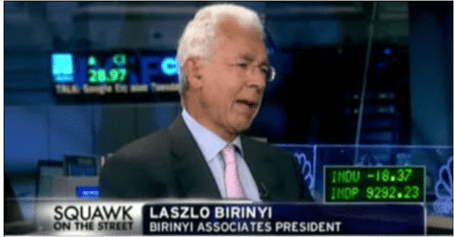
CNBC Interview With the Money Flow Master
Click Here To View CNBC Interview
The bear case always sounds more intelligent, but based on his views into his crystal ball, Mr. Birinyi sees the S&P 500 hitting 1,700 over the next few years (approximately a 70% increase from current levels). What I like about Birinyi’s process is that it’s a strategy based on taking out emotions and following objective data – the strategy is not driven by witty, bearish media sound-bites.
I can’t objectively verify Laszlo Birinyi’s performance; however I can understand his sound, sage advice because his philosophy is based upon objective historical statistics and data, not on the whims of the skittish masses. Birinyi has been around for decades but in the coming weeks and months we’ll discover if the 10% correction boogeyman will spook him or not.
From Pond Scum to the Pump

The “Green” movement got a shot in the arm recently when a $600 million joint venture between Craig Venter, the critical man behind mapping the human genome, and ExxonMobil the oil company (XOM) was formed to engineer oil from green algae. More than half of the money will be directed to Dr. Venter’s La Jolla, California-based biotech firm Synthetic Genomics.
On the surface the announcement is very appealing because it marries the biggest brains in genetic engineering (Venter) with the biggest brains in energy/oil (ExxonMobil). Add hundreds of millions of dollars to this powerhouse dream team and perhaps something miraculous can be commercialized in the next 5 – 10 years. Environmentalists appear to be on board too, if the hype turns to reality, because not only will cleaner fuels be created but the algae production will reduce harmful CO2 (carbon dioxide) emissions from the air. ExxonMobil’s grand scheme is to build algae farms near power plants and other major CO2 emitters –the farms will feed the algae and by doing so will help curb long-term fuel costs for the businesses.
ExxonMobil and Craig Venter are not the only game in town. A scientific article written by Molika Ashford claims there are more than 50 companies trying to affordably squeeze oil from slime, including a creative way of squeezing oil from algae-eating fish.
Although the “Greenies” seem to buy into the algae-oil process, the environmentalists are not the only constituency the genetic engineers must appease. The ethical debate over manipulating life forms is already percolating – just think, Frankenstein meets algae. In a newer Bloomberg article, Alison Smith, a professor of plant sciences at the University of Cambridge in England commented on the state-of-the-art research: “It is an untested technology, and there needs to be extensive debate about the ethics and environmental consequences of generating these new organisms.”
More recently, Dr. Venter performed a pioneering ‘gene swap’ on a simple species of bacteria called Mycoplasma mycoides, which raised optimism levels even higher that a green, bio-engineered fuel solution is indeed possible. Dr. Venter effectively created a new form of bacteria by swapping DNA from one form of bacteria into another. Researchers and scientists around the globe are searching for solutions to our worsening global energy problems, however time is required. I will anxiously watch from the sidelines to see if big brains and big oil can come together to make “green gold.”
Wade W. Slome, CFA, CFP®
Plan. Invest. Prosper.
Sidoxia Capital Management and its clients did not have any direct position in XOM at the time the article was published. No information accessed through the Investing Caffeine (IC) website constitutes investment, financial, legal, tax or other advice nor is to be relied on in making an investment or other decision. Please read disclosure language on IC “Contact” page.
The Emperor Schiff Has No Clothes

In the Hans Christian Andersen fairy tale The Emperor’s New Clothes, the emperor unwittingly hires two swindlers whom he pays to create a special make-believe suit, which the cons claim appears invisible to stupid people. When the emperor cannot visibly see his clothes, he sheepishly avoids confronting the swindlers to escape appearing stupid. Not until a little boy, who is watching the royal precession, points out the “emperor has no clothes” does the emperor finally realize he has been had.
Peter Schiff, former stockbroker and President of Euro Pacific Capital, has been proudly parading along the business media network on route to his senatorial candidacy, taking credit for accurately predicting the timing of the economic financial collapse. Endless amounts of praise have swarmed the airwaves and cyberspace through countless interviews and YouTube clips.
Maybe the same lessons learned from aforementioned fairy tale can be applied to Mr. Schiff? Perhaps he too wears no clothes?!
Let’s take a look at Mr. Schiff’s track record. Certainly Mr. Schiff was correctly bearish on the housing market, albeit about five years too early. I thought “timing is everything?” Apparently not for the media masses judging Peter Schiff’s track record. Let’s take a look at the chief tea-leaf reader in 2002 when he was calling for NASDAQ to reach 500 and the Dow Jones Industrials to reach 2000.
As you can see documented in the video, the Dow didn’t ever come remotely close to collapsing from 10,000 to 2,000 and the NASDAQ didn’t plummet from 1,700 to anywhere near 500. The significant percentage of the Fortune 500 he predicted to file bankruptcy never materialized either. Rather the market proceeded to march upwards on a five year bull market run that led to a doubling in the S&P 500 index from the bottom in 2002. Like a broken clock, if you stubbornly stick to one position, chances are you will eventually become right (at least twice per day).
I am not the only person to question the accuracy of Mr. Schiff’s persistently bearish and often inaccurate calls.
For one, Mike Shedlock of Mish’s Global Economic Trend Analysis gave an incredibly detailed review of Schiff’s track record in an article titled, “Peter Schiff was Wrong.” To get a little flavor of the piece, here is an excerpt:
12 Ways Schiff Was Wrong in 2008
- Wrong about hyperinflation
- Wrong about the dollar
- Wrong about commodities except for gold
- Wrong about foreign currencies except for the Yen
- Wrong about foreign equities
- Wrong in timing
- Wrong in risk management
- Wrong in buy and hold thesis
- Wrong on decoupling
- Wrong on China
- Wrong on US treasuries
- Wrong on interest rates, both foreign and domestic
Todd Sullivan from Seeking Alpha wrote an equally scathing, although shorter, look at Mr. Schiff’s track record.
More recently the ever-bearish Schiff continues to call for a collapse in the U.S. dollar and economy but refuses to short (bet against) the U.S. market because a hyper-inflationary period may ensue, driving U.S. index prices higher. Wait a second; is he saying that buying U.S. equities would be a good hedge against rising inflation? All this talking in circles is getting me dizzy. As for his position on gold, just last year he said gold would hit $2,000 per ounce by 2009 – well if it rises 100%+ in the next few months, then Mr. Schiff will be right on target.
Peter Schiff certainly lacks no confidence in making bold predictions despite his spotty record. Whether you think Peter Schiff is an overly bearish buffoon filled with hot air, or you think he is the greatest market prognosticator since sliced bread, it never hurts to wipe your eyes to make sure the media king du jour is wearing clothes?
Wade W. Slome, CFA, CFP®
Plan. Invest. Prosper.
DISCLOSURE: Sidoxia Capital Management (SCM) and some of its clients own certain exchange traded funds, but at the time of publishing SCM had no direct position in any security referenced in this article. No information accessed through the Investing Caffeine (IC) website constitutes investment, financial, legal, tax or other advice nor is to be relied on in making an investment or other decision. Please read disclosure language on IC “Contact” page.
Wealth Creation Using the Demi-Ashton Ratio

Ajay Kapur at Mirae Asset Securities is bullish on the global markets in the short-run (he sees the S&P 500 index reaching 1250 by March 2010), but even more optimistic in the long-run due to a demographic shift occurring in particular markets. According to this Chief Global Strategist, the more Demi Moores and less Ashton Kutchers we have populating the earth, the better our financial markets will perform.
Mr. Kapur’s Demi-Ashton argument is based on the belief that the higher the ratio of middle aged workers in their 40s (Demis) versus those in their 20s (Ashtons) will result in higher stock prices. Basically, those in their 40s generally have accumulated more wealth to invest and are very concerned about their impending retirement, while those in their 20s have little savings to invest and are more concerned about going to clubs and chasing the opposite sex. Seems to make logical sense.
Even though he is bullish in the domestic markets in the short-run, he sees the U.S., Canada, and Western Europe persisting through a secular bear market that began in 2000 and will last through 2015. Mr. Kapur is quick to point out these markets generally maxed-out when the Demi-Ashton ratios peaked in the 2000 timeframe. When these ratios were rising, for example as in Japan in the 1980s and the U.S. in the 1990s, the respective markets went on an upwards tear. Kapur sees emerging markets like Russia, Eastern Europe, and Latin America benefitting from the rising Demi-Ashton ratios in the coming years.
Whether his hypothesis proves correct or not, I admire the strategist’s bold call on the market direction. Typically economists and strategists herd together due to fear of being an outlier. As for Demi Moore and Ashton Kutcher, they should sleep fine with respect to their retirement plans, as long as they do not go on M.C. Hammer, Michael Jackson, or Mike Tyson spending binges.
Wade W. Slome, CFA, CFP®
Plan. Invest. Prosper.
Measuring Chaos

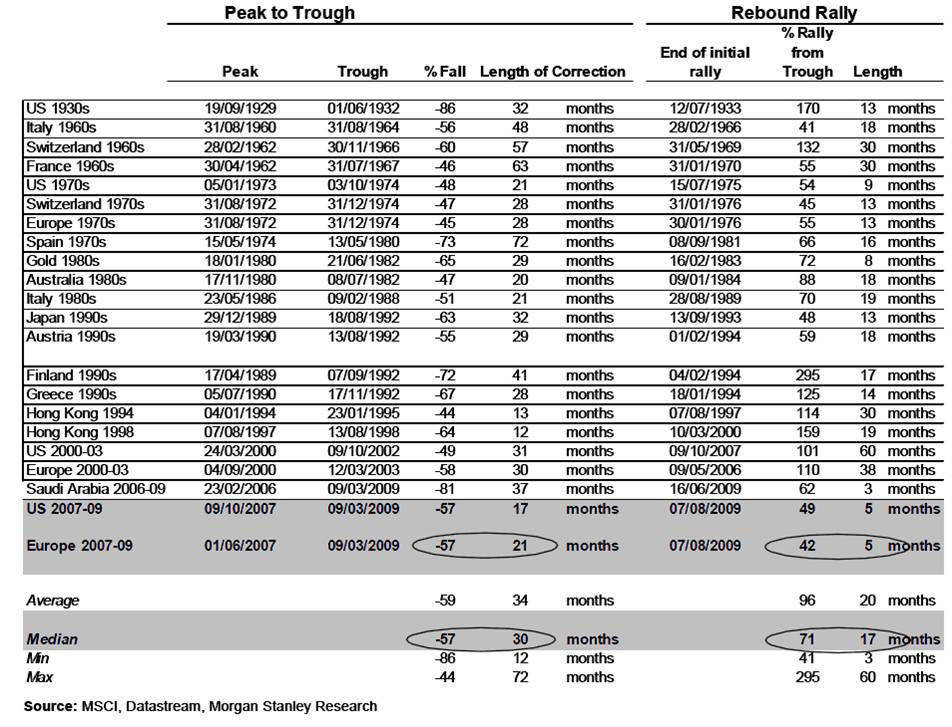
An interesting study was done by Morgan Stanley Europe, in which they looked at the last 19 bear markets and subsequent rallies. I’m not sure how much weight you can put on these results since every bear market is unique in its own right, nonetheless it provides a good frame of reference for debates.
What the Morgan Stanley team found was that the median bear market resulted in a -57% decline over 30 months and the ensuing rally equaled about +71% over 17 months. The problem is that our bear market in the U.S. was much shorter than the median timeframe despite its steepness – the fall effectively began in October 2007 and bottomed in March 2009 (about 17 months in duration). Since the decline was faster in duration, does that mean the advance will be as well? Not sure. Our current rally has lasted about six months, which implies there is about another year for the rally to continue based on this data.
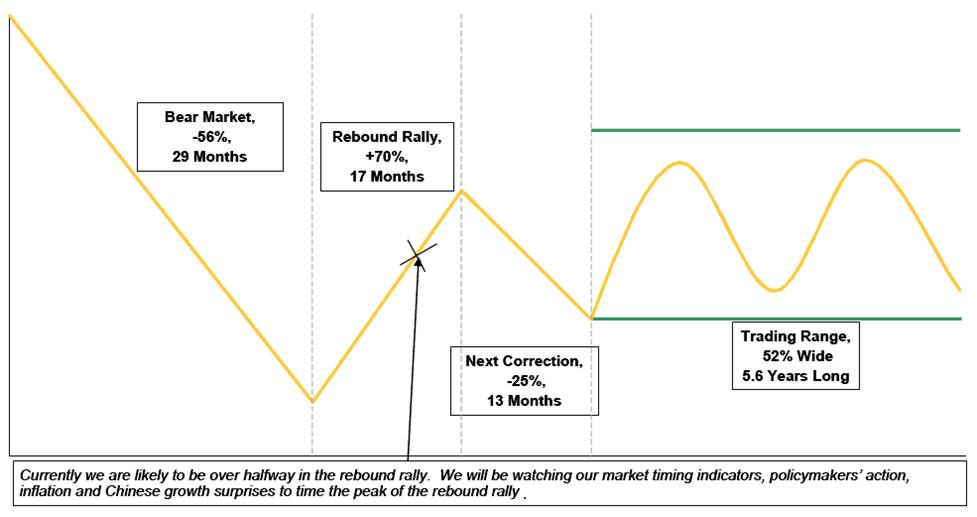
Prieur du Plessis wrote about the Morgan Stanley work for Seeking Alpha
As I alluded to earlier, it’s hard to compare an average to a period in which we had financial institutions dropping like flies (i.e., Bear Stearns, Lehman Brothers, WaMu, Fannie Mae, AIG, etc.) and people were hiding in caves – you knew it was really serious when it even caused voracious consumers to save money…imagine that. At the end of the day, stock and index prices eventually follow earnings. Because of the severity of this downfall, earnings came down faster than prices because fundamentals deteriorated faster than cost cutting could take place. When the economy begins to recover, the opposite will occur – businesses will not be able to hire and spend as fast as earnings are growing. It will be a nice problem to have, but nonetheless characteristic of a typical economic recovery.
In the U.S., the consumer will have a lot to say about the shape of the recovery since they account for about 2/3 of our country’s economic activity. The other “X” factor will be to what extent government legislation will have an impact on the economy. There will be opportunities available domestically and internally, but in order to survive the chaos, one needs to have a diversified and balanced global approach.
Read the Full Seeking Alpha Article Here
Wade W. Slome, CFA, CFP®
Plan. Invest. Prosper.
Green Loses to Greenback

We are currently in a political environment that sees no gray, but rather only sharp contrasts in black and white. As it turns out, these three colors are not the winners or losers – the winner is the almighty “greenback” and the loser is the “green” movement. The so-called environmentally friendly Obama administration recently approved the Alberta Clipper project – a 1,000 mile pipeline being built by Endbridge Energy that is designed to carry 800,000 barrels of fuel from Canada to the U.S.
As our reliance on what New York Times journalist Tom Friedman calls the “petro dictators” has not gone away, the recent decision seems very rational in securing supplies from friendlier neighbors. However, environmental constituents like the Sierra Club feel differently:
“At a time when concern is growing about the national security threat posted by global warming, it doesn’t make sense to open our gates to one of the dirtiest fuels on earth.”
-Carl Pope (Executive Director of the Sierra Club)
As far as I’m concerned, we still import about 2/3 of our oil and until alternative energies become more cost effective, we have little choice but to explore a multitude of strategic supply agreements. Canada is a neighbor and ally, therefore the U.S. should not walk away from any similar future agreement that will bring a stable and reliable source of supply. The scarcity of the critical resource and other commodities is evident by strategic deals and acquisitions being made by China and its government (See previous Investing Caffeine article, “The China Vacuum, Sucking Up Assets”).
As economic hungry emerging markets seek expansionary policies, I expect to see even more of these international types of deals.
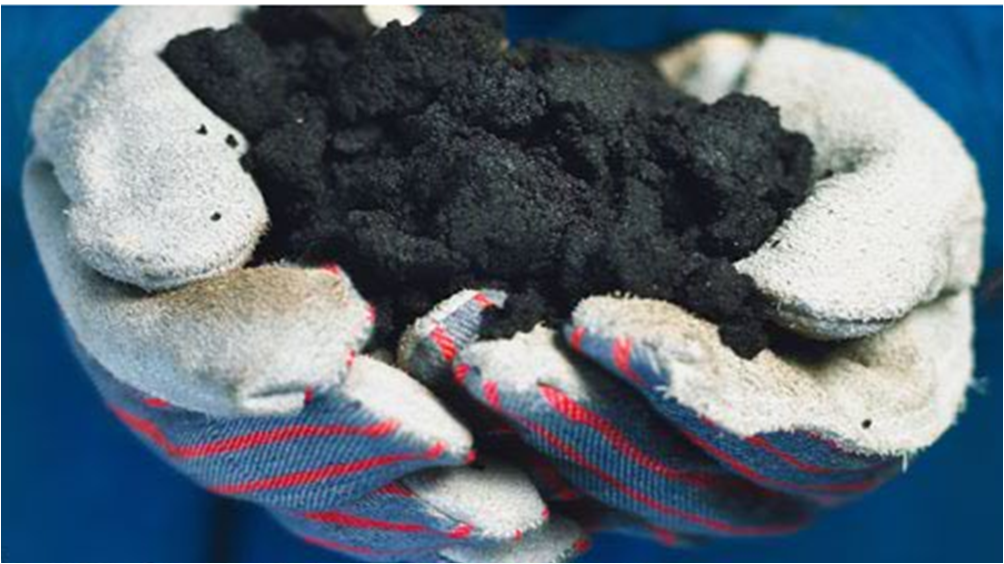
The oil-sands region in the Athabasca region (about the size of Florida) of Alberta holds great promise. If you believe famous oil investor/speculator T. Boone Pickens and other pundits, the oil-sands region holds the equivalent amount of reserves as world supply leader Saudi Arabia – about 250 billion barrels.
I concur with recent comments Financial Times article that says the Endbridge Energy deal meets a number of U.S. strategic interests, including:
“Increasing the diversity of oil supplies for the U.S., amid political tension in many major oil-producing regions; shortening the transportation path for crude oil supplies; and increasing crude oil supplies from a major non-Organization of Petroleum Exporting Countries producer.”
I am not a believer in damaging our environment for the pure sake of profits, however in this competitive global economy I think we need to seek an aggressive dual-source supply of energy (alternative energy AND traditional petroleum/coal products). The fact of the matter is that we have been pursuing solar, wind, nuclear, and other alternative energy resources for decades with very limited success. More financial resources and subsidies must be thrown at these alternative resource possibilities, while we simultaneously seek strategic supplies like this Canadian oil-sands deal.
Wade W. Slome, CFA, CFP®
Plan. Invest. Prosper.
DISCLOSURE: Sidoxia Capital Management and its clients have direct investment exposure in companies investing in Canadian oil-sand projects (SU) at the time the article was published. No information accessed through the Investing Caffeine (IC) website constitutes investment, financial, legal, tax or other advice nor is to be relied on in making an investment or other decision. Please read disclosure language on IC “Contact” page.
The Yuppie Bounce & the Lemming Leap
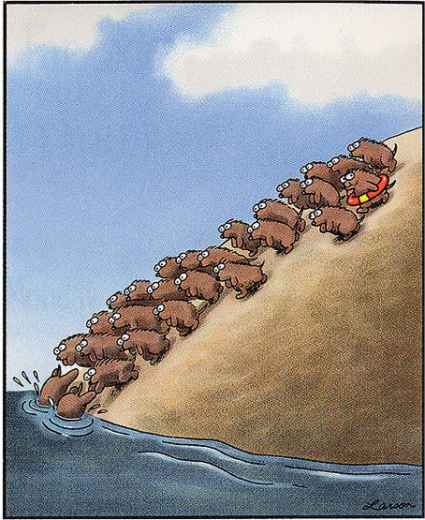
Source: Gary Larson – Where’s Your Preserver?
Making money in the stock market is a tough game, and most people don’t beat the market because like lemmings the average investor follows the herd mentality to underperformance. So, should Wall Street analysts and the media be crucified for their analysis? The short answer is yes. Certainly there are some exceptional analysts and journalists, however most of them merely report what is happening or are looking in the rear-view mirror. Beyond that, the vast majority of commentators prey on emotions of the public and masses by pushing them into knee-jerk selling panics at the bottom and also getting them frothing at the mouth to buy at market peaks. Can I understand why they offer such bad advice? Yes. Quite simply, the incentive structures are wrong.
If you are an analyst or journalist, the number one priority (incentive) is not to be wrong, because if they are mistaken, then job loss becomes a bona fide risk. However, if they throw in some fancy language and mix it in with a lot of caveats, there virtually is no risk of being wrong. If factors happen to change, no worries, their opinions can change too. Therefore, most analysts huddle together in tight packs reporting the same news du jour as everyone else, while mixing in a fair dosage of fear and greed to drum up more interest. These incentives align well for the journalists/analysts but unfortunately not for the average investor.
Joshua Brown over at the Reformed Broker recently wrote an excellent piece highlighting his so-called “Yuppie Bounce” example. Last winter, as all the discretionary consumer stocks (Joshua Brown calls them “waster stocks”) were getting pasted, the pundits were advising investors to pile into defensive stocks. Lo and behold, this was the absolute worst time to follow that advice. Mr. Brown gives a superb Starbucks (SBUX) versus Wal-Mart (WMT) example showing how SBUX has effectively doubled over the last nine months just as WMT flat-lined.

Source: The Reformed Broker (Joshua M. Brown)
Investing is like a game of chess, so although a current move may sound logical, it’s more important to think about decisions multiple steps into the future. Most successful long-term investors don’t follow the conventional lines of thinking, and they are generally swimming against the tide. Therefore, if you are going to jump in with the other lemmings, make sure you have your life preserver with you.
DISCLOSURE: Some Sidoxia Capital Management and client accounts HAVE direct positions in WMT at the time the article was published. No information accessed through the Investing Caffeine (IC) website constitutes investment, financial, legal, tax or other advice nor is to be relied on in making an investment or other decision. Please read disclosure language on IC “Contact” page.
Housing: Green Shoots Turning to Golden Trunks?

The doom and gloomers say the “green shoots” are actually “yellow weeds” and turn a blind eye to the positive (or less negative) economic data. The unemployment rate declined marginally last month to 9.4%, and GDP rates are expected to turn positive in the current quarter. Even so, the nay-sayers like Nouriel Roubini, Marc Faber, and Nassim Taleb still believe worse days lie ahead. Recent comments from a steely industry veteran may point to maturing “golden trunks” rather than younger, greener varieties.
Normally I do not expend too much energy on a single quarter of data relating to a stock I do not own, however comments coming from Bob Toll, founding CEO of Toll Brothers Inc. (dating back to 1967) caught my fancy. Besides the invaluable perspective he provides on the industry, he is in the unique position to explain the spending dynamics covering the higher-end demographic area. Toll Brothers is the largest luxury home builder in the U.S., operating in 21 states spanning the North, South, Mid-Atlantic, and West regions.
Although counterintuitive to many of the current news headlines, here is what Mr. Toll had to regarding Tolls’ recent quarterly earnings data and the state of the U.S. housing market:
• “Although our industry continues to face significant challenges, we are encouraged by the increase in number of net contracts signed this quarter. This marks the first time in sixteen quarters (4 years) dating back to fiscal year ’05’s fourth quarter that our net contracts exceeded the prior year same quarter. (The Results) also marked the first quarterly sequential unit increase in our backlog in more than three years.”• “Price is no longer the overwhelmingly dominant factor. It appears that those taking this step today have more confidence than one year ago.”
• “As the supply of unsold housing inventory shrinks nationwide, and if consumer confidence continues to improve, we should see stronger demands. It has already positively impacted our pricing power as we are reducing incentives in many markets.”
• “Fiscal year ’09’s third quarter cancellation rate, current quarter cancellations divided by current quarter’s signed contracts, was 8.5% versus 19.4% in fiscal year ’08’s third quarter. This was our lowest cancellation rate since the second quarter of fiscal year ’06 and is approaching our historic average of approximately 7% since going public.”
• “There’s a better feeling about jobs, a better feeling about the economy. Six months ago …we were all scared that the end was near…So I think we’ve just got a better market now and if things continue to improve, I think the market will continue to improve.”
• “(Traffic data) is certainly more than anecdotal information. You’re getting these averages from 235 approximately communities, 250 communities, so that’s a pretty good indicator of where the market is right now.”
• “The number of weeks of improvement that we have had as I said in the monologue, are certainly more than anecdotal. You’re talking about a whole lot of communities in 40, 50 markets and 20, 22 states. So we’re getting pretty deep information.”
Certainly Mr. Toll’s responses should be taken with a grain of salt. CEOs comments are generally overoptimistic and the economy is clearly not out of the woods yet. Having said that, for those that have followed Mr. Toll’s comments over the last few years, know that he did not always sugar-coat the weak results on the way down. Just six months ago, Mr. Toll said this: “We have not yet seen a pickup in activity at our communities,” and to combat pricing pressures the company offered a multitude of promotions, including a 3.99% mortgage rate to buyers.
The sustainability of the positive housing trends is unclear, but the signs are encouraging – especially since government stimulus cannot be directly responsible (i.e., no $8,000 new home-buyer credits for homes in the $700,000 price range) for awaking the housing bear from a four-year hibernation. The passage of time will determine whether Toll’s improving assessment of housing fundamentals will deteriorate into “yellow weeds” or flourish into a “golden trunk.”
Watch Extended Interview of CEO Bob Toll (Post Q3 2009 Conference Call)
Sidoxia Capital Management and its clients did not have any position in TOL at the time the article was published. No information accessed through the “Investing Caffeine” website constitutes investment, financial, legal, tax or other advice nor is to be relied on in making an investment or other decision.




