Sachs Prescribes Telescope Over Microscope

Jeffrey Sachs, Professor at Columbia University and one of Time magazine’s “100 most influential people” recommends that our country takes a longer-term view in handling our problems (read Sachs’s full bio). Instead of analyzing everything through a microscope, Sachs realizes that peering out over the horizon with a telescope may provide a clearer path to success versus getting sidetracked in the emotional daily battles of noise.
I do my fair share of media and politician bashing, but every once in a while it’s magnificent to discover and enjoy a breath of fresh common sense, like the advice coming from Sachs. Normally, I become suffocated with a wet blanket of incessant, hyper-sensitive blabbering that comes from Washington politicians and airwave commentators. With the advent of this thing we call the “internet,” the pace and volume of daily information (see TMI “Too Much Information” article) crossing our eyeballs has only snowballed faster. Rather than critically evaluate the fear-laced news, the average citizen reverts back to our Darwinian survival instincts, or to what Seth Godin calls the “Lizard Brain. ”
Sachs understands the lingering nature to our country’s problems, so in pulling out his long-term telescope, he created a broad roadmap to recovery – many of the points to which I agree. Here is an abbreviated list of his quotes:
On Short-Termism:
“Despite the evident need for a rise in national saving after 2008, President Barack Obama tried to prolong the consumption binge by aggressively promoting home and car sales to already exhausted consumers, and by cutting taxes despite an unsustainable budget deficit. The approach has been hyper short-term, driven by America’s two-year election cycle. It has stalled because US consumers are taking a longer-term view than the politicians.”
On Differences between China and the U.S.:
“China saves and invests; the US talks, consumes, borrows, and talks some more.”
On Why Tax Cuts and Stimulus Alone Won’t Work:
“Short-term tax cuts or transfers on top of America’s $1,500bn budget deficit are unlikely to do much to boost demand, while they would greatly increase anxieties over future fiscal retrenchment. Households are hunkering down, and many will regard an added transfer payment as a temporary windfall that is best used to pay down debt, not boost spending.”
On Malaise Hampering Businesses:
“Businesses, for their part, are distressed by the lack of direction….Uncertainty is a real killer.”

On 5-Point Plan to a U.S. Recovery:
1) Increased Clean Energy Investments: The recovery needs “a significant boost in investments in clean energy and an upgraded national power grid.”
2) Infrastructure Upgrade: “A decade-long program of infrastructure renovation, with projects such as high-speed inter-city rail, water and waste treatment facilities and highway upgrading, co-financed by the federal government, local governments and private capital.”
3) Further Education: “More education spending at secondary, vocation and bachelor-degree levels, to recognize the reality that tens of millions of American workers lack the advanced skills needed to achieve full employment at the salaries that the workers expect.”
4) Infrastructure Exports to the Poor: “Boost infrastructure exports to Africa and other low-income countries. China is running circles around the US and Europe in promoting such exports of infrastructure. The costs are modest – essentially just credit guarantees – but the benefits are huge, in increased exports, support for African development and a boost in geopolitical goodwill and stability.”
5) Deficit Reduction Plan: “A medium-term fiscal framework that will credibly reduce the federal budget deficit to sustainable levels within five years. This can be achieved partly by cutting defense spending by two percentage points of gross domestic product.”
Rather than succumb to the nanosecond, fear-induced headlines that rattle off like rapid fire bullets, Sachs supplies thoughtful long-term oriented solutions and ideas. The fact that Sachs mentions the word “decade” three times in his Op-ed highlights the lasting nature of these serious problems our country faces. To better see and deal with these challenges more clearly, I suggest you borrow Sachs’s telescope, and leave the microscope in the lab.
Read Full Financial Times Article by Jeffrey Sachs
Wade W. Slome, CFA, CFP®
Plan. Invest. Prosper.
*DISCLOSURE: Sidoxia Capital Management (SCM) and some of its clients own certain exchange traded funds, but at the time of publishing SCM had no direct position in any security referenced in this article. No information accessed through the Investing Caffeine (IC) website constitutes investment, financial, legal, tax or other advice nor is to be relied on in making an investment or other decision. Please read disclosure language on IC “Contact” page.
“De-Risking” – It’s All Greek to Me

Source: Photobucket
In the classic comedy Animal House John Belushi (who played the character Bluto) gave new meaning to the Greek toga party (who cares if the Romans actually invented the garment?). Belushi also added some flare to Sam Cooke’s timeless song, Wonderful World:
“Don’t know much about history
Don’t know much biology
Don’t know much about the science book
Don’t know much about the French I took.”
Another line should have been added: “Don’t know much about Wall Street jargon.”
“Derisking” – New Wall Street Word Du Jour
Wading through and keeping up with the ever expanding dictionary of Wall Street lingo and acronyms can be a difficult task – much like deciphering the Greek writings of Plato, the famous ancient philosopher.
A recent term repeated constantly by CNBC commentators and hedge fund managers at the annual SALT (SkyBridge Alternatives) conference in Las Vegas, Nevada deserves some more attention…“derisking.” Elegant, simple, chic, and yes, pure B.S. Why not use “mis-risking,” “un-risking,” “dis-risking?” I suppose when charging people 2 and 20 (a 2% management fee plus 20% of profits above a hurdle), one must try to make the most prosaic terms and expressions sound mysterious and dazzling.
Asking one hedge fund manager after another, CNBC commentator David Faber continually asked managers at the May conference what investing strategies were being employed. Faber asked Marc Lasry, CEO and Co-Founder of Avenue Capital Group, the following:
“I have spoken to number of other large hedge fund managers this morning. Derisking, that’s what they are all talking about Marc. So, given that, are you derisking at all?”
Translation: “The market is going down, so are you following all the other lemmings and becoming more conservative because of the panicked-induced headlines we’re shoveling 24/7?”
Glenn Dubin, Co-Founder and CEO of Highbridge Capital Management, a hedge fund company owned by JP Morgan (JPM) got in the “derisking” mood too: “At this point…we are seeing massive de-risking.”
At the time of the SALT conference, European economic concerns were top of mind for all the fast-money traders, as fears of a credit contagion spreading from Greece to larger countries like Italy and Spain felt more palpable to many. Some nine weeks later, the European bank stress tests have been completed, some overseas economic indicators have come in better than anticipated (i.e., U.K. GDP, German business confidence, exports), and some European markets are up about +10% from the “derisking” phase. So, I wonder what those same hedge funds and traders are doing now?
Perhaps they are “rerisking?” I just made that one up out of thin air, but if I hear “rerisking” on CNBC or see it in the Wall Street Journal, I demand a credit in the Merriam-Webster dictionary, or a citation in Wikipedia at a minimum.
The “derisking” wave did not stop at the SALT conference, but remains alive and well today. In fact, a conference has been created in its honor: The 3rd Annual De-Risking Strategies Summit for Pension Funds, Foundations, and Endowments on October 25 – 27, 2010 in New York.
Obviously, this is just one of many terms, acronyms, and euphemisms that the Wall Street machine is constantly churning out. If “derisking” doesn’t float your boat, then why not try on a “swaption” and “straddle” or “contango” and “crawling peg?”
If the never-ending list of Wall Street jargon is weighing you down and a financial professional is speaking Greek to you with confusing financial terminology, then do yourself a favor and slap that person into silence. More often than not, these financial concepts can be explained to a fifth grader (or Bluto). Unfortunately, a convoluted combination of jargon and acronyms is often used in an attempt to impress the listener. The result is usually confusion and a blank stare.
If you are frustrated with learning the language of Wall Street, you are not alone. I recommend you “derisk” your education by adding Greek 101 to your coursework. If you are going to be confused, you might as well do it with a gyro and some Ouzo in hand.
Wade W. Slome, CFA, CFP®
Plan. Invest. Prosper.
*DISCLOSURE: Sidoxia Capital Management (SCM) and some of its clients own certain exchange traded funds, but at the time of publishing SCM had no direct position in JPM or any security referenced in this article. No information accessed through the Investing Caffeine (IC) website constitutes investment, financial, legal, tax or other advice nor is to be relied on in making an investment or other decision. Please read disclosure language on IC “Contact” page.
Paulson Funds: From Ruth’s Chris’s to Denny’s

Investing in hedge funds is similar to eating at a high-priced establishment like Ruth’s Chris’s (RUTH) – not everyone can eat there and the prices are high. In dining terms, John Paulson, President of Paulson & Co. (approximately $34 billion in assets under management), may be considered the managing chef of the upper-crust restaurant. But rather than opening the doors of his funds to an elite few, Paulson is now making his select strategies available to the masses through a much more affordable structure. Or in other words, Paulson is opening an investing version of Denny’s (DENN), in addition to his Ruth’s Chris, so a broader set of investors can buy into his funds at a reasonable price.
Hedge funds typically are reserved for pension funds, endowments, wealthy individuals, or so-called “accredited investors” – individuals earning $200,000 annually, couples earning $300,000, or people with a net worth greater than $1,000,000. By using alternate structures, Paulson will be able to bypass the accredited investor regulatory requirements and reach a more expansive audience.
UCITS Added as a New Item on the Menu
How exactly is Paulson opening his hedge fund strategies to the broader public on a Denny’s menu? He is assembling what is called a “Ucits” structure (Undertakings for Collective Investments in Transferable Securities). These investment vehicles, adopted in 1985, resemble mutual funds and are domiciled in Europe. Although Ucits have been used by relatively few hedge fund managers, Paulson is not the first to institute them (York Capital, Highbridge Capital Management, BlueCrest Capital, and AHL are among the others who have already taken the plunge). According to the Financial Times, Paulson’s Ucits funds will launch later this year. Part of the reason this structure was chosen over others is because the regulations associated with these structures are expected to be less stringent than other onerous regulations currently being discussed by the European Union.
Will the Investing Mouths be Fed?
Should this move by Paulson be surprising? Perhaps Andy Warhol’s quote about everyone being famous for 15 minutes is apropos. Paulson’s $15 billion subprime housing profits in 2007 (read The Greatest Trade Ever) were a handsome reward and now he is attempting to further his wealth position based on this notoriety. Do I blame him? No, not at all, but time will tell if he will be viewed as a one-hit wonder, or whether his subprime bet was only an opening act. More recently, Paulson has been vocal about his seemingly peculiar combination of bullish wagers on gold and California real estate, which he sees rising in price by +20% in 2010 (see Paulson on California home rally). With his optimistic outlook on the U.S. markets and economy, his gold play apparently is riding on the expectation of a future inflation flare up, not another financial meltdown, which was the catalyst that catapulted gold prices higher in late 2008 and throughout 2009.
I’m not sure how many domestic investors will participate in these Ucits investments, however I am eager to see the prospectuses associated with the funds. Like most hedge funds, caution should be used when investing in these types of vehicles, and should only be used as a part of a broadly diversified investment portfolio. For most investors, my guess is the Paulson funds will have an attractive price of entry (i.e., availability), much like a Denny’s restaurant, but the quality and fee structure may be as desirable as a $5.99 greasy steak and pile of gravy-covered mash potatoes.
Read the Entire Financial Times Article on Paulson’s Ucits Launch
Wade W. Slome, CFA, CFP®
Plan. Invest. Prosper.
*DISCLOSURE: Sidoxia Capital Management (SCM) and some of its clients own certain exchange traded funds, but at the time of publishing SCM had no direct positions in RUTH, DENN, or any other security referenced in this article. No information accessed through the Investing Caffeine (IC) website constitutes investment, financial, legal, tax or other advice nor is to be relied on in making an investment or other decision. Please read disclosure language on IC “Contact” page.
WEBINAR: 10 Ways to Protect & Grow Your Nest Egg

If analyzing quarterly reports, managing a hedge fund/client accounts, teaching a course, writing a second book, and squeezing in a vacation is not enough, then why not try to squeeze in a webinar too? That’s exactly what I decided to do, so please join us on Friday (7/23 @ 12:30 p.m. PST) to learn about the critical 10 Ways to Protect and Grow Your Nest Egg in Uncertain Times.
Webinar Details:
—July 23, 2010 (Friday) at 12:30 p.m. – 1:30 p.m. (Pacific Standard Time)
CLICK HERE TO CONNECT TO WEBINAR
Toll Free # (if not using PC): 1-877-669-3239
Access Code: 800 505 230
Managing your investments has never been more difficult in this volatile and uncertain world we live in. With life expectancies increasing, and ambiguity surrounding the reliability of future financial safety nets (Social Security & Medicare), prudently investing your hard earned money to protect and grow your nest egg has never been this critical.
Invest in yourself and block off some time at 12:30 p.m. PST on July 23rd to educate yourself on the “10 Ways to Protect and Grow Your Nest Egg” in a relaxed webinar setting in front of your own computer.
CLICK HERE TO CONNECT TO WEBINAR
Toll Free # (if not using PC): 1-877-669-3239
Access Code 800 505 230
Wade W. Slome, CFA, CFP®
Plan. Invest. Prosper.
*DISCLOSURE: Sidoxia Capital Management (SCM) and some of its clients own certain exchange traded funds, but at the time of publishing SCM had no direct positions in any security referenced in this article. No information accessed through the Investing Caffeine (IC) website constitutes investment, financial, legal, tax or other advice nor is to be relied on in making an investment or other decision. Please read disclosure language on IC “Contact” page.
The Big Short: The Silent Ticking Bomb

A bomb was ticking for many years before the collapse of Bear Stearns in March of 2008, but unfortunately for most financial market participants, there were very few investors aware of the looming catastrophe. In The Big Short: Inside the Doomsday Machine, author Michael Lewis manages to craft a detailed account of the financial crisis by weaving in the exceptional personal stories of a handful of courageous capitalists. These financial sleuths manage not only to discover the explosive and toxic assets buried on the balance sheets of Wall Street giants, but also to realize massive profits for their successful detective skills.
Lewis was not dabbling in virgin territory when he decided to release yet another book on the financial crisis of 2008-2009. Nonetheless, even after slogging through Andrew Ross Sorkin’s Too Big to Fail and Gregory Zuckerman’s The Greatest Trade Ever (see my reviews on Too Big to Fail and The Greatest Trade Ever), I still felt obligated to add Michael Lewis’s The Big Short to my bookshelf (OK…my e-reader device). After all, he was the creator of Liar’s Poker, The New New Thing, Moneyball, and The Blind Side, among other books in his distinguished collection.
Genesis of the Bomb Creations
Like bomb sniffing dogs, the main characters that Lewis describes in The Big Short (Michael Burry/Scion Capital; Steve Eisman/Oppenheimer and Co. & FrontPoint Partners; Gregg Lippman/Deutsche Bank (DB); and Jamie Mai & Charlie Ledley/Cornwall Capital) demonstrate an uncanny ability to smell the inevitable destruction, and more importantly have the conviction to put their professional careers and financial wellbeing at risk by making a gutsy contrarian call on the demise of the subprime mortgage market.
How much dough did the characters in the book make? Jamie Mai and Charlie Ledley (Cornwall Capital) exemplify the payoff for those brave, and shrewd enough to short the housing market (luck never hurts either). Lewis highlights the Cornwall crew here:
“Cornwall Capital, started four and a half years earlier with $110,000, had just netted from a million-dollar bet, more than $80 million.”
Lewis goes on to describe the volatile period as “if bombs of differing sizes had been placed in virtually every major Western financial institution.” The size of U.S. subprime bombs (losses) exploding was estimated at around $1 trillion by the IMF (International Monetary Fund). When it comes to some of the large publicly traded financial institutions, these money bombs manifested themselves in the form of about $50 billion in mortgage-related losses at Merrill Lynch (BAC), $60 billion at Citigroup (C), $9 billion at Morgan Stanley (MS), along with many others.
The subprime market, in and of itself, is actually not that large in the whole scheme of things. Definitions vary, but some described the market at around 7-8 million subprime mortgages outstanding during the peak of the market, which is a small fraction of the overall U.S. mortgage industry. The relatively small subprime market became a gargantuan problem when millions of lucrative subprime side-bets were created through investment banks and unregulated financial behemoths like AIG. The spirits of greed added fuel to the fire as the construction of credit default swap market and synthetic mortgage-backed CDOs (Collateralized Debt Obligations) were unleashed.
Triggering the Bomb
Multiple constituents, including the rating agencies (S&P [MHP], Moodys [MCO], Fitch) and banks, used faulty assumptions regarding the housing market. Since the subprime market was a somewhat new invention the mathematical models did not know how to properly incorporate declining (and/or moderating) national home prices, since national price declines were not consistent with historical housing data. These models were premised on the notion of Florida subprime price movements not being correlated (moving in opposite directions) with California subprime price movements. This thought process allowed S&P to provide roughly 80% of CDO issues with the top AAA-rating, despite a large percentage of these issues eventually going belly-up.
Lewis punctuated the faulty correlation reasoning underlying these subprime assumptions that dictated the banks’ reckless actions:
“The correlation among triple-B-rated subprime bonds was not 30 percent; it was 100 percent. When one collapsed, they all collapsed, because they were all driven by the same broader economic forces. In the end, it made little sense for a CDO to fall from 100 to 95 to 77 to 70 and down to 7. The subprime bonds beneath them were either all bad or all good. The CDOs were worth either zero or 100.”
Steve Eisman adds his perspective about subprime modeling:
“Just throw the model in the garbage can. The models are all backward looking.”
Ignorance, greed, and other assumptions, such as the credibility of VAR (Value-at-Risk) metrics, accelerated the slope of the financial crisis decline.
Eisman had some choice words about many banking executives’ lack of knowledge, including his gem about Ken Lewis (former CEO of Bank of America):
“I had an epiphany. I said to myself, ‘Oh my God he’s dumb!’ A lightbulb went off. The guy running one of the biggest banks in the world is dumb!”
Or Eisman’s short fuse regarding the rating agency’s refusal to demand critical information from the investment banks due to fear of market share loss:
“Who’s in charge here? You’re the grown up. You’re the cop! Tell them to f**king give it to you!!!…S&P was worried if they demanded the data from Wall Street, Wall Street would just go to Moody’s for their ratings.”
A blatant conflict of interest exists between the issuer and rating agency, which needs to be rectified if credibility will ever return to the rating system. At a minimum, all fixed income investors should wake up and smell the coffee by doing more of their own homework, and relying less on the rubber stamp rating of others. The credit default swap market played a role in the subprime bubble bursting too. Without regulation, it becomes difficult to explain how AIG’s tiny FP (Financial Products) division could generate $300 million in profits annually, or at one point, 15% of AIG’s overall corporate profits.
My Take
The Big Short may simply be recycled financial crisis fodder regurgitated by countless observers, but regardless, there are plenty of redeeming moments in the book. Getting into the book took longer than I expected, given the pedigree and track record of Lewis. Nonetheless, after grinding slowly through about 2/3 of the book, I couldn’t put the thing down in the latter phases.
Lewis chose to take a micro view of the subprime mortgage market, with the personal stories, rather than a macro view. In the first 95% of the book, there is hardly a mention of Bear Stearns (JPM) Lehman Brothers, Citigroup, Goldman Sachs (GS), Fannie Mae (FNM), Freddie Mac (FRE), etc. Nevertheless, at the very end of the book, in the epilogue, Lewis attempts to put a hurried bow around the causes of and solutions to the financial crisis.
There is plenty of room to spread the blame, but Lewis singles out John Gutfreund’s (former Salomon Brothers) decision to take Solly public as a key pivotal point in the moral decline of the banking industry. For more than two decades since the publishing of Liar’s Poker, Lewis’s view on the overall industry remains skeptical:
“The incentives on Wall Street were all wrong; they’re still all wrong.”
His doubts may still remain about the health in the banking industry, and regardless of his forecasting prowess, Michael Lewis will continue sniffing out bombs and writing compelling books on a diverse set of subjects.
Wade W. Slome, CFA, CFP®
Plan. Invest. Prosper.
*DISCLOSURE: Sidoxia Capital Management (SCM) and some of its clients own certain exchange traded funds and AIG subsidiary debt, but at the time of publishing SCM had no direct positions in BAC, JPM, FRE, FNM, DB, MS, GS, C, MCO, MHP, Fitch, any security referenced in this article. No information accessed through the Investing Caffeine (IC) website constitutes investment, financial, legal, tax or other advice nor is to be relied on in making an investment or other decision. Please read disclosure language on IC “Contact” page.
Blushing Pinocchio – The Half Trillion Lie

When in doubt, or when in debt by half a trillion dollars, why not just make some crazy stuff up? This is the exact strategy California pension administrators used when implementing +50% increases in union member benefits earlier this decade. The pension plans decided to take a break from reality and enter fantasyland when they projected the Dow Jones Industrial Average would hit 25,000 by the end of the decade and 28,000,000 by 2099, a forecast that would even make Pinocchio blush.
Dealing with the Problem
Governor Arnold Schwarzenegger and his economic advisors attempted to take on the unions. Unfortunately, not everyone got the message. On the day the Governor struck a deal with the unions, California Public Employees’ Retirement System (CalPERS) ordered a hike of $4 billion to the annual pension payments to its members.
The financial woes of California have been well documented as the state looks to lower its $19.1 billion deficit and an estimated one-half trillion dollars in unfunded pension liabilities – a level equal to about seven times the state’s total debt level. Even after multiple years of severe cuts, Schwarzenegger has had to resort to drastic measures, including his most recent desperate move to get some 200,000 state workers to accept slashes in pay to a $7.25/hour minimum wage.
Facing Reality
As I have discussed in the past, dealing with excessive debt requires a gut check. Cutting debt is similar to dieting – easy to understand, but difficult to execute (see my Debt Control article).
Whether Republican candidate Meg Whitman or Democratic candidate Jerry Brown wins the thankless position of California Governor, they will have to face the elephant in the room, but hopefully they will not resort to fuzzy accounting or predictions of Dow 28 million that would make even Pinocchio blush.
Read Full Related Article from Vincent Fernando at Business Insider
Wade W. Slome, CFA, CFP®
Plan. Invest. Prosper.
*DISCLOSURE: Sidoxia Capital Management (SCM) and some of its clients own certain exchange traded funds, but at the time of publishing SCM had no direct positions in any security referenced in this article. No information accessed through the Investing Caffeine (IC) website constitutes investment, financial, legal, tax or other advice nor is to be relied on in making an investment or other decision. Please read disclosure language on IC “Contact” page.
Living Large – Technology Revolution Raises Tide

It’s hard to believe that my kids will never truly know what it is was like to live without a microwave, VCR, GPS device, internet connection or many of the other modern day inventions. In my elementary school days, when I had to write a report about Alfred Hitchcock, I was forced to drag my mom to the public library, chase down some librarians, and comb through floors of book shelves, only to find the book I needed was already checked-out. Today, it’s amazing to watch my kid, barely old enough to pull the milk container out of the fridge, scamper over to the computer, type in a few search words on Google (GOOG) and access an endless pool of information for a homework assignment. Fortunately for my wife and me, my daughter has not discovered Facebook yet.
Rising Tide Lifts All
In the uncertain times we live in, many people lose sight of the incredible advancements achieved over our generation, and ignore the difficult challenges and problems entrepreneurs are solving today. And many of these advancements have trickled down to wide swaths of the population. The minimum wage worker, cleaning dishes at the local restaurant, may not be able to afford the new $500 iPad from Apple Inc. (AAPL), but technology advancements have benefited the less privileged in different ways. For example, similar computing power used in the iPad has also been used in the logistics and sourcing departments of retail chains like Family Dollar (FDO), thereby making goods cheaper for lower-income consumers.
One person who has not lost sight of these advancements of productivity is Mark J. Perry of the Enterprise Blog. In a recent article, Perry compares what a consumer working 152 hours in 1964, earning an average wage, could purchase versus an average consumer today (46 years later) working the same 152 hours. Beyond the average wage of $2.50 per hour increasing to $19 per hour, Perry shows the unbelievable increase in the quality and number of products.
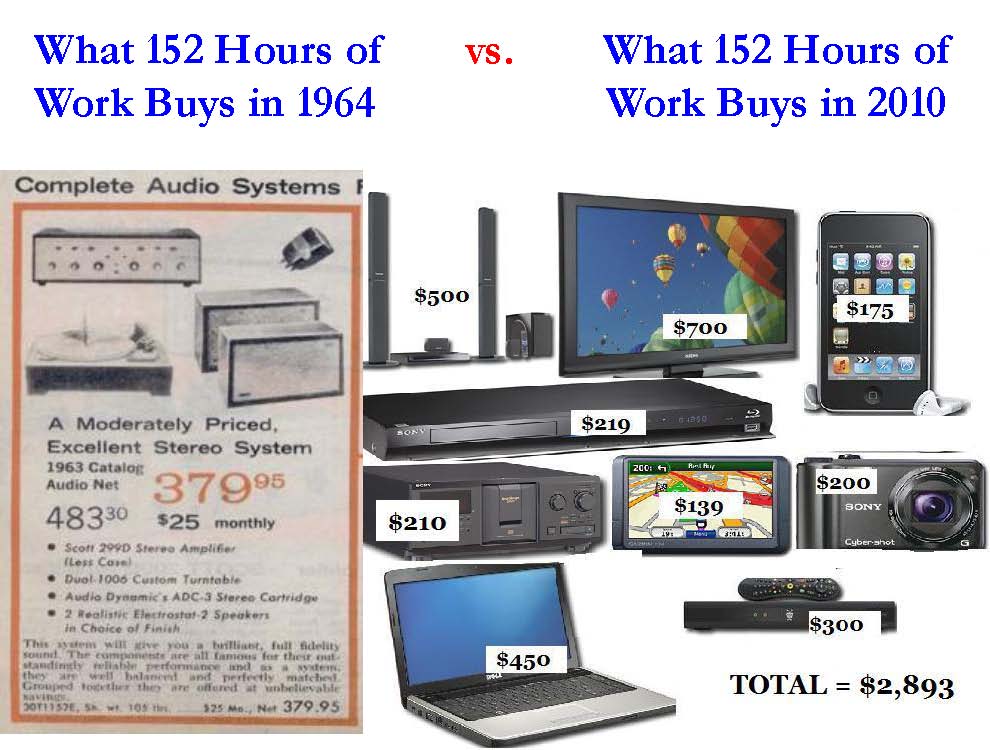
Perry places the continuing technological revolution in context by stating:
“Americans today can purchase low-priced electronics products that even a billionaire in the past wouldn’t have been able to buy.”
Another person that knows a little about technology, Sergey Brin (Co-Founder of Google Inc.), put recent technology advancements in perspective in the company’s 2008 annual report:
“Our first major purchase when we started Google was an array of disk drives that we spent a good fraction of our life savings on and took several car trips to carry. Today, I walked out of a store with a small box in my hand that stores more than all those drives and cost about $100. Similarly, the processors available today are about 100 times as powerful as those we used in 1998.”
Advancements in our standard of living are not only limited to electronic gadgets and internet searches, but also tangible benefits continue to be realized in the most important elements of our human survival. A picture says a thousand words, and these charts speak volumes about our standard of living:
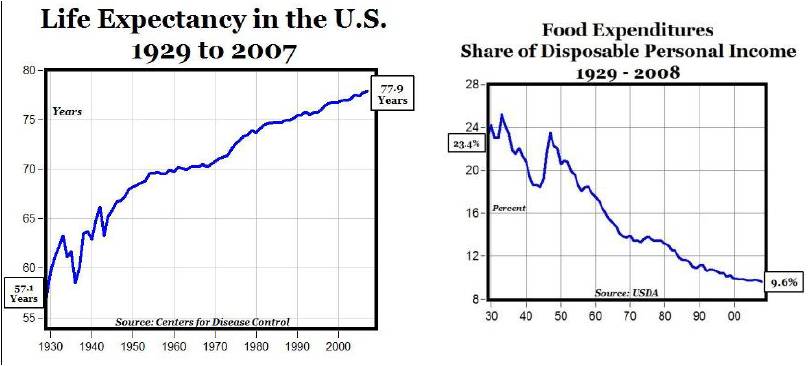
Lives are Extending and Food More Affordable
Obviously, everything is not a bed of roses and some of these improvements have come at a cost. Our country has lost millions of jobs over the last few years, and globalization has significantly increased foreign competition in broad areas of our economy. But before you succumb to the devastation rhetoric of the nay-sayers, please do not forget about the almost imperceptible rising tide of technological innovations that are allowing us to live better lives, even in uncertain times.
Wade W. Slome, CFA, CFP®
Plan. Invest. Prosper.
*DISCLOSURE: Sidoxia Capital Management (SCM) and some of its clients own certain exchange traded funds, GOOG, and AAPL, but at the time of publishing SCM had no direct positions in RSH, FDO, Facebook, or any other security referenced in this article. No information accessed through the Investing Caffeine (IC) website constitutes investment, financial, legal, tax or other advice nor is to be relied on in making an investment or other decision. Please read disclosure language on IC “Contact” page.
Kass: Triple Lindy Redux
About a year ago, I wrote about Doug Kass (founder and president of Seabreeze Partners) and his attempt at pulling off the famous “Triple Lindy” dive, which was made famous in the classic movie Back to School starring Rodney Dangerfield. If I were a judge, I would say Kass’s landing wasn’t a perfect 10, but rather closer to a 6.5. After successfully nailing the bear market in 2008, and subsequently declaring the “generational low” of March 2009, Kass became cautious in June 2009. At the time, Kass pulled in his horns by pronouncing a consumer-led double dip in late 2009 or in the first half 2010 from a consumption binge hangover, while declaring his previous 1050 S&P 500 index target as overly ambitious. What actually transpired is the S&P 500 went from around 942 to 1220 over the next ten months, or up about +30%.
Today, Kass is trying to make another large splash, but now he is reversing course and once more calling for a rally…at least a mini one. Rather than speaking in terms of his previous generational low (S&P 666), Kass sees the recent lows around 1,010 being the “bottom for the year” and his new 2010 target is based on climbing to positive territory for the year, implying a +10% to +12% move from the beginning of July.
 View Doug Kass Interview and Prediction
Kass is not your traditional investor, and he admits as much:
“I’m not a perma-bear, I’m not a perma-bull. I try to be flexible and eclectic in my view, and this is especially necessary in a market, which is so volatile as it’s been for the last several years.”
In explaining his upbeat rationale, Kass highlights nuanced aspects to employment data, payroll growth, moderate economic expansion, and an attractive valuation for the overall market:
“I’m not technically based, therefore I’m not sentiment based, I’m fundamental based….The markets are traveling on a path of fear and share prices have significantly disconnected from fundamentals.”
Even if Kass didn’t nail the “Triple Lindy,” he still deserves special attention as a practitioner, in addition to his side job as a market prognosticator. Additional recognition is warranted solely based on the potshots he aimed at rent-a-strategists like Nouriel Roubini, CNBC celebrity, (see Roubini articles #1 or #2) and Robert Prechter, long-running technician who is currently predicting Dow destruction to unfathomable level of 1,000. I’m not in the business of predicting short-term market gyrations, but I’ll enjoy watching Kass’s next dive to see whether he’ll make a splash or not.
Wade W. Slome, CFA, CFP®
Plan. Invest. Prosper.
*DISCLOSURE: Sidoxia Capital Management (SCM) and some of its clients own certain exchange traded funds, but at the time of publishing SCM had no direct positions in any other security referenced in this article. No information accessed through the Investing Caffeine (IC) website constitutes investment, financial, legal, tax or other advice nor is to be relied on in making an investment or other decision. Please read disclosure language on IC “Contact” page.
Jobs: The Gluttonous Cash Hog

Really? Do you think Steve Jobs actually needs to hoard $42 billion in cash reserves on the company’s balance sheet, when they are already adding to the gargantuan mountain of money at a $12 billion clip per year. Let’s not forget, this gaudy amount of money is being added after all operating expenses and capital expenditures have been paid for.
Perhaps Steve is just a little worried about the economy, and wants a little extra loose change around for a rainy day? I’d buy that argument, but Mr. Jobs and the rest of the executives just witnessed the worst financial crisis in a generation, and the company still managed to generate about $9 billion in free cash flow in both fiscal 2008 and 2009.
If Apple was not creating cash flow like those cascading chocolate fountains I see at wedding receptions, then perhaps a cash safety blanket is needed for acquisitions? Here’s what Steve had to say about Apple’s cash levels in February:

Steve Jobs (Source: Photobucket)
“We know if we need to acquire something – a piece of the puzzle to make something big and bold – we can write a check for it and not borrow a lot of money and put our whole company at risk…The cash in the bank gives us tremendous security and flexibility.”
Let’s explore that idea a little further. First of all, what type of experience does Apple have in doing large acquisitions? Not a lot, and just to humor myself I ran a screen on a universe of more than 10,000 stocks and I came up with 111 companies with a value (market capitalization) greater than $40 billion. Unless Apple plans on buying companies like Coca Cola (KO), Chevron Corp. (CVX), Pfizer (PFE), or United Parcel Service (UPS), I think Apple can part ways with some of their billions. Certainly, there are a handful of theoretical targets in the areas of technology and content, but for certain, (a) any large deal would face intense regulatory scrutiny, and (b) if truly there were grand synergies from doing a massive deal, then most definitely they would be able to issue stock (if Jobs hates debt) to help fund the deal. It is pure nonsense and laughable to believe any “big and bold” acquisition would put the company “at risk.” The only thing at risk for doing a large deal would be Apple’s stock price.
The truth of the matter is returning cash to shareholders would be a fantastic self-disciplining tool, like putting mayonnaise on a brownie to prevent excess calorie consumption. Steve should give current or former CEOs of AOL, Time Warner, Mercedes Benz, Chrysler, Sprint, and Nextel a call to see how those large deals worked out for them. Apple could use an acquisition security blanket, but they do not need a circus tent of cash.
Times of Change
Although times have changed, some executives have not. Many tech companies, including Apple, have nostalgic memories of the go-go tech bubble days of the 1990s when growth at any price was the main mantra and no attention was paid to prudent capital allocation. With a stagnant stock market over the last twelve years, and interest rates sitting sluggishly at record lows (effectively 0% on the Federal Funds rate), investors are demanding prudent decision-making when it comes to capital allocation. Mr. Jobs, it is time to expand your narrow views and show the stewardship of sensibly managing the cash of your loyal investors.
Believe it or not, there are still a few of us actual “investors” that still exist. I’m talking about investors who do not just speculatively rent a stock for a day, week, or month, but rather those who invest for the long-term because they believe in the vision and execution capabilities of management and believe the company’s capital will be invested in their best interest.
I do not mean to single Mr. Jobs out, because he is not the only gluttonous, cash-hog offender among CEOs. In many respects, Apple has the good fortune of becoming a cash-hoarding poster child. The company does indeed deserve credit for becoming a $225 billion technology-consumer-media-retail juggernaut that has spread its tentacles brilliantly across numerous massive markets, whether its PCs, cell phones, music, television, movies, games, advertising etc.…you get the picture. But just because you are an exceptionally gifted visionary doesn’t give you the right to destroy value of hopelessly idle cash, which is begging for a better home than a 0.25% T-Bill.
Solutions – Taming the Cash Hog:
1) Divvy Up Dividends: With $42 billion in cash on the balance sheet and additional annual free cash generation on pace for $12 billion per year, there is no reason Steve Jobs and the board couldn’t declare a dividend that would yield 3% today. If that feels like too much, then how about shave off a pittance of $5 billion or so to pay out a sustainable dividend, which would yield a market-matching 2% dividend yield to investors. This scenario would accommodate Apple with at least a few decades of a cash cushion to cover ALL the company’s operating expenses and capital expenditures. This meagerly, ultra-conservative dividend policy can actually persist (or grow) longer than expected, if Apple can sustainably grow profits – a good possibility.
2) Share Buyback: This solution is much less desirable from my perspective compared to the dividend route, since many of the large share repurchasers tend to also issue lots of new shares to employees and executives, thereby neutering the benefits of the share repurchases.
3) Bank of Apple – (B of A): Why doesn’t Jobs just create a new entity, plop $40 billion of cash from Apple Inc. into the venture, and then open it up as Bank of Apple. At least that way, as an investor in the bank, I could make more profitable lending spreads at B of A relative to the 0.25% yield earned on the mega-billions deteriorating on Apple’s corporate balance sheet.
The downside of instituting these cash reducing solutions:
- The company doesn’t have as much cash as it would like to do large stupid acquisitions.
- The company loses a bunch of day-traders and short-term stock renters that don’t even know what a dividend is.
The upside to efficiently allocating capital through a 2% dividend is Steve (and the other investors) will receive a nice fat quarterly check. In the case of Jobs, he’ll collect a handsome $27 million or so to his measly $1 annual salary. In the process, the company will also gain long term shareholders that buy into the strategic vision of the company.
Stubbornness has served Steve Jobs tremendously well in his career, and a successful CEO like Steve Jobs is not required to listen to my advice. However, I am hopeful that Mr. Jobs will see the hazards of choking on a rapidly growing $42 billion cash hoard and discover the benefits of slimming down a gluttonous cash hog.
Wade W. Slome, CFA, CFP®
Plan. Invest. Prosper.
*DISCLOSURE: Sidoxia Capital Management (SCM) and some of its clients own certain exchange traded funds and AAPL, but at the time of publishing SCM had no direct positions in KO, CVX, PFE, UPS, AOL, Time Warner, Mercedes Benz, Chrysler, Sprint, Nextel, or any other security referenced in this article. No information accessed through the Investing Caffeine (IC) website constitutes investment, financial, legal, tax or other advice nor is to be relied on in making an investment or other decision. Please read disclosure language on IC “Contact” page.
Baseball, Hot Dogs, and Fixed Income Securities

Having just celebrated another 4th of July holiday, I reflected on the historical importance of our country’s independence finalized 234 years ago, the defining birthday of our great country that permanently marked the separation of our nation from Great Britain. In honor of this revolutionary milestone, our culture has added a few American traditions over the centuries, including watching baseball, and gorging ourselves on hot dogs, and apple pie.There is no better symbol of the importance our culture places on overindulgence than Nathan’s International Hot Dog Eating Contest, held each year on July 4th in Coney Island, Brooklyn, New York. The 95th annual contest winner was Joey Chestnut with a total of 54 HDBs (Hot Dogs & Buns) consumed, but not without some controversy thanks to the arrest of former Nathan’s champ Takeru Kobayashi, who watched from the sidelines this year due to a contract dispute with event organizers. Chestnut holds the world record set in 2009 with 68 HDBs, equivalent to about 20,000 calories. In setting the unmatched record, the winner of wiener eating contest inhaled in 10 minutes what an average human should consume in 10 days.
Bond Binge
In the financial markets, Americans have been pigging out on something else over the last few decades, and that is bonds. The craving for bonds has not changed since the end of the financial crisis either. According to Morningstar, since the end of 2008, investors have placed a net $390 billion into taxable bond funds and withdrawn -$45 billion out of U.S. stock funds. A continuation of these trends can be seen in the latest ICI (Investment Company Institute) fund flow data, in which we saw a +$6.3 billion inflow into bonds and a -$1.3 billion abandonment of stocks from the hands of jittery stock investors.
Beyond the endless checklist of worries (Europe default, China slowing, twin deficits, elections, etc.), there has been a consistent exodus of capital from money market funds due to the ridiculously low yields – the seven-day yield on taxable money-market funds, as measured by IMoneyNet, has recently held steady around 0.04%. For yield-hungry investors, bondholders are not getting a lot of bang for their buck if you consider the 10-Year Treasury Note is trading at 2.98%. Nothing in life comes for free, so in the case of Treasuries, bond investors are predominantly swapping market risk for interest rate risk. As I have repeatedly stated in the past, bonds are not evil, however fixed income exposure in a portfolio should be customized for an individual in the context of a diversified portfolio that meets investors’ objectives and risk tolerance.
Although the inflation skies are sunny now, there are clouds on the horizon and the stimulative monetary policies conducted over the last few years do not augur well for a likely climb in future interest rates.
Reversal of Fortune
In the competitive eating world, there is a so-called “reversal of fortune” that disqualifies eaters. At some point, you can only consume so much before the forces of nature take over.
I don’t know when the day of regurgitation will come for many fixed income securities, but managing your consumption of bonds, and the associated duration, becomes crucial as bond bellies continue to bulge. Takeru Kobayashi discovered this first hand at the Nathan’s 2007 championship event.
Baseball, hot dogs, and apple pie have been essential components to the unique aspects of the great American culture. In the world of investing, we have witnessed an acceleration in investors’ appetite for bonds – I just hope for the sake of overzealous bond investors, they will not suffer a reversal of fortune.
Wade W. Slome, CFA, CFP®
Plan. Invest. Prosper.
*DISCLOSURE: Sidoxia Capital Management (SCM) and some of its clients own certain exchange traded funds (including fixed income ETFs), but at the time of publishing SCM had no direct positions in any other security referenced in this article. No information accessed through the Investing Caffeine (IC) website constitutes investment, financial, legal, tax or other advice nor is to be relied on in making an investment or other decision. Please read disclosure language on IC “Contact” page.




 Investing Caffeine
