BP: Sweet Opportunity or Sloppy Mess?

Photo source: 1Funny.com
Discussing the BP oil spill is not exactly cutting-edge, fresh news at this point. However, now that the 5 million barrel gaping gusher of black sludge has been plugged, many of the uncertain variables are beginning to come in focus. From mid-April this year, right before the disaster occurred, the equity value of BP’s stock peaked around $189 billion. The value of the company subsequently shed over $100 billion in value over the next two months, before rebounding to a level about -35% below the April highs today. BP is not out of the woods yet, even though the discussion has migrated from potential bankruptcy scenarios. The question now is whether purchasing BP stock currently is a sweet opportunity or just a sloppy mess that will drag value down for years to come?
Whitney Tilson, whom I profiled last year in Fat Lady Housing article, is the founder and Managing Partner of T2 Partners LLC who decided to tackle the tough BP questions. Tilson compiled his bullish thesis on BP at the 7th Annual Value Investor conference when BP’s share price was trading at $36.76. Why is Tilson so optimistic about BP’s stock price appreciation potential? He uses a few approaches, but his number one approach is a walk down catastrophe memory lane. If previous stock calamities resulted in opportunities due to investor overreaction, then certainly the same principal should apply to BP (or so Tilson believes). Here are some of the previous train wrecks Tilson highlighted in his presentation:

Pretty convincing evidence that the bark was bigger than the bite for these examples, but Tilson chose to save his best precedent illustration for last…Merck (MRK). In 2004, the pharmacy company came under assault after it was revealed the drug Vioxx increased the likelihood of patient heart attacks. What fanned the flames of panic were the allegations that Merck had known about these detrimental risks for years, but the company did not disclose this valuable knowledge. To make a long story short, the initial $50 billion liability estimate attributed to Merck actually came in closer to $5 billion and the stock rallied from a low of $26 in 2005 to $60 by the end of 2007. Tilson however, conveniently neglects to mention that the company’s stock shortly thereafter collapsed, before bottoming at $20 per share in early 2009 and settling in at a price around $35 today.
Regardless, Tilson’s points are well taken. Often these major catastrophes that sprawl across media headlines become overdone and offer an opportunity to those investors with thick skin and a stomach that can withstand severe heartburn.
Besides having history on his side, Tilson provided additional supportive bullet points to bolster his sanguine view on BP:
- BP is a Cash Cow: The average estimate of BP’s liability (approximately $30 billion) is less than the $34 billion in operating profits ($20 billion in net income) expected to be realized by BP in 2010.
- Financial Flexibility: BP has access to over $20 billion in access to cash and liquidity, not even counting the more than $100 billion in property, plant, & equipment (PP&E) on the balance sheet. Asset sales provide BP with even more flexibility.
- Small U.S. Footprint: BP’s Gulf of Mexico operations, home of the Macondo well disaster, represent only about 15% of BP’s total global oil production, so the inference is BP would do just fine without access to the Gulf.
All, in all, Tilson provides a perspective with logical arguments to support his case. The analysis, however, does not give a lot of weight to political consequences that can cause this situation to go from bad to worse. Specifically, some pundits are using a more negative legal precedent of the tobacco companies to explain the downside potential of this situation (see legal pay-out table).

The 1998 master tobacco settlement agreement with the tobacco industry resulted in a whopping $206 billion in pay-outs to be made by the tobacco manufactures over 25 years (Financial Times). This is significantly greater than the $20 billion escrow account that BP has verbally committed to funding (and BP has already funded the account with a $3 billion initial deposit). What’s more, the spill volume estimates are a moving target, and as a result, BP just raised its oil spill cleanup costs from $3.95 billion to $6.1 billion. These numbers can have a way of becoming their own monsters over time.
As you can see, Whitney Tilson makes some pretty compelling arguments for BP, but not many arguments can be made against his long-term performance at the T2 Accredited Fund, which is up +202% since 1999 through mid-2010 (versus +7% for the S&P 500 for the same time period). If you believe Tilson, BP may turn out to be a sweeter kiss than the sloppy mess we constantly hear about.
Wade W. Slome, CFA, CFP®
Plan. Invest. Prosper.
*DISCLOSURE: Sidoxia Capital Management (SCM) and some of its clients own certain exchange traded funds, but at the time of publishing SCM had no direct position in BP, MRK, XOM, or any security referenced in this article. No information accessed through the Investing Caffeine (IC) website constitutes investment, financial, legal, tax or other advice nor is to be relied on in making an investment or other decision. Please read disclosure language on IC “Contact” page.
Investment Credentials: The Letter Shell Game

Photo Source: Imetco.com
In most professional industries – whether you are talking about a doctor, lawyer, dentist, accountant, or other respected field – a comprehensive and rigorous multi-year schooling and examination process is required to gain entrance into the club. Unfortunately for those working with professionals (I use the term loosely) in the investment and insurance fields, all that most advisors need to do is have a pulse and spend a few hours or days studying for an exam. Our structurally flawed and loosely cobbled together financial regulatory system is like a shell game that is constantly moving and hiding different conflicts of interest.
Left in the wake of the financial crisis, the public has been left picking up the pieces from the rating agency conflicts, Madoff scandal, Lehman Brothers bankruptcy, AIG collapse, Goldman Sachs hearings, golden parachute bonuses, billions in fees, commissions, and investor losses. Rather than watch the backs of investors, the system has favored financial institutions and penalized investors with fees, commissions, transactions costs, fine print, and layers of conflicts of interests. Andy Warhol described the amassing of fees like the prices of art – under both circumstances you collect “anything you can get away with.” So unless investors do their own thorough homework, there’s a good chance they will end up with a failing grade.
One of the major deception components is the creation of many worthless, pathetic lettered credentials that in many cases are worth less than the paper or business cards they are written on. Now, I’m sure some of these multi-letter credentials are worth more than others, but as a practicing professional in the industry for more than 15 years, it feels like I come across some new three letter designation every week. I know I am not alone with my sentiments, because respected professionals and colleagues I work with chuckle at many of these lettered credentials, and like me, have no clue what they stand for. When receiving a new business card with some of these strange letters, I often don’t know if I should cover my mouth while I burst out laughing, or if I’m supposed to be genuinely impressed?
Perhaps for hardworking parents, like a Joe and Mary Smith, it may mean something, but unless a multi-year curriculum (for example, the CFA Chartered Financial Analyst or CFP® – Certified Financial Planning programs) is put behind the alphabet of letters on a business card, please do not be offended if I yawn. Investors deserve better and fairer representation from someone managing their life savings, much like they get from a MD performing a surgery, a JD protecting a proprietor’s business, a CPA shielding a tax return from the IRS, or a DDS performing a root canal.
While it may sound like I am demonizing the broker/salesmen/advisors that are swimming around in the investment waters looking for commission opportunities (see Financial Sharks article), I understand some of them have genuine intentions and do not purposely misrepresent their credentials. As a matter of fact, many of the brokerage firms that hire these individuals require them to add funny letters to their business card for marketing purposes.
Here is a list of finance-related credentials other than the aforementioned:
- AAMS (Accredited Asset Management Specialist)
- AFC (Accredited Financial Counselor)
- AWMA (Accredited Wealth Management Advisor)
- CAIA (Chartered Alternative Investment Analyst)
- CASL (Chartered Advisor for Senior Living)
- CCFC (Certified Cash Flow Consultant)
- CFS (Certified Fund Specialist)
- CIMA (Certified Investment Management Analyst)
- CIMC (Certified Investment Management Consultant)
- CMA (Certified Management Accountant)
- CMFC (Chartered Mutual Fund Counselor)
- CMT (Chartered Market Technician)
- ChFC (Chartered Financial Consultant)
- CCFC (Certified Cash Flow Consultant)
- CDFA (Certified Divorce Financial Analyst)
- CEBS (Certified Employee Benefit Specialist)
- CDP (Certified Divorce Planner)
- CLTC (Certified in Long Term Care)
- CLU (Chartered Life Underwriter)
- CPCU (Chartered Property Casualty Underwriter)
- CRPC (Chartered Retirement Planning Counselor)
- CTFA (Certified Trust and Financial Adviser)
- FRM (Financial Risk Manager)
- MSFS (Master of Science in Financial Services)
- PFS (Personal Financial Specialist – awarded by the American Institute of Certified Public Accountants (AICPA))
- QPFC (Qualified Plan Financial Consultant)
- REBC (Registered Employee Benefits Consultant)
- RFC (Registered Financial Consultant)
When it comes to these and other industry credentials I am open to being enlightened on the relative merits…I’m all ears. And even if you trust the CFP® and CFA designations as the gold standards in the investing field, holding those credentials alone are not sufficient to make someone a good adviser. However, until I gain a better understanding of the dozens of other confusing credentials, I will continue to scratch my head and wonder which ones are worth more than the others, and which ones are not worth squat.
Healing the Wounds
It will take a long time for the financial industry to gain back the trust of investors, but it will require a multi-prong effort from regulators, financial industry executives, and investors themselves (who need to do better homework). If we want to more specifically dissect the professional service industry, then why not form one certification for each segment –not dozens.
What’s more, rather than pulling the wool over the public’s eyes with meaningless titles and credentials, let’s establish a fiduciary duty and designation that is demanded of all investment professionals. Moreover, let’s make the filtering process more rigorous in weeding out the dead-weight before handing the precious keys over to a professional. Unless changes are made, the corrupt system will remain structurally flawed, ripe with conflicts of interest, and aggressive salesmen calling themselves professionals –even if meaningless credentials are flaunted around to garner fees and commissions from the unsuspecting public.
Not everyone in the industry is a crook, but make sure you follow the ball very closely, so you do not lose in the investment shell game.
Read the Partial List of Financial Service Credentials on the CFP® Website
Wade W. Slome, CFA, CFP® <— Don’t worry if you are not impressed by these letters…my wife and friends are not either!
Plan. Invest. Prosper.
*DISCLOSURE: Sidoxia Capital Management (SCM) and some of its clients own certain exchange traded funds, but at the time of publishing SCM had no direct position in Lehman/Barclays, GS, or AIG (but do own derivative position in subsidiary) or any security referenced in this article. No information accessed through the Investing Caffeine (IC) website constitutes investment, financial, legal, tax or other advice nor is to be relied on in making an investment or other decision. Please read disclosure language on IC “Contact” page.
Securing Your Bacon and Oreo Future

Stuffing money under the mattress earning next to nothing (e.g., 1.3% on a on a 1-year CD or a whopping 1.59% on a 5-year Treasury Note) may feel secure and safe, but how protected is that mattress money, when you consider the inflation eating away at its purchasing power?
We’ve all been confronted by older friends and family members proudly claiming, “When I was your age, (“fill in XYZ product here”) cost me a nickel and today it costs $5,000!” Well guess what…you’re going to become that same curmudgeon, except 20 or 30 years from now, you’re going to replace the product that cost a “nickel” with a “$15 3-D movie,” “$200 pair of jeans” and “$15,000 family health plan.” Chances are these seemingly lofty priced products and services will look like screaming bargains in the years to come.
The inflation boogeyman has been relatively tame over the last three decades. Kudos goes to former Federal Reserve Chairman Paul Volcker, who tamed out-of-control double-digit inflation by increasing short-term interest rates to 20% and choking off the money supply. Despite, the Bernanke printing presses smoking from excess activity, money has been clogged up on the banks’ balance sheets. This phenomenon, coupled with the debt-induced excess capacity of our economy, has led to core inflation lingering around the low single-digit range. Some even believe we will follow in the foot-steps of Japanese deflation (see why we will not follow Japan’s Lost Decades).
The Essentials: Oreos and Bacon
Even if you believe movie, jeans, and healthcare won’t continue inflating at a rapid clip, I’m even more concerned about the critical essentials – for example, indispensable items like Oreos and bacon. Little did you probably know, but according to ProQuest’s Historic newspaper database, a package of Oreos has more than quadrupled in price over the last 30 years to over $4.00 per package – let’s just say I’m not looking forward to spending $16.00 a pop for these heavenly, synthetic, hockey-puck-like, creamy delights.
Beyond Oreos, another essential staple of my diet came under intense scrutiny during my analysis. I’ve perused many an uninspiring chart in my day, but I must admit I experienced a rush of adrenaline when I stumbled across a chart highlighting my favorite pork product. Unfortunately the chart delivered a disheartening message. For my fellow pork lovers, I was saddened to learn those greasy, charred slices of salty protein paradise (a.k.a. bacon strips), have about tripled in price over a similar timeframe as the Oreos. Let us pray we will not suffer the same outcome again.
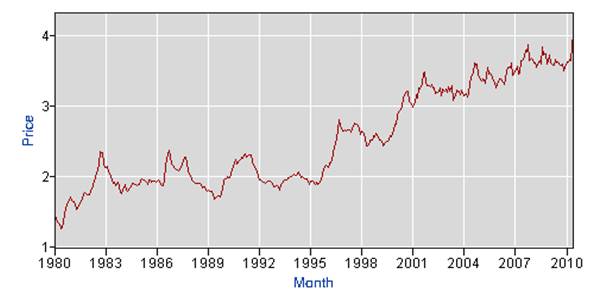
Sliced Bacon Prices (per lb.) – Source (Bureau of Labor Statistics)
It’s Not Getting Any Easier
Volatility aside, investing has become more challenging than ever. However, efficiently investing your nest egg has never been more critical. Why has efficiently managing your investments become so vital? First off, let’s take a look at the entitlement picture. Not so rosy. I suppose there are some retirees that will skate by enjoying their fully allocated Social Security check and Medicare services, but for the rest of us chumps, those luxurious future entitlements are quickly turning to a mirage.
What the financial crisis, rating agency conflicts, Madoff scandal, Lehman Brothers bankruptcy, AIG collapse, Goldman Sachs hearings, FinReg legislation, etc. taught us is the structural financial system is flawed. The system favors institutions and penalizes the investor with fees, commissions, transactions costs, fine print, and layers of conflicts of interests. All is not lost however. For most investors, the money stuffed under the mattress earning nothing needs to be resourcefully put to work at higher returns in order to offset rising prices. Putting together a diversified, low-cost, tax-efficient portfolio with an investment management firm that invests on a fee-only basis (thereby limiting conflicts) will put you on a path of financial success to cover the imperative but escalating living expenses, including of course, Oreos and bacon.
Wade W. Slome, CFA, CFP®
Plan. Invest. Prosper.
*DISCLOSURE: Sidoxia Capital Management (SCM) and some of its clients own certain exchange traded funds, but at the time of publishing SCM had no direct position in KFT, GS, Lehman Brothers, AIG (however own derivative tied to insurance subsidary), or any security referenced in this article. No information accessed through the Investing Caffeine (IC) website constitutes investment, financial, legal, tax or other advice nor is to be relied on in making an investment or other decision. Please read disclosure language on IC “Contact” page.
The New Abnormal – Now and Then

Mohamed El-Erian, bond manager and CEO of PIMCO (Pacific Investment Management Company, LLC) is known for patenting the terms “New Normal,” a period of slower growth, and subdued stock and bond market returns. Devin Leonard, a reporter from BusinessWeek, is probably closer to the truth when he describes our current financial situation as the “New Abnormal.” Accepting El-Erian description is tougher for me to accept than Leonard’s. Calling this economic environment the New Normal is like calling Fat Albert, “fat.” When roughly 15 million people are out of work, not receiving a steady paycheck, am I suppose to be surprised that consumer spending and confidence is sluggish?
Rather than a New Normal, I believe we are in the midst of an “Old Normal.” Unemployment reached 10.8% in 1982, and we recovered quite nicely, thank you, (the Dow Jones Industrial has climbed from a level about 800 in early 1982 to over 11,000 earlier in 2010). Sure, our economy carries its own distinct problems, but so did the economy of the early 1980s. For example:
- Inflation in the U.S. reached 14% in 1982 (core inflation today is < 1%) ;
- The Prime Rate exceeded 20%;
- Mexico experienced a major debt default;
- Wars broke out between the U.K./Falklands & Iran/Iraq;
- Chrysler got bailed out;
- Egyptian President Anwar Sadat was assassinated;
- Hyperinflation spread throughout South America (e.g., Bolivia, Argentina, Brazil)
As I’ve mentioned before, in recent decades we’ve survived wars, assassinations, currency crises, banking crises, Mad Cow disease, SARS, Bird Flu, and yes, even recessions – about two every decade on average. “We’ve had 11 recessions since World War II and we’ve had a perfect score — 11 recoveries,” famed investor Peter Lynch highlighted last year. Media squawkers and industry pundits constantly want you to believe “this time is different.” Economic cycles have an odd way of recurring, or as Mark Twain astutely noted, “History never repeats itself, but it often rhymes.” I agree.
Certainly, each recession and bear market is going to have its own unique contributing factors, and right now we’re saddled with excessive debt (government and consumers), real estate is still in a lot of pain, and unemployment remains stubbornly high (9.5% in June). Offsetting these challenges is a global economy powered by 6 billion hungry consumers with an appetite of achieving a standard of living rivaling ours. Underpinning the surge in developing market growth is the expansion of democratic rule and an ever-sprawling extension of the technology revolution. In 1900, there were about 10 countries practicing democracy versus about 120 today. These political advancements, coupled with the internet, are flattening the world in a way that is creating both new competition and opportunities. The rising tide of emerging market demand for our leading edge technologies not only has the potential of elevating foreigners’ standard of living, but pushing our living standards higher as well.
With the United States economy representing roughly 25% of the globe’s total Gross Domestic Product (~5% of the global population), simple mathematics virtually assures emerging markets will continue to eat more of the global economic pie. In fact, many economists believe China will pass the U.S. over the next 15 years. As long as the pie grows, and the absolute size (not percentage) of our economy grows, we should be happy as a clam as our developing country brethren soak up more of our value-added goods and services.
On a shorter term basis, Leonard profiles several abnormal characteristics practiced by consumers. Here’s what he has to say about the “New Abnormal”:
“The new abnormal has given rise to a nation of schizophrenic consumers. They splurge on high-end discretionary items and cut back on brand-name toothpaste and shampoo. Companies like Apple, whose net income jumped 94 percent in its last quarter, and Starbucks, which is enjoying a 61 percent increase in operating income over the same time frame, are thriving. Mercedes-Benz is having a record sales year; deliveries of new vehicles in the U.S. rose 25 percent in the first six months of 2010. Lexus and BMW were also up. Though luxury-goods manufacturers like Hermýs [sic] and Burberry are looking primarily to Asia for growth, their recent earnings reports suggest stabilization and even modest improvement in the U.S.”
Beyond the fray of high-end products, the masses have found reasons to also splurge at the nation’s largest mall (The Mall of America), home to a massive amusement park and a 1.2 million gallon aquarium. So far this year, the mall has experienced a +9% increase in sales.
So while El-Erian calls for a “New Normal” to continue in the years to come, what might actually be happening is a return to an “Old Normal” with ordinary cyclical peaks and valleys. If this isn’t true, perhaps we will all revert to a “New Abnormal” mindset described by Devin Leonard. If so, I will see you at the Mercedes dealership in my Burberry suit, with $3 latte in hand.
Read Devin Leonard’s Complete New Abnormal Article
Wade W. Slome, CFA, CFP®
Plan. Invest. Prosper.
*DISCLOSURE: Sidoxia Capital Management (SCM) and some of its clients own certain exchange traded funds and AAPL, but at the time of publishing SCM had no direct position in Mercedes, BMW, Burberry, Hermy’s, SBUX, or any security referenced in this article. No information accessed through the Investing Caffeine (IC) website constitutes investment, financial, legal, tax or other advice nor is to be relied on in making an investment or other decision. Please read disclosure language on IC “Contact” page.
Buy-Out Firms Shooting Blanks

Photo source: Photobucket
During the golden age of the mega-buyouts in the mid-2000s, when banks were lending like drunken sailors, and private equity firms were taking the practically free funding to shoot at almost every company in sight, it’s no wonder managers of these funds were “high-fiving” each other. Unfortunately for the participants, the music ended in 2007, and the heavy debt-loaded guns that previously were killing large elephant deals got replaced with harmless toy guns shooting blanks at phantom transactions.
Peter Morris, a former Morgan Stanley (MS) banker and author of the scornful report, “Private Equity, Public Loss,” took a critical eye at the industry pointing to the reasons these high risk-taking private equity firms are underperforming the S&P 500 significantly. Bolstering his underperformance assertions, Morris points to 542 deals in the Yale endowment that underperformed by -40% once fees were subtracted. The Center for the Study of Financial Innovation, which is affiliated with Morris, cites a 2005 paper by Steven Kaplan (University of Chicago), and Antoinette Schoar (Massachusetts Institute of Technology). The paper shows the average buy-out fund underperformed the S&P 500 index from 1980 – 2001.
Another factor that Morris feels should not be ignored relates to risk. Morris feels the excessive risk profiles associated with these private equity funds have not been adequately considered by many unknowing investors and public taxpayers. Pensioners are vulnerable to these underperforming, risk-adjusted returns, while unassuming taxpayers could also be on the hook if risky private equity bets go bad. Under certain scenarios these potentially rocky private equity investments could bring a financial institution to its knees and force governments to use taxpayer bailout money. The Financial Times features a $6.5 billion investment made by Terra Firma, which was subsequently written down to zero, to make its point about the inherent risk private equity plays in the overall financial system.
Heads We Win, Tails You Lose
What makes the purported underperformance more scathing is the fact that these funds should bear higher returns to compensate investors for the additional liquidity risk and leverage that is undertaken. Like hedge funds, most private equity funds charge a 2% management fee, and a 20% performance fee for results achieved above a certain hurdle rate. The problem, that many outside observers highlight, is that the private equity firms have very little skin in the game, for example as little as 2%. With not a lot of their own dough in the game, the fund managers have a built in incentive to swing for the fences, because a profit windfall will filter to them should they hit it big. Morris characterizes this conflict of interest as “heads we win, tails you lose.” Another knock against investors revolves around return calculations. The opacity surrounding returns makes private equity less attractive, since valuations are only truly accurately reflected upon sale, which often takes many years.
Have all these shortcomings scared off investors? Apparently not. Just recently Blackstone Group (BX) raised a new $13.5 billion fund, the firm’s 6th fund, fresh off of its 5th fund that raised a total of $20 billion. The focus of the new fund will be on Asia and North America. In the short-run, Europe will occupy less of the fund’s attention until the region’s economy recovers.
To the extent more of these studies garner traction, I’m sure the private equity industry will react with a forceful response, especially with billions in potential fees at stake. One thing is for sure, investors have become more demanding and shrewd post the financial crisis, so if private equity managers want to earn the rich fees of yesteryear, they will need to do better than shoot blanks.
Read The Financial Times Buy-Out Study Article
Wade W. Slome, CFA, CFP®
Plan. Invest. Prosper.
*DISCLOSURE: Sidoxia Capital Management (SCM) and some of its clients own certain exchange traded funds, but at the time of publishing SCM had no direct position in MS, BX, Terra Firma or any security referenced in this article. No information accessed through the Investing Caffeine (IC) website constitutes investment, financial, legal, tax or other advice nor is to be relied on in making an investment or other decision. Please read disclosure language on IC “Contact” page.
Sachs Prescribes Telescope Over Microscope

Jeffrey Sachs, Professor at Columbia University and one of Time magazine’s “100 most influential people” recommends that our country takes a longer-term view in handling our problems (read Sachs’s full bio). Instead of analyzing everything through a microscope, Sachs realizes that peering out over the horizon with a telescope may provide a clearer path to success versus getting sidetracked in the emotional daily battles of noise.
I do my fair share of media and politician bashing, but every once in a while it’s magnificent to discover and enjoy a breath of fresh common sense, like the advice coming from Sachs. Normally, I become suffocated with a wet blanket of incessant, hyper-sensitive blabbering that comes from Washington politicians and airwave commentators. With the advent of this thing we call the “internet,” the pace and volume of daily information (see TMI “Too Much Information” article) crossing our eyeballs has only snowballed faster. Rather than critically evaluate the fear-laced news, the average citizen reverts back to our Darwinian survival instincts, or to what Seth Godin calls the “Lizard Brain. ”
Sachs understands the lingering nature to our country’s problems, so in pulling out his long-term telescope, he created a broad roadmap to recovery – many of the points to which I agree. Here is an abbreviated list of his quotes:
On Short-Termism:
“Despite the evident need for a rise in national saving after 2008, President Barack Obama tried to prolong the consumption binge by aggressively promoting home and car sales to already exhausted consumers, and by cutting taxes despite an unsustainable budget deficit. The approach has been hyper short-term, driven by America’s two-year election cycle. It has stalled because US consumers are taking a longer-term view than the politicians.”
On Differences between China and the U.S.:
“China saves and invests; the US talks, consumes, borrows, and talks some more.”
On Why Tax Cuts and Stimulus Alone Won’t Work:
“Short-term tax cuts or transfers on top of America’s $1,500bn budget deficit are unlikely to do much to boost demand, while they would greatly increase anxieties over future fiscal retrenchment. Households are hunkering down, and many will regard an added transfer payment as a temporary windfall that is best used to pay down debt, not boost spending.”
On Malaise Hampering Businesses:
“Businesses, for their part, are distressed by the lack of direction….Uncertainty is a real killer.”

On 5-Point Plan to a U.S. Recovery:
1) Increased Clean Energy Investments: The recovery needs “a significant boost in investments in clean energy and an upgraded national power grid.”
2) Infrastructure Upgrade: “A decade-long program of infrastructure renovation, with projects such as high-speed inter-city rail, water and waste treatment facilities and highway upgrading, co-financed by the federal government, local governments and private capital.”
3) Further Education: “More education spending at secondary, vocation and bachelor-degree levels, to recognize the reality that tens of millions of American workers lack the advanced skills needed to achieve full employment at the salaries that the workers expect.”
4) Infrastructure Exports to the Poor: “Boost infrastructure exports to Africa and other low-income countries. China is running circles around the US and Europe in promoting such exports of infrastructure. The costs are modest – essentially just credit guarantees – but the benefits are huge, in increased exports, support for African development and a boost in geopolitical goodwill and stability.”
5) Deficit Reduction Plan: “A medium-term fiscal framework that will credibly reduce the federal budget deficit to sustainable levels within five years. This can be achieved partly by cutting defense spending by two percentage points of gross domestic product.”
Rather than succumb to the nanosecond, fear-induced headlines that rattle off like rapid fire bullets, Sachs supplies thoughtful long-term oriented solutions and ideas. The fact that Sachs mentions the word “decade” three times in his Op-ed highlights the lasting nature of these serious problems our country faces. To better see and deal with these challenges more clearly, I suggest you borrow Sachs’s telescope, and leave the microscope in the lab.
Read Full Financial Times Article by Jeffrey Sachs
Wade W. Slome, CFA, CFP®
Plan. Invest. Prosper.
*DISCLOSURE: Sidoxia Capital Management (SCM) and some of its clients own certain exchange traded funds, but at the time of publishing SCM had no direct position in any security referenced in this article. No information accessed through the Investing Caffeine (IC) website constitutes investment, financial, legal, tax or other advice nor is to be relied on in making an investment or other decision. Please read disclosure language on IC “Contact” page.
“De-Risking” – It’s All Greek to Me

Source: Photobucket
In the classic comedy Animal House John Belushi (who played the character Bluto) gave new meaning to the Greek toga party (who cares if the Romans actually invented the garment?). Belushi also added some flare to Sam Cooke’s timeless song, Wonderful World:
“Don’t know much about history
Don’t know much biology
Don’t know much about the science book
Don’t know much about the French I took.”
Another line should have been added: “Don’t know much about Wall Street jargon.”
“Derisking” – New Wall Street Word Du Jour
Wading through and keeping up with the ever expanding dictionary of Wall Street lingo and acronyms can be a difficult task – much like deciphering the Greek writings of Plato, the famous ancient philosopher.
A recent term repeated constantly by CNBC commentators and hedge fund managers at the annual SALT (SkyBridge Alternatives) conference in Las Vegas, Nevada deserves some more attention…“derisking.” Elegant, simple, chic, and yes, pure B.S. Why not use “mis-risking,” “un-risking,” “dis-risking?” I suppose when charging people 2 and 20 (a 2% management fee plus 20% of profits above a hurdle), one must try to make the most prosaic terms and expressions sound mysterious and dazzling.
Asking one hedge fund manager after another, CNBC commentator David Faber continually asked managers at the May conference what investing strategies were being employed. Faber asked Marc Lasry, CEO and Co-Founder of Avenue Capital Group, the following:
“I have spoken to number of other large hedge fund managers this morning. Derisking, that’s what they are all talking about Marc. So, given that, are you derisking at all?”
Translation: “The market is going down, so are you following all the other lemmings and becoming more conservative because of the panicked-induced headlines we’re shoveling 24/7?”
Glenn Dubin, Co-Founder and CEO of Highbridge Capital Management, a hedge fund company owned by JP Morgan (JPM) got in the “derisking” mood too: “At this point…we are seeing massive de-risking.”
At the time of the SALT conference, European economic concerns were top of mind for all the fast-money traders, as fears of a credit contagion spreading from Greece to larger countries like Italy and Spain felt more palpable to many. Some nine weeks later, the European bank stress tests have been completed, some overseas economic indicators have come in better than anticipated (i.e., U.K. GDP, German business confidence, exports), and some European markets are up about +10% from the “derisking” phase. So, I wonder what those same hedge funds and traders are doing now?
Perhaps they are “rerisking?” I just made that one up out of thin air, but if I hear “rerisking” on CNBC or see it in the Wall Street Journal, I demand a credit in the Merriam-Webster dictionary, or a citation in Wikipedia at a minimum.
The “derisking” wave did not stop at the SALT conference, but remains alive and well today. In fact, a conference has been created in its honor: The 3rd Annual De-Risking Strategies Summit for Pension Funds, Foundations, and Endowments on October 25 – 27, 2010 in New York.
Obviously, this is just one of many terms, acronyms, and euphemisms that the Wall Street machine is constantly churning out. If “derisking” doesn’t float your boat, then why not try on a “swaption” and “straddle” or “contango” and “crawling peg?”
If the never-ending list of Wall Street jargon is weighing you down and a financial professional is speaking Greek to you with confusing financial terminology, then do yourself a favor and slap that person into silence. More often than not, these financial concepts can be explained to a fifth grader (or Bluto). Unfortunately, a convoluted combination of jargon and acronyms is often used in an attempt to impress the listener. The result is usually confusion and a blank stare.
If you are frustrated with learning the language of Wall Street, you are not alone. I recommend you “derisk” your education by adding Greek 101 to your coursework. If you are going to be confused, you might as well do it with a gyro and some Ouzo in hand.
Wade W. Slome, CFA, CFP®
Plan. Invest. Prosper.
*DISCLOSURE: Sidoxia Capital Management (SCM) and some of its clients own certain exchange traded funds, but at the time of publishing SCM had no direct position in JPM or any security referenced in this article. No information accessed through the Investing Caffeine (IC) website constitutes investment, financial, legal, tax or other advice nor is to be relied on in making an investment or other decision. Please read disclosure language on IC “Contact” page.
Paulson Funds: From Ruth’s Chris’s to Denny’s

Investing in hedge funds is similar to eating at a high-priced establishment like Ruth’s Chris’s (RUTH) – not everyone can eat there and the prices are high. In dining terms, John Paulson, President of Paulson & Co. (approximately $34 billion in assets under management), may be considered the managing chef of the upper-crust restaurant. But rather than opening the doors of his funds to an elite few, Paulson is now making his select strategies available to the masses through a much more affordable structure. Or in other words, Paulson is opening an investing version of Denny’s (DENN), in addition to his Ruth’s Chris, so a broader set of investors can buy into his funds at a reasonable price.
Hedge funds typically are reserved for pension funds, endowments, wealthy individuals, or so-called “accredited investors” – individuals earning $200,000 annually, couples earning $300,000, or people with a net worth greater than $1,000,000. By using alternate structures, Paulson will be able to bypass the accredited investor regulatory requirements and reach a more expansive audience.
UCITS Added as a New Item on the Menu
How exactly is Paulson opening his hedge fund strategies to the broader public on a Denny’s menu? He is assembling what is called a “Ucits” structure (Undertakings for Collective Investments in Transferable Securities). These investment vehicles, adopted in 1985, resemble mutual funds and are domiciled in Europe. Although Ucits have been used by relatively few hedge fund managers, Paulson is not the first to institute them (York Capital, Highbridge Capital Management, BlueCrest Capital, and AHL are among the others who have already taken the plunge). According to the Financial Times, Paulson’s Ucits funds will launch later this year. Part of the reason this structure was chosen over others is because the regulations associated with these structures are expected to be less stringent than other onerous regulations currently being discussed by the European Union.
Will the Investing Mouths be Fed?
Should this move by Paulson be surprising? Perhaps Andy Warhol’s quote about everyone being famous for 15 minutes is apropos. Paulson’s $15 billion subprime housing profits in 2007 (read The Greatest Trade Ever) were a handsome reward and now he is attempting to further his wealth position based on this notoriety. Do I blame him? No, not at all, but time will tell if he will be viewed as a one-hit wonder, or whether his subprime bet was only an opening act. More recently, Paulson has been vocal about his seemingly peculiar combination of bullish wagers on gold and California real estate, which he sees rising in price by +20% in 2010 (see Paulson on California home rally). With his optimistic outlook on the U.S. markets and economy, his gold play apparently is riding on the expectation of a future inflation flare up, not another financial meltdown, which was the catalyst that catapulted gold prices higher in late 2008 and throughout 2009.
I’m not sure how many domestic investors will participate in these Ucits investments, however I am eager to see the prospectuses associated with the funds. Like most hedge funds, caution should be used when investing in these types of vehicles, and should only be used as a part of a broadly diversified investment portfolio. For most investors, my guess is the Paulson funds will have an attractive price of entry (i.e., availability), much like a Denny’s restaurant, but the quality and fee structure may be as desirable as a $5.99 greasy steak and pile of gravy-covered mash potatoes.
Read the Entire Financial Times Article on Paulson’s Ucits Launch
Wade W. Slome, CFA, CFP®
Plan. Invest. Prosper.
*DISCLOSURE: Sidoxia Capital Management (SCM) and some of its clients own certain exchange traded funds, but at the time of publishing SCM had no direct positions in RUTH, DENN, or any other security referenced in this article. No information accessed through the Investing Caffeine (IC) website constitutes investment, financial, legal, tax or other advice nor is to be relied on in making an investment or other decision. Please read disclosure language on IC “Contact” page.
WEBINAR: 10 Ways to Protect & Grow Your Nest Egg

If analyzing quarterly reports, managing a hedge fund/client accounts, teaching a course, writing a second book, and squeezing in a vacation is not enough, then why not try to squeeze in a webinar too? That’s exactly what I decided to do, so please join us on Friday (7/23 @ 12:30 p.m. PST) to learn about the critical 10 Ways to Protect and Grow Your Nest Egg in Uncertain Times.
Webinar Details:
—July 23, 2010 (Friday) at 12:30 p.m. – 1:30 p.m. (Pacific Standard Time)
CLICK HERE TO CONNECT TO WEBINAR
Toll Free # (if not using PC): 1-877-669-3239
Access Code: 800 505 230
Managing your investments has never been more difficult in this volatile and uncertain world we live in. With life expectancies increasing, and ambiguity surrounding the reliability of future financial safety nets (Social Security & Medicare), prudently investing your hard earned money to protect and grow your nest egg has never been this critical.
Invest in yourself and block off some time at 12:30 p.m. PST on July 23rd to educate yourself on the “10 Ways to Protect and Grow Your Nest Egg” in a relaxed webinar setting in front of your own computer.
CLICK HERE TO CONNECT TO WEBINAR
Toll Free # (if not using PC): 1-877-669-3239
Access Code 800 505 230
Wade W. Slome, CFA, CFP®
Plan. Invest. Prosper.
*DISCLOSURE: Sidoxia Capital Management (SCM) and some of its clients own certain exchange traded funds, but at the time of publishing SCM had no direct positions in any security referenced in this article. No information accessed through the Investing Caffeine (IC) website constitutes investment, financial, legal, tax or other advice nor is to be relied on in making an investment or other decision. Please read disclosure language on IC “Contact” page.
The Big Short: The Silent Ticking Bomb

A bomb was ticking for many years before the collapse of Bear Stearns in March of 2008, but unfortunately for most financial market participants, there were very few investors aware of the looming catastrophe. In The Big Short: Inside the Doomsday Machine, author Michael Lewis manages to craft a detailed account of the financial crisis by weaving in the exceptional personal stories of a handful of courageous capitalists. These financial sleuths manage not only to discover the explosive and toxic assets buried on the balance sheets of Wall Street giants, but also to realize massive profits for their successful detective skills.
Lewis was not dabbling in virgin territory when he decided to release yet another book on the financial crisis of 2008-2009. Nonetheless, even after slogging through Andrew Ross Sorkin’s Too Big to Fail and Gregory Zuckerman’s The Greatest Trade Ever (see my reviews on Too Big to Fail and The Greatest Trade Ever), I still felt obligated to add Michael Lewis’s The Big Short to my bookshelf (OK…my e-reader device). After all, he was the creator of Liar’s Poker, The New New Thing, Moneyball, and The Blind Side, among other books in his distinguished collection.
Genesis of the Bomb Creations
Like bomb sniffing dogs, the main characters that Lewis describes in The Big Short (Michael Burry/Scion Capital; Steve Eisman/Oppenheimer and Co. & FrontPoint Partners; Gregg Lippman/Deutsche Bank (DB); and Jamie Mai & Charlie Ledley/Cornwall Capital) demonstrate an uncanny ability to smell the inevitable destruction, and more importantly have the conviction to put their professional careers and financial wellbeing at risk by making a gutsy contrarian call on the demise of the subprime mortgage market.
How much dough did the characters in the book make? Jamie Mai and Charlie Ledley (Cornwall Capital) exemplify the payoff for those brave, and shrewd enough to short the housing market (luck never hurts either). Lewis highlights the Cornwall crew here:
“Cornwall Capital, started four and a half years earlier with $110,000, had just netted from a million-dollar bet, more than $80 million.”
Lewis goes on to describe the volatile period as “if bombs of differing sizes had been placed in virtually every major Western financial institution.” The size of U.S. subprime bombs (losses) exploding was estimated at around $1 trillion by the IMF (International Monetary Fund). When it comes to some of the large publicly traded financial institutions, these money bombs manifested themselves in the form of about $50 billion in mortgage-related losses at Merrill Lynch (BAC), $60 billion at Citigroup (C), $9 billion at Morgan Stanley (MS), along with many others.
The subprime market, in and of itself, is actually not that large in the whole scheme of things. Definitions vary, but some described the market at around 7-8 million subprime mortgages outstanding during the peak of the market, which is a small fraction of the overall U.S. mortgage industry. The relatively small subprime market became a gargantuan problem when millions of lucrative subprime side-bets were created through investment banks and unregulated financial behemoths like AIG. The spirits of greed added fuel to the fire as the construction of credit default swap market and synthetic mortgage-backed CDOs (Collateralized Debt Obligations) were unleashed.
Triggering the Bomb
Multiple constituents, including the rating agencies (S&P [MHP], Moodys [MCO], Fitch) and banks, used faulty assumptions regarding the housing market. Since the subprime market was a somewhat new invention the mathematical models did not know how to properly incorporate declining (and/or moderating) national home prices, since national price declines were not consistent with historical housing data. These models were premised on the notion of Florida subprime price movements not being correlated (moving in opposite directions) with California subprime price movements. This thought process allowed S&P to provide roughly 80% of CDO issues with the top AAA-rating, despite a large percentage of these issues eventually going belly-up.
Lewis punctuated the faulty correlation reasoning underlying these subprime assumptions that dictated the banks’ reckless actions:
“The correlation among triple-B-rated subprime bonds was not 30 percent; it was 100 percent. When one collapsed, they all collapsed, because they were all driven by the same broader economic forces. In the end, it made little sense for a CDO to fall from 100 to 95 to 77 to 70 and down to 7. The subprime bonds beneath them were either all bad or all good. The CDOs were worth either zero or 100.”
Steve Eisman adds his perspective about subprime modeling:
“Just throw the model in the garbage can. The models are all backward looking.”
Ignorance, greed, and other assumptions, such as the credibility of VAR (Value-at-Risk) metrics, accelerated the slope of the financial crisis decline.
Eisman had some choice words about many banking executives’ lack of knowledge, including his gem about Ken Lewis (former CEO of Bank of America):
“I had an epiphany. I said to myself, ‘Oh my God he’s dumb!’ A lightbulb went off. The guy running one of the biggest banks in the world is dumb!”
Or Eisman’s short fuse regarding the rating agency’s refusal to demand critical information from the investment banks due to fear of market share loss:
“Who’s in charge here? You’re the grown up. You’re the cop! Tell them to f**king give it to you!!!…S&P was worried if they demanded the data from Wall Street, Wall Street would just go to Moody’s for their ratings.”
A blatant conflict of interest exists between the issuer and rating agency, which needs to be rectified if credibility will ever return to the rating system. At a minimum, all fixed income investors should wake up and smell the coffee by doing more of their own homework, and relying less on the rubber stamp rating of others. The credit default swap market played a role in the subprime bubble bursting too. Without regulation, it becomes difficult to explain how AIG’s tiny FP (Financial Products) division could generate $300 million in profits annually, or at one point, 15% of AIG’s overall corporate profits.
My Take
The Big Short may simply be recycled financial crisis fodder regurgitated by countless observers, but regardless, there are plenty of redeeming moments in the book. Getting into the book took longer than I expected, given the pedigree and track record of Lewis. Nonetheless, after grinding slowly through about 2/3 of the book, I couldn’t put the thing down in the latter phases.
Lewis chose to take a micro view of the subprime mortgage market, with the personal stories, rather than a macro view. In the first 95% of the book, there is hardly a mention of Bear Stearns (JPM) Lehman Brothers, Citigroup, Goldman Sachs (GS), Fannie Mae (FNM), Freddie Mac (FRE), etc. Nevertheless, at the very end of the book, in the epilogue, Lewis attempts to put a hurried bow around the causes of and solutions to the financial crisis.
There is plenty of room to spread the blame, but Lewis singles out John Gutfreund’s (former Salomon Brothers) decision to take Solly public as a key pivotal point in the moral decline of the banking industry. For more than two decades since the publishing of Liar’s Poker, Lewis’s view on the overall industry remains skeptical:
“The incentives on Wall Street were all wrong; they’re still all wrong.”
His doubts may still remain about the health in the banking industry, and regardless of his forecasting prowess, Michael Lewis will continue sniffing out bombs and writing compelling books on a diverse set of subjects.
Wade W. Slome, CFA, CFP®
Plan. Invest. Prosper.
*DISCLOSURE: Sidoxia Capital Management (SCM) and some of its clients own certain exchange traded funds and AIG subsidiary debt, but at the time of publishing SCM had no direct positions in BAC, JPM, FRE, FNM, DB, MS, GS, C, MCO, MHP, Fitch, any security referenced in this article. No information accessed through the Investing Caffeine (IC) website constitutes investment, financial, legal, tax or other advice nor is to be relied on in making an investment or other decision. Please read disclosure language on IC “Contact” page.




 Investing Caffeine
