Questioning the Death of Buy & Hold Investing

In the midst of the so-called “Lost Decade,” pundits continue to talk about the death of “buy and hold” (B&H) investing. I guess it probably makes sense to define B&H first before discussing it, but like most amorphous financial concepts, there is no clear cut definition. According to some strict B&H interpreters, B&H means buy and hold forever (i.e., buy today and carry to your grave). For other more forgiving Wall Street lexicon analysts, B&H could mean a multi-year timeframe. However, with the advent of high frequency trading (HFT) and supercomputers, the speed of trading has only accelerated further to milliseconds, microseconds, and even nanoseconds. Pretty soon B&H will be considered buying a stock and holding it for a day! Average mutual fund turnover (holding periods) has already declined from about 6 years in the 1950s to about 11 months in the 2000s according to John Bogle.
Technology and the lower costs associated with trading advancements is obviously a key driver to shortened investment horizons, but even after these developments, professionals success in beating the market is less clear. Passive gurus Burton Malkiel and John Bogle have consistently asserted that 75% or more of professional money managers underperform benchmarks and passive investment vehicles (e.g., index funds and exchange traded funds).
This is not the first time that B&H has been held for dead. For example, BusinessWeek ran an article in August 1979 entitled The Death of Equities (see Magazine Cover article), which aimed to eradicate any stock market believers off the face of the planet. Sure enough, just a few years later, the market went on to advance on one of the greatest, if not the greatest, multi-decade bull market run in history. People repudiated themselves from B&H back then, and while B&H was in vogue during the 1980s and 1990s it is back to becoming the whipping boy today.
Excuse Me, But What About Bonds?
With all this talk about the demise of B&H and the rise of the HFT machines, I can’t help but wonder why B&H is dead in equities but alive and screaming in the bond market? Am I not mistaken, but has this not been the largest (or darn near largest) thirty year bull market in bonds? The Federal Funds Rate has gone from 20% in 1981 to 0% thirty years later. Not a bad period to buy and hold, but I’m going to go out on a limb and say the Fed Funds won’t go from 0% to a negative -20% over the next thirty years.
Better Looking Corpse
There’s no denying the fact that equities have been a lousy place to be for the last ten years, and I have no clue what stocks will do for the next twelve months, but what I do know is that stocks offer a completely different value proposition today. At the beginning of the 2000, the market P/E (Price Earnings) valued earnings at a 29x multiple with the 10-year Treasury Note trading with a yield of about 6%. Today, the market trades at 13.5 x’s 2010 earnings estimates (12x’s 2011) and the 10-Year is trading at a level less than half the 2000 rate (2.75% today). Maybe stocks go nowhere for a while, but it’s difficult to dispute now that equities are at least much more attractive (less ugly) than the prices ten years ago. If B&H is dead, at least the corpse is looking a little better now.
As is usually the case, most generalizations are too simplistic in making a point. So in fully reviewing B&H, perhaps it’s not a bad idea of clarifying the two core beliefs underpinning the diehard buy and holders:
1) Buying and holding stocks is only wise if you are buying and holding good stocks.
2) Buying and holding stocks is not wise if you are buying and holding bad stocks.
Even in the face of a disastrous market environment, here are a few stocks that have met B&H rule #1:

Maybe buy and hold is not dead after all? Certainly there have been plenty of stinking losing stocks to offset these winners. Regardless of the environment, if proper homework is completed, there is plenty of room to profitably resurrect stocks that are left for a buy and hold death by the so-called pundits.
Wade W. Slome, CFA, CFP®
Plan. Invest. Prosper.
DISCLOSURE: Sidoxia Capital Management (SCM) and some of its clients own certain exchange traded funds and AAPL, AMZN, ARMH, and NFLX, but at the time of publishing SCM had no direct position in GGP, APKT, KRO, AKAM, FFIV, OPEN, RVBD, BIDU, PCLN, CRM, FLS, GMCR, HANS, BYI, SWN (*2,901% is correct %), CTSH, CMI, ISRG, ESRX, or any other security referenced in this article. No information accessed through the Investing Caffeine (IC) website constitutes investment, financial, legal, tax or other advice nor is to be relied on in making an investment or other decision. Please read disclosure language on IC “Contact” page.
The Curious Case of Gen Y and Benjamin Button

If a current Gen Y-er aged backwards like Benjamin Button, he would feel right at home when it comes to investing, because acute conservatism and risk aversion have struck older and younger generations alike. The Curious Case of Benjamin Button is a story that follows the critical peaks and valleys of a boy born in his eighties, who immediately begins to reverse the aging process. Investors of all ages have suffered their peaks and valleys over the last decade, and these experiences have impacted investing attitudes and perceptions heavily during the prime earning years. For retirees, it’s virtually impossible for extreme events like the Great Depression, World War II, Vietnam, Kennedy’s assassination, and Nixon’s impeachment to NOT have had an influence on individuals’ investing behavior.
Investing Consequences on Younger Investors
If a younger Mr. Button were still alive today, there is no doubt the disheartening events experienced in his 80s would only become reinforced by the bleak occurrences in 2008-2009. His reverse aging would not only have allowed him to witness the collapse of Lehman Brothers, but also behold the demise and bailout of other gargantuan financial institutions. Today, if Benjamin wasn’t busy watching the MTV Video Music Awards, he would most likely be diligently managing his bullet-proof portfolio of cash, CDs (Certificates of Deposit), Treasury bills, and maybe some tax-free municipals if he was feeling a little spunky.
The cautious stance of youthful savers was confirmed in a recent study conducted by Merrill Lynch Global Wealth Management. The report demonstrates how the recent financial crisis has had a severe dampening impact on the risk appetites of 18-34 year old “Millennials.” So dramatic an effect was the recession, the nervous conservatism experienced by the 30-somethings was only rivaled by fear from 65 year olds. In fact, the 56% of young investors, who were more cautious today than a year ago, was the highest percentage registered by any age group.
Here’s what Christopher Geczy adjunct associate professor of finance at University of Pennsylvania’s Wharton School had to say about younger Millennials:
“We’re coming off a series of financial crises that hit this young generation at points in their lives where external events shape strong opinions…Many of them have witnessed a decline in the wealth of their families and seen their parents delay retirement or even return to the workforce.”
Beyond witnessing the challenges faced by their parents, the Millennials are encountering their own obstacles – such as joblessness. For those workers under age 35, the unemployment rate in August stood at more than 13% – significantly higher than the 9.6% national rate.
Note to Youths: Stocks for the Long Haul
In the typical life cycle of investing, investors flaunt a higher risk tolerance in their younger years and exhibit more risk aversion as they approach or enter retirement. Historically, this makes perfect sense because workers earlier in their careers have plenty of time to ride out the fluctuations associated with owning equities. Jeremy Siegel, professor at the Wharton University Professor, says stocks significantly outperform bonds by 6% per year over longer timeframes (see Siegel Digs in Heels).
For Gen Y-ers the larger risk is being too conservative, not too aggressive. Barry Nalebuff, a strategy professor at Yale’s School of Management agrees:
“The biggest risk for this generation is that they’ll live too long. With medical breakthroughs, the reality is that many of them will live beyond 100…The only way they have enough assets to last them is to invest in stocks. If they don’t, a lot of people will have to keep working way past when they want to because they won’t have enough money saved up.”
Even for those downbeat on the domestic equity markets – rightfully so with no price gains achieved over the last decade – younger investors should not lose sight of the tremendous equity opportunities available internationally (see the Blowing the Perfect Investment Game).
For many people, reverse aging may be fun for a while, but for Benjamin Button, living through the Great Depression and multiple wars as an adult would likely dampen the mood and increase risk aversion dramatically. Millennials have persevered through difficult times too. Generation Y has survived two recessionary bubbles caused by excessive technology spending and consumer credit binging, both over a short timeframe. Becoming too conservative for these investors will feel comfortable in the short-run if uncertainty continues to prevail. But investing now with adequate, diversified equity exposure is the prudent course of action. Even a wrinkly Benjamin Button could agree, wisely investing in some equities during your earlier career sure beats working as a Wal-Mart (WMT) greeter into your 80s.
Read the full Money-CNN and Newsweek articles on the subject
Wade W. Slome, CFA, CFP®
Plan. Invest. Prosper.
DISCLOSURE: Sidoxia Capital Management (SCM) and some of its clients own certain exchange traded funds and WMT, but at the time of publishing SCM had no direct position in BAC/Merrill, Lehman, or any other security referenced in this article. No information accessed through the Investing Caffeine (IC) website constitutes investment, financial, legal, tax or other advice nor is to be relied on in making an investment or other decision. Please read disclosure language on IC “Contact” page.
From Bearded Monks to Greek Decline

Photo source: vatopaidi.wordpress.com
Noted author Michael Lewis has sold millions of books and written on topics ranging from professional baseball to Wall Street and Iceland to Silicon Valley. Now, he has decided to tackle the gripping but nebulous Greek financial crisis through the eyes and bearded mouths of Greek monks in a recently released article from Vanity Fair.
At the heart of the story is a Christian monastery (Vatopaidi), located on a northeastern peninsula of Greece. This ten-century old sanctuary has helped expose the tenuous state of the Greek economy, which is estimated to be sitting on $1.2 trillion in debt (representing $.25 million per working Greek adult) – a massive number considering the relatively petite size of the country. Beyond interviewing the Vatopaidi monks, Lewis trolled through the country interviewing various politicians, businessmen, government officials, and natives in order to make sense of this Mediterranean mess.
The Scandal Genesis
Starting in 2008, news filtered out that Vatopaidi had somehow acquired a practically worthless lake and swapped it for 73 different government properties, including a 2004 Olympics center. The Vatopaidi monastery effectively created an estimated $1 billion+ commercial real estate portfolio from nothing, thanks to one of the key Vatopaidi monks negotiating a fishy, behind-the-door government exchange scheme. This scandal, among other issues, ultimately lead to the collapse of the prior Greek ruling party and sent Prime Minister Kostas Karamanlis packing his bags.
The Greek crisis did not happen overnight, but rather decades. A casual observer may mistake the caustic Greek media headlines as proof to blame Greece as the reason behind the global financial meltdown, Rather, the challenges faced by this island-based country are more symptomatic of the weak global credit standards and the undisciplined disregard for excessive debt levels. Even with an embarrassingly high debt/GDP ratio (Gross Domestic Product) of about 130%, Greece’s desperate financial situation is a relatively minor blemish in the whole global scheme of things. More specifically, the $300 billion or so in Greek GDP represents the equivalent of a pubescent pimple on the face of a $60 plus trillion global economy.
The Greek Concern
The Vatopaidi scandal is still being investigated, but how did this broader debt-induced, Greek fiscal catastrophe occur?
Lax tax collection, absence of legal enforcement, and simple corruption are a few of the contributing reasons. Lewis describes the situation as follows:
“Everyone is pretty sure everyone is cheating on his taxes, or bribing politicians, or taking bribes, or lying about the value of his real estate. And this total absence of faith in one another is self-reinforcing. The epidemic of lying and cheating and stealing makes any sort of civic life impossible; the collapse of civic life only encourages more lying, cheating, and stealing.”
A tax collector and real estate agent from the article had this to say:
“If the law was enforced, every doctor in Greece would be in jail.” AND
“Every single member of the Greek Parliament is lying to evade taxes.”
The Greek government also did an incredible job of distorting the reported economic data and swept reality under the rug:
“How in the hell is it possible for a member of the euro area to say the deficit was 3 percent of G.D.P. when it was really 15 percent?” a senior I.M.F. (International Monetary Fund) representative asked.
The Greek debacle was not an isolated incident. The significant dislocations occurring around the earth’s small and dark corners have directly impacted our lives here in the U.S. Take for example Iceland, the country that New York Times columnist Thomas Friedman called a converted “hedge fund with glaciers.” Not only did this historically tiny fishing island do dynamic damage to its southern neighbors in Europe, but damage from its collapsing banks extended all the way to busted condominium developments in Beverly Hills, California. Or consider Dubai and the multi-billion dollar debt restructuring at Nakheel Development that held the world breathless as people around the world watched in trepidation.
These examples, coupled with the Greek financial crisis highlight how widespread the collateral damage of cheap credit proliferated. The cost of money is still dangerously low, as governments around the globe attempt to stimulate demand, however the regulators and banking industry must remain vigilant in maintaining loan and capital deployment discipline. The hot debates over financial regulatory reform in the U.S., along with the recent Basel III banking requirement discussions are evidence of the need to restore balance and stability to the global financial playing field.
The global financial crisis has spooked billions of people around the world. Like a mysterious boogeyman, the crisis has turned cheap and easy credit into the public’s worst nightmare. The mysticism and general opacity surrounding the inner-workings of Wall Street and global financial markets attacks at investors’ inherent emotional vulnerabilities. Michael Lewis has once again helped turn what on the exterior seems extremely complex and confusing and boiled the essence of the problem down into terms the masses can digest and put into perspective.
Bearded monks loading up on government-swapped commercial real estate may have provided valuable lessons and insights into the global financial crisis, however now I can hardly wait for Michael Lewis’s next topic…perhaps balding nuns in South African gold mines?
Read the whole Vanity Fair article written by Michael Lewis
Wade W. Slome, CFA, CFP®
Plan. Invest. Prosper.
DISCLOSURE: Sidoxia Capital Management (SCM) and some of its clients own certain exchange traded funds, but at the time of publishing SCM had no direct position in any other security referenced in this article. No information accessed through the Investing Caffeine (IC) website constitutes investment, financial, legal, tax or other advice nor is to be relied on in making an investment or other decision. Please read disclosure language on IC “Contact” page.
Crisis Delivers Black-Eye to Classic Economists

Markets are efficient. Individuals behave rationally. All information is reflected in prices. Huh…are you kidding me? These are the beliefs held by traditional free market economists (“rationalists”) like Eugene Fama (Economist at the University of Chicago and a.k.a. the “Father of the Efficient Market Hypothesis”). Striking blows to the rationalists are being thrown by “behavioralists” like Richard Thaler (Professor of Behavioral Science and Economics at the University of Chicago), who believes emotions often lead to suboptimal decisions and also thinks efficient market economics is a bunch of hogwash.
Individual investors, pensions, endowments, institutional investors, governments, are still sifting through the rubble in the aftermath of the 2008-2009 financial crisis. Experts and non-experts are still attempting to figure out how this mass destruction occurred and how it can be prevented in the future. Economists, as always, are happy to throw in their two cents. Right now traditional free market economists like Fama have received a black eye and are on the defensive – forced to explain to the behavioral finance economists (Thaler et. al.) how efficient markets could lead to such a disastrous outcome.
Religion and Economics
Like religious debates, economic rhetoric can get heated too. Religion can be divided up in into various categories (e.g., Christianity, Islam, Judaism, Hinduism, Buddhism, and other), or more simply religion can be divided into those who believe in a god (theism) and those who do not (atheism). There are multiple economic categorizations or schools as well (e.g., Keynsians, monetarism, libertarian, behavioral finance, etc.). Debates and disagreements across the rainbow of religions and economic schools have been going on for centuries, and the completion of the 2008-09 financial crisis has further ignited the battle between the “behavioralists” (behavioral finance economists) and the “rationalists” (traditional free market economists).
Behavioral Finance on the Offensive
In the efficient market world of the “rationalists,” market prices reflect all available information and cannot be wrong at any moment in time. Effectively, individuals are considered human calculators that optimize everything from interest rates and costs to benefits and inflation expectations in every decision. What classic economics does not include is emotions or behavioral flaws.
Purporting that financial market decisions are not impacted by emotions becomes more difficult to defend if you consider the countless irrational anomalies considered throughout history. Consider the following:
- Tulip Mania: Bubbles are nothing new – they have persisted for hundreds of years. Let’s reflect on the tulip bulb mania of the 1600s. For starters, I’m not sure how classic economists can explain the irrational exchanging of homes or a thousand pounds of cheese for a tulip bulb? Or how peak prices of $60,000+ in inflation-adjusted dollars were paid for a bulb at the time (C-Cynical)? These are tough questions to answer for the rationalists.
- Flash Crash: Seeing multiple stocks (i.e., ACN and EXC) and Exchange Traded Funds (ETFs) temporarily trade down -99% in minutes is not exactly efficient. Stalwarts like Procter & Gamble also collapsed -37%, only to rebound minutes later near pre-collapse levels. All this volatility doesn’t exactly ooze with efficiency (see Making Millions in Minutes).
- Negative T-Bill Rates: For certain periods of 2008 and 2009, investors earned negative yields on Treasury Bills. In essence, investors were paying the government to hold their money. Hmmm?
- Technology and Real Estate Bubbles: Both of these asset classes were considered “can’t lose” investments in the late 1990s and mid-2000s, respectively. Many tech stocks were trading at unfathomable values (more than 100 x’s annual profits) and homebuyers were inflating real estate prices because little to no money was required for the purchases.
- ’87 Crash: October 19, 1987 became infamously known as “Black Monday” since the Dow Jones Industrial Average plunged over -22% in one day (-508 points), the largest one-day percentage decline ever.
The list has the potential of going on forever, and the recent 2008-09 financial crisis only makes rationalists’ jobs tougher in refuting all this irrational behavior. Maybe the rationalists can use the same efficient market framework to help explain to my wife why I ate a whole box of Twinkies in one sitting?
Rationalist Rebuttal
The rationalists may have gotten a black eye, but they are not going down without a fight. Here are some quotes from Fama and fellow Chicago rationalist pals:
On the Crash-Related Attacks from Behavioralists: Behavioralists say traditional economics has failed in explaining the irrational decisions and actions leading up to the 2008-09 crash. Fama states, “I don’t see this as a failure of economics, but we need a whipping boy, and economists have always, kind of, been whipping boys, so they’re used to it. It’s fine.”
Rationalist Explanation of Behavioral Finance: Fama doesn’t deny the existence of irrational behavior, but rather believes rational and irrational behaviors can coexist. “Efficient markets can exist side by side with irrational behavior, as long as you have enough rational people to keep prices in line,” notes Fama. John Cochrane treats behavioral finance as a pseudo-science by replying, “The observation that people feel emotions means nothing. And if you’re going to just say markets went up because there was a wave of emotion, you’ve got nothing. That doesn’t tell us what circumstances are likely to make markets go up or down. That would not be a scientific theory.”
Description of Panics: “Panic” is not a term included in the dictionary of traditional economists. Fama retorts, “You can give it the charged word ‘panic,’ if you’d like, but in my view it’s just a change in tastes.” Calling these anomalous historic collapses a “change in tastes” is like calling Simon Cowell, formerly a judge on American Idol, “diplomatic.” More likely what’s really happening is these severe panics are driving investors’ changes in preferences.
Throwing in White Towel Regarding Crash: Not all classic economists are completely digging in their heels like Fama and Cochrane. Gary Becker, a rationalist disciple, acknowledges “Economists as a whole didn’t see it coming. So that’s a black mark on economics, and it’s not a very good mark for markets.”
Settling Dispute with Lab Rats
The boxing match continues, and the way the behavioralists would like to settle the score is through laboratory tests. In the documentary Mind Over Money, numerous laboratory experiments are run using human subjects to tease out emotional behaviors. Here are a few examples used by behavioralists to bolster their arguments:
- The $20 Bill Auction: Zach Burns, a professor at the University of Chicago, conducted an auction among his students for a $20 bill. Under the rules of the game, as expected, the highest bidder wins the $20 bill, but as an added wrinkle, Burns added the stipulation that the second highest bidder receives nothing but must still pay the amount of the losing bid. Traditional economists would conclude nobody would bid higher than $20. See the not-so rational auction results here at minute 1:45.
- $100 Today or $102 Tomorrow? This was the question posed to a group of shoppers in Chicago, but under two different scenarios. Under the first scenario, the individuals were asked whether they would prefer receiving $100 in a year from now (day 366) or $102 in a year and one additional day (day 367)? Under the second scenario, the individuals were asked whether they would prefer receiving $100 today or $102 tomorrow? The rational response to both scenarios would be to select $102 under both scenarios. See how the participants responded to the questions here at minute 4:30.
Rationalist John Cochrane is not fully convinced. “These experiments are very interesting, and I find them interesting, too. The next question is, to what extent does what we find in the lab translate into how people…understanding how people behave in the real world…and then make that transition to, ‘Does this explain market-wide phenomenon?,’” he asks.
As alluded to earlier, religion, politics, and economics will never fall under one universal consensus view. The classic rationalist economists, like Eugene Fama, have in aggregate been on the defensive and taken a left-hook in the eye for failing to predict and cohesively explain the financial crash of 2008-09. On the other hand, Richard Thaler and his behavioral finance buds will continue on the offensive, consistently swinging at the classic economists over this key economic mind versus money dispute.
See Complete Mind Over Money Program
Wade W. Slome, CFA, CFP®
Plan. Invest. Prosper.
DISCLOSURE: Sidoxia Capital Management (SCM) and some of its clients own certain exchange traded funds, but at the time of publishing SCM had no direct position in ACN, EXC, or any other security referenced in this article. No information accessed through the Investing Caffeine (IC) website constitutes investment, financial, legal, tax or other advice nor is to be relied on in making an investment or other decision. Please read disclosure language on IC “Contact” page.
Winner’s Curse: HP’s Storage Prize

Congratulations HP (HPQ)…you are the proud winner of 3Par Inc. (PAR), a relatively small enterprise storage hardware and software company, for the bargain price of 125x’s 2011 earnings! Never mind that you were late to the game in your winning $2.4 billion bid against Dell Inc. (DELL), or that you paid more than triple the price ($33 per share) that 3Par was trading just 21 days ago (< $10 per share). At least you have a storage trophy you can show all your friends and you don’t have to carry around all those heavy bills anymore.
Winner’s Curse
In bidding wars and auctions, the victor of the price battle runs the risk of earning the “Winner’s Curse.” The curse falls upon those that bid a price that exceeds an auctioned asset’s intrinsic value. How can this occur? Well for one reason, the bidder may not have complete information regarding the value of the asset. Secondly, there can be emotional factors, or ego, that play a role in the decision and price paid. Lastly, unique factors, such as strategic benefits or synergies may exist that allow one bidder to offer a higher price than other auction participants. For example, consider an exploration and production company (XYZ Drilling Co.) that is bidding for drilling lease rights in Prudhoe Bay, Alaska. If XYZ Drilling Co. has unique existing drilling operations in the same area as the auctioned assets, XYZ Drilling Co. may be in a better position of making a profitable bid relative to its peers.
HP vs. Dell – A Deeper Look
Let’s take a deeper dive into the HP bid of 3Par. While HP generates a lot of cash by selling printers, cartridges, and computers, the company doesn’t exactly have a bullet-proof balance sheet. Unlike let’s say Apple Inc. (AAPL), which has about $46 billion in cash on its balance sheet with no debt (see Steve Jobs: Gluttonous Hog), HP actually carries more debt than cash (about $20 billion in debt and $15 billion in cash). What’s more, HP has little tangible equity, once $42 billion in goodwill and intangible assets are subtracted from the total asset value of the company – leaving HP with an astronomically high ratio of 275x’s price to tangible book value. For most companies operating with a positive net cash position, making acquisitions accretive is not that difficult in this current environment – when cash is decaying away with a paltry 1% return. Unfortunately for HP, their accretive hurdle is higher than a cash-rich company. Their weighted average cost of capital is ratcheted significantly higher due to a net debt position (not net cash).
Here is the viewpoint on the deal from Ashok Kumar, senior technology analyst at Rodman & Renshaw LLC:
“It’s in excess of $3 million per employee. To put it in perspective, today 3Par has about 5 percent [market share] of the very high-end market and for these premiums to pay out, [HP] would have to expand their market share to about 25 percent or about $1.5 billion, which is 5x the projected growth rate. And all of that would come at the expense of incumbents [like] IBM, EMC, Hitachi.”
On the Bright Side
Although the price paid by Hewlett-Packard for 3Par is ridiculously too high, this deal alone is not going to break HP’s piggybank. HP is currently raking in about $8 billion in cash flow per year, so absent aggressive share buybacks or other large acquisitions, HP should be able to pay off the cost of the deal in a few quarters. Secondarily, HP does gain some synergies by integrating 3Par’s blocklevel data storage expertise into HP’s existing portfolio of other storage technologies ( i.e., StoreOnce and IBRIX). Thirdly, HP gains some strategic defensive benefits by keeping 3Par out of Dell’s hands, a potentially formidable competitor in the storage space, given the intensive overlap in customer bases between HP & Dell. Lastly, HP will no doubt be able to introduce and cross-sell 3Par products into Hewlett’s vastly larger customer distribution channels and reap the resulting rewards.
All in all, the 3Par acquisition by HP makes perfect strategic sense, however the price paid will turn out to be a much better deal for 3Par shareholders, rather than HP shareholders. HP ultimately shelled out a hefty price tag to become the victorious party in the 3Par bidding war, but rather than increasing shareholder value, HP ended up achieving the “Winner’s Curse.”
Wade W. Slome, CFA, CFP®
Plan. Invest. Prosper.
DISCLOSURE: Sidoxia Capital Management (SCM) and some of its clients own certain exchange traded funds and AAPL, but at the time of publishing SCM had no direct position in HPQ, PAR, DELL, IBM, EMC, Hitachi, or any other security referenced in this article. No information accessed through the Investing Caffeine (IC) website constitutes investment, financial, legal, tax or other advice nor is to be relied on in making an investment or other decision. Please read disclosure language on IC “Contact” page.
Paper Cut to Death with 12b-1 Fees

Paying all these 12b-1 fees and other expenses found in the small-print can be a lot like getting paper-cut to death. The Securities and Exchange Commission (SEC) is looking to put a Band-Aid on the problem by capping these nonsensical fees and proposing more disclosure, albeit three decades after these fees initially got introduced. According to InvestmentNews, the SEC has proposed a .25 percent cap on 12b-1 fees, which may save investors upwards of $857 million per year if the proposal is enacted. That’s all good and great, but aren’t investors already getting pillaged and plundered with load expenses and other investment management fees?
The Original Rationale
The original thought process behind the 12b-1 fee movement was designed to allow the little guys (small fund management companies) to compete on an even playing field against the big guys (think of Fidelity, Vanguard, and the American Funds) when it came to product distribution. The SEC says about 2/3 of the 8,000 mutual funds in the industry charge 12b-1 fees, which reached over $13 billion in 2008. These 12b-1 fees generally account for 18% of the total annual fund expenses (ICI – Investment Company Institute).

Source: ICI. The general trend in 12b-1 fees was upwards until the financial crisis hit.
So are small fund management companies truly benefitting from the customer kickbacks after 12b1-fees were unveiled in 1980? It appears the small fry fund companies have indeed scraped up some extra fees as ammo to market products against the big guys, but the big guys are receiving the same 12b-1 fees. It’s like giving both me and Alex Rodriguez (New York Yankees) an aluminum bat in the game of baseball. There’s a good chance I may be able to clear the infield now, but A-Rod will instantly have the power to hit one out of the stadium – I have effectively gained no advantage with my new metal bat.
The Investor Perspective
If I’m an investor, what do I care if my mutual fund company has one investor or one million investors? I just want the best products at the lowest price. Yeah, there are these special items used in other industries that help pay for marketing and distribution expenses…they’re called sales and profits. What a novel idea.
Deciphering all the mutual fund class flavors is tough enough. Like trading in a used car when buying a new car, the juggling of prices, fees, and taxes can become a head-spinning exercise in discovering the true component costs. The cards become even more stacked against investors, if you consider alternative products like the shady world of annuities (see Annuity Trap article). If translating 12b-1 and load fees is not challenging enough for you, try digesting a slice of legalese heaven by examining this 259 page annuity prospectus gem.
The Flawed Structure
Unfortunately, the financial industry is rife with conflicts and opacity, with the investor getting the short end of the stick. The industry’s main incentive is all about generating commissions for the broker (salesman) and financial institution – not about generating the best return for the client. Here is how I see a typical conversation playing out between a broker and prospect:
Broker A: “This is a slam dunk investment with guaranteed returns.”
Prospect XYZ: “Wow, that sounds great – guaranteed returns in a world that everyone is talking double-dip. How do I learn more?”
Broker A: “You can sign here on the dotted line, or borrow this forklift and take two months to review this gargantuan 259 page prospectus that I don’t even understand.”
Prospect XYZ: “If I have questions about 12b-1 fees, administrative fees, up-front commissions, management fees, mortality charges, trail expenses, or other costs, can I give you call?”
Broker A: “Oh sure, but I’ll probably be in the Bahamas drinking umbrella-coconut drinks with all the commission dollars I’ve earned, so if I don’t answer, just leave a message.”
Why do 12b-1 Fees Exist at All?
OK, now that I’ve returned from my annuity rant, let’s get back to the pointless value of 12b-1 fees. I mean honestly, what privileged status does the financial industry have in charging customers for a business’s operating expenses? Why stop at charging customers for marketing and distribution costs…maybe customers can start paying for new fund development expenses or for employee health benefits? What’s more, if the financial industry is going to nickel and dime clients with all kinds of fees, then why not have customers subsidize the marketing and advertising campaigns in other industries, like in the pharmaceutical, tobacco, beer, and junk food industries?
Not all 12b-1 fees are created equally. Many funds do not even carry 12b-1 fees, or many that do carry a much more modest punch. While I respect Mary Shapiro’s courage in addressing the useless 30-year 12b-1 fee structure institutionalized by industry lobbyists, putting a Band-Aid on this paper-cut is only hiding the wound, not healing it.
Wade W. Slome, CFA, CFP®
Plan. Invest. Prosper.
DISCLOSURE: Sidoxia Capital Management (SCM) and some of its clients own certain exchange traded funds and mutual funds, including Vanguard and Fidelity, but at the time of publishing SCM had no direct position in any other security referenced in this article. No information accessed through the Investing Caffeine (IC) website constitutes investment, financial, legal, tax or other advice nor is to be relied on in making an investment or other decision. Please read disclosure language on IC “Contact” page.
ETF Slam Dunk: Mixing Jordan & Rodman

Players in the same game may use different strategies in the hunt for success. Take five-time NBA champ Dennis “The Worm” Rodman vs. Hall of Famer and fourteen-time All-Star Michael Jordan. Rodman’s bad-boy antics, tattoos, and loud hair colors more closely resemble the characteristics of a brash trader or quick-trigger hedge fund manager, which explains why Rodman played for five different NBA teams. Jordan on the other-hand was less impulsive, and like a long-term investor, held a longer term horizon with respect to team loyalty – he spent 13 seasons with one team (Chicago Bulls), excluding a brief, half-hearted return to the Washington Wizards. Despite their differences, they shared one common goal…the ambition to win.
In the investment world, traders and long-term investors in many cases could be even more different than Rodman and Jordan…just think Jim Cramer and Warren Buffett. But when it comes to the exploding trend of Exchange Traded Funds (ETFs) expansion, traders and investors of all types share the common appreciation for lower costs (management fees and trading commissions). Beyond the lower costs, ETFs also offer a wide and growing range of liquid exposures, regardless of whether a trader wants to hold the ETF for five hours or an investor wants to own it for five years. The benefits of low cost and liquidity, relative to traditional actively managed mutual funds, are two key reasons why this market has blossomed to $822 billion in size and is still strengthening at a healthy clip.

Source: SPDR
The flight to bonds and out of equities has been well documented (see chart below), but underneath the surface is a migrating investor trend out of active managers, and into lower cost vehicles for equity exposure (ETFs and Index Funds). The poster child beneficiary of this movement is the Vanguard Group (based in Valley Forge, Pennsylvania), which manages $1.4 trillion in fund assets, including $112 billion in ETFs (Bloomberg). Equity heavy fund management companies like Janus Capital Group Inc. (JNS) and T. Rowe Price Group Inc. (TROW) have felt the brunt of the pain from the disinterested investing public.

Source: Iacono Research
The migration away from expensive actively managed funds has created a cut-throat dog-fight for ETF market share. Competition has gotten so bad that discount brokerage firms like Fidelity Investments ($1.25 trillion in mutual fund assets) and Charles Schwab Corp. (SCHW) have begun offering free ETF trading. Just two days ago Schwab also purchased Windward Investment Management, Inc. (~$3.9 billion in assets under management), for $150 million in stock and cash.
At the end of the day, money goes where it is treated best. Irrespective of differences between long-term investors and short-term traders, the lower costs and improved liquidity associated with ETFs have shifted money away from more costly, actively traded mutual funds. At my firm, Sidoxia Capital Management, I choose to use a diversified hybrid approach via my Fusion investment products (Conservative, Moderate, and Aggressive). Fusion integrates low-cost, tax-efficient investment vehicles and strategies, including fixed income securities (including funds & ETFs), individual stocks, and equity ETFs. Regardless of the differing preferences of hair colors and tattoos, my bet is that Dennis Rodman and Michael Jordan could agree on the importance of two things…winning games and using ETFs.
Wade W. Slome, CFA, CFP®
Plan. Invest. Prosper.
*DISCLOSURE: Sidoxia Capital Management (SCM) and some of its clients own certain exchange traded funds, but at the time of publishing SCM had no direct position in JNS, TROW, SCHW or any other security referenced in this article. No information accessed through the Investing Caffeine (IC) website constitutes investment, financial, legal, tax or other advice nor is to be relied on in making an investment or other decision. Please read disclosure language on IC “Contact” page.
What Happens in Vegas, Stays on Wall Street
What happens in Vegas, stays in Vegas, unless it’s a habit of betting, in which case that habit will follow you back to Wall Street. Just as there are a million ways to make or lose money by investing or speculating in the market, the same principles apply to sports betting as well. Anybody who has been to Las Vegas and gone to the sportsbook knows how incredibly and insanely accurate the oddsmakers are – I speak from immature experience having traveled there for a healthy number of investment conferences and vacations. The oddsmakers are so accurate; you could say they are almost “efficient” at what they do.
But like the market, in the sports world too, efficiency has a tendency to breakdown occasionally and form bubbles. This dynamic leaves both a huge threat of substantial losses and a potential for windfall gains. Where there are bubbles forming, you are bound to find a large number of excited individuals jumping on a bandwagon. Now, let’s take a look at how the worlds of Wall Street and wagers collide and see if any lessons can be learned.
Jumping on the Stock Bandwagon
band·wag·on [band-wag-uhn]: a party, cause, movement, etc., that by its mass appeal or strength readily attracts many followers.

Photo source: Freshpics.blogspot.com
Everybody loves a winner and no one more so than a fresh fan jumping on the bandwagon. Living in Southern California, the bandwagon is presently fully-loaded with proclaimed Los Angeles Laker fans and USC fans, although the Trojan wagon is currently undergoing repair. It’s easy to identify bandwagoners in sports – just find the face painter, guy with a rainbow afro, Boston native sporting a Kobe Bryant jersey, or the fanatic betting on the team favored by three touchdowns. In the game of stocks, identifying the fickle but passionate followers is a little more subtle. Bandwagon status is not measured by the extent of point spreads (predicted scoring differential between two opponents), but rather by level of P/E ratios (Price-Earnings ratio) or other valuation metric of choice.
While it is clear sports bandwagoners root for the “favorites,” in the realm of investing this translates into piling onto the “growth or momentum” stocks (see Momentum Investing article) – I hate generalizing terms but that’s what we bloggers do. Value investors, on the other hand, root for (buy) the “underdogs.”
To illustrate my point, let’s take a look at a few past bandwagon momentum stocks:
- JDS Uniphase Corp. (JDSU): In 2000 we saw these bandwagoners valuing investor favorites like JDS Uniphase at a whopping $99 billion – meaning investors were willingly paying over 100x’s revenues and 600 x’s trailing earnings to own the stock. At the time, JDSU was a “New Economy” stock that was going to revolutionize the proliferation of bandwidth around the globe with their proprietary optical laser components. For those of you keeping score at home, today JDSU’s stock is valued at approximately $2 billion ($9.97), or -98% less than the market value in March 2000 (split-adjusted peak share price of $1,227.38 per share). If it wasn’t for a 1-for-8 reverse stock split in 2006, then a share of JDSU would fetch you $1.25 today, or less than the amount needed to cover an out of network ATM penalty fee.
- Crocs Inc. (CROX): Crox is another one of my favorite bandwagon stocks, because this loud plastic eyesore footwear was clearly a fad that couldn’t sustain its growth once popularity waned, despite my wife being a bandwagon-ee. Like other fad product-related stocks, the company could no longer maintain its growth once they completed stuffing the channel and their customers cried uncle from choking on inventory. Making matters worse for CROX, knockoff versions were offered for a fraction of the cost at local grocery stores and mall kiosks. After about 20 months post its IPO (Initial Public Offering), the music stopped and within 13 months the stock cratered from a $75 per share peak to $0.79 in 2008. The stock never traded at the absurd dot-com levels, but the lofty 37x P/E in 2007 quickly turned negative after close to $200 million in losses were realized in 2008 and 2009. The stock has since rebounded to $12 and change, and maybe their new Crocs high-heel line of $99.00 shoes (see here) will propel the stock higher…cough, cough.
Point Spread, Point Spread, Point Spread
In sports betting the three most important factors in making a winning bet are point spread, point spread, and point spread. Unlike the March Madness college basketball pool in which you may have participated, in the real world the participant needs to do more than just pick the winning teams – the participant must determine by how much a team will win by. Let’s take a gander at a few actual examples.
- Florida Gators vs. Charleston Southern Buccaneers (9/5/09): Without knowing a lot about the powerhouse squad from South Carolina, 99% of respondents, when asked before the game who would win, would select Florida – a consistently dominant national-powerhouse program. The question gets a little trickier when asked the question: “Will the Florida Gators win by more than 63 points?” That’s exactly the point spread sports bettors faced when deciding whether or not to place the bet – somewhat analogous to the question whether JDSU was a prudent investment at 600x’s earnings? Needless to say, although the Buccs kept it close in the first half, and only trailed by 42-3 at halftime, the Gators still managed to squeak by with a 62-3 victory. Worth noting, the 59 point margin of victory resulted in a losing wager for anyone picking the Gators.

- USC Trojans vs. Stanford Cardinal (10/6/2007): Ranked as the presumptive #1 team of the country pre-season, and entering the game with a 35-0 home-game winning streak, USC was a whopping 41 point favorite over Stanford. On the flip side, the Cardinal came into the game fresh off of a 1-11 losing season the prior year, and in the previous year the Cardinal lost to the Trojans 42-0. Stanford ended up winning the 2007 match-up by a score of 24-23, not only pulling off one of the greatest upsets of all-time, but also spoiling USC’s chances of winning the national championship.
Read more about the greatest upsets of all-time.
Beyond the Point Spread
As you can surmise from our discussion, the same point spread standards apply to investing, but when discussing stocks the spread is measured by various valuation metrics based on earnings, cash flows, book value, EBITDA, sales, and other fundamental growth factors.
Of course, in Las Vegas and on Wall Street not everyone follows traditional fundamental analysis. Some gamblers and speculators will transact solely based on less conventional methods, for example quantitative models, technical analysis and trend review (read Technical Analysis: Astrology or Lob Wedge). For example in sports, handicappers may only wager on teams with five-game winning streaks and winning home records. Whereas on Wall Street, speculators may only trade stocks with positive earnings surprises or “head-and-shoulder” patterns. Hot technicians come and go, but very few real investors survive the long haul without using fundamental analysis and valuation as key components of their winning strategies.
As I have argued, there are many ways to make (and lose) money on Wall Street or in Las Vegas, and consistently jumping on the bandwagon is a sure way to lose. For the successful minority whose performance has endured the test of time, a common thread connecting the two disciplines is the ability to determine and profit from a prudently calculated point spread/valuation. History teaches us that the same effective handicapping skills happening in Las Vegas are the same abilities needed to stay on Wall Street and win.
Wade W. Slome, CFA, CFP®
P.S. See how a pro handicapper conquered Las Vegas and placed sportsbooks on the run.
Plan. Invest. Prosper.
*DISCLOSURE: The undergraduate alma mater of Sidoxia Capital Management’s (SCM) President happens to be UCLA, so although I believe any reference to rival school USC is not provided with any malicious agenda, nonetheless there may exist an inherent conflict of interest. SCM and some of its clients own certain exchange traded funds, but at the time of publishing, SCM had no direct position in JDSU, CROX, or any other security referenced in this article. No information accessed through the Investing Caffeine (IC) website constitutes investment, financial, legal, tax or other advice nor is to be relied on in making an investment or other decision. Please read disclosure language on IC “Contact” page.
M&A: Top or Bottom?

James Stewart at Smart Money recently wrote a piece attempting to debunk the consensus view, which holds the belief that increased mergers and acquisitions (M&A) activities is a leading indicator of positive market returns. There is no doubt, in the desert of positive news headlines, the bulls are searching for signs of an oasis to rescue them. Temporarily quenching the thirst of the bulls were $90 billion of proposed deals last week, including the hefty $40 billion hostile takeover offer of Potash Corp. (POT) by BHP Billiton Ltd. (BHP).
Is this uptick in deal announcements the sign of greener pastures, or is it what Stewart calls a “reverse indicator” of the market’s direction?
Stewart buttresses his argument by showing how record deal activity occurs at peaks of the market. For example, global M&A activity crested at $4.3 trillion in 2007, right before the market cratered in 2008. This peak can be compared to the previous trough of $1.3 trillion in M&A transactions in 2002, just as the economy was freshly recovering out of the recession. The trough to peak period for this M&A cycle lasted about five years (2002-2007), so I’m having a little trouble understanding how Stewart is claiming a peak is imminent after less than 1 year into the new M&A cycle (the recent M&A trough occurred in 2009 at $1.3 trillion)? Wouldn’t his analysis imply a gradual increase in deals until 2014? Well, for now, let’s just go with his rapid orgasm thesis and move onto his next points.
Stewart proceeds to rationalize the spate of new deal announcements with the following reasons:
- Higher Prices Perk Up Previously Reluctant Sellers: The general price rebound in the market from the nadir in March 2009 is one major contributing factor to why previously reluctant targets are now warming up to fresh overtures.
- Suitors More Comfortable: In 2009, buyers weren’t in the mood for paying top dollar for companies experiencing deteriorating fundamentals. Prices may be higher in 2010, but the Armageddon scenarios of early 2009 have momentarily been put on hold.
- Money Can’t Get Any Tighter: The cheap, loosey-goosy lending standards in the pre-2008 M&A golden era no longer exist, but conditions can’t get much worse than the log-jammed lending standards practiced in 2009.
The Real Reason for Deals Rising
Source: The Wall Street Journal
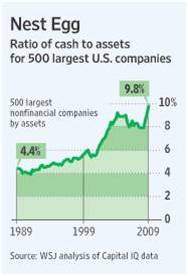
One word…cash. About $1.8 trillion of it is just piling up on the non-financial balance sheets of domestic companies (Financial Times). The tribes are getting restless with the obscene amounts of money earning 1% or less (read Steve Jobs: Gluttonous Hog article) and shareholders want to see more productive strategies applied to their capital. Frankly, I much prefer organic investment (e.g., R&D and marketing), share buybacks, and dividends over large destructive acquisitions any day. Just ask the executives at AOL/Time Warner, Mercedes Benz/Chrysler, and Sprint/Nextel how those large deals worked out for them. For some reason, many men like driving big macho trucks, just as many CEOs like controlling big companies.
One Reason to Buy and Many Reasons to Sell
I can’t disagree with James’s thesis that M&A markets get overheated near market tops, but I think there is a lot of room in deal announcements between the $90 billion in deals announced last week and the $4.3 trillion peak. I also agree that one good week of M&A announcements should not be extrapolated into eternity.
Worth noting as well, I believe there is a substantial difference in the financing market today versus the prior peak. In the BHP/Potash deal for example, BHP offered $40 billion in cash…not stock. BHP is putting its money where its mouth is, particularly its $18 billion in annual cash flow and its healthy balance sheet. Internal financing wasn’t the main priority in the mid-2000s, when companies (including private equity) were more cavalier with OPM (other people’s money), specifically with the endless pools of cheap bank financing.
Currently, companies have deep pockets, but very short arms, and as a result, companies have been very stingy with their capital. However, if we continue to see more internally financed cash deals, I will view that trend as a tremendously positive signal of longer-term fundamental confidence, a characteristic which was absent last year.
On the topic of insider buying, Peter Lynch pointed out “there is only one reason to buy and many reasons to sell” – the only real reason to purchase is the belief stock prices will move higher. Since the availability of cheap capital has been severely hampered, a wide swath of companies will have to rely on their own cash generation – not OPM. Since outside capital is scarce, the companies with cash flexibility will be more prudent in their M&A due diligence.
Overall, James Stewart may be right about the sustainability of M&A going into next year. However, in the short-run, as the gargantuan corporate cash piles get put to use through more M&A, and share buybacks, simple supply-demand economics indicate a shrinking equity base should bode well for market prices, all else equal. Uncertainty is available in large quantities right now, so time will tell if deal making will diminish into a market top, or gain momentum into a bull market. With all that cash sitting on the sidelines, my guess is we are closer to the trough of the M&A wave versus the top. If I’m wrong, don’t hold your breath for a Microsoft-Google (MSFT/GOOG) or Exxon-Chevron (XOM/CVX) merger anytime soon.
Read Full Smart Money M&A Article Here (Hat-Tip Josh Brown TRB)
Wade W. Slome, CFA, CFP®
Plan. Invest. Prosper.
*DISCLOSURE: Sidoxia Capital Management (SCM) and some of its clients own certain exchange traded funds, GOOG, and AAPL, but at the time of publishing SCM had no direct position in BHP, POT, MSFT, XOM, CVX, AOL/Time Warner (TWX), Mercedes Benz/Chrysler, and Sprint/Nextel (S) or any other security referenced in this article. No information accessed through the Investing Caffeine (IC) website constitutes investment, financial, legal, tax or other advice nor is to be relied on in making an investment or other decision. Please read disclosure language on IC “Contact” page.
Productivity & Trade: Pins, Cars, Coconuts & Chips

The concepts of productivity and free trade go all the way back to Adam Smith, widely considered the “father of economics,” who wrote the original capitalism Bible called the Wealth of Nations. Many of the same principles discussed in Smith’s historic book are just as applicable today as they were in 1776 when it was first published.
Economics at its core is the thirst for efficiency and productivity for the sake of profits. Ultimately, for the countries that successfully practice these principles, a higher standard of living can be achieved for its population. For the U.S. to thrive in the 21st century like we did in the 20th century, we need to embrace productive technology and efficiently integrate proven complex systems. To illustrate the benefits of productivity in a factory setting, Smith wrote about the division of labor in a pin factory. Murray N. Rothbard, an economic historian, and political philosopher summed up the takeaways here:
“A small pin-factory where ten workers, each specializing in a different aspect of the work [18 steps], could produce over 48,000 pins a day, whereas if each of these ten had made the entire pin on his own, they might not have made even one pin a day, and certainly not more than 20.”
Dividing up the 18 pin making steps (i.e., pull wire, cut wire, straighten wire, put on head, paint, etc.) lead to massive productivity improvements.
Another economic genius that changed the world we live in is the father of mass production…Henry Ford. He revolutionized the car industry by starting the Ford Motor Company in 1903 with $100,000 in capital and 12 shareholders. By the beginning of 1904, Ford Motors had sold about 600 cars and by 1924 Ford reached a peak production of more than 2,000,000 cars, trucks, and tractors per year. Although, Ford had a dominant market share here in the U.S., the innovative technology and manufacturing processes allowed him to profit even more by exporting cars internationally. This transformation of the automobile industry allowed Ford to hire thousands of workers with handsome wages and spread 15 million of his cars around the globe from 1908 to 1927.
Comparative Advantage: Lessons from Smith & Ford
Foreign trade has continually been a hot button issue – especially during periods of softer global economic activity. Here is what Adam Smith had to add on the subject:
“If a foreign country can supply us with a commodity cheaper than we ourselves can make it, better buy it of them with some part of the produce of our own industry, employed in a way in which we have some advantage.”
Smith believed that parties with an “absolute advantage” in manufacturing would benefit by trading with other partners. Today, it’s fairly clear the U.S. has an absolute advantage in creating biotech drugs, Hollywood movies, and internet technologies (i.e., Google), however in other industries, such as industrial manufacturing, the U.S. has lost its dominant position.
David Ricardo, an English economist who authored the famous work On the Principles of Political Economy and Taxation, is attributed with extending Smith’s “absolute advantage” concept one step further by introducing the idea of “comparative advantage.”
Producing Coconuts and Computer Chips
Let’s explore the comparative advantage concept some more by investigating coconuts and computer chips. As we hemorrhage jobs to other countries that can accomplish work more cheaply and efficiently, increasingly discussions shift to a more protectionist stance with dreams of higher import tariffs. Is this a healthy approach? Consider a two nation island able to produce only two goods (coconuts and computer “chips”), with the U.S. on one half of the island, and the Rest of the World (R.O.W.) on the other half.
Next, let’s assume the following production profile: The R.O.W. can choose to produce 10 coconuts or 10 chips AND the U.S. can produce 4 coconuts or 8 chips.
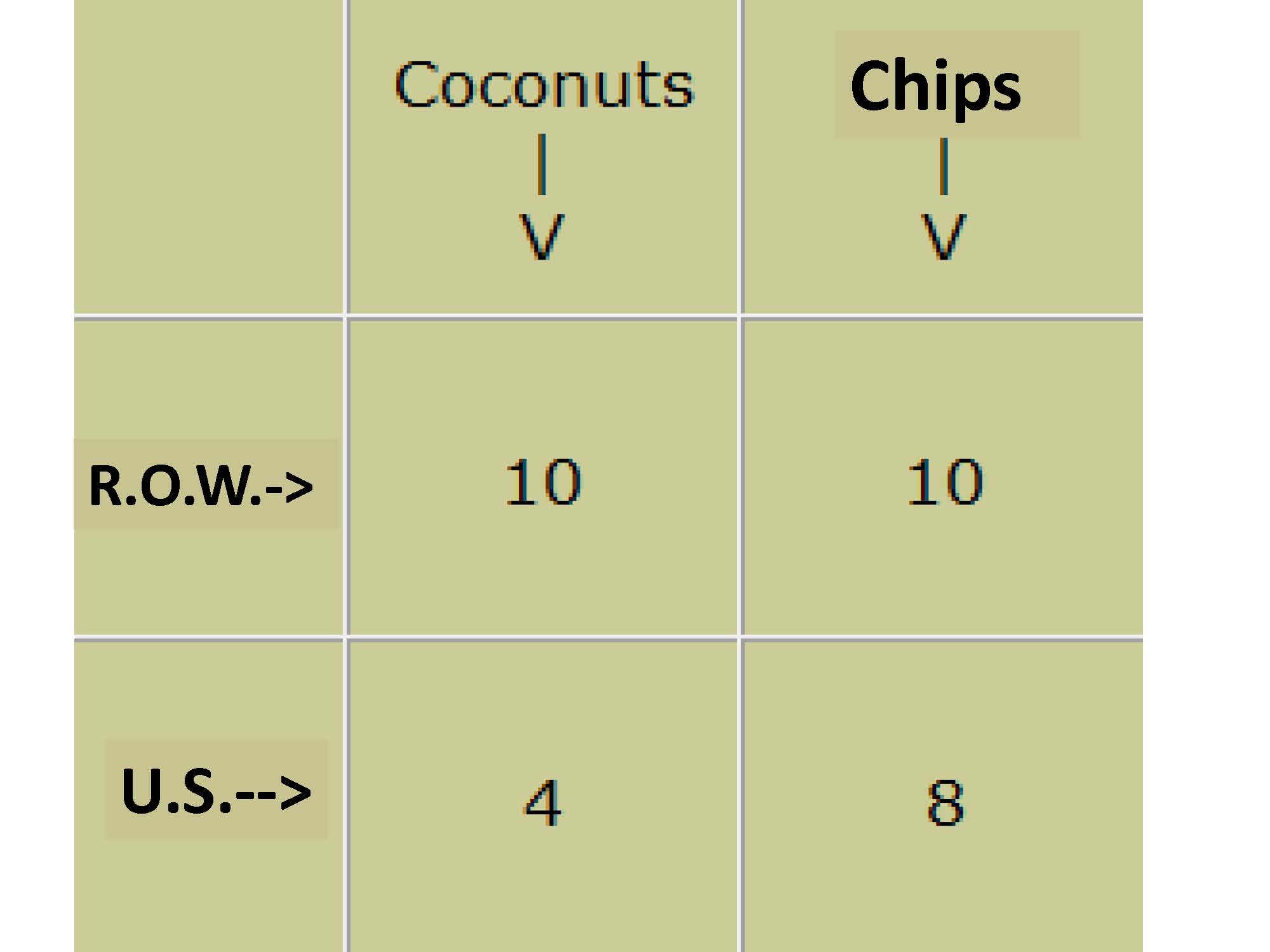
Scenario #1 (No Trade): If we assume both the R.O.W. and the U.S. each spend half their time producing coconuts and chips, then the R.O.W.’s production will create 5 coconuts/5 chips and the U.S. 2 coconuts/4 chips for a combined total of 7 coconuts and 9 chips (16 overall units).
If we were to contemplate the ability of trade between R.O.W. and the U.S., coupled with the concept of comparative advantage, we may see overall productivity of the nation island improve. Despite the R.O.W. having an “absolute advantage” over the U.S. in producing both coconuts (10 vs. 4) and chips (10 vs. 8), the next example demonstrates trade is indeed beneficial.
Scenario #2 (With Trade): If R.O.W. uses its comparative advantage (“more better”) to produce 10 coconuts and the U.S. uses its comparative advantage (“less worse”) to produce 8 chips for a combined total of 10 coconuts and 8 chips (18 overall units). Relative to Scenario #1, this example produces 12.5% more units (18 vs. 16) and with the ability of trade, the U.S. and R.O.W. should be able to optimize the 18 units to meet their individual country preferences.
If we can successfully escape from the island and paddle back to modern times, we can better understand the challenges we face as a country in the current flat global world we live in. Our lack of investment into education, innovation, and next generation infrastructure is making us less competitive in legacy rustbelt industries, such as in automobiles and general manufacturing. If the goal is to maximize productivity, efficiency, and our country’s standard of living, then it makes sense to select trade scenario #2 (even if it means producing zero coconuts and lots of computer chips). The coconut lobby may not be happy under this scenario, but more jobs will be created from higher output and trade while our citizens continue on a path to a higher standard of living.
The free trade strategy will only work if we can motivate, train, and educate enough people into higher paying jobs that produce higher value added products and services (e.g., computer chips and computer consulting). There is a woeful shortage of engineers and scientists in our country, and if we want to compete successfully in the modern world against the billions of people scratching and clawing for our standard of living, then we need to openly accept the productivity and trade principles taught to us by the Adam Smiths and Henry Fords of the world. Otherwise, be prepared to live on a remote, isolated island with a steady diet of coconuts for breakfast, lunch, and dinner.
Read Full NetMBA Article on “Comparative Advantage”
Wade W. Slome, CFA, CFP®
Plan. Invest. Prosper.
*DISCLOSURE: Sidoxia Capital Management (SCM) and some of its clients own certain exchange traded funds and GOOG, but at the time of publishing SCM had no direct position in any other security referenced in this article. No information accessed through the Investing Caffeine (IC) website constitutes investment, financial, legal, tax or other advice nor is to be relied on in making an investment or other decision. Please read disclosure language on IC “Contact” page.




 Investing Caffeine
