Doing the Opposite – Slow Frequency Trading

The business of robot trading, or so-called high-frequency trading (HFT) has grabbed a lot of headlines recently. The recent exposé released by 60 Minutes on the subject has only fanned the flames, which have been blazing harder since the May 6th “flash crash” earlier this year. The SEC is still working through proposed rule changes and regulatory reforms in hopes of preventing a similar crash that saw the Dow Jones Industrial Index almost fall 1,000 points in fifteen minutes, only to recover much of those losses minutes later.
The debate will rage on about the fairness of HFT (read more), but let’s not confuse active day-trading with high-frequency trading. In the case of HFT, the traders are actually getting paid to trade with the assistance of “liquidity rebates.” In exchange for the service of providing liquidity, these computer-based trading companies are earning cold, hard cash. Wouldn’t that be nice if individual day traders got paid money too for trading, rather than flushing commissions down the toilet?
Rather than warn unsuspecting working class Americans of the dangers of trading, discount brokerages and other trading firms peddle talking babies, loud music, back-testing voodoo software, and the prospect of discovering a profit elixir. As it turns out, investing is like weight loss…easy to understand, but difficult to execute. There’s no such thing as a miracle drug or chocolate diet that will shed pounds off your frame, just like there is no miracle trading system that will instantaneously generate millions in profits.
Doing the Opposite
Rather than succumb to the vagaries of the market, investors would be better served by following the mantra of character George Costanza from the hit, comedic television show Seinfeld. In the classic episode, astutely captured by Josh Brown (The Reformed Broker) and also cataloged in chapter four of my book, George realizes that all his instincts are wrong and discovers the road to success can be achieved by doing everything in an opposite fashion. George goes on to flaunt his contrarian approach when he runs into a blonde bombshell at the diner. Rather than boast about his accomplishments, George fesses up to his professional shortcomings by revealing his unemployment status and admitting that he lives at home with his parents. No need to worry, this strategy captivates her and results in George immediately getting the girl. George doesn’t stop there; during the same episode he gets his way with New York Yankee owner, George Steinbrenner, by telling him off. Before long, George is generating big bucks and making key decisions for the organization.
The same contrarian instincts of George apply to the investing world. Resisting the urge to follow the herd is key. The grass is greener and the eating more abundant away from animal pack. Investor extraordinaire Warren Buffett encapsulates the idea in the following advice, “Be fearful when others are greedy, and be greedy when others are fearful.”
There will constantly be an urge to trade frequently and chase performance, whether you’re talking about technology stocks during the boom, real estate five years ago, or the perceived safe-haven of Treasuries and gold today. The melody sounds so beautiful, until the music stops and prices come crashing back down to Earth. If you want to win in the losing game of the financial markets, do yourself a favor and become a slow frequency trader – George would be proud of you doing the opposite.
Wade W. Slome, CFA, CFP®
Plan. Invest. Prosper.
DISCLOSURE: Sidoxia Capital Management (SCM) and some of its clients own certain exchange traded funds, but at the time of publishing SCM had no direct position in any other security referenced in this article. No information accessed through the Investing Caffeine (IC) website constitutes investment, financial, legal, tax or other advice nor is to be relied on in making an investment or other decision. Please read disclosure language on IC “Contact” page.
Ration or Tax: Eating Cake Not an Option

We live in an instant gratification society that would like everything for free ( like my pal Bill Maher), which explains why we want to have our healthcare cake and eat it too. I think George Will said it best when discussing universal healthcare coverage, “If you think health care is expensive now, just wait until it is free.” Look, I love free stuff too, like the rest of us, whether it’s free sausage sample at Costco (COST) or a breath mint at the Olive Garden (DRI). But regrettably, exploding deficits come at a price.
With midterm elections coming up, the issue of healthcare is once again front and center. The majority party feels like a checkbook is a solution to healthcare prosperity. Can you really look me in the eyes and say covering additional 32 million uninsured Americans is going to save us money. The government hasn’t exactly built a ton of credibility with the disastrous train-wreck we call Medicare, which is already carrying 45 million covered passengers.
The minority party hasn’t done a lot better with the layering of the 2006 unsustainable Medicare Part D drug plan. Conservatives are campaigning on “repeal and replace” and that is great, but where are the cuts?
There are only two solutions to our current healthcare problem: ration or tax (read Plucking Feathers of Taxpaying Geese). Is healthcare a right or privilege? I don’t know, but if we want to cover current obligations, or add 32 – 50 million more uninsured, then we will be required to cut expenses (ration) to pay for increased benefits and/or increase taxes to cover additional benefits. I would love to cover all Americans, along with the starving children in Africa too, but unfortunately we are limited by our resources. Writing checks with borrowed money will only last for so long.
How severe are the exploding healthcare costs, which are covering the graying of the 76 million baby boomers? Here’s how Forbes describes the unsustainable Medicare obligations:
The Medicare Trustees tell us that Medicare’s expected future obligations exceeded premiums and dedicated taxes by $89 trillion (measured in current dollars). No, that’s not a misprint. To put that number in perspective, Medicare’s liability is about 5 1/2 times the size of Social Security’s ($18 trillion) and about six times the size of the entire U.S. economy.
Not a pretty picture. These estimates look pretty far in the future, but even more bare bone figures arrive at a still frightening $33 trillion. Take a look at healthcare spending forecasts as a percentage of GDP – even the lowest estimates are depressing:
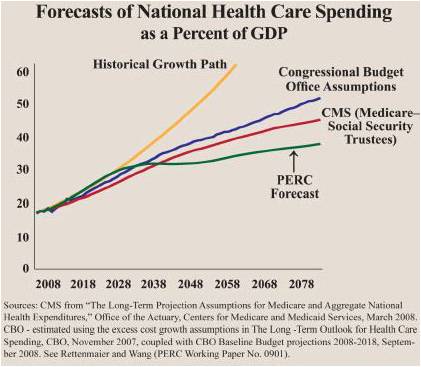
Source: National Center for Policy Analysis via Forbes
In our increasingly flat globalized world, competition between countries is becoming even more intense. We are in a marathon race for improved standards of living, and all these debts and deficits are dragging us down like an anchor tied to our legs. Even without considering other massive entitlements like Social Security, healthcare alone has the potential of grinding our economy to a halt. Politicians are great at promising more benefits and tax cuts in exchange for your votes, but true leadership requires delivering the sour medicine necessary for future prosperity. Before we eat the healthcare cake, let’s raise the money to buy the cake first.
Read more about the Medicare Explosion on Forbes
Wade W. Slome, CFA, CFP®
Plan. Invest. Prosper.
DISCLOSURE: Sidoxia Capital Management (SCM) and some of its clients own certain exchange traded funds, but at the time of publishing SCM had no direct position in COST, DRI, or any other security referenced in this article. No information accessed through the Investing Caffeine (IC) website constitutes investment, financial, legal, tax or other advice nor is to be relied on in making an investment or other decision. Please read disclosure language on IC “Contact” page.
Dealing Currency Drug to Export Addicts

Source: Photobucket
With the first phase of the post-financial crisis global economic bounce largely behind us, growth is becoming scarcer and countries are becoming more desperate – especially in developed countries with challenged exports and high unemployment. The United States, like other expansion challenged countries, fits this bill and is doing everything in its power to stem the tide by blasting foreigners’ currency policies in hopes of stimulating exports.
Political Hot Potato
The global race to devalue currencies in many ways is like a drug addict doing whatever it can to gain a short-term high. Sadly, the euphoric short-term benefit form lower exchange rates will be fleeting. Regardless, Ben Bernanke, the Chairman of the Federal Reserve, has openly indicated his willingness to become the economy’s drug dealer and “provide additional accommodation” in the form of quantitative easing part two (QE2).
Unfortunately, there is no long-term free lunch in global economics. The consequences of manipulating (depressing) exchange rates can lead to short-term artificial export growth, but eventually results convert to unwanted inflation. China too is like a crack dealer selling cheap imports as a drug to addicted buyers all over the world – ourselves included. We all love the $2.99 t-shirts and $5.99 toys made in China that we purchase at Wal-Mart (WMT), but don’t consciously realize the indirect cost of these cheap goods – primarily the export of manufacturing jobs overseas.
Global Political Pressure Cooker
Congressional mid-term elections are a mere few weeks away, but a sluggish global economic recovery is creating a global political pressure cooker. While domestic politicians worry about whining voters screaming about unemployment and lack of job availability, politicians in China still worry about social unrest developing from a billion job-starved rural farmers and citizens. The Tiananmen Square protests of 1989 are still fresh in the minds of Chinese officials and the government is doing everything in its power to keep the restless natives content. In fact, Premier Wen Jiabao believes a free-floating U.S.-China currency exchange rate would “bring disaster to China and the world.”
While China continues to enjoy near double-digit percentage economic growth, other global players are not sitting idly. Like every country, others would also like to crank out exports and fill their factories with workers as well.
The latest high profile devaluation effort has come from Japan. The Japanese Prime Minister post has become a non-stop revolving door and their central bank has become desperate, like ours, by nudging its target interest rate to zero. In addition, the Japanese have been aggressively selling currency in the open market in hopes of lowering the value of the Yen. Japan hasn’t stopped there. The Bank of Japan recently announced a plan to pump the equivalent of approximately $60 billion into the economy by buying not only government bonds but also short-term debt and securitized loans from banks and corporations.
Europe is not sitting around sucking its thumb either. The ECB (European Central Bank) is scooping up some of the toxic bonds from its most debt-laden member countries. Stay tuned for future initiatives if European growth doesn’t progress as optimistically planned.
Dealing with Angry Parents
When it comes to the United States, the Obama administration campaigned on “change,” and the near 10% unemployment rate wasn’t the type of change many voters were hoping for. The Federal Reserve is supposed to be “independent,” but the institution does not live in a vacuum. The Fed in many ways is like a grown adult living away from home, but regrettably Bernanke and the Fed periodically get called by into Congress (the parents) to receive a verbal scolding for not following a policy loose enough to create jobs. Technically the Fed is supposed to be living on its own, able to maintain its independence, but sadly a constant barrage of political criticism has leaked into the Fed’s decision making process and Bernanke appears to be willing to entertain any extreme monetary measure regardless of the potential negative impact on long-term price stability.
Just over the last four months, as the dollar index has weakened over 10%, we have witnessed the CRB Index (commodities proxy) increase over 10% and crude oil increase about 10% too.
In the end, artificially manipulating currencies in hopes of raising economic activity may result in a short-term adrenaline boost in export orders, but lasting benefits will not be felt because printing money will not ultimately create jobs. Any successful devaluation in currency rates will eventually be offset by price changes (inflation). Finance ministers and central bankers from 187 countries all over the world are now meeting in Washington at the annual International Monetary Fund (IMF) meeting. We all want to witness a sustained, coordinated global economic recovery, but a never-ending, unanimous quest for devaluation nirvana will only lead to export addicts ruining the party for everyone.
See also Arbitrage Vigilantes
Wade W. Slome, CFA, CFP®
Plan. Invest. Prosper.
DISCLOSURE: Sidoxia Capital Management (SCM) and some of its clients own certain exchange traded funds and WMT, but at the time of publishing SCM had no direct position in any other security referenced in this article. No information accessed through the Investing Caffeine (IC) website constitutes investment, financial, legal, tax or other advice nor is to be relied on in making an investment or other decision. Please read disclosure language on IC “Contact” page.
California…This Bud’s for You

I guess it’s time for Californians to dust off their bongs and break out the rolling papers because Proposition 19, the proposal to legalize personal marijuana consumption for adults in the Golden State, is coming up for vote next month. Judging by recent polls, the proposition is gaining steam…or smoke.
Results show that 52% of voters are backing the proposition versus 41% opposed and 7% undecided. In fact, the data shows Californians are supporting ganja more than they are backing the state Senatorial and Gubernatorial candidates (Barbara Boxer, Dianne Feinstein, Carly Fiorina, Jerry Brown and Meg Whitman).
Proponents are fiercely battling the opposition in the remaining weeks before the big vote. Given all the controversy, I wouldn’t be surprised if pro-pot advocacy groups enlisted renowned rapper Snoop Dogg as a paid spokesman to support the cause. I can hear Snoop now, “Vote yes on ‘pot,’ but remember friends don’t let friends drive doped.” Alternatively, I’m sure Altria Group (MO), maker of the famous Marlboro branded cigarettes, wouldn’t mind getting into the profitable cannabis business. They could even hire ex-President Clinton, who could admit he “inhaled…and enjoyed it,” while consuming some cannabis legally in California.

Would Snoop and Bill Say Yes to Legalized Marijuana?
The Budding of Prop. 19
What was the genesis of Proposition 19? Well, this isn’t the first time the wacky weed debate has actually been put to a vote in California. Almost four decades ago a similarly titled Proposition 19 initiative showed up on the ballot. Was it a coincidence the same number was used…perhaps? On the bright side, more mature protesters will not have to break the piggybank to buy new Proposition 19 buttons and T-shirts. This type of recycling gives new meaning to the word being “green.”
From a broader political policy perspective, marijuana consumption is no small problem. An estimated $113 billion of pot is sold each year nationally, with more than 10% of that attributed to California weed smokers. A whopping 15 million Americans have admitted to using pot within the last month, according to one survey. Of all the marijuana smoked, around fifty percent of the illegal bud is said to originate from foreign sources, most notably Mexico, which is dealing with deadly drug cartels that are killing innocent civilians by the thousands and threatening our borders. Proposition 19 cheerleaders are quick to point out that the legalization of cannabis would remove valuable money from foreign criminals’ pockets.
Legalizing and taxing cannabis has the potential of raising billions for the state of California. We all know about the sad state of fiscal affairs for California ($19 billion budget deficit) along with the dismal financial shape of neighboring states – an estimated $137 billion in deficits over fiscal 2011 and 2012 (see The Next Looming Bailout). Contributing to the deficits is the overcrowding of our jails and prisons. Ever since the “Just Say No” to drugs campaign, which started in 1984, prison populations have quadrupled – many of the prisoners being non-violent pot smokers. So, why not collect some cash from the millions that are already smoking pot illegally and help reduce our damaging deficits and free up space for more violent criminals?
Calling All Sin-Consuming Hypocrites
I understand the opposition to cannabis legalization, primarily based on concerns relating to public safety, workplace productivity, and potential losses in federal funding, but if certain people are opposed to Proposition 19, I sure hope they are up in arms over the numerous other legal (but sinful) products and services that permeate our daily lives. If pot is deemed harmful and illegal by society, then where are all the picketers protesting this long list of other sinfully legal products and services?
- Casinos/Gambling
- Cigarettes
- Lotteries
- Alcohol
- Prostitution (Nevada)
- Guns/Hunting
- Ho Hos/Twinkies/Sodas (Fat Tax)
The potential safety issue surrounding an increase in stoned drivers is a real one. However, if we have managed to reduce drunk driving, with the help of severe penalties, over the last few decades, I’m fairly confident we can keep slothful, Domino’s pizza (DPZ) loving, pot-smokers under control.
There is no shortage of controversy surrounding this political hot-button issue, but drastic times call for drastic measures. You may be against the legalization of marijuana, but if Proposition 19 passes in California, you may want to go long Domino’s, and short Nike Inc. (NKE).
Wade W. Slome, CFA, CFP®
Plan. Invest. Prosper.
DISCLOSURE: Sidoxia Capital Management (SCM) and some of its clients own certain exchange traded funds, but at the time of publishing SCM had no direct position in MO, DPZ, NKE, or any other security referenced in this article. No information accessed through the Investing Caffeine (IC) website constitutes investment, financial, legal, tax or other advice nor is to be relied on in making an investment or other decision. Please read disclosure language on IC “Contact” page.
Changing of the Guard

Over previous decades, there has been a continual battle between the merits of active versus passive management. Passive management being what I like to call the “do nothing” strategy, in which a basket of securities is purchased, and the underlying positions remain largely static. For all intents and purposes, the passive management strategy is controlled by a computer. Rather than solely using a computer, active management pays professionals six or seven figures to fly around to conferences, interview executive management teams, and apply their secret sauce tactics. Unlike passive managers, active managers do their best to determine which winning securities to buy and which losing ones to sell in their mutual funds and hedge funds.
Caught in the middle of this multi-decade war between passive and active management are Vanguard Group (founded in Valley Forge, Pennsylvania in 1975 by John Bogle) and Fidelity Investments (founded in 1946 in Boston, Massachusetts by Edward C. Johnson II). Currently John Bogle and Vanguard’s passive philosophy is winning the war. A changing of the guard, similar to the daily ceremony witnessed in front of Buckingham Palace is happening today in the mutual fund industry. Specifically, Vanguard, the company spearheading passive investing, has passed Fidelity Investments as the largest mutual fund company according to assets under management. Before 2010, Fidelity topped the list of largest firms every year since 1988, when it passed the then previous leader, Merrill Lynch & Co (BAC).
As of July 2010, Vanguard stands at the top of the mutual fund hill, managing $1.31 trillion versus Fidelity’s $1.24 trillion. Vanguard is sufficiently diversified if one considers its largest fund, the Vanguard Total stock Market Index Fund (VITSX), sits at around $127 billion in assets. The picture looks worse for Fidelity, if you also account for the $113 billion in additional ETF assets (Exchange Traded Funds) Vanguard manages – Fidelity is relatively absent in the ETF segment (State Street). Once famous active funds, such as Fidelity Magellan (now managed by Harry Lange – FMAGX) have underperformed the market over the last ten years causing peak assets of $110 billion in 2000 to decline to around $22 billion today. The $68 billion Fidelity Contrafund (FCNTX), managed by Will Danhoff, has not grown sufficiently to offset Magellan’s (and other funds) declines.
The Proof is in the Pudding
Some in the industry defend the merits of active management, and through some clever cherry-picking and data mining come to the conclusion that passive investing is overrated. If you believe that money goes where it is treated best, then the proof in the pudding suggests active management is the discipline actually suffering the beating (see Darts, Monkeys & Pros). The differences among the active-passive war of ideals have become even more apparent during the heart of the financial crisis. Since the beginning of 2008 through August 2010, Morningstar shows $301 billion in assets hemorrhaging from actively managed U.S. equity funds, while passive equity-index funds have soaked up $113 billion of inflows.
On a firm-specific basis, InvestmentNews substantiated Vanguard’s gains with the following figures:
In the 10 years ended Dec. 31, Vanguard’s stock and bond funds attracted $440 billion, compared with $101 billion for Fidelity, Morningstar estimates. This year through August, Vanguard pulled in $49 billion while Fidelity had withdrawals of $2.8 billion, according to the research firm.
Vanguard is gaining share on the bond side of the house too:
Vanguard also benefited from the popularity of bond funds. From Jan. 1, 2008, through Aug. 31, 2010, the company’s fixed- income portfolios pulled in $134 billion while Fidelity’s attracted $33 billion (InvestmentNews).
Vanguard is not the only one taking share away from Fidelity. Fido is also getting pinched by my neighbor PIMCO (Pacific Investment Management Company), the $1.1 trillion assets under management fixed income powerhouse based in Newport Beach, California. Bond guru Bill Gross leads the $248 billion Pimco Total Return Fund (PTTAX), which has helped the firm bring in $54 billion in assets thus far in 2010.
Passive Investing Winning but Game Not Over
Even with the market share gains of Vanguard and passive investing, active management assets still dwarf the assets controlled by “do-nothing” products. According to the Vanguard Group and the Investment Company Institute, about 25% of institutional assets and about 12% of individual investors’ assets are currently indexed (2009). The analysis gets a little more muddied once you add ETFs to the mix.
Passive investing may be winning the game of share gains, but is it winning the performance game? The academic research has been very one-sided in favor of passive investing ever since Burton Malkiel came out with his book, A Random Walk Down Wall Street. More recently, a study came out in June 2010 by Standard & Poor’s Indices Versus Active Funds (SPIVA) division showing more than 75% of active fixed income managers underperforming their index on a five-year basis. From an equity standpoint, SPIVA confirmed that more than 60% domestic equity funds and more than 84% international equity funds underperformed their benchmark on a five-year basis. InvestmentNews provides some challenging data to active-management superiority, however it is unclear whether survivorship bias, asset-weighting, style drift, and other factors result in apples being compared to oranges. SPIVA notes the complexity over the last three years has increased due to 20% of domestic equity funds, 13% of international equity funds, and 12% of fixed income funds liquidating or merging.
Regardless of the data, investors are voting with their dollars and happily accepting the superior performance, while at the same time paying less in fees. The positive aspects associated with passive investment products, such as index funds and ETFs, are not only offering superior performance like a Ferrari, but that enhanced quality also comes at the low price equivalent of a Hyundai. On a dollar-adjusted basis, stock-index funds charge an average of 29 cents per $100, compared with 95 cents for active funds (almost a 70% discount), according to research firm Lipper. For example, Vanguard’s passive VITSX fund charges clients as little as 6 cents for every $100 invested (Morningstar).
There has indeed been a changing of the market share guard and Fidelity may also be losing the debate over active versus passive management, but you do not need to shed a tear for them. Fidelity is not going to the poorhouse and will not be filing for Chapter 11 anytime soon. Last year Fidelity reported $11.5 billion in revenue and $2.5 billion in operating income. Those Fidelity profits should be more than enough to cover the demoted guard’s job retraining program and retirement plan benefits.
Read the Complete InvestmentNews Article
Wade W. Slome, CFA, CFP®
Plan. Invest. Prosper.
DISCLOSURE: Sidoxia Capital Management (SCM) and some of its clients own certain exchange traded funds, but at the time of publishing SCM had no direct position in VITSX, PTTAX, BAC, FCNTX, FMAGX, or any other security referenced in this article. No information accessed through the Investing Caffeine (IC) website constitutes investment, financial, legal, tax or other advice nor is to be relied on in making an investment or other decision. Please read disclosure language on IC “Contact” page.
September Surge: Stop, Go, or Proceed Cautiously?

The stock market just posted its strongest September and third quarter performance in more than seven decades (S&P 500 +8.8% and +10.7%, respectively), yet people are still waiting for a clear green light to signal blue investment skies ahead. Well of course, once it is apparent to everyone that the economy is obviously back on track, the opportunities persisting today will either be gone or vastly diminished. I’m not a blind optimist, but a sober realist that understands, like Warren Buffett, that it pays to “buy fear and sell greed.” And fear is exactly what we are witnessing today. The $2.6 trillion sitting in CDs earning a horrendously low 1% is simple proof (Huffington Post).
Like the fresh memory of a recent hand burned on the stove, the broader general public is still feeling the pain and recovering from the financial crisis. Each gloomy real estate or unemployment headline triggers agonizing flashbacks (read Unemployment Hypochondria) of the 2008-2009 financial collapse and leads to harmful emotional investment decisions. However, for some of us finance geeks that have cut through the monotony of “pessimism porn” blasted over the airwaves, we have discovered plenty of positive leading economic indicators bubbling up below the surface, like the following:
- Continued Economic Growth: Gross Domestic Product (GDP) grew +1.7% in the second quarter and current estimates stand in the +2.0% to +2.5% range for third quarter GDP, which will mark the fifth consecutive quarter of growth.
- Growing Corporate Profits: S&P 500 earnings are estimated to expand by +45.6% in 2010 and are estimated to grow by another +15% or so next year (Standard & Poor’s September 2010).
- Escalating M&A: Mergers and acquisitions activity increased to $566.5 billion in the third quarter. The value of announced transactions is up +60% from a year ago according to Bloomberg. If you have a tough time comprehending the pickup in M&A, then take a peek here.
- Record Cash Piles: The top 1,000 largest global corporations held a whopping $2.87 trillion in cash (Bloomberg).
- Accelerating Share Buybacks: Share buybacks totaled $77.6 billion in the second quarter, up +221% from a record low last year – Barron’s).
- Dividends Galore: S&P 500 companies have lifted their payouts by $15 billion so far this year versus a reduction of $40 billion for the same period last year (The Wall Street Journal). Tech giant Cisco Systems Inc. (CSCO) announced the pending initiation of a dividend, while Microsoft Corp. (MSFT) increased its dividend by a significant +23%.
I’m not naïve enough to believe choppy waters will disappear for good, but despite the depressing headlines there are constructive undercurrents. Beyond the points above, equity market prices remain attractive relative to the broader fixed-income markets (see Bubblicious Bonds) . More specifically, the S&P 500 is priced at about a 25% discount to historic valuation averages over the last 55 years (currently trading at about 12.5 Price/Earnings ratio vs 16.5x historic Price/Earnings ratio – Bloomberg). Now may not be the time to recklessly run a red light, but if you fearfully remain halted in front of the green light then prepare to receive a pricey ticket.
Wade W. Slome, CFA, CFP®
Plan. Invest. Prosper.
DISCLOSURE: Sidoxia Capital Management (SCM) and some of its clients own certain exchange traded funds and CSCO, but at the time of publishing SCM had no direct position in MSFT, or any other security referenced in this article. No information accessed through the Investing Caffeine (IC) website constitutes investment, financial, legal, tax or other advice nor is to be relied on in making an investment or other decision. Please read disclosure language on IC “Contact” page.
Why it’s NOT Different This Time

“Those who don’t know history are destined to repeat it.”
– Edmund Burke – British Statesman and Philosopher (1729-1797)
I wasn’t a history major in college, but I’ve learned two things by studying history books: 1) The unchanging psyche of human nature leads history consistently to repeats itself; and 2) There is never a shortage of goofballs willing to make zany predictions.
Robert Zuccaro is no exception to lesson number two, as evidenced by his 2001 book, Why it’s Different this Time…Dow 30,000 by 2008! Sticking one’s neck out is never too difficult when you have a multi-decade trend behind your back – I guess Dow “14,000” just didn’t sound sexy enough back then. Unfortunately the herd reacting to these bold, extreme predictions eventually realize (usually post-mortem) that they are quickly approaching a tail-end of a cycle. The cab driver, hair dresser, and mechanic realized the dangers of following the “New Economy” cheerleaders in 1999 when everyone was piling into dot-com stocks (see Bubblicious technology table ).
Dow 1,000 Here We Come!

- Source: Yahoo! Finance

Today, the Zuccaros of the world have been washed to the curb, and new “Armageddon” extremists have sprouted up to the surface, like perma-bear Peter Schiff and his call for Dow 2,000 or his $5,000 per ounce gold estimate. More recently, Robert Prechter has one-upped Schiff by forecasting Dow 1,000 with the assistance of the not-so ironclad Elliott Wave Theory philosophy (see Technical Analysis: Astrology or Lob Wedge). If you’re in the Prechter camp, either crawl back into your bunker or start digging that dream cave you always wanted.

Source: Elliott Wave International
“Hey, Look Here at My Crazy Forecast!”
Publicity doesn’t necessarily rain praise on those parroting the consensus view (although the warmth of job security is appreciated), but rather the extreme outliers love to bask in the glow of media attention. The extremists consistently repeat “why it’s different this time.” What is different is the set of circumstances, but what history shows us over and over again is the emotions of fear and greed feeding the bubbles of excess are exactly the same. Whether you’re talking about the Tulip-Mania of the 1630s, the Nifty Fifty stocks of 1973-1974, the technology Four Horsemen of the mid-1990s, or the Icelandic Banks of 2008, what we learn from the lessons of history is that human nature will never change and fear and greed will continue creating and bursting future bubbles.
People playing the game long enough understand, “It’s NOT different this time.” Not only have we endured repeated wars, recessions, banking crises, currency crises, but we have also survived every exotic animal disease known to man, including Mad Cow, Swine Flu, Bird Flu, West Nile, etc.
Robert Zuccaro and Robert Prechter may get an “A” for their attention grabbing forecasts, but thus far the grade earned on accuracy is closer to an “F.” More specifically, Zuccaro’s prediction never came close to 30,000 by the end of 2008 (only off by about 21,000 points), and guess what, Bob Prechter has a long way to go before reaching his Dow 1,000 target. So here is my proposition: Why don’t we just split the difference between Zuccaro’s 2008 and Prechter’s 2016 forecasts and take the average? If it turns out they are equally bad forecasters, then Dow 15,500 by 2012 should be no problem ([30,000 + 1,000] ÷ 2)!
Regardless of the ultimate outcome of this market (double-dip or sustained recovery), what I do know is there will continue to be wacky outlandish forecasters rationalizing why a trend will go on for infinity and why “this time is different.” In reality these attention mongers will always be around ensuring this time (or next time) will never be different…just the same fear and greed as always.
Wade W. Slome, CFA, CFP®
Plan. Invest. Prosper.
DISCLOSURE: Sidoxia Capital Management (SCM) and some of its clients own certain exchange traded funds, but at the time of publishing SCM had no direct position in any other security referenced in this article. No information accessed through the Investing Caffeine (IC) website constitutes investment, financial, legal, tax or other advice nor is to be relied on in making an investment or other decision. Please read disclosure language on IC “Contact” page.
The Next Looming Bailout…Muni Bonds

Source: Photobucket
Government politicians and voters have made it clear they do not want to bail out “fat-cat” bankers in the private sector, but what about bailing out “fat-cat” state pensioners in the public sector? States and cities across the country are increasingly under economic strain with deficits widening and debt-loads stacking up. California’s statewide budget problems have been well publicized, but you are now also hearing about more scandalous financial problems at the city level (read about the multi-million dollar malfeasance in the city of Bell).
Why Worry?
Well if a 2010 $1.3 trillion federal deficit is not enough to tickle your fancy, then how does another $137 billion in state deficits over fiscal 2011 and 2012 sound to you (National Governors Association)? Unfortunately, the states have made no meaningful structural improvements. If you layer on general economic “double dip” recession fears with excess pension liabilities, then you have a recipe for a major unresolved financial predicament.
Despite the dire financial state of the states, municipal bond prices have generally survived the 2008-2009 financial crisis unscathed. With unacceptably poor state budget risks, muni bond prices have continued to rise in 2010. The downside…new investors must accept a pitiful yield of 2.75% on 10-year municipal debt, according to Financial Advisor Magazine.
One investor who is not buying into the strength of the tax-free municipal bond market is famed investor and CEO of Berkshire Hathaway (BRKA/BRKB), Warren Buffett. Here is what he wrote about munis in his legendary annual shareholder letter last year:
“Insuring tax-exempts, therefore, has the look today of a dangerous business…Local governments are going to face far tougher fiscal problems in the future than they have to date.”
Buffett has this to say about rating muni bonds:
“I mean, if the federal government will step in to help them [municipalities], they’re triple-A. If the federal government won’t step in to help them, who knows what they are?”
Safety Net Disappears

Source: Photobucket
Like a high wire artist dangling high in the air without a safety net below, the states are currently borrowing money with little to no protection from the bond insurance providers. The shakeout of the subprime debt defaults has battered the insurers from many perspectives, leaving a much smaller market in the wake of the financial crisis. In 2007 about 50% of new municipal bonds were issued with bond insurance, while today only approximately 7% carry it (UBS Wealth Management Research). With decreased insurance coverage, the silver lining for muni investors is the necessity for them to perform more comprehensive research on their bond holdings.
Defaults on the Rise
On the whole, less insurance will result in more defaults. Although defaults are expected to decline in 2010, non-payments totaled $6.9 billion in 2009, up from $526 million in 2007 (Distressed Debt Securities). Even though the numbers sounds large, the recent default rate only represents a 0.25% default rate on the hefty $2.8 trillion market. That muni default rate compares to a more intimidating corporate bond default rate of 11% in 2009.
Bigger Bark Than Bite?
James T. Colby, senior municipal strategist at Van Eck Global, understands the severity of the states’ budget crisis but he believes a lot of the doomsday headlines are bogus. Riva Atlas, writer for Financial Advisor Magazine, summarizes Colby’s thoughts:
“Even those states in the worst straits like California and Illinois have provisions in their constitutions or statutes requiring them to pay their debts. In California, the state’s constitution says bondholders come second only to the school system, so the state would have to empty its jails before it stopped paying its teachers.”
Certainly municipalities could raise taxes to compensate for any budget shortfalls, but we all know most politicians are reluctant to raise taxes, because guess what? Tax increases may result in fewer votes – the main motivator driving most politicians.
If the states decide to not raise taxes, they still have other ways to weasel out of obligations. For starters, they can just stick it to the insurance company (if coverage exists). If that option is not available, the municipalities can look to the federal government for a bailout. Irresponsible actions have their consequences, and like consumers walking away from payments on their mortgages, municipalities will effectively be preventing themselves from future access to borrowing. Either way, the bark is less than the bite for investors since the insurance company or federal government will be making them whole.
BABs and Taxes Add Fuel to the Fire
A glut of Build America Bonds (BABs) issued by municipalities, driven by demand from yield hungry pension funds, along with expected tax hikes for the wealthy have created a scarcity of tax-free munis.
In the first half of 2010 BABs accounted for more than 25% of municipal bonds issued, which was a significant contributing factor to the robust muni market. The BABs tailwinds aiding muni prices won’t last forever, as the bond issuance program is expected to expire at the end of 2010.
On the tax front, the wealthy are likely to see higher federal tax rates in the future – upwards of 36% – 40%. If you include the double tax-exempt benefits in states like New York and California, the relative attractiveness becomes even that much better. Combined, these factors have elevated muni prices.
Despite higher defaults, scarier headlines, and the lack of insurance, the municipal bond market remains robust. General interest rate declines caused by macroeconomic fears have caused investors to flock to the perceived “safe haven” status of Treasuries and Munis, but as we have all witnessed, the fickle pendulum of emotions never sits still for long.
Managing the Munis
As is evident from the municipal bond discussion, states and cities across the country have been plagued by the same deficit and debt issues as the country faces on a federal level. Tough structural expense issues, and revenue generating tax policies need to be scrutinized in order to prevent federal taxpayer bailouts of municipalities across the country.
From a municipal bond investor perspective, it’s best to focus on general obligation bonds (GOs) because those bonds are backed by the taxing authority of the municipal government. On the flip side, it’s best to stray away from revenue bonds or privately issued municipals because revenue streams from these bond channels are not guaranteed by the municipality, meaning the risk of default is larger.
While Congress sorts out financial regulatory reform with respect to banking bailouts and “too big to fail” corporations, our federal government should not lose sight of the widespread municipality problems our country faces today. If not, get ready to pull out the checkbook to pay for another taxpayer-led bailout…
Read the Complete Financial Advisor Magazine Article: The Muni Minefield
Wade W. Slome, CFA, CFP®
Plan. Invest. Prosper.
DISCLOSURE: Sidoxia Capital Management (SCM) and some of its clients own certain exchange traded funds (including CMF), but at the time of publishing SCM had no direct position in BRKA/B or any other security referenced in this article. No information accessed through the Investing Caffeine (IC) website constitutes investment, financial, legal, tax or other advice nor is to be relied on in making an investment or other decision. Please read disclosure language on IC “Contact” page.
Microsoft Makes Dividend Splash

Source: ActingLikeAnimals.com
I’ve talked about growing profits and cash piles for a while now (read more), but at some point investors and board members get restless and demand action (Steve Jobs has not yet). The most recent blue-chip company to make a splash, when it comes to capital management, is Microsoft Corp. (MSFT), which just announced a significant +23% increase in its dividend in conjunction with $4.75 billion in debt offerings. These capital structure changes still leave plenty of room for additional share repurchases and acquisitions.
Debt Offering – Are You Sure?
Huh? What in the heck is Microsoft doing borrowing money? I mean, does a company with $44 billion in cash and investments, generating a whopping additional $22 billion in free cash flow in fiscal 2010 (ended in June), really need access to additional capital? The short answer is “NO.” But a company like Microsoft borrowing $4.75 billion is like Donald Trump borrowing $50 on his credit card. Well wait, “The Donald” has actually had some hair and Chapter 11 problems, so the more appropriate analogy would be Bill Gates borrowing $20 on his credit card. Not only is it a rounding error, but it’s a good financial management practice for corporations to take advantage of the debt tax shield (read definition).
What makes Microsoft’s debt issuance that much more incredible is the astonishingly low rates the company is paying investors on the debt. According to Dealogic, Microsoft set a record low for yield paid on corporate unsecured debt. For the separate maturities ranging from 2013 to 2040, Microsoft paid a stunningly low 25-83 basis point spread over Treasuries. I don’t want to get into government credit worthiness today, but who knows, maybe Microsoft will pay lower debt rates than the U.S. Treasury, in the not too distant future?!
Regardless of the array of capital structure management strategies used by other companies, Microsoft is not alone in dealing with its cash hoarding problems. Cisco Systems Inc. (CSCO), another blue-chip cash printing press, just announced the initiation of a 1-2% dividend to be paid by the end of their fiscal year ending in July 2011 (read more about dividend cash “un-hoarding”).
But Who Cares?
Who cares about Microsoft’s wimpy 2.62% yield anyway? Well, for one, I sure care! A 10-year Treasury Note is yielding a measly, static 2.55%. If Microsoft continued on the same dividend path growth over the next five years as it did over the last five years, investors could potentially be talking about a 5.2% yield on our initial investment, and this excludes any potential stock price appreciation. With only roughly a 25% payout ratio on Microsoft’s fiscal 2010 free cash flow, the company has a lot of freedom to hike future dividends, even if earnings don’t grow. Microsoft has also enhanced shareholder value by putting its money where its mouth is by purchasing over $30 billion of company stock over the last three years.
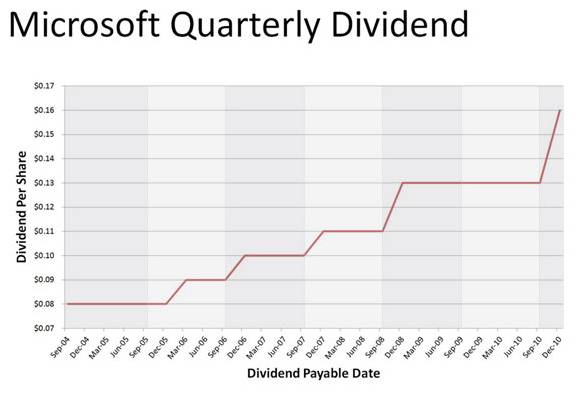
Nice trend in dividend growth.
The extreme case of dividend growth is Wal-Mart Stores (WMT), which if purchased in 1972 would provide a +2,300% yield on the original investment, excluding any benefit from the massive price appreciation ($.05 split-adjusted per share to $53.65). Microsoft is no young chick like Wal-Mart 40 years ago, but you get the gist (read Dividend Sapling to Fruit Tree).
So while strategists and economists fret about the possibilities of a “double dip” recession, in the interim there have been 179 companies in the S&P 500 index that have hiked dividends in 2010 (versus only 3 companies that have cut). Microsoft has been no slouch either, growing revenues by +22% and EPS (Earnings Per Share) by +50% in their most recent fiscal fourth quarter. Although Microsoft’s stock is down -20% for 2010, the capital management and dividend splash recently announced by Microsoft (and other companies) should eventually capture the eye of investors currently earning squat on overpriced bonds and almost worthless Certificates of Deposit.
Read complete Microsoft dividend story
Wade W. Slome, CFA, CFP®
Plan. Invest. Prosper.
DISCLOSURE: Sidoxia Capital Management (SCM) and some of its clients own certain exchange traded funds, CSCO, nd WMT, but at the time of publishing SCM had no direct position in MSFT, or any other security referenced in this article. No information accessed through the Investing Caffeine (IC) website constitutes investment, financial, legal, tax or other advice nor is to be relied on in making an investment or other decision. Please read disclosure language on IC “Contact” page.
Skiing Portfolios Down Bunny Slopes

Oh Nelly, take it easy…don’t get too crazy on that bunny slope. With fall officially kicking off and the crisp smell of leaves in the air, the new season also marks the beginning of the ski season. In many respects, investing is a lot like skiing. Unfortunately, many investors are financially skiing their investment portfolios down a bunny slope by stuffing their money in low yielding CDs, money market accounts, and Treasury securities. The bunny slope certainly feels safe and secure, but many investors are actually doing more long-term harm than good and could be potentially jeopardizing their retirements.
Let’s take a gander at the cautious returns offered up from the financial bunny slope products:
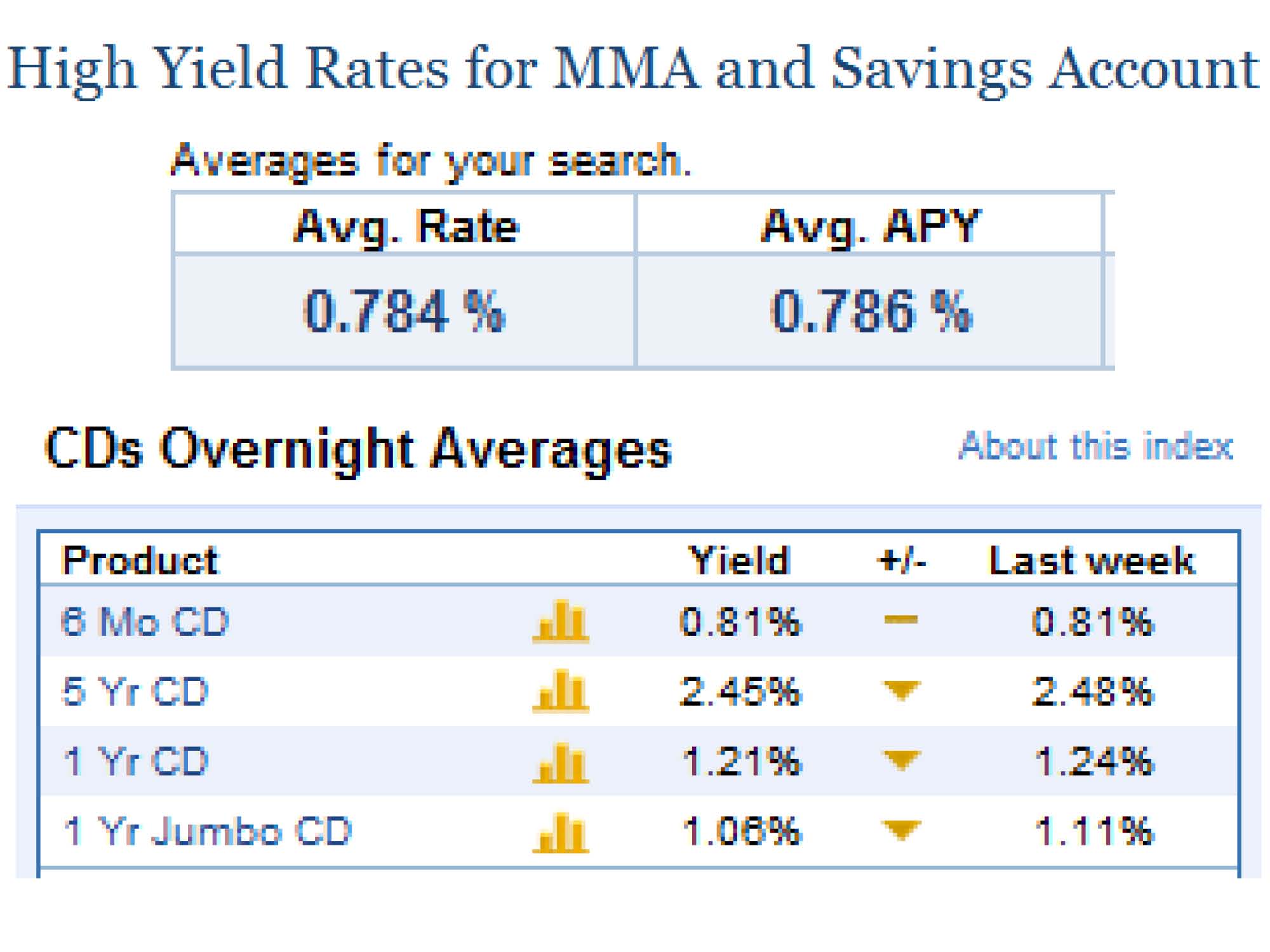
Source: Bankrate.com
That CD earning 1.21% should cover a fraction of your medical insurance premium hike, or if you accumulate the interest from your money market account for a few years, perhaps it will cover the family seeing a new 3-D movie. If you also extend the maturity on that CD a little, maybe it can cover an order of chicken fingers at Applebees (APPB)?!
We all know, for much of the non-retiree population, the probability that entitlement programs like Social Security and Medicare will be wiped out or severely cut is very high. Not to mention, life expectancies for non-retirees are increasing dramatically – some life insurance actuarial tables are registering well above 100 years old. These trends indicate the criticalness of investing efficiently for a large swath of the population, especially non-retirees.
Let’s Face It, One Size Does Not Fit All

Bodie Miller & Grandpa
As I have pointed out in the past, when it comes to investing (or skiing), one size does not fit all (see article). Just as it does not make sense to have Bode Miller (32 year old Olympic gold medalist) ski down a beginner’s bunny slope, it also does not make sense to take a 75-year old grandpa helicopter skiing off a cornice. The same principles apply to investment portfolios. The risk one takes should be commensurate with an individual’s age, objectives, and constraints.
Often the average investor is unaware of the risks they are taking because of the counterintuitive nature of the financial market dangers. In the late 1990s, technology stocks felt safe (risk was high). In the mid-2000s, real estate felt like a sure bet (risk was high), and in 2010, Treasury bonds and gold are currently being touted as sure bets and safe havens (read Bubblicious Bonds and Shiny Metal Shopping). You guess how the next story ends?
Unquestionably, coasting down the bunny slopes with CDs, money market accounts, and Treasuries is prudent strategy if you are a retiree holding a massive nest egg able to meet all your expenses. However, if you are younger non-retiree and do not want to retire on mac & cheese or work at Wal-Mart as a greeter into your 80s, then I suggest you venture away from the bunny slope and select a more suitable intermediate path to financial success.
Wade W. Slome, CFA, CFP®
Plan. Invest. Prosper.
DISCLOSURE: Sidoxia Capital Management (SCM) and some of its clients own certain exchange traded funds, and WMT, but at the time of publishing SCM had no direct position in APPB, or any other security referenced in this article. No information accessed through the Investing Caffeine (IC) website constitutes investment, financial, legal, tax or other advice nor is to be relied on in making an investment or other decision. Please read disclosure language on IC “Contact” page.




