Job Losses = Job Creation

Apple Inc. (AAPL) is considered the quintessential innovation company. After all, if you flip over an iPad or an iPhone it will clearly state, “Designed by Apple in California. Assembled in China.” Apple is just too busy innovating to worry about dirtying their hands by assembling products – they can simply outsource that work. Many people have a problem with the millions of manufacturing jobs moving offshore, but if I am the self anointed “Innovation Czar” for the United States, I definitely favor keeping the $120,000 Apple engineering jobs over the low-cost $2 per hour jobs being lost to China (or cheaper developing country). Oh sure, I would prefer keeping both workers, but if push comes to shove, I much rather keep the six-figure job. The bad news is the displaced American iPhone/iPad assembler must find an alternative lower-skilled employment opportunity. The good news is there are plenty of service-based jobs that will NOT get outsourced to the Chinese. If displaced workers are unhappy serving lattes at Starbucks or changing bedpans at the local hospital (or other unglamorous service-based job), then they can choose to retool their skills through education, in order to land higher-paying jobs not getting outsourced.

Bass Ackwards Job Assessment
While I may agree with many points made by Time Magazine’s Fareed Zakaria in his article, The Future of Innovation: Can America Keep Pace?, I think Zakaria is looking at the job trade-off a little backwards. Here is what says about Apple-created job losses in a CNN blog post:
“Apple has about $70 billion in revenues. The company that makes Apple’s products called Foxconn is in China. They have about the same revenue – $70 billion dollars. Apple employees 50,000 people. Foxconn employs 1,000,000 people. So you can have all the innovation you want and tens of thousands of engineers in California benefit, but hundreds of thousands of people benefit in China because the manufacturing has gone there. What does that mean? America needs to innovate even more to keep pace.”
Wow, that’s very altruistic of Apple to create thousands of jobs for Foxconn in Asia, but that $70 billion in Apple revenues likely generates close to 10 times the profits that Foxconn creates (Apple had 24% net profit margins last quarter versus probably a few percent at Foxconn). As Innovation Czar, I’ll gladly take the $20 billion in Apple profits added to the U.S. economy over the last 12 months versus the $2-3 billion profits at Foxconn (my estimate). Let’s be clear, profitable companies add jobs (Apple added over 12,000 employees in fiscal 2010, up +35%) – not weak or uncompetitive companies losing money.
Although the U.S. is losing low-skilled jobs to the likes of Foxconn, guess what those $120k engineering jobs at Apple are creating? Those positions are also generating lots of $12/hour service jobs. When you are paying your workers billions of dollars, like Apple, a lot of those dollars have a way of recirculating through our economy. For instance, if I am a six-figure employee at Apple, I am likely funding leisure jobs in Tahoe for family vacations; supporting jobs at Cheesecake Factory (CAKE) and Chipotle Mexican Grill (CMG) because my demanding schedule at Apple means more take-out meals; and creating jobs for auto workers at Ford (F) thanks to my new SUV purchase.
Margin Surplus Redux
The same arguments I make in the Apple vs. Foxconn comparison are very similar to the case I wrote about in Margin Surplus Retake, which compares the profit and trade deficit dynamics occurring in a $1,000 Toshiba laptop sale. Although Toshiba and its foreign component counterparts may recognize twice the revenues in a common laptop sale as American suppliers (contributing to our country’s massive trade deficit), Intel Corp. (INTC) and Microsoft Corp. (MSFT) generate six times the profits as Toshiba and company. The end result is a massive profit or margin surplus for the Americans – a better barometer to financial reality than stale government trade deficit statistics.
There are obviously no silver bullets or easy answers to resolve these ever-growing economic issues, but as political gridlock grinds innovation to a halt, globalization is accelerating. The rest of the world is racing to narrow the gap of our innovative supremacy, but our sense of entitlement will get us nowhere. Zakaria points out that by 2013, China is expected to overtake the U.S. as the leading scientific research publisher and after we held a three-fold increase in advanced engineering and technology masters degrees in 1995, China surpassed us in 2005 (63,514 in China vs. 53,349 in the U.S.). China may not be home to Facebook or Google Inc. (GOOG), but Baidu Inc. (BIDU) is headquartered in China with a market capitalization of $43 billion and Tencent Holdings is valued at more than $50 billion (not to mention Tencent has roughly the same number of users as Facebook – more than 600 million).
The jobless recovery has been painful for the 14 million unemployed, but there is hope for all, if innovation and education (see Keys to Success) can create more six-figure Apple jobs to offset less valuable jobs lost to outsourcing. In order to narrow the chasm between rich and poor in our country, Americans need to climb the labor ladder of innovation. Contrary to Fareed Zakaria’s assertion, swapping quality job gains with crappy job losses, is an economic trade I would make every day and twice on Sunday. If the country wants to return to the path of economic greatness and sustainable job creation, the country needs to embrace this idea of outsourced creative destruction.
Wade W. Slome, CFA, CFP®
Plan. Invest. Prosper.
DISCLOSURE: Performance data from Morningstar.com. Sidoxia Capital Management (SCM) and some of its clients own certain exchange traded funds, AAPL, and GOOG, but at the time of publishing SCM had no direct position in Foxconn, Facebook, MSFT, INTC, CAKE, CMG, F, BIDU, Tencent, Toshiba, or any other security referenced in this article. No information accessed through the Investing Caffeine (IC) website constitutes investment, financial, legal, tax or other advice nor is to be relied on in making an investment or other decision. Please read disclosure language on IC “Contact” page.
Ken Heebner: Dr. Adrenaline

Is the market making you feel a little lost, down, or disconnected? Then perhaps what you need is a prescription of adrenaline in the form of some CGM Focus Fund shares (CGMFX). Ken Heebner has captained the CGM Focus Fund since its 1997 inception. This hyper-volatile fund is not for the faint of heart. The concentrated fund holds a narrow portfolio (often 20-30 positions), which is managed with a very itchy trigger-finger. The eye-popping 363% turnover last year is proof of Heebner’s rapid fire approach, which equates to an average stock holding period of around three months. Although “Dr. Adrenaline” has earned the top Morningstar ranking for his Focus Fund on a 10-year basis (annualized +11.8% vs. +2.1% S&P 500 – Morningstar 6/9/11), Heebner is dead last on a 3-year basis (annualized -19.9% vs. +.4% S&P 500).
The Journey from First to Worst
How does a manager go from first to worst? Well, given the fund’s “go anywhere” mandate, Heebner became a hero when he shorted technology and internet stocks in 2000 and 2001during the bubble burst (yes, that’s correct, the Focus Fund has the ability to short securities as well). Simultaneously, Heebner went long the homebuilders and watched the massive appreciation transpire as the real estate bubble inflated. This clever maneuvering earned the fund a whopping +54% return in 2000 and an encore +47% advance in 2001, while the S&P 500 index plummeted -9% and -12%, respectively.
While Heebner captured the inflection of the tech bubble bursting, he has fared less well through the financial crisis and recovery of 2008-2011. After riding the commodities boom in 2007, on the way to an +80% killing, Heebner overstayed his welcome at the trough. Not only did his commodity stocks tank, he prematurely piled into financials and insurance companies (e.g., BAC, C, WFC, HIG). Like many other managers, Heebner underestimated the severity and scope of the financial crisis and he and his investors suffered the consequences (underperformed the S&P 500 by -11% in 2008 and -16% in 2009).
This is what Heebner had to say about the housing market in late 2007:
“It’s a narrow sector. Globally the US housing market is not that important. I think it may flatten out our retail sales and our economy may go sidewise, but I don’t think that’s going to derail this global economy.”
That forecast didn’t really pan out as expected and this year hasn’t exactly gotten off to a rosy start either. The fund is already down -12% in 2011, trailing the S&P 500 by an overwhelming -15% margin.
Behind the Brains
The grey-haired, 70-year-old Heebner has accumulated a lot of real world schooling before starting CGM (Capital Growth Management) in 1990. Heebner started his career as an economist with A & H Kroeger in 1965, before he decided to get his feet wet in money management as a portfolio manager at Scudder, Stevens & Clark, as well as Loomis Sayles & Co.
Heebner does not follow your ordinary run of the mill investment strategy. As the antithesis of a traditional value investor, Heebner typically buys stocks that have already appreciated in price. He is looking for stocks with a “pattern of earnings development in excess of consensus.” Or as Heebner clarifies, “I try and find a situation where the development of the fundamentals is going to be more positive than other investors are experiencing.” When investing in the fund, Heebner combines fundamental analysis with an overlay of a top-down macroeconomic assessment.
At last check in April, Heebner was still optimistic about the prospects for equities, despite the outlook for inflation:
“I ran money from 1976 to 1980. The inflation rate went from 6 to 15. There was a lot of money to be made.”
In inflationary environments, Heebner advocates finding companies with earnings growth profiles that will expand faster than the compression in price-earnings ratios.
Vodpod videos no longer available.Heebner Not Alone
Ken Heebner is certainly not the only hot-shot manager in history to suffer a cold-spell. After setting records and beating the S&P 500 index for 15 consecutive years, Bill Miller has found his fund (Legg Mason Capital Management Value Fund – LMVTX) firmly in the bottom decile of his peer group on a 1-year, 3-year, 5-year, and 10-year basis (see also Revenge of the Dunce). Moreover, Morningstar’s fund manager of the decade, Bruce Berkowitz of the Fairholme Fund (FAIRX), has also recently been hit by the performance ugly stick (see also The Invisible Giant), albeit less bad than Heebner and Miller.
When all is said and done, the flexibility afforded to Ken Heebner in managing the CGM Focus Fund has served long-term investors very well – if they were not prematurely spooked out the investments due to volatility. For those not invested in the CGM Focus Fund, or for those bored individuals looking for rollercoaster returns, Dr. Heebner may have just the adrenaline prescription you were looking for…a healthy dosage of CGM Focus Fund shares!
Wade W. Slome, CFA, CFP®
Plan. Invest. Prosper.
DISCLOSURE: Performance data from Morningstar.com. Sidoxia Capital Management (SCM) and some of its clients own certain exchange traded funds, but at the time of publishing SCM had no direct position in CGMFX, LMVTX, FAIRX, BAC, C, WFC, HIG, MORN, or any other security referenced in this article. No information accessed through the Investing Caffeine (IC) website constitutes investment, financial, legal, tax or other advice nor is to be relied on in making an investment or other decision. Please read disclosure language on IC “Contact” page.
Curing Our Ills with Innovation

Fareed Zakaria thoughts have blanketed both traditional and internet media outlets, spanning everything from Newsweek to Time, and the New York Times to CNN. With an undergraduate diploma from Yale and his PhD from Harvard, Dr. Zakaria has built up quite a following, especially when it comes to foreign affairs.
In his latest Time magazine article, Can America Keep Pace?, Zakaria addresses the role of innovation in the U.S., “Innovation is as American as apple pie.” The innovation lead the U.S. maintains over the rest of the world will not evaporate over night because this cultural instinct is bred into our DNA – innovation is not something you one can learn directly from a textbook, Wikipedia, or Google (GOOG). With that said, the innovation gap is narrowing between developed and developing countries. New York Times columnist Tom Friedman captured this sentiment when he stated the following:
“French voters are trying to preserve a 35-hour work week in a world where Indian engineers are ready to work a 35-hour day.”
The fungibility of labor has pressured industries by transferring jobs abroad to much lower-cost regions like China and India, and that trend is only expanding further into countries with even lower labor cost advantages. Zakaria agrees:
“America’s future growth will have to come from new industries that create new products and processes. Older industries are under tremendous pressure.”
The good news is the United States maintains a significant lead in certain industries. For instance, we Yankees have a tremendous lead in fields such as biotechnology, entertainment, internet technologies, and consumer electronics.
The poster child for innovation is Apple Inc. (AAPL), which arose from the ashes of death ten years ago with its then ground-breaking new product, the iPod. Since then, Apple has introduced many innovative products and upgrades as a result of its research and development efforts, including the recently launched iPad.
The Education Engine
Where we are falling short is in education, which is the foundation to innovation. In a country with a high school system that Microsoft Corp.’s (MSFT) founder Bill Gates calls “obsolete,” society is left with one-third of the students not graduating and nearly half of the remaining graduates unprepared for college. In this instant gratification society we live in, the long-term critical education issue has been pushed to the backburner. Other emerging countries like China and India are churning out more college graduates by the millions, and also dominating us in the key strategic count of engineering degrees.
Government’s Role
With the massive debt and deficits our country currently faces, an ongoing debate about the size and role of government persists. Zakaria makes the case that government must place a significant role when it comes to innovation. Unfortunately, the U.S. wastes billions on pork-barrel projects and suboptimal subsidies while dilly-dallying in political gridlock over critical investments in education, infrastructure spending, basic research, and energy policies. In the meantime, our fellow competing countries are catching up to us, and in certain cases passing us (e.g., alternative energy investments – see Electric Profits).
Zakaria makes this point on the subject:
“The fastest-growing economies are all busy using government policy to establish commanding leads in one industry after another. Google’s Eric Schmidt points out that ‘the fact of the matter is, other countries are putting a lot more money into nurturing new industries than we are, and we are not going to win unless we do something like what they’re doing.’”
As a matter of fact, an ITIF (Information Technology & Innovation Foundation) study measuring innovation improvement from 1999 to 2009, as it related to government funding for basic research, education and corporate-tax policies, ranked the U.S. dead last out of 40 countries.
Not All is Lost – Pie Slice Maintained
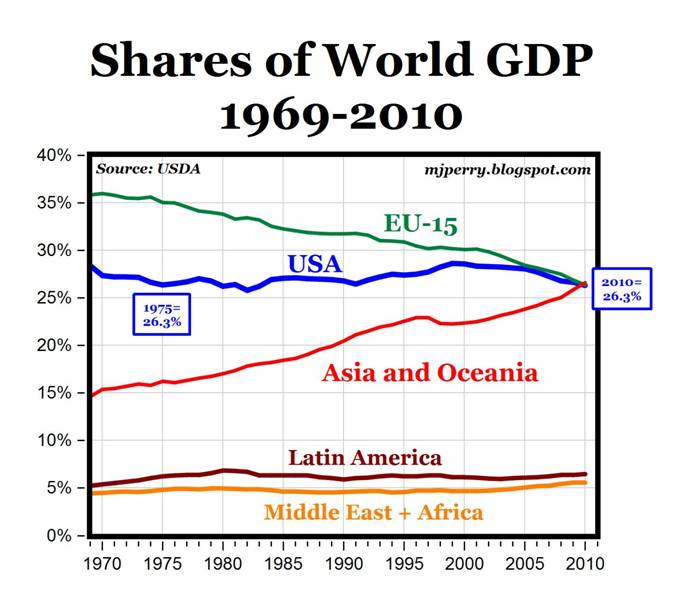
Source: Carpe Diem
Although the outlook may sounds bleak, not all is lost. In a recent Wall Street Journal interview with Bob Doll Chief Equity Strategist at the world’s largest money management company (BlackRock has $3.6 trillion in assets under management), he makes the case that the U.S. remains the leading source of technological innovation and home to the greatest universities and the most creative businesses in the world. He sees this trend persisting in part because of our country’s relative demographic advantages:
“Over the next 20 years, the U.S. work force is going to grow by 11%, Europe’s going to fall by five, and Japan’s going to fall by 17. This alone tells me the U.S. has a huge advantage over Europe and a bigger one over Japan for growth.”
So while emerging markets, like those in Asia, continue to gain a larger slice of the global GDP pie, Mark Perry at Carpe Diem shows how the U.S has maintained its proportional slice of a growing global economic pie, over the last four decades.
Growth is driven by innovation, and innovation is driven by education. If America wants to maintain its greatness, the focus needs to be placed on innovation-led growth. The world is moving at warp speed, and our neighbors are moving swiftly, whether we come along for the ride or not. The current, sour conversations regarding deficits, debt ceilings, entitlements, wars, and unemployment are all essential discussions, but more importantly, if these debates can be refocused on accelerating innovation, the country will be well on its way to curing its ills.
See also Our Nation’s Keys to Success
Wade W. Slome, CFA, CFP®
Plan. Invest. Prosper.
DISCLOSURE: Sidoxia Capital Management (SCM) and some of its clients own certain exchange traded funds, GOOG, and AAPL, but at the time of publishing SCM had no direct position in MSFT, or any other security referenced in this article. No information accessed through the Investing Caffeine (IC) website constitutes investment, financial, legal, tax or other advice nor is to be relied on in making an investment or other decision. Please read disclosure language on IC “Contact” page.
Economic Tug-of-War as Recovery Matures

Excerpt from No-Cost June 2011 Sidoxia Monthly Newsletter (Subscribe on right-side of page)
With the Rapture behind us, we can now focus less on the end of the world and more on the economic tug of war. As we approach the midpoint of 2011, equity markets were down -1.4% last month (S&P 500 index) and are virtually flat since February – trading within a narrow band of approximately +/- 5% over that period. Investors are filtering through data as we speak, reconciling record corporate profits and margins with decelerating economic and employment trends.
Here are some of the issues investors are digesting:
 Profits Continue Chugging Along: There are many crosscurrents swirling around the economy, but corporations are sitting on fat profits and growing cash piles owing success to several factors:
- International Expansion: A weaker dollar has made domestic goods and services more affordable to foreigners, resulting in stronger sales abroad. The expansion of middle classes in developing countries is leading to the broader purchasing power necessary to drive increasing American exports.
- Rising Productivity: Cheap labor, new equipment, and expanded technology adoption have resulted in annualized productivity increases of +2.9% and +1.6% in the 4th quarter and 1st quarter, respectively. Eventually, corporations will be forced to hire full-time employees in bulk, as bursting temporary worker staffs and stretched employee bases will hit output limitations.
- Deleveraging Helps Spending: As we enter the third year of the economic recovery, consumers, corporations, and financial institutions have become more responsible in curtailing their debt loads, which has led to more sustainable, albeit more moderate, spending levels. For instance, ever since mid-2008, when recessionary fundamentals worsened, consumer debt in the U.S. has fallen by more than $1 trillion.
 Fed Running on Empty: The QE2 (Quantitative Easing Part II) government security purchase program, designed to stimulate the economy by driving interest rates lower, is concluding at the end of this month. If the economy continues to stagnate, there’s a possibility that the tank may need to be re-filled with some QE3? Maintaining the 30-year fixed rate mortgage currently around 4.25%, and the 10-year Treasury note yielding around 3.05% will be a challenge after the program expires. Time will tell…
 Slogging Through Mud: Although corporate profits are expanding smartly, economic momentum, as measured by real Gross Domestic Product (GDP) growth, is struggling like a vehicle spinning its wheels in mud. Annualized first quarter GDP growth registered in at a meager +1.8% as the economy weans itself off of fiscal stimulus and adjusts to more normalized spending levels. An elevated 9% unemployment rate and continued weak housing market is also putting a lid on consumer spending. Offsetting the negative impacts of the stimulative spending declines have been the increasing tax receipts achieved as a consequence of seven consecutive quarters of GDP growth.
 Mixed Bag – Euro Confusion: Germany reported eye-popping first quarter GDP growth of +5.2%, the steepest year-over-year rise since reunification in 1990, yet lingering fiscal concerns surrounding the likes of Greece, Portugal, and Italy have intensified. Fitch, for example, recently cut its rating on Greece’s long-term sovereign debt three notches, from BB+ to B+ plus, and placed the country on “rating watch negative” status. These fears have pushed up two-year Greek bond yields to over 26%. Regarding the other countries mentioned, Standard & Poor’s, another credit rating agency, cut Italy’s A+ rating, while the European Union and International Monetary Fund agreed on a $116 billion bailout program for Portugal.
Wade W. Slome, CFA, CFP®
Plan. Invest. Prosper.
DISCLOSURE: Sidoxia Capital Management (SCM) and some of its clients own certain exchange traded funds, but at the time of publishing SCM had no direct position in any security referenced in this article. No information accessed through the Investing Caffeine (IC) website constitutes investment, financial, legal, tax or other advice nor is to be relied on in making an investment or other decision. Please read disclosure language on IC “Contact” page.
It’s the Earnings, Stupid

Source: MaxMillionaire.WordPress.com
Political strategist James Carville famously stated, “It’s the economy stupid,” during the 1992 presidential campaign. Despite a historic record approval rating of 90 by President George H.W. Bush after the 1991 Gulf War victory, Bush Sr. still managed to lose the election to President Bill Clinton because of a weak economy. President Barack Obama would serve himself well to pay attention to history if he wants to enter the “two-termer” club. Pundits are placing their bets on Obama due to his large campaign war chest, a post-Osama bin Laden extinguishment approval bump, and a cloudy Republican candidate weather forecast. If however, the unemployment rate remains elevated and the current administration ignores the spending/debt crisis, then the President’s re-election hopes may just come crashing down.
Price Follows Earnings
The similarly vital relationship between the economy and politics applies to the relationship of earnings and the equity markets too. Instead of the key phrase, “It’s the economy stupid,” in the stock market, “It’s all about the earnings stupid” is the crucial guideline. The balance sheet may play a role as well, but at the end of the day, the longer-term trend in stock prices eventually follows earnings and cash flows (i.e., investors will pay a higher price for a growing stream of earnings and a lower price for a declining or stagnant stream of earnings). Ultimately, even value investors pay more attention to earnings in the cases where losses are deteriorating or hemorrhaging (e.g. a Blockbuster or Enron). Another main factor in stock price valuations is interest rates. Investors will pay more for a given stream of earnings in a low interest rate environment relative to a high interest rate environment. Investors lived through this in the early 1980s when stocks traded at puny 7-8x P/E ratios due to double-digit inflation and a Federal Funds rate that peaked near 20%.

Source: HaysAdvisory.com – S&P 500 earnings growth keeps chugging along despite worries.
Bears Come Out of Hibernation
Today, earnings portray a different picture relative to the early eighties. Not only are S&P 500 operating earnings growing at a healthy estimated rate of +17% in 2011, but the 10-year Treasury note is also trading at a near-record low yield of 3.06%. In spite of these massively positive earnings and cash flow dynamics occurring over the last few years, the recent -3% pullback in the S&P 500 index from a month ago has awoken some hibernating bears from their caves. Certainly a slowing or pause in the overall economic indicators has something to do with the newfound somber mood (i.e., meager Q1 real GDP growth of +1.8% and rising unemployment claims). Contributing to the bears’ grumpy moods is the economic debt hangover we are recovering from. However, a large portion of the fundamental economic expansion experienced by corporate America has not been fueled by the overwhelming debt still being burned off throughout the financial sector and eventually our federal and state governments. Companies have become leaner and meaner – not only paying down debt, but also increasing dividends, buying back stock, and doing more acquisitions. The corporate debt-free muscle is further evidenced by the $100 billion in cash held by the likes of IBM, Microsoft Corp. (MSFT), and Google Inc. (GOOG) – and still growing.
At a 13.5x P/E multiple of 2011 earnings, perhaps the stock market is pricing in an earnings slowdown? But as of last week, about 70% of the S&P 500 companies reporting Q1 earnings have exceeded expectations. If this trend continues, perhaps we will see James Carville on CNBC rightfully shouting the maxim, “It’s the earnings, stupid!”
Wade W. Slome, CFA, CFP®
Plan. Invest. Prosper.
DISCLOSURE: Sidoxia Capital Management (SCM) and some of its clients own certain exchange traded funds and GOOG, but at the time of publishing SCM had no direct position in IBM, MSFT, Blockbuster, Enron, or any other security referenced in this article. No information accessed through the Investing Caffeine (IC) website constitutes investment, financial, legal, tax or other advice nor is to be relied on in making an investment or other decision. Please read disclosure language on IC “Contact” page.
End of the World Put on Ice

Our 3.5 billion year old planet has received a temporary reprieve, at least until the next Mayan Armageddon destroys the world in 2012. Sex, money, and doom sell and Arnold, Oprah, and the Rapture have not disappointed in generating their fair share of advertising revenue clicks.
With 2 billion people connected to the internet and 5 billion people attached to a cell phone, every sneeze, burp, and fart around the world makes daily headline news. The globalization cat is out of the bag, and this phenomenon will only accelerate in the years to come. In 1861 the Pony Express took ten days to deliver a message from New York to San Francisco, and today it takes a few seconds to deliver a message across the world over Twitter or Facebook.
The equity markets have more than doubled from the March 2009 lows and even previous, ardent bulls have turned cautious. Case in point, James Grant from the Interest Rate Observer who was “bullish on the prospects for unscripted strength in business activity” (see Metamorphosis of Bear into Bull) now sees the market as “rich” and asserts “nothing is actually cheap.” Grant rubs salt into the wounds by predicting inflation to spike to 10% (read more).
Layer on multiple wars, Middle East/North African turmoil, gasoline prices, high unemployment, mudslinging presidential election, uninspiring economic growth, and you have a large pessimistic poop pie to sink your teeth into. Bearish sentiment, as calculated by the AAII Sentiment Survey, is at a nine-month high and currently bears outweigh bulls by more than 50%.
The Fear Factor
I think Cullen Roche at Pragmatic Capitalism beautifully encapsulates the comforting blanket of fear that is permeating among the masses through his piece titled, “In Remembrance of Fear”:
“The bottom line is, stay scared. Do not let yourself feel confident, happy or wealthy. You are scared, poor and miserable. You should stay that way. You owe it to yourself. The media says so. And more importantly, there are old rich white men who need to sell books and if you’re not scared by them you’ll never buy their books. So, do yourself a favor. Buy their books and services and stay scared. You deserve it.”
Here is Cullen’s prescription for dealing with all the doom and gloom:
“Associate with people who are more scared than you. That way, you can all sit in bunkers and talk about the end of days and how screwed we all are. Think about how much better that will make you feel. Misery loves company. Do it.”
All is Not Lost
While inflation and gasoline price concerns weigh significantly on economic growth expectations, some companies are taking advantage of record low interest rates. Take for example, Google Inc.’s (GOOG) recent $3 billion bond offerings split evenly across three-year, five-year, and ten-year notes with an average interest rate of 2.3%. Although Google has languished relative to the market over the last year, the market blessed the internet giant with the next best thing to free money by pricing the deal like a AAA-rated credit. Cash-heavy companies have been able to issue low cost debt at a frantic pace for accretive EPS shareholder-friendly activities, such as acquisitions, share buybacks, and organic growth initiatives. Cash rich balance sheets have afforded companies the ability to offer shareholders a steady diet of dividend increases too.
While there is no question high oil prices have put a wet towel over consumer spending, the largest component of corporate check books is labor costs, which accounts for roughly two-thirds of corporate spending. With unemployment rate at 9.0%, this is one area with no inflation pressure as far as the eye can see. Money losing companies that go bankrupt lay-off employees, while profitable companies with stable input costs (labor) will hire more – and that’s exactly what we’re seeing today. Despite all the economic slowing and collapse anxiety, S&P 500 operating earnings, as of last week, are estimated to rise +17% in 2011. Healthy corporations coupled with a growing, deleveraged workforce will have to carry the burden of growth, as deficit and debt direction will ultimately act as a drag on economic growth in the immediate and intermediate future.
Fear and pessimism sell news, and technology is only accelerating the proliferation of this trend. The good news is that you have another 18 months until the next apocalypse on December 21, 2012 is expected to destroy the human race. Rather than attempting to time the market, I urge you to follow the advice of famed investor Peter Lynch who says, “Assume the market is going nowhere and invest accordingly.” For all the others addicted to “pessimism porn,” I’ll let you get back to constructing your bunker.
Wade W. Slome, CFA, CFP®
Plan. Invest. Prosper.
DISCLOSURE: Sidoxia Capital Management (SCM) and some of its clients own certain exchange traded funds and GOOG, but at the time of publishing SCM had no direct position in Twitter, Facebook, or any other security referenced in this article. No information accessed through the Investing Caffeine (IC) website constitutes investment, financial, legal, tax or other advice nor is to be relied on in making an investment or other decision. Please read disclosure language on IC “Contact” page.
O’Neil Swings for the Fences

Approaches used in baseball strategy are just as varied as they are in investing. Some teams use a “small ball” approach to baseball, in which a premium is placed on methodically advancing runners around the bases with the help of bunts, bases on ball, stolen bases, sacrifice flies, and hit-and- run plays. Other teams stack their line-up with power-hitters, with the sole aim of achieving extra base hits and home runs.
Investing is no different than baseball. Some investors take a conservative, diversified value-approach and seek to earn small returns on a repeated basis. Others, like William J. O’Neil, look for the opportunities to knock an investment out of the park. O’Neil has no problem of concentrating a portfolio in four or five stocks. Warren Buffett talks about how Ted Williams patiently waited for fat pitches–O’Neil is very choosy too, when it comes to taking investment swings.
The Making of a Growth Guru

Born in Oklahoma and raised in Texas, William O’Neil has accomplished a lot over his 53-year professional career. After graduating from Southern Methodist University, O’Neil started his career as a stock broker in the late-1950s. Soon thereafter in 1963, at the ripe young age of 30, O’Neil purchased a seat on the New York Stock Exchange (NYX) and started his own company, William O’Neil + Co. Incorporated. Ambition has never been in short supply for O’Neil – following the creation of his firm, O’Neil the investment guru put on his computer science hat and went onto pioneer the field of computerized investment databases. He used his unique proprietary data as a foundation to unveil his next entrepreneurial baby, Investor’s Business Daily, in 1984.
O’Neil’s Secret Sauce
The secret sauce behind O’Neil’s system is called CAN SLIM®. O’Neil isn’t a huge believer in stock diversification, so he primarily focuses on the cream of the crop stocks in upward trending markets. Here are the components of CAN SLIM® that he searches for in winning stocks:
C Current Quarterly Earnings per Share
A Annual Earnings Increases
N New Products, New Management, New Highs
S Supply and Demand
L Leader or Laggard
I Institutional Sponsorship
M Market Direction
Rebel without a Conventional Cause
In hunting for the preeminent stocks in the market, the CAN SLIM® method uses a blend of fundamental and technical factors to weed out the best of the best. I may not agree with everything O’Neil says in his book, How to Make Money in Stocks, but what I love about the O’Neil doctrine is his maverick disregard of the accepted modern finance status quo. Here is a list of O’Neil’s non-conforming quotes:
- Valuation Doesn’t Matter: “The most successful stocks from 1880 to the present show that, contrary to most investors’ beliefs, P/E ratios were not a relevant factor in price movement and have very little to do with whether a stock should be bought or sold.” (see also The Fallacy of High P/Es)
- Diversification is Bad: “Broad diversification is plainly and simply a hedge for ignorance… The best results are usually achieved through concentration, by putting your eggs in a few baskets that you know well and watching them very carefully.”
- Buy High then Buy Higher: “[Buy more] only after the stock has risen from your purchase price, not after it has fallen below it.”
- Dollar-Cost Averaging a Mistake: “If you buy a stock at $40, then buy more at $30 and average out your cost at $35, you are following up your losers and throwing good money after bad. This amateur strategy can produce serious losses and weigh down your portfolio with a few big losers.”
- Technical Analysis Matters: “Learn to read charts and recognize proper bases and exact buy points. Use daily and weekly charts to materially improve your stock selection and timing.”
- Ignore TV & So-Called Experts: “Stop listening to and being influenced by friends, associates, and the continuous array of experts’ personal opinions on daily TV shows.”
- Stay Away from Dividends: “Most people should not buy common stocks for their dividends or income, yet many people do.”
Managing Momentum Risk
Although O’Neil’s CAN SLIM® investment strategy does not rely on a full-fledged, risky style of momentum investing (see Riding the Momentum Wave), O’Neil’s investment approach utilizes very structured rules designed to limit downside risk. Since true O’Neil disciples understand they are dealing with flammable and volatile hyper-growth companies, O’Neil always keeps a safety apparatus close by – I like to call it the 8% financial fire extinguisher rule. O’Neil simply states, “Investors should definitely set firm rules limiting the loss on the initial capital they have invested in each to an absolute maximum of 7% or 8%.” If a trade is not working, O’Neil wants you to quickly cut your losses. As the “M” in CAN SLIM® indicates, downward trending markets make long position gains very challenging to come by. Raising cash and cutting margin is the default strategy for O’Neil until the next bull cycle begins.
While some components of William O’Neil’s “cup and handle” teachings (see link)are considered heresy among various traditional financial textbooks, O’Neil’s lessons and CAN SLIM® method shared in How to Make Money in Stocks provide a wealth of practical information for all investors. If you want to add a power-hitting element to your investing game and hit a few balls out of the park, it behooves you to invest some time in better familiarizing yourself with the CAN SLIM® teachings of William O’Neil.
Wade W. Slome, CFA, CFP®
Plan. Invest. Prosper.
DISCLOSURE: Wade Slome, President of Sidoxia Capital Management (SCM), worked at William O’Neil + Co. Incorporated in 1993-1996. SCM and some of its clients own certain exchange traded funds, but at the time of publishing SCM had no direct position in NYX or any security referenced in this article. No information accessed through the Investing Caffeine (IC) website constitutes investment, financial, legal, tax or other advice nor is to be relied on in making an investment or other decision. Please read disclosure language on IC “Contact” page.
Microsoft Enters Garbage Recycling Business

Microsoft Inc. (MSFT) is going green in more ways than one. Not only is Microsoft shelling out a lot of green ($8.5 billion) to acquire internet communication company Skype, but Microsoft is also going green by recycling Skype – an asset previously tossed away as garbage by eBay Inc. (EBAY). While I’m certain Microsoft executives did their due diligence and a large cadre of savvy bankers provided their stamp of approval on the deal, recycling a previously disposed item successfully poses some unique challenges.
The Problems
What could possibly go wrong in a sexy, strategic deal that plans to leverage Skype’s power of internet communication across Microsoft’s various businesses including mobile, business software, gaming, and advertising platforms?
- Sticker Shock: The Microsoft-Skype deal is still in its early phases, but the multi-billion price tag has already elicited heartburn from some investors (heart attacks among others). In Microsoft’s defense, what’s a mere $8.5 billion among friends, especially if your wallet is stuffed with over $60 billion in cash like Microsoft? With the 3-month Treasury bill currently yielding 0.02%, the massive wads of cash that Microsoft (and other tech giants) is sitting on appear to be burning a hole in buyers’ pockets. In a kooky internet world where IPO valuations of $70 billion for Facebook, $25 billion for Groupon, and $3 billion for LinkedIn are freely tossed around, an $8.5 billion Skype offer may seem like par for the course (or even a bargain). Sadly, however, I am having difficulty reconciling how Microsoft will take 663 million money-losing customers at Skype and balance the laws of economics by adding further volumes of money-losing customers. Apple Inc. (AAPL) spends about $2 billion per year in research & development, and is expected to produce more than $100 billion in revenues in fiscal 2011, while the $8.5 billion that Microsoft spent on Skype produced less than $1 billion in revenues last year. I presume Microsoft has some aggressive assumptions built into their Skype forecasts to rationalize the price paid for Skype.
- Failure Déjà Vu: Does the desire to integrate wiz-bang technology into existing product platforms sound familiar? It should – eBay Inc. (EBAY) already attempted and failed at integrating Skype before it threw in the white towel at the end of 2009 and sold a majority $1.9 billion stake of Skype shares back to a group of investors, including the Skype founders. Back in 2005, when eBay paid a then bargain of $3.1 billion for Skype (including earnouts), former CEO Meg Whitman evangelized the “Power of 3” (Skype + eBay’s Marketplace + PayPal) – I suppose new CEO John Donahoe must now promote the “Power of 2.” In Skype merger sequel of 2011, Microsoft’s CEO Steve Ballmer is espousing the benefits of Skype across Microsoft properties such as Outlook, Windows Live Messenger, Xbox, Kinect, and its newly created Nokia Corp. (NOK) relationship. Gaudy priced mergers in the internet/social media space have a way of eventually ending up in the deal graveyard. Consider AOL Inc.’s (AOL) 2008 deal with social network Bebo for $850 million – two years later AOL sold it for $10 million. News Corp’s (NWS) high profile purchase of MySpace for $580 million is reportedly looking for a new home at a fraction of the original price ($50 million). Hewlett-Packard Co.’s (HPQ) ostentatious $2.4 billion value (~125 x’s forward earnings) paid for 3Par Inc. during a bidding war with Dell Inc. (DELL) in 2010 is another recent example of a risky high-priced deal.
- Telco Carrier Skepticism: Although Microsoft has ambitions of taking over the world with Skype, the telecom service carrier companies that facilitate Skype traffic may feel differently. As the telcos spend billions to expand the global internet superhighway, if Skype is clogging traffic on their networks then the carriers will likely require additional compensation – no freeloaders allowed.
- Rocky Past Marriages: When it comes to acquisitions, Microsoft historically hasn’t fooled around as much as some other large Fortune 100 companies, nonetheless some important past relationships have gone sour. Take for instance Microsoft’s previous largest $6 billion cash acquisition of aQuantive Inc. in 2007. As Microsoft continues to chase Google Inc. (GOOG) at their heels, Microsoft has little to show for the aQuantive deal, except for a lot of employee turnover. The sizable but smaller $1.1 billion acquisition of Great Plains in 2001 has its critics too. Like Skype, the Great Plains business software deal made strategic sense, but six years after the units were fully integrated founder and owner Doug Burgum packed his bags and left Microsoft.
Consequences
What happens next for Microsoft? I know it’s difficult to imagine that Microsoft’s colossal underperformance since the beginning of 2010 could worsen – Microsoft has underperformed the market by a whopping -38% over that period – but by massively overpaying for Skype’s losses, Microsoft is not making their own job any easier. Although Microsoft has missed many key technology trends over the last few years (e.g., search, mobile, tablets, social media, etc.) and its stock has been in the dumps, the PC behemoth is looking to salvage a previously failed merger into a successful one. Time will tell if Microsoft can recycle a trashed, money losing operation into hefty green profits. If not, investors will be out for blood wondering why $8.5 billion was thrown away like garbage.
Wade W. Slome, CFA, CFP®
Plan. Invest. Prosper.
DISCLOSURE: Sidoxia Capital Management (SCM) and some of its clients own certain exchange traded funds, AAPL, and GOOG, but at the time of publishing SCM had no direct position in MSFT, Skype, EBAY, AOL, HPQ, DELL, NOK, Facebook, MySpace, LinkedIn, Groupon, Bebo, or any other security referenced in this article. No information accessed through the Investing Caffeine (IC) website constitutes investment, financial, legal, tax or other advice nor is to be relied on in making an investment or other decision. Please read disclosure language on IC “Contact” page.
Getting Paid to Eat Bon-Bons and Sell Options

I have a diverse set of interests, and two of my passions include eating assorted bon bons, and buying stocks low (selling them high). The only thing better than that is to also get paid for doing those same activities. Until I get paid for competing on the national bon bon competitive eating circuit, I’ll stick to getting paid for selling (“writing”) options.
The Mechanics of Option Writing
There are many places to learn about the basics of options, but for simplicity purposes think of options as tools for speculating, hedging, and generating income. Unfortunately, most people trading options lose money because of speculation and numerous shortcomings. Like guns, knives, or any other weapon, if properly used, these self-defense option tools can provide owners with significant benefits. If however the weapons are used irresponsibly, the consequences can be deadly. The same principles apply to options investing – beneficial in the right hands, disastrous in the wrong hands (see also Butter Knife or Cleaver article).
A Pricey Option Illustration
In order to illustrate the mechanics of option writing, let’s use Priceline.com Inc. (PCLN) as an example:
Suppose I did my in-depth fundamental research on Priceline and upon completion of my due diligence I realized that the stock is fairly valued at its current share price of $529. However, upon further consideration I realize I would love to buy 100 shares at a discount price of $500 if Priceline shares pulled back. In mirror-like fashion my fundamental valuation process may also indicate an adequate selling valuation level at a $560 premium.
Based on these previous assumptions, I could profitably sell (“write”) one naked put option with a strike price of $500 and an expiration date in October (approximately five months from today), in exchange for $3,560 in upfront cash less comissions.* That’s right, someone is going to pay me thousands of dollars to buy something I am openly willing to purchase at lower prices anyway. In bon bon terminology, speculators are paying me to eat bon bons, an activity I love even without upfront cash payments from others. In the case of an escalating Priceline share price, I prefer to sell covered calls (i.e. own underlying stock position plus simultaneously selling a call option), consistent with my valuation sell price targets (strik price of $560 per share).
Selling Insurance
Since writing options is effectively like selling insurance, it intuitively follows the best time to sell insurance is when people (investors) are the most nervous. If you were a fire insurance carrier and wanted to maximize collections, setting prices a week after a large fire in the hot, dry summer season around the firework-laden 4th of July may not be a bad choice. In the equity markets, the VIX (Volatility Index) is often referred to as the “fear gauge,” which can be used as an indicator to optimize premium collections from options sales.
Options, which are part of the derivatives family, get lumped into these wide set of financial instruments that billionaire investor Warren Buffett called “weapons of mass destruction.” The ironic part of that whole situation is that despite the evil titling of these instruments, Buffett has used these “weapons of mass destruction” extensively, more recently with his strategies related to selling index options – see Insurance Weapons of Mass Destruction. For those who followed the financial crisis of 2008-2009, observers fully realize that American International Group (AIG) was selling insurance on credit defaults (Credit Default Swaps). Regrettably, the CDS market was not regulated to a similar extent as the more sophisticated options and futures market.
Eating bon bons for pay can be satisfying, and so can trading stocks for cash, when buying them low and selling them high. On the other hand, these same activities can prove to be harmful if abused or misused. If you eat bon bons in moderation, and receive premiums from thoroughly researched naked puts and covered calls, then you have nothing to worry about.
Wade W. Slome, CFA, CFP®
Plan. Invest. Prosper.
DISCLOSURE: *Based on 5-9-11 closing trade data from Yahoo Finance. Sidoxia Capital Management (SCM) and some of its clients own certain exchange traded funds, but at the time of publishing SCM had no direct position in PCLN, AIG, VXX or any other security referenced in this article. No information accessed through the Investing Caffeine (IC) website constitutes investment, financial, legal, tax or other advice nor is to be relied on in making an investment or other decision. Please read disclosure language on IC “Contact” page.
Getting & Staying Rich 101

Fred J. Young worked 27 years as a professional money manager and investment counselor in the trust department at Harris Bank in Chicago. While working there he learned a few things about wealth accumulation and preservation, which he outlines in his book How to Get Rich and Stay Rich.
There is more than one way to skin a cat, and when it comes to getting rich, Young describes the only three ways of getting loaded:
1.) Inherit It: Using this method on the path to richness generally doesn’t take a lot of blood, sweat, and tears (perhaps a little brown-nosing wouldn’t hurt), but young freely admits you can skip his book if you are fortunate enough to garner boatloads of cash through your ancestry.
2.) Marry It: This approach to wealth accumulation can require a bit more effort than method number one. However, Young explains that if the Good Lord intended you to find your lifetime lover through destiny, then if your soul-mate has a lot of dough Young advises, “You [should] graciously accept the situation. Don’t fight it.”
3.) Spend < Earn: Normally this avenue to champagne and caviar requires the most effort. How does one execute option number three? “You spend less than you earn and invest the difference in something you think will increase in value and make you rich,” simply states Young. Sounds straightforward, but what does one invest their excess cash in? Young succinctly lists the customary investment tools of choice for wealth creation:
- Real estate
- Own their own business
- Common stocks
- Savings accounts (thanks to the magic of compound interest rates) – see also Penny Saved is Billions Earned
Rich Luck
If faced with choosing between good luck and good judgment, here is Fred Young’s response:
“You should take good luck. Good luck, by definition, denotes success. Good judgment can still go wrong.”
Like many endeavors, it’s good to have some of both (good luck and good judgment).
The Role of Courage
Courage is especially important when it comes to equity investing because buying stocks includes a very counterintuitive behavioral aspect that requires courage. Following the herd of average investors and buying stocks at new highs is easy and does not require a lot of courage. Young describes the various types of courage required for successful investing:
“The courage to buy when others are selling; the courage to buy when stocks are hitting new lows; the courage to buy when the economy looks bad; courage to buy at the bottom…The times when the gloom was the thickest invariably turned out to have been the best times to buy stocks.”
Keeping the Cash
Becoming rich is only half the challenge. In many cases staying rich can be just as difficult as accumulating the wealth. Young points out the intolerable pain caused by transitioning from wealth to poverty. What is Young’s solution to this tricky problem? Seek professional help. The risks undertaken to build wealth still exist when you are rich, and those same risks have the capability of tearing financial security away.
There are three paths to riches according to Fred Young (inheritance, marriage, and prudent investing). Some of these directions leading to mega-money require more effort than others, but if you are lucky enough to have deep pockets of riches, make sure you have the discipline and focus necessary to maintain that wealth – those deep pockets could have a hole.
Wade W. Slome, CFA, CFP®
Plan. Invest. Prosper.
DISCLOSURE: Sidoxia Capital Management (SCM) and some of its clients own certain exchange traded funds, but at the time of publishing SCM had no direct position in any other security referenced in this article. No information accessed through the Investing Caffeine (IC) website constitutes investment, financial, legal, tax or other advice nor is to be relied on in making an investment or other decision. Please read disclosure language on IC “Contact” page.