Archive for November, 2026
AI Gold Rush: Digging for Gold or Digging a Grave?

Grab your hard hats, pickaxes, and shovels. The artificial intelligence (AI) gold rush has attracted everyone from Silicon Valley prospectors to Wall Street treasure hunters. Hundreds of billions of dollars are being buried beneath concrete data centers, power plants, semiconductor factories, and cooling equipment. The million-dollar or trillion-dollar question: Are we digging for gold or digging our own financial grave?
October’s final trading days provided a reminder that even gold rushes can have cave-ins. Investors began questioning the economics of AI megaprojects, while election jitters, higher-for-longer interest rates, and a spectacular cryptocurrency heist added to the Halloween fright-fest. Here is how the major stock market indexes performed in October:
Dow Jones Industrial Average: +1.7% (+7.7% YTD)
S&P 500: -0.9% (+10.7% YTD)
Nasdaq Composite: -5.3% (+9.4% YTD)
The Nasdaq’s bruising month, which was capped by a -2.9% plunge on the last trading day of the month, contrasted with the Dow’s positive finish. The market didn’t suddenly abandon AI; it started demanding clearer ROI (return-on-investment) proof for the spending.
There’s Gold in Them Thar Data Centers
Consider the mind-boggling scale. Gartner forecasts $2.67 trillion of worldwide AI spending in 2026 and $3.64 trillion in 2027 , including infrastructure, software, services, and other categories. Separately, Gartner estimates nearly $1 trillion of AI infrastructure investment in 2026, plus another $6 trillion from 2027 through 2030. That’s enough capital to make even the California Gold Rush look more like a backyard lemonade stand.
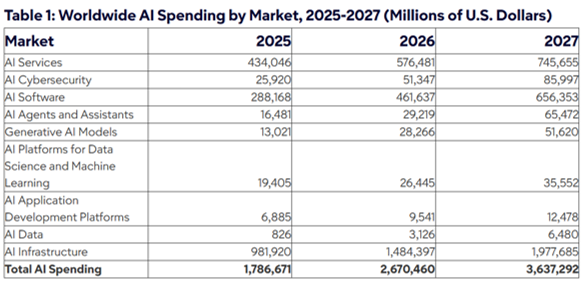
Source: Gartner
Unlike nineteenth-century prospectors, today’s miners aren’t searching for shiny rocks. They’re building the digital plumbing for applications ranging from drug discovery and manufacturing to customer service and autonomous software agents. Yet not every shovel seller, data center landlord, or GPU owner will strike it rich.
The Credit Canary Starts Chirping
The latest sell-off exposed a genuine concern: Can the AI boom earn an attractive return on the enormous capital needed to finance it? Alphabet expects roughly $195 billion – $205 billion of 2026 capital spending, while Amazon projects approximately $220 billion . Alphabet’s advertising revenue missed expectations and cash flow disappointed, raising questions about whether today’s expenditures will translate into tomorrow’s profits.
Here’s the irony: the cloud engines themselves have hardly sputtered. Google Cloud revenue soared +103% year over year, Amazon Web Services accelerated +39%, and Microsoft’s Azure advanced +48%. Microsoft’s cloud business also accelerated, helping distinguish it from worries about softness in portions of Alphabet’s and Amazon’s broader operations. The problem isn’t a lack of growth – it’s whether growth can outrun the cost of buying it.
Credit default swaps (CDS) are an insurance-like way of pricing corporate default risk. When spreads widen, investors demand greater compensation for potential losses. The accompanying chart shows investment-grade spreads around 64 basis points and high-yield spreads around 360, with renewed late-month nervousness. This is a warning light, not yet a five-alarm credit fire. Gartner nevertheless cautions that trillions of dollars of AI infrastructure spending could face future impairment if revenues fail to justify capital costs
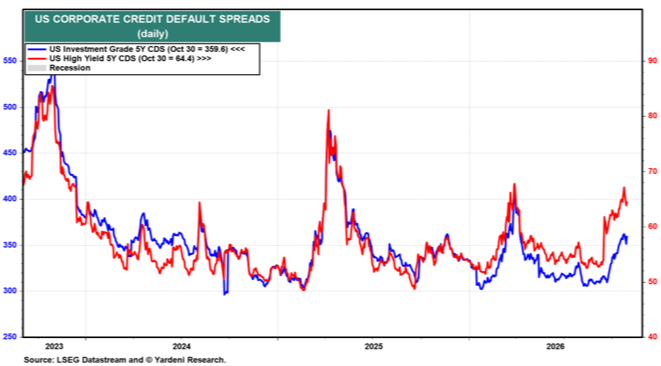
Source: Yardeni.com
The Economy Refuses to Read the Obituary
Meanwhile, the real economy continues to deliver surprisingly healthy results. Third-quarter gross domestic product expanded at a 3.4% annualized pace, accelerating from 2.2% in Q2. That’s not a recessionary-looking number, no matter how loudly the doomsdayers bang their drums.
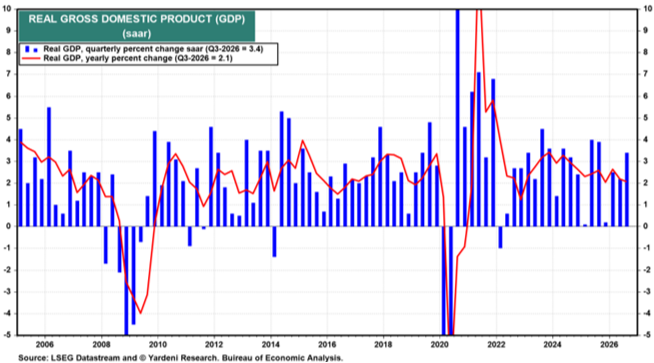
Source: Yardeni.com
The labor market also looks remarkably resilient. New unemployment claims totaled just 194,000 in late October (see below), near the 189,000 July reading – the lowest level since 1969. Continuing claims eased to roughly 1.7 million. Hiring has slowed, but employers still appear reluctant to fire workers en masse. Call it a “low-hire, low-fire” expansion.
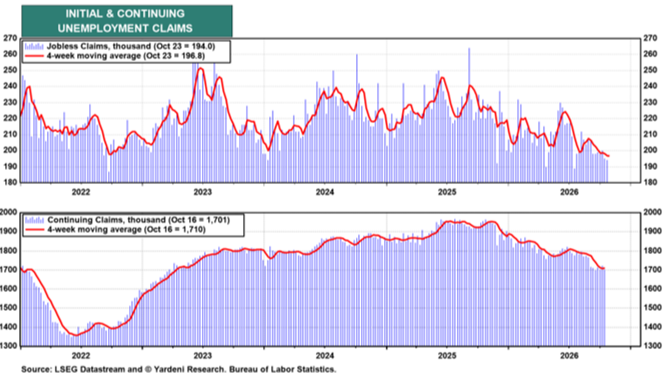
Source: Yardeni.com
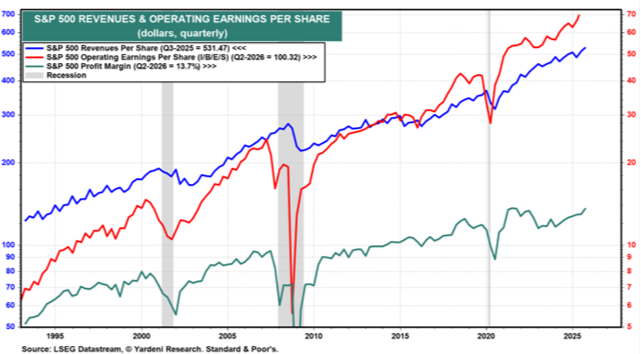
Corporate America is contributing another dose of optimism. S&P 500 revenues and operating earnings have climbed to new highs, while the chart below shows operating profit margins near 13.7%. FactSet likewise projects a 14.9% third-quarter net margin, near historical highs. AI-assisted productivity may be helping some businesses, although strong margins cannot all be credited to robots and algorithms.
Source: Yardeni.com
Rates, Inflation, and the Political Circus
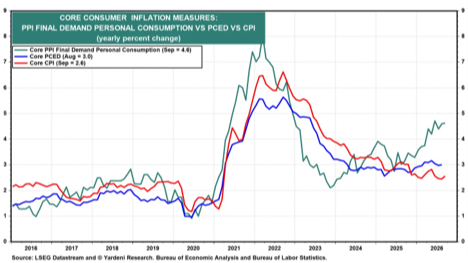
Inflation hasn’t vanished. September’s headline Consumer Price Index rose 3.7% (core CPE 3.1%) from a year earlier, while core CPI ran at 2.6% (see chart below) – well below the peak inflation scare of 2022 but still an uncomfortable distance from the Federal Reserve’s 2% objective. International government bond yields have moved materially higher over the past several years, even though several retreated during October’s flight to safety.
Source: Yardeni.com
At its October meeting, the Fed left its benchmark rate unchanged at 3.75% – 4.00% after September’s hike. Another quarter-point increase in December is widely anticipated, though not guaranteed. Higher borrowing costs raise the hurdle for every prospective AI project, especially those relying on debt rather than internally generated cash flow.
Add November 3rd’s midterm elections to the anxiety cocktail. A possible change in congressional control could complicate legislation, tax policy, oversight, and data-center permitting. Markets dislike uncertainty, but political gridlock is not necessarily a bad thing because controversial legislation gets jammed in the Congressional queue.
A $2 Trillion Dream and a $6 Billion Nightmare
For a measure of AI enthusiasm, consider Anthropic’s pending IPO (Initial Public Offering). Investors once discussed a possible $2 trillion valuation for its anticipated IPO, although Reuters reported in October that some had dialed expectations toward $1.5 trillion. Those numbers speak volumes about the excitement and risk surrounding frontier AI models.
Meanwhile, cryptocurrency investors got a different kind of October surprise: hackers stole approximately $6.3 billion from Binance, according to Reuters. The incident is a sobering reminder that new technology creates opportunities for criminals as well as entrepreneurs.
Keep Digging – But Bring a Map
Will some AI investments become expensive holes in the ground? Absolutely. History’s railroads, internet networks, and telecom booms produced both spectacular winners and bankruptcies. But their excesses also left behind infrastructure that transformed the economy.
Today’s difference is that much of the spending is backed by exceptionally profitable companies, while GDP, employment, and corporate earnings remain sturdy. The prudent response isn’t to throw every pickaxe into the river – or blindly buy every glittering nugget. Diversify across AI beneficiaries, avoid political portfolio bias, rebalance your portfolio, and remember that innovation compounds over years, not daily trading sessions.
The AI gold rush may bury a few reckless prospectors. For patient, disciplined investors, I still believe there’s plenty of gold left in those hills.
Wade W. Slome, CFA, CFP®
Plan. Invest. Prosper.
This article is an excerpt from a previously released Sidoxia Capital Management complimentary newsletter (November 1, 2026). Subscribe Here to view all monthly articles.
Sidoxia Capital Management (SCM) and some of its clients hold positions in AMZN, GOOGL, MSFT, NVDA, and certain exchange traded funds (ETFs), but at the time of publishing had no direct position ANT or in any other security referenced in this article.
DISCLOSURE: No information accessed through the Investing Caffeine (IC) website constitutes investment, financial, legal, tax or other advice nor is to be relied on in making an investment or other decision. Each investor’s situation is unique so please work with a professional financial adviser, tax accountant or legal representative, as applicable, to develop an individualized plan or address any questions you may have. Investing involves risk including the possibility of loss of one’s investment.