Posts filed under ‘Themes – Trends’
TMI: The Age of Information Overload

In raising the issue of TMI (“Too Much Information”), I’m not referring to your parents talking about their sex life, but rather the explosion of data that is flooding our society.
How much data is creeping into our daily lives? The issue impacts all professions, but is especially acute in the investment world. A recent study, co-authored by Roger Bohn and James Short (Directors at the Global Information Industry Center at UC San Diego’s School of International Relations and Pacific Studies), tackles this elusive measurement problem of TMI.
Everyday Life1
One need not become a rocket scientist to figure out we are being inundated with information. The average household already receives 120 TV channels, with no signs of slowing. I love sports just as much as the average person, but do I really need six flavors of ESPN? Or seven different HBO channels? Our TVs (a.k.a., “god box”) even carries the “GOD TV” channel. Does this mean I don’t have to go to church anymore?
Data is permeating other areas as well. Microchips are infiltrating our microwaves, refrigerators and automobiles. The average car now contains more than 50 processors, including a butt-warming car seat chip. Suffice it to say, information is becoming pervasive.
Gorging on Information – Zettabytes at a Time
I think most reasonable people would agree the typical person is consuming more information, but exactly how much? Through Bohn and Short’s rigorous study, they determined Americans consumed 3.6 zettabytes in 2008. A zettabyte is equivalent to 1,000,000,000,000,000,000,000 bytes (21 zeroes), equating to about 10,845 trillion words. This statistic translates into the consumption of approximately 34 gigabytes (about 1/5 the storage in a standard laptop) per day by each American.
Put another way, Kathleen Parker at the Washington Post, calculated the total amount of data produced in 2006 was 3 million times more data than the information contained in all the books ever written.
Investor Dilemma: Paralysis from Analysis
There’s no question in my mind that data can become overwhelming in the investment world. Focusing on the endless concerns spewed over the media can lead to investment paralysis. Each in every day I hear why the world is going to end, or why an investment du jour will rocket to the moon. Not only are the messages schizophrenic, but the quantity is unending. As I mention in my book, while I managed a $20 billion fund, I could receive 500 e-mails, 100 voicemails, and hundreds of pages of hard copy reports and faxes on a daily basis. Completely reviewing the data received in a day’s work could theoretically take weeks, if not months.
Today, the voluminous flow is not retreating, but instead we are seeing new avenues of information distribution, including, Twitter, Facebook, blogs, instant messaging, YouTube, LinkedIn, and numerous other social networking outlets. With the 24/7 daily news cycles, and instantaneous transferability of information, the internet has become a convenience but also a source of heightened anxiety levels. Rather than giving up and throwing in the towel, I willfully accept the challenge to navigate through the masses of data. Automated spam filters, topic alerts, and aggregated news readers are a few basic examples of managing data through technology.
The Surplus Solution
The simple solution to TMI is ignoring and filtering the data. This objective is easier said than done, especially for the inexperienced. Deciphering and tracking the endless creation of new acronyms, alone, can become a full-time job for the less familiar.
The best advice, which I continually take to heart, comes from legendary investor Peter Lynch who states:
‘‘If you spend more than 14 minutes a year worrying about the market, you’ve wasted 12 minutes.’’ He hammers home the point that timing the market based on noisy data is a losing cause. “Anyone can do well in a good market, assume the market is going nowhere and invest accordingly,” adds Lynch.
The other option is to simply outsource the responsibility. Time-strapped professionals follow this strategy when it comes to tax and legal advice, but for some reason many ill-equipped individuals feel they can adequately handle the arguably most important aspect of their financial existence…their investments. While finding an experienced and trusted professional can take some time, it is not an insurmountable task (see my article on selecting an advisor).
Follow a Plan
As the accelerating amounts of data rise in volume, individuals can choose from the following options: 1) Embrace the power of technology to efficiently manage, organize, and filter our consumption of data; or 2) Become slaves to its overwhelming control. I choose the former. Gaining perspective in light of the daily vortex of data we plug ourselves into can be challenging. Taking a step away from the emotional pressures of the daily grind, and exhaling will help you see the forest from the trees. After taking a breather from the chaos, returning to your long-term, disciplined, systematic plan – designed by you or your advisor – will assist you in taming the TMI monster.
Read Full Article from Roger Bohn and James Short
1. Data from Roger Bohn and James Short’s 2009 How Much Information? Report.
Wade W. Slome, CFA, CFP®
Plan. Invest. Prosper.
DISCLOSURE: Sidoxia Capital Management (SCM) and some of its clients own certain exchange traded funds and shares of GOOG, but at time of publishing had no direct positions in DIS, WPO, Twitter, Facebook, or LinkedIn. No information accessed through the Investing Caffeine (IC) website constitutes investment, financial, legal, tax or other advice nor is to be relied on in making an investment or other decision. Please read disclosure language on IC “Contact” page.
NVEC: Profiting from Electronic Eyes, Nerves & Brains

Recently, Seeking Alpha Editor-in-Chief Mick Weinstein interviewed me with the purpose of reviewing an equity investment I find attractive. For the “stock-jock” Investing Caffeine followers, I am publishing the January 5th interview below.
What is your highest conviction stock position in your fund – long or short?
I don’t really have a highest conviction stock, per se, in my fund since I treat all my stocks like children – I love them all. Having said that, NVE Corp. (ticker: NVEC) is a holding of mine that exhibits many of the characteristics I look for in an investment. The Eden Prairie, Minnesota based company is named after “Nonvolatile Electronics,” which refers to memory technology that retains data even when power is removed – a critical attribute for certain applications.
Tell us a bit about the company and what it does.
NVE Corp. is a market leader in nanotechnology sensors, couplers, and MRAM intellectual property (Magnetoresistive Random Access Memory). NVE’s microscopic technology enables the transmission, acquisition, and storage of data across a broad array of applications, including implantable medical devices, mission critical defense weapons, and industrial robots. Major customers include: St. Jude Medical, Inc. (STJ), Starkey Laboratories, Inc., and the U.S. Government.
The company’s coupler and sensor businesses have been ridiculously profitable. Even over a period covering one of the worst global financial crisis in decades, NVE managed to increase its operating margins from an already very respectable 40% range in Fiscal 2007 (ending March) to a stunning 56%+ level in Fiscal 2009.
Beyond sensors and couplers, NVE Corp. is optimistic about the potential for the MRAM market. However, outside of a few one-time licensing fees, NVE is currently generating effectively $0 revenues from this nascent storage technology. Outside of producing small MRAM devices for niche applications such as tamper prevention, NVE Corp. is looking to leverage their IP portfolio by licensing out the patents and subsequently receiving royalties from MRAM device manufacturers. MRAM technology uses magnetic fields to record information, but unlike tape recorders in which a short section of tape holds magnetic information, with MRAM data is held by electrons with out the need of moving parts to read or write data. Believe it or not, this method is highly reliable and is very power-efficient relative to other storage technology alternatives. Currently, the problem with MRAM is the cost prohibitive manufacturing requirements relative to other memories (such as DRAM, SRAM, and Flash), but costs are expected to come down over time. For some MRAM believers, the technology is considered the “Holy Grail” because it may have the potential to combine the speed of SRAM, the density of DRAM, and the non-volatility of Flash memory in a universal source.
If the unproven potential of MRAM ever blossoms, the broad portfolio of NVE Corp.’s MRAM patents should represent a very sizeable profit opportunity. Of course, NVE Corp. must first establish the validity of its MRAM intellectual property and appropriately charge and collect royalties for IP usage. How big can the MRAM market be? Some size the MRAM market in the billions and Toshiba has stated they expect the MRAM market to surpass the size of the traditional memory markets by 2015.
No matter how one measures the size of the market, there will be a substantial revenue opportunity for NVE Corp. if every smart-phone, gaming device and laptop exclusively uses universal MRAM – rather than a combination of DRAM, SRAM, and Flash technologies.
Can you talk a bit about the industry/sector? How much is this an “industry pick” as opposed to a pure bottom-up pick?
Generally speaking, I am a bottom-up investor. I may have concrete views on a particular industry, but the fundamentals of a company will be the main determinant of my investment thesis. Overall, I am looking for market leading franchises that can sustain above-average growth rates for extended periods of time. These traits can come from either a company operating in a mature, sleepy industry (take for example Google in the advertising world) or from a more dynamic growth industry like nanotechnology in the case of NVE Corp.
I believe the nanotechnology industry is in the very early innings of an innovation revolution with regard to new applications and products. Like semiconductors, the economies of scale and technological advances of NVE Corp.’s “spintronic” technology should continually allow faster, smaller, more reliable solutions at lower bit prices. In my view, this snowballing effect will only increase the penetration of nanotechnology solutions and introduce an ever increasing list of new applications.
Can you describe the company’s competitive environment? How is this company positioned vis a vis its competitors?
NVE Corp. has competitors along all three of its spintronic businesses. In their sensor business, most of the competition comes from the makers of legacy electromechanical magnetic sensors, including HermeticSwitch, Inc., Meder Electronic AG (Germany), and Memscap SA (France).
In the coupler space, NVE Corp. faces a larger list of well capitalized, household semiconductor names, including Avago (AVGO), Fairchild Semiconductor International (FCS), NEC Corporation, Sharp Corporation, Toshiba Corporation, Vishay Intertechnology (VSH), Analog Devices, Inc. (ADI), Silicon Laboratories Inc. (SLAB), and Texas Instruments Incorporated (TXN).
A different set of competitors are searching for the MRAM holy grail, including the following companies: Crocus Technology SA (France), Grandis, Inc., MagSil Corporation, Spintec (France), Spintron (France), Spintronics Plc (UK), and IBM.
There is undoubtedly a ton of competition in the spintronics space, but as of October 2009, NVE Corp. has 52 issued U.S. patents and over 100 patents worldwide (either issued, pending, or licensed from others) – many focused on the potentially lucrative MRAM field. Although NVE Corp. has many competitors, they have dominant share in the coupler/sensor market when it comes to high-end, merchant supplied solutions. Moreover, on the MRAM side of the business, the company has already licensed its intellectual property to several companies, including Cypress Semiconductor (CY), Honeywell International Inc. (HON), and Motorola, Inc. (MOT).
Can you talk about valuation? How does valuation compare to the competitors?
Valuation is a key component for all my stock investments. In my valuation work I pore over the income statement, balance sheet and cash flow statement in deriving my price targets.
One area helping NVE Corp.’s valuation case is its improving trend-line of profitability. Over the last 5 years alone, gross margins have gone from 40% to over 70% – not a bad business model if you can execute it. The company also has a pristine balance sheet. Not only does NVE Corp. have no debt, but it also is sitting on a growing mound of cash/investments (over $43 million), representing more than 20% of the company’s market capitalization. Lastly, the company in my view is attractively priced on a free cash flow basis (cash from operations minus capital expenditures), yielding around 6% of the total company value.
What is the current sentiment on the stock? How does your view differ from the consensus?
With small cap stocks like NVE Corp., sentiment and lack of liquidity can create gut-wrenching volatility. Unlike many growth investors who pay more attention to positive momentum factors (price direction), I welcome volatility as it allows me to find more attractive entry and exit points.
With that said, NVE Corp. hit a peak stock price north of $63 per share in early September fueled by 41% revenue growth in their June quarter (fiscal Q1). Subsequently, in fiscal Q2 (ending September 30th), revenue growth decelerated to +14% causing momentum investors to take NVE Corp.’s shares to the woodshed. With the stock down about -35% from its recent crest, I find the valuation only that much more attractive.
Wall Street estimates are calling for further slowing in revenue growth in the coming quarter, so the short term sentiment may or may not continue to sour? Timing bottoms is inherently dangerous and not something I consider myself an expert at. Absent a major deterioration in fundamentals, I stand ready to add to my position if NVE Corp.’s share price falls and valuation metrics improve.
I would argue the typical consensus view advocates selling shares when revenue growth slows. Many of my best performing stocks have been purchased during transitory periods of slowing or cyclical downturns. Let’s hope that’s the case with NVE Corp.
Does the company’s management play a role in your position? If so, how?
Absolutely. There is a continual debate over what is more important, the jockey or the horse? My investment philosophy puts more weight on the jockey than the horse. Obviously, I’m looking for the combination of a talented management team and a solid business model.
When it comes to NVE Corp., Daniel Baker, Ph.D. has done a phenomenal job managing the hyper-growth profile of the company, while preserving prudent and conservative financial values. For the third year in a row, Dr. Baker was also recognized as one of the best U.S. CEOs in the semiconductors and semiconductor equipment industry by investment research and financial consulting firm DeMarche Associates.
At the end of the day, it’s difficult to argue with a track record of success. Since Dr. Baker took over, revenues have more than tripled and earnings have grown from $0.05 in fiscal 2001 to $2.04 in Fiscal 2009.
What catalysts do you see that could move the stock?
Since I hold a longer term investment horizon, catalysts are not a driving aspect to my investment process. But clearly, any additional evidence unearthed in the marketplace validating the growth in the MRAM market, or announcements confirming the value of NVE Corp.’s MRAM intellectual property, should provide support to the stock price.
Beyond that, given where the stock is trading now, I believe merely continuing the execution on their sensor and coupler business provides adequate upside prospects.
What could go wrong with this stock pick?
Investing in small cap technology stocks comes with a whole host of risks. Although I don’t believe the positive scenario of critical mass MRAM commercialization is baked into the current stock price, nevertheless I understand any setbacks announced relative to NVE Corp.’s MRAM prospects or the industry’s MRAM expectations, will likely result in stock price pressure.
NVE also has significant customer concentration, therefore a loss or cutback in sales from a lead customer will probably contribute to price volatility.
From a macro perspective, the company has battled successfully through the economic crisis and proven itself somewhat recession resistant. Nonetheless, the company has sizeable exposure to the industrial segment and would not be immune from the “double-dip” economic recession scenario.
Surely there are additional hazards to this investment, however these are some of the risks I am currently focused on.
Do you have any closing thoughts?
NVE Corp. is not a stock for the faint of heart. However, for those who can stomach the volatility, I encourage you to do some more homework on NVE Corp. Not only will you learn about a phenomenally managed, very profitable, attractively priced nanotechnology company, but you will also gain insight into a leading force behind the eyes, nerves, and brains powering the electronic systems of our future.
Wade W. Slome, CFA, CFP®
Plan. Invest. Prosper.
DISCLOSURE: Sidoxia Capital Management (SCM) and some of its clients own shares in NVEC (and certain exchange traded funds), but did not have any direct positions in the following companies or stocks mentioned in this article at time of publication: STJ, HermeticSwitch, Inc., Meder Electronic AG, and Memscap SA, AVGO, FCS, NEC Corporation, Sharp Corporation, Toshiba Corporation, VSH, ADI, SLAB, TXN, Crocus Technology SA, Grandis, Inc., MagSil Corporation, Spintec, Spintron, and Spintronics Plc, IBM, CY, HON, and MOT. No information accessed through the Investing Caffeine (IC) website constitutes investment, financial, legal, tax or other advice nor is to be relied on in making an investment or other decision. Please read disclosure language on IC “Contact” page.
Our Nation’s Keys to Success

Politics is not a subject I love to debate, but unfortunately politics has a significant impact on economics, which I do care about dearly. I’m no expert on the politics of New York City’s Mayor Michael Bloomberg, but in reflecting on the past decade he highlights a few key areas of focus needed to advance our great nation:
“There are two things that we did not work on and, in fact, have gone the wrong direction during the last decade, which will dictate the economy for the next decade, and that’s immigration and education.”
I couldn’t agree more. With regard to the country’s stimulus program, we hear so much about shovel-ready projects and infrastructure spending. Rather than centering on the immediate gratification of low-paying job creation and building bridges to nowhere, more resources should be invested in education and recruitment of leading edge human capital. Without a competitive and educated workforce, high-paying 21st Century jobs of the future will be lost and outsourced to global challengers.

Bloomberg emphasizes this point by stating:
“Unless we give our young people the kind of education to compete in the global world, we cannot survive.”
Sure, education is a longer-term investment with no immediate pay-off, but in order to become (remain) competitive with other hungry nations, we need to improve our high school education system, which Microsoft Founder and Chairman Bill Gates calls “obsolete”.
National Suicide
I agree with Mayor Bloomberg that the isolationist immigration pendulum has swung too far in the paranoid direction. The recent airline bombing attempt by Yemeni Umar Farouk Abdulmutallab only fans the flames of fear more intensely. However, in order to attract the best and brightest, we need to relax immigration policies – at least loosen policies as they pertain to educated, law-abiding citizens who can assist our dynamic growing economy. I have no problems with “cherry-picking” immigrants. The foundation of capitalism is based on attracting and retaining the best cherries. Bloomberg notes the following:
“And immigration, we’re committing what I call national suicide. Somehow or other, after 9/11 we went from reaching out and trying to get the best and the brightest to come here, to trying to keep them out. In fact, we do the stupidest thing, we give them educations and then don’t give them green cards.”
If fear of job loss is scaring us from letting foreigners in our country, then we need ask ourselves who will pay for our massive debts, deficits and entitlements (i.e., Social Security and Medicare)? Aging demographics is a huge headwind we face (see demographics article) and a quick glance across the Pacific Ocean to our Japanese allies is proof enough of how destructive the graying of society can become.
Also, many ask the question, “Why should we give American jobs to foreigners?” The reality of the situation is we need a competitve work-force to create a competitive country, which can create more sustainable jobs. How many jobs (and tax-dollars) do you think Google co-founder Sergey Brin (Russian-born) has created for American workers? Or Intel’s former CEO Andy Grove (Hungarian-born); Yahoo’s co-founder Jerry Yang (Taiwanese-born); and Sun Microsystem’s co-founders Vinod Khosla (Indian-born) and Andreas von Bechtolsheim (German-born)? More than a few.
Energy Independence
In his Meet the Press Interview, Bloomberg weaves in another issue dragging down the economy – our dependence on foreign oil. Importing more than 2/3 of our oil from foreign nations, many of which harbor or sponsor U.S.-hating terrorists, is not a prudent long-term strategy when it involves such a critical and strategic resource.
“We’ve got to get, somehow or other, energy independence. And so regardless of whether you’re a greenie or not, the bottom line is we cannot keep funding our enemies,” Bloomberg adds.
As the saying goes, the three most important political issues for re-election are: 1) the economy; 2) the economy; and 3) the economy. Unfortunately, short-term sugar-high stimulus spending may help the economy in the short-run but can wear off quickly if not implemented properly. On the other hand, three key strategic areas of investment will lead to sustainable economic expansion, including education, immigration, and energy independence. With new bitter mid-term Congressional elections waiting for us in 2010, let’s hope the candidates take a lead from Mayor Michael Bloomberg by building on his ideas for a firmer economic foundation in the decade to come.
View Meet The Press Roundtable Interview with Mayor Bloomberg (Minute 2:40)
Wade W. Slome, CFA, CFP®
Plan. Invest. Prosper.
DISCLOSURE: Sidoxia Capital Management (SCM) and some of its clients own certain exchange traded funds and GOOG, but at time of publishing had no direct positions in MSFT, JAVA, YHOO, or INTC. No information accessed through the Investing Caffeine (IC) website constitutes investment, financial, legal, tax or other advice nor is to be relied on in making an investment or other decision. Please read disclosure language on IC “Contact” page.
Top 10 Predictions for 2010

#10. Federal Reserve Chairman Ben Bernanke decides pundits were wrong on the housing bubble, so he sets Fed Funds target rate at negative -3.0%. Small businesses start receiving loans.
#9. As part of healthcare reform, Medicare is extended to teens for collagen lip augmentation.
#8. Goldman Sachs, Morgan Stanley, and Citigroup form tri-merger to guarantee they are too big to fail.
#7. Tiger Woods poses in Playgirl to pay for pricey revised terms in his prenup. (see previous post)
#6. Gold spikes to $3,000 per ounce as government subsidizes dental chains in “cash for crowns” gold melting campaign. Consumers get extra cash, but Jujube candy sales plummet. (see previous post)
#5. Bernie Madoff escapes from prison. A cigarette Ponzi Scheme created by Madoff generates enough money to bribe guards.
#4. Apple introduces iPot – a combination iPhone and toilet.
#3. Kazakhstan pays Brazil, Russia, India and China a 5% GDP royalty to be added to the emerging B-R-I-C-K countries. A win-win for all parties, including spelling teachers around the world.
#2. Timothy Geithner retires from Treasury after making millions for being cast as Eddie Haskell in new remake of Leave It to Beaver movie. (see previous post)
#1. Oprah decides to halt her retirement plans. Instead, she signs me to a multi-million dollar deal to co-host a stock & gossip show with her.
HAPPY 2010!!
Wade W. Slome, CFA, CFP®
Plan. Invest. Prosper.
DISCLOSURE: Sidoxia Capital Management (SCM) and some of its clients own certain exchange traded funds (including BKF) and AAPL, but did not have any direct positions in any stock mentioned in this article at time of publication (including GS, MS, C, and GLD). No information accessed through the Investing Caffeine (IC) website constitutes investment, financial, legal, tax or other advice nor is to be relied on in making an investment or other decision. Please read disclosure language on IC “Contact” page.
Decade in Review

We laughed, we cried, we kissed another ten years goodbye. It is virtually impossible to cram ten years into one article, nonetheless I will attempt to chronicle some of the central and silly events that bubble up in my memory bank.
2000

Capture of Elian Gonzalez
- Technology-heavy NASDAQ index peaks at 5,132 before completing its -78% decline by late 2002.
- Y2K (Year 2000) fears do not materialize and technology orders begin downward slide.
- AOL buys Time Warner for $164 Billion in hopes of converging media and internet worlds.
- Al Gore Democratic nominee for the Presidency wins popular vote but loses election to George Bush after effort for Florida recount fails.
- Elian Gonzalez, six-year old boy returned to Cuba.
- Reality TV show Survivor finishes first season with Richard Hatch winning prize.
2001

Enron Logo at Headquarters
- Apple introduces iPod digital music player.
- Enron files Chapter 11 bankruptcy.
- Wikipedia online community encyclopedia launches.
- 9/11 attacks occur pushing economy further down.
- Alan Greenspan starts 1st of 11 rate cuts in 2001.
- China joins WTO (World Trade Organization).
2002

- Severe Acute Respiratory Syndrome (SARS), an atypical form of pneumonia, rears its ugly head in the Guangdong Province of China.
- SEC files charges against WorldCom and Tyco international in connection with accounting irregularities
- United Airlines files for bankruptcy.
- American Idol television singing contest begins first season.
- Guantanomo Bay detention camp is opened.
2003

- Federal Funds rate reaches a 45 year low at 1.00% – fuel for future credit bubble.
- $350 billion in tax cuts approved, spanning a ten year period.
- Iraqi Gulf War II commences with “shock and awe” military campaign.
- Space Shuttle Columbia disintegrates upon attempted reentry into the Earth’s atmosphere.
- Broad stock market recovery (>90% of stocks in S&P500 climb), including a +50% rise in the NASDAQ index.
- Martha Stewart indicted for using privileged investment information and then obstructing a federal investigation.
- Arnold Schwarzenegger, movie star, becomes governor of California.
2004

- Google (GOOG) goes public with IPO at $85 per share.
- Mark Zuckerberg unveils Facebook and people begin “friending” each other.
- Comcast makes failing unsolicited bid for Disney. K-Mart buys Sears with aid of Eddie Lampert
- Ronald Reagan, 40th President, dies at 93.
- Janet Jackson and Justin Timberlake experience “wardrobe malfunction” on Super Bowl halftime show.
- Boston Red Sox win their first World series since 1918.
2005
- P&G announces $57 billion acquisition of Gillette. Conoco Philips buys Burlington Resources for over $30 billion. Bank of America buys credit card company MBNA.
- Ben Bernanke is nominated as new Federal Reserve Chairman.
- Hurricane Katrina overwhelms New Orleans as 80% of city becomes covered with water.
- North Korea announces its nuclear weapons arsenal.
- YouTube starts sharing online videos before Google Inc. eventually buys company.
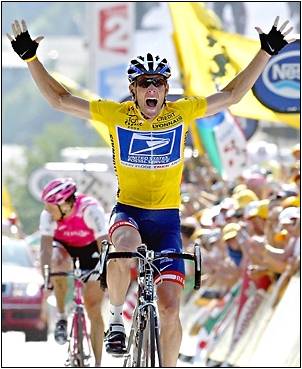
- Lance Armstrong wins 7th consecutive Tour de France.
2006
- Inverted yield curve turns out to be an accurate leading indicator for 2008 recession despite markets advance.
- Internet activity accelerates: Google buys YouTube after News Corp buys MySpace. Twitter is introduced.
- Playstation 3 (PS3) and Nintendo Wii unveiled.
- Merger & acquisition activity reaches $3.79 trillion worldwide, surpassing previous 2000 peak (Thomson).
- Options backdating takes center stage. United Health and technology companies were among those dragged into controversy.
- Housing market peaks.
2007

- Markets continue multi-year rally with three major indexes holding single-digit gains. Emerging markets build on previous year gains – Shanghai composite +97%.
- Monoline insurers MBIA and rival Ambac become early canaries in the coal mine given the greater than $1 trillion in exposure on insuring securities.
- Apple presents the iPhone – part phone, part music, part computer.
- KKR (Kohlberg Kravis Roberts & Co.) and TPG complete $44.4 billion buyout of Texas power company TXU Corp.
- Microsoft Vista operating system introduced after five years of development.
- Housing decline accelerates as Countrywide Financial announces 12,000 job cuts (20% of its workforce), New Century Financial (#2 subprime lender at one point) files Chapter 11 bankruptcy, and two Bear Stearns mortgage based hedge funds go under.
- Chuck Prince, Citigroup CEO, steps down.
2008

- Bank of America agrees to buy Countrywide mortgage company for about $4 billion.
- JPMorgan Chase agrees to buy Bear Stearns for $2 per share in a sale brokered by the Fed and the U.S. Treasury – eventually bid revised upwards to $10 per share (~$1.1 billion) to appease angry shareholders.
- Lehman Brothers goes bankrupt.
- Bank of America agrees to acquire Merrill Lynch for about $50 billion.
- Government takes over AIG after providing insurance company $85 billion loan.
- Goldman Sachs and Morgan Stanley become bank holding companies to improve access to capital.
- Washington Mutual Inc. is seized by FDIC and sold to JPMorgan Chase in the biggest U.S. bank failure in history.
- Wells Fargo & Co., agrees to purchase Wachovia for about $15.1 billion, trumping Citigroup’s bid.
- $700 billion TARP (Troubled Asset Relief Program) eventually approved by Congress to stabilize financial system.
- Eliot Spitzer resigns after prostitution scandal.
- Michael Phelps wins eight gold medals at the 2008 Beijing Summer Olympics.
2009
- Barack Obama inaugurated in as 44th President of the United States. Healthcare reform bills pass in both the House and Senate.
- GM and Chrysler declare bankruptcy.
- Recession ends as stimulus kicks in and inventories rebuild. Government announces new PPIP and TALF programs.
- Warren Buffett pays $26 billion to buy Burlington Northern Santa Fe. Other announcements include: Oracle /Sun Microsystems; Pfizer/Wyeth; Merck/Schering Plough; and Pulte Homes/Centex.
- Commodities and emerging markets rebound. Gold tops $1,000 per ounce.
- Signs of housing bottoming as low mortgage rates, tax credits, and declining inventories create a more constructive environment.
- Madoff goes to prison after he was convicted for a $65 billion Ponzi Scheme.
- Chesley B. “Sully” Sullenberger successfully carries out the treacherous crash-landing of US Airways Flight 1549 into the Hudson River.
- Dubai debt debacle forces Abu Dhabi to lend support to calm global markets.
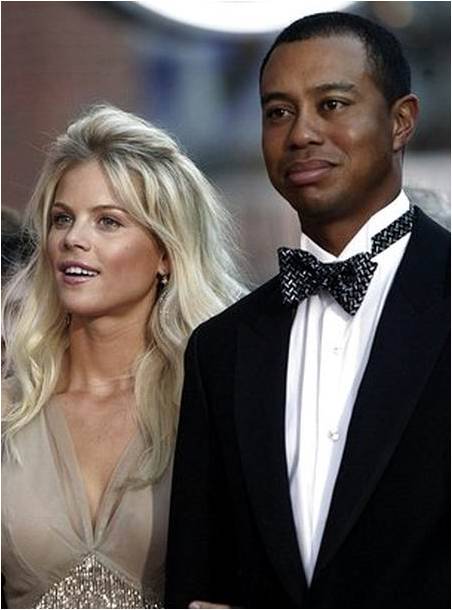
- Tiger Woods admits transgressions after car crash pushes him into spotlight.
2010 ???
Time will tell what the new year will bring. Stay tuned for some iron clad 2010 predictions coming to an Investing Caffeine blog near you in the not too distant future!
Wade W. Slome, CFA, CFP®
Plan. Invest. Prosper.
DISCLOSURE: Sidoxia Capital Management (SCM) and some of its clients own certain exchange traded funds and BAC, AAPL, and GOOG, but did not have any direct positions in the following stocks mentioned in this article at time of publication (including AOL/TWX, VIA/CBS, NWS, TYC, UAUA, MSO, CMCSA, DIS, SHLD, PG, COP, Nintendo, MBI, ABK, MSFT, C, JPM, AIG, MS, WFC, GM, Chrysler, BRKA, ORCL, JAVA, PFE, MRK, PHM, BNI, LCC, GLD, and NKE). No information accessed through the Investing Caffeine (IC) website constitutes investment, financial, legal, tax or other advice nor is to be relied on in making an investment or other decision. Please read disclosure language on IC “Contact” page.
Can the Lost Decade Strike Twice?

There is an old saying that lightning does not strike twice in the same place. I firmly believe this principle will apply to stock returns over the next decade. Josh Brown, investor and writer for The Reformed Broker highlighted a chart published by Bloomberg showing the 10-year return for various asset classes. Statisticians and market commentators have been quick to point out that stocks, as measured by various benchmarks, have not only underperformed bonds for the last 10 years, but stock performance has actually also been negative for the trailing decade.
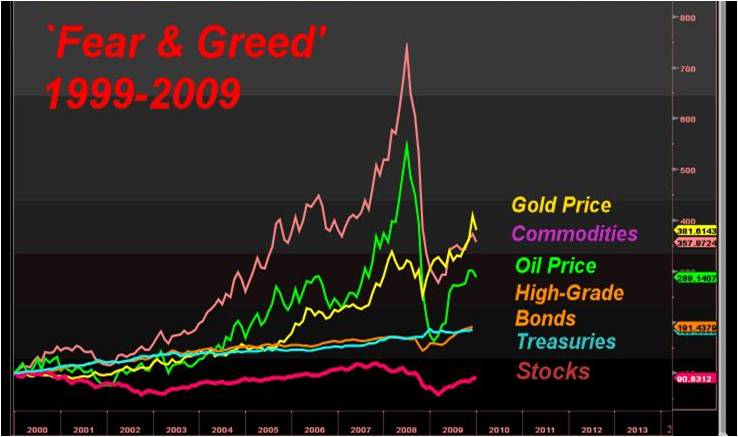
Source: Bloomberg via The Reformed Broker
Will this trend persist during the next decade? Will the lost decade in stocks be repeated again, similar to the deflation death spiral experienced by the Japanese? (Read more regarding Japanese market on IC). With the Fed Funds rate at effectively zero, is it possible bonds can pull off a miracle over the next 10 years? I suppose anything is possible, but I seriously doubt it.
Let’s not forget that the P/E ratio (Price-Earnings) pegged by some to be at about 14-15x’s 2010 expected earnings – nestled comfortably within historical bands. Granted, financials and some other sectors were overheated (e.g. certain Consumer industries), but based on next year’s estimates, some industries are already expected to exceed the peak earnings achieved during 2007 (e.g., Technology).
History on Our Side

Source: Crestmont Research. Dated graph over the last century showing stock returns rarely result in negative returns over a rolling 10 year period.
For the trailing decade using December 20, 2009 as an end point, I arrive at a marginally negative return for the S&P 500 index assuming an average dividend yield of 2.5% for the period. Certainly the negative return would be pronounced by any fees, commissions or taxes related to a 10-year buy-and-hold strategy of the broad market index. This chart gets chopped off in 2005, nonetheless history is on our side, lending support that stock returns have a good chance of improving on the results over the last 10 years.
Equity Risk Premium
The bubbles and scandals that have blanketed corporate America over the last 10 years have made the average investor extremely skeptical. What does this mean for the pricing of risk? Well, if you rewind to the year 2000 when technology exceeded 50% of some indexes, and many investors thought technology was a low risk endeavor, there was virtually no equity risk premium discounted into many stock prices. If you fast forward to today, the reverse is occurring. Investors despise market volatility and arguably demand a much higher risk premium for taking on the instability of stocks. This is the exact environment investors should desire – lots of skepticism and money piled into bonds (See IC article on investor queasiness). As Warren Buffett says, “Be fearful when others are greedy and greedy when others are fearful.” I believe the next 10 years will be a time to be greedy.
The analysis above is obviously very narrow in scope, since we are only discussing domestic stock markets. In my client portfolios I advocate a broadly diversified portfolio across asset classes (including bonds), geographies, and styles. However, in managing bonds across portfolios, I am forced to tactfully include strategies such as inflation protection and shorter duration techniques. With the year-end fast approaching, now is a good time to review your financial goals and asset allocation.
Lightning definitely negatively impacted stocks this decade, but betting for lightning to strike twice this decade could very well turn out to be a losing wager.
Wade W. Slome, CFA, CFP®
Plan. Invest. Prosper.
DISCLOSURE: Sidoxia Capital Management (SCM) and some of its clients own certain exchange traded funds, but at time of publishing had no direct positions in BRKA. No information accessed through the Investing Caffeine (IC) website constitutes investment, financial, legal, tax or other advice nor is to be relied on in making an investment or other decision. Please read disclosure language on IC “Contact” page.
Running with the Bulls

Guest Contributing Writer: Bruce Wimberly
No matter where you turn some “expert” is espousing his or her view on the direction of the market. The reality is none of them know. My advice to anyone is avoid the fallacy of experts. Those that purport to know, donʼt. It is a mere exercise in futility to justify charging higher fees. Letʼs be honest if anyone knew the future direction of asset prices they would be beyond rich (Iʼm talking John Paulson – Trade of the Century rich!). Nice job John who would have thought you could make that much money betting against mortgages.
As investors our best bet is to accept that fact that market timing is a losing strategy. Timing the market is similar to a coin flip. Pure and simple, the cost of getting it wrong wipes out the occasional gain of getting it right. Remember, every time you listen to the perma-bears and try to time the market, there is big time investment professional on the other side of that trade who is by definition taking the opposite view.
Good investors expand their timeframes. They do not get sucked into the news of the day. Let the perma-bears worry about Dubai, currency devaluation, or whatever else is todayʼs fear. Keep in mind there is always something to worry about. For long term investors the greatest fear is not being in the market. For example, if inflation were to average 3% and you are sitting in cash earning nothing your money will be cut in half by 2033. Grandmaʼs mattress is not an option for most people.
Now back to the question of bulls versus bears and the direction of the markets. Who is right? The simplest way to think about this comes from Oracle of Omaha himself, Warren Buffett. Buffett thinks of the market as a reflection of total market cap relative to US GNP (gross national product). After all, in the long run the market should approximate some measure of overall corporate profitability or in this case overall economic growth. If you accept Buffettʼs argument then the market is neither overly expensive or cheap. As of yesterday the total market index is at $11,296.2 billion which is about 79% of the last reported GDP. (I know the perma-bulls will find some reason to bash the reported GDP number). Nevertheless, this simple formula provides a good long term context on which to gage the relative attractiveness of the overall market. To put todayʼs number in context (79%) at the peak of the market bubble in 1999, the ratio of total market cap/GDP was 150% or almost double todayʼs reading. Yes, the market has made a major move from depressed levels earlier in the year but that is irrelevant. Donʼt anchor on that number or you will never get off the sidelines.
My advice is simple, ignore the perma-bears and avoid market timing like the plague for it is a suckers bet (see also article on passive vs. active investing). If the market does pull back (and it will at some point) this is great news for the long term investor. Anytime you can buy a stock on sale – this is a good thing! So enjoy the Christmas holidays, donʼt believe the hyped up bears and as always:
Plan. Invest. Prosper.
DISCLOSURE: Sidoxia Capital Management (SCM) and some of its clients own certain exchange traded funds and equity securities in client and personal portfolios at the time of publishing, but had no direct position in BRKA/B. No information accessed through the Investing Caffeine (IC) website constitutes investment, financial, legal, tax or other advice nor is to be relied on in making an investment or other decision. Please read disclosure language on IC “Contact” page.
The Porsche-Yacht Indicator

Tiger Woods is not the only person who has realized yacht purchases do not guarantee happiness. In previous articles (Back to Future article #1, article #2, article #3), I showed how magazine covers could be used for identifying tops and bottoms in the market. Now I’m researching yacht and Porsche purchases as a complementary indicators for future performance deterioration with the thanks of Slate.com and Bloomberg.
1) Bill Miller: After an incredible 15 consecutive years winning streak against the S&P 500 index, Bill Miller (Fund manager of the Legg Mason Value Trust) thought it was a bright idea to add a yacht to his portfolio in 2006. Needless to say, from that point on, his five-star Morningstar rated fund went on a horrific losing streak, landing him in the bottom decile of peers and forced him to relinquish four of his fund rating stars (See Bill Miller Revenge of the Dunce) .
2) Paul Allen: The jinxing of yacht buying is not limited to fund managers. Paul Allen was the Co-Founder of Microsoft (MSFT) with Bill Gates, Chairman of cable company Charter Communications (CHTRQ), and owner of the Seattle Seahawks football team, and the Portland Trailblazers basketball team. Ever since buying his 300-foot Tatoosh yacht in 2000 and his 400-foot+ Octopus yacht in 2003, Allen’s cable company, Charter Communications, deteriorated and his company went bankrupt before recently reemerging from Chapter 11.
3) Dennis Kozlowski: Corruption didn’t slow down Dennis Kozlowski, CEO of Tyco International (TYC), from buying his 130 foot sailing yacht Endeavor. From around the time he purchased the yacht until he resigned based on the charges, Tyco stock collapsed approximately -70%.
4) Robert Rodriguez: The $1.1 billion FPA Capital Fund has been captained by Bob Rodriguez since 1984 and his 15% average annual return qualifies him as the best manager among diversified U.S. equity funds, according to Morningstar Inc. As a value-based investor his wealthy indulgences are concentrated on driving Porsches. So comfortable is Rodriguez about the performance of the fund, he has decided to take 2010 off traveling. Perhaps he can be my first experimental subject in the testing of my “sabbatical indicator?”
5) Tiger Woods: With the endless media coverage, Tiger’s 155-foot yacht Privacy unfortunately has not secured him any. The $20 million purchase was made in 2004, but with six wins in golf “Majors” over the last five years, the yacht indicator is less conclusive. In the field of faithfulness, there is a higher correlation.
Obviously, there are many instances in which performance has improved over time, even after luxury asset purchase like yachts. I haven’t placed the order for my 400-foot yacht just quite yet, but I have made notes to myself to avoid bankruptcy, jail, car crashes and one-star performances if I decide to go through with the purchase. I’ll keep you posted on my order…
Wade W. Slome, CFA, CFP®
Plan. Invest. Prosper.
DISCLOSURE: Sidoxia Capital Management (SCM) and some of its clients own certain exchange traded funds, but at time of publishing had no direct positions in MSFT, LM, CHTRQ, NKE. No information accessed through the Investing Caffeine (IC) website constitutes investment, financial, legal, tax or other advice nor is to be relied on in making an investment or other decision. Please read disclosure language on IC “Contact” page.
Read Full Yacht Article on Slate.com
Stewart Makes Skewered Beck-Kebabs

Since Fox news-host, Glenn Beck, has been peddling death and destruction, John Stewart, host of the The Daily Show, decided to dish out some devastation of his own to Mr. Beck by skewering him on several issues. Specifically, Stewart questions whether Beck’s Armageddon view on the economy may be influenced by an economic conflict of interest in gold (not just a political axe to grind)?
Beck on Gold
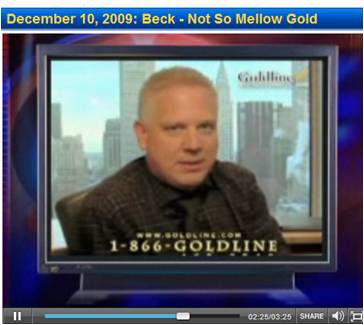
View The Daily Show Clip on Glenn Beck
As the third party mentions, “If you are worried about worrying, you go out and you buy gold.”
Is Glenn Beck a worried, gold lover? (see other IC articles: Gold #1 & Gold #2) Well, judging by the seven responses of Beck specifically spouting out “gold”, along with his panic-filled quotes, I would say “yes”:
- “America is burning down to the ground!”
- “Here are the three scenarios that we could be facing: recession, depression, or collapse.”
- “Here’s our second scenario: global civil unrest.”
- “You are the protector of liberty. You are the guardian of freedom.”
If these feelings were not enough, Beck also goes on to compare the country’s situation to Nazi Germany.
Do any of these issues worry you? Well if they do, then good for gold prices and good also for Glenn Beck, because he is a paid spokesman for Goldline.com, a site that sells gold.
This is how John Stewart boils down the incestuous relationship between Fox, Goldline.com, and Beck:
“This is a kinda nice feedback loop. Glenn Beck is paid by Goldline to drum up interest in gold, which increases in value during times of fear, an emotion reinforced nightly on Fox by Glenn Beck. Alright, I’m almost sold. Fox is vouching for Beck, and Beck is vouching for Goldmine.”
Gold Pricing & Demand
With gold prices setting new all-time highs earlier this month, one might expect gold demand to be sky-rocketing…actually not. Just last month, the World Gold Council said gold demand totaled 800.3 tons in Q3, down -34% year-over-year. What’s more, the supply of gold inventories is at record highs (Comex) and mining production rose +6% over the same time period. Generally speaking, economics would say the combination of these factors would be a bad formula for prices.
Beck and the CEO of Goldmine.com use inflation adjusted prices based on the last $850/oz. peak in 1980 to rationalize $2,000/oz+ targets for gold. If that’s the case then I guess NASDAQ targets of 10,000 (2x of the 5,000 year 2000 peak) shouldn’t be out of the question either (the index currently trades around 2,190)? In the meantime, I’ll let the speculative gold dust settle and comfortably watch from the sidelines.
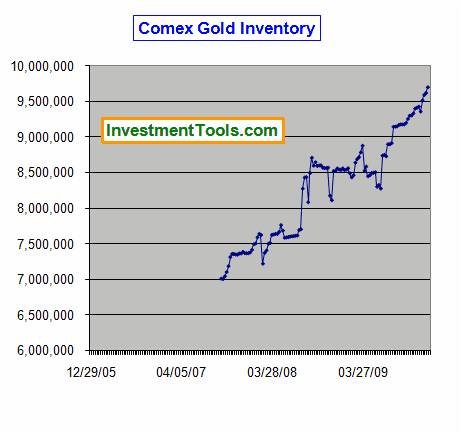
Source: InvestmentTools.com
Hemorrhoid Hypocrisy on Healthcare
In an earlier The Daily Show episode, Stewart questions the consistency of Beck’s changing views on healthcare. So which one is it? Is it the best healthcare program in the world, or the one that doesn’t care for Glenn Beck and the “schlubs that are just average working stiffs?”
In creating a feeling of alarm regarding healthcare reform, here’s what Beck had to say in the middle of the healthcare reform debate:
- “You’re about to lose the best healthcare system in the world.”
- “America already has the best healthcare in the world. We do take care of our sick.”
Rewind 16 months earlier upon completion of Beck’s hemorrhoid surgery:
- “Getting well in this country, can almost kill you.”
- “No matter how much the health care system would try to keep me down, I’m back.”
See Daily Show Clip on Healthcare and Glenn Beck
All this bickering can upset your stomach, but after John Stewart’s skewering of Glenn Beck, I have this sudden urge for shish kebabs. Bon appétit until next time…
Wade W. Slome, CFA, CFP®
Plan. Invest. Prosper.
DISCLOSURE: Sidoxia Capital Management (SCM) and some of its clients own certain exchange traded funds (VFH) and RTP in client and personal portfolios at the time of publishing. No information accessed through the Investing Caffeine (IC) website constitutes investment, financial, legal, tax or other advice nor is to be relied on in making an investment or other decision. Please read disclosure language on IC “Contact” page.
China: The Trade of the Century?

So it goes, Britain was the country of the 19th century, the United States was the country of the 20th century, and China will be the country of the 21st century. Is investment in China hype or reality? Here are some points in China’s favor:
- Large Labor Force: With a population exceeding 1.3 billion people, China has plenty of labor available to expand GDP (Gross Domestic Product).
- No Nonsense Government: An authoritarian government has its advantages. While pornography (see article) and unrest may be problems, infrastructure projects are not.
- Education: Chinese culture values education. As a result, China is slowly shifting away from its roots as the globe’s manufacturing and piracy capital. Intellectual property is appreciated more now that China is becoming a leader in emerging technology areas, such as solar power.
- Trade Surplus & Currency Reserves: Must be nice to have trade surpluses and massive currency reserves (~$2.3 trillion). This is what happens when you are in a position to export more than you import.
- Manageable Debt: China’s Debt/GDP ratio is less than 25%. You can compare that to the U.S. at around 100% and Japan at over 200%. Disciplined fiscal management provides the Chinese government with more options in dealing with the global slowdown (e.g., stimulus).
- Long Runway of Growth (Read More): China’s long runway of growth has allowed it, and should continue to allow it, to grow at above average growth rates – in the 3rd quarter of 2009 the Chinese economy grew at a very healthy +8.9% rate.
With all these positives, it’s no wonder China is the darling of the world. Given the constructive outlook, how can investors take advantage of the Far East opportunity in China? Our good friend at Investing Caffeine (figuratively speaking), Burton Malkiel (Princeton Professor of Economics and Chief Investment Officer at AlphaShares), is bullish about China and is sharing his preferred participation method…an all-cap China exchange traded fund (ticker: YAO) – Read more about Malkiel and Active vs. Passive Investing (12/8/09 Post).
Just how bullish is Professor Malkiel?
“I think China will continue to have the highest growth rate of any major country in the world, and within 20 years, China will be the world’s leading economic power.”
And he puts his money where his mouth is. Last year the professor shared his Chinese exposure in his personal portfolio:
“My portfolio is probably 20 percent Chinese, and that includes not only indices but also individual companies.”
Risks: The Price to Play
Professor Malkiel is not blindly diving into China – he researched the markets for years before taking the plunge. In an article from last year (From Wall Street to the Great Wall), he highlighted some of the inherent risks:
1) Foreign Neighbors: China continues to have tense, although cordial, relations with some of its neighbors like Taiwan and Japan. Their dealings are stable now, but the future is uncertain.
2) Social Unrest: An uneven distribution of income can lead to serious social unrest, especially in the rural parts of the country. If the government can’t keep the economy humming along, those left behind may fight back.
3) Environmental Degradation: China is building nuclear, wind, and solar projects at a frenetic pace, but China is also the globe’s largest emitter of greenhouse gases (relies on dirty coal for 70% of its energy), according to CNN. If China becomes an irresponsible power hog, there could be damaging effects to the economy.
4) Corruption: This continues to be a problem, but Malkiel points out the case of Zheng Xiaoyu, a former director of China’s FDA (Food and Drug Administration) equivalent. In 2007, he was executed after being found guilty of taking bribes.
5) Banking System: Malkiel notes that China continues to have a fragile banking system with a lot of bad loans. Due to political reasons, certain government owned entities may receive risky loans in the name of creating jobs – even if it means keeping unhealthy zombie banks alive.
Trading Strategies:
Beyond investing in AlphaShare ETFs (YAO), Malkiel advocates considering the other options, such as the “A”, “H”, and “N” shares. Unfortunately, the more inefficient “A” shares, which trade in Shanghai and Shenzen, are largely unavailable to investors outside of China. However, the “H” shares and “N” shares are available to international investors. “H” shares are listed on the Hong Kong Stock Exchange and the listed companies follow globally accepted accounting principles. The “N” shares come from companies registering with the SEC (Securities and Exchange Commission) and trade either on the NYSE (New York Stock Exchange) or NASDAQ exchanges.
Lastly, Malkiel knows he is not the only investor to pick-up on the China growth story. Multinationals are investing heavily in China, and these domestically based companies can serve as indirect investment vehicles to benefit from the attractive fundamentals as well.
Professor Malkiel calls China the “growth story of the world.” Simple math shows us that this Asian juggernaut (the third largest country in the world by GDP) will soon pass Japan in the number two position and the U.S. is likely only a few decades ahead after that. Having explored and studied China firsthand, I concur with many of Malkiels conclusions, which opens the possibility that China could reasonably be the top country (and top trade) of the 21st century?
Full Malkiel Article: From Wall Street to the Great Wall – Investment Opportunities in China
Wade W. Slome, CFA, CFP®
Plan. Invest. Prosper.
DISCLOSURE: Sidoxia Capital Management (SCM) and some of its clients own certain exchange traded funds, like FXI, at the time of publishing. No information accessed through the Investing Caffeine (IC) website constitutes investment, financial, legal, tax or other advice nor is to be relied on in making an investment or other decision. Please read disclosure language on IC “Contact” page.




 Investing Caffeine
