Posts filed under ‘Stocks’
Ooops…Siegel Data Questioned

Professor Jeremy Siegel is well-known in large part due to his famed book, “Stocks for the Long Run,” which Siegel uses as a foundation for his assertion that stocks have dramatically outperformed bonds since 1802. Siegel has four versions of his book, but the basic conclusion is that stocks have averaged about a 7% annual return (approximately 10% after accounting for inflation) versus around 4% for bonds, over a two hundred plus year timeframe. One problem – the validity of 69 years of the data (1802 – 1870) are now being questioned.

Any Utopian study or mathematical model is only as valuable as the data that goes into it. “Garbage in” will result in “garbage out.” According to a Wall Street Journal article (Does Stock-Market Data Really Go Back 200 Years?) written by Jason Zweig, the index data used by Siegel was too narrow on an industry basis and involved too few stocks (e.g., primarily banks, insurance and transportation stocks). In addition, the reliability of the conclusions is being second guessed because the data used by Professor Siegel starting back as far as 1802 were compiled decades ago by two separate economists, Walter Buckingham Smith and Arthur Harrison Cole.
According to Zweig, another area of concern is the fluctuating dividend yield used by Professor Siegel:
In an article published in 1992, he estimated the average annual dividend yield from 1802-1870 at 5.0%. Two years later in his book, it had grown to 6.4% — raising the average annual return in the early years from 5.7% to 7.0% after inflation. Why does that matter? By using the higher number for the earlier period, Prof. Siegel appears to have raised his estimate of the rate of return for the entire period by about half a percentage point annually.
I’m sure Professor Siegel has a rebuttal to all these accusations, but we’ll just have to wait and see how credible the response is. Maybe Siegel’s next book will be entitled, “Bonds for the Long Run”?
Wade W. Slome, CFA, CFP®
Plan. Invest. Prosper.
DISCLOSURE: Sidoxia Capital Management (SCM) and some of its clients own certain exchange traded funds, but at the time of publishing SCM had no direct position in any other security referenced in this article. No information accessed through the Investing Caffeine (IC) website constitutes investment, financial, legal, tax or other advice nor is to be relied on in making an investment or other decision. Please read disclosure language on IC “Contact” page.
Is the Recession Over?

Dennis Kneale, bullish commentator on CNBC presented his case on why he thinks the recession is over:
Positive Technical Indicators: Kneale points out that in recent history when the 50-day moving price average cuts upward through the 200-day moving average there is a positive directional bias for the market in the ensuing months.
Personal Income: +1.4% in May for 2 consecutive months.
Personal Spending: Consumer spending was up again in May, and up more than in April.
University of Michigan Consumer Sentiment: The survey rose again to a reading of 70.8 in the recent measurement period.
VIX Volatity Index: The so called “Fear Index” is down -43% in about 3 months – stabilizing to a more normalized level. He argues this should bring in some cash on the sidelines into the stock market.
Eric Schmidt Positive: CEO of search giant, Google, says the worst is behind for the U.S. economy.
Most of the guests rang a more cautious tone, not the least of which, Peter Schiff sees Armageddon ahead for the U.S. economy. Mr. Schiff goes on to compare CNBC to the Gardening channel with all the talk about “green shoots.” Not to mention, he sees the trillions of stimulus dollars only providing a temporary, artificial boost that will eventually cause a horrible economic hangover. Lucky for Peter, he has perfectly timed the international rebound in 2009…cough, cough.
Water…the Next Oil?
Water engulfs our daily lives – we drink, bathe, wash clothes, soak our lawns and brush our teeth with it on a consistent basis. We notice our reliance in our monthly water bills. The earth is covered by approximately 70% water, so if this commodity is so abundant, then how could it be such a scarce, valuable resource? Water is so important; the majority of our body mass consists of the fluid (about 60% in males and 55% in females). Although our planet is covered with this liquid, the main problem surrounding the issue is that only about 2% of the water supply is considered fresh water (predominantly located in Antarctica). Desalinization of salt water is one solution to the limited amount of fresh water, but unfortunately the current technology and energy requirements make it a cost prohibitive process. As a result of the inadequate supply, over an estimated 1 billion people do not have access to clean water and 2.4 billion people are subject to stressed water conditions.

In the “Golden State” of California, budgetary problems are not the only concern on people’s minds – the state is in the middle of a water shortage. Certain water jurisdictions are escalating prices by upwards of +15%. Regardless of your view on “climate change,” objective data points to declining water levels and heightened scarcity. By 2030, OECD predicts that half of the world’s population will live in areas under severe water stress.
I’m certainly not the only believer in this theme as an investment opportunity. T. Boone Pickens, renowned commodity investor, is spending over $100 million on water investments (including access to water rights) because he believes that H2O is the next oil. Water, like oil, is a depleting resource that will experience intensified demand over time.
How to Invest in Water:
Not everyone has millions of dollars like Pickens to invest in land and water rights, so there are different ways for the average investor to participate in the rising demand for water. For example, investors, like Sidoxia Capital Management, can invest in ETFs (exchange traded funds) with a water focus. ETF options include, PowerShares Water Resources (PHO), PowerShares Global Water ETF (PIO), and/or Claymore S&P Global Water (CGW). For those wishing to invest in individual stocks, some water related companies include, Nalco Holding Company (NLC), Danaher Corporation (DHR), Itron Inc. (ITRI), and Valmont Industries, Inc. (VMI).
Water Demand Drivers
- The globe’s population of approximately 6.5 billion people is growing and becoming thirstier. Water demand is expanding much faster than population growth.
- Climate change exacerbates the growing water supply problem.
- Agriculture and irrigation needs are driving the majority of global water demand.
- There is no substitute for water at any price.
Conservation, technology, and efficiency are tools to improve the usage of our finite water resources. As the water problem becomes more acute, profiting from water investments is a way to offset the inevitably higher costs of usage. Now if you’ll please excuse me, I’m thirsty for a glass of water.
Wade W. Slome, CFA, CFP® www.Sidoxia.com
DISCLOSURE: At the time of publishing, Sidoxia Capital Management and some of its clients owned certain exchange traded funds (including PHO & CGW), but had no direct positions in PIO, CGW, NLC, DHR, ITRI, VMI, or any other security referenced. No information accessed through the Investing Caffeine (IC) website constitutes investment, financial, legal, tax or other advice nor is to be relied on in making an investment or other decision. Please read disclosure language on IC “Contact” page.
U.S. to China, “What’s Wrong With a Little Porn and Anarchy?”
The U.S. recently scheduled talks with the Chinese government to discuss the appropriateness of automated personal computer (PC) content filtering (including, pornography, Falun Gong, and governmental protest content). Falun Gong is a meditatitve spiritual discipline frowned down upon by the Chinese government.
I can picture it now, U.S. officials calling up Chinese President Hu Jintao and saying, “Hey Hu, why not lighten up a bit on the freedom crackdowns – what’s the big deal with a little pornography and anarchy?” The Chinese government feels that in the absence of structured laws, which would limit access to inappropriate content, the natives will become restless and ultimately disruptive. PC manufacturers would prefer not to reengineer PCs and increase the embedded costs to consumers by adding additional components. However, given the size of the Chinese PC market, the dominant foreign manufacturers are likely to cave to Chinese government demands, given the massive long-term potential of this Asian market. We have already seen Google (GOOG), Yahoo (YHOO), and Microsoft (MSFT) make concessions to the Chinese government in the algorithmic search arena.
 The thematic parallels presently occurring in China apply to William Golding’s Lord of the Flies (1954) as well. Lord of the Flies is a story about a group of stranded kids (surviving a plane crash) that battle for survival on a deserted island. Due to the lack of law, adult supervision and questionable tendencies, all hell eventually breaks loose. The Chinese government, managing a population of 1.3 billion people, fears a similarly hellacious outcome if an uncontrolled, lawless population consumes unfettered, unhealthy content. Given mistakes we’ve made abroad (e.g., Abu Ghraib, and Guantanomo), the Chinese and other countries are questioning the strength of our moral compass in judging or guiding other countries’ policies.
Although the U.S. government’s intentions are in the right place to protect the personal freedoms of people globally, we are not currently in the strongest moral position right now to cram our beliefs down other’s throats. Even the freest of societies such as our own limits certain actions – such as underage voting, underage drinking, and public nudity (O.K., I’m stretching a bit).
Regardless of your political views, one can appreciate the fear of anarchy in the hearts of the Chinese government. Practically speaking however, given the openness and rapid expansion of the global internet, the Chinese can only slow the expansion of individuals’ freedoms – recent events in the Middle East just provide additional evidence to this premise.
DISCLOSURE: At the time of publishing, in addition to owning certain exchange traded funds, Sidoxia Capital Management and some of its clients also owned GOOG, but had no direct positions in YHOO, MSFT, or any other security referenced. No information accessed through the Investing Caffeine (IC) website constitutes investment, financial, legal, tax or other advice nor is to be relied on in making an investment or other decision. Please read disclosure language on IC “Contact” page.
Kass Attempts the “Triple Lindy”
 Although Doug Kass, founder and president of Seabreeze Partners, has historically been primarily a dedicated short-seller, he presciently called the market low in March 2009 (what he now calls a “generational low”). Like in the movie Back to School starring Rodney Dangerfield, Doug Kass is trying to successfully execute the impossible “Triple Lindy” dive of his own. Thus far, Kass has completed the first two legs of the dive by accurately being bearish in late 2007 and subsequently bullish at the recent market bottom in March 2009. Now he sees, “potholes on the road to higher prices,” and he thinks we will be stuck in neutral for quite a while.
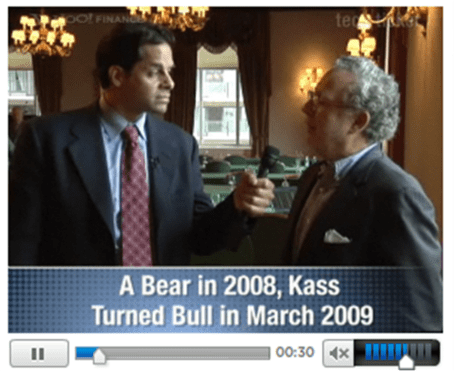 Click Here for Kass’ Yahoo! Video Interview
Like other prognosticators, I feel like Mr. Kass is trying to have a little of his cake and eat it too, since he previously called a run to 1,050 (S&P was at 942 on 6/4/09) and now he has adjusted his posture to a neutral stance. Therefore if prices move upwards, his previous 1,050 call is firmly in place, and on the other hand if we move sideways or downwards, then his neutral prediction is still in play.

The "Triple Lindy" Dive
As one of the American judges, I give Kass a score of 9.0 regardless of whether his squishy call for a potential double-dip (consumer led recession) comes to fruition in late 2009, or early 2010. Congratulations Doug on completion of the first two sequences of the Triple Lindy!
The Dirty Little Secret Shrinking Your Portfolio

There’s a dirty little secret in the investment industry and it’s called “fees”. I constantly interact with investors from all walks of life and inevitably the topic turns to fees. Although they may know the daily price of the Starbucks coffee they buy down to the penny, when I ask them about the hundreds or thousands of dollars they are paying in fees and expenses, I get the proverbial deer in the headlights glare. Who can blame them when they are effectively forced to hire a lawyer to decipher the layers of costs buried in thick legal client documents? These fees and expenses include, but are not limited to, load fees, management fees, 12b-1 fees, trading commissions, soft dollars, surrender charges, administrative charges, bid-ask spread, impact costs along with other kitchen sink charges (enough to make your head spin).
Are the fees worth the price? The short answer is NO. On average 75% of professional managers underperform the benchmarking strategy, which I call the “do-nothing” or passive indexing approach. Standard & Poor’s SPIVA division (S&P Indices Versus Active Funds) discovered the following over the five year market cycle from 2004 to 2008:
- S&P 500 outperformed 71.9% of actively managed large cap funds;
- S&P MidCap 400 outperformed 79.1% of mid cap funds;
- S&P SmallCap 600 outperformed 85.5% of small cap funds.
Most individuals would be better served by purchasing a diversified basket of low-cost, tax efficient index funds or ETFs (Exchange Traded Funds). Unfortunately, the deafening noise and chest thumping from the ever-changing top 25% of investment managers muddies the waters for rational investment decision makers. Proprietary algorithms, can’t-lose strategies (ala Bernie Madoff), pretty pie charts, and a rosy story explaining a path of future outperformance are typically used as smoke and mirrors to confuse unsuspecting investors into unwanted decisions. For the day-trading addicts, financial intermediaries peddle their unique software in commercials with flashing light and hip music, touting the newest bells and whistles that will catapult the masses into riches.
What’s the solution? Well, if you have the time, discipline, and emotional make-up then you should call the manufacturers of low-cost index funds and ETFs (Exchange Traded Funds) like Vanguard Group, PowerShares or iShares and construct a diversified equity and fixed income portfolio. I recommend rebalancing client portfolios periodically subject to your objectives, constraints, risk tolerance and changing circumstances.
If you don’t have the time, discipline, or emotional make-up necessary to manage your investments, then interview a group of “fee-only” advisors who have no conflicts of interest and subscribe to a diversified, low-cost, tax efficient strategy (for disclosure purposes, Sidoxia Capital Management is a fee-only advisor).
Regardless of portfolio management choices, do yourself a favor and ask your broker/advisor or investment company what you are paying in fees/expenses. It’s your money and you deserve answers, despite the dirty little secret that pervades the industry.
GM Fatigue Setting In

Yaaaawn. Sorry to be cold-hearted and insensitive, but I have to admit all this bankruptcy car talk is making me tired and fatigued. According to the Associated Press, General Motors is cutting 21,000 jobs in North America, about 34% of the total workforce – these cuts include pending dealership, plant, and warehouse closings. Twenty-one thousand certainly is not a minor number, but how do you think the other 6,000,000 Americans feel who have lost their jobs in this economic recession since the beginning of 2008?
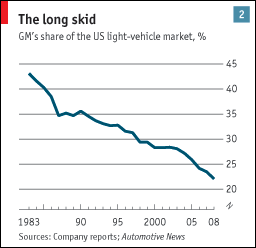
Chart Source: The Economist
Don’t get me wrong, I like every other American do not want to see our historic industry vanish into thin air, but as the chart above shows, we have been witnessing this slow motion train wreck developing for decades. Detroit’s combined market share in 1980 was around 75%, and today that share amounts to less than 50%…ouch. Our auto industry needs to become more competitive, and to do so will require tough decisions like the ones being made today.
Does $65 billion in government bailout feel right? Definitely not, especially vis-a-vis the industry track record of government bailouts (i.e., 1980 Chrysler lifeline). History and current industry trends tell us that the odds of taxpayers earning any reasonable return off our bailout contributions will be extremely challenging to salvage.
Politics and votes always play a role when large numbers of jobs are impacted by government decisions, and this case has proved no different. On the flip side, nobody can say the automakers are not suffering tremendously from this bankruptcy solution. I truly believe the surviving entities will be much leaner and meaner to compete in this dog-eat-dog global economy. Sacrifices have been immense, but we’ll never know the true net economic effect had the administration not bestowed the billions and billions upon this selective slice of industries.
Money goes where it is treated best, and I would have preferred seeing the capital naturally migrating to its most productive use. Perhaps the $65 billion could have provided 65,000 different companies access to $1,000,000 each in financing for creative, and innovative job creating purposes? Only time will tell if our billions in taxes were properly used, but in the mean time I’m going to turn off the CNBC car debate and take a nap. Zzzzzz….
Rogers Sees an Explosion in Stock Prices…Or Complete Collapse
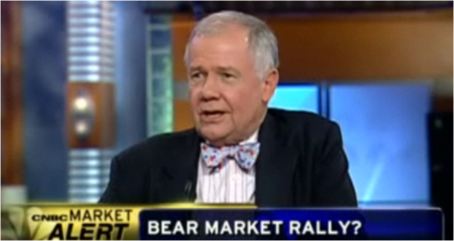
CNBC Interview with Jimmy Rogers
I love it! Jimmy Rogers, chairman of Rogers Holdings is really going out on limb this time. Well, not really. It’s more like he is on a fence, and ready to fall over to whichever side the wind blows. Let me explain this claim in more detail. With the Dow Jones Industrials Average currently trading at about 8,800, Rogers sees the market climbing higher by +240% to 30,000 or perhaps collapsing another -43% (after the worse bear market in decades) to 5,000.
“I’m afraid they’re printing so much money that stocks could go to 20,000 or 30,000,” Rogers said. “Of course it would be in worthless money, but it could happen and you could lose a lot of money being short,” he adds.
Why stop there – why not a more outrageous range of guesses between 100,000 and 1,000? If inflation is his worry, then maybe Mr. Rogers should be concerned about declining PE (Price/Earnings) multiples, which reached single digits in the late-1970s and early-1980s when we were experiencing double-digit inflation.
Thanks Jimmy, those meticulously defined predictions will make many fellow astrologists proud. These prophetic claims remind me of my prescient call this year that I would either gain 100 pounds or lose 100 pounds. So far my forecast has turned out to be spot on, however I won’t confess which direction my weight has swung.
Although Jimmy’s tone is notably pessimistic, he reminds us that this is the last time he has had NO short positions since after the “Crash of 1987.” If lightning strikes twice, maybe his actions demonstrate that now is not such a bad time to buy.
However, be wary because Rogers is not only frightened by inflation. He goes onto say that some country is going to suffer a currency crisis, but he does not know which one yet. “I expect there to be a currency crisis later this year or maybe next year,” he states. Let us hope that “Zimbabwean-esque” inflation does not take hold, otherwise we will be in line with Rogers at the grocery store buying millions of dollars in the vegetable aisle.
Jimmy Rogers is obviously a bright investor (not to mention the Wall Street bow-tie king) who has achieved great success over his career. Nonetheless, I believe he could go into a little more detail in explaining his outrageous, sensationalized claims. For some reason I don’t think this trend will change, but at a minimum, he will continue to provide food for thought and fantastic entertainment.
Chasing Profits – Can Fund Managers Beat the Game?

Achieving Long-Term Excess Returns is a Tough Race
How someone invests their money should fundamentally be based on their view of what’s the best way of playing the investment game. Before playing, the investor should answer the following key question: “Is the market efficient?” Efficient market followers believe active managers – professionals that periodically buy and sell with a profit motive – CANNOT consistently earn excess returns over longer periods of time, in part because market prices reflect all available information. If you fall into the efficiency camp, then you should dial 1-800-VANGUARD to simply buy some index funds. However, if you believe the market is inefficient, then invest in an exploitable strategy or hire an active investment manager you believe can outperform the market after fees and taxes.
For me personally, I fall somewhere in between both camps. I opportunistically invest my hedge fund in areas where I see superior return potential. However, in other areas of my investment practice (outside my main circle of expertise), I choose to side with the overwhelming body of evidence from academics that show passive/indexing slaughters about 75% of professionals.
Richard Roll, renowned economist and thought leader on the efficient market hypothesis, said this:
“I have personally tried to invest money, my client’s and my own, in every single anomaly and predictive result that academics have dreamed up. And I have yet to make a nickel on any of these supposed market inefficiencies. An inefficiency ought to be an exploitable opportunity. If there’s nothing investors can exploit in a systematic way, time in and time out, then it’s very hard to say that information is not being properly incorporated into stock prices. Real money investment strategies don’t produce the results that academic papers say they should.”
—(Wall Street Journal, 12/28/00)
The market gurus du jour blanket the media airwaves, but don’t hurt your back by hastily bowing. Having worked in the investment industry for a long time, you learn very quickly that many of the celebrated talking-heads on the TV today rotate quickly from the penthouse to the outhouse. Certainly, there are the well regarded professional money managers that survive the walk across the burning-coals and have performed great feats with their clients’ money over long periods of time. But even the legendary ones take their lumps and suffer droughts when their style or strategy falls out of favor.
The professional investing dynamics are no different than professional baseball. There are a relatively few hitters in the Major Leagues who can consistently achieve above a .300 batting average. In 2007, AssociatedContent.com did a study that showed there were only 12 active career .300 hitters in Major League Baseball. The same principle applies to investing – there is a narrow slice of managers that can consistently beat the market over longer periods of time.

There Are Only So Many .300 Hitters
Some statisticians point to the “law of large numbers” when describing long term investor success (a.k.a. “luck”) or ascribe the anomaly to statistical noise. Peter Lynch might have something to say about that. Peter Lynch managed the Fidelity Magellan Fund from 1977 – 1990, while he visited 200 companies per year and read about 700 company reports annually. Over that period Lynch averaged a 29% annual return for his investors vs. a 15% return for the S&P 500 index. Luck? How about Bill Miller from Legg Mason who outperformed the major industry benchmark for 15 consecutive years (1991-2005). Perhaps that too was good fortune? Or how about investor extraordinaire Warren Buffet who saw his stock price go from $33 per share in 1967 to $14,972 in 2007 – maybe that was just an accident too? An average schmuck off the street achieving Warren’s Buffett performance over a multi-decade period is equivalent to me batting .357 against Nolan Ryan and Randy Johnson…pure fantasy.
Academics also have difficulty with their efficiency arguments when it comes to explaining events like the “1987 Crash,” the technology bubble bursting in 2000, or the recent subprime derivative security meltdown. If all available information was already reflected in the market prices, then it would be unlikely the markets would experience such rapid and dramatic collapses.
What these bubbles show me is no matter how much academic research is conducted, the behavioral aspects of greed and fear will always create periods of inefficiency in the marketplace. These periods of inefficiency generate windows of profit opportunity that can be exploited by a subset of skillful managers. In the short-run, luck plays a great role; in the long-run sklill level determines ultimate performance. Benjamin Graham, summed it up best when he said, “In the short-term, the stock market is a voting machine; in the long-term a weighing machine.”
Wade W. Slome, CFA, CFP®
Plan. Invest. Prosper.
DISCLOSURE: Sidoxia Capital Management and client accounts do not have direct positions in LM or BRKA/B at the time the article was published.No information accessed through the Investing Caffeine (IC) website constitutes investment, financial, legal, tax or other advice nor is to be relied on in making an investment or other decision. Please read disclosure language on IC “Contact” page.
Building Your Financial Future – Mistakes Made in Investment Planning

Building Your Dream Future Requires a Plan
Building your retirement and financial future can be likened with the challenge of designing and building your dream home. The tools and strategies selected will determine the ultimate cost and outcome of the project.
I constantly get asked by investors, “Wade, is this the bottom – is now the right time to get in the markets?” First of all, if I precisely knew the answer, I would buy my own island and drink coconut-umbrella drinks all day. And secondarily, despite the desire for a simple, get-rich quick answer, the true solution often is more complex (surprise!). If building your financial future is like designing your dream home, then serious questions need to be explored before your wealth building journey begins:
1) Do I have enough money, and if not, how much money do I need to develop my financial future?
2) Can I build it myself, or do I need the help of professionals?
3) Do I have contingency plans in place, should my circumstances change?
4) What tools and supplies do I need to effectively bring my plans to life?
Most investors I run into have no investment plan in place, do not know the costs (fees) of the tools and strategies they are using, and if they are using an advisor (broker) they typically are in the dark with respect to the strategy implemented.
For the “Do-It-Yourselfers”, the largest problem I am witnessing right now is excessive conservatism. Certainly, for those who have already built their financial future, it does not make sense to take on unnecessary risk. However, for most, this is a losing strategy in a world laden with inflation and ever-growing entitlements like Medicare and Social Security. There’s clearly a difference between stuffing money under the mattress (short-term Treasuries, CDs, Money Market, etc.) and prudent conservatism. This is a credo I preach to my clients.
In many cases this conservative stance merely compounds a previous misstep. Many investors undertook excessive risk prior to the current financial crisis – for example piling 100% of investment portfolios into five emerging market commodity stocks.
What these examples prove is that the average investor is too emotional (buys too much near peaks, and capitulates near bottoms), while paying too much in fees. If you don’t believe me, then my conclusions are perfectly encapsulated in John Bogle’s (Vanguard) 1984-2002 study. The analysis shows the average investor dramatically underperforming both the professionally managed mutual fund (approximately by 7% annually) and the passive (“Do Nothing”) strategy by a whopping 10% per year.
Building your financial future, like building your dream home, requires objective and intensive planning. With the proper tools, strategies and advice, you can succeed in building your dream future, which may even include a coconut-umbrella drink.