Posts filed under ‘Stocks’
From Pond Scum to the Pump

The “Green” movement got a shot in the arm recently when a $600 million joint venture between Craig Venter, the critical man behind mapping the human genome, and ExxonMobil the oil company (XOM) was formed to engineer oil from green algae. More than half of the money will be directed to Dr. Venter’s La Jolla, California-based biotech firm Synthetic Genomics.
On the surface the announcement is very appealing because it marries the biggest brains in genetic engineering (Venter) with the biggest brains in energy/oil (ExxonMobil). Add hundreds of millions of dollars to this powerhouse dream team and perhaps something miraculous can be commercialized in the next 5 – 10 years. Environmentalists appear to be on board too, if the hype turns to reality, because not only will cleaner fuels be created but the algae production will reduce harmful CO2 (carbon dioxide) emissions from the air. ExxonMobil’s grand scheme is to build algae farms near power plants and other major CO2 emitters –the farms will feed the algae and by doing so will help curb long-term fuel costs for the businesses.
ExxonMobil and Craig Venter are not the only game in town. A scientific article written by Molika Ashford claims there are more than 50 companies trying to affordably squeeze oil from slime, including a creative way of squeezing oil from algae-eating fish.
Although the “Greenies” seem to buy into the algae-oil process, the environmentalists are not the only constituency the genetic engineers must appease. The ethical debate over manipulating life forms is already percolating – just think, Frankenstein meets algae. In a newer Bloomberg article, Alison Smith, a professor of plant sciences at the University of Cambridge in England commented on the state-of-the-art research: “It is an untested technology, and there needs to be extensive debate about the ethics and environmental consequences of generating these new organisms.”
More recently, Dr. Venter performed a pioneering ‘gene swap’ on a simple species of bacteria called Mycoplasma mycoides, which raised optimism levels even higher that a green, bio-engineered fuel solution is indeed possible. Dr. Venter effectively created a new form of bacteria by swapping DNA from one form of bacteria into another. Researchers and scientists around the globe are searching for solutions to our worsening global energy problems, however time is required. I will anxiously watch from the sidelines to see if big brains and big oil can come together to make “green gold.”
Wade W. Slome, CFA, CFP®
Plan. Invest. Prosper.
Sidoxia Capital Management and its clients did not have any direct position in XOM at the time the article was published. No information accessed through the Investing Caffeine (IC) website constitutes investment, financial, legal, tax or other advice nor is to be relied on in making an investment or other decision. Please read disclosure language on IC “Contact” page.
The Yuppie Bounce & the Lemming Leap

Source: Gary Larson – Where’s Your Preserver?
Making money in the stock market is a tough game, and most people don’t beat the market because like lemmings the average investor follows the herd mentality to underperformance. So, should Wall Street analysts and the media be crucified for their analysis? The short answer is yes. Certainly there are some exceptional analysts and journalists, however most of them merely report what is happening or are looking in the rear-view mirror. Beyond that, the vast majority of commentators prey on emotions of the public and masses by pushing them into knee-jerk selling panics at the bottom and also getting them frothing at the mouth to buy at market peaks. Can I understand why they offer such bad advice? Yes. Quite simply, the incentive structures are wrong.
If you are an analyst or journalist, the number one priority (incentive) is not to be wrong, because if they are mistaken, then job loss becomes a bona fide risk. However, if they throw in some fancy language and mix it in with a lot of caveats, there virtually is no risk of being wrong. If factors happen to change, no worries, their opinions can change too. Therefore, most analysts huddle together in tight packs reporting the same news du jour as everyone else, while mixing in a fair dosage of fear and greed to drum up more interest. These incentives align well for the journalists/analysts but unfortunately not for the average investor.
Joshua Brown over at the Reformed Broker recently wrote an excellent piece highlighting his so-called “Yuppie Bounce” example. Last winter, as all the discretionary consumer stocks (Joshua Brown calls them “waster stocks”) were getting pasted, the pundits were advising investors to pile into defensive stocks. Lo and behold, this was the absolute worst time to follow that advice. Mr. Brown gives a superb Starbucks (SBUX) versus Wal-Mart (WMT) example showing how SBUX has effectively doubled over the last nine months just as WMT flat-lined.

Source: The Reformed Broker (Joshua M. Brown)
Investing is like a game of chess, so although a current move may sound logical, it’s more important to think about decisions multiple steps into the future. Most successful long-term investors don’t follow the conventional lines of thinking, and they are generally swimming against the tide. Therefore, if you are going to jump in with the other lemmings, make sure you have your life preserver with you.
DISCLOSURE: Some Sidoxia Capital Management and client accounts HAVE direct positions in WMT at the time the article was published. No information accessed through the Investing Caffeine (IC) website constitutes investment, financial, legal, tax or other advice nor is to be relied on in making an investment or other decision. Please read disclosure language on IC “Contact” page.
Coke Targets Cows

Coca-Cola (KO) has come up with a new product idea: fizzy milk. Sound strange? From my perspective, I prefer my milk with cereal and chocolate chip cookies. I never received a marketing degree, so somebody please explain to me what the heck Coke is thinking?
What’s next? Coca-Cola anchovy and liver protein shakes. Or perhaps fizzy gravy? What better than a little carbonation to liven up your mash potatoes on Thanksgiving?!
The name of Coke’s new carbonated milk product is Vio, and the creation is being test-marketed throughout New York (primarily in delis and health food stores) to gauge acceptance. The fizzy milk product comes in various fruit flavors, including Tropical Colada, Very Berry, Citrus Burst, and Peach Mango. Peculiarly, the product is stocked on shelves at room temperature. Mmm, nothing like lukewarm milk, it just sounds so delightful (I don’t think so).

Coke also has grander ambitions of rolling Vio out globally, if the U.S. launch proves successful. According to the TimesOnline article, perhaps natural food stores should not be targeted since Vio contains similar levels of sugar as Coca-Cola’s main non-diet drinks. Some believe Coke’s introduction of Vio is merely a crafty exploitation of a technicality in school beverage rules. A recent article written on creativematch states, “The American Beverage Association’s School Beverage Guidelines prohibits sugar-sweetened carbonated soft drinks from being sold in elementary, middle, and high schools. However, the guidelines still allow some milk-based products to be sold.” Perhaps Vio is Coke’s Trojan Cow for getting new drinks onto schools’ menus.
Time will tell whether Coke is successful in this beverage niche, but I will not hold my breath for its triumph. No matter the level of Vio achievement, at a minimum, dairy cows have found a new revenue stream to keep them employed in a tough economic environment.
Wade W. Slome, CFA, CFP®
Plan. Invest. Prosper.
DISCLOSURE: Sidoxia Capital Management and its clients do not have direct investment exposure in Coca Cola Co. (KO) at the time the article was published. No information accessed through the Investing Caffeine (IC) website constitutes investment, financial, legal, tax or other advice nor is to be relied on in making an investment or other decision. Please read disclosure language on IC “Contact” page.
Technology Does Not Sleep in a Recession

Our economy may be coming out of a long economic hibernation; however technology does not sleep through a recession. Gordon Moore, co-founder of Intel Corporation, has proven this trend true through his groundbreaking piece written in the April 1965 issue of Electronics Magazine. In the article Mr. Moore predicted transistor densities would double about every two years (“Moore’s Law”). Transistors can be thought of as the brains of electronics devices, and the industry (Intel and other semiconductor manufacturers) has been boosting the brain power of electronics for decades. How far has the industry come? The number of transistors contained on a chip has gone from 16 in 1960s to over 600 million today – now that’s what I call progress!
These achievements have been nothing short of revolutionary, and many people consider the introduction of the transistor as the greatest invention of the 20th century. According to many industry experts, Mr. Moore’s forecasts have been shockingly accurate and many believe “Moore’s Law” will hold true for years to come – despite challenging technological limitations.

Source: The Financial Times
We may curse at our computers (I absolutely despise Vista), but there is no arguing with the huge productivity and standard of living improvements we have experienced over the last forty years – since the introduction of the transistor. Many take their GPS, Tivo, WiFi laptop, iPhone, and HiDef TVs for granted, however I for one thank Gordon Moore and those diligent engineers for making my geeky tech dreams come true.
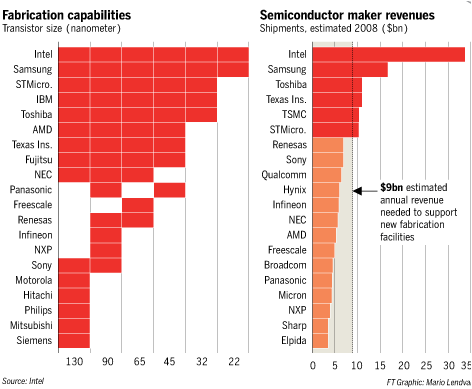
However the cost of further advancements is becoming pricier. As line widths (the ability to add more transistors) narrow, the costs of building fabrication plants (“fabs”) with the necessary equipment are running in the multi-billion range. The Financial Times (FT) article talking about semiconductor trends mentions a $4.2 billion state-of-the-art factory in upstate New York that is just beginning construction. The FT notes that only two players (Intel and Samsung) have firm plans to build 20 nanometer fabs. For comparison purposes, one nanometer is equal to one-billionth of a meter and a human hair is 100,000 nanometers wide. In other words, a nanometer is pretty darn tiny. To further illustrate the point, Intel has managed to fit up to 11 Intel Atom processors – each packed with 47 million transistors – on the face of an American penny.
Source: The Financial Times
As the chip making industry become more costly, fewer semiconductor manufacturers will be playing in the sandbox:
“Intel argues that only companies with about $9bn in annual revenues can afford to be in the business of building new fabs, given the costs of building and operating the factories and earning a decent 50 per cent margin. That leaves just Intel, Samsung, Toshiba, Texas Instruments and STMicroelectronics.”
The economy may still be in the doldrums, but the $60 trillion global economy (as measured by Gross Domestic Product) never sleeps – technologies created by Gordon Moore and others continue to propel amazing advancements.
Wade W. Slome, CFA, CFP®
Plan. Invest. Prosper.
Buffett Sells Insurance: Weapons of ANTI-Destruction

Writing Options is the Opposite of Mass Destruction
Those same “Weapons of Mass Destruction” that Warren Buffett so ardently warned investors against are the same derivatives that catapulted Berkshire Hathaways (BRKA) Q2 earnings performance. Chris McKhann at OptionMonster summarized Buffet’s moves:
Buffett has sold a large number of puts on four major indexes starting in 2007: the S&P 500, the FTSE 100, the Euro Stoxx 50, and the Nikkei 225. He took in $4.9 billion, with a potential loss of more than $35 billion–but only if all four indexes were at zero come the expiration date (at which point we would be worrying about other things).
Derivatives are like a gun, if used responsibly for gaming or for self-defense, then they can be a useful tool. Unfortunately, like guns, these derivatives are used irresponsibly in many instances. This point is especially true in areas like Credit Default Swaps where there were inadequate regulations and capital requirements to prevent disastrous outcomes (e.g., AIG’s collapse). With proper transparency, capital requirements, and proper regulation, derivatives can be used to manage risk rather than create additional risk.
Although I wouldn’t categorize myself as a value investor like Warren, I would prefer to call myself a growth investor with a value conscience. With that said, if you incorporate valuation within your investment discipline, I believe writing (selling) options is a brilliant idea. I can make this assertion because I’ve used this strategy for myself and my hedge fund. Volatility has a direct impact on the amount of premiums collected; therefore the trading levels of the CBOE Volatility Index (VIX) will have a directly correlated impact on option writing profitability. For example, if I’m selling flood insurance, I’m going to collect much higher rates in the period right after Katrina occurred.
If you are willing to accept free money from speculators betting on short-term swings in prices (Warren sold long-term, multi-year options), while being forced to sell/buy stock at price levels you like, then why not?! However, buying and selling puts and calls is a different game in my book, and one I personally do NOT excel at. I’ll keep to utilizing “Weapons of Anti-Destruction” and collect premiums up-front, like Warren, from speculators and leave the rest of the options strategies to others.
Wade W. Slome, CFA, CFP®
Plan. Invest. Prosper.
DISCLOSURE: Sidoxia Capital Management and client accounts do not have direct positions in AIG or BRKA/B at the time the article was published. Sidoxia Capital Management and its clients do have long exposure to TIP shares. No information accessed through the Investing Caffeine (IC) website constitutes investment, financial, legal, tax or other advice nor is to be relied on in making an investment or other decision. Please read disclosure language on IC “Contact” page.
“Bye Bye Roubini, Hello Abby”

Perma-Bull with Perma-Grin
Bye-bye” Dr. Doom” and hello “Happy Abby.” Abby Joseph Cohen is back in the spotlight with the recent market resurgence and is calling for a sustained bull market rally. The death-like sentiment spread by NYU professor Nouriel Roubini has now swung – it’s time for CNBC to call in the bulls, much like a baseball coach calls in a fresh reliever after a starter has exhausted his strength.
Over the last year, we’ve gone from full-fledged panic, into a healthy level of fear – the decline in the CBOE Volatility Index (VIX) supports this claim. But with cash still piled to the ceiling and broad indices still are about -35% below 2007 peaks, I wouldn’t say sentiment is wildly ebullient quite yet. The low-hanging fruit has been picked and now we need to tread lightly and delay the victory lap for a little longer. Market timing has never been my gig, so gag me any time I attempt a market prediction. Having said that, sentiment comprises the softer art aspects of investing, and therefore it can swing the markets wildly in the short-run. Ultimately in the long-run, profits and cash flows are what drive stock prices higher, and that’s what I pay attention to. Profits and cash flows are currently depressed and unemployment remains high by historical standards, but there are signs of recovery. Cohen highlights easy profit comparisons in the second half of 2009 (versus 2008), coupled with inventory replenishment, as significant factors that can lead to larger than anticipated surges in early economic cycle recoveries. Whether the pending economic advance is sustainable is a question that Cohen would not address.
Investors are emotional creatures, and CNBC realizes this fact. Before investing in that 30-1 leveraged, long-only hedge fund, prudence should reign supreme as we start to see some of the previously bullish strategists begin crawling out of their caves – including perma-bull Abby Joseph Cohen.
Wade W. Slome, CFA, CFP®
Plan. Invest. Prosper.
Ackman Builds Fortune Through Optimism and Confidence

Source: Portfolio.com
Bill Ackman, 43 year old famed hedge fund manager and activist, was profiled by Jesse Eisenger in a May 2009 Portfolio.com piece with a title that has special meaning to me…The Optimist. I would never be presumptuous enough to compare myself to Mr. Ackman, but my firm, Sidoxia Capital Management, shares something in common with him – the name of my firm is actually derived from the Greek word for optimism (aisiodoxia).
Some confuse his confidence with arrogance, but regardless of your opinion, he has a track record to back up his bold assertions. For example, his six year investment in MBIA Inc. (MBI) netted Ackman about $1.1 billion in profits. At the end of 2008, his firm (Pershing Square Capital Management) managed $4.4 billion. His brainpower has been sought after by the upper echelon of Washington finance – Ackman has rubbed elbows and provided his views to the likes of Lawrence Summers (director of President Barack Obama’s National Economic Council) and Timothy Geithner (Treasury Secretary). Those who have invested for long periods know there is a fine balance between confidence and hubris as Ackman recognizes:
“The investment business is about being confident enough to know that you’re right and everyone else is wrong. Yet you have to be humble enough that you recognize when you’ve made a mistake.”
Another common trait with all good investors is the ability and willingness to put yourself out on a limb. As legendary investor Benjamin Graham states, “You’re neither right nor wrong because others agree with you. You’re right because your facts and reasoning are right.” This is exactly the approach Ackman took when he researched MBIA. While the rest of the world was following the real estate herd as they were about to fall off a cliff, Ackman realized the calamitous situation brewing and warned others of the pending disaster. Being a contrarian is hard-work, and requires detailed analysis for the necessary conviction, a key ingredient for successful investments. Lots of blood, sweat, and tears were certainly used in Ackman’s long-lasting review and attack on MBIA Inc. that began in 2002, punctuated with a 66 page report entitled “Is MBIA Triple A?”

Click Here to Watch November 2008 Interview With Charlie Rose
There is another universal bond between all great investors – failure. Ackman is no exception and suffered his fair share of bumps along the road. Most notably, the forced closure of his hedge fund and investment firm Gotham Partners in 2003 was an unpleasant experience. His concentrated fund that held Target (TGT) investments was down -93% in early March 2009, according to Portfolio.com. Throughout all the trials and tribulations, Ackman remains as he likes to call it, “resilient.”
Life is never easy for the great investors, or as Don Hays says, “You are only right on your stock purchases (and sales) when you are sweating.” Ackman has had to sweat out a volatile ride ever since he first dove in to purchase Target Corp. shares. As the article in Portfolio.com points out, at one point Ackman had nearly lost $2 billion with his bet on Target and suffered a hard fought loss in a proxy battle with the Target board.
Investing bystanders should do themselves a favor and carefully track Ackman’s moves. The outcome of his Target investment is unknown; however I’m confident and optimistic that Bill Ackman will ultimately build on his long-term track record of success.
Wade W. Slome, CFA, CFP®
Plan. Invest. Prosper.
Wade W. Slome, CFA, CFP®
Plan. Invest. Prosper.
DISCLOSURE: Sidoxia Capital Management (SCM) and some of its clients own certain exchange traded funds and AAPL, but at the time of publishing SCM had no direct position in MBI, TGT, or any other security referenced in this article. No information accessed through the Investing Caffeine (IC) website constitutes investment, financial, legal, tax or other advice nor is to be relied on in making an investment or other decision. Please read disclosure language on IC “Contact” page.
Momentum Investing: Riding the Wave

Riding the Momentum Wave Can Be Dangerous
As famed trader Jesse Livermore (July 26, 1877 — November 28, 1940) stated, “Prices are never too high to begin buying or too low to begin selling.”
For the most part, the momentum trading philosophy dovetails with Livermore’s mantra. The basic premise of momentum investing is to simply buy the outperforming stocks and sell (or short) the underperforming stocks. By following this rudimentary formula, investors can generate outsized returns. AQR Capital Management and Tobias Moskowitz (consultant), professor at Chicago Booth School of Management, ascribe to this belief too. AQR just recently launched the AQR Momentum Funds:
- AQR Momentum Fund (AMOMX – Domestic Large & Mid Cap)
- AQR Small Cap Momentum Fund (ASMOX – Domestic Small Cap)
- AQR International Momentum Fund (AIMOX – International Large & Mid Cap)
Professor Moskowitz Speaks on Bloomberg (Thought I looked young?!)
As I write in my book, How I Managed $20,000,000,000.00 by Age 32, I’m a big believer that successful investing requires a healthy mixture of both art and science. Too much of either will create negative outcomes. Modern finance teaches us that any profitable strategy will eventually be arbitraged away, such that any one profitable strategy will eventually stop producing profits.
A perfect example of a good strategy, gone bad is Long Term Capital Management. Robert Merton and Myron Scholes were world renowned Nobel Prize winners who single handedly brought the global financial markets to its knees in 1998 when it lost $500 million in one day and required a $3.6 billion bailout from a consortium of banks. Their mathematical models weren’t necessarily implementing momentum strategies, however this case is a good lesson in showing that even when smart people implement strategies that work for long periods of time, various factors can reverse the trend.
I wish AQR good luck with their quantitative momentum funds, but I hope they have a happier ending than Jesse Livermore. After making multiple fortunes and surviving multiple personal bankruptcies, Mr. Livermore committed suicide in 1940. In the mean time, surf’s up and the popularity of quantitative momentum funds remains alive and well.
Wade W. Slome, CFA, CFP®
Plan. Invest. Prosper.
Howard Right on the Mark(s)
Legendary investor Howard Marks opines on the financial markets in his recently quarterly client memo. One should pay attention to these battle-tested veterans with scars to prove their survival skills. Rather than neatly package a common theme from the long document I will highlight a few areas.

Marks is cautious but sees better buying opportunities ahead.
Recent Past vs. Long Past: For most of the 16 page memo Howard Marks reminisces on his 40+ years in the investment industry and contrasts the 2003-2007 period with the majority of his years. He states in the old days, “There were no swaps, index futures or listed options. Leverage wasn’t part of most institutional investors’ arsenal…or vocabulary. Private equity was unknown, and hedge funds were too few and outré to matter. Innovations like quantitative investing and structured products had yet to arrive, and few people had ever heard of ‘alpha.'”
Marks on Siegel: Marks targets Wharton Professor Jeremy Siegel as a contributor to the overly bullish mentality of 2003-2007, “Siegel’s research was encyclopedic and supported some dramatic conclusions, perhaps foremost among them his showing that there’s never been a 30-year period in which stocks didn’t outperform cash, bonds and inflation…but…30 years can be a long time to wait.”
Marks on Risk: “So yes, it’s true that investor’s can’t expect to make much money without taking risk. But that’s not the same as saying risk taking is sure to make you money…If risky investments always produced high returns, they wouldn’t be risky.” On the psychological impacts of risk, Marks goes on to say, “When investors are unworried and risk-tolerant, they buy stocks at high p/e ratios and private companies at high EBITDA multiples, and they pile into bonds despite narrow yield spreads and into real estate at minimal “cap rates.'”
On Quant Models and Business Schools: Marks quotes Warren Buffet regarding the complexity of quantitative models, “If you need a computer or a calculator to make a calculation, you shouldn’t buy it.” Charlie Munger adds his two cents on why quantitative models exist: “They teach that in business schools because, well, they’ve got to do something.”
Investing as a Mixture of Art & Science: In my book I describe investing as a combination of “Art” and “Science.” Marks addresses a s similar insight through an Albert Einstein quote:
“Not everything that can be counted counts, and not everything that counts can be counted.”
Views on the Credit Rating Agencies: To highlight the absurdity of the mortgage credit rating system, Marks compares the agencies’ ratings to hamburger: “If it’s possible to start with 100 pounds of hamburger and end up selling ten pounds of dog food, 40 pounds of sirloin and 50 pounds of filet mignon, the truth-in-labeling rules can’t be working.”
If you would like to access the remainder of memo, click here to read the rest. Overall, Mr. Marks gives a balanced view of the markets and economy, but feels “better buying opportunities lie ahead.” Thankfully, I’m finding some myself.
Wade W. Slome, CFA, CFP®
Plan. Invest. Prosper.
Calamos Still “Growing” Strong

Calamos Investments recently came out with their quarterly Market Review and Outlook. John P. Calamos, Sr., the Company founder, began investing his family’s money over 50 years ago and is well known for their successful “growth” style of investing. Calamos founded Calamos Asset Management in 1977, and won BusinessWeek’s best manager for 2003 and 2004. Over the years, the company diversified from its bread and butter convertibles into equity, enhanced fixed-income, global and international, core bond, cash management and alternative strategies. Overall, the newsletter offers a fairly sobering outlook (“Longterm Scared”); however there are some excellent investing nuggets, especially when it comes to the firm’s current positioning:
“Because we are not in a secular bull market, investing discipline is even more important. We believe these are the rules for today’s environment”:
1. Washington D.C. is the new growth city
2. Valuations will not get as stretched in the equity markets and growth expectations will be revised down considerably
3. Old-fashioned dividends mean something
4. G7 competitive devaluations and protectionist legislation will become the norm
5. To grow, emerging nations must become consumption driven and attempt to become independent of the developed nations
6. Knowledge is free, but capital may be much harder to get
7. Real returns after tax will take on new meaning
8. Baby boomers will reprioritize spending
9. The rules will change often!
Technology Exposure: For those that have followed my writings in the past, you are familiar with my positive bias towards technology. The technology sector is littered with land mines and risks. Nonetheless, through technology, our country has and will continue to innovate new products and services that will improve our standard of living. The “Technology Revolution” is not only benefiting our society, we are exporting the fruits of our discoveries to developing countries across the world. Take Intel Corporation (INTC) for example – it garnered about 85% of its revenues in 2008 from international markets.
Here is what Calamos has to say about their “Significant Overweight” exposure to the Technology sector:
“Productivity enhancement and cost controls should help technology spending.”
- We see consumers remaining willing to purchase certain “special” products such as iPhones, laptops and flat-screens.
- We have found software companies offering stable revenue streams, strong balance sheets with lots of cash, and products that offer solutions for cost reduction and productivity.
- The sector will also benefit from global infrastructure stimulus spending.
- Stock valuations are attractive and the risk/reward is compelling.
- The sector may be re-establishing its leadership position in the equity market for the first time since last decade’s collapse.”
Materials and Energy Exposure: Developing countries are joining the party too, albeit later than the rest of the partygoers. The price of admission to the party is access to valuable commodities. Calamos has other reasons to be overweight the Materials and Energy sectors:
- Muted recovery implied in stock valuations.
- Further U.S. dollar devaluation and global stimulus spending should help boost commodity prices.
- The small capitalization of this sector and volatility of commodity prices will again make it prone to large price swings.
- U.S. dollar devaluation should help support energy prices.
- Mid-East turmoil adds to the attractiveness of this sector as it can hedge unforeseen energy price spikes.
- Stock valuations appear reasonable but government intervention will make this a difficult sector to value.
Like all great managers, Calamos has taken his lumps, but through it all his firm is still “growing” strong.
Wade W. Slome, CFA, CFP®
Plan. Invest. Prosper.




 Investing Caffeine
