Posts filed under ‘International’
Timothy Geithner, the Eddie Haskell Dollar Czar

Treasury Secretary Timothy Geithner recently stated after a meeting of G-7 financial officials that “it is very important to the United States that we continue to have a strong dollar.”
With comments like this, why does Timothy Geithner remind me so much of Eddie Haskell (played by Ken Osmond) from the 1950s suburban sitcom Leave It to Beaver? Eddie Haskell plays the scheming trouble maker who is extremely polite on the exterior around adults, but reverts to a crafty conniver once the grown-ups leave the room.
I can just picture the conversations between Treasury Secretary Geithner and President Obama before a high powered meeting with Chinese administration officials:
Geithner: “Barack, the skyrocketing debt will be no problem, we can we shovel plenty of this paper on these Chinese.”
Barack: “Uh, oh…Hu is here for our meeting.”
Geithner: “Oh hello Mr. President Jintao – what a lovely trade surplus you have. We look forward to keeping a very fiscally responsible agenda here in the United States, so you can keep buying our valuable debt.”
Where did Timothy Haskell get his crafty dollar oration skills?
According to David Malpass, president of the research firm Encima Global and deputy assistant Treasury Secretary, Geithner training came from “using a code phrase, a carryover from the Bush administration. It means that the U.S. approves of a constantly weakening dollar but doesn’t want a disruptive collapse.”
These tactics and rhetoric can only work for so long. Exploding deficits and skyrocketing debt levels will eventually lead to a dumping of our debt, rising interest rates, crowding-out of private investments, and a damaging decline in the dollar. Sure, the weakening dollar helps us in the short-run with exports but eventually major U.S. debtholders will no longer buy our sweet talking.
With all the “U.S. dollar is going to collapse” talk, one would think a shift to an SDR (Special Drawing Rights) global currency structure is an inevitable outcome. Just six months ago the governor of China’s central bank argued the U.S. dollar’s role as the world’s reserve currency should be restructured. The SDR model has already been implemented by the IMF (International Monetary Fund), so if the Chinese wanted to create an SDR proxy, they could easily purchase euros, sterling, and yen in proper proportions. Would the Chinese want to make any sudden changes? Certainly not, because any quick adjustments would destroy the value of the Chinese’s existing dollar denominated portfolio. The logistics surrounding a legitimate SDR program would require the IMF or some other international agency to act as a global central bank, which would not only need to determine the appropriate mix of currencies in the SDR, but also decide future global liquidity actions. In order to legitimately run a new SDR program, countries like China would need to give up sovereignty – not a likely scenario.
Until a new SDR regime is agreed upon, dollar-reliant countries will continue to have barks bigger than their bites and Timothy Geithner Haskell will continue to sweet talk U.S. dollar owners.
Wade W. Slome, CFA, CFP®
Plan. Invest. Prosper.
Hear Eddie (or Treasury Secretary) Speak Here:
How Sweet it Is: Sugar Prices Near 30-Year High

The Cap'n Hangin' with the Crunch Berry Beast
The cost of a sugar coma has gone up, making my Cap’n Crunch with Crunch Berries craving a pricier endeavor. It’s seems like almost yesterday when I was crouched over my sugar cereal on a Saturday morning watching cartoons – hey wait, maybe that was last weekend? Regardless of the timeframe, prices for sugar have not been this high since Coke and Pepsi used sugar, rather than corn syrup, in their 1970s formulations and Cuba was the world’s largest sugar producer.
What’s the reason for the +67% price rise in sugar this year*? There are several reasons:
1) Disappointing Crops: India is the largest consumer of sugar at 23.5 million tons and a very significant producer of the sweetener. Due to deficient rainfall in the northeast and southern regions in India (caused in part by El Niño conditions), the country is estimated to need more than double the imports of the good this year. Disappointing crops in Brazil have also contributed to the tightening global supply. India and Brazil account for about 40% of global sugar supplies.
2) Forward Buying / Hedging: The supply-demand dynamics of the sugar market have caused certain high sugar-consuming countries, like Egypt and Mexico, to buy large stockpiling purchases – further pushing up prices. Beyond consumer and speculators, global food and beverage companies from the likes of Kraft, General Mills and ConAgra Foods have been purchasing futures to hedge the risk of additional price hikes.
3) Oil Increase Buoys Ethanol: Oil’s +59% price increase this year to about $70 per barrel has provided additional price support through increased demand for sugar-based ethanol.
Weather, oil demand, and sentiment may change thereby easing the cost burden of higher priced sugar goods, but irrespective of sugar prices you can rest assured my Cap’n Crunch with Crunch Berries addiction will remain resilient.
*Source: The Financial Times (8-7-09).
Read Financial Times Article on Sugar Here
Wade W. Slome, CFA, CFP®
Plan. Invest. Prosper.
V-Shaped Recovery or Road to Japan Lost Decades?
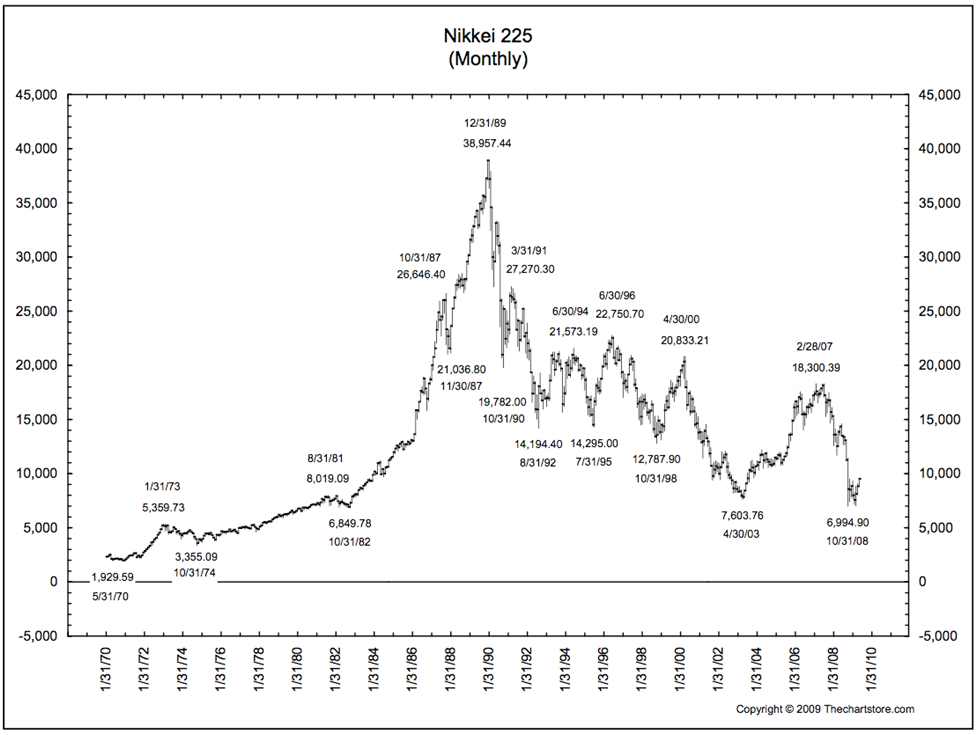
The Lost Decades from the 1989 Peak
On the 6th day of March this year, the S&P 500 reached a devilish low of 666. Now the market has rebounded more than 50% over the last five months. So is this a new bull market throttled into gear, or is it just a dead-cat bounce on route to a lost two decades, like we saw in Japan?
Smart people like Nobel Prize winner and economist Paul Krugman make the argument that like Japan, the bigger risk for the U.S. is deflation (NY Times Op-Ed), not inflation.
Now I’m no Nobel Prize winner, but I will make a bold argument of why Professor Krugman is out to lunch and why we will not go in a Japanese death-like, deflationary spiral.
Let’s review why our situation is dissimilar from our South Pacific friends.
Major Differences:
- Japanese Demographics: The Japanese population keeps getting older (see UN chart), which will continue to pressure GDP growth. According to the National Institute of Population and Social Security Research, by 2055 the Japanese population will fall 30% to 90 million (equivalent to 1955 level). Over the same time frame, the number of elderly under age 65 is expected to halve. To minimize the effects of the contraction of the working population, it will be necessary both to increase labor productivity, loosen immigration laws, and to promote the employment of woman and people over 65. Japan’s population is expected to expected contraction in Japan’s labor force of almost 1% a year in 2009-13.

Source: The Financial Times/UN (Declining Workforce Per 65 Year Old)
- Bank of Japan Was Slow to React: Japan recognized the bubble occurring and as a result hiked its key lending discount rate from 1989 through May 1991. The move had the desired effect by curbing the danger of inflation and ultimately popped the Nikkei-225 bubble. Stock prices soon plummeted by 50% in 1990, and the economy and land prices began to deteriorate a year later. Belatedly, Japan’s central bank began a series of interest rate-cuts, lowering its discount rate by 500-basis points to 1% by 1995. But the Japanese economy never recovered, despite $1-trillion in fiscal stimulus programs.
- The Higher You Fly, the Farther You Fall: The relative size of the Japanese bubble was gargantuan in scale compared to what we experienced here in the United States. The Nikkei 225 Index traded at an eye popping Price-Earnings ratio of about 60x before the collapse. The Nikkei increased over 450% in the eight years leading up to the peak in 1989, from the low of about 6,850 in October 1982 to its peak of 38,957 in December 1989. Compare those extreme bubble-icious numbers with the S&P 500 index, which rose approximately a more meager 20% from the end of 1999 to the end of 2007 (U.S. peak) and was trading at more reasonable 18x’s P-E ratio.
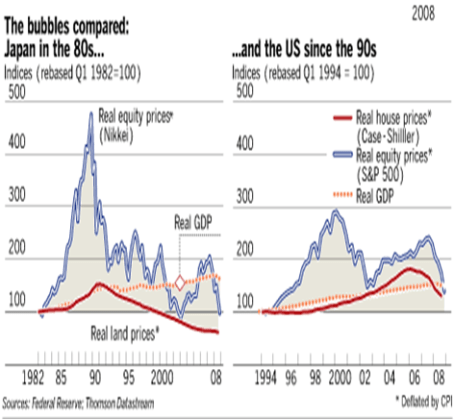
Source: Dow Jones
- Debt Levels not Sustainable: Japan is the most heavily indebted nation in the OECD. Japan is moving towards that 200% Debt/GDP level rapidly and the last time Japanese debt went to 200% of GDP (during WWII), hyper-inflation ensued and forced many fixed income elderly into poverty. Although our debt levels have yet to reach the extremes seen by Japan, we need to recognize the inflationary pressure building. Japan’s debt bubble cannot indefinitely sustain these debt increases, leaving little option but to eventually inflate their way out of the problem.
- Banking System Prolongs Japanese Deflation: Despite the eight different stimulus plans implemented in the 1990s, Japan lacked the fortitude to implement the appropriate corrective measures in their banking system by writing off bad debts. An article from July 2003 Barron’s article put it best:


After the collapse of the property bubble, many families and businesses had debts that far exceeded their devalued assets. When a version of this happened in America in the savings-and-loan crisis, the resulting mess was cleaned up quickly. The government seized assets, sold them off, bankrupted ailing banks and businesses, sent a few crooks to jail and everything started fresh, so that deserving new businesses could get loans. The process is like a tooth extraction — painful but mercifully short. In Japan this process has barely begun. Dynamic new businesses cannot get loans, because banks use available credit to lend to bankrupt businesses, so they can pretend they are paying their debts and avoid the pain of write-offs. This is self-deception. The rotten tooth is still there. And the Japanese people know it.
The Future – Rise of the Rest: Fareed Zakaria, Newsweek editor wrote about the “Rise of the Rest” in an incredible article (See Sidoxia Website) describing the rising tide of globalization that is pulling up the rest of the world. The United States population represents only 5% of the global total, and as the technology revolution raises the standard of living for the other 95%, this trend will only accelerate the demand of scarce resources, which will create a constant inflationary headwind.
For those countries in decline, like Japan, demand destruction raises the risk of deflation, but historically the innovative foundation of capitalism has continually allowed the U.S. to grow its economic pie. Economic legislation by our Congress will help or hinder our efforts in dealing with these inflationary pressures. One way is to incentivize investment in innovation and productive technologies. Another is to expand our targeted immigration policies towards attracting college educated foreigners, thereby relieving aging demographics pressures (as seen in Japan). These are only a few examples, but regardless of political leanings, our country has survived through wars, assassinations, terrorist attacks, banking crises, currency crises, and yes recessions, to only end up in a stronger global position.
This crisis has been extremely painful, but so have the many others we have survived. I believe time will heal the wounds and we will eventually conquer this crisis. I’m confident that historians will look at the coming years in favorable light, not the lost decades of pain as experienced in Japan.
Wade W. Slome, CFA, CFP®
Plan. Invest. Prosper.
The China Vacuum, Sucking Up Assets

That's not Hoover making that sucking noise - it's China
Shhh, if you listen hard enough you can hear a faint sucking sound coming from the other side of the Pacific Ocean. In the midst of the greatest economic collapse since the Great Depression, China is rolling around the globe sucking up international assets as if it were a Hoover vacuum cleaner. As a member of the current account and budget surplus club, China is enjoying the membership privileges. Evidence is apparent in several forms.
Most recently, Chinese state oil and gas company, Sinopec (China Petrochemical Corporation) has bid close to $7 billion for Addax Petroleum, an oil explorer with significant energy assets in the Kurdistan region of northern Iraq.
Another deal, newly announced not too long ago, occurred on our own soil when another Chinese company (Sichuan Tengzhong Heavy Industrial Machinery Co.) made a bid for the ailing Hummer unit of bankrupt General Motors. Just as we have begun exporting our obesity to China through McDonald’s and KFC, now we are sharing our lovely gas guzzling habits.
In May, The Wall Street Journal reported the following:
Chinese companies and banks have also agreed to a string of credit and oil supply deals worth more than US$40 billion with countries such as Brazil, Russia and Kazakhstan, in line with efforts to secure its energy supply.
Beyond the oil markets, China is also hungry for other hard assets. The failed $20 billion investment in Chinalco (Aluminum Corporation of China) by Rio Tinto garnered a lot of press. But other deals are making headlines too. Metallurgical Corp. of China Ltd. (MCC) is planning a $5.15 billion thermal coal project in Queensland state, Australia in conjunction with Waratah Coal Pty Ltd. China has a voracious appetite for coal -its coal imports are estimated to surpass 50 million tons in 2009.
Cash is king, especially in crises like we are experiencing now, however we want to be careful that we don’t give away the farm out of desperation. Making tough decisions to preserve assets, like cutting expenditures and expenses, is a better strategy versus making fire sale disposals of crown jewels. Becoming energy independent and investing in environmentally sustaining technologies will serve our long term economic interests better as well.
If we’re not careful, that active Chinese Hoover vacuum cleaner is going to come over to our home turf and suck up more than just our loose change.
Wade W. Slome, CFA, CFP®
Plan. Invest. Prosper.
*DISCLOSURE: Sidoxia Capital Management (SCM) and some of its clients own certain exchange traded funds, RTP and was short MCD, but at the time of publishing SCM had no direct position in YUM, Sinopec (China Petrochemical Corporation), Addax Petroleum, Chinalco (Aluminum Corporation of China), Metallurgical Corp. of China Ltd. (MCC),Waratah Coal Pty Ltd or any security referenced in this article. No information accessed through the Investing Caffeine (IC) website constitutes investment, financial, legal, tax or other advice nor is to be relied on in making an investment or other decision. Please read disclosure language on IC “Contact” page.




 Investing Caffeine
